
Introduction
The UAE has built one of the most dynamic digital economies in the world. With a cashless transaction rate exceeding 90% in major urban centers, a mobile-first consumer base, and government-backed digital infrastructure pushing the boundaries of smart city development, the conditions for financial technology growth here are exceptional. Businesses across every sector — from retail and healthcare to logistics and real estate — are rethinking how they deliver financial services to customers.
The shift is clear: customers no longer want to leave your platform to complete a payment, access credit, or buy insurance. They expect everything in one place. This expectation is driving enterprises toward embedded finance apps — platforms that weave financial services directly into non-financial products and experiences. Rather than redirecting users to banks or third-party financial portals, businesses can now offer payments, lending, insurance, and wallets natively within their own apps.
For UAE businesses, this is not just a technology upgrade — it is a strategic competitive advantage. Early adopters are seeing higher retention, stronger revenue per user, and faster digital growth. Those who delay risk watching customers move to platforms that simply do one thing better: make financial transactions effortless.

What Are Embedded Finance Apps?
Embedded finance is the integration of financial services — payments, credit, insurance, banking — directly into platforms that are not traditionally financial in nature. An embedded finance app does not simply link to a bank. It becomes the financial touchpoint for users, delivering services without routing them elsewhere.
Think about how a ride-hailing app lets you pay, tip, and split fares without opening a banking app. Or how an ecommerce platform offers installment payments at checkout without a separate credit application. These are embedded finance models in action.
The difference between traditional banking and embedded finance is significant. Traditional banking requires users to navigate separate institutions, complete standalone applications, and manage relationships with multiple service providers. Embedded finance collapses all of that into a single, contextual user experience.
Common embedded finance capabilities include:
- In-app payments — seamless checkout without leaving the platform
- Digital wallets — branded wallets with stored value and transaction history
- Buy Now, Pay Later (BNPL) — instant credit at the point of purchase
- Embedded insurance — contextual coverage offered during relevant transactions
- Lending integrations — working capital or consumer credit offered within business workflows
For enterprise decision-makers, embedded finance represents a fundamental redesign of how value is delivered to customers — and how revenue is generated from every interaction. Businesses looking to implement these solutions should work with experienced fintech application development firms in UAE that understand both the technology and the regulatory environment.
Why Embedded Finance Is Growing Rapidly in UAE
The UAE's environment is uniquely suited for embedded finance adoption. A combination of government vision, consumer behavior shifts, and technology infrastructure has created a perfect ecosystem for rapid growth.
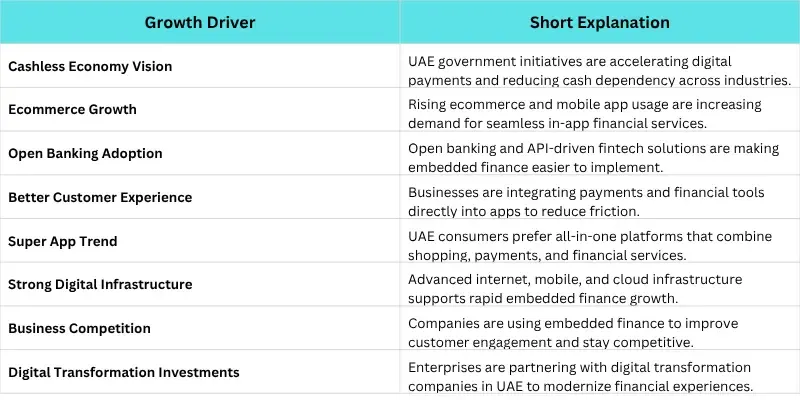
UAE's Cashless Economy Vision
The UAE government's financial strategy actively encourages the elimination of cash-dependent processes. Dubai's Cashless Strategy aims to convert 90% of all transactions to digital formats. Abu Dhabi's smart city initiatives are integrating digital payments into public services, transportation, and healthcare. These policy-level drivers push enterprises to build digital-first financial experiences — and embedded finance apps are the natural output of that push.
Growth of Ecommerce and Super Apps
UAE ecommerce revenue is projected to cross $9 billion by 2026, with mobile commerce accounting for a dominant share. Consumers in this market are accustomed to apps that do more — super apps that combine shopping, payments, loyalty programs, and financial tools. Demand for seamless, in-context payments is no longer optional. It is the baseline expectation for any competitive digital platform.
Open Banking and Fintech Innovation
The Central Bank of UAE has moved decisively toward open banking frameworks, enabling Financial API Integration across licensed financial institutions and third-party providers. This infrastructure underpins Banking-as-a-Service UAE models, where businesses access banking functionality — accounts, payments, compliance — through API layers rather than building it from scratch. The result is faster deployment, lower capital requirements, and greater flexibility for businesses of every size.
Increasing Demand for Digital Customer Experience
Today's enterprise customer does not distinguish between a great product and a great payment experience. Friction at the checkout, delayed loan approvals, or clunky insurance processes cost businesses customers. Embedded finance removes friction entirely, creating personalized financial ecosystems that feel native to the platform rather than bolted on.
Working with experienced digital transformation companies in uae is critical for businesses looking to align their embedded finance strategy with both customer expectations and national digital infrastructure priorities.
Key Features Businesses Want in Embedded Finance Apps
The most effective embedded finance platforms combine multiple capabilities into a cohesive financial layer. Here is what enterprise teams prioritize when evaluating solutions.
Embedded Payments
Real-time, multi-channel payment processing is the core of any embedded finance offering. Whether it is card payments, bank transfers, QR codes, or wallet-based transactions, the payment layer must be fast, reliable, and globally interoperable — particularly important for UAE businesses operating across borders.
Digital Wallets
Branded digital wallets allow businesses to store customer funds, manage loyalty balances, and enable instant peer-to-peer transfers. They also reduce transaction fees by routing payments through proprietary rails rather than card networks.
Buy Now, Pay Later (BNPL)
BNPL is growing faster in UAE than almost any other market in the region. Embedding BNPL at checkout increases average order values, improves conversion rates, and opens access to credit for customers who prefer installment-based purchasing.
AI-Based Financial Analytics
Real-time financial intelligence — spending patterns, credit risk signals, fraud detection — delivered through AI-powered dashboards gives businesses unprecedented visibility into customer financial behavior. This data directly informs product decisions and risk management.
Loyalty and Rewards Integration
Embedding rewards programs into financial transactions creates compounding engagement loops. Customers earn while they spend, redeem within the same platform, and have fewer reasons to take their business elsewhere.
Embedded Insurance
Contextual insurance — offered at the moment a customer buys a product, books travel, or completes a health appointment — converts traditional insurance friction into a single-tap decision. Revenue-sharing models make this a meaningful new income stream for non-insurance businesses.
Financial Automation Tools
Automated invoicing, reconciliation, payroll, and expense management tools embedded within SaaS or enterprise platforms eliminate manual financial workflows and reduce operational overhead significantly.
The development of these features requires careful planning around both architecture and cost. Teams should explore both ai developmemt cost and secure app development services in UAE when budgeting embedded finance projects.
Industries in UAE Using Embedded Finance Apps
Ecommerce and Retail
UAE retail platforms are embedding checkout financing, branded wallets, and loyalty point systems directly into their storefronts. The result: fewer abandoned carts, higher average order values, and repeat purchase rates that outpace traditional retail models.
Healthcare
Private healthcare providers and telehealth platforms are integrating digital medical payments, insurance claim processing, and BNPL for elective procedures. Patients complete their billing journey without leaving the care platform — reducing administrative burden and improving collection rates.
Real Estate
Property developers are using digital escrow systems, milestone-based payment releases, and embedded mortgage pre-qualification tools to accelerate transaction timelines and reduce buyer friction in one of the world's most active real estate markets.
Travel and Hospitality
Travel platforms operating in the UAE are embedding multi-currency wallets, travel insurance, and loyalty-linked payment systems into booking flows. Business travelers benefit from expense automation; leisure travelers get personalized offers at the right moment in their journey.
Logistics and Transportation
Fleet management platforms are financing vehicle acquisitions, managing fuel card integrations, and enabling instant driver payments through embedded finance layers. This eliminates delays in supply chains and improves working capital management for logistics operators.
Enterprise SaaS Platforms
B2B SaaS companies are embedding subscription billing, automated invoicing, and financial analytics dashboards into their products — turning financial tools into a differentiating feature rather than an afterthought.
Businesses across these sectors looking for localized expertise should consider working with app development companies in cities like abu dhabi and Dubai that understand regional compliance, language, and infrastructure requirements. Those focused specifically on financial platforms should engage banking application development services to ensure regulatory alignment from day one.
Business Benefits of Fintech Integration
Higher Customer Retention
When customers complete financial transactions within your platform, the relationship deepens. Each interaction creates data, personalization opportunities, and switching costs that keep users engaged longer.
New Revenue Streams
Embedded finance is not just about improving existing experiences — it creates entirely new revenue lines. Payment processing fees, lending interest spreads, insurance commission, and data monetization are all incremental revenue sources that businesses unlock through fintech integration.
Better User Experience
Removing third-party redirects, simplifying authentication, and enabling one-tap financial actions dramatically improves satisfaction scores. In competitive markets, this directly translates to market share.
Faster Transactions
Real-time payment rails and automated approval workflows reduce transaction time from days to seconds. For enterprise clients, this means faster cash cycles and more predictable cash flow.
Improved Business Scalability
API-first embedded finance architectures scale with your user base without proportional increases in operational complexity. Cloud-based infrastructure handles volume spikes without service degradation.
Stronger Customer Insights
Every embedded financial transaction generates behavioral data. Enterprises that analyze this data systematically gain competitive intelligence that drives smarter product development, marketing, and risk decisions.
Technologies Powering Embedded Finance Apps
APIs and Open Banking
Financial API Integration is the backbone of every embedded finance solution. RESTful APIs connect business platforms to banking infrastructure, payment processors, and insurance providers. Open banking frameworks in UAE make licensed financial data accessible to authorized third parties.
Artificial Intelligence
AI drives credit scoring, fraud detection, spending categorization, and personalized financial product recommendations. Machine learning models improve continuously, making every embedded finance system smarter over time.
Cloud Infrastructure
Scalable, multi-region cloud deployment ensures availability, redundancy, and the ability to serve growing user bases without rebuilding core architecture. Most modern embedded finance platforms are built cloud-native from the ground up.
Blockchain-Based Transactions
Blockchain enables tamper-proof transaction records, smart contract-based payment automation, and cross-border settlement at reduced cost and latency. For UAE businesses with international operations, Blockchain for Fintech applications is becoming a practical infrastructure choice rather than a speculative one.
Advanced Cybersecurity Systems
Encryption, tokenization, biometric authentication, and real-time anomaly detection protect financial data at every layer. Security must be built into architecture from the start — retrofitting security onto embedded finance platforms is expensive and often incomplete.
Security and Compliance Challenges in UAE Fintech Apps
Embedded finance operates at the intersection of technology and regulation. UAE businesses must navigate a demanding compliance landscape to operate legally and maintain customer trust.
PCI DSS compliance is mandatory for any platform handling card data. KYC (Know Your Customer) verification is required before onboarding users to financial services. AML (Anti-Money Laundering) frameworks mandate transaction monitoring, suspicious activity reporting, and audit trail maintenance.
Data protection under the UAE Personal Data Protection Law requires explicit consent management and secure data storage practices. API security — particularly for platforms using open banking connections — requires rate limiting, token-based authentication, and continuous vulnerability monitoring.
Fraud prevention systems must balance security with user experience. Overly aggressive fraud filters increase false positives and frustrate legitimate customers. Calibrating these systems requires ongoing data analysis and model refinement.
Working with secure app development services in UAE ensures that compliance architecture is not treated as an afterthought but engineered as a foundational layer of every embedded finance platform.
Embedded Finance App Development Cost in UAE
Development investment varies significantly based on the scope, features, and compliance requirements of your platform.
Features and Complexity
A payment-only MVP is substantially less expensive than a full embedded banking suite with wallets, BNPL, insurance, and analytics. Define your core use case before estimating costs.
API Integrations
Third-party API licensing fees and custom integration development contribute meaningfully to project cost. Complex banking partnerships or multi-provider payment stacks increase this line item.
Security Requirements
Enterprise-grade security infrastructure — penetration testing, compliance audits, encryption implementation — adds cost but is non-negotiable for regulated financial services.
AI and Automation Features
Custom AI model development is more expensive than off-the-shelf integrations but delivers proprietary competitive advantages. Review ai developmemt cost benchmarks before finalizing feature scope.
Compliance Infrastructure
KYC, AML, and data protection compliance systems require both technology build and ongoing maintenance. Factor in recurring compliance overhead, not just initial development.
Platform Scalability
Multi-region deployment, load balancing, and disaster recovery infrastructure add upfront cost but prevent expensive performance failures at scale.
Estimated ranges for UAE market:
|
Platform Type |
Estimated Investment |
|
MVP (core payments + wallet) |
$40,000 – $80,000 |
|
Mid-level fintech app |
$80,000 – $200,000 |
|
Enterprise fintech ecosystem |
$200,000 – $500,000+ |
For detailed project-specific estimates, explore app development cost in 2026 frameworks and consult a specialized fintech development partner before committing to a scope.
Why UAE Businesses Need a Specialized Fintech Development Partner
Building embedded finance is not the same as building a standard mobile application. The combination of financial regulation, security architecture, API ecosystem management, and enterprise-scale reliability demands a development partner with specific domain expertise.
A specialized UAE fintech development partner brings knowledge of CBUAE regulations, DIFC and ADGM compliance frameworks, and local banking partnerships that generic software agencies simply do not have. They understand how to build systems that satisfy regulators while delivering the seamless user experience that modern consumers expect.
SISGAIN has established itself as a strategic fintech transformation partner for enterprises across the UAE. With deep expertise in embedded banking solutions, API-first architecture, and security-first development practices, SISGAIN works with businesses from early strategy through to live deployment — ensuring that embedded finance investments deliver measurable business outcomes, not just functional software.
Whether you are a startup building your first financial feature or an enterprise modernizing a legacy payments infrastructure, the right development partner shortens your path to market and reduces the risk of costly compliance failures. Connect with fintech application development firms in UAE that have a verifiable track record in financial services delivery.
Future Trends in Embedded Finance for UAE Businesses
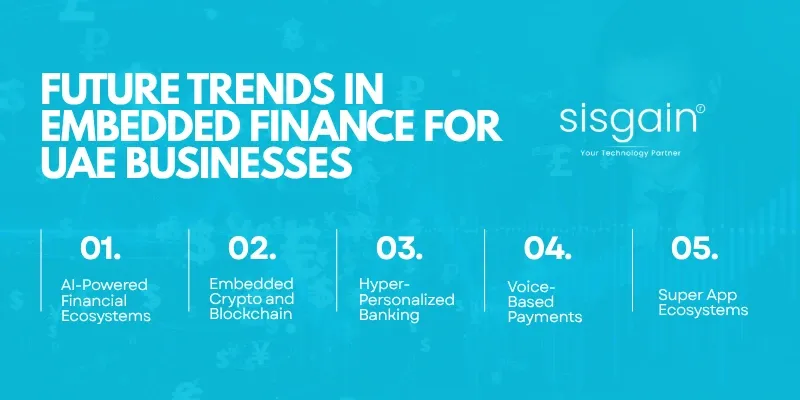
AI-Powered Financial Ecosystems
The next generation of embedded finance will move beyond reactive processing to predictive intelligence — anticipating customer needs before they arise and offering the right financial product at precisely the right moment.
Embedded Crypto and Blockchain
As the UAE advances its virtual asset regulatory framework, embedded crypto wallets and blockchain-based settlement rails will move into mainstream business applications. Blockchain for Fintech applications will become a standard architecture consideration within the next two to three years.
Hyper-Personalized Banking
Using behavioral data and AI, embedded finance platforms will offer individualized financial products — custom credit limits, dynamic insurance pricing, and personalized savings goals — that feel tailored rather than generic.
Voice-Based Payments
Conversational AI is bringing payment initiation to voice interfaces. Businesses that build voice-payment capability into their embedded finance stack will capture a growing segment of hands-free commerce.
Super App Ecosystems
UAE is already producing super app contenders across retail, mobility, and lifestyle verticals. Embedded finance is the connective tissue that makes super apps viable — without it, multi-service platforms fragment into disconnected experiences.
Predictive Financial Intelligence
Machine learning models will increasingly forecast cash flow challenges, fraud risk, and credit needs before users are even aware of them — transforming reactive financial tools into proactive business intelligence systems.
Conclusion
Embedded finance has moved from early adopter territory to enterprise priority across the UAE. Businesses that integrate financial services natively into their platforms are building stronger customer relationships, creating new revenue streams, and establishing competitive moats that are difficult for slower-moving competitors to replicate.
The UAE's regulatory environment, digital infrastructure, and consumer expectations all point in the same direction: financial services belong inside the platforms where business happens, not in separate institutions that interrupt the customer journey.
The window to build a meaningful embedded finance advantage is open — but it will not stay open indefinitely. First movers in each sector are establishing loyalty effects and data advantages that will compound over time.