
What Is an Automation Integration System?
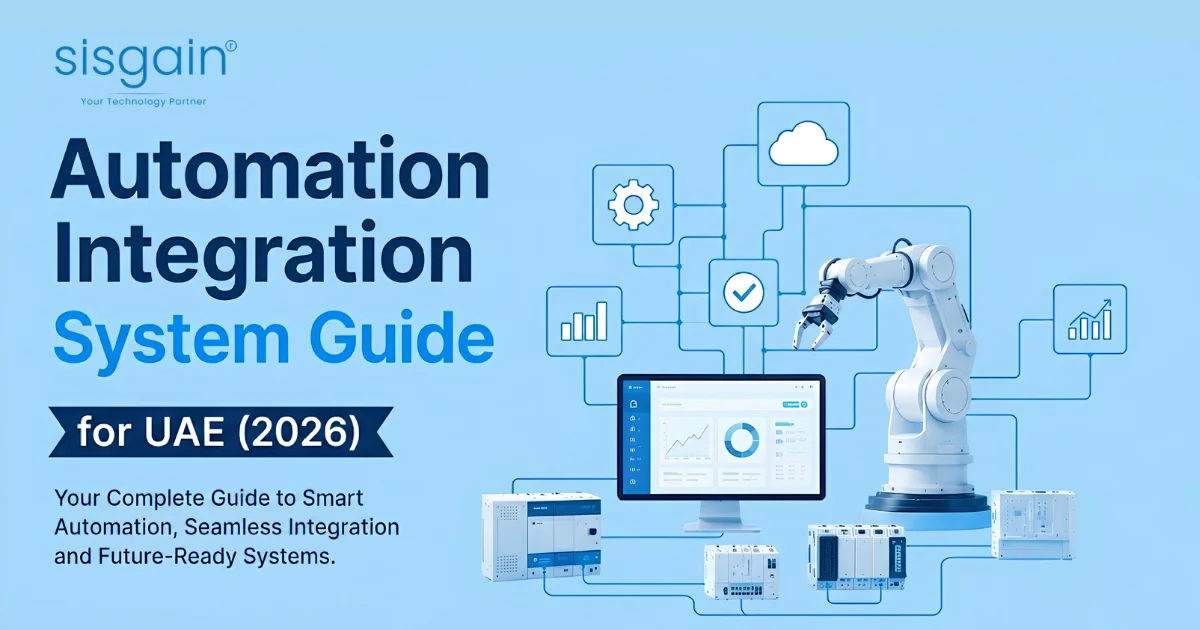
An automation integration system connects an organization's software, data, and workflows into one automated layer, so information moves between tools like CRM, ERP, and finance systems without manual re-entry. It combines system integration (linking applications) with automation (removing manual steps) and, increasingly, AI-based decision-making. UAE enterprises use it to cut operating costs, speed up approvals, and comply with fast-changing digital government mandates.
What an Automation Integration System Actually Means
Most conversations about this topic conflate two different things. Integration is the plumbing — APIs, connectors, and data pipelines that let separate systems talk to each other. Automation is what runs through that plumbing — rules and workflows that act without a human clicking "next." An automation integration system is the combination: connected systems and the automated logic that uses those connections to do actual work.
The evolution matters here. A decade ago, "integration" mostly meant point-to-point connections — System A talks to System B through a custom script that breaks the moment either system updates. Intelligent integration platforms replaced that with reusable APIs and iPaaS (integration platform as a service) layers that can absorb changes without a rebuild. Layer automation and AI decision-making on top, and you get something that doesn't just move data — it acts on it.
A simple way to see the progression:
Manual Workflow → Connected Systems → Automation Layer → AI Layer → Business Intelligence
Each stage builds on the last. Skip a stage — say, automate before you integrate — and you end up automating a broken, disconnected process faster. That's a common and expensive mistake, and we'll come back to it.
Automation vs. Integration vs. Automation Integration System vs. Hyperautomation
|
Term |
What it means |
Example |
|
Automation |
Removing manual steps from a single task or process |
A bot that auto-fills an expense form |
|
Integration |
Connecting two or more systems so data flows between them |
CRM data syncing into the ERP |
|
Automation integration system |
Integration and automation designed together across multiple systems and workflows |
Order in the CRM automatically triggers inventory checks, invoicing, and shipping — no human touch |
|
Hyperautomation |
Automation integration extended with AI, process mining, and orchestration at enterprise scale |
A bank that automates loan origination end-to-end, with AI flagging exceptions for human review |
Enterprises that outsource this groundwork often start with software integration services in Dubai to handle the API and data layer, then layer robotic process automation services on top once the connections are stable.
Why UAE Enterprises Are Rapidly Adopting Automation Integration Systems
The UAE's private sector isn't automating in a vacuum — it's responding to a government that has made digital-first operations a national target. The country's National Strategy for Artificial Intelligence 2031 aims to generate up to AED 335 billion in additional economic growth, and separate targets call for lifting AI's share of national GDP from roughly 9% today to 45% by 2031, alongside a push toward fully paper-free government services across all seven emirates. When government services digitize at that pace, vendors, banks, and logistics partners that touch those services have to keep up or get left out of the workflow entirely.
That pressure compounds with what's happening globally. Gartner projects the market for hyperautomation-enabling software will reach nearly $1.04 trillion by 2026, and separately, roughly 90% of large enterprises now treat hyperautomation as a standard operating practice rather than a pilot project. UAE enterprises competing for regional and global capital are measured against that baseline, not against slower-moving neighbors.
Statistics block:
- UAE AI Strategy 2031 targets AED 335 billion in additional economic value and a rise in AI's share of GDP from ~9% to 45%
- Global hyperautomation software spend: ~$1.04 trillion by 2026 (Gartner)
- 30% of enterprises will automate more than half their network activities by 2026, up from under 10% in 2023 (Gartner)
None of these numbers guarantee results for any single company. What they show is direction: budget, government mandate, and competitive pressure are all pointing the same way, at the same time.
Why System Integration and Automation Must Work Together
Here's the part most vendors skip over: automation and integration each fail on their own.
Automate without integrating first, and you speed up a process that's still trapped in a silo — a faster version of a broken workflow is still broken. Integrate without automating, and you've built pipes that move data between systems, but a person still has to look at that data and decide what to do with it. Neither half delivers the outcome on its own.
The dependency runs both ways:
- Without integration → automation has nothing reliable to act on, so it fails or produces errors.
- Without automation → integration just creates faster-moving data silos, not fewer of them.
This is why enterprise automation software integration touches almost every core system in a UAE business at once: APIs, ERP, CRM, HRMS, cloud platforms, and — critically — the legacy systems most companies here still run in parallel with newer cloud tools.
How Intelligent Integration Actually Works, Step by Step
A customer order is a good example because it moves through nearly every department:
Customer submits order → CRM → ERP → Inventory → Finance → Notification → Analytics Dashboard
In a disconnected setup, each arrow in that chain is a person: someone re-keys the order into the ERP, someone else checks stock manually, someone emails finance. In an automation integration system, each arrow is an automated handoff, and the only human involvement is exception handling — the 5% of orders that don't fit the standard pattern.
Core Components of an Automation Integration System
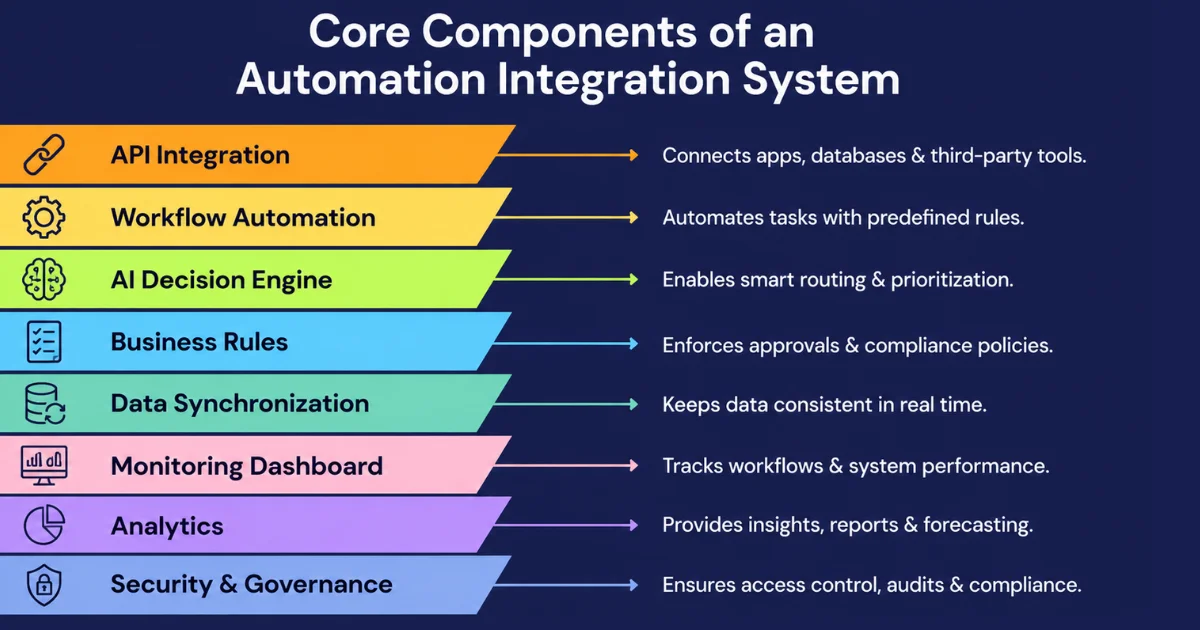
Every serious platform, regardless of vendor, is built from the same core parts:
- API integration — the connective layer linking applications, databases, and third-party services
- Workflow automation — the rules engine that moves work from step to step without manual triggers
- AI decision engine — handles judgment calls (fraud scoring, routing, prioritization) that pure rules can't
- Business rules engine — encodes company policy (approval limits, compliance thresholds) into the system itself
- Data synchronization — keeps records consistent across every connected system in near real time
- Monitoring dashboard — gives IT and operations visibility into what's running, failing, or queued
- Analytics — turns the operational data flowing through the system into reporting and forecasting
- Security & governance — access controls, audit trails, and compliance logging, especially critical for UAE-regulated sectors like banking and healthcare
Miss any one of these and the system tends to develop a blind spot — usually security or monitoring, since they don't show up as a problem until something goes wrong.
Top Business Benefits of Automation Software Integration
Each benefit below follows the same shape: a real operational problem, what the system does about it, and the business outcome that follows.
Reduce operational costs. Manual data entry and reconciliation eat staff hours across finance, HR, and operations. Automated integration removes the re-keying step entirely, which is usually where the labor cost lives — not in the decision itself, but in the data handling around it.
Increase productivity. Staff stop chasing approvals and start doing the parts of their job that actually need judgment. Teams that used to spend a morning reconciling spreadsheets can spend it on the work the spreadsheet was supposed to support.
Real-time visibility. Leadership sees inventory, cash flow, or service tickets as they happen, not in a report compiled three days later. For fast-moving sectors like retail or logistics, that lag is often the difference between catching a problem and explaining one.
Improve compliance. Rules-based automation applies the same policy every time, and logs every step. That audit trail matters in the UAE's regulated sectors — DIFC-regulated finance, healthcare data handling, and banking compliance all benefit from a system that can't "forget" to log an approval.
Reduce human errors. Manual re-entry is where most data errors originate. Removing the re-entry step removes most of the error source with it.
Better customer experience. An order, claim, or application that moves through the backend automatically reaches the customer faster — without them ever knowing an automation integration system was involved. That's usually the point: the customer only notices when it's slow.
Faster decision-making. Decisions that used to wait for someone to pull a report now happen against live data, sometimes automatically within the rules engine itself.
Scalable business growth. Adding transaction volume doesn't require adding headcount at the same rate, which matters for any UAE enterprise scaling across emirates or into new markets.
Industry-Wise Applications of Automation Integration Systems in the UAE
Banking & Financial Services
Loan processing, fraud detection, regulatory compliance, and payment automation are the four areas where integration automation delivers the fastest, most measurable returns in UAE banking — largely because these processes are rules-heavy and already digitized at the data layer. Banks that don't have this expertise in-house typically bring in fintech development experts to handle the compliance-sensitive parts of the build.
Healthcare
Patient records, billing, insurance claims, and lab system integration all depend on data moving accurately between providers, insurers, and labs — a natural fit for automated integration, with strict governance requirements layered on top. Many UAE providers get here faster by starting from hospital practice management software solutions already built around these data flows, rather than integrating from scratch.
Logistics & Supply Chain
Shipment tracking, inventory management, fleet coordination, and warehouse operations benefit from real-time data synchronization across every partner in the chain, not just the parts a single company controls. This is where purpose-built AI shipment tracking solutions in UAE tend to outperform generic integration platforms, since they're already tuned to regional carrier and customs data.
Retail & E-commerce
POS systems, CRM, marketing platforms, and inventory management need to stay in sync constantly, especially during peak periods like Ramadan or the UAE's major retail seasons, when manual reconciliation simply can't keep pace. Retailers usually pair custom retail software development services in Dubai for the backend systems with AI marketing automation in ecommerce app development to keep customer-facing campaigns synced to real-time inventory.
Manufacturing
Production scheduling, IoT sensor data, ERP systems, and quality control processes come together in automation integration systems that catch defects and bottlenecks before they cascade downstream.
Government
Citizen services, regulatory compliance, and internal workflow approvals are where the UAE's public sector has led by example — and where private enterprises interfacing with government systems have had to build compatible integration layers of their own.
Real UAE Success Story: Digital Ajman
Ajman is the smallest emirate, and its government department Digital Ajman used that as an advantage — moving fast on integration rather than trying to modernize everything at once.
Problem: Information was siloed across local, federal, and private entities, with wildly inconsistent technology between them. Point-to-point integration with each partner individually wasn't sustainable.
Solution: Digital Ajman deployed an integration platform (IBM Cloud Pak for Integration, including API Connect and App Connect Enterprise) to connect finance, planning, utilities, and licensing systems into unified service bundles rather than one-off connections.
Result: The clearest example is "Bait Amer," the bundle that handles new-home construction. What used to require 17 separate touchpoints with government entities now takes five. A second integration, the "Bashr" company-formation service, lets investors set up a company entirely online in about 15 minutes, without visiting a single office.
Measurable outcome: The integration work has saved over 2 million dirhams through simplified processes, and reduced paperwork enough to save nearly 200 trees a year from eliminated printing.
The lesson generalizes well beyond government: the win wasn't automating faster, it was integrating first, then automating the workflow that sat on top of clean, connected data.
Step-by-Step Automation Integration Roadmap
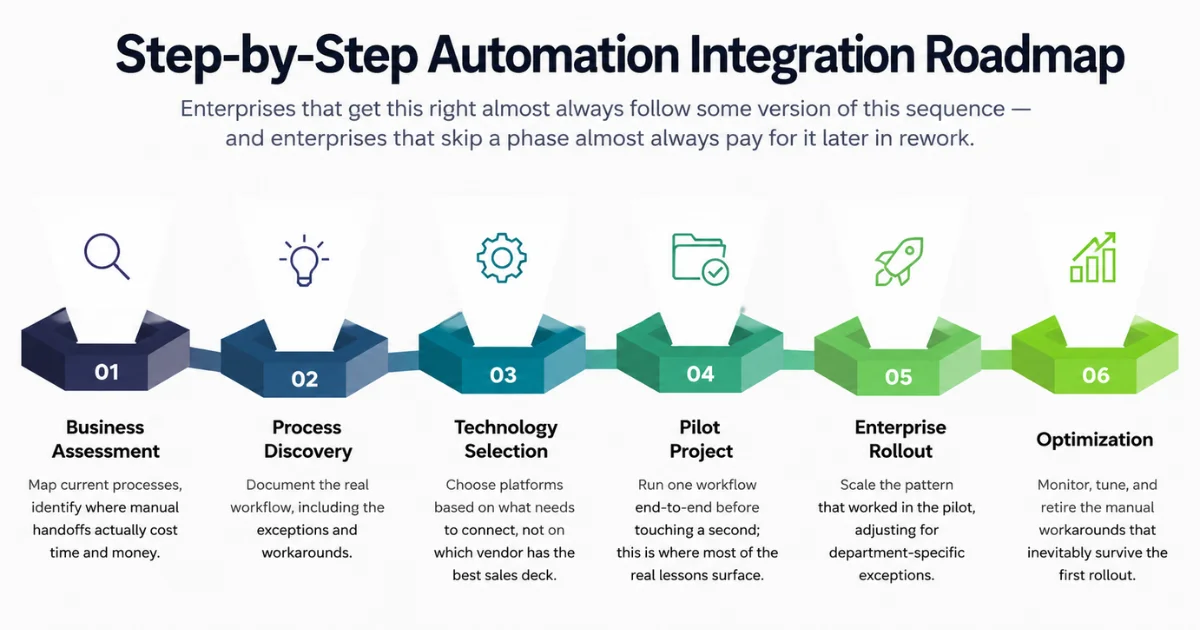
Enterprises that get this right almost always follow some version of this sequence — and enterprises that skip a phase almost always pay for it later in rework.
- Business assessment — map current processes, identify where manual handoffs actually cost time and money (not just where they're annoying)
- Process discovery — document the real workflow, including the exceptions and workarounds staff have built informally
- Technology selection — choose platforms based on what needs to connect, not on which vendor has the best sales deck
- Pilot project — run one workflow end-to-end before touching a second; this is where most of the real lessons surface
- Enterprise rollout — scale the pattern that worked in the pilot, adjusting for department-specific exceptions
- Optimization — monitor, tune, and retire the manual workarounds that inevitably survive the first rollout
Common mistakes at this stage: automating a process before fixing it, skipping the pilot to "save time," and underestimating how much legacy ERP data needs cleaning before it's fit to automate against.
Automation Integration Technologies Explained
The technical layer behind an automation integration system usually draws from several of these, combined rather than used in isolation:
- RPA (Robotic Process Automation) — bots that mimic manual, rules-based tasks across existing interfaces
- AI & Machine Learning — pattern recognition and prediction layered on top of rules-based automation
- APIs — the connective tissue between modern applications
- iPaaS — cloud-hosted integration platforms that manage connections at scale
- Cloud integration — linking on-premise and cloud systems without a full migration
- Low-code platforms — letting business teams build and adjust workflows without a full development cycle
- Workflow engines — the orchestration layer that sequences multi-step processes
- Event-driven architecture — systems that react to triggers in real time, rather than on a batch schedule
- Microservices — modular application design that makes integration far less brittle than monolithic systems
- Digital twins — virtual models used mostly in manufacturing and logistics to simulate and monitor physical operations
Most UAE enterprises don't build this stack from scratch — they combine specialist robotic process automation services for the task-level automation with intelligent workflow automation solutions for Dubai enterprises to orchestrate everything above it.
Best Automation Integration Platforms for UAE Enterprises
|
Platform |
Best For |
Strengths |
Enterprise Size |
Deployment |
|
Microsoft Power Automate |
Microsoft-ecosystem businesses |
Deep Office 365/Azure integration, low-code |
SME to enterprise |
Cloud |
|
UiPath |
Heavy RPA use cases |
Strong bot library, AI-assisted automation |
Mid-size to enterprise |
Cloud/hybrid |
|
Automation Anywhere |
Complex, high-volume process automation |
Cloud-native RPA, strong analytics |
Enterprise |
Cloud |
|
IBM (Cloud Pak for Integration) |
Legacy + government-grade integration |
Proven in UAE public sector, strong API management |
Enterprise |
Hybrid |
|
SAP |
ERP-centric organizations |
Deep native ERP automation |
Enterprise |
Cloud/on-prem |
|
ServiceNow |
IT and service workflow automation |
Strong workflow orchestration, ITSM roots |
Mid-size to enterprise |
Cloud |
|
Boomi |
Fast iPaaS deployment |
Quick setup, strong connector library |
SME to mid-size |
Cloud |
|
MuleSoft |
API-first integration strategies |
Mature API management, Salesforce ecosystem |
Enterprise |
Cloud/hybrid |
|
OutSystems |
Custom low-code app + automation builds |
Fast development cycles |
Mid-size to enterprise |
Cloud/on-prem |
|
Mendix |
Citizen-developer-led automation |
Business-user friendly low-code |
SME to mid-size |
Cloud |
No platform here is a universal "best" — the right one depends on what's already running in your environment. A SAP-heavy manufacturer and a Salesforce-heavy retailer will land in very different places.
Cost of Automation Integration Systems in the UAE
|
Business Size |
Typical Implementation |
Ongoing Support |
Timeline |
Payback Period |
|
SME |
Lower-cost, single-workflow deployments |
Vendor-managed or light in-house |
4–8 weeks |
6–12 months |
|
Mid-size |
Multi-system integration, several workflows |
Dedicated support contract |
3–6 months |
9–18 months |
|
Enterprise |
Full-scale, multi-department rollout |
Dedicated Automation Center of Excellence |
6–12+ months |
12–24 months |
A simple ROI formula to start with:
ROI = (Annual Savings from Automation − Total Implementation Cost) ÷ Total Implementation Cost × 100
Savings should include labor hours reclaimed, error-correction costs avoided, and — where relevant — compliance penalties avoided. Costs should include licensing, integration work, staff training, and change management, which is the line item most cost estimates leave out and most projects underestimate.
Common Challenges and How to Avoid Them
- Legacy systems — audit data quality before integrating, not after; garbage in still means garbage out, just faster
- Employee resistance — involve the staff who actually run the process in the pilot design, not just IT
- Poor planning — a pilot without a defined success metric isn't a pilot, it's a demo
- Wrong vendor fit — match the platform to your existing stack, not to the most polished sales pitch
- Security gaps — build access controls and audit logging into the design phase, not as a post-launch patch
- Compliance blind spots — UAE-regulated sectors need governance mapped to specific regulatory requirements (DIFC, healthcare, banking) from day one
- Integration failures — test against real data volumes, not sample datasets, before go-live
- Hidden costs — budget for change management and training explicitly, since they're usually the first thing cut and the first thing missed later
- Vendor lock-in — favor open APIs and portable data formats where the option exists
How to Choose the Right Automation Integration Partner
Run any shortlisted vendor through this checklist before signing:
- Proven experience with UAE-specific regulatory environments (DIFC, ADGM, healthcare, banking)
- Industry-specific expertise, not just generic integration know-how
- Real AI/automation capability, not automation-branded manual configuration
- Security and compliance credentials appropriate to your sector
- Local UAE support and implementation teams, not remote-only delivery
- Architecture that scales past the first project, not just for it
- Documented case studies with measurable, verifiable outcomes
|
|
Good Vendor |
Great Vendor |
|
Discovery |
Asks about your systems |
Asks about your actual workflow, including the workarounds |
|
Proof |
Shows a demo |
Shows a reference client with comparable scale |
|
Support |
Ticket-based |
Dedicated team with UAE time-zone coverage |
|
Roadmap |
Sells the current platform |
Shows where the platform is going over 2–3 years |
The Future of Integration Automation Beyond 2026
The direction of travel is toward systems that don't just execute rules — they make more of the judgment calls themselves. Expect these to move from buzzword to standard deployment over the next few years:
- Hyperautomation as the default operating model, not a differentiator
- Agentic AI — software agents that plan and execute multi-step tasks, not just respond to triggers
- Predictive automation — systems that act ahead of a problem, not just in response to one
- Generative AI embedded directly into workflow and document processing
- Multi-agent systems coordinating across departments without human orchestration
- Process mining — using system logs to find inefficiencies humans wouldn't spot
- Self-healing integrations that detect and repair broken connections automatically
For UAE enterprises, the practical implication is straightforward: the systems being built now need to be architected for that next layer, even if the AI layer isn't switched on yet. Retrofitting agentic AI onto a brittle, poorly integrated system is far harder than adding it to one built with clean APIs from the start — a shift covered in more depth in our breakdown of the UAE AI market landscape.
Final Thoughts
The UAE's push toward digital-first government services isn't a side story to enterprise automation — it's the reason the timeline for adopting an automation integration system has compressed so fast. Waiting isn't a neutral choice anymore; every quarter without integrated, automated workflows is a quarter of manual cost that a competitor isn't carrying.
The enterprises getting the most out of this aren't the ones with the biggest budgets. They're the ones that integrated before they automated, piloted before they scaled, and treated an automation integration system as infrastructure — not a one-time project with an end date.
Ready to Build an Intelligent Automation Ecosystem?
Instead of managing disconnected applications and manual workflows, transform your business with a fully integrated automation platform built for UAE enterprises.
Sources: UAE Artificial Intelligence Office (ai.gov.ae), Gartner, IBM Case Studies.