
A super app sounds like a single product. It rarely starts that way. Most of the platforms people describe as super apps today — the ones that let you book a ride, order food, pay a bill and top up a wallet without leaving the app — began as one service done well, then grew a second, then a third, over years.
That distinction matters for any UAE business evaluating super app development UAE as a strategy in 2026. The businesses that get this right don't set out to build "everything" on day one. They pick a service people use often, build the identity and payment layer underneath it properly, and expand once real usage tells them where to go next.
This article walks through what a super app actually is, why the UAE market rewards this model, what it costs, how long it takes, what the technical architecture looks like, and how to choose a development partner that can deliver it. If you're a founder, CTO or product leader weighing UAE super app development against a simpler single-service app, this is written for you.
What Is a Super App?
A super app is a single mobile or web platform that hosts multiple, often unrelated, services under one login, one wallet and one user profile. Instead of downloading five separate apps for transport, food delivery, payments and bookings, the user does everything inside one ecosystem.
The term originated with WeChat in China, and the model has since been adapted across Southeast Asia, South Asia and the Middle East, most visibly through platforms like Careem and Grab. In the Gulf, the concept has taken on its own shape — shaped by a mobile-first population, strong digital payment adoption, and a government push toward unified digital services.
Super App vs Traditional Mobile App
A traditional app is built around one job: booking a table, ordering groceries, hailing a car. A multi-service app places several of these jobs inside the same shell but often keeps them loosely connected — separate logins, separate carts, separate support flows dressed up in one interface.
A true super app goes further. Every service shares:
- One identity and login
- One payment method and wallet
- One loyalty or rewards system
- One customer data profile
- One support and notification system
That shared foundation is what turns a bundle of features into a super app ecosystem rather than just a folder of mini-apps.
How Does a Super App Work?
Technically, a super app is a shell application connected to a set of modular backend services — sometimes called "mini programs" or "modules" — each responsible for one function: rides, payments, food, bookings. A central identity layer authenticates the user once. A central wallet or payment engine handles transactions across every module. An API gateway routes requests to the right service.
This modular structure is what allows a business to add a new service later — say, grocery delivery six months after launch — without rebuilding the whole product. We'll cover the technical side of this in more detail in the architecture section below.
What Makes a Super App Successful?
Usage frequency is the real driver. Super apps succeed when the core service is something people need weekly, not annually. Ride-hailing, food ordering and bill payments work as anchor services because people return to them constantly. Real estate transactions or annual insurance renewals don't generate that kind of repeat behavior, which is why they tend to work better as an adjacent service layered onto a frequent one, rather than the anchor itself.
The other ingredient is trust in the payment and data layer. Once users store a card, wallet balance or personal documents in an app, switching cost goes up and so does the incentive for the business to keep them inside the ecosystem for other services.
Why Are Super Apps Growing in the UAE?
The UAE has a specific combination of conditions that makes multi-service platforms commercially attractive in a way that doesn't apply everywhere.
Dubai's Digital-First Consumer Market
Dubai has one of the highest smartphone penetration rates in the world, a population accustomed to cashless payments, and a consumer base that already expects instant delivery, real-time tracking and digital-first service across retail, mobility and hospitality. A resident booking a salon appointment, ordering dinner and paying a DEWA bill in the same week already touches three or four separate apps to do it. That's the exact friction a well-built super app platform is designed to remove.
Abu Dhabi's Enterprise Digital Ecosystem
Abu Dhabi's growth is coming from a different direction — enterprise and government-adjacent digital transformation. Smart-city initiatives, unified citizen service portals and enterprise digitization programs have normalized the idea of one platform handling many transaction types for one identity. Businesses building B2B or B2G-adjacent platforms in Abu Dhabi can borrow directly from this model: one login, multiple services, centralized reporting.
Regional Super App Growth
Across the wider GCC, the pattern is consistent. Mobility platforms have expanded into payments and delivery. Government portals have consolidated dozens of services into single logins. Retail groups are connecting loyalty programs across brands. The direction of travel across the region points toward consolidation, not toward more standalone apps.
Why Businesses Shouldn't Build an "Everything App" on Day One
This is worth stating plainly, because it's the single most common strategic mistake in this category: trying to launch mobility, delivery, payments, bookings and a marketplace simultaneously.
Every additional service at launch adds:
- Development cost, because each service needs its own workflows, screens and backend logic
- Operational complexity, since each service usually needs its own supply side — drivers, merchants, providers — before it can function
- Customer confusion, because a first-time user faced with ten unrelated services doesn't know why they opened the app
- Integration risk, since more services mean more third-party dependencies that can each introduce delays or failures
- Longer time to market, because nothing ships until everything is ready
- Higher ongoing maintenance, since every service needs monitoring, support and updates indefinitely
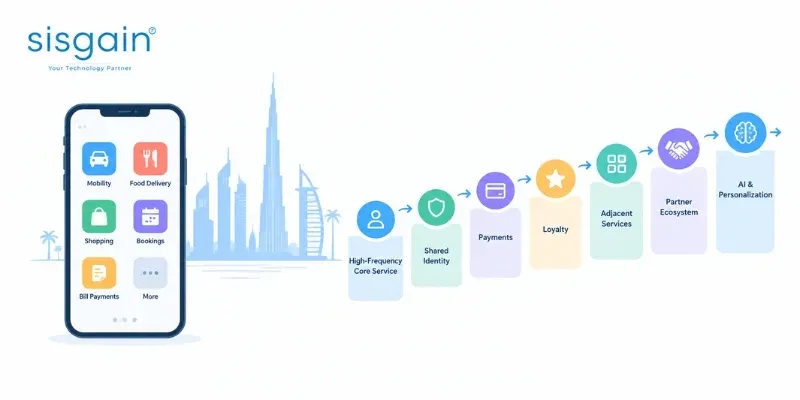
The more practical sequence looks like this: high-frequency core service → shared identity → payments → loyalty → adjacent services → partner ecosystem → AI and personalization.
Start with the one service people will use often enough to justify opening the app. Build the identity and payment layer properly under that single service. Add loyalty once there's a returning user base worth rewarding. Only then start layering in adjacent services that make sense for that same audience. This is why MVP development is treated as a strategic filter in this article, not a corner-cutting exercise — it's the mechanism that tells you which second service is actually worth building.
How Much Does It Cost to Build a Super App in UAE?
There's no single honest number here. The cost to build a super app in the UAE depends on how many services you're launching with, how complex the payment and compliance requirements are, how many platforms you're targeting, and how much of the backend needs to be custom-built versus assembled from existing infrastructure.
What can be given honestly is a range, tied to what each level of investment realistically buys.
Super App Development Cost by Development Stage
|
Development Level |
Estimated Cost in UAE |
Typical Timeline |
Suitable Use Case |
|
MVP Super App |
AED 80,000–200,000 |
3–6 months |
Startup validation; one core service |
|
Growth-Stage Super App |
AED 200,000–600,000 |
6–12 months |
Multiple services, loyalty, APIs |
|
Full Custom Platform |
AED 400,000–1,000,000+ |
8–15 months |
Marketplace, wallet, partner integrations |
|
Enterprise Ecosystem |
AED 600,000–2,500,000+ |
12–24+ months |
AI, enterprise integrations, high-scale infrastructure |
As a general guide: the cost to build a super app in the UAE typically starts from AED 80,000–200,000 for a focused MVP built around one core service. A scalable multi-service platform with payments, loyalty and partner integrations usually falls in the AED 400,000–1,000,000+ range, while enterprise-grade ecosystems with advanced AI, regulated payment capabilities and high-scale infrastructure can exceed AED 2.5 million. These figures are directional, not quotes — actual pricing depends on the scope defined during discovery.
What Does a Basic Super App MVP Cost?
At the MVP level, AED 80,000–200,000 typically covers one core service (rides, bookings, delivery or a single-category marketplace), user registration and login, a payment gateway integration, basic push notifications, an admin dashboard and simple analytics. It's enough to launch, get real users transacting, and gather the data needed to decide what to build next. It is not enough for a digital wallet, multi-service architecture or advanced AI — those come later.
What Does a Full-Scale Super App Cost?
At AED 400,000–1,000,000 and above, a custom super app typically includes multiple integrated services, a merchant or partner portal, loyalty and rewards, real-time tracking, a more sophisticated payment architecture (potentially including a wallet, subject to the compliance considerations covered later), and a backend built to handle meaningfully higher transaction volume. Enterprise ecosystems above AED 2.5 million generally involve custom AI features, deeper third-party and enterprise integrations, and infrastructure built for scale from day one rather than added later.
Factors That Affect Super App Development Cost
Several variables move the number up or down within these bands:
- Number of services launched at once, and how different they are from each other
- Mobile platforms targeted — iOS only, Android only, or both, plus web
- UI/UX complexity, including how many distinct user journeys need to be designed
- Arabic/English localization, which affects both design and backend content structure
- Backend architecture — a simple monolith versus a modular, microservices-based system
- APIs and third-party integrations, including maps, delivery logistics or CRM systems
- Payment integrations, particularly if multiple gateways or a wallet are involved
- Digital wallet requirements, which add both development and compliance work
- Merchant or partner portals for onboarding and managing third-party service providers
- Admin dashboards, and how much operational control they need to expose
- AI features, from basic recommendations to more advanced personalization engines
- Cloud infrastructure, sized for expected traffic and designed for high availability
- Cybersecurity, including penetration testing and ongoing monitoring
- Compliance requirements, which vary by the specific regulated activities involved
- Expected user volume, which affects infrastructure sizing and load testing needs
- Real-time tracking, which requires location services and live data pipelines
- Analytics and reporting, from basic dashboards to a full data warehouse
- Post-launch maintenance, which is an ongoing cost, not a one-time line item
Businesses researching app development cost in 2026 more broadly will find the same pattern applies across categories — scope defines cost far more than the app type alone.
Must-Have Features for Super App Development UAE
Essential MVP Features
A focused MVP for super app development in UAE should include:
- User registration and login, including single sign-on
- User profiles
- Arabic and English language support from day one
- Service discovery and search
- Payment gateway integration
- The core booking, order or request workflow
- Push notifications
- Ratings and reviews
- Customer support access
- An admin dashboard
- Basic analytics
- Secure authentication
This list is deliberately tight. Every item on it exists to get a real transaction completed, tracked and supported — nothing more.
Advanced Super App Features
As the platform matures beyond MVP, the next layer typically includes:
- A digital wallet
- Loyalty points and memberships
- Subscriptions
- Referral programs
- Real-time tracking
- Merchant onboarding and partner dashboards
- In-app chat and AI-assisted customer support
- Dynamic pricing, promotions, coupons and bundled offers
- Fraud monitoring
- KYC workflows, where applicable to the services offered
- Risk-based authentication
- Cross-service analytics and a unified customer data platform
Each of these should be added when there's a business reason for it — a loyalty program only matters once there's a returning user base to reward, and merchant dashboards only matter once there are enough merchants to justify self-service onboarding.
AI-Powered Features
AI earns its place in a super app when it changes what the product can do, not when it's added as a label on the app store listing. Practical applications worth building toward include:
- Personalized and predictive recommendations based on usage history
- Intelligent search that understands intent, not just keyword matching
- AI-assisted customer support that resolves routine queries without a human agent
- Demand forecasting for services with variable supply, like rides or deliveries
- Fraud detection layered on top of transaction monitoring
- Customer segmentation for more targeted offers
- Dynamic, automated marketing based on behavior
- Churn prediction, flagging users likely to disengage
- Conversational interfaces for booking or support
These capabilities sit on top of the same customer data platform that powers cross-service personalization, which is one of the reasons AI works better in a super app than in a single-purpose app — there's simply more behavioral data to learn from. Businesses building this layer often connect it to broader AI-Powered IT Services covering personalization, automation and intelligent workflows, rather than treating AI as a one-off feature bolted onto a single screen.
Arabic, English and UAE-First UX
Arabic and English Interface
Bilingual support in a UAE super app isn't a translation task — it's an architecture decision. Right-to-left (RTL) layout needs to be built into the interface from the start, because retrofitting RTL onto a left-to-right design usually breaks navigation patterns, icon alignment and form layouts.
A few specifics matter here:
- Arabic typography needs its own type scale and line-height treatment; Latin-script fonts don't translate cleanly
- Content should be localized, not literally translated — pricing formats, date formats and tone all shift between the two languages
- Push notifications, SMS and email need to render correctly in both languages, including on older devices
- Customer support should be genuinely bilingual, not routed through a translation layer at the point of contact
- Checkout and payment screens need to read naturally in Arabic, since this is the point where trust matters most
Treating Arabic support as a late-stage translation pass is one of the more common and more expensive mistakes in this category, because it usually means redesigning screens that were never built with RTL constraints in mind.
Designing for UAE Customer Expectations
Beyond language, UAE users have specific expectations shaped by the market they're already used to: fast checkout with minimal steps, location-aware service discovery, clear upfront pricing with no hidden fees revealed at the last screen, real-time order or booking updates, easy access to support, visible trust signals (verified reviews, secure payment badges), and mobile-first navigation that assumes the user is on a phone, not a desktop.
Compliance, Payments and Security Requirements
This section requires more care than most, because the right answer depends entirely on what the platform actually does — not on the fact that it's called a super app.
Does a UAE Super App Need a Payment Licence?
Not automatically. Whether authorization is required depends on the specific regulated payment activities being performed — things like holding customer funds in a stored-value wallet, initiating payments on a customer's behalf, or moving money between parties. A platform that simply integrates a licensed third-party payment gateway to process card payments is operating very differently, from a regulatory standpoint, than one building its own wallet with stored balances.
Businesses planning to offer stored-value wallets, payment initiation, or money movement should validate their licensing and partnership model early, ideally before development begins. In many cases, integrating with an appropriately licensed UAE payment provider is a more practical launch path than attempting to build and operate a regulated wallet independently. This should be confirmed with a qualified regulatory or legal advisor based on the actual business model, not assumed from general guidance.
Payment Gateway and Licensed PSP Integration
Most super apps in the UAE start with integration into an established, licensed payment service provider rather than building payment rails from scratch. This covers card payments, and often local payment methods, without the platform itself taking on the regulatory burden of holding or moving customer funds directly. Where a wallet is genuinely part of the product vision, it's typically layered on top of a licensed provider's infrastructure rather than built independently.
Data Protection and Privacy
Any platform collecting personal data — names, contact details, location history, payment information — should be designed around data protection principles from the outset: clear consent management, defined data retention periods, and a documented basis for how customer data is used across services. Given that requirements can vary by sector and by the type of data involved, businesses should validate specific obligations with legal counsel familiar with the applicable UAE data protection framework for their business activities.
KYC and AML
Know-your-customer and anti-money-laundering requirements typically apply where financial services, payment initiation or wallet functionality are involved, and the specific obligations depend on the regulated activity and the licensing pathway chosen. Platforms offering purely non-financial services (booking, delivery, marketplace discovery) generally carry a lighter compliance burden here than those handling money movement directly — but this should be assessed case by case rather than assumed.
Security Architecture
Regardless of the specific compliance pathway, a few security practices apply broadly across this category:
- Encryption of data in transit and at rest
- Strong access control and role-based access control (RBAC) for internal systems
- Multi-factor authentication (MFA) for both customers and admin users
- Audit trails for sensitive actions, particularly around payments and account changes
- Ongoing fraud monitoring on transactions
- API security, including rate limiting and proper authentication on every endpoint
- Clear data governance policies covering who can access what, and why
- PCI-DSS considerations wherever card data is processed, stored or transmitted, even indirectly through a gateway
Super App Architecture: How to Build for Scale
Recommended Architecture
The architecture question that matters most isn't which cloud provider or programming language to use — it's whether the system is built as a rigid single block or as a set of independent, connected modules. A conceptual model that works well for this category looks like this:
Mobile Applications → API Gateway → Identity & Authentication → Modular Services / Microservices → Payments + Orders + Bookings + Loyalty → Data + Analytics → Partner APIs / Merchant Ecosystem
In practical terms: the mobile app talks to a single API gateway, which routes requests to the right backend service. A central identity and authentication layer confirms who the user is once, regardless of which service they're using. Each service — payments, orders, bookings, loyalty — runs as its own module, so a change or outage in one doesn't take down the others. All of this feeds a central data and analytics layer, which is also what powers cross-service personalization and reporting. Partner and merchant APIs sit at the edge, allowing third parties to plug into the platform without direct access to core systems.
This is what allows a business to launch with one service and add a second one later without rebuilding the identity, payment or data layers from scratch — which is precisely why getting this right at the MVP stage matters, even if only one service is live at launch.
Technology Stack
There's no universally "correct" stack — the right choice depends on the product's requirements, expected scale, security needs, the development team's expertise, integration requirements, budget and long-term maintainability. That said, a few categories of tools are commonly used in this space:
Mobile: Flutter or React Native for cross-platform efficiency, or native iOS and Android development where performance or platform-specific features justify the extra cost.
Backend: Node.js, Java, .NET or Python, chosen based on team expertise and the specific performance characteristics needed for each service.
APIs: REST for straightforward service-to-service communication, GraphQL where clients need flexible, efficient data fetching, and an API gateway to manage routing, authentication and rate limiting centrally.
Infrastructure: AWS, Microsoft Azure or Google Cloud, typically combined with Docker for containerization and Kubernetes for orchestration once the platform reaches a scale that justifies it.
Databases: PostgreSQL or MySQL for structured transactional data, MongoDB for more flexible document storage, and Redis for caching and session management.
Identity: OAuth 2.0 and OpenID Connect as the standard protocols, layered with MFA and RBAC for both customer and admin access control.
AI: Machine learning models for recommendation engines, and LLM integrations where conversational interfaces or intelligent support are part of the roadmap.
None of these should be selected because they're popular. A team with deep .NET expertise building on Node.js because it's trendier is a false economy — the stack should follow the team, the requirements and the long-term maintenance plan, not the other way around.
APIs and Partner Ecosystem
The partner API layer deserves its own mention because it's what eventually turns a platform from a single company's product into a genuine super app ecosystem. Well-documented, secure APIs let external merchants, service providers or logistics partners plug into the platform without direct database access — which is how mature super apps scale service variety without the core team having to build every service themselves.
How to Build a Super App in Dubai or Abu Dhabi
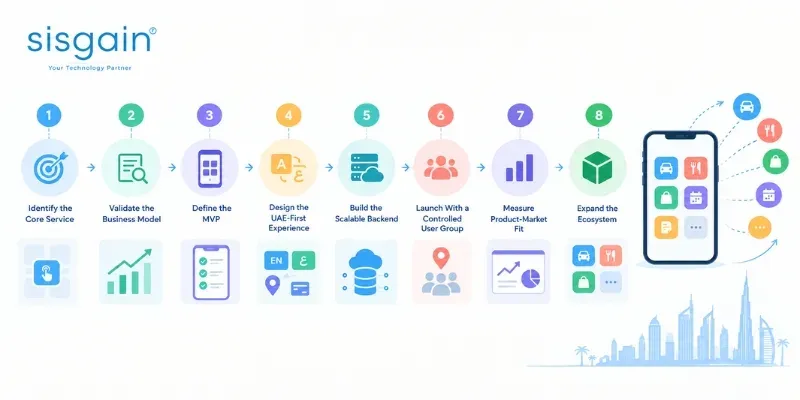
Step 1: Identify the Core Service
Choose one high-frequency service that your business already has some operational advantage in — an existing customer base, a supply-side relationship, or domain expertise. This is the anchor everything else gets built around.
Step 2: Validate the Business Model
Before writing a line of code, research the actual customer, the competitive landscape, real demand signals, and how the service will make money. Rough unit economics at this stage — cost to acquire a customer versus what a typical transaction is worth — will save far more money than they cost to work out.
Step 3: Define the MVP
Scope the MVP around the core service plus the essential supporting infrastructure: identity, payments, notifications, an admin dashboard and basic analytics. Resist the urge to add a second service until the first one is proven.
Step 4: Design the UAE-First Experience
Build Arabic and English support, RTL layout, local payment journeys and location-based services into the design from the start, not as a post-launch addition.
Step 5: Build the Scalable Backend
Use a modular architecture and well-defined APIs so that additional services can be introduced later without rebuilding the identity, payment or data layers.
Step 6: Launch With a Controlled User Group
Rather than a full market launch, consider starting with one city, one customer segment, or one service category. This limits risk and produces cleaner data on what's actually working.
Step 7: Measure Product-Market Fit
Track activation rate, conversion rate, retention, repeat transaction rate, customer acquisition cost, customer lifetime value, average transaction value and service utilization. These numbers, not intuition, should decide what gets built next.
Step 8: Expand the Ecosystem
Introduce adjacent services based on demonstrated customer demand and real usage patterns from the core service, not based on what competitors happen to offer.
Which Industries Can Benefit From a Super App?
|
Industry |
Strong Initial Service |
Natural Expansion |
|
Mobility |
Ride booking |
Parking, EV charging, rental, insurance |
|
Retail |
Marketplace |
Grocery, pharmacy, delivery, loyalty |
|
Real Estate |
Property discovery |
Maintenance, utilities, moving |
|
Healthcare |
Appointments |
Telemedicine, pharmacy, labs, wellness |
|
Hospitality |
Hotel booking |
Dining, transport, concierge |
|
Government / Smart City |
Citizen services |
Payments, permits, transport, alerts |
Mobility businesses typically anchor around ride or fleet booking, since it's used frequently enough to justify daily engagement, then expand into parking, EV charging, vehicle rental or insurance once there's a large enough active user base to cross-sell into.
Retail and eCommerce platforms often start with a marketplace or single-category store and grow into grocery, pharmacy and delivery, layering loyalty on top once repeat purchasing is established. Retail businesses building this out frequently pair the super app experience with eCommerce Platform Development to connect product discovery, ordering, payments and fulfillment into one coherent flow rather than treating them as separate systems.
Real estate platforms tend to start with property discovery and listings, then expand into maintenance requests, utility connections and moving services — lower-frequency by nature, which is why pairing this with a broader service ecosystem matters more here than in mobility.
Healthcare organizations often anchor around appointment booking, expanding into telemedicine, pharmacy delivery, lab results and wellness services once patient trust and data infrastructure are established.
Hospitality businesses typically start with hotel or venue booking and expand into dining reservations, transport arrangements and concierge services for guests already inside the ecosystem.
Government and smart-city platforms usually start with a defined set of citizen services and expand into payments, permit applications, transport information and public alerts — a model that draws heavily on industry-specific expertise in regulated, high-trust environments, given the compliance and security bar involved.
Super App vs Multi-Service App: What's the Difference?
A multi-service app provides several services inside one application. That's it — several features, one download.
A mature super app connects those services through shared infrastructure: one identity across every service, common payment and wallet infrastructure, a unified loyalty program, a single customer data profile that informs every interaction, personalization that draws on behavior across services (not just within one), cross-service discovery that surfaces relevant offers from other modules, partner APIs that let third parties plug in, and an integrated ecosystem where using one service makes the others more valuable, not just more visible.
The practical implication: a business can build a multi-service app relatively quickly by bolting features together. Building an actual super app ecosystem requires the identity, payment and data architecture to be designed correctly from the start — which is exactly why the architecture decisions covered earlier in this article matter more than the feature list.
How to Build a Careem-Like App in the UAE
This is one of the most common questions UAE founders bring to a technology partner, and it's worth answering carefully. Trying to copy another company's product feature-for-feature is rarely the right strategy — by the time a clone launches, the original has usually moved further ahead, and a copy has no distribution advantage of its own.
What's more useful is understanding the underlying ecosystem model these platforms follow: core mobility → payments → loyalty → delivery → food → lifestyle services → broader ecosystem. Each stage was added once the previous one had a large enough active user base and enough trust in the payment layer to support it.
A UAE business pursuing this model should build its own version of that sequence based on its actual strengths — its audience, its distribution advantage, how frequently its core service gets used, the strength of its partner or supplier network, its operational capacity to deliver the core service reliably, and a monetization model suited to its specific market position. Copying the architecture pattern makes sense. Copying the exact feature list rarely does.
How Long Does Super App Development Take in the UAE?
|
Platform Type |
Typical Timeline |
|
MVP |
3–6 months |
|
Growth Stage |
6–12 months |
|
Full Custom Platform |
8–15 months |
|
Enterprise Ecosystem |
12–24+ months |
Actual timelines shift based on scope, the number of services included at launch, the complexity of third-party integrations, the payment architecture chosen, applicable compliance requirements, UX complexity across Arabic and English, backend architecture decisions, the depth of testing required, and the size of the development team assigned to the project. A tightly scoped MVP with one service and a standard payment gateway can realistically launch in three to four months. A platform with a wallet, multiple services and partner integrations rarely launches in under eight.
How to Choose a Super App Development Company in UAE
Choosing a super app development company UAE is where most of the risk in this process actually sits — not in the idea itself. A few criteria are worth applying rigorously.
Product Engineering Experience
Look for demonstrated experience across mobile app development, marketplace platforms, enterprise systems, API design, cloud infrastructure and payment integrations — not just one of these in isolation. A super app touches all of them simultaneously.
UAE Market Understanding
A partner should understand Arabic UX and RTL design as a default, not an add-on request. They should also understand local customer expectations around speed and pricing transparency, the local payment ecosystem, relevant privacy considerations, and the general UAE business environment — including how licensing and compliance conversations typically unfold with regulated activities.
Technical Capability
Evaluate depth in AI integration, cloud architecture, DevOps practices, cybersecurity, microservices design, third-party API integration and data engineering. A team strong in mobile UI but thin on backend architecture will struggle once the platform needs to scale past its first service.
Security
Ask specific questions: how is secure coding enforced, how is data encrypted, what authentication standards are used, what testing happens before release, how is the system monitored post-launch, and how is vulnerability management handled on an ongoing basis. Vague answers here are a warning sign.
Post-Launch Support
Development doesn't end at launch. Ask about ongoing maintenance, system monitoring, bug fixing turnaround, performance optimization, security patching, how new features get added over time, and how cloud infrastructure scales as usage grows.
IP Ownership and Transparency
Confirm, in writing, who owns the source code and documentation, what third-party dependencies the platform relies on, how development milestones are structured and reported, and how pricing is broken down. A serious mobile app development company in Dubai should be able to answer all of this clearly before a contract is signed, not after.
Super App Business Models and Revenue Opportunities
Revenue models vary by service type, and most mature super apps run several simultaneously: commission on transactions completed through the platform, flat transaction fees, subscription or premium membership tiers, merchant fees for access to the platform's user base, advertising placements within the app, partner commissions from cross-sold services, dedicated service fees for specific features, and cross-selling between services once a user is active in more than one.
The right model depends on how frequently the core service is used and how customers already expect to pay for it. A daily-use service like ride-hailing tends to support commission-based pricing well. A lower-frequency service like real estate or healthcare bookings often works better with a subscription or membership layer, since the per-transaction value doesn't support high commission rates on its own.
The Future of Super App Development in UAE
The direction for UAE super app development over the next few years is toward deeper AI integration, more consolidated payment infrastructure, and tighter connections between government digital services and private-sector platforms. Businesses that build with modular architecture now will be in a far stronger position to plug into that shift than those that launch a rigid, single-purpose app and try to retrofit multi-service capability later.
The businesses most likely to succeed in this category won't be the ones that launch with the most features. They'll be the ones that got the core service right, built the identity and payment foundation properly, and expanded deliberately based on what customers actually did — not what looked good on a roadmap slide.
Build Your Super App in the UAE With the Right Technology Partner
A super app isn't won by shipping the longest feature list at launch. It's won by getting one service right, building the identity and payment foundation underneath it properly, and expanding deliberately as real usage data points the way — through shared identity, payments, data, APIs, loyalty and AI, added in that order, not all at once.
That's the core message behind everything in this article, and it's the same principle worth applying whether you're planning a mobility platform in Dubai, a healthcare booking system in Abu Dhabi, or a retail ecosystem serving both. Super app development UAE projects that skip this sequencing tend to cost more, take longer, and confuse the exact customers they're trying to win over.
Planning a multi-service platform in the UAE? Start by defining the core service, target users, integrations and expansion roadmap before committing to full-scale development.
Looking to build a secure, bilingual and scalable super app for the UAE market? SISGAIN Technologies works with UAE businesses across product strategy, UI/UX, mobile and backend development, API integrations, AI integration, cloud deployment, cybersecurity, payment integrations and post-launch support — as a Super App Development Company in Dubai built around exactly this kind of phased, modular approach.
Get a UAE super app development estimate based on your services, integrations, expected users, compliance requirements and launch timeline.
Get a Super App Development Estimate