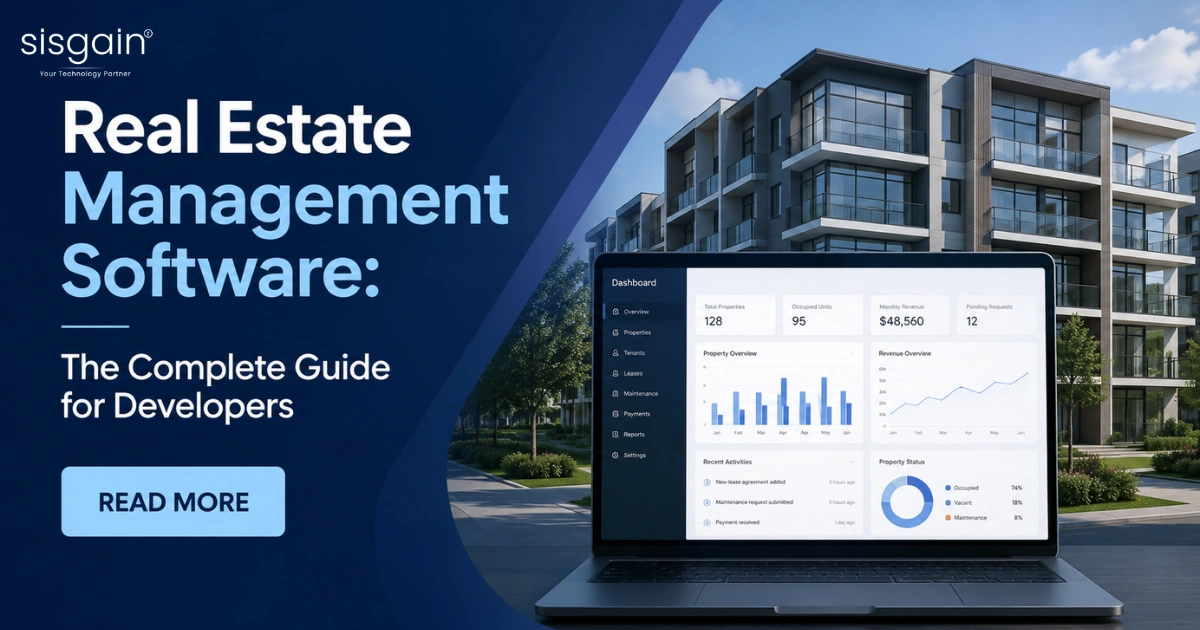

Real estate management software is the system that turns scattered spreadsheets, WhatsApp threads, and paper contracts into one connected platform for property, sales, and finance data. If you're a developer, agency owner, or PropTech founder trying to decide whether to buy, customize, or build one from scratch, this guide walks through everything: what the software actually does, what it costs, how it's built, and where the category is heading in 2026.
Real estate has always been a data-heavy business — units, leads, contracts, payments, approvals — but most of that data still lives in disconnected tools. A sales team runs leads through a CRM. Finance tracks payments in Excel. Legal keeps contracts in shared drives. None of it talks to the others. That gap is exactly what real estate management software exists to close.
This guide covers what the software is, why developers are adopting it faster than ever, the features that separate a serious platform from a glorified spreadsheet, and a practical path for building or buying one in 2026.
What Is Real Estate Management Software?
Real estate management software is a centralized platform that connects property data, customer data, financial records, and operational workflows into a single system of record. Instead of a broker checking unit availability in one file, a sales rep tracking leads in another, and finance reconciling payments in a third, everything lives in one place and updates in real time. For businesses with unique workflows, custom software development Dubai can also help create real estate platforms tailored to specific operational and reporting requirements.
It's easy to confuse this with adjacent categories, so here's the distinction:
- Real estate management software vs. property management software — Property management software is narrower. It's built for landlords and property managers handling leases, rent collection, and maintenance requests on existing rental units. Real estate management software is broader — it spans development, sales, leasing, and asset management across an entire portfolio or project pipeline.
- Real estate management software vs. CRM — A CRM manages leads and customer relationships. Real estate management software includes CRM functionality but adds property inventory, transactions, and financial reporting on top of it.
- Real estate management software vs. ERP — An ERP handles enterprise-wide resource planning (HR, procurement, accounting) across any industry. Real estate management software is industry-specific — it's built around units, bookings, and property transactions rather than generic business operations.
The people actually using this software day to day include developers managing multi-phase projects, property managers overseeing occupied buildings, agencies running sales pipelines, brokers closing individual deals, and investors tracking portfolio performance. Each of these users touches a different slice of the same underlying data — which is exactly why a unified platform beats five disconnected tools.
Why Developers Need Real Estate Management Software
Managing five properties on a spreadsheet is annoying. Managing fifty across three cities without a centralized system is close to impossible. That's the core reason developers move to dedicated software — but the benefits go deeper than scale.
Manual admin work eats hours that should go toward sales and strategy. A missed follow-up costs a lead. A double-booked unit costs trust. Real estate management software fixes these failure points by automating the repetitive parts of the job:
- Tracking multiple properties and projects without losing visibility into any single one
- Cutting the manual data entry that eats up sales and ops teams' time
- Capturing and qualifying leads faster than a shared inbox ever could
- Automating recurring workflows — reminders, approvals, status updates
- Giving management real-time visibility into project performance instead of a monthly report
- Connecting sales, finance, and operations so nobody's working off stale information
- Supporting the digital-first booking and communication experience today's buyers expect
The real payoff is decision speed. When a developer can see occupancy, revenue, and lead conversion on one dashboard instead of chasing three departments for updates, decisions that used to take a week happen in an afternoon.
Key Features of Real Estate Management Software
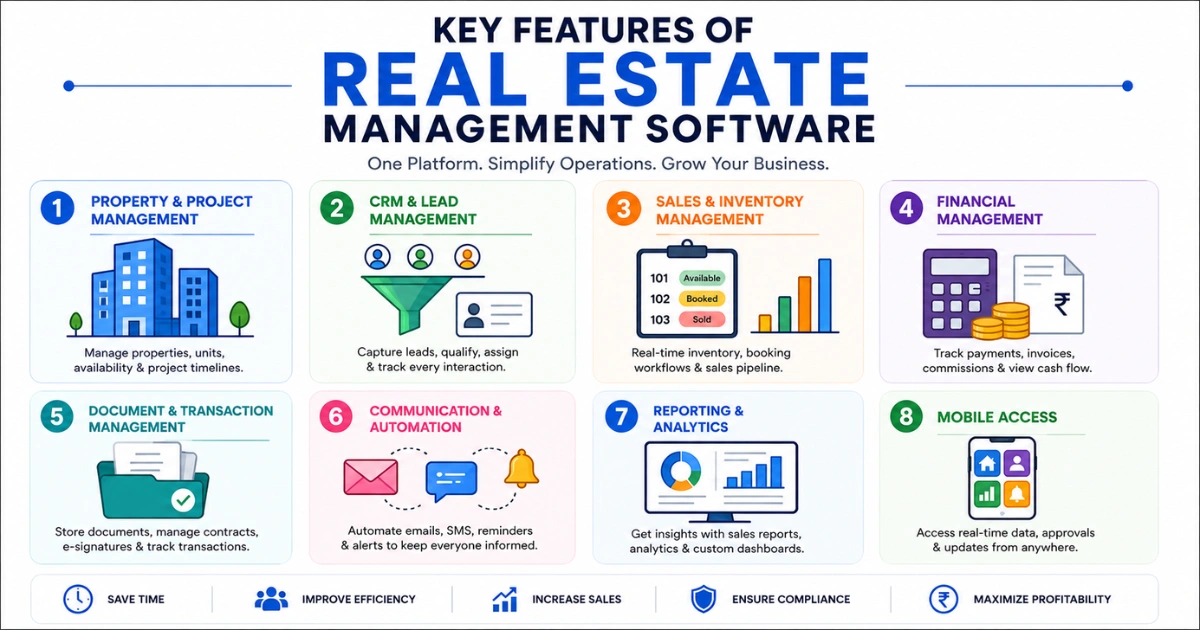
A platform is only as useful as the modules underneath it. Here's what a serious real estate management system needs to cover.
Property and Project Management
This is the foundation layer — property listings, unit-level details, real-time availability tracking, and project/development timelines for multi-phase builds.
CRM and Lead Management
Lead capture from web forms, ads, and referrals; automated lead qualification and assignment; follow-up sequencing; and a full customer profile with interaction history so no rep starts a conversation blind.
Sales and Inventory Management
Live inventory syncing so two agents can't sell the same unit, booking workflows, a visible sales pipeline, and agent performance tracking that turns "who's closing deals" from a guess into a number.
Financial Management
Payment tracking, invoicing, commission calculation, revenue reporting, and dashboards that show cash flow without a finance team pulling a manual report.
Document and Transaction Management
Digital document storage, contract management, e-signatures, transaction tracking, and compliance documentation — the paperwork layer that used to live in filing cabinets.
Communication and Automation
Email and SMS notifications, automated reminders for renewals and payments, structured customer communication workflows, and internal alerts that keep teams synced without a dozen daily check-in messages.
Reporting and Analytics
Sales reports, property performance breakdowns, revenue analytics, lead conversion metrics, and custom dashboards built around what each team actually needs to see.
Mobile Access
Field agents and property managers need real-time data on their phones — not just the office. Mobile apps enable remote approvals, on-site updates, and faster response times when a buyer is standing in front of a unit asking a question.
How Real Estate Management Software Works
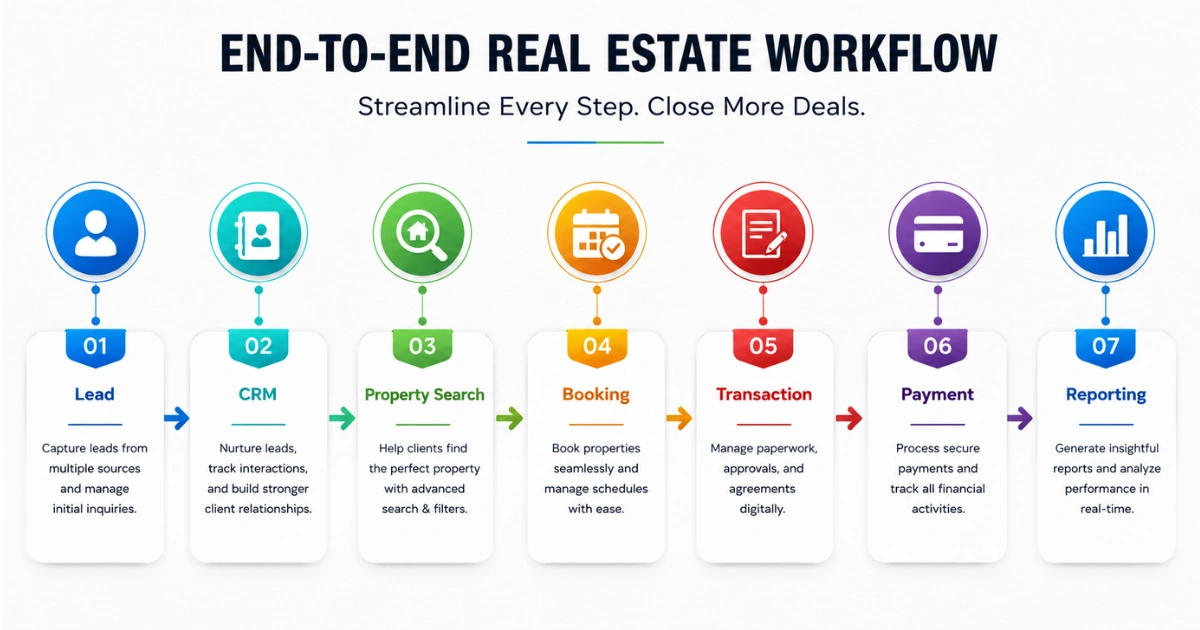
Under the hood, real estate management software runs on a centralized database with role-based user permissions layered on top — a sales rep sees leads and inventory, finance sees payments and invoicing, and management sees everything. Workflow automation handles the repetitive triggers (a new lead gets auto-assigned, a payment due date sends a reminder), while third-party integrations pull in accounting tools, marketing platforms, and listing portals. Analytics and dashboards sit on top of all of it, and web and mobile interfaces make the data usable wherever the team is working.
The typical flow through the system looks like this:
Lead → CRM → Property Search → Booking → Transaction → Payment → Reporting
A prospect submits interest, the CRM logs and routes it, the buyer searches available units, a booking gets created, the transaction moves through contracts and payment, and the whole thing rolls up into a report — without anyone manually re-entering data at each step.
Real Estate Management Software vs. Traditional Real Estate Operations
The shift from spreadsheets to software isn't cosmetic — it changes how fast a team can actually operate.
| Traditional Process | Software-Based Process |
|---|---|
| Spreadsheets | Centralized platform |
| Manual follow-ups | Automated workflows |
| Paper documents | Digital documents |
| Delayed reports | Real-time dashboards |
| Scattered customer data | Centralized CRM |
Traditional operations are reactive by nature — a team finds out about a problem (a missed payment, a stale lead, a double booking) after it's already caused damage. Software-based operations are proactive: the system flags the issue before it becomes a lost deal. That's the real difference between the two columns above.
What Is a PropTech Platform for Real Estate?
A PropTech platform for real estate is a technology system that applies automation, AI, IoT, cloud computing, and data analytics specifically to real estate operations — from development and sales to leasing and asset management. It's the broader ecosystem that real estate management software sits inside.
Where traditional real estate software digitizes existing processes (a digital version of the same paper workflow), a true PropTech platform for real estate rethinks the process itself — using AI to score leads before a human ever touches them, IoT sensors to monitor building conditions in real time, or predictive models to flag which units are likely to sit unsold.
Common PropTech use cases developers are already building around include AI-driven lead scoring, virtual property tours, smart building sensors for maintenance prediction, blockchain-backed transaction records, and dynamic pricing models based on market demand. For developers running multiple projects or business units, building a customized PropTech ecosystem — rather than buying isolated point solutions — is increasingly the difference between a platform that scales and one that needs to be replaced in three years.

Benefits of Using Real Estate Management Software
The value looks different depending on who's using it.
For developers: better project visibility across every phase, faster sales cycles because inventory and CRM data are synced, centralized operations instead of five disconnected tools, and lower operational costs from reduced manual work.
For property managers: easier maintenance tracking, automated tenant and customer communication, and task management that doesn't rely on memory or sticky notes.
For sales teams: faster lead response times, better tracking of where every lead sits in the pipeline, and clear visibility into what's actually converting.
For customers: faster communication back from the agency, easier property discovery, digital booking and documentation instead of paperwork, and a smoother experience after the sale closes too.
How to Choose the Right Real Estate Management Software
Before comparing vendors, define what the business actually needs — most failed software rollouts start with skipping this step. Work through the following:
- Define business requirements first, before looking at any product demo
- Identify the specific modules and workflows the team needs (not the ones a sales rep pitches)
- Evaluate whether the platform scales as the portfolio or team grows
- Check available integrations and whether the platform has an open API
- Assess security certifications and compliance coverage
- Review how much the platform can be customized versus locked into defaults
- Decide between cloud and on-premise deployment based on IT resources and data policy
- Confirm mobile capabilities actually match how the field team works
- Compare pricing models — per-user, per-unit, flat-rate — against real usage patterns
- Assess vendor support responsiveness and long-term maintenance commitments
- Request a live demo and run a proof of concept before signing anything
For teams comparing what's already on the market, it's worth reviewing the best real estate software systems in 2026 before deciding whether an off-the-shelf platform covers the requirements or whether custom development is the better route.
Essential Integrations for Real Estate Management Software
No real estate platform operates in isolation — it needs to talk to the other tools a business already runs on. The essential integrations include:
- CRM integration for unified customer data
- Accounting software and payment gateways
- Email and SMS platforms for communication automation
- E-signature solutions for contract closing
- Maps and location services for property search
- Marketing automation tools for lead generation
- ERP systems for broader enterprise data
- Property listing portals for distribution
- Analytics and BI tools for deeper reporting
- AI-powered services for lead scoring and recommendations
A platform without solid API support locks a business into whatever features the vendor decided to ship — which is one of the biggest reasons developers eventually outgrow off-the-shelf tools.
Custom vs. Off-the-Shelf Real Estate Management Software
Off-the-Shelf Software
Off-the-shelf platforms get a business running fast — implementation is measured in weeks, not months, and the feature set is standardized around common use cases. The tradeoff is flexibility: if a workflow doesn't match how the software was designed, the business adapts to the tool instead of the other way around.
Custom Real Estate Management Software
Custom software is built around the business's actual workflows, not a generic template. It supports whatever integrations the operation needs, scales with the specific way the business grows, and — critically — the business owns its own data and infrastructure instead of renting access to it.
When Should Developers Build Custom Software?
Custom development starts making sense when a business has workflows too specific for an off-the-shelf tool to handle well, manages multiple projects or business units with different needs, requires proprietary features competitors don't have, runs integration-heavy operations that off-the-shelf APIs can't support cleanly, or is planning for scale that a generic platform's pricing and architecture won't accommodate long-term.
Real Estate Software Development: Key Considerations
Building real estate management software from scratch means getting a long list of technical decisions right before writing production code:
- Clear business and technical requirements documented up front
- UI/UX design built around actual user workflows, not assumptions
- Web and mobile application development running in parallel
- Backend architecture that can handle transactional data at scale
- Database design that supports complex relationships between properties, users, and transactions
- API development for every integration the platform will need
- Cloud infrastructure that scales with usage instead of requiring a rebuild
- Security built in from day one, not bolted on after launch
- Testing and QA across every module before release
- A deployment plan that doesn't disrupt an operating business
- Ongoing maintenance and upgrade cycles post-launch
Regional context matters here too. Teams building for markets like the UAE will find a deeper breakdown of requirements in Real Estate Software Development in UAE: Cost & Solutions, which covers localization and region-specific implementation in detail.
How Much Does Real Estate Management Software Cost to Develop?
There's no single number that answers this honestly — cost depends on complexity, module count, platform coverage, and how deep the integrations go. What matters more is understanding the variables that actually move the price:
- Overall software complexity and number of custom workflows
- How many modules are included (CRM, inventory, finance, documents, analytics)
- Which platforms are targeted — web, iOS, Android, or all three
- UI/UX complexity and how much custom design work is involved
- Backend architecture requirements for scale and data volume
- Number and depth of third-party integrations
- Whether AI and automation features are part of the build
- Security and compliance requirements specific to the region or industry
- Where the development team is located
- Ongoing maintenance and post-launch support commitments
A realistic cost breakdown moves through discovery and business analysis, UI/UX design, frontend development, backend development, API integrations, QA and testing, deployment, and maintenance — each phase adding its own line item to the total.
Development team location has an outsized effect on the final number, which is worth understanding through app development cost in Dubai if the team is based in or building for the UAE market. For the broader picture of what drives app development budgets generally, how much does it cost to develop an app breaks down the variables that apply well beyond real estate.
Real Estate Management Software Development in Dubai and the UAE
Dubai has become one of the most active PropTech markets globally, driven by aggressive digital transformation mandates across the UAE real estate sector and a buyer base that expects a fully digital transaction experience from first inquiry to handover.
Developers building for this market typically need features tuned to local conditions: Arabic and English language support running in parallel, payment integrations compatible with regional banking and financial regulations, compliance with UAE-specific data and real estate regulatory requirements, and cloud infrastructure built to scale as the market's transaction volume grows.
Teams evaluating who can actually build this kind of platform will want to look at a Real Estate App Development Company in Dubai that understands both the technical requirements and the regional regulatory landscape — building for the UAE market without local context is one of the more common ways real estate software projects go over budget.
How to Build Real Estate Management Software: Step-by-Step
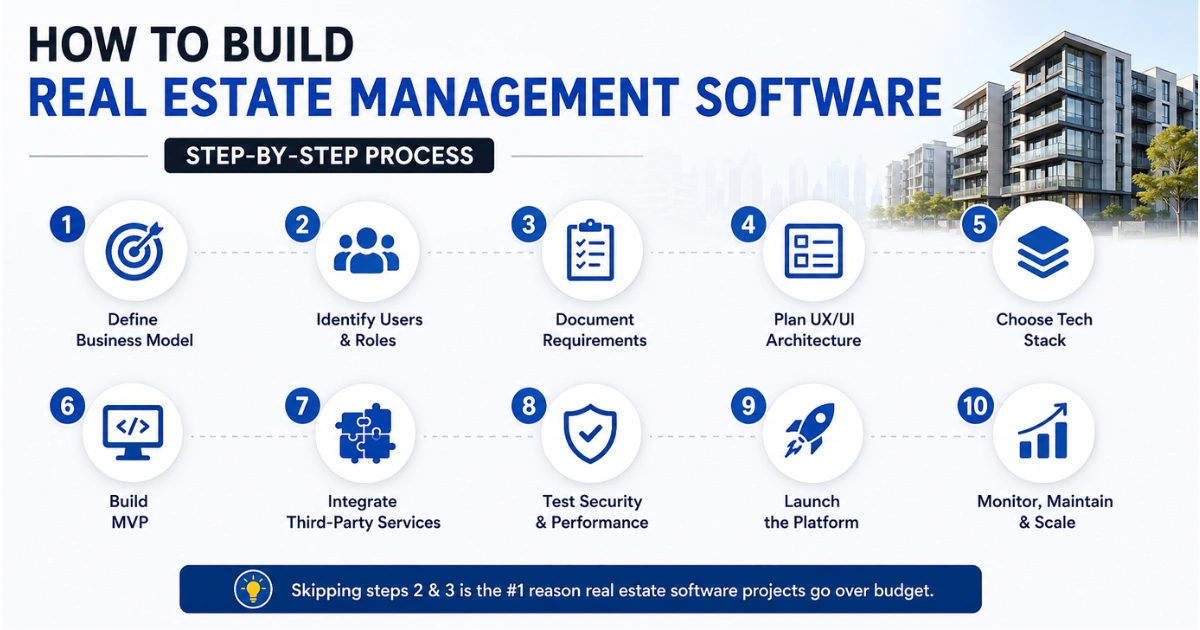
Building a platform from zero follows a fairly consistent sequence, regardless of team size or market:
- Define the business model — what kind of real estate operation is this software actually supporting?
- Identify users and user roles — who logs in, and what should each role be able to see and do?
- Document functional requirements — what does the software need to do, in specific, testable terms?
- Create UX/UI architecture — map the user journeys before designing screens.
- Select the technology stack — choose based on scale and integration needs, not trend.
- Develop the MVP — build the smallest version that solves the core problem end to end.
- Integrate third-party services — connect CRM, payments, e-signatures, and listing portals.
- Test security and performance — under real load, not just happy-path testing.
- Launch the platform — with a rollout plan, not a single flip of a switch.
- Monitor, maintain, and scale — a launched platform is the start of the work, not the end of it.
Skipping steps 2 and 3 is the single most common reason real estate software projects blow past their original budget — teams start building before they've actually agreed on what "done" looks like.
Technology Stack for Real Estate Management Software
The right stack depends on scale and team expertise, but the categories a platform needs to cover stay consistent: frontend technologies for the user-facing interface, backend technologies for business logic and data processing, databases built for relational and transactional data, cloud infrastructure for hosting and scaling, APIs for every integration point, mobile development technologies for iOS and Android, AI/ML technologies where automation and recommendations are part of the product, analytics tooling for reporting, and cybersecurity technologies woven through every layer.
When evaluating stack choices, weigh them against scalability, performance under real transaction volume, security posture, how well the stack supports integration work, and long-term maintainability — a stack that's fast to build with but hard to maintain becomes expensive within two years, not immediately.
Security and Compliance Considerations
Real estate platforms handle financial data, personal information, and legal documents — which makes security non-negotiable, not a nice-to-have. The baseline requirements include role-based access control so users only see what their role permits, data encryption both at rest and in transit, secure authentication (multi-factor where possible), API security to protect every integration point, backup and disaster recovery planning, audit logs for every sensitive action, payment security aligned with relevant financial standards, data privacy practices that respect regional regulations, broader compliance requirements specific to the market being served, and regular security testing rather than a one-time audit at launch.
AI and Automation in Real Estate Management Software
AI is moving real estate management software from a passive record-keeping system into something closer to a decision-support tool. The most practical applications already in use include AI-powered lead qualification that scores prospects before a human touches them, automated customer support handling routine questions, property recommendations based on buyer behavior, predictive analytics for pricing and demand forecasting, sales forecasting built on historical pipeline data, automated document processing that extracts key contract terms, AI chatbots for first-touch customer interaction, broader workflow automation across the platform, and predictive property maintenance that flags issues before they become expensive.
The direction this is heading is clear: platforms that used to just store data are starting to actively recommend what to do with it — which unit to promote, which lead to prioritize, which listing is underpriced for its market.
Best Real Estate Software Systems in 2026: What to Look For
When evaluating platforms on the market today, the differentiators worth weighing are core functionality against the business's actual needs, how easy the platform is for non-technical staff to use day to day, whether it scales as the portfolio grows, the depth of CRM capabilities, how well property management is handled at the unit level, transaction management coverage, the quality and flexibility of analytics, breadth of integrations, mobile capabilities for field teams, security posture, and how much the platform can be customized without custom development.
For a full comparison of platforms currently leading the market, see best real estate software systems in 2026.
Real Estate Transaction Management Software: Key Features
Transaction management is often the most operationally painful part of real estate — and the most valuable to get right. The key features to look for include end-to-end transaction tracking from offer to close, contract management with version control, structured document workflows that don't rely on email attachments, built-in e-signature support, automated compliance checks against regulatory requirements, deadline and reminder automation so nothing slips, collaboration tools for the multiple parties involved in a single deal, and transaction reporting that shows where every deal actually stands.
For a closer look at platforms built specifically around this function, see Top Real Estate Transaction Management Software 2026.
Common Mistakes to Avoid When Implementing Real Estate Software
Most failed rollouts trace back to a handful of avoidable mistakes: building without clearly defined requirements, trying to cram every possible feature into version one instead of shipping a focused MVP, ignoring UX in favor of pure functionality, underestimating how much integration work is actually involved, poor planning around migrating existing data into the new system, treating security as an afterthought, choosing technology based on what's trendy rather than what scales, skipping planning for ongoing maintenance, failing to properly train the team that has to use the software daily, and measuring success by whether the platform launched rather than whether it actually improved business outcomes.
That last one matters more than it sounds — a platform can launch on time, on budget, and still fail if nobody actually adopts it.
KPIs to Measure the Success of Real Estate Management Software
Launch day isn't the finish line — these are the numbers that show whether the software is actually working: lead response time, lead-to-sale conversion rate, sales cycle duration, property occupancy and availability metrics, revenue per project, customer response time, operational cost reduction, user adoption rate across the team, transaction processing time, and customer satisfaction scores.
If these numbers aren't improving within a few months of rollout, the problem usually isn't the software — it's either the implementation or the training behind it.
Future of Real Estate Management Software
The next phase of real estate management software is being shaped by AI-first platforms built around prediction rather than record-keeping, deeper predictive analytics for pricing and demand, intelligent automation handling more of the workflow without human triggers, connected property ecosystems where every system talks to every other system, IoT-enabled property management feeding real-time building data into the platform, digital twins modeling entire developments before they're built, blockchain-based transactions for tamper-proof records, increasingly personalized customer experiences driven by behavioral data, mobile-first operations as the default rather than the exception, and rising demand for integrated PropTech platforms over single-purpose tools.
The through-line across all of these trends is the same: real estate software is moving from something that records what happened to something that helps decide what happens next.
Building a Smarter Real Estate Operation
Centralized software isn't a nice-to-have anymore — it's what separates operations that scale from ones that stall out under their own complexity. The developers seeing the biggest gains aren't the ones with the most features. They're the ones who built (or bought) around automation, real-time visibility, solid integrations, and a platform that scales without needing to be rebuilt every two years.
The right choice isn't "off-the-shelf" or "custom" as a blanket rule — it's whichever one actually matches your workflows, growth plans, and technical requirements. Feature count is a distraction if the platform doesn't fit how your business actually runs.
If you're weighing whether to build custom real estate management software, estimate development scope, or shortlist an existing platform, start by mapping your actual requirements before you look at a single demo — that one step prevents most of the expensive mistakes covered in this guide.