
Custom Blockchain Application Development
We build decentralised and permissioned applications around your workflows, from asset tracking and digital records to multi-party transaction platforms.
SISGAIN designs and builds private blockchain networks, smart contracts and enterprise integrations, helping UAE businesses create secure, transparent and auditable workflows from feasibility assessment through to deployment and support.
We help businesses turn blockchain ideas into secure, working systems, covering strategy, smart contracts, private networks, integration and ongoing support, with each service tied to a clear business problem.
We build decentralised and permissioned applications around your workflows, from asset tracking and digital records to multi-party transaction platforms.

Our developers write, test and audit self-executing contracts that automate agreements, payments and approvals, with security reviews before deployment.

We set up controlled networks where only approved participants can read, write or validate data.
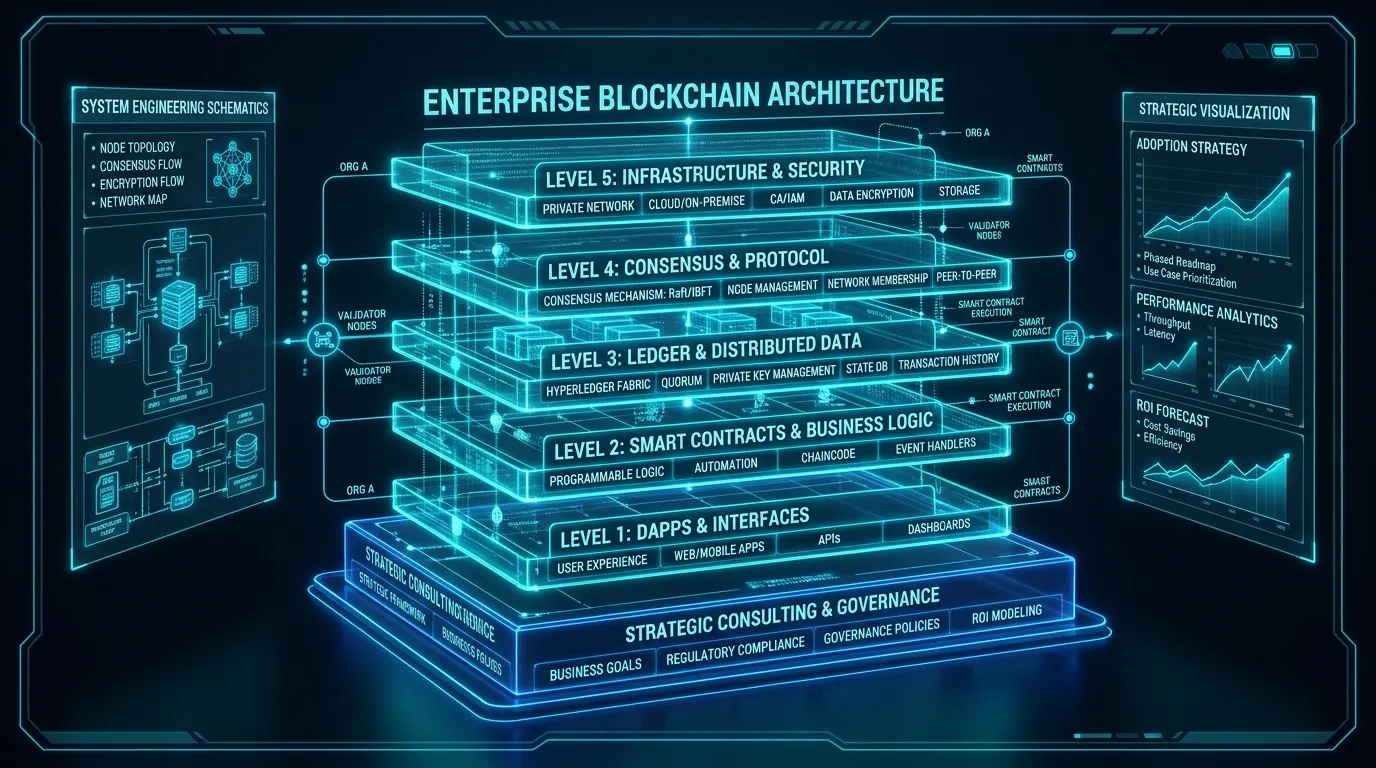
We assess feasibility, compare platforms and define the architecture so you invest in the right solution before development starts.

We connect blockchain applications to your ERP, CRM, payment systems and cloud infrastructure, so data flows without disrupting daily operations.

We monitor performance, apply security updates and optimise your network as usage and requirements grow.
Blockchain is not the answer to every problem. These are the business challenges where it delivers real value, and how we approach each one.
Blockchain approach: A shared, time-stamped ledger that authorised parties can verify.
Expected outcome: Clearer visibility into who did what, and when.
Blockchain approach: Tamper-resistant records with a complete, traceable history of changes.
Expected outcome: Faster audits and greater confidence in your data.
Blockchain approach: A single source of truth shared between organisations, with smart contracts automating checks.
Expected outcome: Less duplicate data entry and fewer disputes between parties.
Blockchain approach: End-to-end tracking of goods, documents and handovers on a shared network.
Expected outcome: Better traceability from origin to delivery.
Blockchain approach: Permissioned networks with defined roles and rule-based automation.
Expected outcome: Smoother collaboration between partners, suppliers and regulators.
Blockchain approach: Structured code reviews, security testing and governance rules for upgrades.
Expected outcome: Lower risk of errors and a clearer decision-making process.
Every project follows a structured path with defined deliverables and approval points, so you always know what is being built, why, and what comes next.
We define your goals, users and constraints, and confirm whether blockchain is the right fit. Deliverable: feasibility report. Approval checkpoint: scope sign-off.
We design the network, data model, roles and security approach. Deliverable: architecture document. Approval checkpoint: architecture approval.
We select the most suitable platform and build a working prototype to validate the concept. Deliverable: proof of concept. Approval checkpoint: prototype review.
We develop the contracts and test them against realistic scenarios. Deliverable: tested contracts and test reports. Approval checkpoint: functional acceptance.
We connect your existing systems, run security checks and launch in a controlled environment. Deliverable: deployed solution and security report. Approval checkpoint: go-live approval.
We track performance, fix issues and plan improvements. Deliverable: regular performance and support reports.
Our consultants help you decide whether blockchain fits your use case, which architecture to choose, and how to plan security, governance and integration before development begins.
A clear strategy prevents costly rework. Before any code is written, we help you answer the questions that shape the whole project:
Is blockchain the right tool, and what return should you expect?
Should you use a public, private or hybrid network, and which platform suits your needs?
Which business rules should be automated, and how should they be structured?
Who controls access, approves upgrades and manages risk?
How will the solution grow and connect with your current systems?
Private and permissioned networks give enterprises control over who joins, who sees what, and how decisions are governed, while keeping a tamper-resistant record of every transaction.
Only approved users and organisations can participate.
Every participant is verified and assigned a defined role.
Sensitive data is shared only with the parties who need it.
Every action is recorded for internal and regulatory review.
Clear rules for managing the network, with performance tuned to your workload.
A private blockchain is a good fit when several organisations need to share data they do not fully trust each other to control, when records must be auditable, and when access must be restricted.
If one organisation controls all the data and no independent verification is needed, a traditional database is usually simpler, faster and cheaper. We will tell you honestly if that is the case.
We design private blockchain networks around your organisation's access rules, workflows and compliance needs, then build, test and maintain them so participants can transact with confidence.
We plan nodes, consensus, data storage and security so the network is reliable and ready to scale.
We build networks shared by multiple organisations, with agreed rules for membership, validation and data visibility.
Business rules, approvals and payments run automatically on the network, reducing manual effort and delays.
We define who can view, add or change information, and enforce those rules at network level.
We monitor uptime, performance and security, and handle updates so your network stays stable.
Blockchain delivers the most value where several parties share data, trust matters and records must be audited. Here is how it applies across six industries.

Problem: Slow settlement and repeated verification between institutions.
Application: Shared ledgers, digital identity checks and automated settlement through smart contracts.
Potential benefit: Faster processing and stronger audit trails.

Problem: Limited visibility across suppliers, carriers and customs.
Application: Shared tracking of goods, documents and handovers.
Potential benefit: Improved traceability and fewer disputes.

Problem: Paper-heavy processes and difficulty verifying ownership history.
Application: Digital records and smart contracts for agreements and payments.
Potential benefit: Simpler verification and quicker transactions.

Problem: Patient data scattered across providers, with strict privacy needs.
Application: Permissioned access and audit logs for secure data sharing.
Potential benefit: Controlled access and better accountability.

Problem: Difficulty proving product authenticity and managing loyalty programmes across partners.
Application: Product provenance records and shared rewards systems.
Potential benefit: Greater customer trust and less fraud.

Problem: Fragmented records across production, quality and procurement.
Application: A shared record of parts, inspections and approvals.
Potential benefit: Better compliance tracking and faster issue resolution.
A blockchain application only creates value when it works with the systems you already use. We connect it to your ERP, CRM, payment and identity platforms through secure APIs.
ERP and CRM integration: Keep your business data consistent between blockchain records and core systems.
APIs and middleware: Secure interfaces that let applications exchange data with the network.
Payment and transaction systems: Link blockchain events to payment gateways and financial platforms.
Cloud infrastructure: Deploy and scale on the cloud environment that fits your security and compliance needs.
Identity and access management: Connect existing user directories and permissions to the network.
Legacy application interoperability: Bridge older software to blockchain without rebuilding everything.
We choose technology by use case, not trend. The stack below is organised by implementation layer so you can see what each component does.
| Layer | Technologies |
|---|---|
|
Blockchain platforms
|
 Ethereum  Hyperledger Fabric  Polygon  Enterprise Networks |
|
Smart contract languages and tooling
|
 Solidity  Go  JavaScript / TypeScript  Hardhat & Tooling |
|
APIs and integration frameworks
|
 REST APIs  Middleware & RPC
Web3.js  Messaging Services |
|
Cloud and deployment infrastructure
|
 AWS  Microsoft Azure  Google Cloud  Docker & Containers |
|
Security, monitoring and testing tools
|
 Code Analysis & Audits  OWASP Vulnerability Testing  Testing Suites  Network Monitoring |
Good architecture balances performance, privacy, regulatory obligations and business goals. Our framework covers six layers, each designed to be secure, scalable and easy to govern.

Web and mobile interfaces that users interact with.
Automated rules that process transactions and approvals.
Nodes and validation methods that keep the ledger consistent.
On-chain and off-chain data, plus links to existing systems.
Verified participants, role-based permissions and encryption.
Performance tracking, upgrade rules and capacity planning.
High transaction volumes may call for a different consensus method. Strict privacy needs may require private channels or off-chain storage. Regulatory obligations affect where data is kept and who can see it. We document these trade-offs so every decision is clear.
Choosing a blockchain partner is a high-stakes decision. Here is the evidence we provide so you can assess our expertise, quality standards and support before you commit.
Our team combines blockchain engineers, solution architects and project managers.
Every solution goes through code review, functional testing and security checks before launch.
We provide post-launch monitoring, updates and issue resolution.

Explore how SISGAIN Technologies helps organizations accelerate digital transformation through AI, custom software, cloud modernization, and enterprise solutions that deliver measurable business outcomes.

Developed a unified healthcare platform combining EMR, telemedicine, and remote patient monitoring to streamline patient care. Doctors can access real-time medical records, vitals, and treatment history from a centralized database while providing 24/7 telehealth services.

Built a comprehensive digital health platform integrating telemedicine, mobile lab services, and preventive health screening. Patients can consult doctors through video, voice, or chat while also scheduling home lab sample collection.

Developed a telemedicine platform integrated with the insurance ecosystem, allowing members to access virtual healthcare directly through their insurance policies while automating claims processing and policy management.

Created a cross-platform Remote Patient Monitoring (RPM) application enabling continuous vitals tracking through cellular-enabled medical devices. Clinicians receive real-time alerts when patient readings cross risk thresholds, enabling faster medical intervention.

Designed a comprehensive Hospital Information System (HIS) to unify clinical, operational, and administrative workflows across departments. The platform integrates modules for patient records, lab management, pharmacy, billing, scheduling, and inventory.

Developed an advanced Remote Patient Monitoring platform integrated with OxiTone devices enabling continuous health tracking with automated alerts for abnormal readings.

Built a customized CRM platform to manage business projects, sales pipelines, and client relationships in a centralized system. The solution replaced fragmented spreadsheets with real-time dashboards and automated workflows.

Developed an OTT streaming platform bringing live TV and on-demand content into a single interface supporting Smart TVs, mobile apps, and Android devices.

Created a scalable OTT platform delivering live TV, on-demand content, and third-party streaming integrations across multiple devices with cloud-based architecture.

Developed a cloud-native healthcare ecosystem integrating EMR, telemedicine, patient engagement, remote monitoring, and AI-powered clinical insights to improve care coordination and operational efficiency.

Built an AI-driven business intelligence platform that consolidated enterprise data from multiple sources, enabling predictive analytics, automated reporting, and real-time decision-making across departments.

Designed and deployed a scalable multi-cloud infrastructure with automated provisioning, disaster recovery, monitoring, and security controls to support business-critical applications with high availability.

Implemented an intelligent operations management platform leveraging AI and workflow automation to streamline processes, reduce manual intervention, and improve organizational productivity.

Developed a secure digital banking and fintech solution featuring automated KYC, fraud detection, payment processing, AI-based risk assessment, and cloud-hosted infrastructure for seamless scalability.

Created an end-to-end logistics and supply chain management platform with route optimization, fleet tracking, warehouse automation, predictive demand forecasting, and real-time operational visibility.

Implemented a centralized data lake and analytics platform enabling organizations to collect, process, and visualize large-scale business data while supporting AI and machine learning initiatives.

Created an AI-powered customer support ecosystem featuring conversational chatbots, automated ticket management, sentiment analysis, and omnichannel communication to improve service delivery.

Designed a telehealth platform combining virtual consultations, electronic prescriptions, remote patient monitoring, AI-assisted triage, and secure cloud hosting for healthcare providers.

Established an enterprise cybersecurity framework incorporating identity management, threat monitoring, vulnerability assessments, compliance controls, and cloud security governance.

Built a smart manufacturing solution integrating IoT devices, production monitoring, predictive maintenance, inventory optimization, and AI-driven operational analytics.

Developed a modern learning platform featuring virtual classrooms, adaptive learning paths, AI-powered assessments, student analytics, and cloud-based content delivery.

Created a real estate management ecosystem supporting property listings, CRM, document management, AI-powered lead scoring, and analytics for enhanced sales performance.

Implemented a digital transformation platform for public sector organizations, streamlining citizen services, workflow automation, document management, and cloud-based governance systems.

Established a CI/CD-driven DevOps framework with automated testing, containerization, Kubernetes orchestration, infrastructure as code, and cloud deployment pipelines for faster software releases.

Developed an enterprise AI platform enabling predictive analytics, generative AI integrations, intelligent document processing, and workflow automation across business functions.

Transformed legacy systems into scalable cloud-native applications using microservices architecture, API integrations, containerized deployments, and automated infrastructure management.
Discover how businesses evaluate blockchain strategy, private network development, smart contract solutions and enterprise integration.
★★★★★ 5.0/5
“The team took the time to understand our business requirements before discussing the right blockchain solution. Their structured approach to planning, architecture and development made the entire process easier to understand.”

★★★★★ 5.0/5
“We wanted to explore private blockchain development to improve data transparency and control access across our operations. The team helped us understand the available options and identify an approach that aligned with our business needs.”

★★★★★ 4.9/5
“Our project required careful planning around smart contract functionality, business rules and testing. We appreciated the focus on understanding the requirements and considering security throughout the development process.”

★★★★★ 5.0/5
“Connecting blockchain with existing business systems requires a clear integration strategy. The discussions around system compatibility, data flow and security helped us better understand how blockchain could fit into our existing infrastructure.”

★★★★★ 4.9/5
“Before investing in blockchain, we needed to understand whether it was the right fit for our use case. The focus on feasibility, platform selection and long-term requirements helped us evaluate the project more effectively.”

Tell us about your use case and we will advise honestly on whether blockchain is the right fit, which architecture suits you, and what comes first.
Discuss Your Blockchain Project
Straightforward answers to the questions UAE businesses ask most often before starting a blockchain project.
It plans, designs, builds and maintains blockchain-based systems, including smart contracts, private networks and integrations with existing software. It also advises on whether blockchain suits the problem you are trying to solve.
This depends on your goals. Common options include smart contract development, private or consortium networks, supply chain tracking, and integration with ERP or payment systems.
Choose a private blockchain when several known organisations need to share data, access must be restricted, and records must be auditable. For a single organisation, a conventional database may be enough.
Blockchain connects to existing systems through APIs and middleware. Your ERP, CRM, payment and identity platforms can exchange data with the network without being replaced.
Hyperledger Fabric is often considered for permissioned enterprise networks, while Ethereum and Polygon suit public or hybrid applications. The right choice depends on privacy, performance and compliance needs.
Cost depends on project scope, number of smart contracts, network type, integration complexity, security testing requirements and ongoing support. A feasibility assessment gives a more reliable estimate.
A focused prototype may take a few weeks, while a full enterprise solution with integrations can take several months. Timelines depend on scope, approvals and testing.
Review their relevant case studies, technical expertise, security practices and post-launch support. Ask for a clear process with deliverables, and confirm they will advise honestly on whether blockchain is needed.