

Quick answer: Digitising construction safety in Dubai means replacing paper files and chat-group reporting with one mobile-first platform. It captures incidents, near misses, inspections, permits and corrective actions with photo and GPS evidence, routes each action to a named owner, and keeps an audit trail that is ready for regulators, consultants and clients.
Let me start with a scene I think every site person in Dubai will recognise.
It's 6:40 on a Tuesday morning. A supervisor spots a missing guardrail on level 14, takes a photo and drops it into the project WhatsApp group. By 9 am, that photo is buried under 300 messages about concrete deliveries and a lift breakdown. By Friday, nobody can say who was meant to fix it, and when the consultant's inspector asks for the closure record, the HSE team spends half a day digging through phones.
(This is an illustrative scenario, not a specific client case. But after 19 years leading delivery and operations for enterprise IT programmes, I can tell you the pattern is common in any industry that still runs critical records through chat apps and spreadsheets.)
Nothing in that story is about a careless team. It's about a system that can't keep up. If you're running safety on Dubai projects today, this guide shows how to fix that system with a connected safety management system approach, in plain language and in a practical order.
Why Dubai construction safety is under more scrutiny in 2026
Dubai's construction market is in a high-activity, high-scrutiny phase. According to Dubai government figures reported in the media, Dubai Municipality issued 10,776 building permits in Q1 2026, up 12% year on year, and carried out 10,855 on-site structural inspections in the same quarter.
More activity means more things going on at once:
- Multiple live sites running at the same time
- Large, multinational workforces
- Long subcontractor chains, where the person doing the work may be three contracts removed from the main contractor
- High-rise work, crane and lifting operations, deep excavation, confined spaces and temporary works
- Months of extreme heat every year
Here's how I explain it to clients. A single site can be managed with a good HSE manager and a loud voice. Ten sites with forty subcontractors cannot. At that scale, you need data that moves by itself.
The regulatory direction: safety records are going digital
The direction of travel from Dubai authorities is clear: building safety information is becoming structured, digital and traceable.
|
Development |
What it means for contractors |
|
Dubai's Safety Guide for Construction Works, approved through Administrative Resolution No. 112 of 2026 |
Align site procedures, inspections, method statements and training records with the current Guide |
|
Dubai Municipality publishes the Construction Work Safety Guide in electronic parts |
Map your digital checklists and evidence directly to the Guide's requirements |
|
Dubai's building quality and safety law directs Dubai Municipality to develop a digital management system, keep a unified building database, investigate incidents and apply corrective actions |
Safety records should be structured and retrievable across the building lifecycle, not locked in disconnected spreadsheets |
|
Continued intensive site inspections |
You need real-time visibility of open findings, owners, deadlines and closure evidence |
One honest caveat: I'm an IT delivery leader, not a regulator or a lawyer. Treat this table as a map of the direction, and confirm your exact obligations with Dubai Municipality and your HSE and legal advisers.
The practical point is simple. If the authority is moving to digital, unified building data, contractors who can hand over timestamped, photo-backed, searchable safety evidence are in a far stronger position than those assembling files the night before an audit.
What breaks when safety still lives on paper, WhatsApp and Excel
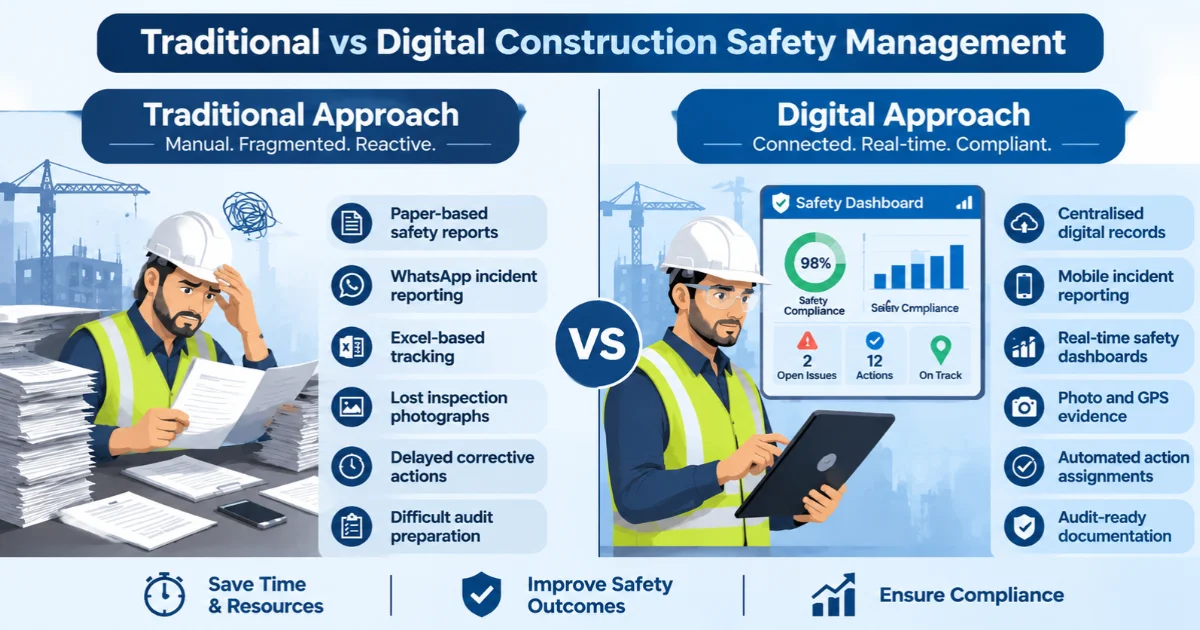
When I review how operations run in any complex, multi-site environment, the failures usually look the same:
- Reports don't become actions. A hazard is reported, everyone nods, and no one owns it.
- Evidence goes missing. The photo is on someone's phone. The signature is on a paper that got wet.
- Repeat hazards stay invisible. Each incident is treated as a one-off, so patterns never show up.
- Subcontractors become blind spots. Their records sit in their own files, in their own format.
- Audit prep becomes a fire drill. Days of chasing people for documents you should have had in one click.
The issue is rarely effort. It's that disconnected tools can't answer the one question a regulator or client asks first: "Show me what you found, who fixed it, and when."
The connected digital safety workflow
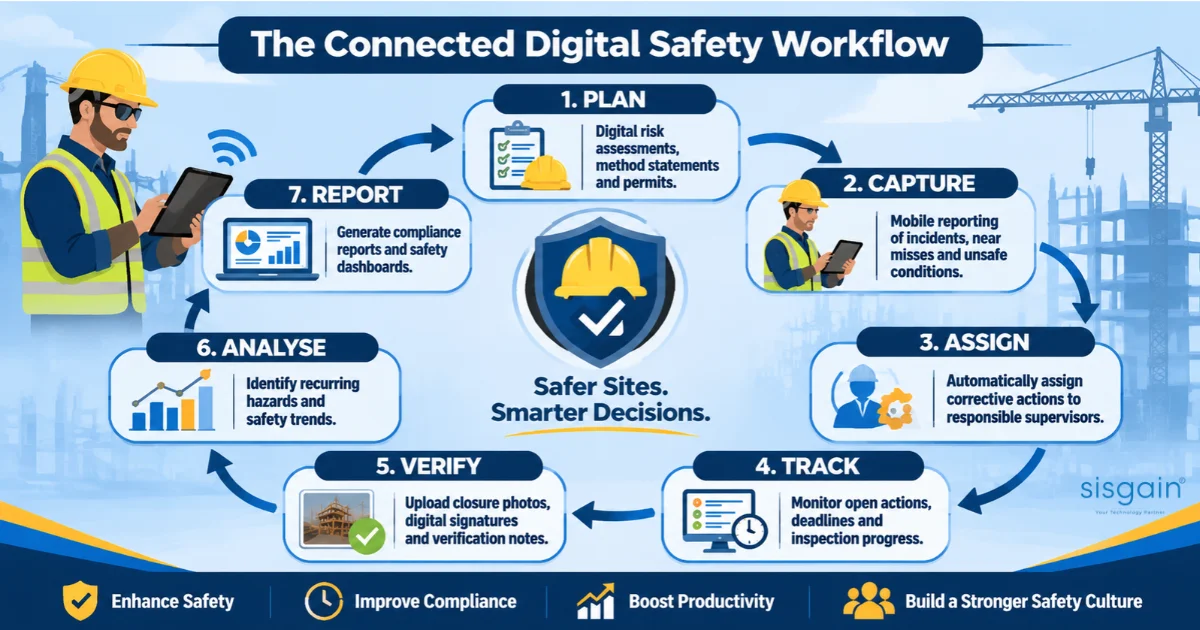
A good platform doesn't just store records. It runs one connected loop:
- Plan: digital risk assessments, method statements, job hazard analyses, permits to work and pre-task briefings.
- Capture: mobile reporting of incidents, near misses and unsafe acts or conditions, with photo, GPS, time, zone and subcontractor attached.
- Assign: automatic routing of each corrective action to the right supervisor, subcontractor or HSE officer.
- Track: dashboards for overdue actions, repeat hazards, high-risk trades and inspection completion.
- Verify: closure photos, digital signatures, closure notes and a full audit trail.
- Analyse: trends by project, contractor, trade, location, time of day, weather and activity.
- Report: dashboards and exportable compliance packs for clients, consultants, regulators and your own board.
Go back to the guardrail on level 14. In this loop, the supervisor logs it in under a minute, the system assigns it to the scaffolding subcontractor's foreman with a deadline, the foreman uploads a closure photo, and the HSE officer verifies it. Nobody searches WhatsApp. If you want to see how connected systems like this reduce manual chasing, our guide on automation and integration in the UAE explains the thinking behind it.
How to digitise workplace incidents
The most common mistake I see is treating "incidents" as "injuries only." A mature system records much more:
- Injuries, illnesses, dangerous occurrences and property damage
- Near misses and safety observations
- Heat stress symptoms and unsafe weather exposure
- Equipment, lifting, scaffold, excavation, electrical and temporary-works events
- Fire, flood, trespass and utility-strike events
- Welfare concerns such as fatigue, hydration and accommodation risks
The real value comes from standard fields: date, time, location, project zone, activity, subcontractor, direct cause, contributing factors, injury classification, immediate action, root cause, corrective action, owner, due date and closure evidence. Once every record uses the same fields, you can finally ask, "Why do dropped-object near misses keep clustering around the façade zone?" instead of treating each event as isolated.
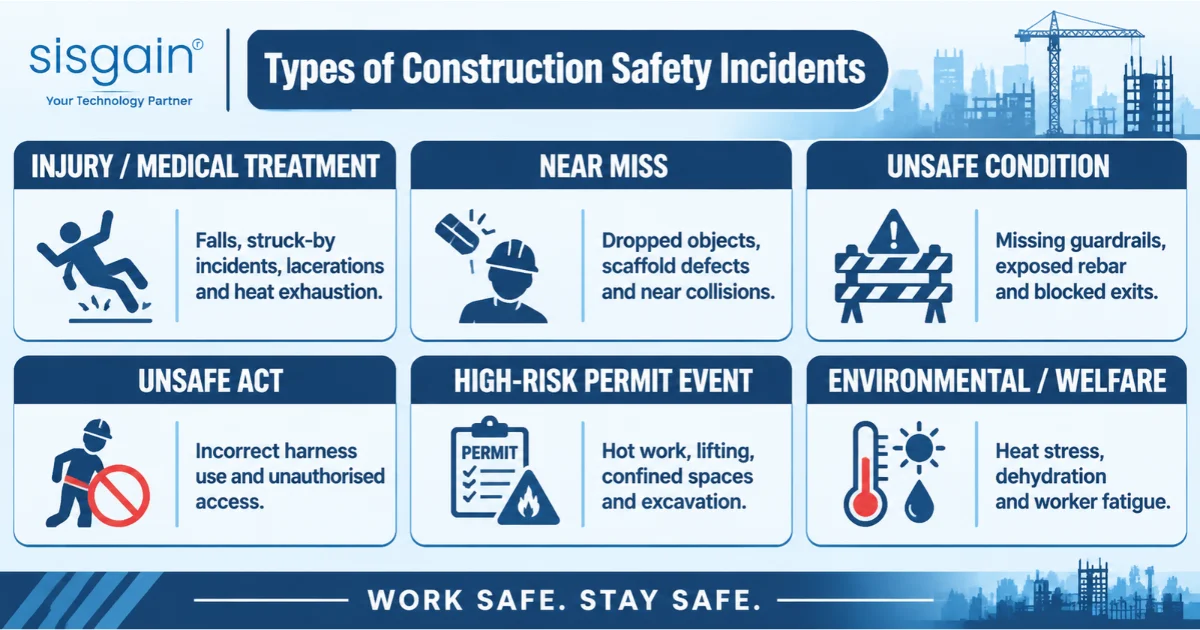
A simple incident taxonomy to start from
|
Category |
Examples |
What the system should produce |
|
Injury / medical treatment |
Fall, struck-by, laceration, heat exhaustion |
Incident report, investigation, corrective and preventive action |
|
Near miss |
Dropped object, scaffold defect, near collision |
Hazard alert, preventive action |
|
Unsafe condition |
Missing guardrail, exposed rebar, blocked exit |
Inspection finding and rectification record |
|
Unsafe act |
Incorrect harness use, unauthorised access |
Coaching record, toolbox talk, escalation |
|
High-risk permit event |
Hot work, lifting, confined space, excavation |
Permit deviation and stop-work record |
|
Environmental / welfare |
Heat stress, dehydration, fatigue |
Hydration, rest and monitoring record |
A tip from delivery experience: keep the mandatory fields few and the dropdowns smart. If reporting an issue takes more than about 60 seconds, people will quietly stop doing it. The goal is a worker or supervisor raising a hazard with a photo, a location and a category, even with weak signal, and moving on.
How to digitise site inspections
Inspections are where digital tools pay back fastest, because a paper checklist can't push back. A mobile checklist can: it can insist on a photo for a failed item, auto-create the corrective action and notify the owner.
The inspection types worth digitising first:
- Daily site walkdowns and weekly HSE inspections
- Pre-pour, scaffolding, excavation, crane, lifting, electrical, fire and housekeeping inspections
- Permit-to-work compliance checks
- Subcontractor onboarding and ongoing performance reviews
- PPE, welfare, accommodation and transport inspections
- Heat-stress and hydration inspections through the summer
One point I always raise with project teams: field apps must work offline and be fast. Basements, shafts and half-built towers don't have reliable connectivity. If the app freezes at the point of work, people will go back to photos and messages. That's why the build quality of the field app matters as much as the HSE logic behind it, and why experienced mobile app development services are a core part of any safety platform rather than an afterthought.
Building a single source of truth for safety records
The aim is to replace WhatsApp groups, paper files, Excel trackers and email chains with one searchable record. A complete platform should hold:
- Worker profiles, inductions, competencies and training validity
- Subcontractor HSE prequalification and performance scores
- Risk assessments, method statements and permits
- Toolbox talks, safety briefings and attendance
- Inspection and audit records
- Incident and near-miss investigations
- Corrective and preventive actions
- PPE issue and replacement records
- Equipment inspection and certification records
- Emergency drills, first-aid records and welfare checks
- Regulatory correspondence and inspection evidence
Here's the hard part, and I'll be straightforward about it: the platform is rarely the difficult piece. Integration is. Your HR system, access control, ERP, BIM, quality and procurement tools each hold part of the picture. Good software integration services connect them so safety data isn't re-typed three times. And if your current tools are old and brittle, our piece on modernizing legacy systems in Dubai will help you decide what to keep, wrap or replace.
Not sure where your safety records stand today? Request a short safety workflow assessment and we'll map your current process against the connected workflow above. Talk to our team.
Where AI, IoT and drones fit (and where they don't)
This is the part everyone wants to jump to. My advice, from watching many technology programmes succeed and stall: earn the right to use advanced tools by getting the data foundation right first.
Once your basics are solid, these tools add real value:
- Computer vision. Cameras can flag missing PPE, fall exposures, equipment-interaction risks and unauthorised access that manual observation can miss. Computer vision solutions should prioritise human review, not replace your HSE team.
- IoT and wearables. Environmental sensors and wearables can support monitoring of heat, hydration, fatigue, location and access control, which is especially useful in Dubai's hottest months. Our IoT development services cover how these devices connect into one platform.
- Drones. Faster, safer inspection of façades, towers and hard-to-reach areas.
- Predictive analytics. With enough clean history, you can spot patterns such as incidents clustering around night pours, tower-crane operations, particular subcontractors or periods of extreme heat.
Picture this (again, illustrative): a contractor notices that near misses involving lifting spike every time a night pour overlaps with tower-crane activity. Without structured data, that pattern lives only in one experienced manager's head. With it, the system can trigger an extra toolbox talk or supervision check before the next overlap.
Two cautions matter here:
- Privacy. Limit camera and wearable data to safety purposes, define retention periods and get appropriate consent. Our guide to PDPL compliance for mobile apps is a useful starting point on UAE data-protection thinking.
- Over-reliance on AI. An alert is decision support. A competent person still verifies and investigates.
A realistic 12-month roadmap
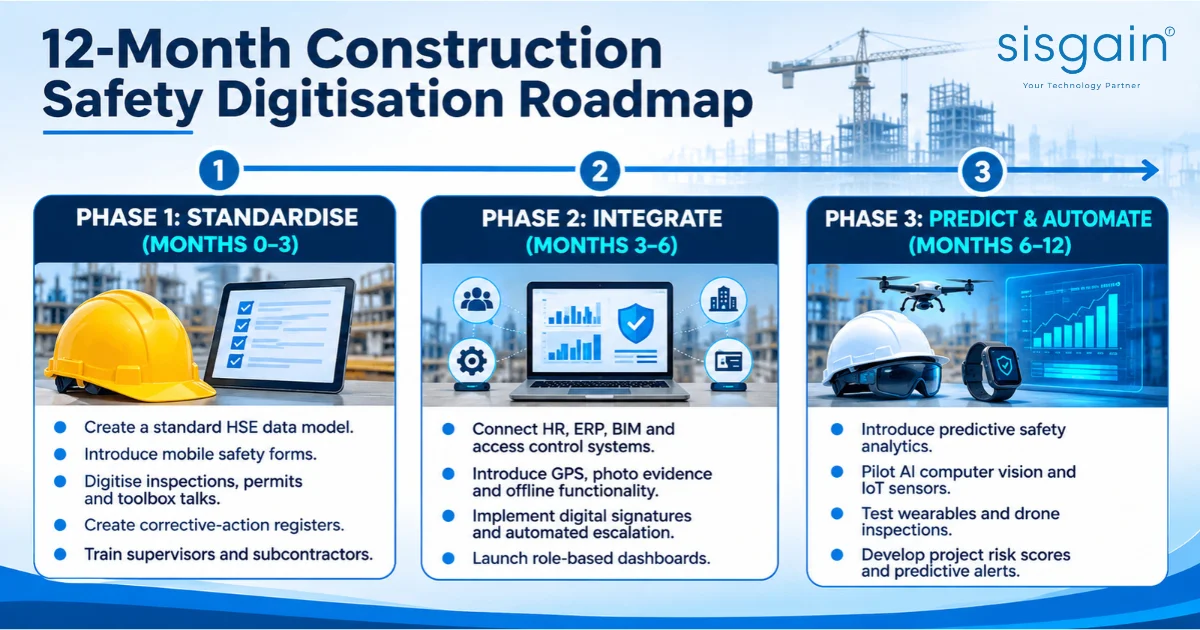
You don't need to digitise everything at once. This is the order I recommend.
Phase 1: Standardise (months 0–3)
- Define one group-wide HSE data model and incident taxonomy
- Replace paper checklists with mobile forms
- Digitise toolbox talks, inductions, permits and inspection records
- Create a corrective-action register with owners and due dates
- Train supervisors and subcontractor HSE leads
Phase 2: Integrate (months 3–6)
- Connect HR, access control, ERP, BIM, quality and procurement data where feasible
- Add photo, GPS, offline mode, digital signatures and automatic escalation
- Launch role-based dashboards for executives, project managers, consultants and clients
- Set leading indicators and start reporting on them
Phase 3: Predict and automate (months 6–12)
- Deploy analytics to detect repeat hazards and high-risk combinations
- Pilot computer vision, wearables, drones or sensors on selected projects
- Build project risk scores from incidents, observations, weather, schedule pressure and workforce mix
- Use predictive alerts to trigger toolbox talks, supervision changes or stop-work interventions
Budget is the next natural question. Costs depend heavily on scope, integrations and the number of sites, which is why I'd point you to our software development costs guide for 2026 for the main cost drivers rather than quoting a single number here.
The KPIs that tell you it's working
|
Type |
Metric |
Why it matters |
|
Leading |
Near-miss reports per 200,000 work hours |
Shows whether people feel safe reporting |
|
Leading |
Inspection completion rate |
Shows whether controls are actually being checked |
|
Leading |
Corrective-action closure within deadline |
Measures management responsiveness |
|
Leading |
Toolbox talk and induction compliance |
Indicates workforce engagement |
|
Leading |
Permit-to-work compliance |
Reduces exposure on high-risk activity |
|
Lagging |
Recordable injury rate |
Tracks serious outcomes |
|
Lagging |
Lost-time injury frequency rate |
Measures severity and disruption |
|
Lagging |
Repeat hazard rate |
Tests whether root causes are truly fixed |
|
Digital |
Time from hazard report to action assigned |
Measures operational speed |
|
Digital |
Share of records with photo/GPS evidence |
Measures evidence quality |
One thing that surprises people: a rising near-miss count in the first months is usually good news. It means people are reporting more, not that the site got less safe.
Risks and how to control them
|
Risk |
Practical control |
|
Data overload |
Use role-based dashboards. Don't send every observation to every manager. |
|
Poor data quality |
Keep mandatory fields simple, use dropdowns and photo evidence, and audit records weekly. |
|
Subcontractor adoption |
Write digital HSE reporting into subcontract terms, onboarding and payment milestones. |
|
Privacy concerns |
Limit data to safety purposes, set retention periods and get consent. |
|
Over-reliance on AI |
Treat alerts as decision support and require human verification. |
|
Change resistance |
Start with incident reporting, inspections and corrective actions before advanced tech. |
If I had to pick one risk to worry about, it would be subcontractor adoption. The best platform in the world fails if the foreman on level 14 doesn't use it. Make it easy, make it part of the contract, and show people what's in it for them.
How to choose a safety platform or technology partner
When you evaluate vendors, ask these questions:
- Does it work offline and stay fast on a busy site?
- Can checklists and evidence be mapped to Dubai's safety guide requirements?
- Does it support role-based dashboards so each person sees what's relevant?
- How does it integrate with your HR, access control, ERP and BIM tools?
- Does it support Arabic–English use and multilingual workforces?
- Where is the data stored, and how are privacy and data residency handled?
- Is there a full audit trail with timestamps, photos and signatures?
- Is there local support that understands Dubai site realities?
If you're also weighing who should build or customise the solution, how to choose a mobile app development company in the UAE walks through the questions worth asking any technology partner.
What this means for your next project
Our team supports contractors and developers with construction software solutions, from field apps and integrations to analytics and AI-based monitoring.
My suggestion for a first step: pick one live project, digitise incident reporting and inspections for 90 days, and measure three things: time to assign actions, closure within deadline, and share of records with photo evidence. The results usually make the business case for you.
Want a head start? Download our HSE digitisation scoping checklist, or book a consultation to talk through your sites, subcontractors and systems.