
A bank in Dubai recently found out its core banking platform couldn't talk to a modern mobile app without three separate middleware patches. That's not a hypothetical — it's what happens when software built for a different decade meets a market that now expects real-time everything.
Across the city, plenty of organizations are running on systems that are 10, sometimes 20 years old. The software still works, technically. But it slows down every new feature, drains budgets on maintenance, and makes UAE compliance harder than it should be. Every quarter you wait, the gap between what your system can do and what your customers expect gets wider.
Three forces are pushing modernization to the top of the agenda right now. First, maintenance costs on old code climb every year — the developers who understand it are retiring or moving on. Second, Dubai's own digital transformation push, through initiatives like Smart Dubai, UAE Vision, and a cloud-first government mandate, is raising the bar for every business that wants to stay competitive or work with government partners. Third, cybersecurity risk on unsupported platforms isn't theoretical anymore — it's a line item insurers and regulators are watching closely.
This guide walks through what legacy system modernization in Dubai actually costs, what kind of ROI to expect, which industries are seeing the biggest wins, and how to decide between upgrading what you have versus replacing it outright. If you're modernizing legacy systems Dubai-wide across multiple business units, the same framework applies — just at a larger scale.
Why Legacy System Modernization Matters in Dubai
Rising Maintenance Costs
Old systems accumulate technical debt the way unpaid interest accumulates on a loan — quietly, then all at once. Every workaround, every patch bolted onto outdated infrastructure, adds a little more fragility to the system. Licensing for legacy platforms often gets more expensive over time too, as vendors push customers toward newer (and pricier) versions or sunset support entirely.
Then there's the talent problem. Developers who know COBOL, old .NET frameworks, or proprietary ERP customizations are a shrinking pool, and they don't come cheap. A specialist who can maintain a 15-year-old system will often cost more per hour than a full-stack engineer building on a modern stack — simply because there are fewer of them left.
UAE Digital Transformation Is Accelerating
Dubai isn't waiting for businesses to catch up on its own timeline. Smart Dubai has pushed government services toward full digitization for years now. The Dubai Paperless Strategy eliminated physical paperwork across government transactions. UAE PASS gave residents a single digital identity that touches banking, healthcare, and municipal services alike. And the UAE's national AI strategy is nudging every sector toward systems that can actually support automation and data-driven decisions — something a rigid legacy platform usually can't do without heavy rework.
Businesses that still run on outdated software aren't just falling behind competitors. They're increasingly out of step with the digital infrastructure the country itself is building around them.
Hidden Business Risks of Legacy Systems
The visible cost of a legacy system is the maintenance bill. The hidden costs are the ones that actually hurt:
- Downtime that legacy infrastructure can't always recover from quickly
- Customer dissatisfaction when competitors offer faster, mobile-first experiences and you can't
- Cybersecurity exposure on systems no longer receiving security patches
- Compliance gaps that widen as UAE data protection rules evolve
- Poor scalability that caps growth right when the business needs to scale
If any of this sounds familiar, it's worth exploring software development services in Dubai built specifically to assess and modernize aging systems.
Signs Your Legacy System Is Holding Your Business Back
Not every old system needs to go. But certain patterns are a reliable signal that the cost of staying put has quietly overtaken the cost of change.
- Slow releases. A new feature that should take two weeks takes two months because of brittle, tangled code.
- Frequent outages. The system goes down more than it used to, and each incident takes longer to fix.
- High maintenance costs. More of the IT budget goes to "keeping the lights on" than to building anything new.
- Difficult integrations. Connecting to a modern payment gateway, CRM, or AI tool requires custom middleware every time.
- Security vulnerabilities. The vendor has stopped issuing patches, or your team is patching around known flaws manually.
- No cloud readiness. The architecture assumes on-premise servers and doesn't translate to cloud infrastructure without a rebuild.
- Poor reporting. Getting real-time data out of the system means exporting to spreadsheets and doing it by hand.
- Employee frustration. Staff build workarounds — shadow spreadsheets, side apps — because the core system can't keep up.
Quick self-check: if you're nodding along to four or more of these, modernization isn't a "someday" project anymore.
Legacy System Upgrade vs Replacement: Which Is Right?
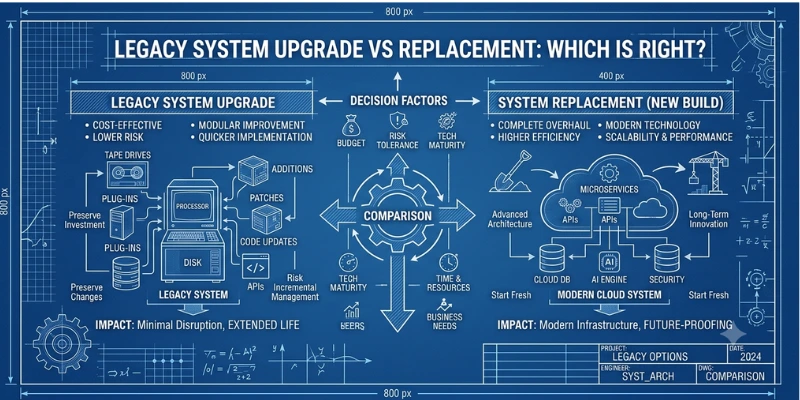
This is the decision that determines everything else — budget, timeline, risk, and how much disruption your team absorbs along the way. There's no universal right answer here. It depends on how much life is left in your current system and how far it is from where the business needs to be.
| Factor |
Upgrade | Replacement |
|---|---|---|
| Upfront cost | Lower | Higher |
| Implementation speed | Faster | Longer timeline |
| Business disruption | Less | More, but temporary |
| Architecture | Keeps core system | Completely modern platform |
| Scalability | Limited by original design | Future-ready |
Four modernization paths sit on the spectrum between "leave it alone" and "start from scratch."
Rehosting
This is the "lift and shift" — moving the existing application to modern infrastructure (usually the cloud) without changing the code itself.
Pros: Fastest option, lowest risk, minimal disruption to daily operations.
Cons: Doesn't fix underlying architectural problems — you're moving the technical debt, not resolving it.
Best for: Businesses that need immediate infrastructure relief (cost, uptime, capacity) but aren't ready for a bigger overhaul yet.
Replatforming
Here, you make targeted changes to the underlying platform — a new database engine, an updated operating environment — while keeping the core application logic mostly intact.
Pros: Meaningful performance and scalability gains without a full rebuild.
Cons: Some development effort required; not every legacy limitation gets solved.
Best for: Systems with solid business logic but outdated technical foundations.
Refactoring
This is a deeper restructuring of the codebase itself — cleaning up architecture, breaking monoliths into services, improving how the system is built internally — without changing what it does for the end user.
Pros: Fixes root-cause technical debt; sets up the system for long-term flexibility. Cons: More time and budget than rehosting or replatforming.
Best for: Core systems that are business-critical and worth investing in for the next decade, not just the next two years.
Complete Replacement
Retiring the old system entirely and building or buying a modern platform from the ground up.
Pros: Maximum flexibility, full alignment with current technology and compliance standards. Cons: Highest cost, longest timeline, most change management required.
Best for: Systems so outdated or so misaligned with current business needs that incremental fixes would cost more than starting fresh.
Decision Matrix
Weigh each option against these factors before committing:
- Budget — what can you realistically fund this fiscal year versus phase over multiple years?
- Compliance — does the current system actively block PDPL or DIFC compliance, or just make it inconvenient?
- Integrations — how many other systems depend on this one, and how brittle are those connections?
- Technical debt — is the codebase merely dated, or genuinely unmaintainable?
- Business goals — is this system central to a growth strategy, or a back-office tool that just needs to keep running?
- Timeline — do you need results in one quarter, or can this unfold over 18 months?
For most mid-sized organizations, the honest answer isn't "upgrade OR replace" — it's a mix, tackled system by system. That's usually where Cloud Migration & Modernization Services earn their keep: sequencing the work so the highest-risk systems move first.
Real Industry Use Cases of Legacy System Modernization in Dubai
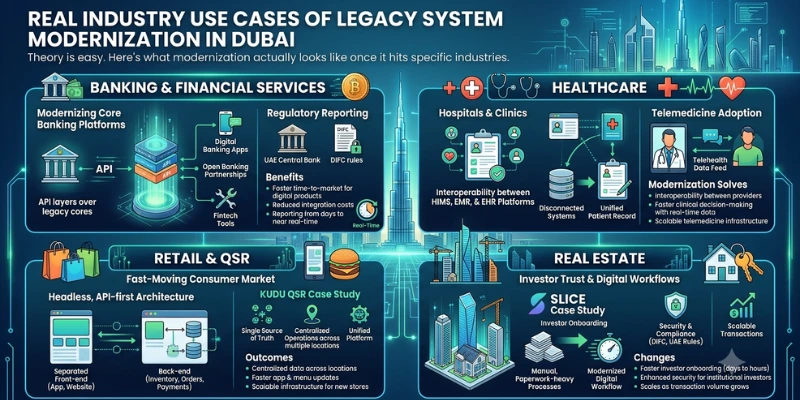
Theory is easy. Here's what modernization actually looks like once it hits specific industries.
Banking & Financial Services
Core banking platforms are some of the oldest, most mission-critical systems in any organization — which is exactly why they're the hardest to touch and the most expensive to leave alone. Modernization here usually centers on building API layers over legacy cores, so the bank can plug into digital banking apps, open banking partnerships, and third-party fintech tools without rewriting the core ledger itself.
Regulatory reporting is another driver. UAE Central Bank requirements and DIFC data rules increasingly expect real-time, auditable data — something batch-processing legacy systems weren't built to deliver.
Benefits banks typically see: faster time-to-market for digital products, reduced integration costs with fintech partners, and reporting that used to take days now happening in near real-time.
Healthcare
Hospitals and clinics across the UAE are under real pressure to modernize their Hospital Information Management Systems (HIMS), Electronic Medical Records (EMR), and Electronic Health Records (EHR) platforms — not just for efficiency, but because interoperability has become a baseline expectation. A patient who visits three different providers expects their records to follow them, not live in three disconnected systems.
Telemedicine adoption accelerated the pressure further. A legacy EMR that can't feed data into a telehealth platform in real time creates a gap in care coordination that patients notice immediately.
What modernization solves: interoperability between providers, faster clinical decision-making with real-time data access, and infrastructure that can actually support telemedicine at scale rather than bolting it on as an afterthought.
Retail & QSR
Retail and quick-service restaurant brands operating in Dubai's fast-moving consumer market are moving toward headless, API-first architecture — separating the front-end customer experience from the back-end systems that manage inventory, orders, and payments. This lets a brand update its app or website constantly without touching the underlying business logic.
Kudu, a well-known regional QSR brand, modernized its backend to centralize operations across multiple locations, replacing a patchwork of location-specific systems with one unified platform. The result was faster order processing and a single source of truth for inventory and sales data across every outlet — instead of reconciling numbers location by location at the end of each day.
Business outcomes: centralized data across locations, faster app and menu updates, and infrastructure that scales with new store openings instead of requiring a new system each time.
Real Estate
Dubai's real estate sector runs on investor trust, and investor trust runs on how smoothly onboarding, documentation, and transactions move. Slice, a real estate investment platform, modernized its digital workflow to handle investor onboarding securely and at scale — replacing manual, paperwork-heavy processes with a system built for both speed and compliance.
What changed: investor onboarding that used to take days now happens in a fraction of the time, security controls that meet the expectations of institutional investors, and a platform that can scale as transaction volume grows instead of buckling under it.
Legacy System Modernization Costs in Dubai
Cost is usually the first question — and the honest answer is "it depends," but not in a vague way. It depends on specific, identifiable factors.
Major Cost Drivers
- Discovery — auditing the current system, mapping dependencies, identifying risks before any code changes
- Architecture — designing the target-state system (cloud-native, microservices, API layer, etc.)
- Migration — moving data and functionality from old to new without losing anything critical
- Development — the actual build work, whether that's refactoring or building new
- Testing — QA, security testing, performance testing before go-live
- Security — hardening the new system against the vulnerabilities that plagued the old one
- Compliance — ensuring the modernized system meets PDPL, DIFC, and sector-specific requirements
- Training — getting internal teams comfortable with the new system
- Support — post-launch maintenance and monitoring
| Project Type | Estimated Cost |
|---|---|
| Discovery & Assessment | $30K – $75K |
| Incremental Modernization | $75K – $180K |
| Enterprise Transformation | $180K – $350K+ |
These ranges shift based on how many systems integrate with the one you're modernizing, how strict your compliance requirements are, the state of your existing infrastructure, and how much custom development the project actually needs. A single-department system with few integrations sits at the low end. A core banking or hospital-wide EMR overhaul sits at the high end — and often exceeds it once every dependency surfaces.
ROI of Modernizing Legacy Systems
Cost Savings
Modernized systems typically cost less to run. Cloud infrastructure replaces the capital expense of on-premise servers with predictable operating costs. Licensing simplifies once you're not paying for legacy software maintenance contracts on top of new tools bolted around them. And support costs drop once you're not paying a premium for scarce legacy-system specialists.
Productivity Improvements
Developers move faster on modern, well-structured codebases — that's not a matter of opinion, it's why refactoring exists as a discipline. Automation becomes possible in ways it simply wasn't on rigid legacy platforms. And release cycles shrink from months to weeks, sometimes days, once the underlying architecture supports it.
Customer Experience
Faster systems mean faster service. Better uptime means fewer moments where a customer hits an error and goes to a competitor instead. And stronger security means fewer breaches — which, in sectors like banking and healthcare, is as much about trust as it is about compliance.
| Timeline | Typical Benefits |
|---|---|
| 0–6 Months | Reduced infrastructure costs, fewer outages |
| 6–18 Months | Measurable productivity gains, faster releases |
| 18+ Months | Sustained competitive advantage, easier scaling |
Set expectations honestly here: modernization isn't an overnight fix, and any vendor promising instant transformation is overselling. The 6–18 month window is where most organizations start seeing ROI show up in the numbers, not the pitch deck.
How to Build a Business Case for Legacy Modernization
Getting budget approved means speaking the language of the people signing off on it — not just the language of the engineering team that has to live with the old system every day.
Start with clear business objectives: what specific outcome does this project need to deliver — cost reduction, compliance, faster time-to-market, all three? Identify the stakeholders who need to be in the room, from IT to finance to compliance, since modernization touches all of them. Run a proper risk assessment that spells out what happens if you don't modernize, not just what modernization costs. Build a phased roadmap so leadership sees a sequence, not a single massive ask. Define KPIs upfront — uptime, release velocity, cost per transaction, whatever matters to your business — so success is measurable rather than assumed. And package all of it for executive approval in terms of business impact, not technical detail.
UAE Compliance & Regulatory Considerations
Compliance isn't a side effect of modernization — for a lot of Dubai businesses, it's the actual trigger. A handful of regulatory realities shape almost every modernization project in the region:
- PDPL (Personal Data Protection Law) sets the baseline for how personal data must be collected, stored, and processed across the UAE.
- DIFC Data Protection Law applies an additional, often stricter layer for organizations operating within the DIFC free zone.
- Dubai Paperless Strategy pushes government-facing processes toward full digitization, which indirectly pressures private businesses that interact with government systems.
- Data residency requirements mean where your data physically sits matters, not just how it's protected.
- Identity management ties into UAE PASS and similar frameworks, especially for sectors handling sensitive personal data.
- Encryption standards apply both to data at rest and data in transit.
- API security matters more with every integration a modernized system adds.
- Audit readiness — a modern system should be able to produce a clean audit trail on demand, not require a manual reconstruction of events.
A legacy system built before these frameworks existed usually wasn't designed to meet them. That gap is often the real reason "we should modernize eventually" turns into "we need to modernize this quarter."
Best Practices for a Successful Legacy Modernization Project
- Assess first. Don't start writing code before you understand exactly what the current system does, including the undocumented parts.
- Build cloud-first. Design for cloud infrastructure from the outset rather than treating it as a later migration step.
- Go API-first. APIs make future integrations dramatically easier — build them in from day one.
- Use microservices where it makes sense. Not every system needs to be broken into microservices, but tightly coupled monoliths are exactly what got you into legacy-system trouble in the first place.
- Set up CI/CD. Continuous integration and deployment pipelines turn releases from risky events into routine ones.
- Automate what you can. Testing, deployment, monitoring — automation reduces both cost and human error.
- Migrate incrementally. A phased migration lets you catch problems early instead of discovering them all at once during a single high-stakes cutover.
- Monitor continuously. Modernization isn't a one-time project; ongoing monitoring catches issues before they become outages.
- Design security in, not on. Retrofitting security after launch is always harder and more expensive than building it into the architecture from the start.
Many of these practices depend on tools working together seamlessly — which is where automation software integration becomes part of the modernization conversation, not a separate project.
Why Choose SISGAIN for Legacy System Modernization?
Modernization projects fail more often from poor execution than from bad strategy. The organizations that get it right tend to work with partners who've actually done this before, in this region, in their specific industry.
SISGAIN brings enterprise modernization experience across healthcare, government, and financial services — sectors where the margin for error during a migration is thin and the compliance stakes are high. That experience spans AI integration, cloud architecture, security hardening, complex data migration, and building modern architectures that hold up under real production load, not just in a demo environment.
Working across the UAE market specifically means understanding PDPL and DIFC requirements from the start of a project, not discovering them mid-build. Combined with enterprise software expertise and specialists who understand the specific demands of banking, healthcare, and retail systems, that regional context tends to be the difference between a modernization project that stays on budget and one that doesn't.
For organizations evaluating IT software development companies in UAE for a modernization project, it's worth reviewing SISGAIN's portfolio to see the range of systems already modernized across these industries.
Conclusion
Legacy system modernization in Dubai isn't just an IT upgrade — it's a business decision with real costs, real timelines, and real returns. The investment ranges from $30K for a focused assessment to $350K+ for a full enterprise transformation, and most organizations start seeing measurable ROI within 6-18 months through lower infrastructure costs, faster releases, and fewer outages. Beyond the numbers, modernization closes the compliance gap with UAE regulations like PDPL and DIFC, and it gives the business room to scale instead of hitting a ceiling the old system quietly built in years ago.
Companies that modernize today gain a competitive advantage. The ones that keep delaying it are still paying for it — just less visibly, in the form of technical debt that compounds every quarter they wait.
Ready to Modernize Your Legacy Systems?
Whether you're planning a cloud migration, modernizing mission-critical enterprise software, or replacing outdated applications altogether, the right strategy reduces costs, improves compliance, and speeds up innovation.
Book your free consultation with SISGAIN's modernization experts to assess your existing systems, identify quick wins, and build a phased modernization roadmap tailored to your business goals.