
Healthcare ERP for UAE Hospitals: Complete Guide to ERP, HIS, EMR, Compliance & Digital Transformation (2026)
UAE hospitals are under mounting pressure—rising patient volumes, complex insurance ecosystems, multi-emirate compliance requirements, and the push toward national digital health platforms like NABIDH, Malaffi, and Riayati. An ERP system in healthcare isn't a luxury anymore; it's the operational backbone that connects every department, automates financial workflows, and ensures regulatory readiness. This guide covers everything hospital leaders, CIOs, and digital transformation teams need to know: what healthcare ERP is, how it differs from HIS, EMR, and EHR, what modules matter, how implementation works in practice, and why AI-powered ERP platforms are defining the next generation of smart hospitals in the UAE.
What Is an ERP System in Healthcare?
An ERP system in healthcare is an integrated enterprise software platform that unifies a hospital's clinical, financial, administrative, and supply chain operations into a single connected environment. Unlike traditional standalone tools—separate billing software, a disconnected HR system, or paper-based procurement—a healthcare ERP platform ensures that data flows in real time across every department. When a physician orders a medication, the pharmacy, inventory, billing, and finance modules all update automatically. That's the operational coherence an ERP delivers.
Traditional hospital management systems handled specific functions in isolation. Healthcare ERP replaces that fragmented model with a unified architecture where patient data, financial transactions, procurement records, and compliance reports all live in one system—accessible, auditable, and actionable.
Why UAE Hospitals Need Healthcare ERP More Than Ever
The UAE's healthcare sector is growing fast. Dubai and Abu Dhabi continue to attract medical tourism, expatriate populations, and government investment. That growth brings complexity.
Patient volumes are rising. Multi-specialty hospital groups now operate across multiple emirates, managing shared resources, different regulatory environments, and a web of insurance payers and TPAs. Manual processes that worked at smaller scale simply break under the weight of that complexity.
At the same time, the UAE's regulatory ecosystem has moved well beyond recommendation. The Dubai Health Authority (DHA), Department of Health Abu Dhabi (DOH), and Ministry of Health and Prevention (MOHAP) each impose specific standards for data management, clinical reporting, and system interoperability. NABIDH and Malaffi require hospitals to submit structured clinical data in HL7 FHIR formats. Riayati, the federal platform under MOHAP, is fast becoming a baseline requirement for healthcare organizations operating across emirates.
Insurance complexity adds another layer. Mandatory health insurance laws in Dubai and Abu Dhabi require hospitals to manage pre-authorizations, claims, and adjudication with precision. A missed pre-authorization or a poorly coded claim doesn't just cause a denial—it delays cash flow and creates compliance risk.
Healthcare ERP addresses all of this. It gives hospital leaders the operational visibility, automation, and compliance infrastructure to manage a modern UAE healthcare organization.
ERP, HIS, HMS, EMR, EHR: What's the Difference?
These terms are often used interchangeably, but they represent genuinely different systems with different purposes and user groups. Choosing the wrong platform—or misunderstanding what each does—is an expensive mistake. For a deeper technical breakdown, see our guide on Modern Hospital Information Systems for Smarter, Connected Healthcare in UAE.
|
Attribute |
ERP |
HIS |
HMS |
EMR |
EHR |
|---|---|---|---|---|---|
|
Purpose |
Enterprise-wide resource and operations management |
Integrated hospital-wide system management |
Administrative and operational hospital management |
Clinical documentation per encounter |
Longitudinal patient health record across providers |
|
Primary Users |
CFOs, COOs, finance, HR, supply chain |
All hospital departments |
Administrators, finance, billing |
Physicians, nurses, clinical staff |
Clinicians, patients, insurers, regulators |
|
Clinical Records |
Indirect (via integration) |
Yes, full clinical record |
Limited |
Yes, full encounter documentation |
Yes, cross-facility health history |
|
Financial Management |
Core functionality |
Integrated |
Moderate |
Minimal |
Minimal |
|
Integration |
Cross-department enterprise integration |
Full departmental integration |
Administrative integration |
Clinical system integration |
HIE integration (NABIDH, Malaffi, Riayati) |
|
Compliance |
Financial, procurement, labor compliance |
DHA, DOH, MOHAP, NABIDH, Malaffi |
Basic regulatory |
EMR standards |
HL7, FHIR, national HIE standards |
|
Best Use Case |
Multi-department enterprise operations |
Full-service hospitals and health systems |
Clinics and smaller facilities |
Specialty practices |
National and regional health networks |
In practice, modern enterprise healthcare platforms often combine ERP, HIS, and EMR functionality. The important distinction is that ERP anchors the financial and operational backbone, while HIS and EMR anchor the clinical one. Both are necessary for a fully connected hospital.
Core Modules Every Healthcare ERP Should Include
A well-designed ERP for the healthcare industry covers every operational domain. Here's what hospitals should expect:
|
Module |
Core Function |
|---|---|
|
Finance & Accounting |
General ledger, UAE VAT compliance, multi-currency support, P&L reporting |
|
Revenue Cycle Management (RCM) |
Charge capture, claims submission, denial management, accounts receivable |
|
Procurement & Supply Chain |
Vendor management, purchase orders, contract management |
|
Inventory Management |
Real-time stock tracking, expiry alerts, reorder automation |
|
Pharmacy |
Drug dispensing, interaction checks, formulary management, insurance billing |
|
Laboratory (LIS) |
Sample tracking, result entry, analyzer interfacing, critical value alerts |
|
Radiology (RIS/PACS) |
Imaging orders, worklist management, DICOM integration |
|
HR & Payroll |
Credentialing, shift scheduling, UAE labor law compliance, payroll |
|
Asset Management |
Equipment tracking, maintenance scheduling, depreciation reporting |
|
Insurance Claims |
Eligibility verification, pre-authorization, claims submission, TPA management |
|
Business Intelligence |
Executive dashboards, KPI monitoring, operational and financial analytics |
|
Compliance Dashboard |
DHA, DOH, MOHAP reporting, NABIDH/Malaffi/Riayati data submissions, audit logs |
No single module operates in isolation. The power of healthcare ERP lies in how these modules communicate—a physician's order triggers the pharmacy module, updates the inventory system, generates a billing record, and feeds the finance dashboard, all without manual re-entry.
Benefits of ERP in Healthcare
Healthcare ERP improves patient care, reduces operational costs, accelerates revenue collection, and ensures regulatory compliance by replacing disconnected manual processes with a single integrated platform that connects every department in real time.
Beyond that summary, the benefits break down into several concrete operational gains:
Better Patient Care — When clinical, pharmacy, and lab data all flow through one system, physicians get a complete patient picture faster. Drug interaction alerts, allergy checks, and real-time lab results reduce adverse events and diagnostic delays.
Centralized Data — A single source of truth eliminates the data reconciliation problem that plagues hospitals running separate systems for billing, HR, and inventory. Executives see accurate, real-time performance data without waiting for monthly reports compiled by hand.
Faster Billing and Reduced Revenue Leakage — Automated charge capture at the point of service—in the pharmacy, operating room, or lab—ensures nothing is missed. Claims validated against payer rules before submission have significantly lower rejection rates.
Reduced Operational Costs — Automated procurement workflows, demand-based inventory reordering, and AI-powered forecasting reduce waste, prevent emergency purchasing, and lower carrying costs across the supply chain.
Inventory Optimization — Real-time visibility across hospital stores prevents stockouts that delay care and overstocking that drives up costs. Expiry tracking reduces medication waste.
Staff Productivity — Automating repetitive tasks—eligibility checks, appointment reminders, report generation, payroll calculations—frees clinical and administrative staff to focus on higher-value work.
Regulatory Compliance — Built-in compliance frameworks for DHA, DOH, MOHAP, and UAE VAT requirements reduce the risk of inspection failures, claim rejections, and licensing issues.
Better Decision-Making — Executive dashboards surface KPIs across every department in real time. Hospital CEOs and CFOs can spot claim denial spikes, capacity strains, or departmental underperformance while they're still manageable.
How ERP Integrates Every Hospital Department
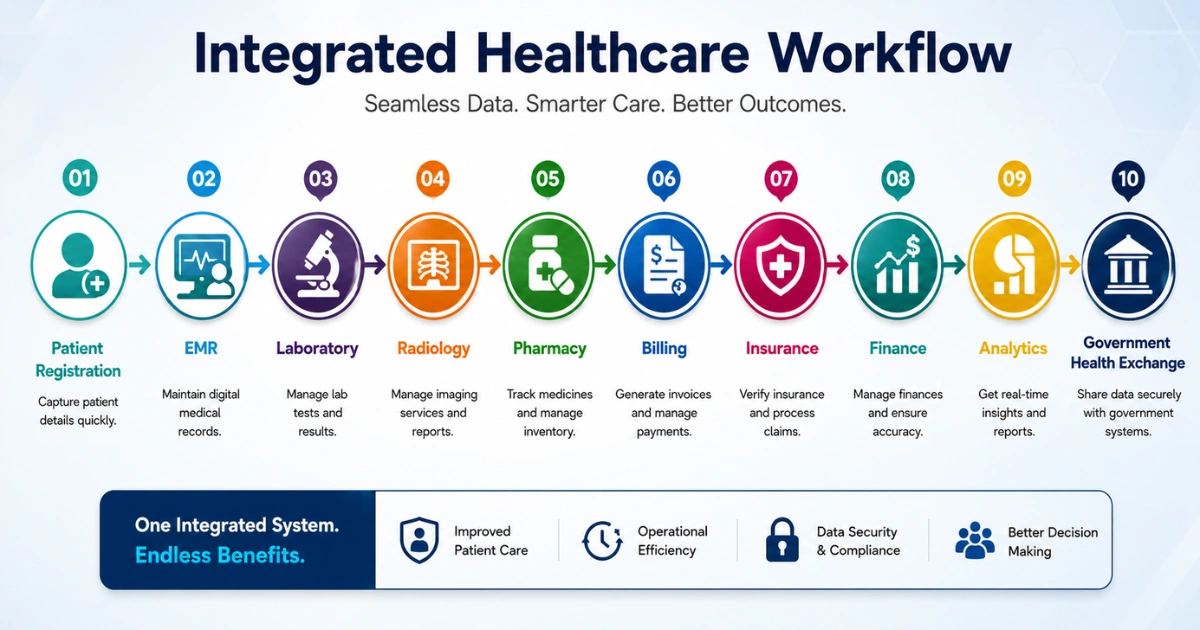
The real differentiator of a healthcare ERP platform is end-to-end workflow integration. Here's how a single patient encounter flows through a fully integrated system:
Patient Registration → EMR → Laboratory → Radiology → Pharmacy → Billing → Insurance → Finance → Analytics → Government Health Exchange
At each stage:
- Registration captures demographic and insurance data once, pushing it downstream automatically
- EMR documents the clinical encounter, generating orders for lab, radiology, and pharmacy
- Laboratory and Radiology receive orders, process them, and return results to the EMR without manual data entry
- Pharmacy receives e-prescriptions directly, checks interactions, and updates inventory
- Billing captures charges from each department automatically, generates an itemized invoice, and submits claims to the insurer
- Finance receives payment data, updates the general ledger, and produces VAT-compliant financial reporting
- Analytics aggregates all of this into real-time dashboards for operational and executive oversight
- Government Health Exchanges (NABIDH, Malaffi, Riayati) receive structured clinical data via HL7, FHIR, and standard APIs, satisfying DHA, DOH, and MOHAP reporting requirements
This connected workflow is what separates a healthcare ERP from a collection of point solutions. Interoperability standards—HL7 v2 messaging for legacy connections, FHIR R4 APIs for modern exchanges—ensure data moves cleanly between systems. For hospitals working toward health information exchange compliance in the UAE, this architecture is the foundation.
ERP Implementation in Healthcare: A Step-by-Step Roadmap
ERP implementation in healthcare follows a structured, phased approach—starting with requirements analysis and ending with continuous optimization—designed to minimize disruption to live patient care while ensuring every module is configured correctly before go-live.
|
Phase |
Key Activities |
Typical Timeline |
|---|---|---|
|
1. Requirement Analysis |
Stakeholder workshops, workflow mapping, compliance gap assessment |
2–4 weeks |
|
2. Vendor Selection |
RFP process, demos, UAE compliance verification, reference checks |
3–6 weeks |
|
3. Workflow Mapping |
Department-by-department process documentation, integration planning |
2–4 weeks |
|
4. Data Migration |
Data extraction, cleansing, validation, legacy system mapping |
2–6 weeks |
|
5. System Integration |
NABIDH/Malaffi/Riayati connectors, lab analyzers, insurance portals, payment gateways |
3–8 weeks |
|
6. User Training |
Role-based training for clinicians, billing staff, pharmacists, administrators |
1–3 weeks |
|
7. Go-Live |
Phased rollout by department, on-site support, parallel system access |
1–2 weeks |
|
8. Continuous Optimization |
Performance monitoring, workflow refinement, feature enhancements |
Ongoing |
Clinics typically complete this process in 6–10 weeks. Multi-specialty hospitals with complex integrations should plan for 12–20 weeks. The phased approach—starting with registration and EMR before extending to billing and insurance—reduces risk by surfacing issues in lower-stakes environments before full cutover.
Common Challenges During ERP Implementation—and How to Solve Them
Most ERP implementations that fail do so not because of technology, but because of predictable operational and organizational problems that weren't addressed early enough.
- Legacy System Integration — Many UAE hospitals run HL7 v2-based legacy systems that don't natively support FHIR. Solution: Use a dedicated integration engine that transforms and routes messages between legacy and modern systems without data loss.
- User Adoption — Clinical staff often resist new systems if they disrupt familiar workflows. Solution: Involve department champions early, run UAT with real clinical scenarios, and provide hands-on sandbox training before go-live.
- Data Migration — Migrating years of patient records, billing history, and inventory data introduces data integrity risk. Solution: Dedicate migration planning as its own project phase with strict validation checkpoints.
- System Integration Complexity — Connecting to NABIDH, Malaffi, insurance portals, lab analyzers, and payment gateways simultaneously is technically demanding. Solution: Prioritize integrations by clinical and compliance impact, and test each in staging before production deployment.
- Security During Transition — ERP migrations temporarily expand system access points, creating vulnerability windows. Solution: Apply Zero Trust principles throughout migration, with strict RBAC and audit logging active from day one.
- Budget Management — Scope creep is common in ERP projects. Solution: Define the implementation scope contractually before kickoff, with a clear change management process for additions.
- Minimizing Downtime — ERP go-lives can disrupt clinical operations if not managed carefully. Solution: Use a phased rollout and maintain legacy system access during the transition period.
Essential Compliance Requirements for UAE Healthcare ERP
Compliance in UAE healthcare is not a checklist completed once at deployment—it's an ongoing operational discipline built into every layer of the ERP platform. Here's what a fully compliant healthcare ERP must address:
|
Compliance Area |
Requirement |
|---|---|
|
DHA (Dubai) |
EMR standards, NABIDH integration, insurance data formats, facility licensing documentation |
|
DOH (Abu Dhabi) |
Malaffi integration, ADHICS security standard, clinical quality reporting |
|
MOHAP (Federal) |
National reporting standards, Riayati connectivity, drug formulary compliance |
|
NABIDH |
HL7 FHIR data submission, bidirectional patient data exchange for Dubai facilities |
|
Malaffi |
FHIR-based data exchange, Abu Dhabi HIE connectivity for DOH-licensed facilities |
|
Riayati |
Federal-level multi-emirate HIE integration |
|
HL7 & FHIR |
Structured data exchange between clinical systems and government health platforms |
|
ISO 27001 |
Information security management system certification |
|
Audit Logs |
Immutable, timestamped records of all system access and data modifications |
|
Encryption |
AES-256 encryption at rest, TLS 1.3 in transit |
|
RBAC |
Role-based access control ensuring staff access only the data relevant to their role |
|
Disaster Recovery |
Documented RPO/RTO targets, tested recovery procedures, UAE data residency compliance |
Healthcare ERP platforms built for the UAE must embed these requirements into core architecture—not configure them as add-ons after the fact. An ERP vendor that treats NABIDH or Malaffi integration as an optional module is a significant implementation risk.
AI Is Transforming Healthcare ERP
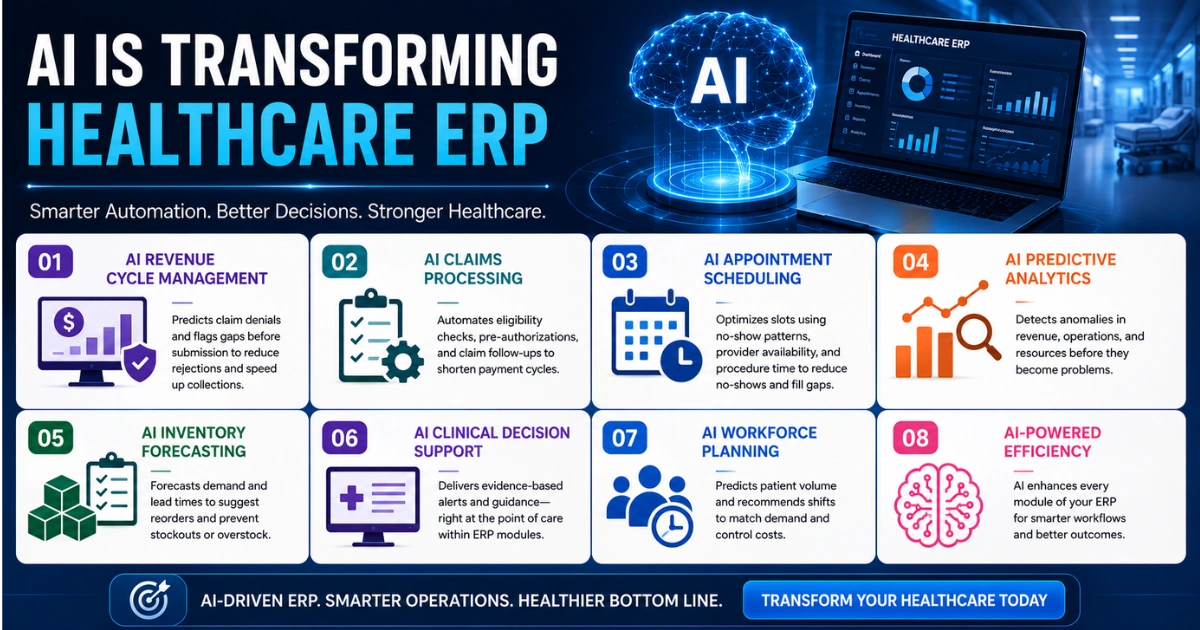
Artificial intelligence is no longer a future-state aspiration for healthcare ERP—it's already changing how hospitals manage revenue, inventory, staffing, and clinical operations.
- AI Revenue Cycle Management — Machine learning models analyze claims data to predict denial likelihood before submission, flagging documentation gaps so clinical teams can resolve them proactively. This reduces rejection rates and accelerates cash collection.
- AI Claims Processing — AI automates eligibility verification, pre-authorization requests, and claim status follow-up—reducing manual administrative hours and shortening the payment cycle.
- AI Appointment Scheduling — Predictive scheduling algorithms optimize appointment slots based on historical no-show rates, provider availability, and procedure duration variability. High-risk no-show slots are proactively filled from waitlists.
- AI Predictive Analytics — Executive dashboards powered by machine learning surface anomalies—a spike in claim denials, an unusual drop in bed turnover, supply consumption patterns that indicate waste—before they escalate into operational problems.
- AI Inventory Forecasting — AI models analyze historical consumption, seasonal demand patterns, and lead times to generate automated reorder recommendations that prevent both stockouts and excess inventory.
- AI Clinical Decision Support — Embedded clinical decision support tools provide evidence-based recommendations at the point of care—drug dosing guidance, allergy cross-references, diagnostic protocol alerts—directly within the ERP's clinical modules.
- AI Workforce Planning — Predictive staffing models forecast department-level demand and recommend shift configurations that match patient volume without creating overtime cost.
How to Choose the Best ERP Software for the Healthcare Industry
The best ERP software for the healthcare industry combines deep clinical domain expertise, UAE compliance readiness, AI-native capabilities, and a track record of successful implementations—not just the longest feature list.
Use this evaluation checklist when assessing vendors:
|
Evaluation Criteria |
What to Look For |
|---|---|
|
Healthcare Domain Expertise |
Built with input from clinicians and revenue-cycle specialists, not just software developers |
|
UAE Compliance |
Native NABIDH, Malaffi, Riayati, DHA, DOH, and MOHAP integration—not optional modules |
|
Scalability |
Handles a 20-bed clinic and a 400-bed multi-facility group on the same platform |
|
Cloud Readiness |
Supports cloud, on-premise, and hybrid deployment with enterprise-grade security |
|
AI Capabilities |
AI features embedded in core modules—scheduling, claims, analytics—not added as separate tools |
|
Integration Architecture |
FHIR R4 and HL7 v2/v3 native support, open APIs, no vendor lock-in |
|
Security |
AES-256 encryption, RBAC, MFA, audit logging, ISO 27001 alignment |
|
Customization |
Configurable workflows, forms, and reporting without custom-code risk |
|
Local Support |
UAE-based implementation and support teams available during UAE business hours |
|
Total Cost of Ownership (TCO) |
Transparent pricing with no hidden integration or compliance engineering fees |
Request UAE-based hospital references. Ask specifically about NABIDH or Malaffi integration experience. A vendor who has never implemented in the UAE regulatory environment carries meaningful compliance risk regardless of how well the platform performs elsewhere.
Future Trends in Healthcare ERP for UAE Hospitals
The next generation of healthcare ERP platforms will be defined by what they anticipate, not just what they manage.
- AI-First ERP Architecture — AI embedded natively across every module rather than bolted on as an analytics layer.
- Agentic AI — Autonomous AI agents executing routine tasks—pre-authorization requests, reorder triggers, appointment rebooking—without human initiation.
- Hyperautomation — End-to-end automation of complex, multi-step clinical and administrative workflows using a combination of RPA, AI, and API orchestration.
- Smart Hospitals and IoT Integration — Medical devices, infusion pumps, and bedside monitors feeding real-time data directly into the ERP's clinical modules.
- Predictive Analytics at Scale — Population-level analytics forecasting disease burden, capacity requirements, and preventable readmissions months in advance.
- Digital Twins — Virtual hospital models simulating resource allocation, patient flow, and operational scenarios before decisions are implemented.
- Cloud-Native ERP — Full cloud deployment with multi-facility data isolation, automated backups, and zero on-premise server dependency.
- Value-Based Care Support — ERP platforms evolving to track outcome-based metrics alongside cost metrics as UAE payers shift toward value-based reimbursement models.
- Interoperable Healthcare Ecosystems — As NABIDH, Malaffi, and Riayati mature their FHIR API capabilities, UAE hospitals will operate within a genuinely national health data network where any authorized clinician can access a complete, standardized patient record.
Why Choose SISGAIN for Healthcare ERP Development in UAE
SISGAIN brings 17+ years of healthcare IT experience and a team that includes former hospital administrators, clinical informaticists, and revenue-cycle specialists—not just software engineers reading hospital workflows off a whiteboard. That operational context shows up in the details that generic ERP vendors miss.
Here's what differentiates SISGAIN's approach to healthcare IT solutions in the UAE:
Custom Healthcare ERP Development — SISGAIN builds ERP platforms configured to the specific clinical workflows, departmental structures, and operational requirements of UAE hospitals—not a one-size-fits-all product with limited configurability.
UAE Healthcare Compliance — NABIDH and Malaffi integration is part of the core platform architecture, not an add-on module. DHA, DOH, and MOHAP compliance frameworks are embedded from the design stage. SISGAIN's hospital management system is built specifically for the UAE regulatory environment.
Enterprise Integrations — SISGAIN connects healthcare ERP platforms to lab analyzers, imaging systems, insurance portals, government health exchanges, and third-party clinical applications using HL7, FHIR, and REST APIs—without custom point-to-point integrations for every new connection.
AI-Powered Healthcare Solutions — Predictive analytics, AI-driven claims processing, automated scheduling, and clinical decision support are built into SISGAIN's platform—not priced separately as add-on modules.
End-to-End Digital Transformation — From requirements analysis and architecture design through implementation, training, go-live, and post-launch optimization, SISGAIN manages the full lifecycle. Whether deploying EHR/EMR software or connecting to national health information exchanges, the same team that builds the platform supports it long-term.
Healthcare ERP Is the Operational Backbone of a Modern UAE Hospital
A hospital that runs on disconnected systems—separate billing software, a standalone HR tool, a legacy inventory tracker—is building operational risk into every patient encounter. Missed charges, rejected claims, compliance gaps, and real-time inventory blind spots aren't IT problems. They're business problems that compound over time.
Healthcare ERP resolves these at the architecture level. By connecting clinical, financial, and operational workflows into a single platform, hospitals gain the data quality, automation, and compliance infrastructure to operate at the scale UAE healthcare demands in 2026 and beyond.
The hospitals investing in scalable, AI-ready, UAE-compliant ERP platforms now are the ones that will handle the next wave of regulatory requirements—and patient volume growth—without scrambling to retrofit their systems.
Ready to build a healthcare ERP platform designed for UAE compliance and enterprise scale? Book a free consultation with SISGAIN's healthcare IT team and get a tailored assessment of your hospital's ERP requirements.