
The UAE healthcare industry is rapidly moving toward digital-first patient experiences, and clinics that still rely on manual booking systems are beginning to feel the pressure. Overloaded call centers, rising appointment no-show rates, delayed patient onboarding, and increasing telemedicine demand are creating operational bottlenecks for healthcare providers across Dubai, Abu Dhabi, and other Emirates. At the same time, UAE patients now expect instant doctor discovery, online scheduling, digital prescriptions, and virtual consultations directly from their smartphones.
This shift has fueled the rapid growth of healthcare platforms like Okadoc, Vezeeta, and Doctoruna, all of which have transformed how patients interact with clinics and hospitals in the region. For clinic owners, healthcare startups, hospital administrators, and investors, the opportunity to build scalable healthcare platforms has never been bigger.
But one major question continues to dominate the conversation: how much does doctor appointment app development in the UAE actually cost in 2026?
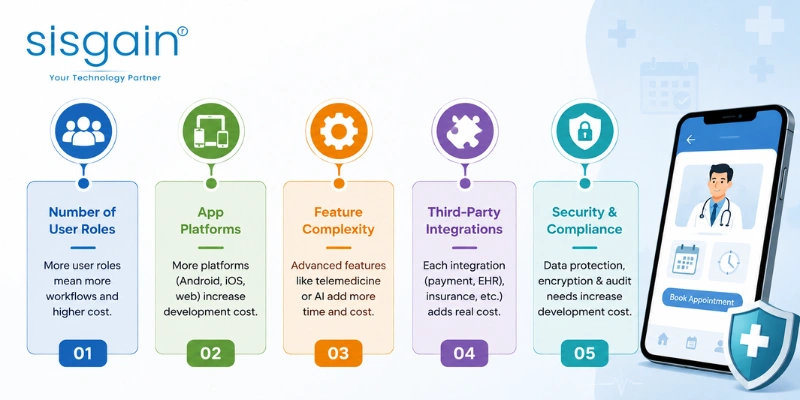
The answer depends on several factors including compliance requirements, telemedicine functionality, AI integrations, multilingual support, and scalability. On average, the cost ranges between AED 110,000 and AED 450,000+ depending on the platform complexity and healthcare app development services involved.
UAE Digital Healthcare Market Is Growing Faster Than Ever
The UAE has emerged as one of the most technologically advanced healthcare markets in the Middle East. Over the last few years, government-led digital transformation initiatives, increasing smartphone usage, and rising patient expectations have accelerated the adoption of healthcare technology across both public and private sectors.
According to recent digital health market projections, the UAE healthcare technology sector is expected to witness strong year-on-year growth through 2030, driven largely by telemedicine, AI-powered diagnostics, electronic medical records, and mobile healthcare applications. This growth is closely aligned with the UAE Health Strategy 2031, which prioritizes smart healthcare infrastructure, AI integration, preventive care, and digital patient engagement.
Healthcare authorities in Dubai and Abu Dhabi are also actively encouraging hospitals and clinics to modernize their operations through connected healthcare systems. Initiatives led by the Dubai Health Authority (DHA), Department of Health – Abu Dhabi (DOH), Nabidh, and Malaffi are creating an ecosystem where digital interoperability is becoming mandatory rather than optional.
Today, more than 99% of UAE residents use smartphones, giving healthcare providers direct access to patients through mobile-first platforms. This behavioral shift is especially visible among younger professionals, expatriates, and families who increasingly prefer booking appointments digitally instead of calling reception desks.
Telemedicine adoption has also expanded significantly after COVID-19 accelerated virtual healthcare acceptance across the GCC region. Many UAE patients now expect features such as:
- instant doctor availability
- online consultation booking
- digital prescriptions
- insurance filtering
- multilingual healthcare support
- secure online payments
As a result, healthcare providers investing in doctor appointment app development in the UAE are not simply building convenience tools anymore — they are building essential healthcare infrastructure for the future.
Another major growth factor is competition. Premium healthcare groups across Dubai and Abu Dhabi are investing heavily in healthcare digitization to improve patient retention and operational efficiency. Clinics that fail to modernize risk losing patients to competitors offering faster, more accessible digital experiences.
For healthcare entrepreneurs and investors, this creates a strong commercial opportunity. Demand for healthcare app development services is increasing not only from hospitals, but also from:
- telehealth startups
- specialty clinics
- home healthcare providers
- diagnostic centers
- wellness platforms
- insurance-integrated healthcare businesses
The market is no longer asking whether digital healthcare platforms are necessary. The real question is which organizations will lead the next phase of healthcare innovation in the UAE.
Why Clinics Are Losing Revenue Without Digital Booking
Many healthcare businesses in the UAE underestimate how much revenue is lost through outdated appointment management systems. While manual scheduling may still work for smaller practices, it creates major operational inefficiencies as patient volume increases.
One of the biggest challenges is appointment no-shows. Clinics relying on phone-based scheduling often struggle with missed reminders, delayed confirmations, and poor patient communication. Even a moderate no-show rate can significantly impact daily revenue, doctor utilization, and administrative efficiency.
For example, a mid-sized Dubai clinic handling 50 appointments per day can lose thousands of dirhams weekly due to unfilled slots and last-minute cancellations. Digital appointment systems with automated reminders and real-time confirmations dramatically reduce these losses.
Another major issue is overloaded reception and call center teams. Many clinics still depend on front-desk staff to manually:
- answer appointment calls
- reschedule visits
- verify insurance eligibility
- update patient information
- coordinate doctor availability
This process slows down patient onboarding and increases administrative costs. During peak hours, patients may wait several minutes just to book a consultation, leading to frustration and abandoned appointments.
Modern healthcare apps solve this problem by allowing patients to complete the entire booking process independently within minutes. Features such as live scheduling, insurance-based doctor filtering, digital registration, and teleconsultation access improve both operational efficiency and patient satisfaction.
Competition pressure is another key reason UAE healthcare providers are accelerating digital transformation. Patients today compare healthcare experiences the same way they compare banking, travel, or e-commerce services. If one clinic offers instant online booking while another requires multiple phone calls, patients increasingly choose the more convenient option.
Healthcare digitization initiatives supported by DHA and DOH are further reinforcing this transition. Platforms integrated with systems like Nabidh and Malaffi gain stronger interoperability, improved patient trust, and better long-term scalability within the UAE healthcare ecosystem.
Industry analysts also project continued growth in regional telehealth adoption over the next five years, especially in:
- chronic disease management
- mental health consultations
- pediatric telemedicine
- women’s healthcare
- remote follow-up care
This means healthcare businesses investing in digital infrastructure today are positioning themselves ahead of long-term market demand rather than reacting to it later under competitive pressure.
For clinic owners, hospital administrators, and healthcare startups, the financial impact is becoming clear: digital healthcare platforms are no longer optional operational upgrades — they are strategic revenue and patient retention systems.
What Makes Apps Like Okadoc Successful in UAE?

The success of healthcare platforms like Okadoc, Vezeeta, and Doctoruna is not accidental. These applications were built specifically around the expectations of modern UAE patients, healthcare providers, and regulatory frameworks. They solve real operational problems while delivering the convenience and digital experience users now expect from healthcare services.
In the UAE healthcare market, patients are no longer satisfied with basic appointment forms or delayed callbacks. They expect healthcare platforms to function with the same speed, personalization, and accessibility as banking or e-commerce applications.
The apps that succeed are the ones that combine convenience, trust, compliance, multilingual accessibility, and intelligent automation into a seamless patient experience.
Features That UAE Patients Actually Expect
Bilingual Arabic + English User Experience
One of the most important success factors in the UAE healthcare sector is multilingual accessibility. The UAE is home to a highly diverse population with residents from more than 200 nationalities, while Arabic remains the official language across all Emirates.
Successful healthcare apps offer fully localized Arabic and English experiences rather than basic machine translations. This includes:
- right-to-left (RTL) Arabic interface support
- Arabic search functionality
- bilingual notifications
- localized healthcare terminology
- culturally adapted UX design
Healthcare providers that ignore Arabic localization significantly limit their audience reach and reduce patient trust.
Modern healthcare app development services now prioritize multilingual architecture from the beginning because retrofitting Arabic UX later increases development complexity and cost.
Arabic NLP and RTL user experience are no longer optional in UAE healthcare apps.
This is especially important for healthcare startups targeting government partnerships, Emirati users, or older patient demographics who prefer Arabic-first digital experiences.
Real-Time Doctor Availability
UAE patients expect instant confirmation when booking appointments. Static inquiry forms or delayed call-back systems create friction and increase abandonment rates.
Leading doctor appointment apps provide:
- real-time calendar synchronization
- live doctor availability
- instant appointment confirmation
- dynamic slot management
- cancellation and rescheduling automation
This functionality improves operational efficiency for clinics while giving patients greater flexibility and control.
For hospitals and specialty clinics managing multiple doctors across departments, real-time scheduling also reduces front-desk workload significantly.
Insurance Filtering & Verification
Health insurance plays a critical role in the UAE healthcare ecosystem. Most patients prefer platforms that allow them to instantly filter doctors, clinics, and hospitals based on accepted insurance providers.
Successful apps simplify complex insurance workflows by enabling:
- insurance provider selection
- eligibility verification
- network-based doctor discovery
- cashless consultation visibility
- integrated billing support
This feature is particularly important in Dubai and Abu Dhabi, where insurance-linked healthcare access is deeply integrated into patient decision-making.
Secure Online Payment Systems
Digital healthcare platforms in the UAE are increasingly expected to support seamless online payments. Patients prefer apps that provide:
- AED payment support
- Apple Pay integration
- card payments
- digital wallets
- secure payment gateways
- automated invoices
Payment convenience improves conversion rates while reducing administrative overhead for clinics.
Healthcare platforms commonly integrate UAE-compliant payment systems such as:
- Telr
- PayTabs
- Stripe UAE
- Network International
For healthcare businesses investing in Custom Android & iOS App Development in UAE, payment security and transaction reliability are critical trust factors.
Telemedicine & Video Consultations
Telehealth adoption has become one of the biggest healthcare trends in the UAE. Since the expansion of DHA and DOH telemedicine frameworks, patients increasingly expect virtual consultations as part of standard healthcare access.
Modern healthcare apps now commonly include:
- secure video consultations
- digital prescriptions
- remote follow-up sessions
- in-app chat functionality
- file sharing for reports and scans
Telemedicine is especially valuable for:
- chronic disease management
- pediatric consultations
- mental health services
- elderly patient follow-ups
- remote specialist access
Healthcare providers that fail to offer digital consultation capabilities risk losing patients to more accessible competitors.
E-Prescriptions & Digital Healthcare Workflows
Digital prescription systems improve convenience for both patients and healthcare providers. Leading UAE healthcare platforms allow doctors to:
- issue electronic prescriptions
- share prescriptions directly with pharmacies
- maintain digital patient records
- reduce prescription errors
- streamline follow-up treatment
E-prescription capabilities are becoming increasingly important as healthcare digitization expands across Dubai and Abu Dhabi healthcare networks.
The Rise of AI-Powered Healthcare Experiences
Artificial intelligence is rapidly transforming the healthcare technology landscape in the UAE. Healthcare platforms are moving beyond simple booking systems and evolving into intelligent patient engagement ecosystems.
The next generation of healthcare apps is focused on automation, predictive analytics, and personalized patient experiences.
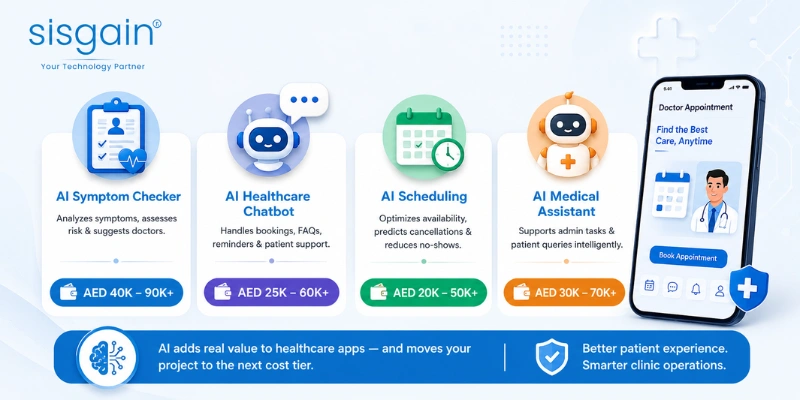
AI Symptom Checkers
AI-powered symptom checkers help patients identify the appropriate healthcare specialty before booking appointments.
These systems:
- reduce incorrect bookings
- improve patient guidance
- shorten decision-making time
- increase operational efficiency
Advanced healthcare apps now integrate machine learning models capable of analyzing symptoms in both English and Arabic.
This is where technologies like an arabic medical ai assistant are becoming increasingly valuable for UAE-focused healthcare platforms.
AI Scheduling & Smart Appointment Management
AI-driven scheduling systems optimize appointment distribution automatically by analyzing:
- doctor availability
- patient preferences
- historical booking patterns
- cancellation probabilities
This reduces scheduling conflicts and improves clinic utilization rates.
For large hospital groups, AI scheduling can significantly improve operational efficiency across multiple departments and facilities.
Smart Reminders & No-Show Reduction
Appointment no-shows remain one of the biggest revenue challenges for clinics.
AI-powered reminder systems now use:
- behavioral prediction
- preferred communication channels
- engagement timing optimization
- automated rescheduling prompts
These systems help reduce missed appointments while improving patient retention.
Automated Patient Engagement
Modern healthcare platforms increasingly use AI for:
- automated FAQs
- multilingual chatbot support
- appointment assistance
- patient follow-up reminders
- medication adherence notifications
These features improve patient satisfaction while reducing administrative burden on clinic staff.
Healthcare businesses investing in healthcare app development services are increasingly prioritizing automation features because they directly impact scalability and operational cost reduction.

Core Features Required in a Doctor Appointment App
Building a successful healthcare platform requires much more than a simple appointment booking interface. A scalable healthcare ecosystem includes patient-facing applications, doctor management tools, administrative dashboards, AI automation systems, and regulatory compliance infrastructure.
The complexity of these features directly influences the overall app development cost in 2026.
Patient Panel Features
The patient application is the foundation of the entire healthcare platform. This is where user experience directly impacts patient acquisition and retention.
Registration & Login System
Patients expect:
- email/mobile registration
- OTP verification
- social login options
- biometric authentication
- secure profile management
Healthcare apps must also maintain secure patient identity verification for compliance purposes.
Appointment Booking System
The booking module typically includes:
- doctor availability calendars
- instant slot booking
- appointment rescheduling
- cancellation management
- consultation history
This feature requires real-time synchronization between patient and doctor dashboards.
Doctor Search & Discovery
Patients should be able to search doctors using:
- specialty
- location
- insurance network
- language
- ratings
- consultation type
Advanced search systems improve patient conversion significantly.
Insurance Filters
Insurance integration is considered a core requirement in the UAE healthcare market.
Patients expect visibility into:
- accepted insurance providers
- co-payment information
- eligibility coverage
- cashless treatment availability
Notifications & Reminders
Automated notifications reduce operational overhead while improving patient engagement.
These systems include:
- appointment reminders
- prescription alerts
- consultation updates
- follow-up notifications
Payment Integration
Secure payment systems allow:
- online consultation payments
- wallet integrations
- invoice generation
- subscription billing
Payment security is particularly important for healthcare trust and compliance.
Doctor Dashboard
The doctor portal helps healthcare professionals manage patient interactions efficiently.
Schedule Management
Doctors require:
- dynamic availability controls
- leave management
- slot optimization
- appointment approvals
Teleconsultation Management
Telemedicine systems include:
- secure video conferencing
- consultation recording
- file sharing
- digital patient communication
Prescription Management
Doctors should be able to:
- issue digital prescriptions
- manage medication history
- renew prescriptions
- connect with pharmacy systems
Patient History Access
Doctors benefit from centralized access to:
- previous consultations
- uploaded reports
- medical history
- treatment notes
This becomes even more important when integrating with Nabidh or Malaffi systems.
Admin Panel
The administrative dashboard acts as the operational control center for the healthcare platform.
Analytics & Reporting
Admins need access to:
- appointment analytics
- patient acquisition metrics
- doctor performance reports
- operational KPIs
Revenue Tracking
Financial dashboards help healthcare businesses monitor:
- consultation revenue
- payment status
- refunds
- subscription plans
Doctor Verification & Approvals
Healthcare apps must verify:
- medical licenses
- certifications
- specialist approvals
- DHA/DOH registrations
Complaint & Support Management
Administrative systems often include:
- ticket management
- patient complaints
- dispute resolution workflows
- feedback monitoring
Advanced AI Features
AI features significantly increase development complexity but also create strong competitive advantages.
AI Symptom Checker
Estimated Complexity: High
Uses machine learning models to guide patients toward appropriate healthcare services.
AI Chatbot
Estimated Complexity: Medium–High
Supports:
- appointment assistance
- FAQs
- multilingual patient communication
- automated onboarding
Predictive No-Show Alerts
Estimated Complexity: High
AI models analyze behavioral patterns to identify patients likely to miss appointments.
Smart Appointment Routing
Estimated Complexity: High
Automatically recommends doctors based on:
- symptoms
- specialization
- location
- insurance compatibility
- appointment urgency
Estimated Feature Development Cost
|
Feature |
Estimated Cost (AED) |
Complexity |
|
User Registration & Login |
12,000 – 20,000 |
Medium |
|
Appointment Booking System |
20,000 – 40,000 |
High |
|
Real-Time Scheduling |
18,000 – 35,000 |
High |
|
Telemedicine Module |
35,000 – 70,000 |
High |
|
Insurance Integration |
20,000 – 45,000 |
High |
|
Online Payment Integration |
10,000 – 25,000 |
Medium |
|
E-Prescription System |
15,000 – 35,000 |
High |
|
Doctor Dashboard |
25,000 – 50,000 |
High |
|
Admin Analytics Panel |
20,000 – 40,000 |
Medium–High |
|
AI Symptom Checker |
40,000 – 90,000 |
Advanced |
|
AI Chatbot |
25,000 – 60,000 |
Advanced |
|
Arabic RTL Localization |
15,000 – 30,000 |
Medium |
|
Nabidh/Malaffi Integration |
50,000 – 120,000 |
Enterprise |
Healthcare providers investing in custom Android & iOS app development in the UAE should understand that feature complexity, compliance infrastructure, and scalability requirements all directly influence development costs.
DHA, DOH & UAE Healthcare Regulations Explained
Healthcare application development in the UAE is heavily regulated due to the sensitive nature of patient data and medical services. Compliance is not simply a technical requirement — it is a legal and operational necessity.
Healthcare businesses that fail to meet UAE healthcare regulations risk:
- legal penalties
- operational shutdowns
- loss of patient trust
- licensing delays
- data breach liabilities
This is why compliance planning must begin during the earliest stages of healthcare app development services.
Dubai Health Authority (DHA) Requirements
The Dubai Health Authority regulates digital healthcare operations within Dubai and establishes standards for telemedicine, healthcare licensing, patient data management, and interoperability.
DHA Licensing Requirements
Healthcare platforms facilitating patient-doctor interactions often require:
- healthcare service approvals
- telehealth licensing
- physician verification
- operational compliance audits
Nabidh Integration
Nabidh is Dubai’s unified healthcare information exchange platform.
Healthcare apps operating within the Dubai ecosystem increasingly require Nabidh interoperability to:
- exchange patient data securely
- synchronize medical records
- support connected healthcare infrastructure
Integration complexity can significantly impact development timelines and budgets.
Telehealth Permissions
Apps offering virtual consultations must comply with DHA telemedicine standards covering:
- consultation protocols
- physician licensing
- patient consent
- secure communication infrastructure
Department of Health Abu Dhabi (DOH/HAAD)
Healthcare platforms operating in Abu Dhabi must align with DOH regulations and interoperability frameworks.
Malaffi Integration
Malaffi serves as Abu Dhabi’s centralized health information exchange platform.
Integration enables:
- secure patient record sharing
- clinical interoperability
- healthcare data synchronization
This is especially important for enterprise-level healthcare ecosystems.
Compliance Approvals
DOH regulations require healthcare applications to maintain:
- patient confidentiality
- cybersecurity controls
- clinical governance standards
- operational transparency
UAE Personal Data Protection Law (PDPL)
The UAE PDPL establishes strict rules governing personal and healthcare data processing.
Healthcare apps must implement:
- explicit patient consent systems
- data access transparency
- breach notification procedures
- secure data storage protocols
Patient privacy protection is now a core trust factor within the UAE healthcare sector.
Data Hosting & Residency Requirements
Many healthcare providers prefer cloud hosting environments located within UAE-approved regions such as:
- Azure UAE North
- AWS Middle East (Bahrain)
Regional hosting improves compliance readiness and patient trust.
Why Compliance Increases Development Cost
Healthcare compliance requirements add significant technical and operational complexity to app development.
Security Infrastructure
Healthcare platforms require:
- advanced authentication systems
- role-based access control
- secure APIs
- protected healthcare databases
Encryption Systems
Sensitive healthcare data must be encrypted:
- during storage
- during transmission
- across integrated systems
This requires enterprise-grade cybersecurity architecture.
Security Audits & Testing
Healthcare applications undergo:
- penetration testing
- vulnerability assessments
- compliance audits
- infrastructure reviews
These processes increase both development time and operational cost.
Legal & Regulatory Approvals
Healthcare businesses must also budget for:
- licensing approvals
- legal consultations
- regulatory submissions
- compliance documentation
This is one reason why healthcare app development costs are higher than standard mobile application projects.
Doctor Appointment App Development Cost in UAE (2026)
The cost of building a healthcare app in the UAE depends heavily on platform complexity, compliance requirements, AI functionality, integrations, scalability goals, and user experience expectations.
Businesses researching app development cost in 2026 should understand that healthcare platforms involve far more infrastructure than traditional mobile apps because they combine:
- patient management
- healthcare compliance
- payment systems
- real-time communication
- medical data security
- AI automation
MVP Development Cost
Estimated Cost: AED 110,000–185,000
An MVP is designed for startups or smaller clinics seeking a faster market launch.
Typically includes:
- appointment booking
- doctor search
- user registration
- notifications
- simple admin panel
- single-language interface
This version focuses on validating the business model before expanding into advanced healthcare functionality.
Mid-Level Telemedicine Platform
Estimated Cost: AED 185,000–295,000
This is the most common investment range for growing healthcare businesses in the UAE.
Features usually include:
- bilingual Arabic + English UI
- telemedicine integration
- online payments
- insurance filtering
- doctor dashboards
- e-prescriptions
- analytics systems
This pricing tier reflects increased backend infrastructure, compliance implementation, and UX complexity.
Enterprise Healthcare Platform
Estimated Cost: AED 295,000–450,000+
Enterprise healthcare systems are designed for:
- hospital groups
- government healthcare projects
- multi-clinic operations
- insurance-integrated healthcare ecosystems
These platforms commonly include:
- AI automation
- EMR/EHR integration
- Nabidh & Malaffi connectivity
- advanced analytics
- enterprise cybersecurity
- multi-location management
Large-scale healthcare ecosystems require extensive infrastructure planning, security architecture, and interoperability engineering.
Hidden Costs Most Businesses Ignore
Many healthcare startups underestimate operational costs beyond initial development.
Maintenance & Support
Healthcare apps require continuous:
- bug fixes
- feature updates
- server monitoring
- performance optimization
Annual maintenance often costs 15–25% of the initial development budget.
Compliance Renewals
Regulatory compliance is ongoing, not one-time.
Businesses may need:
- annual audits
- license renewals
- security reviews
- infrastructure upgrades
Cloud Hosting Costs
Healthcare platforms handling sensitive patient data require reliable cloud infrastructure with high uptime and strong security standards.
Hosting costs increase with:
- video consultations
- AI systems
- patient database growth
- traffic scaling
Cybersecurity Investments
Healthcare data is one of the most targeted categories for cyberattacks globally.
Security investments may include:
- firewall systems
- endpoint protection
- penetration testing
- threat monitoring
- encrypted backup systems
API & Integration Costs
Third-party integrations often involve recurring operational expenses:
- payment gateway fees
- SMS/notification systems
- telemedicine APIs
- AI infrastructure
- healthcare interoperability systems
Understanding why these costs exist helps healthcare businesses plan realistically instead of focusing only on initial development pricing.
Best Technology Stack for UAE Healthcare Apps
Choosing the right technology stack is one of the most important decisions in healthcare application development. The technologies used behind a healthcare platform directly impact scalability, security, compliance readiness, performance, AI capabilities, and long-term maintenance costs.
For UAE healthcare businesses, the technology stack must support:
- multilingual experiences
- telemedicine infrastructure
- healthcare compliance
- secure patient data handling
- high user traffic
- future scalability
A poorly planned architecture may reduce initial development costs, but it often creates serious performance, security, and compliance problems later.
Healthcare businesses investing in application software development in dubai should prioritize technologies that are scalable, secure, and proven within healthcare ecosystems.
Recommended Tech Stack for Scalability & Compliance
|
Layer |
Recommended Technology |
Why It Works for UAE Healthcare Apps |
|
Mobile App Development |
Flutter / React Native |
Faster cross-platform deployment with Arabic RTL support |
|
Frontend Web Portal |
React.js / Next.js |
Fast performance and scalable UI architecture |
|
Backend Framework |
Node.js / Django |
Secure APIs and scalable healthcare workflows |
|
Database |
PostgreSQL + MongoDB |
Structured and unstructured healthcare data handling |
|
Video Consultation |
Twilio / Agora |
Reliable telemedicine infrastructure |
|
Cloud Hosting |
AWS Bahrain / Azure UAE North |
Regional hosting with compliance-ready infrastructure |
|
Authentication |
OAuth 2.0 + MFA |
Secure patient and doctor access management |
|
AI & Machine Learning |
Python, TensorFlow, OpenAI APIs |
AI symptom checkers and predictive healthcare automation |
|
Notifications |
Firebase Cloud Messaging |
Real-time reminders and alerts |
|
Payment Integration |
Telr, PayTabs, Stripe UAE |
UAE-compliant payment processing |
|
Analytics |
Power BI / Google Analytics / Mixpanel |
Operational and patient behavior insights |
|
Healthcare Integration |
Nabidh API / Malaffi API |
UAE healthcare interoperability support |
Flutter vs React Native for Healthcare Apps
Cross-platform development frameworks are commonly used to reduce development time and operational costs while maintaining consistent experiences across iOS and Android devices.
Flutter
Flutter has become increasingly popular for healthcare applications because of:
- strong UI customization
- smooth animations
- high performance
- excellent RTL Arabic support
- consistent interface rendering across devices
Flutter is especially effective for healthcare apps requiring visually rich interfaces and multilingual experiences.
React Native
React Native remains a strong option for scalable healthcare ecosystems because of:
- faster developer availability
- large community support
- reusable components
- easier third-party integrations
Healthcare startups often prefer React Native for faster MVP deployment and cost optimization.
Which One Is Better for UAE Healthcare Apps?
For healthcare businesses prioritizing Arabic UX, custom UI experiences, and high-performance patient applications, Flutter often provides stronger visual consistency.
For faster scalability and broader development ecosystem support, React Native remains highly competitive.
The final choice usually depends on:
- project complexity
- budget
- scalability goals
- integration requirements
- long-term maintenance plans
Node.js vs Django for Healthcare Backend Development
The backend infrastructure powers everything behind the healthcare platform:
- patient management
- scheduling systems
- telemedicine workflows
- APIs
- compliance architecture
- AI integrations
Node.js
Node.js is widely used because of:
- high scalability
- real-time data processing
- fast API performance
- event-driven architecture
It performs particularly well for:
- appointment systems
- live chat
- real-time notifications
- telemedicine communication
Django (Python)
Django is commonly preferred for healthcare applications because of:
- strong built-in security
- rapid development capabilities
- AI/ML compatibility
- structured architecture
Django is highly effective for:
- healthcare analytics
- AI-powered healthcare systems
- compliance-focused architectures
- complex medical workflows
Which Backend Is Better?
For AI-heavy healthcare platforms with predictive automation, Django often offers stronger flexibility due to Python’s AI ecosystem.
For highly scalable real-time systems and telemedicine-heavy applications, Node.js performs exceptionally well.
Many enterprise healthcare systems now combine both technologies depending on operational needs.
AWS Bahrain vs Azure UAE North
Cloud hosting decisions are critical in UAE healthcare app development because healthcare platforms process highly sensitive patient data.
Regional cloud infrastructure improves:
- latency
- performance
- compliance readiness
- disaster recovery
- data governance
AWS Middle East (Bahrain)
AWS Bahrain is widely used because of:
- strong scalability
- advanced AI tools
- enterprise security
- global infrastructure support
It is commonly preferred by healthcare startups and scalable SaaS healthcare platforms.
Azure UAE North
Azure UAE North is often preferred by enterprise healthcare organizations because of:
- regional data residency support
- Microsoft healthcare ecosystem integrations
- enterprise-grade compliance infrastructure
Healthcare groups already using Microsoft systems frequently choose Azure for easier integration.
Twilio vs Agora for Telemedicine
Video consultation systems are one of the most infrastructure-intensive components of healthcare applications.
Twilio
Twilio provides:
- highly secure communication APIs
- reliable video quality
- healthcare-grade infrastructure
- scalable telemedicine support
It is commonly used for enterprise healthcare applications.
Agora
Agora is often selected because of:
- lower latency
- cost efficiency
- strong mobile optimization
- smooth real-time communication
Healthcare startups frequently use Agora for telemedicine MVPs and mid-scale healthcare apps.
AI & Machine Learning Stack
Artificial intelligence is rapidly becoming a core part of modern healthcare ecosystems.
Healthcare apps increasingly use AI for:
- symptom analysis
- appointment predictions
- patient engagement
- operational automation
- multilingual healthcare assistance
Most healthcare AI systems are built using:
- Python
- TensorFlow
- PyTorch
- OpenAI APIs
- AWS SageMaker
These technologies help healthcare businesses create:
- AI symptom checkers
- predictive scheduling systems
- multilingual healthcare chatbots
- smart patient support systems
AI integration complexity is one of the major reasons healthcare app development costs have increased in app development cost in 2026 calculations.
Why Arabic RTL Support Matters in Development
Arabic localization is one of the most underestimated challenges in UAE healthcare app development.
Many businesses assume Arabic translation is enough. In reality, Arabic healthcare UX requires deep architectural and design considerations.
UI Complexity
Arabic interfaces use right-to-left (RTL) alignment, which affects:
- navigation structure
- menus
- icons
- animations
- content hierarchy
- form alignment
Designing healthcare interfaces for both RTL and LTR environments requires significantly more frontend planning.
Font Rendering Challenges
Arabic typography behaves differently than English text.
Healthcare apps must optimize:
- font readability
- text scaling
- dynamic content spacing
- multilingual rendering consistency
Poor Arabic rendering damages user trust and reduces accessibility for native Arabic speakers.
Localization Beyond Translation
True healthcare localization involves:
- culturally adapted UX
- Arabic healthcare terminology
- bilingual notifications
- localized date/time formatting
- multilingual search optimization
This becomes especially important for hospital groups serving Emirati and GCC patient demographics.
UX Optimization for UAE Users
Healthcare apps in the UAE must optimize experiences for:
- Arabic-speaking patients
- expatriate communities
- elderly users
- multilingual healthcare staff
This is one reason healthcare businesses increasingly prioritize specialized healthcare app development services rather than generic app agencies.
Timeline Breakdown from Planning to Launch
One of the biggest misconceptions in healthcare app development is the belief that healthcare platforms can be built quickly without operational risk.
In reality, healthcare applications involve:
- regulatory approvals
- secure infrastructure
- patient data systems
- telemedicine integration
- multilingual UX
- interoperability requirements
This makes healthcare development timelines significantly longer than standard mobile applications.
Healthcare businesses planning doctor appointment app development in the UAE should approach timelines strategically rather than aggressively.
Development Timeline Breakdown
|
Development Phase |
Estimated Timeline |
|
Discovery & Requirement Analysis |
2–4 Weeks |
|
UI/UX Design |
3–6 Weeks |
|
Backend Development |
8–14 Weeks |
|
Frontend Mobile Development |
8–12 Weeks |
|
Telemedicine & API Integrations |
3–6 Weeks |
|
Testing & QA |
3–5 Weeks |
|
DHA/DOH Compliance Approvals |
4–8 Weeks |
|
Deployment & Launch |
1–2 Weeks |
|
Total MVP Timeline |
3–5 Months |
|
Enterprise Healthcare Platform |
9–14 Months |
Discovery & Planning Phase
This stage defines:
- business goals
- compliance requirements
- technical architecture
- feature prioritization
- healthcare workflows
Skipping discovery often leads to expensive redevelopment later.
UI/UX Design Phase
Healthcare UX design focuses heavily on:
- patient accessibility
- multilingual usability
- doctor workflow optimization
- Arabic RTL support
This phase is critical for patient adoption and retention.
Backend Development
Backend systems handle:
- appointment logic
- authentication
- patient records
- payment processing
- API integrations
- telemedicine infrastructure
This is usually the most technically intensive stage.
Frontend Development
Frontend teams build:
- patient applications
- doctor portals
- admin dashboards
Cross-platform development frameworks help reduce overall timelines.
Testing & QA
Healthcare applications require extensive testing because system failures can directly impact patient experiences and clinical workflows.
Testing typically includes:
- functionality testing
- security testing
- load testing
- device compatibility testing
- compliance verification
Compliance Approvals
Healthcare compliance approvals often create the biggest timeline uncertainty.
Regulatory processes may involve:
- infrastructure reviews
- telemedicine assessments
- licensing checks
- interoperability verification
Healthcare businesses should account for approval delays during project planning.
Why Rushing Healthcare Apps Is Risky
Many businesses attempt to accelerate healthcare app launches to reduce costs or beat competitors to market.
However, rushed healthcare platforms often suffer from:
- security vulnerabilities
- poor patient experience
- compliance failures
- unstable infrastructure
- scalability issues
In healthcare technology, operational trust matters more than launch speed.
A poorly executed healthcare platform can damage patient confidence and create regulatory complications that are far more expensive to fix later.
Will a Doctor Appointment App Actually Generate Revenue?
For many clinic owners and healthcare investors, the biggest concern is not just development cost — it is return on investment.
The good news is that healthcare apps can generate measurable operational and financial returns when implemented correctly.
The most successful healthcare platforms improve:
- patient acquisition
- appointment efficiency
- retention rates
- operational scalability
- telemedicine revenue
- patient lifetime value
In many cases, healthcare apps become long-term revenue ecosystems rather than simple appointment tools.
Real ROI Example for a Dubai Clinic
Consider a mid-sized multi-specialty clinic in Dubai handling approximately 40 appointments daily.
Before Digital Transformation
|
Metric |
Traditional Operations |
|
Daily Appointments |
40 |
|
No-Show Rate |
20–25% |
|
Average Consultation Value |
AED 350 |
|
Daily Revenue |
AED 11,000–12,000 |
|
Telemedicine Revenue |
Minimal |
After Implementing a Doctor Appointment App
|
Metric |
After App Launch |
|
Daily Appointments |
55–60 |
|
No-Show Rate |
8–10% |
|
Average Consultation Value |
AED 350–500 |
|
Daily Revenue |
AED 18,000–24,000 |
|
Telemedicine Revenue |
Additional AED 25K–60K Monthly |
How Revenue Improves
Reduced No-Shows
Automated reminders and AI-powered scheduling reduce appointment gaps significantly.
Even reducing no-shows by 10–15% can create major revenue recovery for busy clinics.
More Appointments Per Day
Online booking systems improve slot utilization and reduce administrative delays.
Patients can schedule instantly without depending on front-desk availability.
Higher Patient Retention
Digital healthcare experiences improve convenience and patient loyalty.
Features such as:
- digital follow-ups
- teleconsultation
- prescription reminders
- easy rebooking
encourage repeat consultations.
Telemedicine Revenue
Virtual consultations create entirely new service opportunities.
Many UAE clinics now charge:
- AED 150–350 for general teleconsultations
- AED 400–900 for specialist virtual consultations
This creates scalable revenue without requiring physical clinic expansion.
New Revenue Streams Healthcare Apps Create
Modern healthcare applications open multiple monetization opportunities beyond appointment scheduling.
Subscription-Based Healthcare Plans
Clinics increasingly offer:
- monthly wellness subscriptions
- chronic disease management packages
- family healthcare memberships
Typical UAE pricing ranges:
- AED 99–399/month depending on services included
Pharmacy Partnerships
Digital prescriptions enable partnerships with pharmacies for:
- medicine fulfillment
- prescription delivery
- referral commissions
This improves patient convenience while creating recurring partnership revenue.
Insurance Integrations
Healthcare apps integrated with insurance workflows can:
- simplify claims
- accelerate approvals
- improve cashless treatment experiences
Enterprise healthcare platforms may also monetize insurance analytics and healthcare coordination services.
Premium Consultations
Healthcare apps allow clinics to offer:
- priority consultations
- specialist access
- extended virtual care packages
- executive healthcare services
Premium healthcare accessibility is a growing trend within UAE private healthcare markets.
Corporate Wellness Programs
Many UAE companies now partner with healthcare providers for employee wellness ecosystems.
Healthcare apps can support:
- corporate consultations
- wellness monitoring
- preventive healthcare plans
- occupational health programs
This creates scalable B2B healthcare opportunities.
Questions UAE Healthcare Businesses Must Ask Before Hiring Developers
Choosing the right healthcare technology partner is one of the most important decisions in doctor appointment app development in the UAE.
Healthcare applications involve far more complexity than standard mobile apps because they combine:
- compliance
- cybersecurity
- patient experience
- operational workflows
- healthcare integrations
- multilingual infrastructure
The wrong development partner can create expensive operational problems later.
Healthcare App Development Evaluation Checklist
Before selecting a healthcare technology company, UAE healthcare businesses should evaluate the following areas carefully.
DHA & DOH Compliance Experience
- Have they worked on regulated healthcare platforms before?
- Do they understand UAE telemedicine requirements?
- Can they explain healthcare compliance workflows clearly?
Nabidh & Malaffi Integration Expertise
- Have they previously integrated healthcare interoperability systems?
- Do they understand UAE healthcare data exchange standards?
Arabic UX & RTL Design Experience
- Can they demonstrate Arabic healthcare interfaces?
- Do they understand RTL optimization challenges?
Healthcare Case Studies
- Have they developed healthcare apps before?
- Can they provide healthcare-specific project examples?
Cybersecurity Standards
- What security protocols do they follow?
- Do they conduct penetration testing?
- How do they handle healthcare data encryption?
UAE Hosting Infrastructure Knowledge
- Do they understand regional hosting requirements?
- Can they configure AWS Bahrain or Azure UAE North environments properly?
Long-Term Support & Scalability
- Do they provide maintenance support?
- Can the infrastructure scale for future growth?
- Do they offer SLA agreements?
Healthcare businesses investing in healthcare app development services should prioritize long-term operational capability rather than simply comparing development quotes.
Red Flags to Avoid
Not every mobile app company is qualified to build healthcare systems.
Unrealistically Low Pricing
Healthcare applications require:
- security infrastructure
- compliance engineering
- healthcare integrations
- AI systems
- scalable backend architecture
Extremely low pricing often indicates missing infrastructure or poor-quality development practices.
No Healthcare Portfolio
Healthcare workflows differ significantly from standard mobile applications.
Agencies without healthcare experience may overlook:
- compliance requirements
- patient privacy workflows
- interoperability standards
- healthcare UX needs
No Compliance Understanding
If a company cannot explain:
- DHA regulations
- PDPL requirements
- telemedicine standards
- data residency considerations
they are not prepared for UAE healthcare development.
Generic Mobile App Agencies
Generic agencies may build functional interfaces but struggle with:
- healthcare scalability
- patient data protection
- AI healthcare workflows
- multilingual healthcare UX
- enterprise integrations
This is why many healthcare organizations prefer specialized healthcare app development services with regional healthcare expertise.
Future Trends in UAE Healthcare Apps (2026–2030)
The UAE healthcare sector is entering a new phase of digital transformation where healthcare applications will evolve far beyond appointment booking and telemedicine. Over the next five years, healthcare platforms across Dubai, Abu Dhabi, and the wider GCC region are expected to become more predictive, AI-driven, connected, and patient-centric.
Government-backed digital health initiatives, rising healthcare investments, AI adoption strategies, and increasing patient expectations are accelerating this shift. Healthcare providers that invest early in advanced digital ecosystems will gain significant competitive advantages in operational efficiency, patient retention, and long-term scalability.
The next generation of healthcare apps will not simply help patients book appointments — they will actively guide, monitor, predict, and personalize healthcare experiences in real time.
Technologies That Will Shape the Next Generation of Health Apps
AI Healthcare Assistants
Artificial intelligence is rapidly becoming the foundation of modern healthcare ecosystems. AI-powered healthcare assistants are expected to play a major role in patient communication, appointment management, symptom analysis, and healthcare automation across the UAE.
Future healthcare apps will increasingly use AI to:
- answer patient questions instantly
- automate appointment scheduling
- provide medication reminders
- assist with symptom pre-screening
- improve doctor-patient communication
- support multilingual healthcare experiences
One of the fastest-growing opportunities in the region is the development of an arabic medical ai assistant capable of understanding regional dialects, Arabic medical terminology, and culturally localized healthcare interactions.
As Arabic NLP technology improves, healthcare providers will be able to deliver more personalized digital healthcare experiences for Emirati and GCC users.
Healthcare businesses investing in AI today are positioning themselves ahead of the next wave of healthcare transformation rather than reacting to it later.
Voice-Based Arabic Booking Systems
Voice-enabled healthcare interfaces are expected to become increasingly common across the UAE, especially among:
- elderly patients
- busy professionals
- accessibility-focused healthcare systems
Future healthcare applications may allow patients to:
- book appointments through Arabic voice commands
- search for doctors conversationally
- receive voice-based reminders
- interact with AI healthcare assistants naturally
This trend is particularly important in the UAE market because voice-based Arabic interfaces remain significantly underdeveloped compared to English-language systems.
Healthcare organizations that optimize for voice-driven experiences early could gain strong market differentiation over competitors relying solely on traditional interfaces.
Wearable Device Integrations
The rise of wearable healthcare technology is transforming how healthcare providers collect and analyze patient data.
Future healthcare apps are expected to integrate directly with:
- Apple Watch
- Fitbit
- Samsung Health
- glucose monitoring systems
- cardiac monitoring devices
- sleep tracking systems
These integrations will allow healthcare providers to monitor:
- heart rate patterns
- blood oxygen levels
- physical activity
- sleep behavior
- chronic disease indicators
This creates opportunities for preventive healthcare and continuous patient engagement rather than reactive treatment models.
In the UAE, wearable-driven healthcare is expected to grow rapidly due to increasing health awareness, premium healthcare adoption, and smart city initiatives.
Predictive Healthcare Analytics
Healthcare apps between 2026 and 2030 will increasingly use predictive analytics to identify health risks before symptoms become severe.
AI-powered predictive systems may help healthcare providers:
- identify high-risk patients
- predict chronic disease progression
- reduce hospital readmissions
- optimize resource allocation
- personalize treatment recommendations
For clinics and hospital groups, predictive healthcare can significantly improve operational efficiency while reducing long-term treatment costs.
This trend aligns closely with the UAE’s broader AI and smart healthcare strategies focused on preventive care and data-driven healthcare ecosystems.
AI Triage Systems
AI triage systems are expected to become one of the most important technologies in future healthcare applications.
Instead of manually searching for specialists, patients will increasingly use AI systems that:
- analyze symptoms
- assess urgency levels
- recommend appropriate departments
- prioritize emergency cases
- route patients intelligently
This improves both patient experiences and healthcare operational efficiency.
Large healthcare organizations in Dubai and Abu Dhabi are already exploring AI-assisted triage models to reduce waiting times and improve clinical workflows.
Remote Patient Monitoring
Remote healthcare monitoring is expected to become a core part of chronic disease management across the UAE.
Healthcare applications will increasingly support:
- continuous health tracking
- remote doctor supervision
- connected diagnostic devices
- automated alerts for abnormal readings
- post-surgical monitoring
This is particularly important for:
- diabetes management
- cardiovascular care
- elderly patient monitoring
- rehabilitation programs
As healthcare systems move toward preventive and home-based care models, remote monitoring capabilities will become essential rather than optional.
Blockchain-Based Medical Records
Blockchain technology is gaining attention for its ability to improve healthcare data security, interoperability, and transparency.
Future healthcare ecosystems may use blockchain systems for:
- secure patient identity verification
- tamper-proof medical records
- decentralized healthcare data sharing
- transparent consent management
- insurance verification
Although blockchain adoption in healthcare is still evolving, many healthcare analysts expect it to become increasingly relevant as healthcare data interoperability expands across the GCC region.
For UAE healthcare providers, blockchain-based systems may eventually help improve trust, reduce fraud risks, and strengthen healthcare data governance.
The Future of UAE Healthcare Apps Will Be Ecosystem-Driven
One of the biggest shifts expected between 2026 and 2030 is the movement from standalone healthcare applications toward fully connected healthcare ecosystems.
Future healthcare platforms will likely integrate:
- hospitals
- pharmacies
- laboratories
- insurance providers
- wearable devices
- AI systems
- government healthcare exchanges
This interconnected infrastructure will allow patients to experience seamless digital healthcare journeys rather than fragmented interactions across multiple systems.
Healthcare businesses investing in scalable healthcare app development services today are building the foundation for this future ecosystem economy.
The healthcare providers that succeed over the next decade will not necessarily be the ones with the most features — they will be the ones that combine:
- compliance
- AI innovation
- multilingual accessibility
- interoperability
- patient-centered experiences
- operational scalability
into a single connected healthcare ecosystem.
The UAE Healthcare Market Is Going Digital — Fast
The UAE healthcare industry is no longer experimenting with digital transformation — it is actively accelerating toward it. Across Dubai, Abu Dhabi, and the wider GCC region, healthcare providers are investing heavily in mobile healthcare ecosystems to improve patient experiences, operational efficiency, and long-term scalability.
The opportunity is enormous.
Patients now expect:
- instant appointment booking
- telemedicine access
- digital prescriptions
- multilingual healthcare experiences
- AI-powered healthcare support
At the same time, healthcare authorities are strengthening compliance requirements around patient privacy, interoperability, and digital healthcare infrastructure. Platforms that fail to align with DHA, DOH, PDPL, Nabidh, and Malaffi standards will struggle to compete in the evolving UAE healthcare landscape.
For healthcare businesses, the financial potential is equally significant. A well-built healthcare application can:
- reduce appointment no-shows
- increase patient retention
- create recurring telemedicine revenue
- improve operational efficiency
- unlock new healthcare monetization models
However, competition is intensifying rapidly. Clinics, hospital groups, healthcare startups, and investors across the UAE are already accelerating investments into digital healthcare infrastructure. Businesses that delay modernization risk losing patients to faster, more accessible, and more technologically advanced competitors.
The healthcare platforms that succeed over the next decade will be the ones that combine:
- strong compliance architecture
- intelligent AI automation
- scalable infrastructure
- Arabic-first user experiences
- seamless patient engagement
into a unified healthcare ecosystem.
Whether you are planning a startup healthcare platform, expanding a clinic network, or modernizing an existing hospital system, investing in the right healthcare technology strategy today can create long-term competitive advantages for years to come.