
Quick answer: An enterprise mobile application in Abu Dhabi commonly requires an indicative implementation budget of
AED 250,000–1,200,000+, while government-grade or multi-system digital services can exceed
AED 1.2 million. The final number depends primarily on system integrations, security and privacy requirements, Arabic/English UX, accessibility compliance, operating scale, and the delivery model you choose. Treat any single "app cost" figure you see online with caution — it almost never reflects enterprise or government scope.
Why This Article Exists
After 25 years writing about and working alongside enterprise software delivery teams, I can tell you the single most common failure point in a public-sector or large-enterprise mobile programme isn't the technology. It's the budget conversation happening too late, with too little detail, based on a number pulled from a generic "how much does an app cost" article written for a restaurant ordering app.
Abu Dhabi's enterprise and government buyers are not shopping for an app. They're commissioning a digital service — one that has to satisfy security assurance obligations, work seamlessly in Arabic and English, remain accessible to People of Determination and older residents, integrate with systems that were never designed to talk to a mobile client, and keep running reliably for years after the launch party is over.
This guide is built for the person who has to defend a number in a budget committee meeting or write a credible RFP — not for someone comparing freelancer quotes. If you're earlier in your research and want a broader view of what's involved in commissioning an app in the first place, our Mobile App Development Services in Abu Dhabi overview is a useful starting point before you dive into procurement-level detail here.
How Much Should You Budget for an Enterprise App in Abu Dhabi?
Rather than quoting a single average, the most useful way to plan is against five realistic budget bands. These are indicative planning ranges based on typical enterprise and government-sector scope in the UAE market — not a quotation, and not a promise of what any specific project will cost.
|
Budget Band |
Indicative Budget (AED) |
Typical Scope |
Likely Timeline |
Best-Fit Buyer |
|
Discovery & Solution Definition |
40,000 – 120,000 |
User research, stakeholder workshops, service blueprint, UX prototype, technical architecture, backlog, delivery roadmap |
4–8 weeks |
Organisation with a complex idea but no RFP-ready scope yet |
|
Controlled Enterprise MVP |
250,000 – 500,000 |
One core user journey, cross-platform iOS/Android app, role-based access, basic admin portal, limited integrations, QA, deployment support |
3–5 months |
Department-level pilot, internal operations app, narrowly scoped service |
|
Integrated Enterprise Application |
500,000 – 1,200,000 |
Multiple workflows, SSO, CRM/ERP/API integrations, analytics, bilingual UX, audit trails, notification engine, stronger DevOps and testing |
6–10 months |
Enterprise business unit, regulated service provider, multi-team operations |
|
Government-Grade Digital Service |
1,200,000 – 3,000,000+ |
Multi-persona journeys, Arabic/English delivery, accessibility, enterprise integrations, high availability, security assurance, auditability, operational handover |
9–18+ months |
Government entity, public service platform, major transformation programme |
|
Multi-Agency / Ecosystem Platform |
3,000,000+ |
Multiple apps/channels, complex case management, several agencies or partners, data platform, advanced identity, AI/automation, 24/7 operations |
12–24+ months |
Large government, banking, utilities, transport, or health ecosystem programmes |
A note on these figures: These bands are intended for 2026 budgeting and procurement planning in Abu Dhabi. They exclude VAT where applicable and typically do not include third-party software licences, cloud consumption, payment-gateway fees, SMS/WhatsApp messaging charges, government platform fees, hardware, independent security audits, or multi-year managed support — unless a proposal explicitly states otherwise. A detailed discovery phase materially reduces estimation uncertainty before you commit to a fixed implementation number, which is exactly why it's listed as its own band rather than folded into "Phase 1."
If your organisation is still deciding whether to pilot small or commit to a full programme, it's worth reading about how a Minimum Viable Product fits into enterprise delivery — an MVP done properly can validate a workflow before you scale a AED 1 million+ investment.
What's Actually Included in an Enterprise App Budget?
A number without a breakdown is not a budget — it's a guess. Here's how the money in a typical integrated enterprise or government mobile programme is actually distributed across delivery workstreams.
|
Workstream |
Typical Deliverables |
|
Discovery |
Workshops, stakeholder interviews, process mapping, requirements backlog |
|
UX/UI Design |
User journeys, prototypes, bilingual design, design system components |
|
Mobile App Development |
iOS/Android native or cross-platform build |
|
Backend & APIs |
APIs, databases, integration middleware, workflow engines |
|
Quality Assurance |
Functional, regression, device, performance, and UAT testing support |
|
Security |
Threat modelling, secure implementation, penetration testing, remediation |
|
DevOps |
Environments, CI/CD pipelines, monitoring, release management |
|
Launch & Handover |
App-store release, documentation, training, knowledge transfer |
Notice how little of that list is "building screens." That's deliberate — it reflects where enterprise and government budgets actually go.
Seven Factors That Increase Enterprise App Development Costs
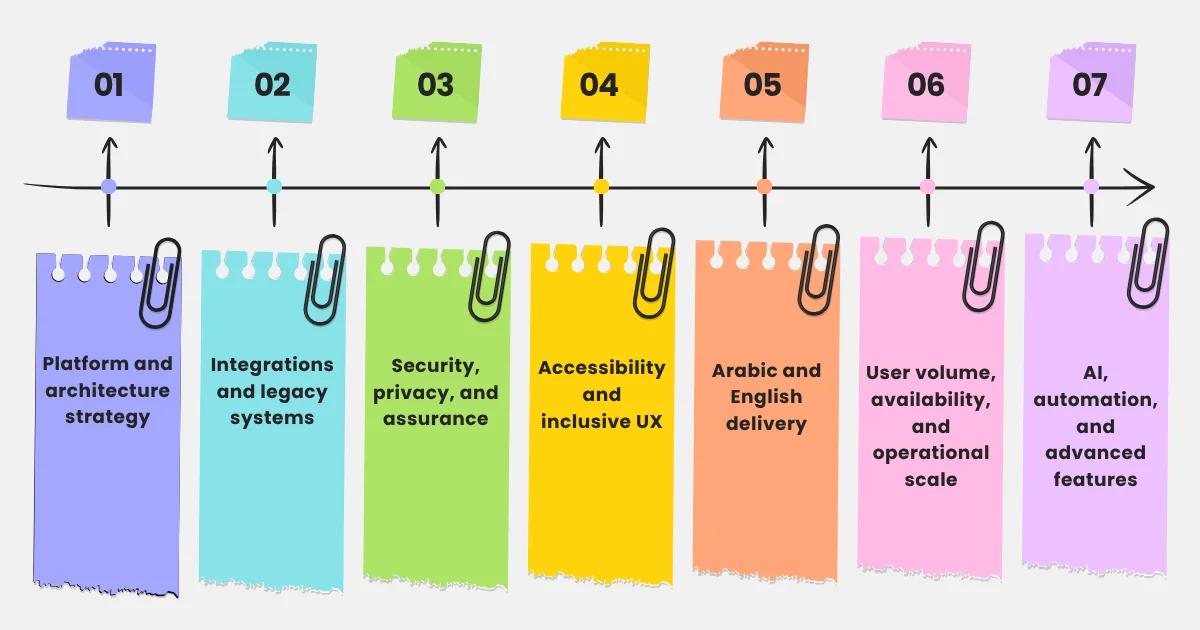
1. Platform and architecture strategy
Whether you need a single platform, a cross-platform build (Flutter or React Native), fully separate native iOS and Android apps, or a broader ecosystem including a web portal, admin panel, and tablet or kiosk support all materially change cost. Cross-platform frameworks can reduce duplicated front-end effort, but they don't remove the backend, integration, security, or testing work sitting behind the interface — be wary of any vendor claiming a flat percentage cost reduction without backing it with delivery data.
2. Integrations and legacy systems
For most enterprise and government buyers, this is the largest hidden cost variable. Think ERP, CRM, HRMS, finance, case-management, GIS, and document-management systems; single sign-on and identity federation; payment gateways, SMS/email notification services, and contact-centre platforms; and, frequently, APIs that are undocumented, rate-limited, unstable, or owned by a third party altogether. As a rule of thumb from real delivery experience: the mobile interface itself might represent only 20–30% of total programme effort. Most of the risk — and cost — sits behind the screen.
3. Security, privacy, and assurance
Government and critical-service projects in the UAE cannot treat security as a late-stage testing checkbox. Budget needs to account for threat modelling and security architecture, secure coding practices and code review, encryption in transit and at rest, identity and access-control design with audit logging, vulnerability assessment and penetration testing, disaster recovery planning, and ongoing incident response and patch management. Data privacy obligations around processing, confidentiality, and retention also need to be mapped early — this is an area where you should always validate specific obligations with your organisation's legal, cybersecurity, and procurement teams rather than relying on a vendor's generic compliance claim.
4. Accessibility and inclusive UX
This is one of the most commonly underestimated cost drivers on government projects — and one of the clearest differentiators between a generic UAE app-cost article and a genuinely government-aware one. UAE digital accessibility policy applies to government digital services across web, mobile, and self-service channels, aligned with WCAG 2.2 accessibility standards. That translates into real scope: screen-reader and keyboard compatibility, colour contrast and typography standards, semantic labelling and logical focus order, plain-language content and accessible error handling, and testing with assistive technologies. Accessibility needs to sit in your acceptance criteria from day one — retrofitting it later is significantly more expensive than designing for it upfront.
5. Arabic and English delivery
Bilingual delivery is not translation bolted onto an English app. It affects right-to-left layout engineering, content expansion and contraction across languages, terminology validation for legal and service-specific wording, bilingual notification templates and error messages, and QA across both language and device-locale settings. If your organisation delivers citizen-facing or public-sector services, bilingual UX should be scoped as a core requirement, not an add-on line item.
6. User volume, availability, and operational scale
Cost rises meaningfully when a solution must support thousands (or millions) of concurrent users, critical or 24/7 service availability, monitoring and SLA reporting, high-availability infrastructure with failover and disaster recovery, and continuous release management across app-store and OS updates. A departmental pilot for 200 internal staff has a fundamentally different infrastructure cost profile than a citizen-facing service expected to handle a national campaign spike.
7. AI, automation, and advanced features
AI capability should be estimated as a genuine product requirement — with data readiness, model evaluation, guardrails, human oversight, and ongoing monitoring — not treated as a feature label added casually to an RFP. Automation and AI features frequently add meaningful discovery and operational cost that isn't visible in an initial feature list.
Government App Development: What Affects the Budget Beyond the Build
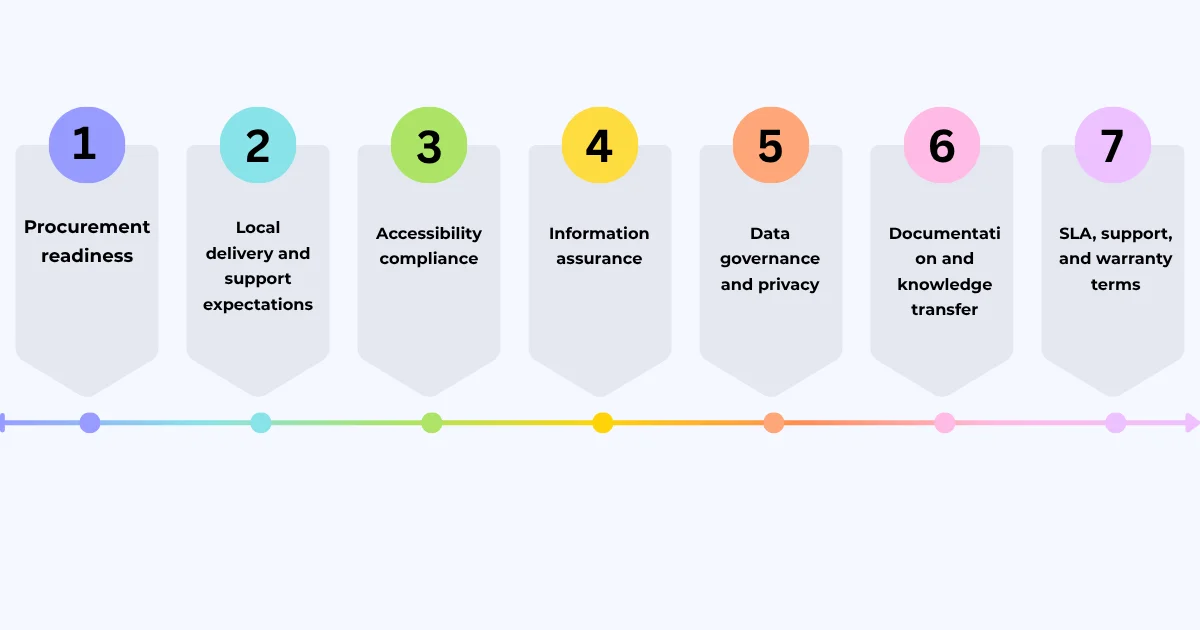
Government-sector mobile programmes carry procurement and governance requirements that private-sector apps generally don't. Before you finalise a budget, factor in:
- Procurement readiness — registering and engaging through the appropriate government procurement channels before vendor selection can even begin
- Local delivery and support expectations — many government tenders favour suppliers with a demonstrable local operations and support presence in the UAE
- Accessibility compliance — as covered above, this is a defined requirement for government digital services, not optional best practice
- Information assurance — UAE information assurance guidance sets out management and technical controls that public-sector systems are expected to establish and maintain
- Data governance and privacy — UAE personal data protection obligations shape how citizen or employee data is processed, stored, and retained
- Documentation and knowledge transfer — source-code ownership, IP rights, and a clear exit or handover plan are typically mandatory in public-sector contracts
- SLA, support, and warranty terms — government contracts commonly require defined service levels well beyond initial go-live
Real-world UAE government tender documentation frequently asks suppliers to demonstrate prior government delivery experience, relevant certifications (such as ISO or CMMI), local operational capacity, client references, and named, experienced delivery personnel. Treat this as an illustration of what serious tenders typically expect — not a universal checklist every entity will require — but it's a useful reality check for budgeting supplier-qualification effort, which itself takes time and cost to prepare for.
If you're at the stage of comparing potential delivery partners against these kinds of expectations, our guide on how to Choose the Best Mobile App Development Company in UAE walks through the evaluation criteria that matter most for enterprise and government procurement specifically — not just portfolio quality.
Fixed Cost vs Dedicated Team vs Time & Materials: Choosing the Right Engagement Model
The commercial structure of your engagement affects your budget predictability just as much as scope does. Here's how the three core models — plus the hybrid approach most enterprise and government programmes end up using — compare.
|
Model |
Best When |
Budget Predictability |
Flexibility |
Main Client Responsibility |
Commercial Risk |
|
Fixed-cost project |
Scope, designs, integrations, and acceptance criteria are already well defined |
High at contract signature |
Low–Medium |
Rapid approvals, tight change control |
Scope changes become change requests; low initial bids may quietly omit essential items |
|
Dedicated team |
Product roadmap is still evolving and continuous delivery/discovery is needed |
Medium |
High |
Product ownership, backlog prioritisation, governance, timely decisions |
Cost can drift without disciplined governance and prioritisation |
|
Time & materials |
Investigation-heavy work, legacy-system uncertainty, urgent enhancements, or specialist tasks |
Lower |
Very high |
Active oversight of hours, priorities, and delivery evidence |
Hard to forecast without a capped budget and clear reporting cadence |
|
Hybrid model |
Common for enterprise/government programmes needing both certainty and evolution |
High for defined phases; medium overall |
High |
Phase-gate approvals and roadmap governance |
Requires clearly defined transition criteria between phases |
Our recommendation for most government and large-enterprise mobile programmes: a hybrid structure — fixed-price discovery and architecture, a fixed-price build for a clearly defined Release 1 with measurable acceptance criteria, followed by a dedicated cross-functional team for integrations, roadmap releases, and ongoing support. This gives finance teams the budget certainty they need for approval cycles, while giving delivery teams the flexibility complex integration work almost always demands.
Not sure which commercial model matches your scope? Compare our fixed-cost, dedicated team, and time & material models in detail before you finalise your procurement approach.
One-Time Build Cost vs Ongoing Ownership Cost
This is the section most generic cost articles skip entirely — and it's often where budget committees get blindsided a year after launch.
|
Cost Area |
Typical Planning Method |
|
Support and maintenance |
Often budgeted as a percentage of implementation cost, or as a retained delivery team; the right figure depends on your defined support scope |
|
Cloud infrastructure |
Monthly usage-based spend, driven by traffic, storage, data transfer, availability targets, and managed services |
|
Third-party licences |
Per-user, per-transaction, monthly, annual, or enterprise licensing models |
|
Security testing |
Periodic or release-based penetration testing, plus remediation effort |
|
App-store and OS upgrades |
Ongoing lifecycle maintenance as Apple and Google update platform requirements |
|
Feature roadmap |
Dedicated team capacity, or a phased change budget |
|
Analytics and reporting |
Tool licensing, dashboard development, data pipeline maintenance, and governance |
A word of caution: you'll see confident claims online that "maintenance always costs 15–20% of build cost." Treat that as a planning convention at best, not a UAE-specific market fact. The right ongoing budget depends on your SLA commitments, release frequency, cloud footprint, integration surface area, and security obligations — all of which vary enormously between a departmental pilot and a citizen-facing national service.
If your organisation is weighing whether a fuller multi-service offering makes more sense than a single-purpose app, it's also worth understanding how Super App Development in UAE programmes are typically budgeted — the ownership-cost dynamics are similar, but scale and integration surface area both increase substantially.
Building an RFP-Ready App Development Budget
Vendors quote inconsistently for one reason more than any other: the scope they're quoting against is genuinely different from one supplier's interpretation to the next. A well-structured RFP closes that gap and gets you comparable, defensible numbers.
RFP-ready checklist
Before issuing a tender or requesting proposals, make sure your documentation covers:
- Business objective and defined service outcomes
- User groups and estimated user volumes
- Required platforms: iOS, Android, web portal, tablet, kiosk, or field devices
- Arabic and English content/UX requirements
- Existing systems, API owners, documentation, and known dependency risks
- Authentication, SSO, permissions, audit trails, and data classification
- Security, privacy, and accessibility requirements
- Required hosting, environments, release process, and operational support model
- Acceptance criteria, performance targets, SLA expectations, and warranty period
- Source-code ownership, IP rights, documentation, and exit/handover plan
- Pricing format requested: discovery, implementation, licences, cloud, third-party costs, support, and change-request capacity
- Supplier evidence required: case studies, local support model, team CVs, certifications, and references
What to request from suppliers
Ask every vendor to break their proposal into the same workstreams (discovery, UX, mobile build, backend/integrations, QA, security, DevOps, launch) rather than accepting a single lump-sum figure. This alone will surface which vendors have genuinely scoped your integrations and which have quoted a generic template.
Real-World Scenarios (Anonymised)
Scenario 1 — Internal field operations app. A government department needs a cross-platform mobile app for field teams: single sign-on, task assignment, offline data capture, photo uploads, and manager dashboards. In this case, the budget is shaped far less by the visible screens and much more by identity integration, backend APIs, offline data-sync conflict handling, device testing across a range of hardware, and ongoing operations support. This sits comfortably in the Integrated Enterprise Application band.
Scenario 2 — Public-facing government service. A citizen-facing service needs full Arabic and English interfaces, appointment booking, document uploads, status tracking, push notifications, accessible user flows, audit logging, and integration with several existing government systems. Scope here must include integration discovery, accessibility testing against WCAG 2.2, security testing, performance planning for peak load, and a defined post-launch incident and support process. This typically sits in the Government-Grade Digital Service band.
Get an RFP-Ready Enterprise App Estimate
Need a defensible budget before you issue an RFP or present to a budget committee? Share your target users, required integrations, security and compliance needs, platform requirements, and timeline — our team can provide a phased estimate covering discovery, implementation, launch, and ongoing support, built around Abu Dhabi's procurement realities rather than a generic price list.
If you're still narrowing down who should deliver this, our breakdown of the Best Agencies for Mobile Application Development in Abu Dhabi is a useful next read alongside this budget guide — pricing and capability should always be evaluated together, not in isolation.