
Why MVP Development Matters for Startups in 2026
The global startup ecosystem in 2026 is more competitive and fast-moving than ever before. Thousands of new startups launch every month across industries such as fintech, AI, health tech, SaaS, and mobility. While innovation continues to accelerate, the harsh reality remains the same: a large percentage of startups fail within their first few years. One of the biggest reasons behind this failure is building products without validating real market demand.
In today’s environment, investors and founders are increasingly focused on efficiency, speed, and validated ideas. Venture capital firms are no longer interested in funding ideas alone—they want proof that a product solves a real problem and attracts users. This shift has made mvp development one of the most important strategies for startups that want to launch smarter and reduce risk.
A Minimum Viable Product (MVP) allows startups to launch a simplified version of their product with only the core features needed to solve the main user problem. Instead of investing large budgets into full product development, startups test their concept early, collect real user feedback, and iterate quickly.
This approach aligns closely with the lean startup methodology, which emphasizes experimentation, continuous learning, and rapid product iteration. By building a smaller but functional version of the product, founders can validate assumptions before scaling development efforts.
Another key factor driving the popularity of mvp development for startups is the need for speed. Modern markets evolve quickly, and customer expectations change rapidly. Startups that wait too long to launch often lose opportunities to faster competitors. An MVP helps founders bring a product to market quickly, test user reactions, and improve the product based on real insights rather than assumptions.
Rapid experimentation has also become easier in 2026 due to advances in cloud infrastructure, AI tools, and agile development frameworks. These technologies allow startups to prototype, build, and deploy applications faster than ever before. As a result, the MVP approach is now widely used by founders who want to validate product ideas without overcommitting resources.
Another important goal of MVP development is achieving product-market fit. This occurs when a product successfully addresses a clear customer need and gains consistent user adoption. Instead of spending months or years building complex features, startups can launch an MVP, measure user engagement, and determine whether the product resonates with its intended audience.
Early traction metrics are especially important for startup growth. Investors often evaluate signals such as active users, retention rates, and user engagement before deciding to fund a company. By launching an MVP early, startups can collect these metrics and demonstrate that their product has real potential in the market.
In short, mvp development for startups has become the most practical and strategic way to transform innovative ideas into validated digital products. It reduces development risks, accelerates learning, and increases the chances of building a product that customers genuinely need.
What Is an MVP in Software Product Development?
A Minimum Viable Product, commonly known as an MVP, is the earliest functional version of a product that includes only the core features necessary to solve a specific problem for users. The goal of an MVP is not to create a perfect or fully developed application but to release a working product that allows startups to test their idea in real market conditions.

The concept of MVP originated from lean product development practices, where businesses focus on validating ideas quickly before making large investments. Through the mvp product development process, startups can learn how users interact with their product and identify which features truly matter.
However, many founders confuse an MVP with other early-stage product concepts such as prototypes or proof-of-concept solutions. Understanding these differences is essential when planning product development.
Prototype
A prototype is an early visual or interactive representation of a product idea. It is often used to demonstrate design concepts, workflows, or user interfaces before development begins. Prototypes typically do not contain full functionality and are mainly used for design validation or stakeholder presentations.
Proof of Concept (PoC)
A proof of concept focuses on verifying whether a specific technical idea or technology is feasible. For example, a startup might create a PoC to test whether an AI algorithm works effectively or whether a particular integration is technically possible.
While a PoC validates technical feasibility, it usually does not represent a usable product for real customers.
Minimum Viable Product (MVP)
An MVP goes a step further. It is a functional product that real users can access and interact with. Although it contains limited features, it delivers the core value proposition of the startup’s idea. This allows founders to gather real feedback, track user behavior, and determine whether the product has potential.
Full Product
A full product includes advanced features, polished design, scalability infrastructure, and optimized performance. It is typically developed only after the MVP phase confirms that there is strong demand and a clear product-market fit.
The mvp product development process helps startups move from idea validation to real product development while minimizing unnecessary complexity. Instead of building every possible feature, development teams focus on the most essential functionality that solves the primary problem for users.
Today, many startups rely on professional mvp software development services to accelerate this process. Experienced development teams can help founders define core features, design intuitive user experiences, and build scalable MVP applications that support future growth.
Modern MVP solutions also vary depending on the type of product being developed. Some common examples include:
Mobile MVP Applications
Many startups begin with a simplified mobile application that focuses on a single core function. This approach is common in industries such as fintech, transportation, social platforms, and e-commerce.
AI-Powered MVP Platforms
With the rapid growth of artificial intelligence technologies, startups are increasingly building AI-driven MVP products. These applications may include recommendation engines, automation tools, or intelligent analytics features designed to solve specific user challenges.
SaaS MVP Solutions
Software-as-a-Service products often launch with basic subscription features, dashboards, and core functionality. As the user base grows, startups expand their SaaS platforms with additional capabilities and integrations.
Regardless of the product type, the purpose of an MVP remains the same: validate the idea, gather real user insights, and improve the product through continuous learning.
Why MVP Development Is Critical for Startup Success
Launching a startup involves significant uncertainty. Founders must make decisions about product features, customer needs, and market demand while operating with limited resources. This is why mvp development plays a crucial role in helping startups reduce risk and make smarter decisions during the early stages of growth.
By focusing on the most essential features first, startups can validate their product idea quickly and adjust their strategy based on real customer feedback. Below are some of the key reasons why MVP development has become a fundamental part of successful startup strategies.
Faster Product Launch
One of the biggest advantages of mvp app development is speed. Instead of spending years building a fully featured application, startups concentrate on creating a simple version that delivers the core functionality. Agile development methodologies in mobile application development allow teams to break the process into smaller iterations, enabling faster testing and deployment. This approach helps startups launch products in weeks or months rather than enduring long development cycles.
Launching early also allows startups to enter the market before competitors and start building a user base quickly.
Lower Development Costs
Developing a full-scale software product requires significant financial investment. For early-stage startups with limited budgets, this can be a major challenge.
The mvp development for startups approach reduces financial risk by limiting development efforts to only the most important features. This lean development strategy allows founders to validate their idea without committing large amounts of capital.
If the product shows strong user demand, startups can gradually expand the product with additional features.
Market Validation
Many startup failures occur because companies build products that customers do not actually need. MVP development helps prevent this by validating real user demand early in the process.
Startups can test their product idea through:
- customer interviews
- usability testing
- early adopter feedback
These insights help founders understand how users interact with the product and identify improvements that increase product value.
Improved Investor Confidence
Investors are far more likely to fund startups that demonstrate real traction rather than just presenting theoretical ideas. An MVP provides tangible evidence that a product works and that users are interested in it.
During funding discussions, investors often evaluate metrics such as:
- user growth
- customer retention
- engagement levels
- early revenue potential
By launching an MVP and collecting these metrics, startups can build a stronger case for investment.
Faster Product Iteration
The MVP approach encourages continuous learning and improvement. Once the product is launched, startups gather user feedback and identify opportunities to enhance functionality or improve the user experience.
This iterative process is a core component of the mvp product development process. Each product update is informed by real data and user behavior, helping startups move closer to achieving product-market fit.
Over time, this cycle of testing, learning, and improving enables startups to build products that align closely with customer needs and market expectations.
Step-by-Step MVP Product Development Process
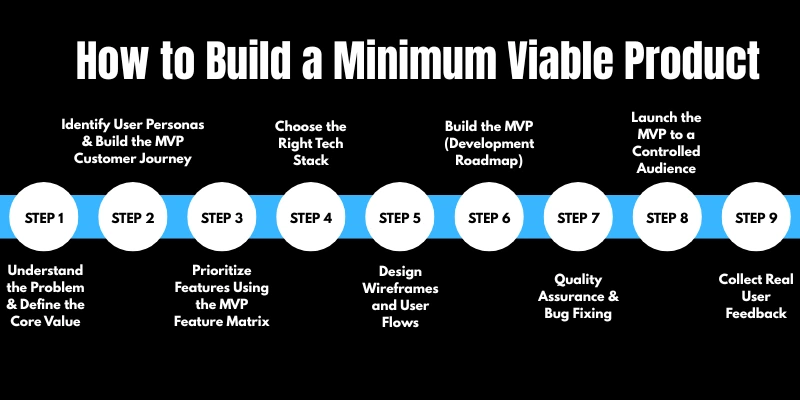
Building a Minimum Viable Product (MVP) is a critical step for any startup aiming to validate its idea, attract early users, and secure funding. A well-planned mvp product development process ensures that every stage—from ideation to launch—is efficient, measurable, and focused on delivering real-world results. In 2026, the rise of Artificial Intelligence Apps has transformed MVP strategies, allowing startups to integrate AI-driven features early, accelerate development, and gather actionable user insights faster than ever.
Step 1 — Identify the Core Problem
The foundation of any successful MVP is a clear understanding of the problem it intends to solve. Without proper problem identification, even the best technology stack or user interface can fail to gain traction.
Market Research Methods
- Customer Pain Points – Conduct surveys, interviews, and social listening to uncover recurring frustrations in your target market. Tools like Typeform, Google Forms, and LinkedIn polls can provide actionable insights.
- Industry Gaps – Analyze competitors’ offerings to identify where their solutions fall short. Look at product reviews, app ratings, and forum discussions to spot unmet needs.
- Problem Validation – Validate the problem before building by creating a small landing page, pre-launch signups, or a “smoke test” campaign to measure interest. Even a minimal campaign can reveal whether users are actively seeking a solution.
Step 2 — Define Target Users
Once the core problem is clear, the next step is to understand who you are building for. Targeting the right audience ensures your mvp development for startups is focused and efficient.
User Personas and Segmentation
- Personas – Create 2–5 detailed profiles including age, occupation, tech proficiency, and key motivations. For instance, a B2B SaaS product might target “Busy Executives” who need time-saving automation tools.
- Behavioral Patterns – Map out how users interact with similar products. Do they prefer mobile over web? Do they consume content via social media or email newsletters?
- Customer Segments – Group users by demographics, psychographics, and usage frequency. This helps prioritize features for MVP launch, ensuring maximum relevance.
Step 3 — Prioritize Core Features
Feature prioritization is critical to avoid “feature bloat,” which can derail timelines and inflate budgets. A lean MVP focuses on the essential functionality that delivers the highest value.
Frameworks to Prioritize Features:
- MoSCoW Model – Classify features as Must-have, Should-have, Could-have, and Won’t-have. Ensures focus on essentials first.
- Value vs Complexity Matrix – Plot features on a grid by value to users versus development effort. Prioritize high-value, low-complexity features for the MVP.
- RICE or ICE Scoring – Quantify reach, impact, confidence, and effort to make objective decisions.
Step 4 — Choose the Right Technology Stack
Selecting the appropriate technology stack ensures your MVP is scalable, maintainable, and efficient. Modern mvp software development services rely on flexible, cross-platform tools to accelerate launch timelines.
Recommended Technology Options:
- Frontend: React Native, Flutter (cross-platform mobile)
- Backend: Node.js, Python (fast iteration, scalable APIs)
- Database: MongoDB, PostgreSQL (flexible schemas for evolving data needs)
- Cloud/Hosting: AWS, Firebase, Vercel (scalable, secure, and fast deployment)
Scalability Considerations:
- Use cloud services that allow on-demand scaling.
- Design a modular architecture to accommodate future features without complete rewrites.
Step 5 — Design User Experience and Wireframes
A strong user experience (UX) can make or break an MVP. Even with minimal features, the product must be intuitive and delightful to encourage adoption.
Design Focus Areas:
- Wireframing – Sketch low-fidelity layouts to define core flows before coding. Tools: Figma, Sketch, Adobe XD.
- User Journey Mapping – Identify key touchpoints from onboarding to first successful action. Optimize the “core loop” that delivers the main value.
- Usability Optimization – Test wireframes with a small set of users. Track confusion points and adjust before development.
Step 6 — Build the MVP Application
With research, features, tech stack, and UX in place, the MVP can now be developed. This step converts planning into a tangible product.
Development Stages:
- Backend Architecture – APIs, database integration, and server-side logic.
- Frontend Interfaces – User-facing screens optimized for simplicity and speed.
- API Integration – Payment gateways, authentication, or third-party services.
Step 7 — Test the MVP Product
Even a minimal product requires thorough quality assurance to ensure reliability.
Testing Practices:
- Functional Testing – Verify all features work as intended.
- Security Testing – Ensure data privacy and protection, especially for web and mobile apps handling sensitive info.
- Usability Testing – Observe real users interacting with the MVP to detect friction points.
Step 8 — Launch MVP to Early Users
A controlled launch allows you to validate assumptions and collect real-world feedback.
Soft Launch Strategies:
- Beta Release – Invite 50–500 target users to test the MVP.
- Product Communities – Engage niche communities on platforms like Reddit, Discord, or LinkedIn groups.
- Targeted Campaigns – Email outreach, social media teasers, or pre-launch landing pages.
Step 9 — Collect Feedback and Improve the Product
The mvp product development process is iterative. Continuous improvement based on user feedback is the lifeblood of a successful MVP.
Feedback & Iteration Tools:
- Surveys and NPS scores to gauge satisfaction
- Analytics dashboards (Mixpanel, Amplitude, Google Analytics)
- Session recording and heatmaps (Hotjar, FullStory)
Iteration Strategy:
- Prioritize changes based on impact and feasibility.
- Release frequent minor updates to demonstrate responsiveness.
MVP Development Cost in 2026
Understanding the cost of MVP app development is critical for startups planning their product journey. In 2026, mvp development budgets vary widely depending on complexity, region, and the type of development team you hire. Accurate budgeting ensures startups can validate their product idea without overspending, attract investors, and scale efficiently.
MVP Cost by Complexity
The complexity of your MVP directly impacts the development cost. Generally, MVPs fall into three categories: Simple, Medium, and AI-based.
Simple MVP
- Definition: Core functionality only; minimal screens and features.
- Examples: Basic login, product listing, or booking functionality.
- Development Time: 2–4 weeks
- Estimated Cost: $10K–$50K USD
- Best For: Startups validating demand quickly with minimal resources.
Medium Complexity MVP
- Definition: Includes advanced features such as payments, analytics dashboards, or integrations.
- Development Time: 4–8 weeks
- Estimated Cost: $50K–$150K USD
- Best For: Startups aiming for early traction and stronger investor confidence.
AI-Based MVP
- Definition: Incorporates AI/ML features, personalization, or predictive analytics.
- Development Time: 8–12 weeks
- Estimated Cost: $100K–$300K USD
- Best For: Startups in healthtech, fintech, or e-commerce leveraging AI-driven differentiation.
Pro Tip: Leveraging no-code or low-code tools in 2026 can reduce costs by 20–30% without sacrificing validation speed.
MVP Cost by Region
Development costs also vary significantly based on the region of your development team:
- North America: $100K–$250K for mid-level MVPs; high-quality talent but higher labor costs.
- Europe: $70K–$180K; GDPR expertise adds value for global compliance.
- India: $30K–$80K; cost-effective while maintaining high-quality English-speaking developers.
- Middle East (e.g., UAE): $60K–$120K; proximity to MENA markets and tax benefits, especially useful if hiring a premium app development company in uae.
Regional differences often reflect labor costs, compliance requirements, and infrastructure availability. Startups can balance cost and quality by choosing hybrid teams.
MVP Cost by Development Team
Startups have three main options for building their MVP, each with pros and cons:
Freelancers
- Pros: Affordable (30–50% savings vs. in-house), flexible schedules.
- Cons: Risk of inconsistency, communication delays, limited accountability.
- Best For: Small MVPs with limited features or experimental prototypes.
In-House Team
- Pros: Full control over development, better team alignment.
- Cons: High overhead (20–30%), longer ramp-up times, recruitment challenges.
- Best For: Startups planning long-term product ownership.
Professional MVP Software Development Services
- Pros: Expert development, faster time-to-market, scalable solutions.
- Cons: Slightly higher upfront cost, potential coordination with internal teams.
- Best For: Startups wanting a reliable, polished product; often collaborate with a web and mobile app development company in uae for end-to-end delivery.
For early-stage startups, professional mvp software development services often provide the best balance between speed, quality, and investor confidence.
Real Startup Examples of Successful MVP Development
Learning from top startups highlights why mvp development for startups is a game-changer:
- Dropbox (2007): MVP was a 3-minute demo video showing file-syncing functionality. Result: 75,000 users signed up pre-launch. Early traction attracted $1.2M seed funding.
- Airbnb (2007): MVP involved renting air mattresses during a conference. Result: $1,000 revenue validated demand; $600K seed funding followed.
- Spotify (2006): Desktop streaming MVP in Sweden avoided piracy issues and tested regional interest. Result: €21.6M raised; 626M users today.
- Slack (2013): Internal communication tool MVP for Tiny Speck. Result: $427M Series D; product pivot from gaming failure led to $2.8B enterprise value.
These examples demonstrate how focused mvp app development reduces risk, validates ideas, and accelerates funding opportunities.
How Startups Raise Funding After MVP Launch
Once your MVP demonstrates traction, fundraising becomes more straightforward.
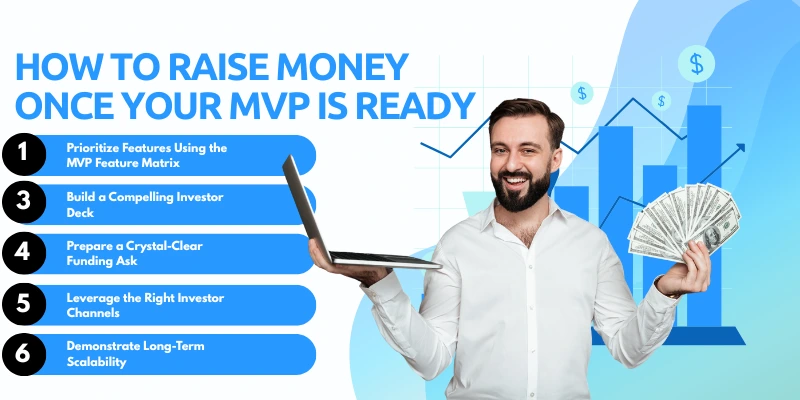
What Investors Look for in MVP Startups
Key metrics that attract investors:
- User Growth: Daily and monthly active users.
- Engagement: Core feature usage and retention rates.
- Revenue Potential: Early monetization and unit economics.
- Scalability: Product architecture and growth potential.
Where to Find Startup Investors
Funding options include:
- Angel Investors: AngelList syndicates or individual investors.
- Venture Capital Firms: Sequoia, a16z, Techstars.
- Startup Accelerators: Y Combinator, 500 Global, local programs.
Building an Effective Pitch Deck
Essential components:
- Problem
- Solution
- Traction (early MVP metrics)
- Market Opportunity
- Revenue Model
- Team Credentials
Legal Preparation for Funding
Startups should prepare:
- Company formation (Delaware C-Corp for US funding, UAE freezone options)
- Intellectual property protection (provisional patents, NDAs)
- Compliance (GDPR, HIPAA if applicable)
Advanced MVP Strategies for 2026 Startups
AI-Driven MVP Development
- Use AI to automate tasks, personalize user experience, or optimize analytics.
- Examples: GPT-based recommendation engines, predictive analytics dashboards.
Growth Loops for MVP Products
- Leverage viral loops: action → reward → next action.
- Example: Dropbox incentivized referrals with extra storage space.
Scalable Product Architecture
- Adopt microservices, serverless architecture, and cloud infrastructure from day one.
- Ensures your MVP can scale without major rewrites.
Security and Compliance
- Build security in: OAuth2, zero-trust models, encrypted storage.
- Ensure compliance with GDPR, HIPAA, PCI-DSS as relevant.
Conclusion: Building a Successful MVP in 2026
- Validate your startup idea: Reduce risks by testing with real users.
- Reduce development costs: Focus on essential features first.
- Attract investors: Demonstrated traction increases funding odds.
- Accelerate product growth: Early feedback enables smarter pivots.
Encourage founders to start their MVP journey today, leveraging mvp development and mvp app development strategies to secure both users and funding.