
Introduction
Building a game today is rarely just a matter of writing code. A production-ready title usually demands game design, prototyping, Unity or Unreal engineering, 2D/3D art, animation and VFX, multiplayer infrastructure, backend development, QA and performance testing, platform optimization, porting, certification, analytics, and — increasingly — live operations that continue long after launch day.
Few studios, especially indie teams and mid-sized developers, have every one of these disciplines fully staffed in-house. That gap is exactly what game development services exist to close. Game development services allow studios to access specialized capabilities, additional production capacity, technology expertise, or an entire development pipeline without necessarily building every function internally.
For projects that need tailored gameplay systems, custom technology, unusual platform combinations, or non-standard business models, custom game development for gaming becomes the natural approach — a way to shape every layer of the game around the studio's specific vision rather than working within the limits of an off-the-shelf template.
Quick Answer
What are game development services? Game development services are specialized offerings — spanning design, engineering, art, QA, porting, and live operations — that studios hire externally to build all or part of a game. They let teams fill skill gaps, add production capacity, or access technology expertise without expanding their permanent headcount.
What Are Game Development Services?
"Game development services" is a broad umbrella term, and studios evaluating providers should understand that not every company under that umbrella offers the same thing. It helps to separate four distinct roles:
- A game development service provider typically offers a range of production capabilities — design, engineering, art, QA — that can be combined depending on the project.
- An asset or vendor provider focuses narrowly on a deliverable, such as 3D models, sound design, or localization, without owning broader production responsibility.
- A co-development partner works alongside an existing internal team, sharing responsibility for specific systems or content while the original studio retains creative direction.
- A full-cycle game development company can take a project from concept through launch and into live operations, managing the entire pipeline.
Within these roles, the actual scope of work spans concept development, game design, prototyping, engineering, art production, animation, audio integration, backend development, multiplayer systems, QA, porting, deployment, and live operations.
It's worth being direct about one thing: not every provider genuinely offers everything on that list. Studios should evaluate a potential partner based on demonstrable capabilities — a portfolio that matches the project's genre and platform, technical expertise proven through prior work, a coherent delivery methodology, and a team composition that actually covers the skills the project needs. Claims of full-service capability are only useful when backed by evidence.
When Should a Studio Use Custom Game Development Services?
When internal development capacity is limited
Not every studio needs — or can afford — a permanent team large enough to handle peak production demand. External specialists can fill temporary gaps during a production crunch or cover permanent gaps for capabilities the studio doesn't plan to build in-house at all, such as console porting or backend infrastructure.
When specialized technical expertise is required
Some systems demand deep, narrow expertise that's expensive to maintain year-round: multiplayer networking, cloud infrastructure, AI-driven systems, AR/VR development, advanced Unreal Engine rendering, Unity cross-platform pipelines, or performance optimization for constrained hardware. Bringing in specialists for these areas is often more efficient than training generalist staff from scratch.
When entering a new platform
Moving from mobile to PC, PC to console, or into web and XR environments introduces new certification requirements, input models, and performance constraints. Studios entering unfamiliar platforms often benefit from partners who already understand that platform's specific pitfalls.
When production timelines are aggressive
Additional teams or co-development pods can expand production capacity quickly, without the lead time of a full internal hiring cycle — which, for specialized roles, can take months.
When post-launch operations require dedicated specialists
Launch is often just the midpoint of a game's real lifecycle. Updates, bug fixes, content releases, analytics review, performance tuning, player retention work, and live events all require sustained attention that many internal teams aren't structured to provide indefinitely.
Types of Game Development Services
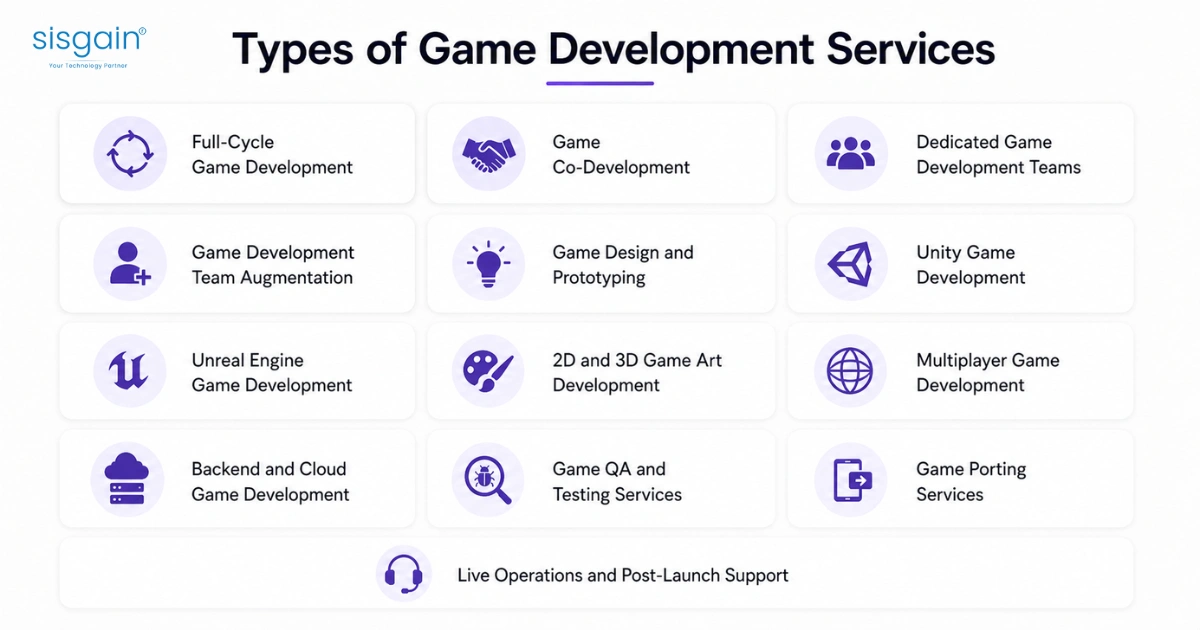
Studios don't have to choose between building everything internally or outsourcing an entire project. Game development capabilities can be purchased modularly — a studio might keep creative direction in-house while bringing in a specialist team for one system, such as multiplayer or porting.
Full-Cycle Game Development
Full-cycle development covers the whole journey: discovery, game design, prototyping, pre-production, production, QA, optimization, certification, launch, and live operations. This model makes sense for studios that want a single accountable partner managing the entire pipeline — often useful for teams without an established internal production process, or those launching their first title.
Game Co-Development
In co-development, production responsibility is shared. The original studio retains creative direction while an external team handles specific systems or production areas. For example, a publisher might own the core game while an external team builds multiplayer infrastructure, additional content, platform ports, or specific gameplay systems. This model is useful primarily for capacity expansion rather than full outsourcing.
Dedicated Game Development Teams
A dedicated team model provides a group of developers, designers, artists, QA engineers, project managers, and technical specialists who work exclusively (or near-exclusively) on the studio's project over an extended period. This offers continuity and deep familiarity with the codebase, though it typically requires a longer-term commitment than short-term augmentation.
Game Development Team Augmentation
Staff augmentation differs from a dedicated team in scope and duration. It's designed to close specific skill gaps or add short-term capacity — bringing in, say, a single specialized multiplayer engineer for a few months — while the studio's existing project structure and management remain intact. It offers flexible scaling but less of the deep continuity a dedicated team provides.
Game Design and Prototyping
This covers game mechanics, player journeys, core loops, monetization concepts, game economy design, UX, prototypes, vertical slices, and playtesting. Early prototyping is one of the highest-leverage investments in a project, because it validates whether the core gameplay loop is fun before the studio commits to expensive full production.
Unity Game Development
Unity work spans 2D and 3D development, mobile games, cross-platform builds, AR/VR, rapid prototyping, multiplayer, and performance optimization. Unity tends to be strategically appropriate when a project prioritizes cross-platform deployment, rapid iteration cycles, mobile-first release, or XR experiences — rather than simply because it's a popular engine. The right choice ultimately depends on the game's specific technical and visual requirements.
Unreal Engine Game Development
Unreal work typically covers high-fidelity 3D, PC and console titles, realistic environments, advanced rendering, multiplayer, simulation, virtual production, and XR. Unreal tends to fit projects that prioritize visual fidelity, complex rendering, or console-grade performance over rapid cross-platform iteration.
A brief Unity vs. Unreal decision framework:
|
Consideration |
Favors Unity |
Favors Unreal Engine |
|
Primary platform |
Mobile, cross-platform |
PC, console |
|
Visual fidelity target |
Stylized, mid-fidelity |
High-fidelity, realistic rendering |
|
Iteration speed |
Faster prototyping |
Slower but more powerful pipeline |
|
Team's existing skill set |
C# familiarity |
C++ familiarity |
|
XR requirements |
Strong support |
Strong support, more render-heavy |
|
Budget for tooling/rendering |
Lower |
Often higher |
2D and 3D Game Art Development
Art production covers character design, environment design, props, UI assets, 2D illustration, 3D modeling, texturing, rigging, animation, and VFX. An integrated art pipeline — where concept, modeling, texturing, and animation stages are coordinated rather than handled in isolation — matters more to final quality and schedule than any single artist's individual skill.
Multiplayer Game Development
Multiplayer systems involve real-time networking, matchmaking, player sessions, authentication, leaderboards, game servers, cloud infrastructure, scalability planning, anti-cheat considerations, and network performance tuning. Multiplayer architecture is something that should be planned early in production, not added as an afterthought — retrofitting networking into a game built for single-player is significantly more expensive than designing for it from the start.
Backend and Cloud Game Development
Backend work includes APIs, databases, player accounts, cloud infrastructure, data synchronization, analytics pipelines, notifications, content management, and server scaling. This layer is often invisible to players but determines whether a game can actually support live updates, persistent progression, and growth in its player base. Much of this infrastructure overlaps with broader enterprise engineering practices — teams building this layer often draw on the same architectural discipline used in Software Application Development Dubai projects outside of gaming.
Game QA and Testing Services
QA covers functional testing, compatibility testing, regression testing, performance testing, multiplayer testing, device testing, security testing, usability testing, load testing, and certification testing. QA works best as a continuous discipline running throughout development — a "shift-left" approach — rather than a single pass squeezed in right before launch, when there's little time left to fix what's found.
Game Porting Services
Porting moves a game between mobile, PC, console, web, and XR platforms. It involves UI adaptation, input system changes, performance tuning, accounting for hardware differences, meeting platform-specific requirements, certification, and optimization. Each target platform brings its own constraints, so porting is rarely a simple recompile. For teams porting into or launching within the mobile-first Gulf market specifically, this often overlaps with broader mobile app development solutions in UAE, where regional device fragmentation and network conditions add another layer of testing.
Live Operations and Post-Launch Support
Launch doesn't have to be the finish line. Live operations cover content updates, seasonal events, bug fixing, performance optimization, analytics review, player feedback integration, feature releases, monetization tuning, infrastructure monitoring, and security updates. For games built around ongoing engagement, live operations can represent a larger long-term investment than the original production itself.
Technologies Used in Modern Game Development
|
Technology Area |
Examples |
Typical Use |
|
Game Engines |
Unity, Unreal Engine |
Game production |
|
Programming |
C#, C++, JavaScript/TypeScript, Python |
Gameplay, backend, tooling |
|
Mobile |
iOS, Android |
Mobile gaming |
|
Cloud |
AWS, Azure, Google Cloud |
Multiplayer, backend infrastructure |
|
Databases |
PostgreSQL, MySQL, MongoDB |
Player and game data |
|
AI |
ML models, generative AI, AI agents |
NPCs, personalization, workflow automation |
|
XR |
AR, VR, MR |
Immersive experiences |
|
DevOps |
Docker, Kubernetes, CI/CD |
Deployment and scalability |
|
Analytics |
Player analytics platforms |
Engagement and retention tracking |
Technology choices should follow the project's requirements — target platform, expected scale, visual ambitions, and team skill sets — rather than following whatever is trending. A studio building a small mobile puzzle game and one building a persistent multiplayer shooter will land on very different stacks even if both call themselves "game development." This is also why development partners who use many technologies rather than a single narrow stack tend to be better positioned to recommend the right combination for a specific project instead of defaulting to whatever they know best.
How AI Is Changing Game Development Services in 2026
AI is increasingly present across the production pipeline, but it's most useful understood as a set of tools that assist specific tasks — not as a replacement for the creative and engineering judgment that shapes a game.
AI-assisted game design. AI can support idea exploration, gameplay balancing analysis, procedural content generation, and game economy modeling, giving designers faster ways to test variations before committing to a direction.
AI for NPCs and game characters. Dynamic dialogue systems, adaptive enemy or companion behavior, and more personalized player interactions are increasingly built with AI-driven systems rather than purely scripted logic trees.
AI-assisted art and asset workflows. AI tools can speed up concept ideation, asset iteration, texture workflows, and animation assistance. This comes with real caveats: teams need to actively manage IP and licensing risk, verify originality, and apply human review to anything AI-assisted before it ships.
AI for testing. Automated test scenario generation, bug detection, regression testing, and gameplay behavior testing can all be accelerated with AI tooling, catching issues that manual testing might miss or take longer to surface.
AI-powered player analytics. Churn prediction, player segmentation, engagement analysis, and personalization increasingly rely on AI models applied to live player data.
It's worth being clear about the boundary here: there's a real difference between AI-assisted development, where AI tools support human decision-making at specific steps, and fully autonomous game development, which isn't a realistic description of how production-quality games get made. Human creative direction, engineering decisions, QA judgment, product management, and production governance remain central to shipping a game that actually works and holds together as a coherent experience. The same governance principles apply to AI applications built outside of gaming — the technology changes the workflow, not the need for human oversight.
How Does the Custom Game Development Process Work?
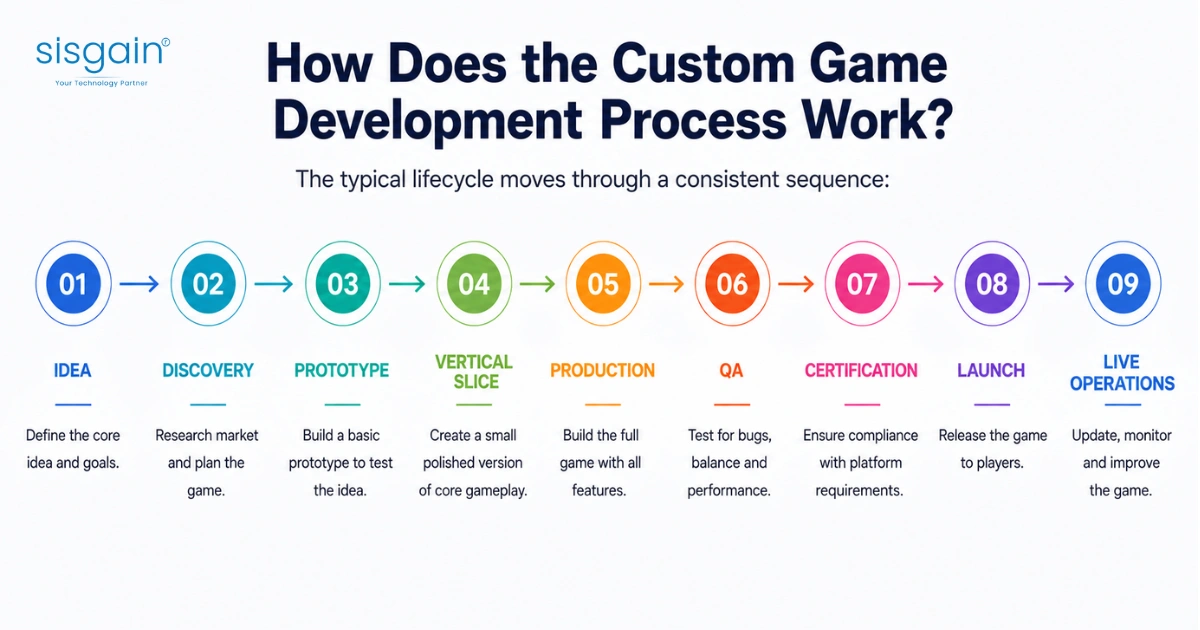
The typical lifecycle moves through a consistent sequence:
Idea → Discovery → Prototype → Vertical Slice → Production → QA → Certification → Launch → Live Operations.
Stage 1 — Discovery and Requirements. This stage defines the game concept, target audience, genre, platform, business objectives, technical requirements, budget range, and timeline. The typical deliverable is a game development brief that both sides use as a shared reference point.
Stage 2 — Game Design and Pre-Production. Here the team develops the Game Design Document (GDD), core mechanics, game loop, art direction, technical architecture, monetization approach, and a production roadmap.
Stage 3 — Prototype. Before committing to full production, studios should validate that the core gameplay loop is actually fun and functional. A prototype is the cheapest point in the project to discover that a mechanic doesn't work.
Stage 4 — Vertical Slice. A vertical slice demonstrates a representative section of the final game at near-production quality — testing art, gameplay, performance, technology, and UX together, rather than in isolation.
Stage 5 — Full Production. This is where the bulk of the work happens: programming, art, animation, level design, backend systems, multiplayer implementation, and integration of all the pieces built earlier.
Stage 6 — QA and Optimization. Functional QA, device testing, performance tuning, security review, multiplayer testing, and regression testing all run through this stage, ideally overlapping with production rather than following it entirely.
Stage 7 — Certification and Launch. Each platform has its own certification requirements and release preparation steps that need to be planned well ahead of the target launch date.
Stage 8 — Live Operations. Post-launch work includes monitoring, updates, new content, analytics review, player feedback, and ongoing optimization.
Full-Cycle vs. Co-Development vs. Dedicated Team vs. Staff Augmentation
|
Model |
Best For |
Control |
Scalability |
Typical Use |
|
Full-Cycle |
Studios needing complete production |
High, through partner governance |
High |
New game production |
|
Co-Development |
Existing studios needing specialist capacity |
Shared |
High |
Specific systems or content |
|
Dedicated Team |
Long-term development |
High |
High |
Ongoing production |
|
Staff Augmentation |
Filling specific skill gaps |
Very high internally |
Medium |
Short-term expertise |
Which engagement model is right for your studio?
The right choice depends on several factors working together, rather than any single one:
- Existing team size — a small internal team may need full-cycle support; a larger one may only need augmentation.
- Internal expertise — gaps in specific disciplines (multiplayer, porting, AR/VR) point toward co-development or augmentation.
- Project stage — early concept work often benefits from full-cycle guidance; a project already in production may just need capacity.
- Timeline — aggressive deadlines usually favor models that can scale quickly, like augmentation or co-development pods.
- Budget — fixed-scope full-cycle engagements versus flexible, capacity-based augmentation carry different cost structures.
- Required control — studios wanting to retain full creative and technical control may prefer augmentation or co-development over full outsourcing.
- Technology complexity — highly specialized systems (networking, AI, cloud) often justify bringing in dedicated specialists.
- Long-term support needs — games with an expected long live-service life benefit from partners who can commit to ongoing operations, not just a one-time build.
How Much Do Game Development Services Cost?
There is no single price for custom game development, because production cost is determined by scope, technology, content volume, platform requirements, team composition, and post-launch expectations. Any quoted range that doesn't account for these variables should be treated with caution.
Major Factors Affecting Game Development Cost
- Game genre
- Platform (mobile, PC, console, web, XR)
- 2D vs. 3D production
- Art complexity
- Number of characters
- Number of levels or content volume
- Multiplayer requirements
- Backend infrastructure needs
- AI functionality
- AR/VR requirements
- Third-party integrations
- QA scope
- Certification requirements
- Porting needs
- Live operations plans
How to Get a More Accurate Game Development Estimate
- Prepare a game concept brief.
- Define target platforms.
- Document core features.
- Define art direction.
- Identify multiplayer requirements.
- Estimate content volume.
- Conduct technical discovery with the prospective partner.
- Break development into milestones.
- Request a detailed, itemized proposal rather than a single lump-sum figure.
Working through discovery and estimation properly up front is one of the most reliable ways to avoid budget surprises later in production. Game budgets are also worth viewing alongside broader industry benchmarks — the same factors that drive software development cost in 2026 generally, such as integration complexity and post-launch support, apply directly to game projects too.
How Long Does Custom Game Development Take?
Timelines vary widely because they depend on game complexity, genre, the number of target platforms, team size, art requirements, multiplayer scope, backend needs, testing depth, certification processes, and how much scope changes during development.
The conceptual lifecycle remains consistent regardless of project size:
Discovery → Prototype → Vertical Slice → Production → QA → Launch → Live Ops.
Studios should be wary of any partner promising a fixed, universal timeline before discovery has actually defined the scope — realistic estimates only become possible once the brief, platform list, and content volume are clear.
Common Game Development Risks and How to Manage Them
|
Risk |
Why It Happens |
Mitigation |
|
Scope creep |
Poor requirements definition |
Milestone-based scope management |
|
Budget overruns |
Unclear complexity at the outset |
Thorough discovery and estimation |
|
Technical debt |
Rapid, unplanned development |
Upfront architecture planning |
|
Poor performance |
Optimization left too late |
Continuous profiling throughout production |
|
QA problems |
Testing starts too late |
Shift-left QA integrated from early stages |
|
Asset delays |
Weak production pipeline |
Structured production tracking |
|
Ownership disputes |
Unclear contracts |
Explicit IP clauses from the start |
|
Multiplayer instability |
Poor network architecture |
Early and ongoing network testing |
|
Launch delays |
Certification issues discovered late |
Early platform requirement planning |
|
Post-launch problems |
No live-ops strategy in place |
Dedicated live operations planning |
How to Choose the Right Game Development Company
Evaluate Technical Expertise
Check the provider's actual depth in Unity, Unreal, backend systems, multiplayer, cloud infrastructure, mobile, PC, console, AR/VR, and AI — not just whether these appear on a services page.
Evaluate Relevant Portfolio Experience
The number of past projects matters less than their relevance. Look for similar genre, similar platform, similar technical complexity, similar target audience, and similar production scale to your own project.
Examine Development Methodology
Ask how milestones are defined, how scope is managed when requirements shift, how often builds are delivered, how QA is integrated into the schedule, and how risks are reported as they arise.
Review Security and IP Ownership
Confirm NDA terms, source-code ownership, asset ownership, IP rights, repository access policies, data protection practices, and how third-party licensing is handled.
Assess Communication and Governance
Understand who the project manager is, what reporting cadence to expect, whether sprint reviews are part of the process, what documentation is provided, what the escalation process looks like, and which collaboration tools are used.
Ask for Evidence
Request case studies, client references, a technical portfolio, evidence of team expertise, a clear description of development methodology, and any relevant certifications. Learning how to verify a vendor's claims is more valuable than any single claim itself — and a credible partner will welcome the scrutiny.
In-House vs. Outsourced Game Development: Which Is Better?
|
Factor |
In-House |
Outsourced |
Hybrid |
|
Control |
High |
Medium–High |
High |
|
Hiring effort |
High |
Low |
Medium |
|
Specialist access |
Limited by hiring |
High |
High |
|
Scalability |
Slower |
Faster |
High |
|
Institutional knowledge |
Strong |
Partner-dependent |
Strong |
|
Cost structure |
Fixed team costs |
Variable |
Mixed |
|
Best for |
Long-term internal capability |
Capacity or specialist needs |
Growing studios |
There isn't a universally "better" option here — the right approach depends on the studio's maturity, available resources, and the specific requirements of the project at hand. A studio building long-term internal capability may lean in-house; one that needs to move fast on a single title may lean outsourced; many growing studios land somewhere in between.
Game Development Opportunities in the UAE and MENA
The regional gaming ecosystem across the UAE and broader MENA region has been growing, supported by Saudi Arabia's expanding gaming ambitions, Dubai's developing gaming ecosystem, and increased regional investment activity. Studios entering this market typically need to think about localized content, Arabic language support, regional payment considerations, culturally appropriate UX, robust multiplayer infrastructure for regional player bases, and a go-to-market strategy tailored to local platforms and audiences. Studios evaluating local partners often start by researching an established gaming app development company in Dubai that already understands these regional nuances rather than adapting a global playbook after the fact.
This regional momentum is part of a broader pattern — gaming is one piece of a much larger wave of digital transformation in the UAE across entertainment, retail, and public-sector technology, which is also shaping the infrastructure and talent pool available to game studios operating in the region.
Localized development considerations
Entering the MENA market successfully generally requires:
- Arabic localization
- RTL (right-to-left) UX considerations
- Cultural adaptation of content and mechanics
- Regional marketing approaches
- Regional payment method support
- Local player behavior analysis
- Cloud infrastructure that scales for the region's player base
Where Game Development Technologies Are Used Beyond Entertainment
Game engines and production techniques increasingly extend well past entertainment titles.
Training and simulation. Employee training, industrial simulation, healthcare training, and aviation training all draw on interactive, engine-driven environments originally developed for games.
Education. Interactive learning tools, gamification of coursework, and virtual learning environments apply game mechanics to educational outcomes.
Healthcare. Medical simulations, rehabilitation experiences, and patient education tools use game technology to create safe, repeatable, interactive environments.
Marketing and brand experiences. Interactive campaigns, branded virtual environments, and immersive product experiences increasingly borrow directly from game development pipelines.
AR/VR experiences. Beyond games, AR and VR technologies built on game engines support everything from product visualization to remote collaboration and immersive training. Studios and businesses exploring this space typically evaluate dedicated AR/VR development services separately from core game production, since the platforms, hardware targets, and UX considerations differ meaningfully from a standard game build.
Game Development Checklist Before Launch
- Core gameplay loop validated
- Game mechanics tested
- Performance targets defined
- Device/platform compatibility tested
- Multiplayer tested if applicable
- Backend load tested
- Security reviewed
- Analytics implemented
- Monetization tested where applicable
- Localization completed
- Accessibility considered
- Platform certification completed
- Crash monitoring configured
- Post-launch support plan prepared
- Update/content roadmap prepared
15 Questions to Ask Before Hiring a Game Development Company
- Have you developed games for our target platform?
- Which game engines do you specialize in?
- Can you support multiplayer development?
- How do you structure milestones?
- Who owns the source code?
- Who owns the game IP?
- How is QA handled throughout the project?
- How do you manage scope changes?
- What happens if the project timeline changes?
- Can your team scale up or down during production?
- Do you provide post-launch support?
- How do you handle security?
- What development documentation will we receive?
- How frequently will we receive builds?
- Can you provide relevant case studies or references?