
Software development in Dubai typically costs between AED 50,000 for a focused MVP and AED 2.5 million+ for a complex enterprise platform. That's a wide spread — and if you've already read a few generic pricing guides, you've probably noticed most of them stop at a single "average" number and call it a day.
The problem is that a healthcare portal, a fintech wallet, and a restaurant ordering app all technically fall under "software," but they don't remotely belong in the same budget conversation. One requires DHA-aligned patient workflows and encrypted health records; another requires KYC checks and PCI-DSS compliance; the third mostly needs a solid POS integration and a delivery tracking screen. Treating them as one market average is exactly why so many buyers walk into vendor calls with the wrong number in their head.
This guide breaks down realistic 2026 cost of software development in Dubai across 22 industries — healthcare, fintech, logistics, real estate, eCommerce, aviation, hospitality, utilities, government, and more — so you can budget against your actual sector instead of a generic median. We'll also cover what each budget tier actually gets you, the Dubai-specific factors that move the needle, and a simple formula for estimating your own project cost.
Pricing note: every figure below is an indicative 2026 planning range in AED for custom software development. Final cost depends on scope, UI/UX complexity, integrations, security, data migration, compliance, cloud architecture, and delivery model. These are budgeting inputs, not quotations.
Software Development Cost Dubai Businesses Should Plan For: Quick Overview
Before the industry breakdown, here's the baseline framework used throughout this guide. Every project, regardless of sector, tends to land in one of four tiers.
|
Build Level |
Typical Budget (AED) |
Typical Duration |
Best Fit |
|
Prototype / narrow MVP |
50,000 – 150,000 |
2–4 months |
Validation, an internal workflow, or one focused customer journey |
|
Production MVP |
150,000 – 350,000 |
3–6 months |
Startup launches and single-business-unit rollouts |
|
Growth platform |
350,000 – 900,000 |
6–10 months |
Multi-role systems, integrations, mobile apps, analytics |
|
Enterprise platform |
900,000 – 2,500,000+ |
9–24+ months |
Regulated, high-scale, multi-entity, AI-enabled, legacy-integrated platforms |
A broad Dubai custom-software project commonly falls between AED 146,000 and AED 1.8 million+, and enterprise-grade platforms with regulated workflows, AI, legacy integrations, or multi-entity operations routinely exceed that ceiling. As a working number: budget AED 150,000–350,000 for a lean, production-ready MVP, and expect that to climb past AED 350,000 the moment you add multiple user roles, third-party integrations, or a mobile app alongside your web platform.
Want a number specific to your product rather than a market range?
Get a preliminary cost range in 48 hours.
Custom Software Development Cost in Dubai, by Industry
This is where a generic cost page usually stops short — and where the real budgeting decisions actually happen. The table below assumes a custom platform, mobile app, or operational system, not a brochure website or a basic no-code form.
|
Industry |
Typical Software Examples |
MVP / Focused Solution |
Growth Platform |
Enterprise Ecosystem |
Main Cost Drivers |
|
Healthcare |
Telemedicine, patient portal, clinic management, EHR integrations |
AED 100k–250k |
AED 250k–750k |
AED 750k–1.8m+ |
Patient data, DHA/MOHAP workflows, EHR, secure video, interoperability |
|
Fintech |
Wallet, BNPL, lending, wealthtech, payments |
AED 220k–440k |
AED 440k–1.1m |
AED 1.1m–5.5m+ |
KYC/AML, PCI-DSS, fraud prevention, open banking, payment rails |
|
Aviation |
Booking, crew, airport operations, maintenance systems |
AED 200k–500k |
AED 500k–1.2m |
AED 1.2m–3m+ |
Real-time data, flight APIs, IoT, safety workflows, high availability |
|
Real Estate |
Property portal, CRM, broker app, tenant platform |
AED 120k–250k |
AED 250k–650k |
AED 650k–1.5m+ |
Listings, CRM, maps, payments, document workflows, multilingual UX |
|
Logistics |
Fleet, dispatch, warehouse, delivery tracking |
AED 150k–300k |
AED 300k–800k |
AED 800k–2m+ |
GPS, routing, IoT, WMS/ERP, driver apps, real-time notifications |
|
Gaming |
Casual game, multiplayer app, game platform |
AED 150k–350k |
AED 350k–1m |
AED 1m–3m+ |
Game engine, 3D assets, multiplayer infrastructure, live ops |
|
Food & Beverages |
Restaurant app, delivery, ordering, kitchen system |
AED 100k–220k |
AED 220k–600k |
AED 600k–1.5m+ |
POS, delivery, loyalty, kitchen display, inventory |
|
Travel |
Booking app, itinerary, OTA, travel marketplace |
AED 150k–300k |
AED 300k–850k |
AED 850k–2m+ |
GDS/APIs, inventory, dynamic pricing, multilingual support |
|
Fitness |
Gym management, fitness app, trainer marketplace |
AED 80k–180k |
AED 180k–450k |
AED 450k–1m+ |
Wearables, subscriptions, video, bookings, analytics |
|
eCommerce |
D2C store, marketplace, B2B commerce platform |
AED 120k–300k |
AED 300k–900k |
AED 900k–2.5m+ |
Payments, inventory, OMS, personalization, fulfilment |
|
Government |
Citizen portal, workflow automation, service platform |
AED 300k–700k |
AED 700k–2m |
AED 2m–5m+ |
Security, Arabic UX, integrations, governance, procurement |
|
Mining |
Asset monitoring, safety, field operations, predictive maintenance |
AED 200k–500k |
AED 500k–1.5m |
AED 1.5m–4m+ |
IoT, OT/IT integration, offline use, geospatial data |
|
Media & Entertainment |
OTT, content platform, media workflow, streaming |
AED 150k–350k |
AED 350k–1m |
AED 1m–3m+ |
Video delivery, DRM, CDN, subscriptions, recommendations |
|
Hospitality |
Hotel app, PMS integration, booking, guest experience |
AED 120k–280k |
AED 280k–750k |
AED 750k–2m+ |
PMS, channel manager, booking engine, loyalty |
|
Education |
LMS, edtech platform, virtual classroom, assessment |
AED 100k–250k |
AED 250k–700k |
AED 700k–1.8m+ |
Video, assessments, learner analytics, integrations |
|
Telecommunications |
Self-service app, OSS/BSS, billing, field service |
AED 300k–800k |
AED 800k–2.5m |
AED 2.5m–6m+ |
Billing, provisioning, network data, security |
|
Sports |
Fan app, booking platform, sports analytics, club system |
AED 120k–250k |
AED 250k–750k |
AED 750k–1.8m+ |
Live data, ticketing, wearables, memberships |
|
Retail |
POS-linked commerce, loyalty, inventory, omnichannel |
AED 150k–300k |
AED 300k–900k |
AED 900k–2.5m+ |
POS, ERP, inventory, analytics, omnichannel fulfilment |
|
Agribusiness |
Farm management, traceability, supply-chain platform |
AED 150k–350k |
AED 350k–1m |
AED 1m–2.5m+ |
IoT sensors, weather data, traceability, mobile field use |
|
Utilities |
Billing, smart metering, customer portal, field service |
AED 300k–750k |
AED 750k–2.5m |
AED 2.5m–6m+ |
Metering, billing, GIS, IoT, legacy systems |
|
EV |
Charging app, charger management, fleet platform |
AED 180k–400k |
AED 400k–1.2m |
AED 1.2m–3m+ |
Charger protocols, payments, telematics, fleet data |
|
Meetings & Events |
Event app, registration, ticketing, exhibitor platform |
AED 80k–200k |
AED 200k–550k |
AED 550k–1.5m+ |
Registration, ticketing, schedules, badges, streaming |
A few of these sectors carry enough range and complexity to deserve their own explanation — which is exactly what the rest of this guide is for.
Healthcare, Fintech, and Government: Why They Cost More
These three verticals sit at the top of nearly every serious Dubai cost guide, and for good reason — they combine sensitive data, heavy compliance obligations, and integration-heavy technical scope. If you're building in one of these spaces, plan around the upper end of the range from day one.
Fintech app development cost in Dubai
Fintech is arguably the most expensive category on this list, and the spread reflects how differently "fintech app" gets scoped in practice:
- Payment MVP: AED 220,000 – 440,000
- Standard fintech application: AED 440,000 – 1.1 million
- Advanced platform (wealthtech, lending, BNPL): AED 1.1 million – 2.202 million
- Licensed digital-bank platform: AED 2.202 million – 5.505 million+
What drives fintech costs up is rarely the interface — it's what sits behind it: KYC and AML verification, PCI-DSS compliance, fraud detection, integration with local and international payment rails, open banking connections, and audit-grade transaction logging. A simple wallet that moves money between two parties is a fundamentally different build from a lending platform underwriting risk in real time.
Healthcare software development cost in Dubai
Healthcare pricing varies just as widely, depending on whether you're building a narrow patient-facing tool or a full clinical system:
- Focused healthcare MVP: starting around AED 100,000
- Telemedicine or clinic-management platform: AED 250,000 – 750,000
- Hospital-grade or EHR-integrated system: AED 750,000 – 1.5 million+
The jump comes from patient data protection, DHA/MOHAP-aligned workflows, secure video consultations, and interoperability with existing electronic health record systems. A standalone appointment-booking app is inexpensive; a system that has to talk to a hospital's EHR, insurance provider, and lab network is an entirely different order of complexity.
Government software development cost in UAE
Government and public-sector platforms — citizen portals, workflow automation, service-delivery systems — start at a higher floor (AED 300,000) than most private-sector projects because they carry non-negotiable requirements around security, bilingual (Arabic/English) accessibility, integration with existing government systems, and procurement governance. Enterprise-grade citizen platforms with heavy integration and scale can reach AED 2–5 million+.
The common thread across all three sectors: it's rarely the visible feature list that drives cost — it's the invisible layer of compliance, security, and integration work needed to make the product safe and legally usable in a regulated environment.
Logistics, Retail, and Supply Chain: Where Operational Complexity Drives Cost
Not every expensive project is regulated — some are simply operationally complex. Logistics is a good example. A focused logistics MVP priced around AED 150,000–300,000 typically covers dispatcher access, a driver app, order-status updates, basic route visibility, proof of delivery, and an admin dashboard. Push into the AED 300,000–800,000 growth tier and you're adding live GPS tracking, route optimization, warehouse workflows, and ERP connectivity — territory covered in more depth in our dedicated breakdown of logistics and fleet management app development cost.
Retail and supply-chain platforms follow a similar pattern. A retailer running a single storefront can launch on the lower end of the eCommerce band, but the moment inventory needs to sync across warehouses, suppliers, and multiple sales channels, the project shifts from a storefront build into a genuine operations platform — which is really a supply chain management software cost conversation rather than a simple eCommerce one. Businesses running fleets that need centralized command-and-control — dispatch, incident routing, real-time vehicle status — should budget closer to what's outlined in our computer aided dispatch software cost in UAE guide, since dispatch systems carry their own real-time and reliability requirements distinct from standard fleet tracking.
If your logistics or retail roadmap eventually needs predictive routing, demand forecasting, or automated exception-handling, that's an AI layer on top of the base platform — worth scoping separately using our guide to AI development cost in Dubai.
eCommerce, Media, and Gaming: Consumer-Facing Platforms at Scale
Consumer-facing products carry a different cost profile than operational or regulated systems — the spend is less about compliance and more about scale, personalization, and content delivery.
eCommerce in Dubai spans a wide range depending on whether you're building a single-vendor storefront or a multi-vendor marketplace with fulfilment, personalization, and mobile commerce built in. A narrow D2C store can launch in the AED 120,000–300,000 band, but once you add multi-vendor operations, inventory sync, and native apps, you're closer to the numbers laid out in our dedicated guide on the cost to build an eCommerce app in Dubai.
Media and entertainment platforms — particularly streaming and content products — carry cost drivers that don't show up in a typical eCommerce build: video delivery infrastructure, DRM, CDN costs, and subscription billing. If you're scoping a streaming product specifically, our OTT app development cost breakdown covers video-specific infrastructure in more detail than the general table above can.
Gaming and iGaming platforms sit on their own cost curve entirely, driven by game engine licensing, multiplayer infrastructure, and — for real-money or betting products — a substantial compliance and licensing layer. Because licensing requirements materially change the budget, our separate guide on the cost of iGaming software development in UAE is worth reading before scoping a real-money product against the general gaming row in the table above.
What Is Included at Each Budget Level?
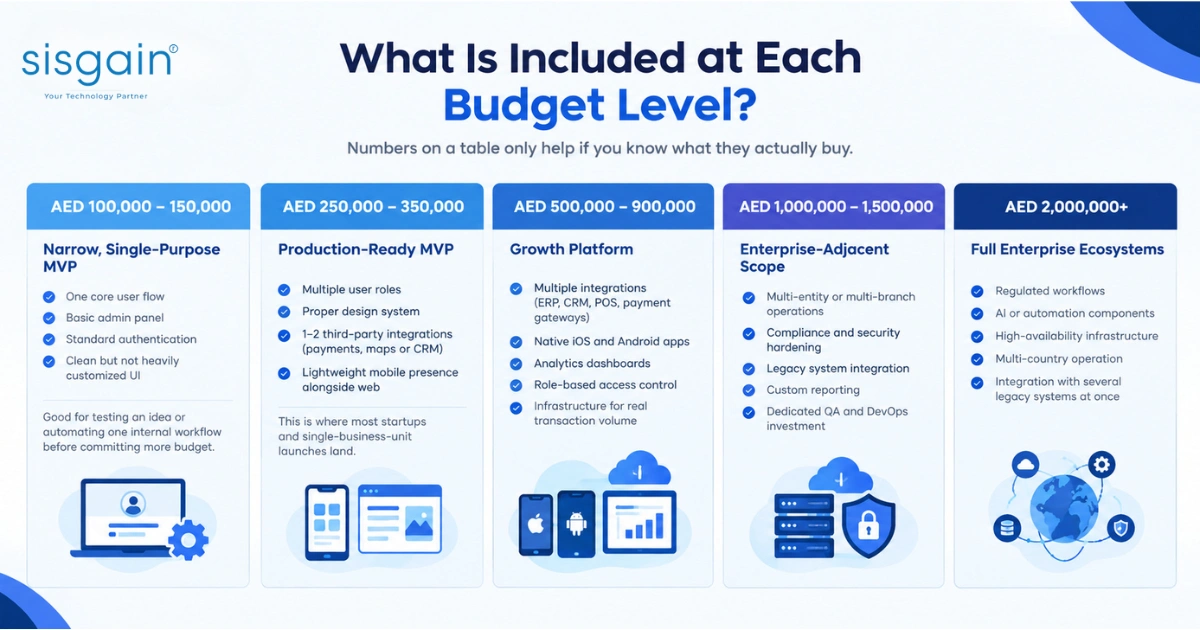
Numbers on a table only help if you know what they actually buy.
AED 100,000 – 150,000 A narrow, single-purpose MVP: one core user flow, a basic admin panel, standard authentication, and a clean but not heavily customized UI. Good for testing an idea or automating one internal workflow before committing more budget.
AED 250,000 – 350,000 A production-ready MVP with multiple user roles, a proper design system, one or two third-party integrations (payments, maps, or a CRM), and a lightweight mobile presence alongside web. This is where most startups and single-business-unit launches land.
AED 500,000 – 900,000 A genuine growth platform: multiple integrations (ERP, CRM, POS, payment gateways), native iOS and Android apps, analytics dashboards, role-based access control, and infrastructure built for real transaction volume rather than a pilot group.
AED 1,000,000 – 1,500,000 Enterprise-adjacent scope: multi-entity or multi-branch operations, compliance and security hardening, legacy system integration, custom reporting, and dedicated QA and DevOps investment.
AED 2,000,000+ Full enterprise ecosystems — regulated workflows, AI or automation components, high-availability infrastructure, multi-country operation, and integration with several legacy systems at once. This is where fintech, telecom, utilities, and large government programs typically live.
Software Development Cost by Project Phase
A common mistake is assuming the entire budget goes toward "coding." In practice, engineering is the largest slice — but far from the only one.
|
Project Phase |
Typical Share of Budget |
What You Receive |
|
Discovery and business analysis |
5–10% |
Requirements, user journeys, backlog, architecture direction |
|
UI/UX design |
10–15% |
Wireframes, clickable prototype, design system, usability validation |
|
Engineering and integrations |
45–60% |
Front-end, back-end, mobile, APIs, database, cloud setup |
|
QA and security testing |
15–20% |
Functional, regression, performance, device, and security testing |
|
Deployment and launch |
5–10% |
CI/CD, production setup, app-store release, monitoring, training |
|
Maintenance after launch |
15–25% annually |
Bug fixes, OS updates, patches, monitoring, minor improvements |
Treat this as a planning allocation rather than a fixed rule. A heavily regulated fintech or healthcare build will shift more budget toward QA, security testing, and compliance documentation — sometimes pushing that line item closer to 25–30% of total spend.
A simple formula to estimate your own cost
Most Dubai vendors, including the more transparent ones, build their estimates from the same basic formula:
Estimated project cost = total delivery hours × blended team rate + third-party and infrastructure costs
To use it yourself:
- List every core feature the product needs at launch — not the entire long-term vision.
- Estimate hours per feature based on complexity. A login screen and a real-time dispatch engine are not comparable units of work.
- Apply a blended hourly rate that reflects a full team (design, engineering, QA, project management), not just developer time.
- Add third-party and infrastructure costs separately — payment gateways, cloud hosting, APIs, and licensing fees.
- Add a contingency buffer of 10–15% for scope refinement during discovery.
This won't replace a proper discovery conversation, but it gets you close enough to set a realistic range before you talk to a vendor.
Dubai-Specific Factors That Affect Your Budget
This is where a generic global cost guide falls short. Building for the Dubai and wider UAE market comes with cost multipliers that simply don't show up in a US- or Europe-focused estimate.
|
Cost Multiplier |
Typical Impact |
Why It Matters in Dubai |
|
Arabic and English product experience |
Moderate |
Requires localization beyond literal translation — layouts, content hierarchy, and full right-to-left (RTL) testing |
|
Compliance and security |
Moderate to high |
Particularly important in fintech, healthcare, government, telecom, and utilities |
|
Local payment and identity integrations |
Moderate |
Payment rails, KYC checks, fraud prevention, and local service integrations add engineering and testing effort |
|
Regional cloud and data architecture |
Moderate |
Data residency, backup, monitoring, reliability, and multi-region planning affect both build and running costs |
|
Legacy enterprise integrations |
High |
ERP, CRM, POS, EHR, billing, and operational technology systems often drive the bulk of scope |
|
Multi-country GCC expansion |
Moderate to high |
Adds localization, currencies, taxes, compliance, and operational workflows for each additional market |
|
AI and automation |
High |
Requires data readiness, model evaluation, governance, inference costs, and ongoing monitoring |
Security deserves its own line item rather than being folded quietly into "development." Advanced security implementation for a Dubai project can range anywhere from roughly AED 55,000 to AED 367,000+ depending on the sensitivity of the data involved, and it should be scoped as a distinct workstream from the start — not discovered as a surprise mid-project.
AI is the multiplier most buyers underestimate today. Whether it's demand forecasting on a logistics platform, fraud detection in a fintech product, or a recommendation engine on a media platform, the cost isn't just model development — it's data readiness, evaluation, governance, and ongoing inference spend. If AI is part of your roadmap, it's worth scoping separately against our AI development cost in Dubai guide rather than folding it into a general feature estimate.
Hidden Costs Businesses Must Budget For
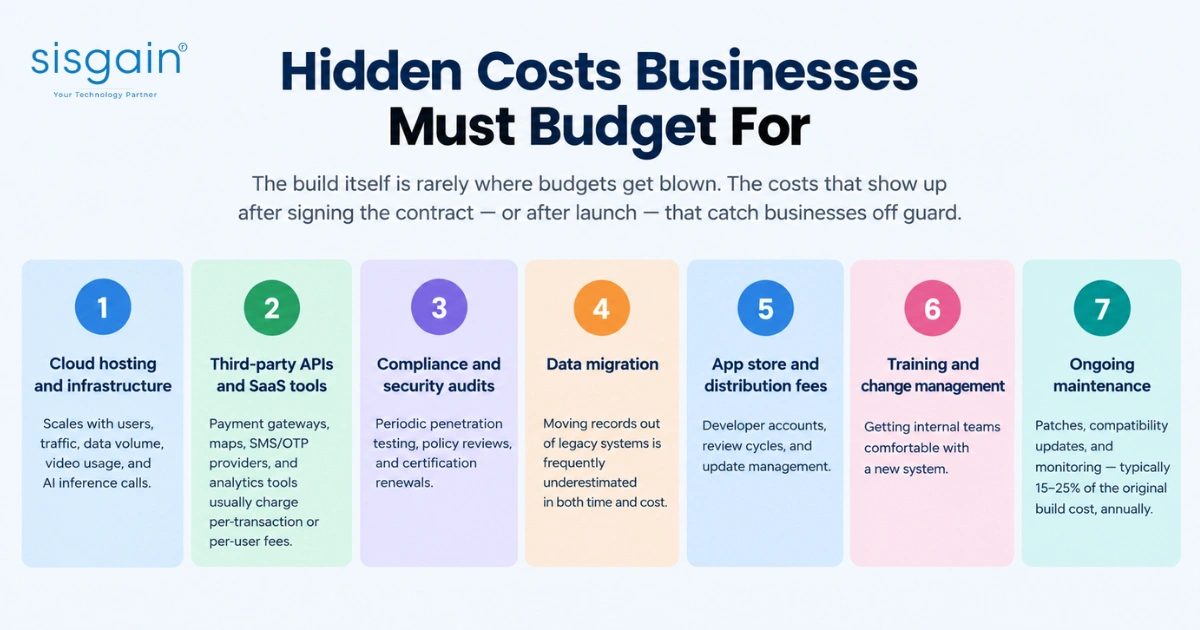
The build itself is rarely where budgets get blown. It's the costs that show up after signing the contract — or after launch — that catch businesses off guard.
- Cloud hosting and infrastructure: scales with users, traffic, data volume, video usage, and AI inference calls
- Third-party APIs and SaaS tools: payment gateways, maps, SMS/OTP providers, and analytics tools usually charge per-transaction or per-user fees
- Compliance and security audits: periodic penetration testing, policy reviews, and certification renewals
- Data migration: moving records out of legacy systems is frequently underestimated in both time and cost
- App store and distribution fees: developer accounts, review cycles, and update management
- Training and change management: getting internal teams comfortable with a new system
- Ongoing maintenance: patches, compatibility updates, and monitoring — typically 15–25% of the original build cost, annually
Ongoing Cost of Ownership
|
Cost Category |
Planning Guidance |
|
Maintenance and support |
15–25% of initial build cost annually |
|
Cloud hosting and monitoring |
Depends on users, traffic, data, video, AI inference, and uptime requirements |
|
Third-party APIs and SaaS tools |
Recurring per-user, per-transaction, or usage-based fees |
|
Security testing and compliance |
Periodic reviews, penetration testing, audits, policy updates |
|
New feature development |
Separate roadmap budget, ideally planned quarterly |
|
Customer support and operations |
May require internal staff, outsourced support, or platform administration |
Regulated or high-availability systems — fintech, healthcare, government, utilities — tend to sit at the upper end of that 15–25% maintenance range, simply because the cost of an outage or a compliance gap is much higher than in a typical consumer app.
How to Reduce Software Development Cost in Dubai Without Cutting Quality
Cutting cost usually goes wrong when it means cutting corners. Done properly, it means cutting scope intelligently.
- Start with a true MVP. Ship the smallest version that proves the core value proposition, then expand based on real usage data rather than assumptions.
- Prioritize ruthlessly. Separate "must-have for launch" from "nice to have later" before development starts, not during it.
- Phase your rollout. Launch core workflows first, then layer in integrations, automation, and advanced analytics in later releases.
- Reuse proven components. Authentication, payment integration, and admin dashboards rarely need to be built from scratch.
- Invest in discovery. A proper technical discovery phase costs a small fraction of the total budget but prevents expensive rework later.
- Consider a hybrid delivery model. Pairing an experienced local team for compliance and stakeholder alignment with a broader delivery team for engineering throughput can control cost without sacrificing quality.
In-House vs. Outsourcing Software Development in Dubai
There isn't a universally cheaper option — it depends on your timeline, in-house expertise, and how long-term the need is.
In-house teams make sense when software is core to your product and you need continuous, long-term ownership. The trade-off is the cost and time of hiring, plus the overhead of managing infrastructure, tooling, and retention in a competitive UAE tech talent market.
Outsourcing to a custom software development company in Dubai makes sense when you need speed, a full multidisciplinary team (design, engineering, QA, DevOps) without hiring each role separately, and delivery experience with UAE-specific compliance and integration requirements already built in.
Hybrid models — a small in-house product or compliance lead working alongside an outsourced delivery team — are increasingly common for mid-to-large Dubai projects, combining internal accountability with external delivery capacity.
Avoid the trap of assuming one model is always cheaper on paper. In-house often looks cheaper per hour and outsourcing looks more expensive per hour — but total cost of ownership, speed to market, and delivery quality usually tell a different story once hiring time and management overhead are factored in.
Final Thoughts
There's no single honest answer to "how much does software cost in Dubai" — and any page that gives you one number without context is oversimplifying. What you can walk away with here is a framework: know your tier (MVP, production, growth, enterprise), know your industry's typical cost drivers, and know which Dubai-specific factors — compliance, localization, integrations — actually apply to your product.
The most reliable way to turn this framework into an actual budget is a short discovery conversation with a team that has delivered in your industry before. As a custom software development company in Dubai, we scope every project against the same transparency principles used in this guide: realistic ranges, clear inclusions and exclusions, and no quote handed over before we understand your compliance and integration needs.
Get a Dubai software cost estimate based on your industry, product scope, compliance requirements, integrations, and launch timeline. Start your project discovery →