
Quick Answer
Healthcare software integration is the process of securely connecting clinical and administrative systems — EHRs, billing platforms, labs, imaging, telehealth, and patient portals — so patient data flows automatically between them. Done right, it eliminates duplicate data entry, reduces claim denials, speeds up diagnosis and treatment, and gives clinicians a single, trustworthy view of every patient. In 2026, the standard approach combines FHIR R4 APIs for modern systems with HL7 v2 messaging for legacy ones, routed through a middleware/integration engine, and secured under HIPAA and UAE health-data regulations (DHA, DoH, ADHICS).
Introduction: Why Integration Has Become Non-Negotiable
Every hospital, clinic, and telehealth platform today runs on more than one system. A mid-sized hospital in Dubai might operate an EHR, a separate LIS for lab results, a RIS/PACS for imaging, a billing and revenue-cycle platform, a patient portal, and — increasingly — remote monitoring devices and a telehealth app. When these systems don't talk to each other, the cost shows up everywhere: nurses re-typing the same patient history into three different screens, billing teams chasing denied claims because insurance data didn't sync, and physicians making decisions without the full clinical picture.
This is the problem healthcare software integration solves. And in 2026, it's stopped being a "nice to have" for forward-thinking hospitals — it's the baseline expectation from regulators, insurers, and patients alike.
The numbers back this up. The global healthcare IT integration market is forecast to grow from roughly USD 5.81 billion in 2025 to USD 6.49 billion in 2026, reaching close to USD 11.23 billion by 2031 at an 11.6% CAGR. Zoom out further, and healthcare IT systems interoperability as a whole is projected to expand from about USD 4.70 billion in 2025 to USD 15.73 billion by 2035. That growth is being driven by FHIR adoption, cloud-first platforms, telehealth expansion, and API-first architecture — all pointing toward the same conclusion: organizations that integrate now build a durable advantage, and those that delay accumulate what the industry calls "interoperability debt."
This guide is written as a practitioner-level blueprint. It covers what integration actually means, the standards that make it work, the architecture patterns to choose from, an 8-step implementation playbook, security and compliance requirements (including UAE-specific considerations), common pitfalls, and where the industry is heading next.
What Is Healthcare Software Integration?
Healthcare software integration is the practice of connecting separate clinical and administrative applications — Electronic Health Records (EHR/EMR), Laboratory Information Systems (LIS), Radiology/Picture Archiving Systems (RIS/PACS), pharmacy systems, billing and revenue-cycle management (RCM) platforms, telehealth tools, patient portals, and increasingly wearables and remote-monitoring devices — so they can exchange data reliably, securely, and in near real time.
Medical software integration is often used interchangeably with the above, but in practice it tends to emphasize the integration of medical devices and clinical applications directly into hospital information systems — think connecting a bedside monitor, an infusion pump, or a home glucose meter so its readings flow straight into the patient's chart without manual entry.
The umbrella concept both terms point to is interoperability: the ability of different systems to exchange data and interpret it correctly (this second part — semantic interoperability — is where most integration projects actually succeed or fail).
Why this distinction matters for your project
When you scope a project, ask which problem you're actually solving:
- Connecting applications to each other (EHR ↔ billing ↔ patient portal) → this is classic healthcare software integration.
- Connecting devices and diagnostic equipment into those applications → this leans more toward medical software integration.
Most real-world projects need both, which is why a unified integration strategy — rather than a series of one-off point connections — pays off.
The Standards That Power Integration (Explained Simply)
If you take one technical concept away from this guide, make it this: integration succeeds or fails based on the standards you choose and how consistently you implement them.
HL7 v2 — the workhorse
HL7 v2 is the messaging standard that has quietly run hospital admissions, lab orders, and results delivery for decades. It's ubiquitous, but every hospital implements it slightly differently — which means each new connection is effectively a custom mapping project. Any integration partner offering an HL7 Integration Service should be able to show you real experience handling these site-specific "dialects," not just textbook HL7 knowledge.
FHIR (Fast Healthcare Interoperability Resources) — the modern standard
FHIR is a RESTful, API-based standard, with FHIR R4 as the 2026 baseline. It structures data into resources like Patient, Observation, Encounter, and MedicationRequest, and it's what makes app-to-EHR data exchange — the kind that powers patient portals, third-party health apps, and SMART on FHIR authentication — actually feasible at scale.
C-CDA — the document-based approach
C-CDA (Consolidated Clinical Document Architecture) exchanges data as structured documents rather than discrete messages or API calls. It's consistent in structure but inconsistent in how thoroughly vendors populate it, which makes reliable data extraction harder than it looks on paper.
Terminologies that make data meaningful
- LOINC — standardizes lab test names and results
- SNOMED CT — standardizes clinical concepts and diagnoses
- ICD-10 — standardizes diagnosis and billing codes
Without shared terminologies, two systems can be technically "connected" and still misinterpret each other's data — a dangerous and underappreciated failure mode.
Quick Answer — HL7 vs FHIR: HL7 v2 is a mature, message-based standard best suited to legacy hospital workflows (admissions, orders, results). FHIR is a modern, REST API–based standard built for real-time, app-to-EHR data exchange and patient-facing access. Most 2026 integration projects use both: FHIR for new development, HL7 v2 for legacy system support.
Architecture Patterns for Healthcare Integration
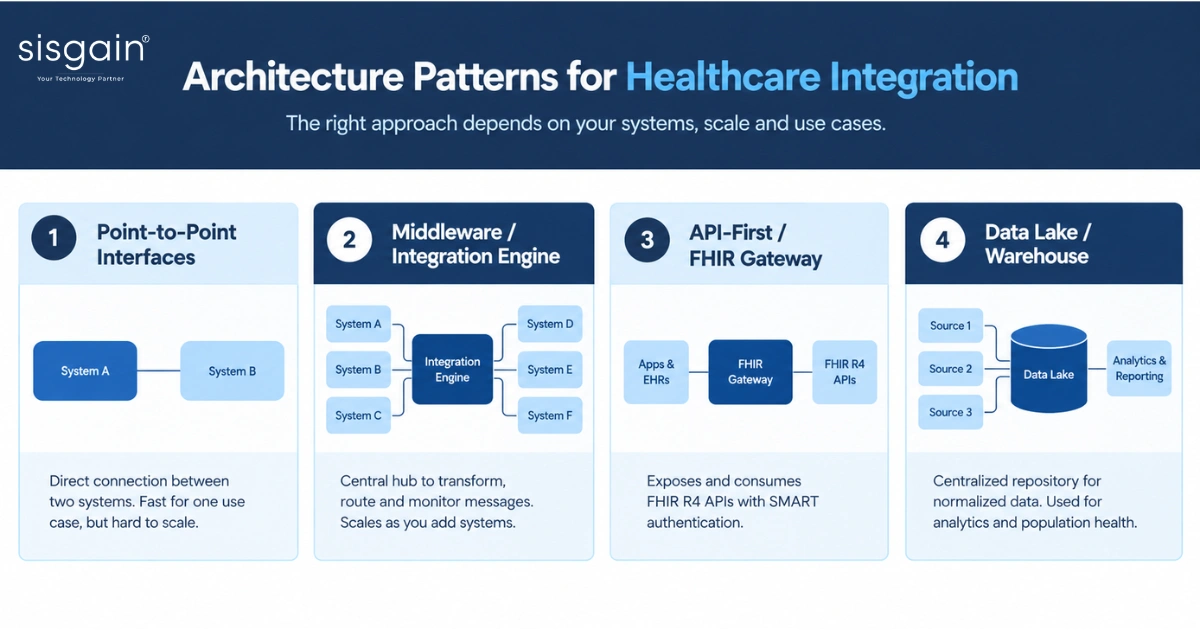
There's no single "correct" integration architecture — the right choice depends on your systems, scale, and use cases. Here are the four patterns you'll choose between:
1. Point-to-Point Interfaces
Direct connections between two systems. Fast to build for a single, narrow use case, but brittle and expensive to maintain as you add more systems — each new connection multiplies complexity.
2. Middleware / Integration Engine
A central hub (tools like Mirth Connect and its equivalents) that transforms, routes, and monitors messages across many systems at once. This is the most common pattern for hospitals with a mix of legacy HL7 v2 systems and modern platforms, and it's the backbone of most professional Software Integration Service in Dubai engagements because it scales cleanly as new departments or vendors come online.
3. API-First / FHIR Gateway
Exposes and consumes FHIR R4 APIs, typically with SMART on FHIR authentication. Ideal for modern EHRs, patient-facing apps, and any scenario where third-party developers need controlled access to clinical data.
4. Data Lake / Warehouse
A centralized repository that ingests normalized data from multiple sources, used primarily for analytics, reporting, and population health management rather than real-time clinical workflows.
How to choose
Ask four questions:
- Scope — Is this a single department, an entire hospital, or a multi-organization health information exchange (HIE)?
- Systems — Are you dealing mostly with legacy HL7 v2 systems, modern FHIR-capable platforms, or raw device data?
- Use case — Do you need real-time clinical workflows, batch reporting, or patient-facing app access?
- Governance — Do you need centralized audit trails, consent management, and policy enforcement across every connection?
A hospital modernizing its entire stack will often land on a hybrid: a middleware/integration engine for legacy HL7 v2 systems, layered with a FHIR gateway for anything new — a pattern increasingly common across modern hospital information systems deployments in the region.
The 8-Step Implementation Playbook
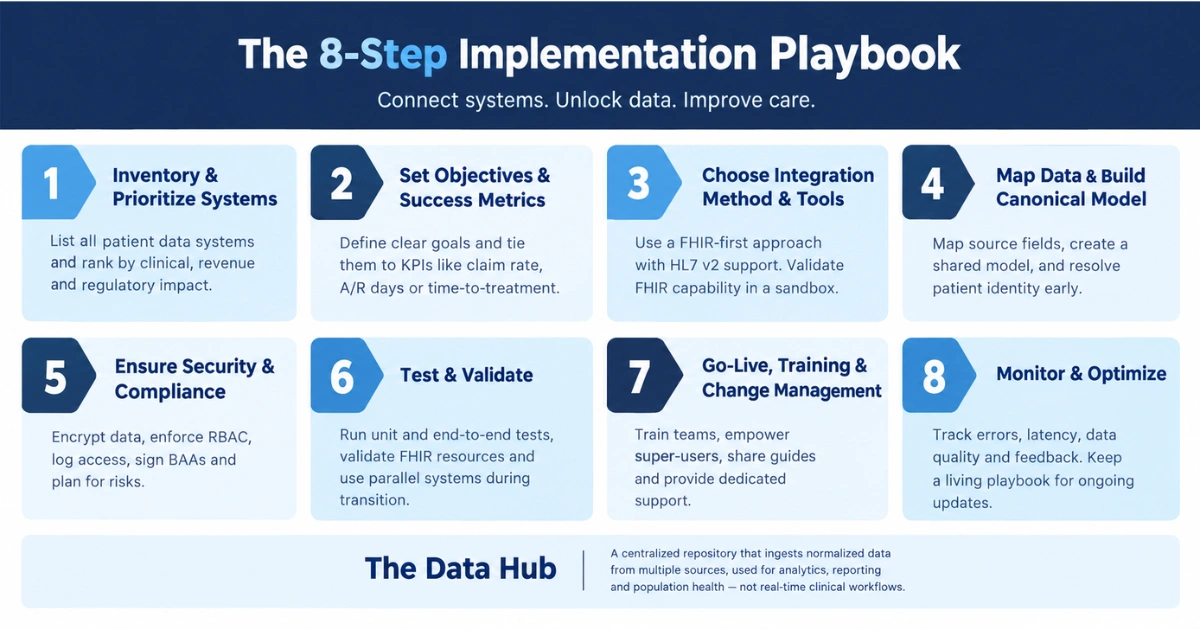
This is the practical, step-by-step sequence to follow for any healthcare software integration project, whether you're connecting two systems or overhauling an entire hospital's data architecture.
Step 1 — Inventory and Prioritize Systems
Catalog every system that touches patient data: EHR/EMR, LIS, RIS/PACS, pharmacy, billing/RCM, telehealth, patient portal, wearables/IoMT devices, and any HIE connections. Rank them by clinical impact, revenue impact (denials, accounts receivable), and regulatory deadlines. Don't skip "minor" systems — a disconnected scheduling tool causes just as much friction as a disconnected lab feed.
Step 2 — Define Objectives and Success Metrics
Vague goals like "improve interoperability" don't survive budget review. Set specific, measurable targets:
- Reduce duplicate lab orders by X%
- Cut claim denial rate by Y%
- Reduce chart-pull time by Z%
- Enable FHIR-based patient data access within N weeks
Tie every objective to a KPI that leadership already tracks: clean claim rate, A/R days, time-to-treatment, readmission rates, or patient portal activation rate.
Step 3 — Select Integration Methodology and Tools
For most mixed environments in 2026, a FHIR-first strategy with HL7 v2 support via an integration engine is the practical default. Before committing to any tooling or vendor, validate the EHR's actual FHIR capabilities using its CapabilityStatement and test in a vendor sandbox — don't take marketing claims at face value.
Step 4 — Data Mapping and Canonical Model
Map every source field to a shared canonical data model. Treat each HL7 v2 site as its own custom mapping project with a documented interface specification. Resolve patient identity matching (via a Master Patient Index, or MPI) early — this single step prevents the majority of duplicate-record and claim-mismatch problems down the line.
Step 5 — Security and Compliance by Design
This is where projects either earn trust or create liability. At minimum:
- Encrypt data in transit (TLS 1.2/1.3) and at rest (AES-256)
- Enforce role-based access control (RBAC), multi-factor authentication, and automatic session logoff
- Maintain immutable audit logs for every instance of PHI access
- Execute Business Associate Agreements (BAAs) with every vendor that touches patient data
- Document a formal risk analysis and incident response plan
Step 6 — Testing and Validation
Unit test each interface individually, then run end-to-end workflow testing under realistic peak load. Validate FHIR resources against tools like ONC Inferno or the vendor's own test suite. Run new and legacy systems in parallel during the transition period to avoid clinical disruption — cutting over cold is one of the most common causes of go-live chaos.
Step 7 — Go-Live, Training, and Change Management
Technology is only half the project. Train clinicians and administrative staff on the new workflows, identify department "super-users" who can support their peers, and provide quick-reference guides for the first few weeks. Staff a dedicated support team to monitor issues closely immediately after go-live.
Step 8 — Continuous Monitoring and Optimization
Integration isn't a one-time project — it's ongoing infrastructure. Track interface error rates, message latency, data quality metrics, and user feedback continuously. Maintain a living integration playbook that's updated every time a new site, department, or vendor comes online.
Security, Privacy, and Compliance (Non-Negotiable)
Technical safeguards
|
Safeguard |
Requirement |
|
Encryption in transit |
TLS 1.2 minimum, TLS 1.3 preferred |
|
Encryption at rest |
AES-256 |
|
Access control |
Unique user IDs, RBAC, MFA, automatic session timeout |
|
Audit logging |
Immutable logs for all PHI access; PHI masked in error logs |
|
Resilience |
Tested backups and disaster recovery procedures |
Administrative and legal safeguards
- BAA (Business Associate Agreement): Required with every vendor that touches patient data — no exceptions.
- Risk analysis: A documented, regularly updated HIPAA (or equivalent) risk analysis, with formal policies and workforce training.
- Incident response: A clear breach detection, notification, and remediation plan with defined timelines.
UAE-specific compliance layer
Providers operating in the UAE face compliance obligations on top of international standards like HL7/FHIR and HIPAA-equivalent practices — including DHA (Dubai Health Authority) data-sharing requirements, DoH Abu Dhabi's ADHICS (Abu Dhabi Healthcare Information and Cyber Security) standard, and health information exchange platforms like Malaffi and Riayati. Any integration built for a UAE hospital or clinic needs to be a genuinely UAE-Compliant Healthcare App from the architecture stage — not adapted after the fact.
The cost of getting this wrong
Building HIPAA-grade (and equivalent) compliance into your architecture from the start typically adds 15–25% to development cost. Retrofitting it after launch can add 40–80% — plus the risk of regulatory fines that range from thousands to millions of dollars per incident, depending on severity and jurisdiction. Compliance is dramatically cheaper as a design decision than as a repair job.
Common Challenges — and How to Solve Them
|
Challenge |
Practical Fix |
|
Legacy system incompatibility |
Use middleware and a canonical data model instead of brittle point-to-point connections |
|
HL7 v2 dialect complexity |
Build interface-spec-driven mapping with reusable configuration libraries per site |
|
FHIR capability gaps |
Validate endpoints early; keep HL7 v2 as a fallback where FHIR support is incomplete |
|
Patient identity mismatches |
Implement a Master Patient Index (MPI) and clear data stewardship rules |
|
Inconsistent data quality/semantics |
Enforce standard terminologies (LOINC, SNOMED CT, ICD-10) and data governance |
|
Security exposure with every new connection |
Harden APIs, apply least-privilege access, test continuously |
|
Difficulty proving ROI |
Tie every integration outcome directly to revenue-cycle KPIs (denials, A/R days) |
The recurring theme across all seven: integration problems are rarely purely technical. They're usually a mix of technical debt, unclear ownership, and a missing link between the IT project and the metrics leadership actually cares about.
What Does It Cost, and How Long Does It Take?
Timelines and budgets vary significantly based on scope, but as a general guide:
- A well-scoped FHIR integration with a FHIR-capable EHR typically takes 8–16 weeks.
- Complex, multi-vendor environments — multiple hospitals, legacy HL7 systems, several third-party apps — can extend well beyond that.
- Budget should always include compliance and security work as a core line item, not an add-on.
If you're scoping a broader project — not just integration, but a full platform build — it's worth reviewing typical Healthcare App Development Cost benchmarks before finalizing your budget, since integration complexity is usually the single biggest cost variable in these projects.
Emerging Trends Shaping Integration in 2026
- AI + interoperability: Ambient clinical documentation, AI-assisted summarization, and AI agents that consume FHIR data directly are now top priorities for forward-looking health systems.
- Cloud-first integration: More organizations are operationalizing cloud infrastructure specifically to support AI, analytics, and broader modernization efforts.
- Remote patient monitoring (RPM) and IoMT: Multi-system integration demand from RPM programs is one of the strongest growth drivers in the integration market today.
- Semantic interoperability: The industry is moving past simply exchanging data (syntactic interoperability) toward making sure systems interpret that data the same way (semantic interoperability) — a subtler but more consequential shift.
Why UAE Healthcare Providers Need a Specialized Integration Partner
Integration in the UAE carries an extra layer of complexity that generic, US- or Europe-focused guidance doesn't cover: DHA and DoH regulatory requirements, Malaffi/Riayati HIE connectivity, Arabic-English bilingual data handling, and a healthcare IT vendor landscape that's still maturing compared to more established Western markets.
This is exactly why hospitals and clinics across the region increasingly look for partners who specialize in Healthcare Software Development in Dubai — teams who understand both the international standards (HL7, FHIR) and the local regulatory and infrastructure realities. Whether the project is a ground-up build of Custom EMR Software Development in the UAE, a targeted integration between an existing EHR and a billing platform, or a full upgrade to modern hospital information systems, the difference between a project that ships on time and one that stalls in compliance review almost always comes down to regional expertise.
Conclusion: Integration Is Infrastructure, Not a One-Time Project
Healthcare software integration has crossed a threshold. It's no longer a differentiator reserved for the most advanced health systems — it's the baseline infrastructure that everything else (AI-assisted care, telehealth, remote monitoring, patient engagement) depends on. Organizations that treat it as ongoing infrastructure — with clear KPIs, security built in from day one, and a governance process that evolves with every new system — consistently outperform those treating it as a one-off IT project.
For UAE hospitals and clinics, the stakes and the opportunity are both higher: get the regulatory layer right (DHA, DoH, ADHICS, Malaffi/Riayati) alongside the technical layer (HL7, FHIR, security), and you build a platform that scales cleanly for years. Get it wrong, and you inherit exactly the kind of interoperability debt this guide is meant to help you avoid.
If you're planning a healthcare software integration project — whether it's a single system connection or a full hospital information system overhaul — the team behind this guide works exclusively on Healthcare Software Development in Dubai and across the UAE, with direct experience in HL7 integration, FHIR API development, and UAE-compliant EMR builds. Get in touch to scope your project and get a realistic cost and timeline estimate.