
Introduction
A water authority in the UAE rolls out thousands of smart meters across a new district. Consumption data now arrives hourly instead of monthly. The billing system, however, was built for a world of manual meter readings and quarterly invoice runs. Within months, operations teams are exporting spreadsheets to reconcile readings, finance is chasing payment mismatches, and customer service is fielding calls about bills that don't match what people actually used.
This gap is becoming common across the UAE's utility sector. Smart meters, connected infrastructure, and digital customer expectations are moving faster than the billing platforms meant to support them. Utility billing software built for periodic, low-frequency data simply wasn't designed to process continuous meter streams, validate them at scale, or turn them into accurate invoices in near real time.
For UAE water and energy providers, billing can no longer function as a standalone, back-office application. It needs to operate as part of a connected ecosystem — metering, data validation, tariff logic, payments, customer communication, and analytics all working together. This guide walks through what that ecosystem looks like, how water and energy billing differ, what smart grid integration actually involves, and what UAE utility decision-makers should evaluate before investing in a new platform.
Quick Answer: What Is Utility Billing Software?
Utility billing software is the system that converts meter and consumption data into accurate customer invoices. It processes meter readings, applies tariff and billing rules, generates invoices, manages payments, and produces reconciliation and reporting outputs. For UAE utilities, it matters because it connects metering infrastructure, customer service, and finance into one auditable, digitally accessible process.
What Is Utility Billing Software?
At its core, utility billing software manages the full financial relationship between a utility and its customers. It holds customer account records, tracks service connections, ingests meter data, applies the correct tariff to that data, and produces an invoice that reflects actual consumption. From there, it manages payment collection, reconciles what was billed against what was paid, and generates the reporting that finance and operations teams rely on.
For UAE water and energy providers, this typically means managing a workflow that looks like this:
Smart Meter / Meter Reading → Data Validation → Billing Engine → Invoice → Payment → Reconciliation → Reporting
Each stage depends on the one before it. A meter reading that fails validation — because it's missing, implausible, or out of sequence — can produce an incorrect invoice if the system doesn't catch it early. A billing engine that can't apply the right tariff rule produces a dispute. A reconciliation process that can't match payments to invoices creates a growing backlog for finance.
This is why mature utility billing solutions are evaluated less on their invoice templates and more on how reliably they handle the stages before invoicing — data ingestion, validation, and rule application. A platform that gets these stages right produces bills that are accurate the first time, which reduces disputes, call volumes, and manual rework.
For a CIO or billing director evaluating a UAE utility billing software, the practical question is not "can it print an invoice," but "can it reliably turn high-volume, high-frequency meter data into a correct one, at scale, with a clear audit trail." That distinction shapes almost every decision covered in this guide.
Why UAE Utilities Need Smarter Billing Solutions
The UAE's utility landscape is shifting on several fronts at once. Smart metering programmes are expanding across water and energy networks. Infrastructure is more connected than it was even a few years ago, generating far more consumption data than legacy systems were built to handle. Customers — both residential and commercial — increasingly expect the same digital experience from their utility provider that they get from their bank or telecom operator: instant visibility into usage, digital invoices, and self-service payment options.
At the same time, utility operators are under pressure to tighten revenue assurance, reduce manual processing, and give operations and finance teams a shared, accurate view of consumption and billing data. When metering, billing, and finance systems don't talk to each other, the result is duplicated data entry, delayed billing cycles, and blind spots that make it harder to catch anomalies — whether that's a billing error or a potential leak.
Smarter billing solutions address this by processing connected meter data continuously rather than in periodic batches, automating validation so exceptions are flagged rather than missed, and giving both operators and customers dashboards instead of static reports.
|
Traditional Utility Billing |
Smart Utility Billing |
|
Periodic readings |
Connected meter data |
|
Batch processing |
Faster data processing |
|
Manual validation |
Automated validation |
|
Limited visibility |
Usage dashboards |
|
Manual reconciliation |
Automated reconciliation |
|
Reactive exception handling |
Automated alerts |
Key Takeaway: The shift isn't just about digitising invoices — it's about connecting metering, billing, and finance into one system so data flows once and errors get caught early, not after a customer complains.
Water Billing Software in the UAE
Water utilities have billing requirements that differ meaningfully from other utility types, which is why generic billing platforms often fall short. Water billing software needs to handle consumption-based billing built around meter readings, often with tiered pricing structures where the rate per unit changes based on usage bands. It also needs to account for seasonal consumption swings, estimated readings when a meter can't be read on schedule, and billing adjustments when an estimate is later corrected against an actual reading.
Where minimum or service charges apply, the billing engine needs to apply them alongside consumption charges without manual intervention. And because water infrastructure carries the added risk of physical loss — through leaks or ageing pipework — water billing platforms increasingly need to support anomaly detection at the meter level, not just at the invoice level.
A typical smart water billing flow looks like this:
Smart Water Meter → AMI/IoT → Data Validation → Billing Engine → Customer Portal
The value of connecting AMI (Advanced Metering Infrastructure) directly into the billing pipeline is that consumption data becomes available for analysis well before an invoice is generated. Analytics layered on top of this data can help identify:
- Unusual consumption compared to a household or facility's typical pattern
- Signals consistent with a possible leak, which the utility or customer can then investigate
- Meter anomalies, such as a reading that stops incrementing or jumps implausibly
- Sudden consumption spikes tied to a specific date or event
- Data-quality problems, such as gaps or duplicate reads, before they reach the billing engine
It's worth being precise here: software doesn't fix leaks or reduce water loss on its own. What it can do is surface the signals — unusual consumption, meter anomalies, data gaps — early enough for operations teams or customers to act on them, which is a meaningfully different and more accurate claim than promising automatic water-loss reduction.
For UAE water providers managing large, mixed residential and commercial customer bases, a billing platform that can flag these patterns before a bill goes out — rather than after a customer disputes it — represents one of the clearest operational returns from investing in smarter water billing software.
Energy Billing Software for UAE Providers
Energy billing software carries its own set of demands, shaped by how electricity consumption is measured and priced. Where water billing is largely volume-based, energy billing often needs to account for time-based usage patterns, demand-related calculations for larger commercial and industrial accounts, and — increasingly — prosumer scenarios where a customer both consumes and generates energy.
This means the billing engine sitting underneath an energy platform needs to be considerably more flexible than one built for simple volumetric billing. It has to apply tariff rules that may vary by customer class, time period, or consumption tier, and it needs to do this without requiring a custom development cycle every time a commercial rule changes.
Core requirements for energy billing solutions operating in the UAE include:
- Smart meter integration that captures interval-level consumption data, not just monthly totals
- Automated billing that applies the correct tariff logic without manual calculation
- Payment processing that supports the range of digital payment methods UAE customers expect
- Consumption analytics that give both the utility and the customer visibility into usage trends
- Forecasting capability to support demand planning and revenue projections
- Revenue assurance checks that flag billing exceptions before invoices are finalised
The common thread across all of these is flexibility. Energy tariff structures and commercial rules evolve, and a billing platform that can't accommodate that evolution without significant rework becomes a liability rather than an asset. When evaluating energy billing software, UAE providers should weigh how easily the platform's rules can be reconfigured against how much of that flexibility would need to be custom-built.
Cloud-Based Utility Billing Software and E-Billing
The infrastructure choice behind a billing platform — on-premise versus cloud — has a direct effect on how well it can scale and integrate with the rest of a utility's technology stack.
Traditional, on-premise systems place the full infrastructure burden on the utility's IT team: servers to maintain, upgrade cycles to manage, and data that often sits in silos disconnected from CRM, ERP, or customer-facing systems. Scaling this kind of environment to handle a growing meter fleet or an expanding customer base typically means new hardware procurement and longer deployment timelines.
Cloud-based utility billing software shifts that burden. Infrastructure scales with demand rather than requiring upfront capacity planning. Data is centralised, which makes it far easier to connect billing with CRM, ERP, and analytics systems through APIs. Deployment and updates can happen faster, since there's no dependency on physical infrastructure refresh cycles, and teams can access the system remotely rather than being tied to an on-premise environment.
Cloud-Based E-Billing for UAE Utility Companies
Layered on top of cloud infrastructure, e-billing capability is what customers actually interact with. For UAE utility customers, this typically includes digital invoices delivered by email or through a portal, online payment options, SMS or email notifications for upcoming or overdue bills, payment reminders, and access to bill history and usage history without needing to call customer service. The cumulative effect is a move toward paperless communication that reduces both cost and turnaround time for the utility.
One point worth being direct about: moving to the cloud does not automatically mean a system is "more secure." Security outcomes depend on how the architecture is designed — identity and access controls, encryption in transit and at rest, continuous monitoring, and the governance processes wrapped around the implementation. A poorly configured cloud deployment can be less secure than a well-managed on-premise one. The infrastructure model is a foundation; security is a function of how well that foundation is built and maintained.
How Smart Grid Software Works With Utility Billing
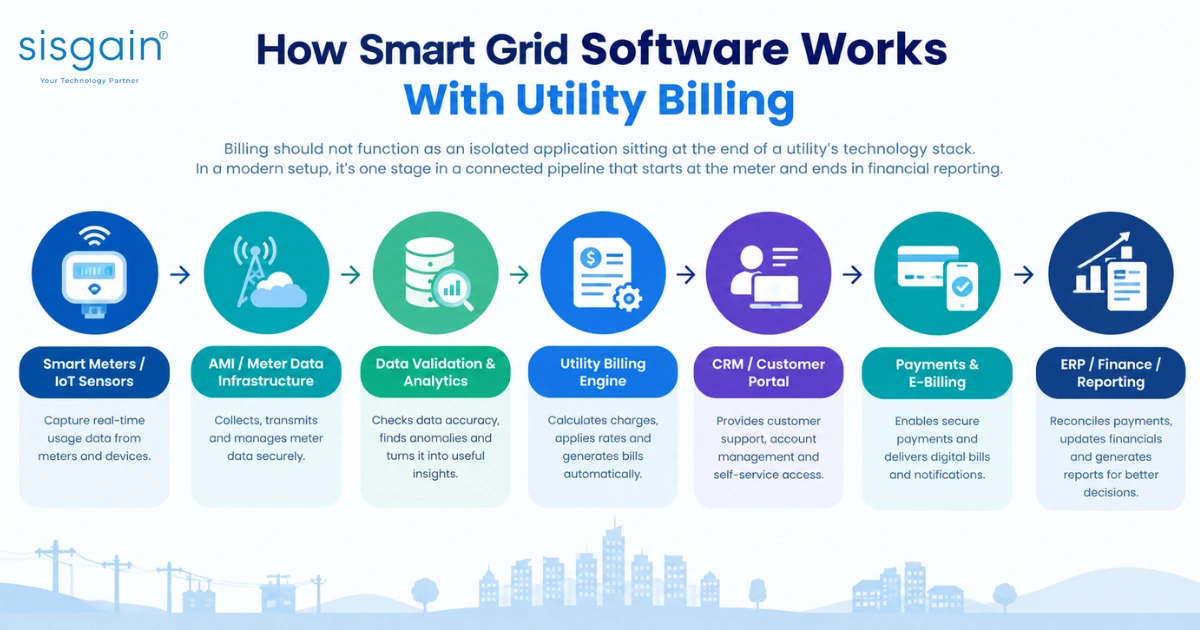
Billing should not function as an isolated application sitting at the end of a utility's technology stack. In a modern setup, it's one stage in a connected pipeline that starts at the meter and ends in financial reporting.
Smart Meters / IoT Sensors ↓ AMI / Meter Data Infrastructure ↓ Data Validation & Analytics ↓ Utility Billing Engine ↓ CRM / Customer Portal ↓ Payments & E-Billing ↓ ERP / Finance / Reporting
Each layer has a distinct role. Smart meters and IoT sensors capture consumption data at the source. AMI and meter data infrastructure transport and aggregate that data at scale. Data validation and analytics — often referred to as VEE (Validation, Estimation, and Editing) — check the data for quality issues before it ever reaches the billing engine. The billing engine applies tariff logic and generates invoices. CRM and customer portal systems give customer service and end users visibility into accounts and usage. Payment and e-billing systems handle collections. And ERP integration ensures billing data flows into the utility's broader financial reporting without manual re-entry.
APIs are what make this pipeline function as a system rather than a set of disconnected tools — allowing meter data platforms, billing engines, CRM, and ERP systems to exchange data automatically.
Once this pipeline is connected, AI becomes genuinely useful because it has consistent, high-quality data to work with. Practical applications include:
- Consumption forecasting to support demand and capacity planning
- Anomaly detection across meter data and billing patterns
- Leak detection signals for water utilities, based on consumption behaviour
- Revenue leakage detection, flagging accounts where billed amounts don't align with expected consumption
- Billing anomaly detection, catching invoices that fall outside normal patterns before they're sent
- Demand forecasting for energy providers managing peak load
- Customer segmentation to support targeted communication
- Predictive alerts that flag likely issues before they escalate
For UAE utilities exploring these capabilities, this is typically where AI application development in dubai becomes relevant — building the models and integrations that turn raw consumption data into the forecasting and anomaly-detection tools described above, rather than bolting on generic analytics that don't reflect the utility's actual tariff and operational logic.
Must-Have Features of Utility Billing Solutions in the UAE
Selecting a billing platform comes down to a fairly consistent set of capabilities, though the weighting differs by utility type.
|
Feature |
Purpose |
|
Smart meter integration |
Automates consumption data collection |
|
AMI integration |
Handles connected meter infrastructure |
|
Tariff management |
Configures billing rules |
|
Automated billing |
Reduces manual processing |
|
VEE |
Improves meter-data quality |
|
E-billing |
Enables digital invoices |
|
Payment integration |
Supports digital collections |
|
Customer portal |
Enables self-service |
|
AI analytics |
Detects patterns and anomalies |
|
Leak detection |
Supports water monitoring |
|
Revenue assurance |
Identifies billing exceptions |
|
API integration |
Connects enterprise systems |
|
Mobile support |
Enables field operations |
|
Audit trails |
Improves billing transparency |
|
Reporting |
Supports management decisions |
A handful of these deserve a closer look.
Tariff and Billing Rule Management
The tariff engine is arguably the most important component in the entire platform. It needs to support tiered pricing, seasonal adjustments, time-based rates, and configurable rules that business teams can adjust without submitting a development ticket every time a commercial policy changes.
Meter Data Validation
Data quality determines billing accuracy. This typically follows a three-step process: Validation → Estimation → Editing — checking incoming reads against expected ranges, estimating values when a read is missing, and allowing authorised staff to correct records when something doesn't reconcile.
Customer Self-Service
A customer portal that provides bill history, usage history, online payment, consumption alerts, and the ability to submit service requests reduces call centre volume while giving customers the digital experience they now expect from any service provider.
Revenue Assurance
Automated revenue assurance checks can identify missing meter reads, incorrectly applied tariffs, data anomalies, mismatches between payments and invoices, and other billing exceptions — surfacing them for review rather than letting them go unnoticed until a customer or auditor flags them.
How to Choose Utility Billing Software in Dubai and the UAE
Selecting a platform is less about comparing feature checklists and more about matching a system's architecture to the utility's actual operating environment. Buyers should evaluate:
- Utility type — water, energy, or multi-utility
- Existing and planned metering infrastructure
- Tariff complexity and how frequently rules change
- Integration requirements with CRM, ERP, and payment systems
- Cloud architecture and deployment model
- Data and security requirements
- Customer experience expectations
- Scalability as the meter fleet and customer base grow
- AI and analytics requirements
- Vendor support model and responsiveness
Practical questions worth asking any prospective vendor include: Can the platform integrate with our existing smart meters? Can it process high-frequency meter data without performance issues? Can tariffs be configured without rebuilding the platform? Does it integrate with our ERP and CRM through documented APIs? Can billing calculations be audited end to end? Can customers access bills digitally? And can the platform scale as our customer base grows, without a costly re-architecture?
These questions matter more than any single feature, because they reveal whether a platform was built to adapt to a utility's specific operating model — or whether it will require significant customisation to fit.
Utility Billing Software Implementation Roadmap
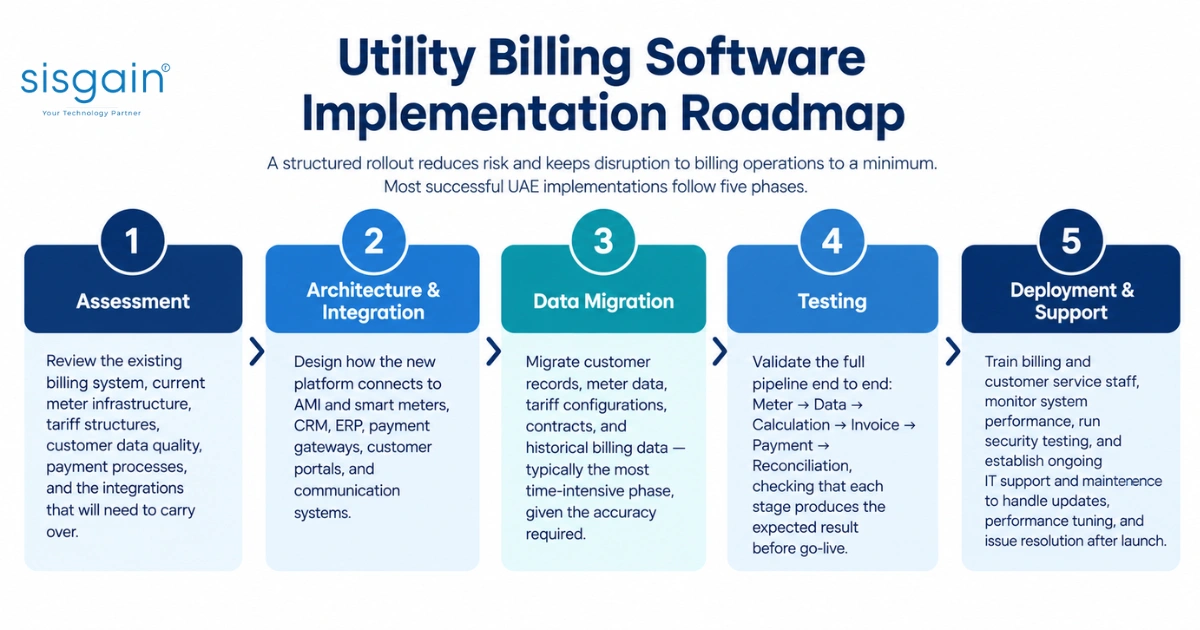
A structured rollout reduces risk and keeps disruption to billing operations to a minimum. Most successful UAE implementations follow five phases.
Phase 1: Assessment. Review the existing billing system, current meter infrastructure, tariff structures, customer data quality, payment processes, and the integrations that will need to carry over.
Phase 2: Architecture and Integration. Design how the new platform connects to AMI and smart meters, CRM, ERP, payment gateways, customer portals, and communication systems.
Phase 3: Data Migration. Migrate customer records, meter data, tariff configurations, contracts, and historical billing data — typically the most time-intensive phase, given the accuracy required.
Phase 4: Testing. Validate the full pipeline end to end: Meter → Data → Calculation → Invoice → Payment → Reconciliation, checking that each stage produces the expected result before go-live.
Phase 5: Deployment and Support. Train billing and customer service staff, monitor system performance, run security testing, and establish ongoing IT support and maintenence to handle updates, performance tuning, and issue resolution after launch.
Skipping or rushing any of these phases — particularly testing and data migration — is where most billing implementations run into trouble.
Utility Billing Software Development Cost in the UAE
There's no fixed price for a utility billing platform, and any vendor offering one without understanding a utility's specific requirements should be treated cautiously. Cost depends on a combination of factors: the number of customers and meters being managed, the utility type, how complex the platform needs to be, the degree of customisation required, smart meter and AMI integration work, ERP and CRM integration, payment gateway integration, whether mobile applications are needed, AI modules, cloud infrastructure requirements, security implementation, testing scope, deployment complexity, and ongoing maintenance.
A useful way to think about it conceptually:
Total Software Cost = Core Platform + Integrations + Custom Features + Infrastructure + Testing + Deployment + Maintenance
Each variable in that formula can shift the total significantly. A utility with a small, homogenous customer base and standard tariff rules will have a very different software development cost than a multi-utility operator integrating dozens of legacy systems and building custom AI-driven analytics. For UAE buyers considering custom development over an off-the-shelf platform, the right starting point is a detailed scoping exercise that maps requirements against each of these cost drivers before requesting vendor proposals.
Benefits of Modern Utility Billing Solutions
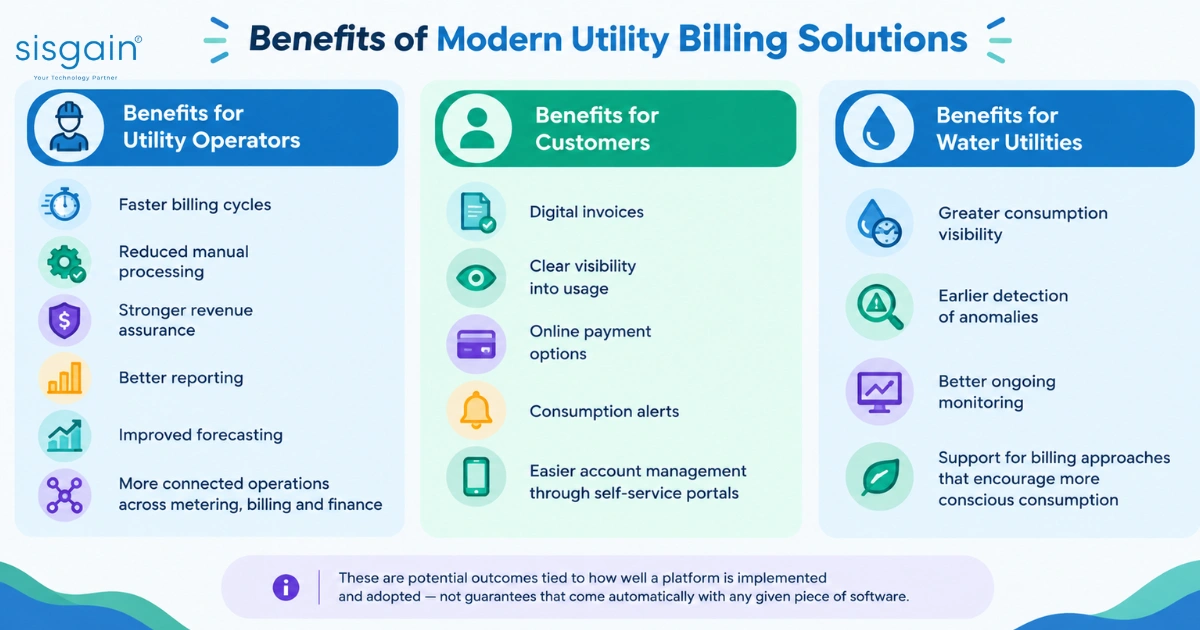
Benefits for Utility Operators
Faster billing cycles, reduced manual processing, stronger revenue assurance, better reporting, improved forecasting, and more connected operations across metering, billing, and finance.
Benefits for Customers
Digital invoices, clear visibility into usage, online payment options, consumption alerts, and easier account management through self-service portals.
Benefits for Water Utilities
Greater consumption visibility, earlier detection of anomalies, better ongoing monitoring, and support for billing approaches that encourage more conscious consumption.
These are potential outcomes tied to how well a platform is implemented and adopted — not guarantees that come automatically with any given piece of software.
The Future of AI-Powered Utility Billing in the UAE
The next generation of utility platforms is built around continuous data and connected systems rather than periodic processing.
AI-powered billing analytics can identify unusual consumption and billing patterns across a customer base far faster than manual review. Predictive utility operations use historical and live data together to flag potential issues — from a failing meter to a developing leak — before they become larger problems. Automated revenue assurance extends this further, surfacing missing data, billing anomalies, payment inconsistencies, and other signals of revenue leakage as they occur rather than at the end of a billing cycle.
Underpinning all of this is a broader shift toward digital utility ecosystems: Smart Meters + IoT + AI + Cloud + Billing + Mobile + Analytics working as one connected environment rather than separate tools bolted together. The value here is practical rather than theoretical — better data quality, earlier issue detection, and less manual reconciliation work, not a wholesale reinvention of how utilities operate.
Why Choose a UAE Utility Software Development Partner?
Building or modernising a utility billing platform involves more than software licensing — it requires a partner who understands the UAE's regulatory environment, integration landscape, and operational realities. A UAE-based development partner brings proximity for custom platform builds, smart meter and AMI integration work, billing system development, customer portal and mobile application design, AI analytics implementation, cloud architecture, and ERP/CRM integration — along with the ability to provide ongoing local support after launch.
Working with an IT software development company in Dubai also means shorter response times for implementation and support, and a partner who understands how UAE utilities operate day to day. For organisations evaluating a full-scope technology partner, a Utilities Software and Mobile App Development Company in Dubai can support the entire journey — from initial architecture through to long-term platform evolution — without the utility needing to manage multiple disconnected vendors across metering, billing, and customer experience.