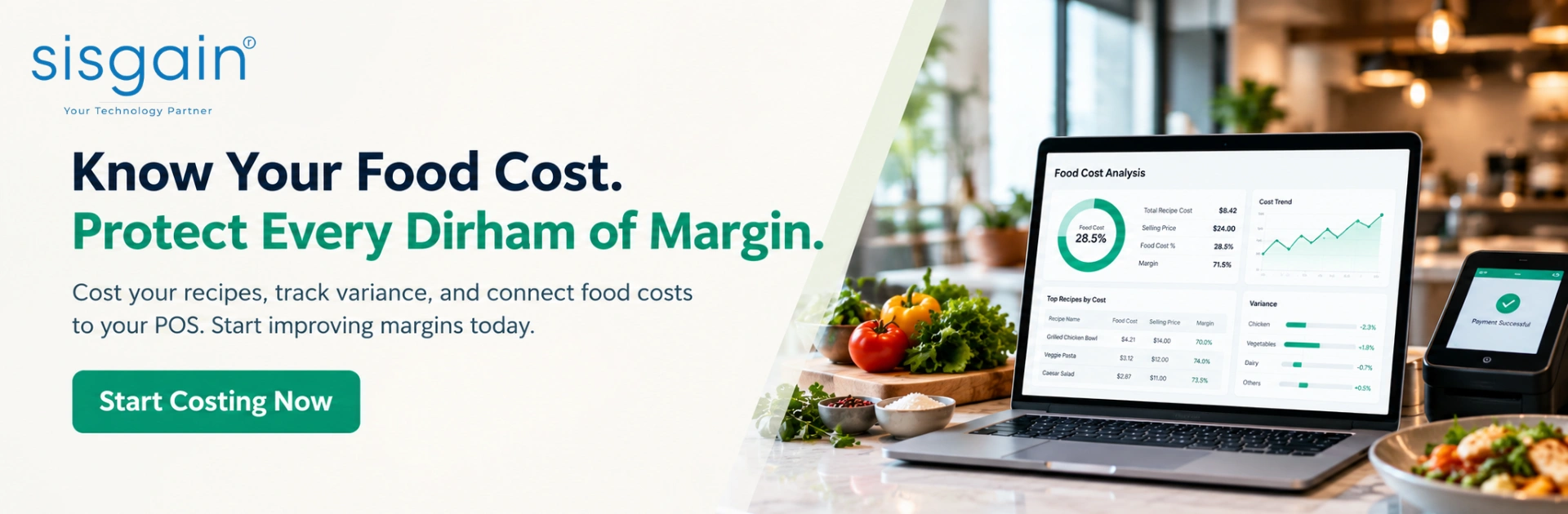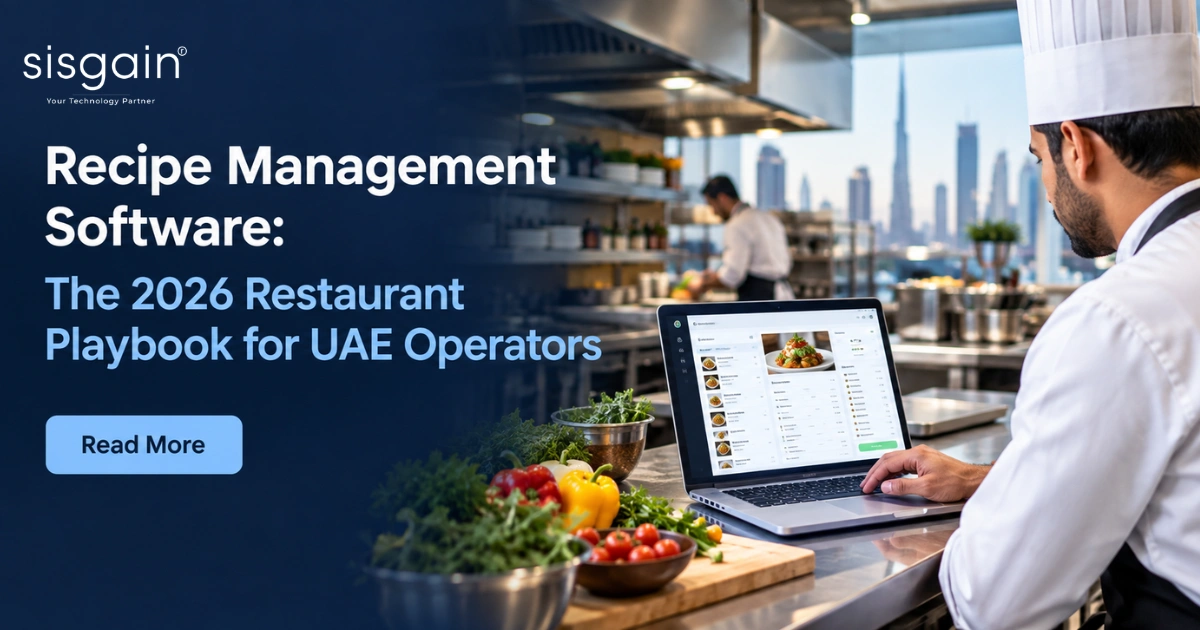

If you run a restaurant, café, cloud kitchen, or multi-outlet F&B group in the UAE, you already know the math doesn't forgive guesswork. Import-dependent supply chains, a 5% VAT layer, Dubai's rent curve, and a kitchen workforce that turns over every 12-18 months make food cost the one number that quietly decides whether your concept survives its second year.
Recipe management software is how serious operators — from a single Al Quoz café to a 20-outlet group across Dubai, Abu Dhabi, and Sharjah — stopped guessing. This is a full playbook: what the software does, what it costs in AED, which tools fit which stage of growth, how to roll it out without disrupting service, and what ROI actually looks like once it's running.
Quick Answer
Recipe management software is a centralized system that costs, scales, and standardizes your recipes, then connects that data to inventory, purchasing, and POS. For UAE restaurants, the best 2026 platforms auto-update food cost when supplier prices shift (critical given how much is imported), flag menu items bleeding margin, and give operators in Dubai, Abu Dhabi, and Sharjah one source of truth across multiple kitchens. Typical results: a 2-5 percentage point drop in food cost and 20-100+ hours saved per month on manual recipe admin.
What Is Recipe Management Software, Exactly?
Strip away the marketing language and it's this: a database that holds every recipe your kitchen makes — mains, sauces, stocks, garnishes, the lot — with exact quantities, yields, and trim loss, then multiplies those quantities by live ingredient prices to tell you what a dish actually costs to plate.
It replaces the three things most UAE kitchens still run on:
- A shared spreadsheet that three people have slightly different versions of
- Laminated recipe cards taped inside a walk-in
- A costing exercise done once at menu launch and never touched again
None of those survive contact with a 400-cover Friday brunch, a chef rotation, or a 12% spike in the price of imported butter. A proper system does.
Who's actually using this in the UAE right now:
- Independent restaurants and cafés in JLT, Al Barsha, and Business Bay standardizing a single kitchen
- Multi-brand groups running five to twenty outlets across Dubai, Abu Dhabi, and the Northern Emirates
- Cloud kitchens and delivery-only brands where menu velocity is high and margin visibility has to be real-time
- Hotel F&B departments managing banqueting, room service, and multiple outlet concepts under one roof
- Catering companies scaling recipes from 10 covers to 1,000 without a spreadsheet falling apart
Why This Matters More in the UAE, Specifically, in 2026
Your ingredient costs move faster than your menu prices do
A huge share of what a UAE kitchen buys — dairy, red meat, produce, packaged goods — arrives by ship or plane from outside the country. That supply chain means a currency shift in Europe, a bad harvest in India, or a shipping delay in the Red Sea shows up in your invoice within weeks. Restaurants pricing menus off last quarter's costs are, in effect, subsidizing every dish that's crept above its target food-cost percentage. A system that recalculates cost the moment a supplier invoice changes closes that gap before it compounds.
Labor is transient, so your recipes can't live in someone's head
Most UAE kitchen brigades are built on expatriate staff, and turnover in this sector is genuinely high — chefs and cooks move between properties, renew visas elsewhere, or rotate out entirely within a year or two. When "how we really make the lamb ouzi" lives only in one sous chef's memory, you lose consistency the day he gives notice. Digitized, versioned recipes with exact yields and step photos mean a new hire can hit the same plate on day three, not week three.
Multi-outlet groups need one truth, not five
Dubai's F&B scene rewards brands that scale — a concept that works in Dubai Marina gets replicated in Abu Dhabi's Al Reem Island, then Sharjah, then a food court unit. Every additional location multiplies the ways a recipe can drift: a different supplier, a manager who "improves" the sauce, a walk-in that's slightly under-stocked so the line cook substitutes. Centralized recipe software with location-level variance reporting is the only practical way to catch that drift before it shows up as a 4-point food-cost gap between your best and worst outlet.
AI costing has stopped being a differentiator and become the baseline
By 2026, the platforms worth considering all do some version of the same thing: recalculate cost per portion automatically when a linked ingredient price changes, flag dishes drifting below target margin, and suggest pricing or menu adjustments based on actual sales mix. This isn't replacing your chef's judgment — it's removing the spreadsheet math so culinary teams spend their time on the plate, not the P&L.
Compliance isn't optional here, and recipe data is what makes it easy
Dubai Municipality, ADAFSA in Abu Dhabi, and Sharjah's municipal food control departments all expect HACCP-aligned processes, and halal certification requirements touch sourcing decisions at the ingredient level, not just the finished dish. When your recipe data lives in a spreadsheet, proving to an inspector that every batch of a dish traces back to a certified supplier is a scramble. When it lives in a proper system, ingredient-to-supplier linkage is already there — you're pulling a report, not reconstructing one from memory.
This matters even more for groups running mixed concepts, where one outlet might need strict halal sourcing across the entire menu and another has more flexibility. Location-level supplier overrides, mentioned earlier as a "must-have," exist for exactly this reason.
Tourism swings mean your demand forecasting has to work harder
Dubai and Abu Dhabi both run on a tourism calendar that doesn't match a typical Western restaurant's seasonality — peak season runs roughly October through April, Ramadan shifts menus and service hours across the entire market for a full month, and summer sees genuine covers drop in a lot of concepts outside hotel properties. Recipe software that's linked to actual sales data helps here too: you can see which dishes carry the shoulder season and which only perform when tourist footfall is high, and adjust purchasing and prep quantities accordingly instead of over-ordering perishables that end up as waste in July.
The Feature Checklist: What "Good" Actually Looks Like
Use this when you're sitting through vendor demos. If a platform is missing more than one or two of the "must-haves," keep looking.
Recipe building and standardization
- Ingredient lists with proper unit conversions (grams to kilograms, ml to liters — and ideally metric-only, since that's the UAE standard)
- Sub-recipe nesting, so a mother sauce used in six dishes only needs updating once
- Yield and trim-loss accounting built in, not bolted on
- Instant portion scaling — one covers-for-two recipe scaled to a 300-guest banquet without manual math
- Step-by-step method with photo or video attachments
Nice to have: allergen tagging (genuinely useful given the density of dietary-restricted diners in Dubai's expat population) and nutrition breakdowns for concepts marketing health-forward menus.
Live costing and menu engineering
- Real-time cost per portion tied to current ingredient pricing
- Food cost percentage and gross margin, per dish, always current
- A menu engineering matrix — stars, plow horses, puzzles, dogs — so you know which items to promote, reprice, or cut
- "What if" scenario modeling: what happens to margin if you raise a price 5%, or switch a supplier
Advanced tier: AI recommendations on pricing and bundling, and integration with your POS sales mix so you're looking at actual profitability, not theoretical.
Inventory and purchasing integration
This is where most of the real ROI hides, and it's the section operators most often underweight when comparing tools.
- An ingredient master linked to actual suppliers and purchase units
- Automatic stock deduction as recipes are produced
- Par levels and reorder suggestions built from real recipe usage, not gut feel
- Invoice capture that updates ingredient costs automatically instead of manual re-entry
Multi-location and role-based control
- A central recipe library with controlled edits — head chef approves, location managers can't quietly rewrite the ratio
- Local overrides where genuinely needed (a Sharjah outlet using a different halal-certified supplier, for instance)
- Role-based permissions across chef, manager, finance, and corporate
- Variance reporting broken out by location and by item
Integrations that actually matter
Check compatibility before you sign anything, not after:
- POS systems — this is the connection that turns theoretical cost into actual cost, and it's non-negotiable for any group tracking margin properly. If you haven't locked down your front-of-house platform yet, get that decision right first — a modern Restaurant POS Software setup is the foundation everything else in this stack plugs into.
- Accounting — QuickBooks, Xero, or a full back-office ERP, so recipe costs flow straight into your COGS reporting instead of a second manual entry
- Inventory and purchasing platforms — for groups already running a dedicated stock system
- Delivery platform sync, if a meaningful share of your covers come through aggregators
The 2026 Tool Landscape, Segmented by Where You Actually Are
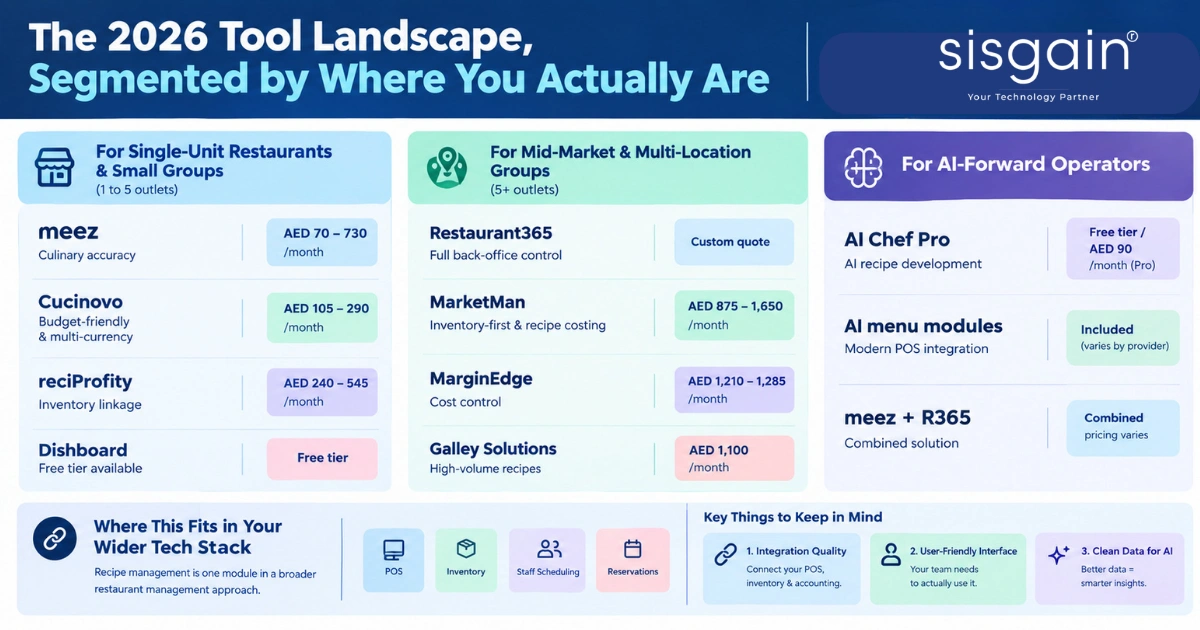
Prices below are converted to AED from vendor USD listings at roughly 3.67, since that's how most UAE operators will actually experience the invoice unless the vendor bills locally. Treat these as planning figures — confirm exact pricing and regional availability directly with each vendor before budgeting.
For single-unit restaurants and small groups (one to five outlets)
meez — the strongest pick if your priority is culinary accuracy over back-office depth. Entry plans run roughly AED 70-90/month, scaling to AED 660-730/month for the premium tier with full AI menu insight. Best suited to chef-led concepts that want one culinary source of truth rather than a finance-first tool.
Cucinovo — the most budget-friendly serious option, with a genuinely usable free tier for very small operations and paid plans from roughly AED 105-290/month. Multi-currency support is a real advantage here for UAE operators sourcing from multiple countries, and the Pro tier adds purchase order generation.
reciProfity — a mid-range cloud tool with solid inventory linkage, from around AED 240/month up to AED 545/month for multi-unit plans. A reasonable middle ground if meez feels too culinary-only and MarginEdge feels like overkill for your size.
Dishboard — worth a look purely because of the free entry tier, if you want to trial recipe costing before committing budget.
For mid-market and multi-location groups (five-plus outlets)
Restaurant365 — full back-office control spanning accounting, inventory, and recipes in one system, priced on custom quote. This is the strongest option once you're managing several outlets and need recipe data flowing straight into consolidated financials. Many groups pair it with meez specifically to keep the culinary layer strong while R365 handles the numbers.
MarketMan — an inventory-first platform with solid recipe costing bolted on, from roughly AED 875 to AED 1,650/month depending on module and location count. Strongest where supplier ordering and waste tracking matter as much as recipe costing itself.
MarginEdge — tightly built for operators already running Toast, Square, or Lightspeed who want serious control over theoretical-versus-actual cost variance. Pricing runs around AED 1,210-1,285 per location per month, with invoice automation that meaningfully cuts manual data entry.
Galley Solutions — built for high-volume, complex recipe environments: large hospitality groups, stadium catering, in-flight or contract catering. Around AED 1,100 per location per month, with recipe and menu operations depth that smaller independents simply don't need.
For AI-forward operators
AI Chef Pro — a free limited tier and a roughly AED 90/month Pro plan, focused on AI-assisted recipe development and profitability analytics across multiple locations.
AI menu modules built into modern POS platforms — if your front-of-house system already offers this, it's often the fastest path to price simulation and contribution-margin analysis without adding a separate vendor relationship.
meez paired with Restaurant365 — the combination one multi-brand group used to cut overall food cost by a reported 21%, by letting meez handle culinary accuracy while R365 handles the financial consolidation across brands.
Where This Fits in Your Wider Tech Stack
Recipe management software rarely works alone, and treating it as an isolated purchase is one of the most common mistakes UAE operators make. It's genuinely just one module inside a broader Restaurant Management Software approach — the layer that also covers your POS, inventory, staff scheduling, and reservations.
A few things worth knowing before you buy:
Integration quality decides whether you actually save time. A recipe platform that doesn't sync with your POS still requires someone to manually reconcile theoretical cost against actual sales — which defeats most of the point. If your current systems weren't built to talk to each other, working with an experienced Software Integration Partner to connect POS, accounting, and recipe data properly is usually worth more than switching vendors again.
The interface your kitchen team actually touches matters as much as the backend math. A recipe platform with brilliant costing logic and a confusing screen for line cooks will get ignored during service, and the data goes stale within a month. If you're building or customizing any part of this stack in-house — a kitchen display, a training portal, a manager dashboard — UI/UX Design Backed by Real Development Expertise is the difference between a tool your team adopts and one that becomes shelfware.
AI is only useful once your data is clean. Automated costing, price simulation, and demand forecasting all depend on accurate recipe and inventory data feeding them. Groups looking to go further — predictive ordering, automated variance alerts, AI-assisted menu redesign — are increasingly working with dedicated AI Automation Services In Dubai providers to connect these tools into something closer to a unified operating system, rather than five separate dashboards nobody checks.
The Implementation Playbook: Rolling This Out Without Chaos
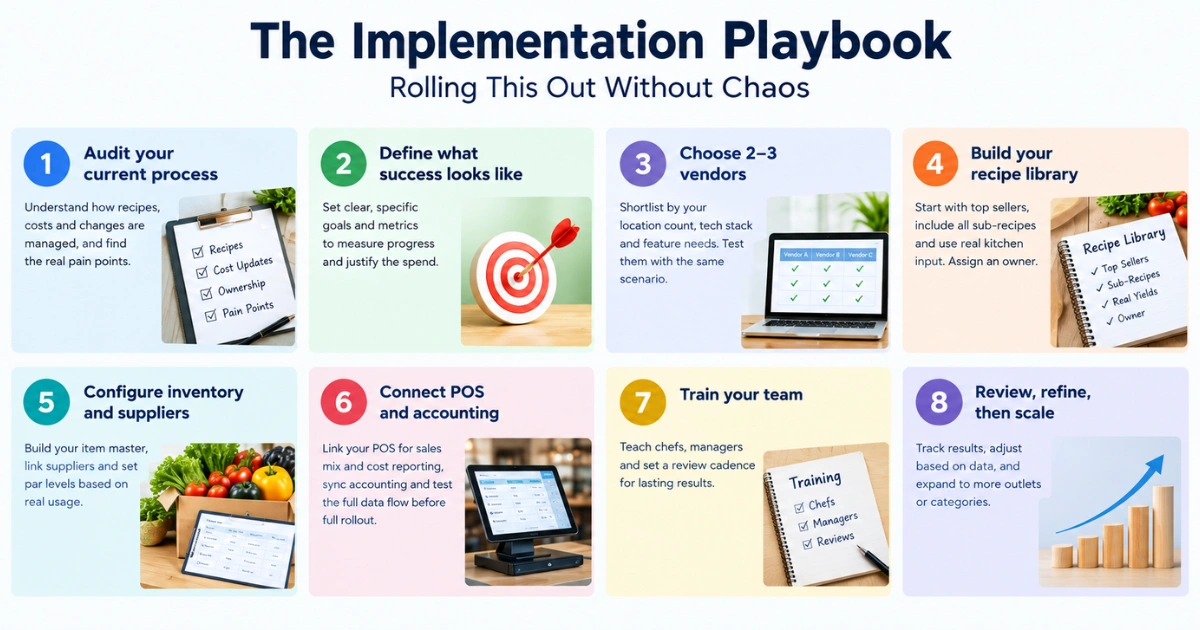
Step 1: Audit what you're actually doing today
Before you buy anything, write down how recipes are currently stored, how often costs get updated, who owns changes, and where the real pain is — is it waste, inconsistency, or just pricing guesswork? You can't measure improvement without a starting point.
Step 2: Define what success actually means
Vague goals produce vague results. Set specific ones: "cut food cost by 3 points in six months," or "standardize the top 50 sellers across five outlets by Q3." These numbers become your success metrics later, and they're what you'll use to justify the spend to a finance stakeholder.
Step 3: Shortlist two or three vendors, not ten
Filter by location count, current POS and accounting stack, and whether you need AI-forward features or just solid costing. Then request demos using the exact same scenario for each vendor — "show me how you cost this shawarma plate, and how it updates when the lamb price changes" is a better test than any feature comparison sheet.
Step 4: Build the recipe library in order of impact, not alphabetically
Start with your top 20-30 sellers — the 80/20 rule holds here almost every time. Include every sub-recipe: sauces, marinades, house-made condiments. Capture real yields and trim loss with actual kitchen input, not estimates from a supplier spec sheet. Assign an owner — usually the head chef or a senior sous — for each recipe.
Don't try to migrate the entire menu on day one. Prioritize, prove value, then expand.
Step 5: Get inventory and suppliers configured properly
Build an accurate item master with correct purchase units and linked suppliers, map every recipe ingredient to that master, and set par levels based on real usage patterns rather than habit.
Step 6: Connect POS and accounting before you go live everywhere
This is the step most operators rush, and it's the one that determines whether the tool actually saves time. Connect your POS for sales-mix and actual-versus-theoretical cost reporting, sync accounting for COGS tracking, and validate the whole data flow with a single pilot location before rolling out group-wide.
Step 7: Train the team, then set a review cadence
Chefs need to know how to build and update recipes; managers need to know how to read variance reports without a finance degree. Set a fixed rhythm — a weekly cost review, a monthly menu engineering session — so this doesn't become a system everyone forgets after week two.
Step 8: Review, refine, then scale
In the first three to six months, track food cost percentage, variance, and actual time saved against your Step 2 targets. Adjust recipes, portions, or prices based on what the data shows, then expand to more outlets or menu categories once the pilot has proven itself.
ROI: What the Numbers Actually Look Like in AED
Typical impact ranges across 2025-2026 operator data
- Food cost reduction: 2-5 percentage points
- Time saved: 20-100+ hours per month on recipe and inventory admin
- Overall COGS improvement: 3-5% in many documented implementations
A worked example
Take a restaurant spending AED 180,000/month on food (roughly USD 49,000 at current rates) with a software subscription running AED 550-1,100/month:
- Time savings: 4-8 hours a month freed up from manual recosting, at a blended manager rate — worth roughly AED 400-1,450
- Pricing accuracy: recovering 2-4% on that AED 180,000 food spend by catching underpriced dishes — roughly AED 3,600-7,200
- Waste reduction: better portion control and yield tracking typically saves AED 1,800-3,700
Add it up and you're looking at roughly AED 5,800-12,400 in monthly benefit against AED 550-1,100 in cost — somewhere between a 5x and 20x return in the first year, before accounting for the harder-to-quantify value of consistency and faster onboarding.
At group scale, the numbers get serious fast
A 2-point food cost improvement on AED 36 million in annual revenue works out to roughly AED 720,000 in recovered profit — money that was leaking out through unpriced menu drift, not a single bad decision anyone made on purpose. One multi-store group documented nearly AED 2.2 million saved from a 4-5% COGS reduction across its locations after a full rollout.
Common Pitfalls (And the Fix for Each)
Treating it as set-and-forget. Teams build the recipe library once, then never touch costs again. The fix is a fixed monthly cost review tied to supplier price changes and menu reviews — put it on the calendar, not on a hope.
Trying to migrate everything on day one. Attempting every recipe, every location, and every supplier simultaneously is how rollouts stall. Pilot with one outlet or one menu section, prove the value, then scale with confidence.
Building recipes without the kitchen team. Office-built recipe data that skips chef input tends to be unrealistic on yield and trim loss. Involve the people actually cooking the dish — their knowledge of real portions is the data your costing depends on.
Underestimating integration work. A recipe tool that doesn't talk to POS or accounting quietly reintroduces double data entry, which is exactly what you bought the software to eliminate. Prioritize integration compatibility before feature lists, and test the actual data flow during your pilot, not after full rollout.
How to Choose Between These Tools: A Practical Filter
Rather than working through every feature list side by side, ask yourself four questions in order:
- How many locations am I running today, and how many in 18 months? Single-unit tools like Cucinovo and entry-tier meez get expensive to outgrow; enterprise platforms like Restaurant365 are overbuilt and overpriced for one café. Buy for where you'll be in a year and a half, not just today.
- What POS and accounting system am I already committed to? Compatibility here should eliminate half your shortlist before you even look at pricing. A platform with perfect costing logic that can't sync with your existing POS creates more manual work, not less.
- Do I need AI-driven menu recommendations, or just accurate costing? Plenty of UAE operators are well served by solid costing and inventory sync alone. AI pricing suggestions are useful, but they're not the reason most restaurants fail to control food cost — inconsistent portioning and stale pricing are.
- Who owns this once it's live? If there's no clear internal owner — a head chef, an operations manager, a finance controller — the system will decay back into a spreadsheet habit within three months, regardless of which vendor you picked.
Where to Start
If you're running one location, start small: pick your top 20 sellers, get them properly costed and yield-tested, and connect that data to your POS before you worry about anything more advanced. If you're managing multiple outlets across the UAE, the priority shifts to centralized control and variance reporting — one location quietly drifting 4 points off target food cost costs you the same whether you notice it or not.
Either way, the operators winning on margin in 2026 aren't the ones with the fanciest menu. They're the ones who know, to the dirham, what every plate actually costs — and who built the systems to keep it that way as prices, staff, and locations keep changing around them.