
Dubai traffic doesn't care about your delivery window. Neither does a stuck vessel at Jebel Ali, a mislabeled bilingual address in Sharjah, or a heatwave that turns a 40-minute route into a 90-minute one. For years, UAE logistics teams have absorbed this chaos with spreadsheets, gut instinct, and overtime. That era is ending.
AI is no longer a pilot project sitting in an innovation lab somewhere. It's routing trucks around Sheikh Zayed Road congestion in real time, reading bills of lading in seconds, and predicting which forklift will break down next week. The Middle East is expected to capture close to $320 billion in AI-driven economic benefits by 2030, and in the UAE specifically, AI's impact on GDP is closing in on 14%. Logistics is one of the sectors absorbing that shift the fastest.
This guide breaks down exactly what AI in logistics means, where it's already working in the UAE and wider GCC, what it actually costs businesses to get wrong, and how to start using it without blowing up your operations. No fluff, no vendor pitch — just the data, the use cases, and a practical path forward.
Quick Answer: What Is AI in Logistics?
AI in logistics is the use of machine learning, optimization algorithms, and generative AI to forecast demand, plan shipments, optimize delivery routes, monitor cargo, and automate documents and customer service across transportation and warehousing. In the UAE, it's applied to solve very specific regional problems: bilingual and descriptive addresses, extreme summer heat affecting delivery windows, Ramadan demand spikes, and high volumes of time-sensitive trans-shipment cargo moving through Jebel Ali and Dubai South.
Why AI in Logistics Matters Right Now in the UAE
Three things are converging at the same time, and together they explain why 2026 is the year AI in logistics stops being optional.
First, there's policy. The UAE's National AI Strategy and the push toward chief AI officer roles across government and enterprise are accelerating adoption at a pace most private companies can't match on their own. When the regulatory and investment environment moves this fast, waiting becomes the expensive choice.
Second, there's the money. The UAE's Generative AI in Logistics market is on track to grow more than seven-fold between 2025 and 2032, which tells you where vendor investment, talent, and tooling are heading. This isn't a niche trend — it's where the infrastructure is being built.
Third, and this is the part most reports skip: the UAE's physical logistics performance is already world-class. The country sits in the global top 10 on the Logistics Performance Index. But the software layer underneath that physical performance — address intelligence, dispatch automation, dynamic routing — still lags behind. That gap between hardware-grade logistics and software-grade logistics is exactly where AI creates the fastest ROI.
If your trucks are good, your warehouses are good, but your dispatch board still runs on a spreadsheet and a dispatcher's memory, you're leaving money on the table every single day.
There's also a competitive angle that's easy to miss. When one 3PL in your market starts quoting more accurate ETAs and hitting 95%+ on-time delivery while a competitor is still stuck at 80%, that gap doesn't stay hidden for long. Retailers and manufacturers talk to each other. Once a shipper realizes reliable delivery windows are achievable, "usually on time" stops being an acceptable baseline — it becomes the reason they switch providers.
AI vs. Traditional Logistics Software: What Actually Changes
It helps to be precise about what's genuinely new here, because "AI" gets attached to a lot of things that are really just rules-based automation with a new name.
Traditional logistics software — a standard TMS, WMS, or ERP module — runs on fixed rules. If X happens, do Y. It's reliable, but it's static. It doesn't learn from last month's traffic patterns, and it doesn't get better at predicting Ramadan demand spikes the more Ramadans it sees.
AI-driven logistics software does. A route optimization engine trained on your actual delivery history gets more accurate the longer it runs, because it's learning from real outcomes, not just following a rulebook someone wrote two years ago. That's the core distinction: traditional software executes instructions, AI-driven software improves its own instructions over time.
This matters when you're evaluating vendors. A lot of platforms marketed as "AI-powered" are really just traditional automation with a chatbot bolted on the front end. Ask specifically what the system learns from and how often its models retrain — the answer tells you a great deal about whether you're buying genuine AI capability or a marketing label.
Role of AI in Modern Logistics
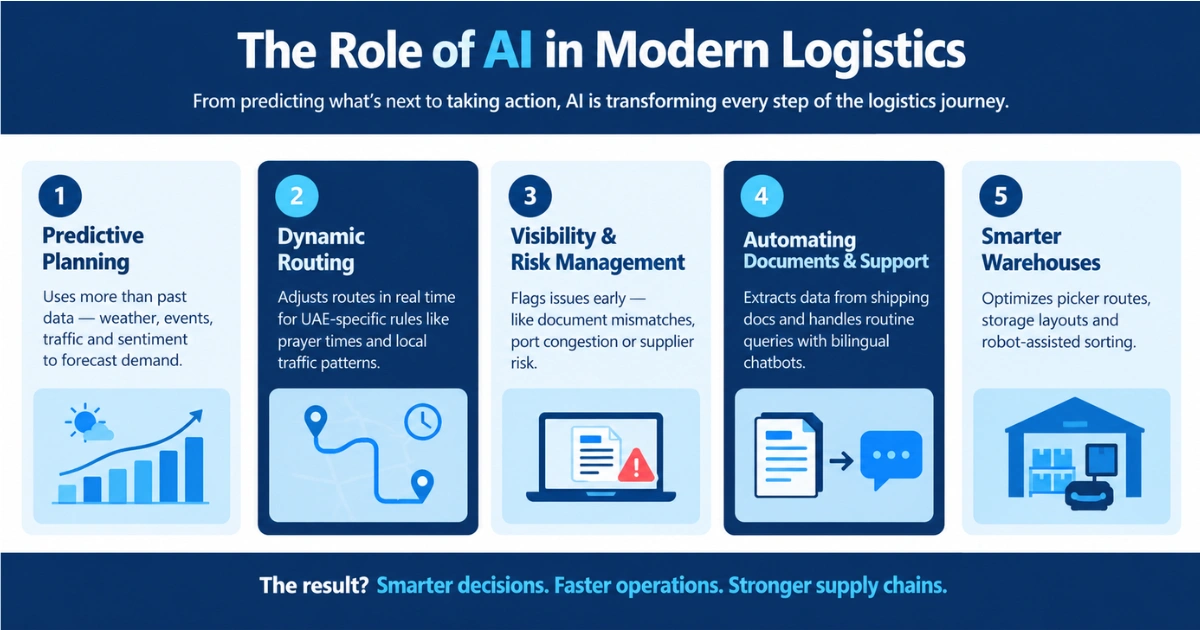
AI's role in logistics has moved well past dashboards and reports. It's shifted from telling you what happened to deciding what should happen next — and in some cases, acting on that decision without waiting for a human to approve it.
Here's how that plays out across a modern UAE logistics operation.
Predictive planning, not reactive firefighting
Traditional demand planning looks backward: last month's sales, last year's seasonality. AI-driven forecasting pulls in external signals too — weather patterns, local events, traffic conditions, even social sentiment — to predict demand shifts before they hit your warehouse. That matters enormously in a market where Ramadan alone can swing demand by double digits in either direction depending on the category.
Dynamic routing and dispatch
This is where UAE-specific constraints really show up. A route optimization engine built for a generic Western market doesn't know what to do with prayer time windows, Ramadan delivery hour restrictions, or the reality that a route through Deira at 6 PM on a Thursday is a completely different beast than the same route at 10 AM on a Sunday. AI systems trained on local patterns replan routes in real time around these exact variables — something no static route sheet can do.
Visibility and risk management
AI flags documentation mismatches, port congestion, or supplier risk before they become a missed delivery. Instead of a customs discrepancy surfacing three days later as an angry client call, it surfaces the moment the document is uploaded — giving your team hours, not days, to fix it.
Automating documents and customer service
Generative AI now reads bills of lading, invoices, and customs paperwork, extracts the relevant fields, and pushes them straight into your systems. Combine that with bilingual Arabic/English chatbots handling routine tracking and eligibility questions, and your team's time gets freed up for the exceptions that actually need a human.
Smarter warehouses
Inside the four walls, AI is optimizing picker routes, suggesting storage layouts based on order frequency, and coordinating robot-assisted sorting. None of this replaces your Warehouse Management System — it makes it smarter, turning a static rules engine into something that adapts to real order patterns week over week.
The common thread across all five of these: AI is moving from reporting to deciding. That's a fundamentally different relationship between your team and your technology stack, and it's why so many companies are realizing their existing Logistics Software Development partner needs to be thinking in AI-native terms, not bolting AI onto a legacy system as an afterthought.
Benefits of AI in Logistics (With Real Numbers)
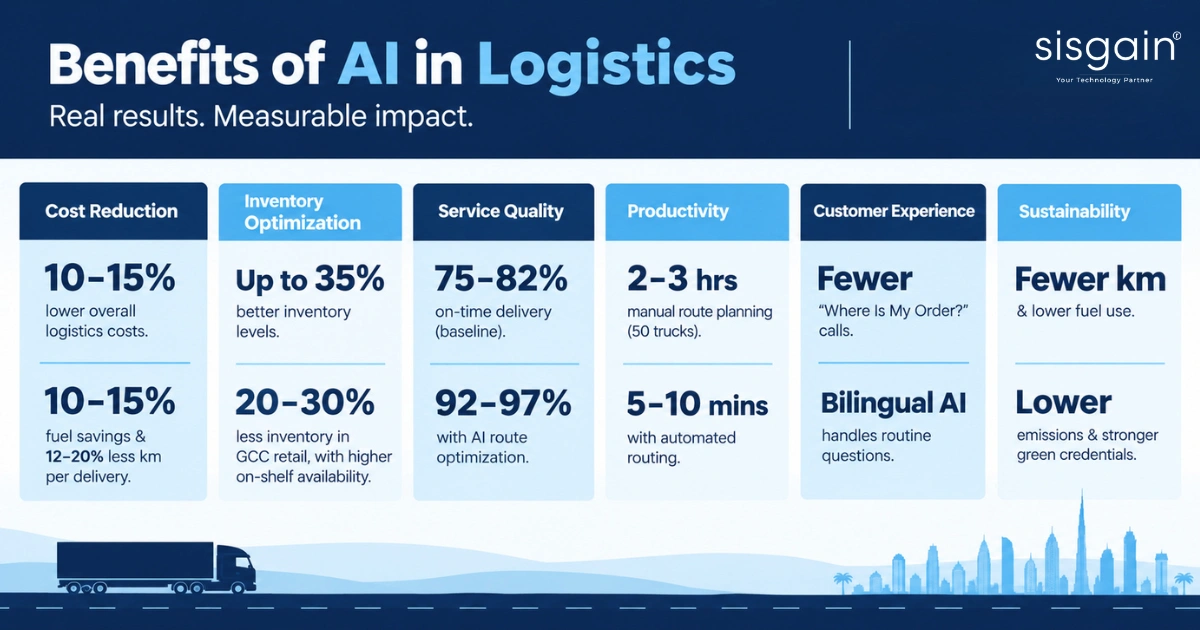
Vague promises of "efficiency" don't convince a CFO. Numbers do. Here's what AI adoption is actually delivering for logistics operators in the UAE and wider GCC.
Cost reduction. Early adopters report 10-15% lower overall logistics costs. On the transport side specifically, AI-driven route optimization is delivering 10-15% fuel savings and cutting kilometers driven per delivery by 12-20%. For a fleet running hundreds of deliveries a day, that's not a rounding error — it's real margin.
Inventory optimization. Companies using AI for demand planning report inventory level improvements of up to 35%. GCC retail case studies specifically have seen 20-30% inventory reduction while improving on-shelf availability — which sounds contradictory until you realize that's exactly the point of better forecasting. You're not just cutting stock; you're cutting the wrong stock.
Service quality. This is the number that should get every operations director's attention: GCC fleets using AI route optimization have pushed on-time delivery rates from a baseline of 75-82% up to 92-97%. That's the difference between "usually fine" and "genuinely reliable" — the kind of consistency that turns a logistics provider into a competitive advantage for the retailers and manufacturers who depend on it.
Productivity. One documented case: a dispatcher planning routes for 50 trucks manually took 2-3 hours a day. With automated routing, that dropped to 5-10 minutes. That's not incremental improvement — that's a different job entirely, freeing dispatchers to manage exceptions instead of drawing lines on a map.
Customer experience. More accurate ETAs and proactive delivery updates cut down on "Where Is My Order?" calls, which is one of the highest-volume, lowest-value tasks most customer service teams deal with. Bilingual AI support handles the routine questions so human agents can focus on the ones that actually need judgment.
Sustainability. Fewer kilometers driven and better-optimized loads directly reduce fuel consumption and emissions — which increasingly matters for UAE companies working toward national green logistics targets, and for the growing number of enterprise clients who now factor supplier emissions into procurement decisions.
How fast does this actually pay back?
This is the question every finance team asks, and the honest answer is: it depends on the use case. Route optimization tends to show measurable results within one to two months, because the input data (your existing delivery history and live traffic feeds) is usually already available. Demand forecasting takes longer to prove out — typically one to two full sales cycles — because you need enough real-world outcomes to validate the model's accuracy against what actually happened. Document automation sits somewhere in between: the time savings are immediate, but the full ROI case usually needs a quarter of volume to demonstrate clearly to stakeholders.
The practical takeaway: don't evaluate every AI use case on the same timeline. A pilot that looks disappointing after six weeks might just be a forecasting model that needs six months to prove itself.
None of these benefits come from a single tool bolted onto your existing stack. They come from rethinking how your Transportation Management Software Development and Fleet Management Software Development work together, with AI sitting at the center coordinating both.
AI Applications in Logistics: Where the ROI Actually Is
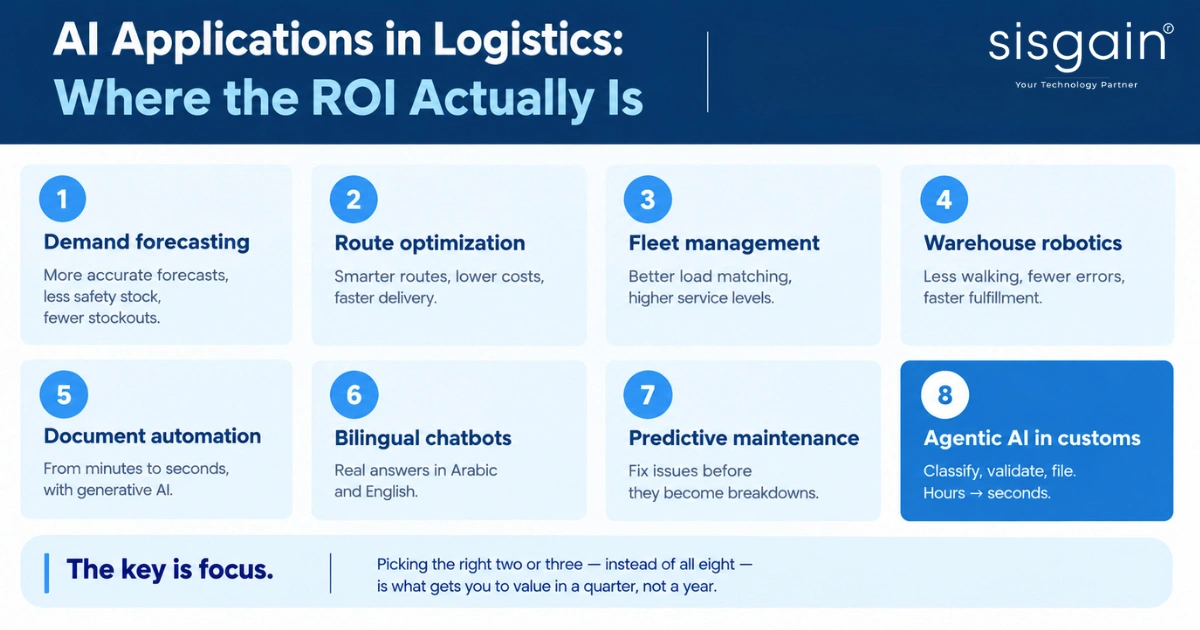
Not every AI use case delivers the same return, and chasing all of them at once is how pilot projects die in committee. Here are the seven applications delivering the clearest ROI for UAE logistics operators right now.
1. Demand forecasting
Blending point-of-sale data with seasonality, Ramadan peaks, and local events produces forecasts that are measurably more accurate than historical-average models. The payoff shows up directly in reduced safety stock and fewer stockouts.
2. Route optimization and last-mile planning
The single highest-ROI application for most UAE operators. Systems that incorporate Makani codes, bilingual address formats, heat constraints, prayer times, and live traffic data consistently outperform generic routing tools built for other markets. This is also where the fastest payback period tends to show up — often within a single fiscal quarter for mid-sized fleets.
3. Fleet management
AI assigns loads across private and for-hire carriers automatically, balancing cost against service level in real time and adjusting dispatch start times based on both historical patterns and live conditions on the road.
4. Warehouse robotics and picking optimization
AI suggests floor layouts based on actual order patterns, optimizes picker routes to cut walking distance, and increasingly coordinates robot-assisted sorting — reducing both errors and fulfillment time.
5. Document automation with generative AI
Digitizing bills of lading and invoices, extracting the relevant fields, and auto-populating your Supply Chain Software Development stack turns a task that used to take a data entry clerk twenty minutes into something that happens in the background while the document is still uploading.
6. Bilingual customer service chatbots
Handling shipping eligibility questions, multi-piece and cross-country shipping rules, and tracking queries in both Arabic and English — a genuinely difficult problem for a market this linguistically split, and one where generic off-the-shelf chatbots consistently fall short.
7. Predictive maintenance
Using sensor data from forklifts and trucks to forecast failures before they happen, rather than reacting after a breakdown strands a delivery halfway through its route.
There's an eighth application worth flagging separately because it's moving fast: agentic AI in customs and trade compliance. These systems classify HS codes, validate documentation, and in some cases file directly with customs authorities — cutting processing time for standard shipments from hours down to seconds. For any UAE business dealing with high trans-shipment volume through Jebel Ali, this is worth watching closely over the next 12-18 months.
Picking the right two or three from this list — rather than trying to deploy all eight simultaneously — is usually the difference between a project that ships in a quarter and one that stalls for a year.
Examples of AI in Logistics: Real Companies, Real Numbers
Case studies matter because they answer the question every skeptical operations director is actually asking: does this work outside of a vendor's slide deck?
Western Digital's "Logibot." A digital assistant handling logistics questions around the clock, gathering feedback automatically, and resolving the majority of routine queries without human intervention — freeing up support agents to handle the complex exceptions that actually need their expertise.
A GCC omni-channel retailer. This one is particularly instructive because it shows what happens when AI is embedded across the entire chain rather than a single point solution. The retailer applied AI across demand planning, warehousing, logistics, and supplier risk management together. The result: a 10-15% drop in logistics costs, a 20-30% reduction in inventory, and — critically — better on-shelf availability at the same time. That combination is hard to achieve manually; forecasting and inventory reduction usually pull in opposite directions unless the underlying prediction accuracy genuinely improves.
FedEx in Saudi Arabia. Launching AI-powered shipment monitoring in 2026 to improve visibility and respond faster to risks on critical, time-sensitive shipments — a direct signal that even the largest global logistics players see the GCC as a priority market for this kind of investment, not an afterthought.
UAE last-mile operators. Across multiple operators, AI route optimization built around local traffic patterns, events, and delivery constraints has delivered roughly 15% lower travel time alongside the 10-15% fuel savings mentioned earlier. These aren't projected numbers from a vendor pitch — they're documented outcomes from live GCC deployments.
The pattern across all four examples is the same: the biggest wins come from applying AI across a connected system, not from a single isolated tool. A route optimizer bolted onto a dispatch process that hasn't changed in five years will produce modest gains. A route optimizer feeding into an integrated Freight Management Software platform, connected to live fleet data and warehouse output, produces the kind of numbers you see above.
Challenges in AI Adoption for UAE Logistics (And How to Actually Fix Them)
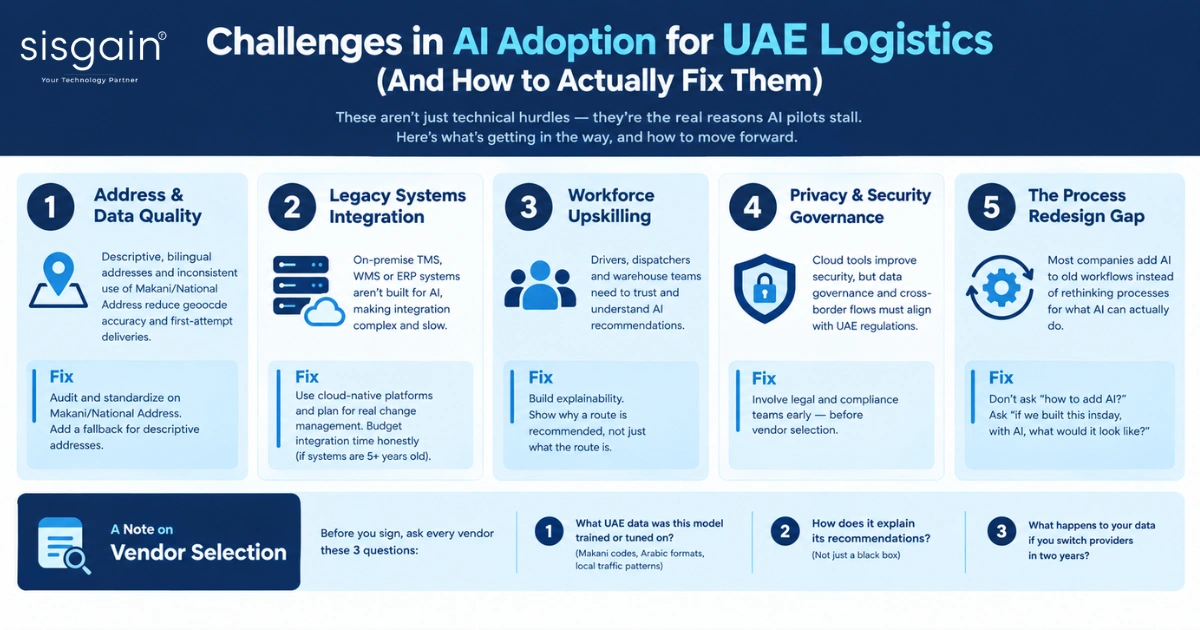
Most AI content skips this section or treats it as an afterthought. That's a mistake, because these are exactly the issues that separate a successful rollout from an expensive pilot that quietly gets shelved.
Address and data quality
This is the UAE's single biggest AI adoption bottleneck, and it's rarely discussed openly. Descriptive, bilingual addresses — "near the blue mosque, behind the petrol station" — and inconsistent adoption of Makani and National Address systems drag down geocode confidence and first-attempt delivery rates. No routing algorithm, however sophisticated, can optimize around an address it can't accurately locate.
Fix: Before investing in any AI routing tool, audit your address data. Standardize on Makani or National Address fields wherever possible, and build a fallback process for descriptive addresses rather than treating them as edge cases to ignore.
Integration with legacy systems
Most UAE logistics operators are running on-premise TMS, WMS, or ERP systems that were never designed to talk to AI tools. Retrofitting AI onto that stack is genuinely complex, and it's the number one reason pilot projects stall before reaching production.
Fix: Cloud-native logistics platforms reduce this friction significantly, but they still require real change management — not just a vendor contract. If your core systems are more than five years old, budget integration time honestly rather than assuming a plug-and-play rollout.
Workforce upskilling
Drivers, dispatchers, and warehouse managers need to trust AI-generated alerts and optimized routes before they'll actually follow them. A dispatcher who's been drawing routes by hand for fifteen years isn't going to blindly trust a black-box algorithm on day one — and honestly, they shouldn't have to.
Fix: Build explainability into the rollout. Show dispatchers why the system recommends a route, not just what the route is. Trust gets built through transparency, not mandate.
Privacy and security governance
Cloud-based AI logistics tools typically come with automated security updates, which is a genuine advantage over legacy on-prem systems. But data governance and cross-border data flows still need to align carefully with UAE regulatory requirements, especially for any business handling customer or shipment data that crosses jurisdictions.
Fix: Get your legal and compliance teams involved at the vendor selection stage, not after the contract is signed.
The process redesign gap
This is the challenge with the most room for competitive advantage. 66% of Middle East organizations report efficiency gains from AI — but only 34% have actually redesigned their processes around it. Most companies are running AI on top of their old workflow instead of rebuilding the workflow to take advantage of what AI actually makes possible.
Fix: Don't ask "how do we add AI to our current process?" Ask "if we were building this process today, with AI as a given, what would it look like?" That's a harder question, and it's exactly why it's still an open opportunity for whoever answers it first.
A note on vendor selection
Given how crowded the "AI logistics" vendor space has become, it's worth having a short filter before signing anything. Ask three questions of any vendor: What specific UAE data was this model trained or tuned on — Makani codes, Arabic address formats, local traffic patterns? How does the system explain its recommendations to a human dispatcher, rather than just outputting a black-box result? And what happens to your data if you switch providers in two years? A vendor that can't answer these clearly in the first meeting usually can't answer them well after the contract is signed, either.
UAE AI in Logistics: Market Stats Worth Knowing
|
Metric |
Figure |
|
Middle East AI economic benefit by 2030 |
~$320 billion |
|
UAE AI impact on GDP |
Approaching 14% |
|
UAE Generative AI in Logistics market, 2025 |
~$16.2 million |
|
UAE Generative AI in Logistics market, 2032 (projected) |
~$121.8 million |
|
Generative AI logistics CAGR (UAE) |
33.4% |
|
Middle East orgs reporting AI efficiency gains |
66% |
|
Middle East orgs redesigning processes around AI |
34% |
|
Fuel savings from AI route optimization (GCC) |
10-15% |
|
Reduction in km driven per delivery |
12-20% |
|
On-time delivery improvement (GCC fleets) |
75-82% → 92-97% |
Implementation Checklist: Getting Started Without Overreaching
If you're an operations or IT leader trying to move from "we should look into AI" to an actual rollout plan, this is the order that works.
- Start with data, not software. Cleanse your address data, standardize on Makani or National Address fields, and fix bilingual input inconsistencies before you buy anything.
- Pick two or three high-ROI use cases. Demand forecasting, route optimization, and document automation are the strongest starting points for most UAE operators — resist the urge to tackle all seven applications at once.
- Integrate with your core systems. AI needs to connect to your TMS, WMS, ERP, and telematics data to actually drive execution rather than just generate reports nobody acts on.
- Train your teams before you flip the switch. Build clear playbooks for dispatchers and drivers covering how to handle AI alerts, exceptions, and edge cases.
- Measure what actually matters. Track first-attempt delivery rate, kilometers per drop, fuel use, on-time percentage, WISMO call volume, and cost-to-serve — not vanity metrics like "number of AI features deployed."
One thing worth budgeting for honestly upfront: AI development cost varies enormously depending on whether you're integrating an existing platform's AI features versus building custom models trained on your own operational data. A route optimization add-on to an existing TMS might be a matter of weeks and a modest licensing fee. A custom-trained demand forecasting model built on your proprietary sales history is a different scale of investment entirely — get a clear cost breakdown before you commit to either path.
Where to Start
The UAE logistics sector isn't short on ambition or infrastructure — it's short on the software layer that turns world-class physical logistics into world-class intelligent logistics. The 34% of Middle East companies actually redesigning their processes around AI, rather than just adding it on top, are the ones pulling ahead right now.
Whether that starting point for you is a route optimization pilot, a rebuild of your Warehouse Management System, or a full Supply Chain Software Development overhaul, the companies that move deliberately — clean data first, two or three focused use cases, real integration, real training — are the ones seeing the 15%, 20%, 30%+ numbers cited throughout this guide. The ones that bolt AI onto an unchanged process are the ones still waiting to see results a year from now.
If you're mapping out what an AI-driven logistics rollout would actually look like for your fleet or warehouse operation, that's exactly the conversation worth having next.