
If you have collected three quotes for a healthcare app in Dubai, you already know the problem. One vendor says AED 90,000. Another says AED 600,000. A third won’t give a number until “discovery.” All three can be honest, because they are quoting different products.
So here is the straight answer. Healthcare app development in Dubai typically costs between AED 100,000 and AED 1,500,000+ in 2026, depending on scope. A basic patient app sits at the low end. A multi-role clinic or hospital platform with clinical integrations sits at the top. There is no single verified, Dubai-wide price, and anyone who tells you otherwise is selling a headline.
I run delivery at SISGAIN, and most of my week is spent in the room where a budget meets reality: a clinic owner with a clear idea, a finance lead with a fixed number, and a list of integrations nobody priced. This guide is how I walk those people through the decision. If you are still shaping the project, our healthcare software development team in Dubai can help you scope it properly.
One rule runs through the whole article. I separate three kinds of numbers:
- Verified statistics from official UAE sources, which show how big and mature the market is.
- Published vendor estimates, which show how the market prices work. These are not audited averages.
- Planning assumptions, which are my working numbers for budgeting. They are labelled every time, and they are not a quotation.
Mixing those three is how healthcare budgets go wrong.
Quick Answer: What Does a Healthcare App Cost in Dubai?
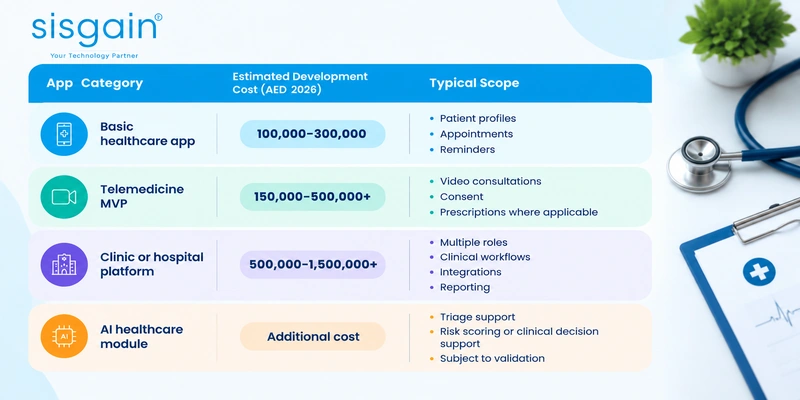
Here are the indicative 2026 planning ranges we use for first conversations:
|
App category |
Estimated development cost (AED) |
Typical scope |
|
Basic healthcare app |
100,000–300,000 |
Patient profiles, appointments, reminders |
|
Telemedicine MVP |
150,000–500,000+ |
Video consultations, consent, prescriptions where applicable |
|
Clinic or hospital platform |
500,000–1,500,000+ |
Multiple roles, clinical workflows, integrations, reporting |
|
AI healthcare module |
Additional cost |
Triage support, risk scoring or clinical decision support, subject to validation |
These are planning ranges, not guaranteed quotes. The final figure follows a proper discovery phase, because integrations, compliance scope and the delivery team change the number more than any feature list does.
Want a number for your own scope? Request a project estimate and we will map your features, integrations and compliance needs before anyone commits to a price.
Why Dubai Is Worth the Investment: What the Numbers Say
Before we talk about cost, it helps to know what you are building into. These are the figures I open client conversations with.
|
Indicator |
Figure |
Context |
|
Licensed healthcare facilities |
~5,800 |
Dubai, 2025 |
|
Annual facility growth |
8%+ |
From 5,340 in 2024 to ~5,800 in 2025 |
|
Private healthcare professionals |
69,400+ |
Dubai, 2025 |
|
Connected medical records |
4.0 billion |
UAE’s Riayati national health-record platform, as reported by MoHAP |
Sources: Dubai Media Office’s February 2026 report on 2025 healthcare growth, and the UAE Ministry of Health and Prevention’s Riayati information page.
What do these numbers actually tell you?
A large and growing provider base means real potential demand. More than 5,800 facilities, growing at over 8% a year, creates room for patient apps, appointment management, telemedicine and clinic workflow automation.
Staff-facing tools matter as much as patient apps. With over 69,400 private healthcare professionals, the doctor, nurse and admin side of the app is often where the efficiency gain sits. Founders tend to design for the patient and forget the receptionist who has to live in the admin dashboard all day.
Interoperability is not optional thinking. A national health-record platform holding billions of records means any app that touches clinical data has to be designed with data exchange in mind from the start.
One honest caveat. These figures prove the ecosystem is large and digitally mature. They do not measure healthcare app demand, app spending, or the revenue your product can expect. Please don’t put “8% growth” into a revenue forecast. It is a signal about the market, not a prediction about your app.
If you are still working out which type of product fits your facility, our guide to healthcare software types for the UAE is a useful starting point.
Healthcare App Development Cost in Dubai by App Category
Let’s unpack the table from the top of the page, because each row hides a different project.
Basic healthcare app: AED 100,000–300,000
This is the patient-facing starter. Think patient profiles, appointment booking, reminders and notifications, with a simple admin panel behind it. It suits small clinics, wellness providers and founders validating an idea.
The gap between AED 100,000 and AED 300,000 is large, and it usually comes down to scheduling logic. A clinic with one doctor and one location is simple. A clinic with six doctors, two branches and different consultation lengths is a scheduling engine in disguise. For a deeper look at that one use case, read our breakdown of the cost to build a doctor appointment app in the UAE.
Telemedicine MVP: AED 150,000–500,000+
Now you are adding video consultations, consent capture and, where applicable, prescriptions. The range is wide for a reason: a bare video-call wrapper and a product that is genuinely ready for commercial launch are very different builds. The more clinical workflow you add, the closer you get to the upper end.
We cover the product side in telemedicine app development for UAE providers, and you can see how the market looks in our roundup of the best telemedicine apps in the UAE.
Clinic or hospital platform: AED 500,000–1,500,000+
This is a different category of software. Multiple user roles, clinical workflows, integrations with existing systems and reporting all stack up. It behaves more like enterprise software with a mobile front end than a simple app. If your project sits here, our hospital management system work and the guide to modern hospital information systems are worth reading alongside this one.
AI healthcare module: additional cost
AI is priced as an add-on, not a tier. Triage support, risk scoring and clinical decision-support features all need data quality checks, validation, safety controls and monitoring. A symptom questionnaire is cheap. A model a clinician relies on is not. Our overview of AI in healthcare in Dubai explains where the line sits, and AI software development cost in Dubai covers how the pricing behaves.
How Other Vendors Price It (And Why the Numbers Don’t Match)
You will see different ranges on every vendor site. Don’t read that as a contradiction. Read it as a definitions problem. Here is what three published sources say:
|
Published source |
Indicative price information |
How to use it |
|
Techugo, Dubai guide |
AED 100k–250k basic; AED 250k–700k mid-level; AED 700k–1.5m+ advanced |
Dubai-oriented comparison |
|
Carmatec, UAE guide |
AED 40k–100k basic; AED 100k–250k mid-level; AED 150k–350k telemedicine; AED 300k–800k+ enterprise |
Shows how vendors define tiers differently |
|
SISGAIN healthcare app guide |
AED 100k–300k basic; AED 150k–500k+ telemedicine MVP; AED 500k–1.5m+ clinic or hospital platform |
SISGAIN’s own published planning estimates |
These are vendor estimates, not independently audited market averages. They are also not directly comparable until you normalise the inputs: the feature list, number of platforms, team location, integrations, testing, compliance scope and post-launch support.
A lower price can mean a smaller scope, remote delivery or a standardised package. It does not, by itself, tell you anything about quality. And a higher price doesn’t guarantee depth either. When I review a competing quote for a prospective client, the first thing I do is line the scope up item by item. Nine times out of ten, the “cheaper” quote simply left something out: security testing, an admin dashboard, or any budget for integrations.
That is why I tell clients to ask one question of every quote: what is not included?
If you want a broader benchmark across industries, our mobile app development cost guide for Dubai and the UAE shows how general app pricing behaves before healthcare-specific requirements are added.
My recommended scoping budget
If you need one number to start planning, use AED 150,000–300,000 as a preliminary scoping budget for a focused MVP. Please note the condition: only if the scope excludes major hospital integrations and other enterprise-level requirements. It is a planning envelope, not a promise. The real quote comes after discovery.
A Worked Example: Where AED 250,000 Actually Goes
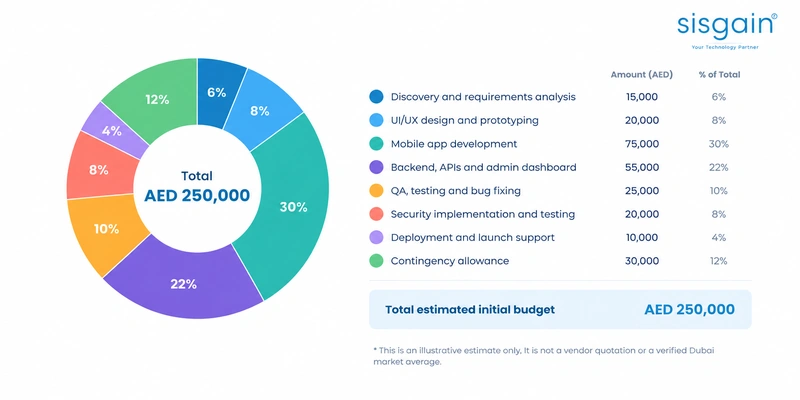
Ranges are useful, but they are abstract. Let me show you how a budget breaks down. The example below assumes a patient-facing healthcare MVP with appointment booking, patient profiles, notifications, an admin portal and basic clinic workflows.
This is an illustrative estimate only. It is not a vendor quotation or a verified Dubai market average.
|
Development component |
Estimated budget (AED) |
|
Discovery and requirements analysis |
15,000 |
|
UI/UX design and prototyping |
20,000 |
|
Mobile app development |
75,000 |
|
Backend, APIs and admin dashboard |
55,000 |
|
QA, testing and bug fixing |
25,000 |
|
Security implementation and testing |
20,000 |
|
Deployment and launch support |
10,000 |
|
Contingency allowance |
30,000 |
|
Total estimated initial budget |
250,000 |
The assumptions matter as much as the total. This budget assumes:
- No major third-party clinical system integration.
- No advanced AI features.
- No separate native iOS and Android codebases.
Change any of those and the number moves.
Three lines people skip
Discovery (AED 15,000). It feels like money spent before anything exists. In reality it is the cheapest insurance in the plan. It is where integration surprises, role complexity and compliance questions come out while they are still cheap to fix. Our UI/UX design services team joins this stage so the prototype and the requirements stay in step.
Security (AED 20,000). Health data can’t be reset like a password. Encryption, access controls, audit logging and testing are the foundation, not a finishing touch. We go deeper in our post on mobile app security and PDPL compliance.
Contingency (AED 30,000). That is 12% of the budget, held for the things nobody can foresee: an API that behaves differently from its documentation, a late change to the consultation flow, a testing finding. Projects with no contingency don’t avoid these problems. They just stop mid-build to argue about them.
What to confirm before you accept any quotation
Ask whether the quote includes:
- VAT
- Third-party subscriptions
- Cloud hosting
- External video services
- Regulatory consulting
- Post-launch support
These items can change the total materially, and they are the usual reason a signed quote and a final invoice drift apart.
Which Features Increase the Cost?
Here is how I rate common features when planning a healthcare app. These are qualitative planning judgements, not measured average price increases.
|
Feature or requirement |
Cost impact |
Why it matters |
|
Appointment booking and reminders |
Low–medium |
Scheduling rules, calendars and notifications |
|
Patient and doctor accounts |
Medium |
Different roles, permissions and profile management |
|
Telemedicine and video consultations |
Medium–high |
Video services, consultation workflows and reliability |
|
E-prescriptions |
Medium–high |
Clinical workflow and applicable regulatory requirements |
|
EHR/EMR integration |
High |
Existing system APIs, data mapping and testing |
|
NABIDH integration |
Potentially high |
Readiness, onboarding, interoperability and validation |
|
Insurance and claims integration |
High |
Payer workflows, eligibility and claims processing |
|
AI-assisted clinical features |
High or variable |
Data quality, validation, safety controls and monitoring |
|
Arabic and English support |
Low–medium |
Translation, right-to-left layout and QA |
|
Multiple clinics or hospitals |
High |
Multi-tenant access, permissions and complex workflows |
Booking and reminders: low to medium
Every healthcare app needs them, and they look easy. The cost climbs when you sync several doctors, locations or specialties, or when reminders need to go out by SMS or WhatsApp.
Patient and doctor accounts: medium
Once you have more than one type of user, each needs its own permissions, screens and workflow. A patient-only app is a different project from one that also serves doctors, nurses and administrators. Six roles don’t cost six times one role, but it isn’t far off.
Telemedicine: medium to high
Video is not just a feature, it’s a reliability promise. A dropped call during a consultation is a clinical problem, not only a user-experience one. There are also usage-based costs from the video provider, which belong in your operating budget.
E-prescriptions: medium to high
They sound simple until you look at the regulatory trail they have to leave behind. If you are scoping this, see our eRx software development page for how we approach it.
EHR/EMR integration: high
This is where I see budgets move the most. Some integrations are a clean API call. Others become a long negotiation with a legacy system’s IT team about access, data mapping and testing. Understanding the difference between these systems helps, so see HIMS vs EMR vs EHR, and our EHR, EMR and PHR development page for the build side.
NABIDH and insurance integration: potentially high to high
Both depend on the other party’s systems, timelines and approvals, not only your code. We expand on NABIDH in the compliance section below.
AI-assisted clinical features: high or variable
The cost isn’t in the model call. It’s in data quality, validation, safety controls and ongoing monitoring. If a feature influences care decisions, treat it as a clinical-safety project, not a feature.
Arabic and English support: low to medium
This is cheap when planned from the start and expensive when retrofitted. Right-to-left layouts affect every screen, not just the text. Plan it into design and QA from week one. Our Arabic medical AI assistant article shows what bilingual healthcare experiences look like in practice.
Multiple clinics or hospitals: high
Multi-tenant access and permissions turn a simple app into a platform. Each additional facility brings its own users, rules and reporting needs.
Integration costs depend particularly on which systems are involved and how much access they give you. Which is exactly why you should never price a NABIDH or EMR integration before someone has looked at the actual system.
Healthcare Compliance in Dubai: The Workstream You Must Budget For
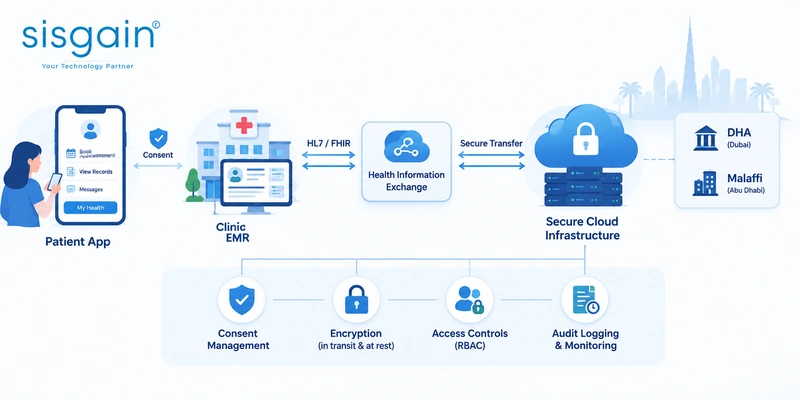
If there is one lesson I would tattoo on every project plan, it is this: compliance is a separate workstream, not an afterthought. The projects that struggle are rarely the ones with a hard technical problem. They are the ones where nobody asked, until week twenty, what the regulator expects.
NABIDH interoperability
Dubai Health Authority (DHA) publishes interoperability standards and requirements for relevant healthcare facilities. A DHA circular dated 26 May 2025 specifically addresses EMR systems compliant with NABIDH integration requirements and single sign-on.
What should you do with that? First, find out whether your facility and your proposed app actually require integration. Then define the onboarding and technical scope. Exchange standards such as HL7 and FHIR sit underneath most of this work, which is why teams often bring in specialists for HL7 and FHIR integration and health information exchange connectivity.
A note for anyone operating across emirates: Abu Dhabi runs its own exchange, Malaffi, so a group with clinics in both Dubai and Abu Dhabi should plan for two connectivity paths, not one.
Budgeting caution: Do not quote a fixed NABIDH integration price until the client’s existing EMR, access arrangements, data flows and onboarding requirements have been assessed.
I repeat this to every client because the temptation to “just put a number on it” is strong. A guessed number becomes a commitment, and the real cost then lands on whoever signed.
Health data privacy and security
The UAE Personal Data Protection Law, Federal Decree-Law No. 45 of 2021, sets personal-data processing and protection obligations. Health-sector ICT is also subject to specific legislation and health-authority requirements.
Practically, that means assessing consent, access controls, encryption, audit logs, retention and incident response with qualified compliance advisers. I am an engineering and delivery lead, not your lawyer, so treat this section as a map of what to ask, not legal advice. If you build for patients who may sit outside the UAE, our guide to building a HIPAA-compliant app covers where US requirements can enter the picture. For the technical controls themselves, our cybersecurity services team works on testing and hardening.
Testing, deployment and ongoing compliance
Plan for security testing, clinical workflow validation, backup and recovery, monitoring and any applicable approval processes. If your product provides diagnosis, treatment recommendations or regulated medical-device functionality, further assessment may be needed. That one sentence can add months, so ask early.
Our QA and testing practice builds this validation into the delivery plan rather than leaving it for the last fortnight.
Official references to share with your team
- DHA circular on EMR and NABIDH requirements
- DHA interoperability and data exchange standards
- UAE Government portal (u.ae) pages on data protection laws
Regulations change. Check the current text before you finalise scope, and read our write-up on the challenges in healthcare app development in Dubai for the problems we see most often.
Native or Cross-Platform: Which One Costs Less?
This question comes up in almost every first meeting, so here is the short version.
Cross-platform (Flutter or React Native) shares one codebase across iOS and Android. For most clinics and healthtech startups, that means less to build, less to test and less to maintain. Our worked AED 250,000 example assumes this route.
Native iOS or Android costs more because you are effectively building two apps. It earns its place when you need deep device features, such as tight Apple Health or wearable integrations that a shared codebase handles awkwardly.
My rule of thumb: start cross-platform unless a specific, named requirement forces native. Don’t pick native because it sounds more serious. For the full trade-offs, read native vs cross-platform app development, or talk to our cross-platform app development team about your case.
How Long Does It Take?
Here are the indicative planning timelines.
|
Project type |
Planning timeline |
|
Basic healthcare app |
2–4 months |
|
Telemedicine MVP |
3–7 months |
|
Integrated clinic or hospital platform |
6–12+ months |
|
Enterprise healthcare ecosystem |
8–14+ months |
These are planning ranges, not delivery guarantees. Vendor estimates vary, and integrations, approvals, clinical validation and client-side dependencies can all stretch the schedule.
What usually causes the slip? In my experience it is rarely the coding. It is waiting: for API access from a third party, for the client’s own team to approve a workflow, or for a decision on scope that keeps changing. A short, clear requirements document at the start saves more calendar time than extra developers later.
The Cost After Launch: Running Costs and Three-Year TCO
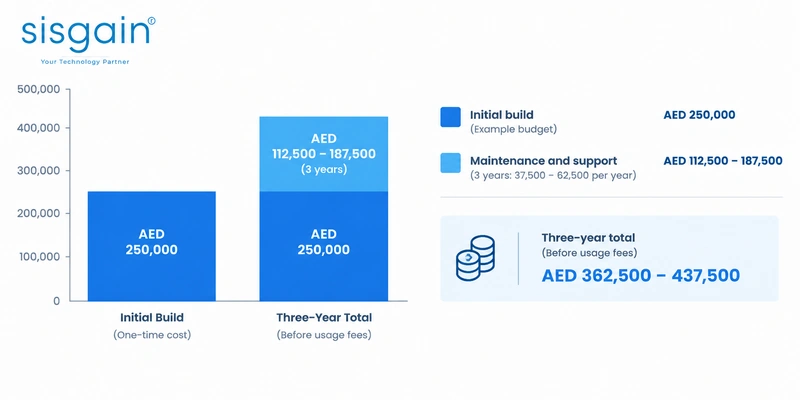
Here is a number most first-time buyers never see: the build is only part of what you will spend. Compare the initial build with the total cost of ownership (TCO) over three years.
|
Operating expense |
What to include |
|
Cloud infrastructure |
Hosting, database, backups, storage and monitoring |
|
Maintenance |
Bug fixes, operating-system updates and dependency upgrades |
|
Security |
Monitoring, vulnerability remediation and periodic assessments |
|
Third-party services |
Video, SMS, email, maps, identity verification and other APIs |
|
Compliance |
Required reviews, documentation and integration maintenance |
|
Product improvements |
New features, workflow changes and usability improvements |
|
Support |
User assistance, incident response and service-level commitments |
For early financial modelling, you can provisionally set aside 15–25% of the initial development cost per year for maintenance and support. This is a budgeting assumption, not a verified Dubai healthcare industry benchmark. Hosting, video usage, support hours and compliance scope may need their own budgets.
On a AED 250,000 build, that works out to AED 37,500–62,500 a year, before usage-based services or major enhancements.
A three-year view of the same example looks like this:
|
Item |
Calculation |
Amount (AED) |
|
Initial build |
Example budget |
250,000 |
|
Maintenance and support, 3 years |
37,500–62,500 × 3 |
112,500–187,500 |
|
Three-year total before usage fees |
|
362,500–437,500 |
This is my own illustration built on the 15–25% assumption, not a quotation. But look at what it shows: the “AED 250,000 app” is closer to a AED 360,000–440,000 commitment over three years once you keep it healthy. If you would rather not hire an in-house team for upkeep, our cloud managed services are one way to cover hosting and monitoring.
ROI: How to Justify the Investment Without Overpromising
I will be blunt about this one. Please don’t promise a board that an app will lift revenue or cut costs by a fixed percentage unless you have your own operational data. Show a transparent scenario instead, and let the assumptions be visible.
A worked ROI example
These are hypothetical inputs, not observed client results:
|
Input |
Value (AED) |
|
Initial development cost |
250,000 |
|
Monthly operational savings |
16,000 |
|
Additional monthly contribution from app-enabled business |
5,000 |
|
Annual running costs |
50,000 |
Annual net benefit = 12 × (16,000 + 5,000) − 50,000 = AED 202,000
Now compare the evaluation periods:
|
Evaluation period |
Net value (AED) |
ROI |
Note |
|
1 year |
−48,000 |
−19.2% |
Not yet paid back |
|
3 years |
356,000 |
142.4% |
Net value = 202,000 × 3 − 250,000 |
|
5 years |
760,000 |
304.0% |
Net value = 202,000 × 5 − 250,000 |
Simple payback period = 250,000 ÷ 202,000 = about 1.2 years.
The formulas, so you can rebuild this with your own figures:
- Annual net benefit = 12 × (monthly operational savings + monthly additional contribution) − annual running costs
- Net value = annual net benefit × years − initial build cost
- ROI = net value ÷ initial build cost × 100
This model assumes constant benefits and costs, with no discounting, tax, financing or revenue ramp-up. And don’t count gross sales as profit. Use the incremental contribution after variable costs.
Notice the first row. Even a healthy scenario is negative in year one. That isn’t a failure, it is how most software investments behave, and a finance team that sees it upfront trusts the rest of your numbers more.
What to measure
A business case is only as good as its baseline. Measure these before you launch, not after:
- Staff time spent on manual appointments and follow-ups.
- Missed appointments, against a reliable baseline.
- Administrative cost per completed booking.
- Completed consultations attributable to the app.
- Time to reach relevant patient information, where appropriate.
- Patient retention and satisfaction, over time.
Your clinic needs to supply its baseline volumes, staff costs, no-show rate, contribution per consultation and expected adoption. Those inputs turn a generic ROI model into a credible business case. If revenue-cycle leakage is part of your problem, our guide to AI in revenue cycle management and RCM services show where the savings often hide.
How to Keep the Cost Down Without Cutting the Wrong Things
Cost control in healthcare is about sequencing, not skipping. Here is what works:
- Start with an MVP. Build the smallest version that proves adoption. Our guide to building a minimum viable product shows how to cut scope sensibly.
- Fund the features that earn their keep first. Everything else is phase two.
- Use cross-platform technology where deep native integration isn’t needed.
- Buy proven services for video, payments and messaging instead of building them.
- Design compliance in from the architecture stage.
- Plan Arabic and RTL from day one. Retrofitting touches every screen.
- Sequence integrations by business value, not by ease.
- Avoid custom AI where an existing service does the job.
And the mistakes that quietly inflate budgets:
- Starting to build before regulatory planning has begun.
- Treating NABIDH or Malaffi as a “later phase” problem.
- Leaving Arabic support until late.
- Choosing a tech stack on price alone.
- Underestimating how hard one particular integration is.
- Skipping security testing to hit a launch date.
- Overloading the MVP.
- Leaving healthcare domain experts out of the design process.
- Hiring the cheapest team available.
Cost optimisation should never mean cutting security, compliance or clinical safety. A cheaper partner who misses a regulatory requirement can easily cost more than a stronger team that got it right the first time.
How to Choose a Healthcare App Development Partner in Dubai
Look past the portfolio screenshots. Ask:
- Have you built healthcare software before, not just general apps?
- Which UAE requirements, including DHA and NABIDH, have you worked with directly?
- How do you handle security? Can you show examples?
- What is your EHR/EMR integration experience?
- Who will actually work on my project, and what is their technical depth?
- How is post-launch support structured?
- Can you show healthcare case studies?
- Will you itemise the price instead of giving one lump sum?
A partner who can talk fluently about NABIDH and DHA without you explaining what they are is usually a good sign. Our broader guide on how to choose a mobile app development company in the UAE has a fuller checklist, and you can see how our delivery teams work on our mobile app development page.

Building Your Internal Business Case: A Simple Eight-Step Flow
If you need to present this to a board, a partner or an investor, here is the structure I recommend for a 10–15 minute meeting:
- Market opportunity. Dubai’s facility growth and digital health ecosystem.
- Project definition. Who will use the app, what problem it solves and which workflows it covers.
- Development cost. MVP, telemedicine and enterprise budget scenarios.
- Detailed cost breakdown. Design, development, backend, QA, security and contingency.
- Compliance and integrations. NABIDH applicability, privacy, security and clinical workflows.
- Timeline and TCO. Launch phases, maintenance, hosting and third-party services.
- ROI and success measures. Your own assumptions, the financial model and KPIs.
- Recommended next step. Requirements discovery followed by a scope-based proposal.
The strongest proposals keep three things visibly separate throughout: verified UAE statistics, published vendor pricing and your own budget assumptions. That makes the case defensible when someone in the room starts asking where a number came from.
My Final Recommendation
Begin with a clearly defined MVP. Validate adoption and operational benefit. Then expand into telemedicine, clinical integrations or AI based on evidence, not enthusiasm.
Use AED 150,000–300,000 as a preliminary planning envelope for a focused MVP, not as a guaranteed quote. Before you commit, write down:
- The features you need.
- Your platform strategy.
- Integration obligations.
- The compliance work that applies.
- Delivery milestones and acceptance criteria.
- Annual support costs.
That list is the real deliverable of discovery. Once it exists, any quote you receive becomes comparable, and your decision rests on scope and business value instead of a headline price.
Ready to turn your idea into a scoped budget? Request a detailed project estimate with your features, integrations and compliance needs, and our team will respond with a roadmap. You can also review our healthcare software development work and portfolio before you reach out.
Statistics are drawn from the Dubai Media Office (February 2026) and the UAE Ministry of Health and Prevention. Vendor ranges are published estimates, not audited market averages. Budgets, maintenance percentages and ROI figures in this guide are planning assumptions, not quotations or legal advice.