
Twenty-five years in IT teaches you one uncomfortable lesson: security problems are rarely caused by exotic attacks. They are caused by ordinary decisions made under deadline pressure. A token stored in plain text because it was quicker. An API endpoint that checks whether a user is logged in but never checks whether that user is allowed to see a particular record. A third-party analytics SDK added by marketing that quietly collects more than anyone realised.
In Abu Dhabi, these ordinary decisions now carry more weight. Customers use mobile apps for banking, healthcare appointments, food delivery, government services, retail loyalty and property transactions. Every one of those apps collects personal data. And the UAE now has a federal data protection framework, Federal Decree-Law No. 45 of 2021 (the Personal Data Protection Law, or PDPL), that expects businesses to treat that data with discipline.
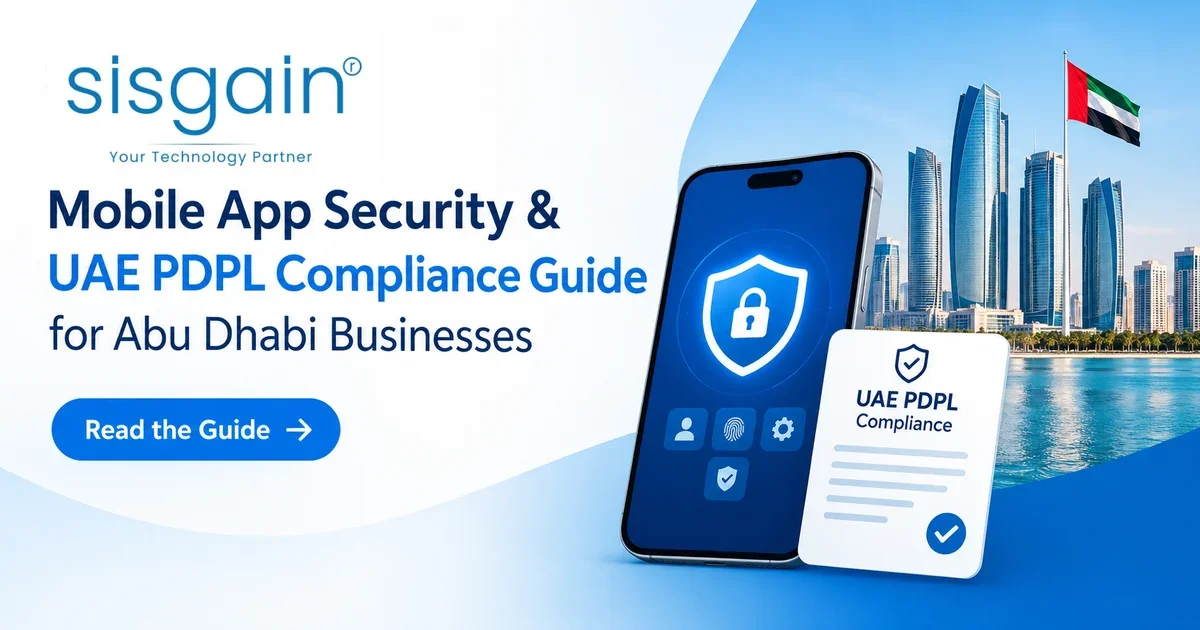
This guide is written for founders, CTOs, CIOs, product managers and IT leaders who run or plan to launch mobile apps in Abu Dhabi. It combines practical mobile app security best practices Abu Dhabi teams can implement with a clear explanation of what PDPL means for app design, vendors and incident readiness. It is not legal advice, but it will help you ask the right questions of your engineers, your vendors and your legal counsel.
Quick Answer: What Should Abu Dhabi Businesses Do to Secure Mobile Apps and Meet PDPL Expectations?
Abu Dhabi businesses should protect mobile apps through secure-by-design development, encryption, strong authentication, secure APIs, least-privilege access, continuous testing, and a privacy governance process aligned to UAE PDPL obligations. Healthcare, fintech and government-adjacent apps may also face sector-specific requirements, so confirm which rules apply to your organisation with qualified legal counsel.
The Security + Privacy Matrix at a Glance
|
Area |
What the business should do |
|
Data inventory |
Identify what personal data the app collects, why it is needed, and where it is stored and shared |
|
Privacy governance |
Define the lawful basis for processing, privacy notices, consent flows where appropriate, retention periods and data-subject request processes |
|
Mobile protection |
Use secure device storage, code hardening, correct certificate validation and secure session controls |
|
API security |
Enforce authorization on every endpoint, validate inputs, rate-limit requests and protect secrets |
|
Identity and access |
Use multi-factor authentication (MFA) for administrative access and role-based permissions |
|
Assurance |
Perform code review, penetration testing, vulnerability management and incident-response exercises |
Why Mobile App Security in Abu Dhabi Matters More Than Ever
Abu Dhabi has invested heavily in digital transformation. Healthcare, government services, finance, real estate, tourism, logistics and retail are all moving customer interactions into apps. That creates three pressures on any business operating there.
First, customers expect trust by default. Residents and visitors in the UAE are highly digitally active. When an app handles Emirates ID details, payment cards, health records or location history, users assume it is protected. A visible incident damages trust far faster than a feature launch builds it.
Second, apps concentrate risk. A mobile app is a client on a device you do not control, talking to APIs you do control, using third-party SDKs you only partly control. Attackers look for the weakest link across all three.
Third, regulation is maturing. The UAE Data Office serves as the federal regulator under the PDPL, and sector regulators in Abu Dhabi, such as the Department of Health, set their own expectations. Enterprise buyers increasingly ask vendors to demonstrate security and privacy maturity during procurement.
The practical conclusion: mobile app security Abu Dhabi is now a business-continuity and reputation topic as much as a technical one. It deserves a place in your roadmap, budget and board-level risk discussions.
UAE PDPL: What It Means for Mobile Apps
The PDPL is the UAE's national personal data protection framework. In plain business terms, it sets out duties for organisations that handle personal data and rights for the individuals the data relates to. The UAE government describes it as an integrated framework for protecting the confidentiality and privacy of personal data.
Here is how that translates into app development.
1. Understand What Your App Actually Collects
A mobile app often gathers personal data through many channels at once:
- Registration and profile forms (name, phone number, email, Emirates ID details where relevant)
- Location features, including background location
- Device identifiers and advertising IDs
- Payment flows and tokenised card data
- Customer support chats and uploaded documents
- Biometric authentication prompts
- Push notification tokens
- Analytics, crash-reporting and attribution SDKs
Most teams can list the first two or three items. Fewer can list everything their SDKs collect. That gap is where compliance problems start. Build a data inventory (sometimes called a record of processing) that documents each data element, its purpose, where it is stored, who can access it and how long it is kept.
2. Make Your Privacy Notice Match Real App Behaviour
A privacy notice that was copied from a template and never updated is a liability. If your app collects location, contacts, biometrics, payment information, health data or identifiers, the notice should say so clearly and explain the purpose in language users can understand. Whenever you add a feature or SDK, review whether the notice is still accurate.
3. Minimise Data Collection
The safest data is the data you never collect. Ask of every field and permission: Do we need this for a defined business purpose? If the answer is "it might be useful later," that is a signal to remove it. Data minimisation reduces your breach exposure, your storage costs and your compliance burden at the same time.
4. Define Lawful Basis, Consent and User Rights
Work with your legal team to decide on what basis each type of processing relies, and where consent is appropriate, build consent flows that are specific, understandable and easy to withdraw. Your operations must also be able to handle data-subject requests, such as requests to access, correct or delete data, which means your backend must be able to find and act on a person's data across systems.
5. Review Third-Party SDKs and Vendors
Analytics tools, payment gateways, crash reporters, push providers, chat widgets and cloud vendors may all receive or process user data. Include them in your compliance review. For each vendor, understand what data they receive, where it is processed, what contract terms apply and how you would remove data or end the relationship if needed. Where data may leave the UAE, ask your legal advisers to review cross-border transfer requirements before launch, not after.
6. Set Retention and Deletion Rules
Keeping data forever is not a strategy. Define how long each category of data is retained, build deletion into the backend, and make sure backups and logs follow the same logic.
7. Prepare for Incidents
PDPL compliance affects breach readiness. Rather than relying on a single remembered number or deadline, establish a documented incident-response process to assess, contain, investigate, and notify the relevant authority and affected individuals where required. The exact notification duties that apply to your organisation should be confirmed with legal counsel, because they can depend on your sector, your contracts and the applicable regulations at the time.
Does PDPL Apply to Every Business in Abu Dhabi?
Not necessarily in the same way. Some free zones have their own data protection regimes. For example, businesses licensed in Abu Dhabi Global Market (ADGM) operate under ADGM's data protection regulations. Certain categories of data, such as health data governed by its own legislation, may also be treated differently. This is why a simple "PDPL yes or no" answer is rarely enough. Map your legal entity, your licence jurisdiction, your data types and your customers, then get a written view from legal counsel on which rules apply.
What Happens If You Get It Wrong?
Non-compliance may expose organisations to regulatory, contractual, operational and reputational consequences. Obtain legal advice for the penalties and notification duties that apply to your organisation, rather than relying on figures quoted in general articles, including this one.
Abu Dhabi Sector-Specific Considerations
PDPL provides the national baseline. In Abu Dhabi, several sectors layer additional expectations on top. Here is how the major app categories typically think about it.
Healthcare Apps
Apps that generate, access, store, process, use or transmit health information in Abu Dhabi can fall within the scope of the Abu Dhabi Healthcare Information and Cyber Security Standard (ADHICS V2) published by the Department of Health. The standard applies to healthcare facilities, payers, healthcare technology providers and service providers operating in the emirate.
For teams building patient apps, telemedicine platforms, appointment booking tools, pharmacy apps or insurance apps, this means:
- Treat health information as your highest-sensitivity data class
- Apply strict access control, audit logging and encryption
- Review hosting, vendor and subcontractor arrangements carefully
- Confirm in writing how ADHICS and any health-data legislation apply to your specific product
Fintech and Payment Apps
Financial apps are prime targets for fraud and account takeover. Emphasise:
- Strong authentication and step-up verification for sensitive transactions
- Transaction monitoring and fraud controls
- Secure APIs with strict authorization
- Encryption of sensitive data and secure key management
- Detailed audit logs
- Vendor and third-party risk management
The applicable Central Bank or financial-regulator requirements depend on your licence and activities. Confirm the exact rules that apply to you with your compliance team rather than assuming.
Retail, Delivery and Loyalty Apps
These apps look low-risk but hold large volumes of personal data, stored payment tokens and behavioural data. Common problems include account takeover through weak login protection, insecure APIs that expose customer records, excessive app permissions and insecure third-party analytics SDKs. Loyalty points have real monetary value, which makes these apps attractive to fraudsters.
Government-Adjacent and Enterprise Apps
If your app serves government entities or large enterprises, expect procurement teams to request security assessment evidence, penetration test reports and documented governance. Building these artefacts into your delivery process early saves months later. If you are planning a larger programme, our guide to enterprise mobile app development Abu Dhabi explains how security fits into enterprise delivery.
The Framework: Use OWASP MASVS Instead of Random Tips
Most security articles give you a list of tips. Lists are easy to read and hard to audit. A better approach is to anchor your programme to a recognised standard. The OWASP Mobile Application Security Verification Standard (MASVS) is widely used for exactly this purpose. It covers storage, cryptography, authentication, network communication, platform interaction, code quality, resilience and privacy.
|
OWASP MASVS area |
Business-friendly guidance |
Privacy outcome |
|
Secure storage |
Never store passwords, tokens, keys or sensitive data in plain text on the device |
Lost or compromised phones do not expose customer data |
|
Cryptography |
Encrypt sensitive data at rest and in transit using established libraries, never homemade algorithms |
Intercepted or stolen data is unreadable |
|
Authentication |
Protect logins, sessions, password reset and sensitive account actions |
Fewer account takeovers and unauthorised access |
|
Network security |
Enforce HTTPS, validate certificates correctly and block insecure API communication |
Data is not exposed in transit |
|
Platform security |
Use Android Keystore and iOS Keychain or Secure Enclave capabilities appropriately |
Secrets are protected by hardware-backed features |
|
Code security |
Remove secrets from code, review dependencies and scan builds before release |
Fewer vulnerabilities reach production |
|
Resilience |
Add anti-tampering and reverse-engineering defences in proportion to app risk |
Harder to clone, repackage or abuse the app |
|
Privacy |
Limit access to device data, explain collection clearly and give users meaningful controls |
Data collection is transparent and proportionate |
An Important Distinction: Client vs Backend
MASVS assesses the mobile client. APIs and remote backend services need separate verification, for example against the OWASP Application Security Verification Standard (ASVS). This matters because many teams proudly harden the app and then leave the API wide open. Attackers do not need to break your app if they can call your API directly. Plan for both.
Mobile App Security Best Practices Abu Dhabi Teams Should Implement
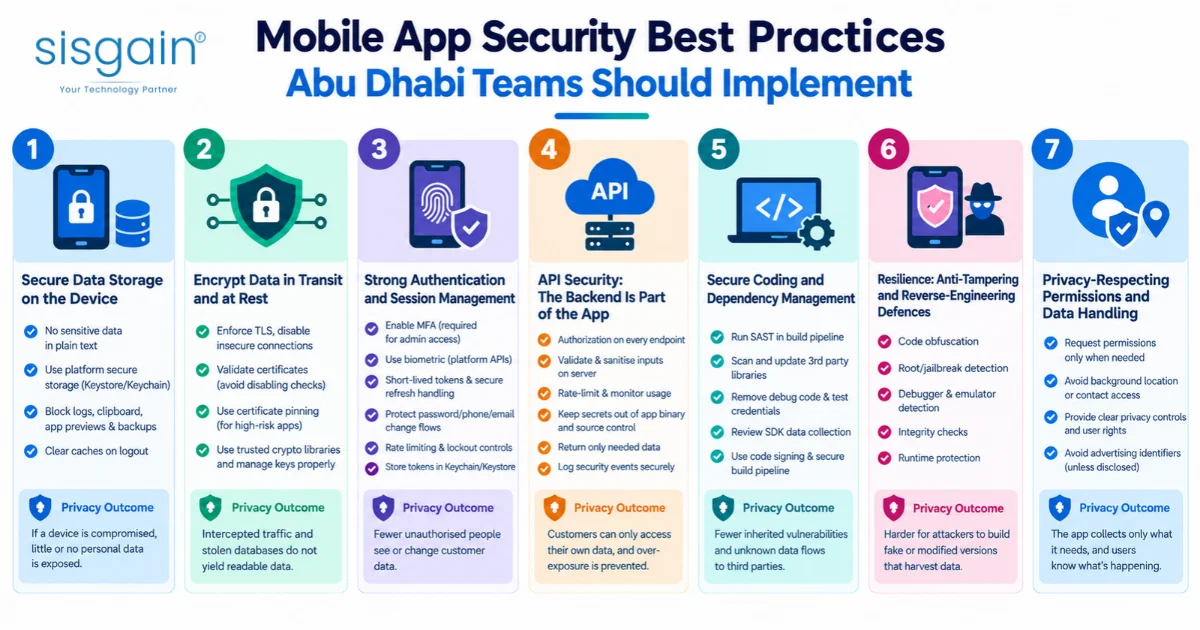
The following mobile application security best practices Abu Dhabi organisations can adopt map to the MASVS areas above. Each one is tied to a privacy outcome, because the strongest argument for security investment is that it reduces unnecessary data exposure and strengthens accountability.
1. Secure Data Storage on the Device
Phones get lost, stolen, shared and compromised. Treat the device as an untrusted environment.
- Do not store passwords, API keys, session tokens or sensitive personal data in plain text, shared preferences, local databases, logs or screenshots
- Use the platform's secure storage: Android Keystore and EncryptedSharedPreferences, or iOS Keychain with appropriate accessibility classes
- Prevent sensitive data from appearing in system logs, clipboard history, app-switcher previews and backups
- Cache as little as possible, and clear caches on logout
Privacy outcome: if a device is compromised, little or no personal data is exposed.
2. Encrypt Data in Transit and at Rest
- Enforce TLS for all communication and disable fallback to insecure connections
- Use certificate validation correctly. Disabling certificate checks "for testing" and forgetting to remove the change is a surprisingly common production flaw
- Consider certificate pinning for high-risk apps such as banking or healthcare, with a safe update and rotation strategy so a certificate change does not break the app
- Use established, well-maintained cryptographic libraries, never custom algorithms
- Manage keys carefully: generate, store, rotate and retire them with a defined process
Privacy outcome: intercepted traffic and stolen databases do not yield readable personal data.
3. Strong Authentication and Session Management
This is where most account takeover attacks succeed or fail.
- Offer multi-factor authentication for customers, and require it for administrative access
- Use biometric authentication through the platform's official APIs rather than building your own
- Use short-lived access tokens with secure refresh handling, and invalidate sessions on logout, password change and suspicious activity
- Protect password reset, phone-number change and email change flows, because attackers target them
- Apply rate limiting and lockout or step-up controls against credential stuffing
- Store authentication tokens in Keychain or Keystore, never in plain local storage
Privacy outcome: fewer unauthorised people see or change customer data.
4. API Security: The Backend Is Part of the App
For most business apps, the API is where the real data lives, so API security deserves its own focus.
- Authorization on every endpoint. Authentication proves who the user is. Authorization checks what that user may access. Broken object-level authorization, where changing an ID in a request reveals another user's record, is one of the most common and damaging API flaws
- Validate and sanitise all inputs on the server, never trusting the client
- Rate-limit requests and monitor for abnormal usage patterns
- Keep secrets, API keys and credentials out of the app binary and out of source control. Anything shipped inside an app can eventually be extracted
- Return only the data the screen needs, not entire database objects
- Log security-relevant events and protect the logs themselves, since they often contain personal data
Privacy outcome: customers can only access their own data, and over-exposure of records is prevented by design.
5. Secure Coding and Dependency Management
- Run static application security testing (SAST) in your build pipeline
- Scan third-party libraries and SDKs for known vulnerabilities, and keep them updated
- Remove debug code, test credentials and verbose error messages from release builds
- Review each new SDK for the data it collects and where it sends it
- Use code signing and protect your build and release pipeline from tampering
Privacy outcome: fewer inherited vulnerabilities and fewer unknown data flows to third parties.
6. Resilience: Anti-Tampering and Reverse-Engineering Defences
Resilience controls make it harder for attackers to analyse, modify or repackage your app. These include code obfuscation, root and jailbreak detection, debugger and emulator detection, integrity checks and runtime protection. They are not a substitute for fixing core vulnerabilities, and they should be proportionate to risk. A banking or healthcare app typically justifies stronger controls than a simple event-information app.
Privacy outcome: harder for attackers to build fake or modified versions that harvest credentials and personal data.
7. Privacy-Respecting Permissions and Data Handling
- Request permissions only when needed, and explain why at the moment of the request
- Avoid background location or contact access unless the feature genuinely depends on it
- Provide clear in-app privacy controls and a path for users to exercise their rights
- Avoid collecting advertising identifiers unless there is a clear and disclosed purpose
Privacy outcome: the app collects only what it needs, and users understand what is happening.
Android vs iOS Security: Platform-Specific Considerations
The same principles apply to both platforms, but implementation details differ.
|
Topic |
Android |
iOS |
|
Secure key and secret storage |
Android Keystore, hardware-backed where available |
Keychain and Secure Enclave |
|
Local data protection |
Encrypted Shared Preferences, encrypted databases |
Data Protection API with appropriate file protection classes |
|
Biometric authentication |
Biometric Prompt API |
Local Authentication framework with Face ID or Touch ID |
|
Network configuration |
Network Security Configuration to restrict cleartext traffic |
App Transport Security to enforce secure connections |
|
Integrity checks |
Play Integrity API |
App Attest and Device Check |
|
Common risk areas |
Exported components, insecure intents, sideloaded or repackaged apps, device fragmentation |
Misconfigured Keychain accessibility, insecure URL schemes, over-broad entitlements |
|
Release hygiene |
Code shrinking and obfuscation, signing key protection |
Code signing, provisioning profile control, binary hardening |
If you build with a cross-platform framework such as Flutter or React Native, the same storage, networking and authentication principles apply, but you must verify that plugins and bridges call the native secure APIs correctly rather than falling back to insecure defaults.
Common Mobile App Security Mistakes We See in UAE Businesses
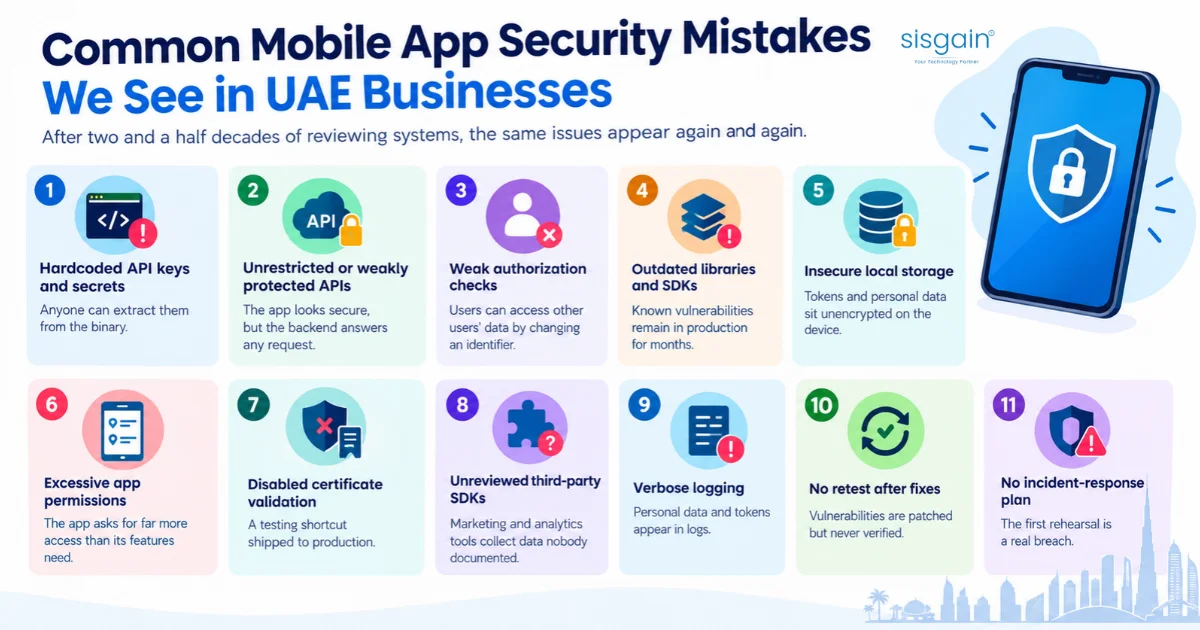
After two and a half decades of reviewing systems, the same issues appear again and again.
- Hardcoded API keys and secrets in the app. Anyone can extract them from the binary.
- Unrestricted or weakly protected APIs. The app looks secure, but the backend answers any request.
- Weak authorization checks. Users can access other users' data by changing an identifier.
- Outdated libraries and SDKs. Known vulnerabilities remain in production for months.
- Insecure local storage. Tokens and personal data sit unencrypted on the device.
- Excessive app permissions. The app asks for far more access than its features need.
- Disabled certificate validation. A testing shortcut shipped to production.
- Unreviewed third-party SDKs. Marketing and analytics tools collect data nobody documented.
- Verbose logging. Personal data and tokens appear in logs.
- No retest after fixes. Vulnerabilities are patched but never verified.
- No incident-response plan. The first rehearsal is a real breach.
Most of these are preventable with a structured review and basic engineering discipline.
UAE PDPL Mobile App Compliance Checklist (Mobile App Security Checklist Abu Dhabi)
Use this mobile app security checklist Abu Dhabi teams can adapt before launch and before every major release. It combines security controls with privacy governance. Treat it as a working tool for your engineering, product and legal teams, not a certificate of compliance.
|
# |
Checklist item |
Owner |
Done? |
|
1 |
Data inventory completed: every data element, purpose, storage location and recipient documented |
Product / Legal |
☐ |
|
2 |
Lawful basis and consent approach defined for each processing activity |
Legal |
☐ |
|
3 |
Privacy notice reviewed and matches actual app behaviour |
Legal / Product |
☐ |
|
4 |
Data minimisation review: unnecessary fields and permissions removed |
Product |
☐ |
|
5 |
Retention and deletion rules defined and implemented in the backend |
Engineering |
☐ |
|
6 |
Data-subject request process tested end to end |
Operations |
☐ |
|
7 |
Third-party SDKs and vendors reviewed for data collection, location of processing and contract terms |
Security / Legal |
☐ |
|
8 |
No sensitive data, tokens or keys stored in plain text on the device |
Engineering |
☐ |
|
9 |
TLS enforced; certificate validation verified; pinning evaluated for high-risk apps |
Engineering |
☐ |
|
10 |
MFA available for customers and mandatory for admin access |
Engineering |
☐ |
|
11 |
Authorization verified on every API endpoint, including object-level checks |
Engineering / QA |
☐ |
|
12 |
Secrets removed from app code and repositories |
Engineering |
☐ |
|
13 |
Dependencies and SDKs scanned and updated |
Engineering |
☐ |
|
14 |
SAST, DAST and API testing completed and results triaged |
Security / QA |
☐ |
|
15 |
Manual penetration test completed and critical findings fixed and retested |
Security |
☐ |
|
16 |
Logging and monitoring enabled without storing excess personal data in logs |
Engineering |
☐ |
|
17 |
Incident-response plan documented, owners named and exercise completed |
Security / Management |
☐ |
|
18 |
Sector requirements confirmed in writing (for example ADHICS for healthcare, financial-sector rules for fintech) |
Legal / Compliance |
☐ |
Need a Mobile App Security and PDPL Readiness Review?
Assess your app's data flows, API exposure, authentication, secure storage, third-party SDKs and testing gaps before launch or a major release. Our specialists can walk through the checklist with your team and identify what to fix first. Explore our Comprehensive Cybersecurity Services or download the Abu Dhabi Mobile App Security & PDPL Readiness Checklist and talk to an expert.
Mobile App Security Testing Before Launch
No single test finds everything. A reliable assurance programme layers several techniques, each catching different problems.
|
Testing type |
What it does |
When to run it |
|
SAST (static analysis) |
Scans source code for insecure patterns, hardcoded secrets and risky functions |
Every commit or build |
|
Dependency / SCA scanning |
Identifies known vulnerabilities in libraries and SDKs |
Every build and on a scheduled basis |
|
DAST (dynamic analysis) |
Tests the running app and backend for runtime weaknesses |
Pre-release and regularly in staging |
|
API security testing |
Tests authentication, authorization, input handling and rate limiting on endpoints |
Pre-release and after API changes |
|
Manual penetration testing |
Skilled testers attempt realistic attacks, chaining weaknesses automated tools miss |
Before launch, after major releases and periodically |
|
Reverse-engineering and tampering review |
Checks how easily the app can be decompiled, modified or repackaged |
For higher-risk apps |
|
Retesting |
Verifies that fixes actually closed the issues without creating new ones |
After every remediation round |
Two practical points. First, automated tools are valuable for coverage and speed but generate false positives and miss business-logic flaws, which is why manual testing remains essential for apps handling sensitive data. Second, testing is only useful if findings are prioritised, assigned and closed. Build vulnerability management into your delivery process, with agreed timelines for fixing critical and high-severity issues.
Security testing also overlaps with functional quality. A strong QA & Testing Services function can embed security test cases alongside functional, performance and compatibility testing, so problems are caught earlier and cheaper.
How Often Should a Mobile App Be Penetration Tested?
As a practical guide, test before the initial launch, after any major release or architectural change, after significant changes to authentication, payments or data handling, and on a regular schedule such as annually. Apps in healthcare, finance or other high-sensitivity categories often warrant more frequent assurance. Your risk assessment, contracts and sector requirements should set the final cadence.
Mobile App Incident Response Plan
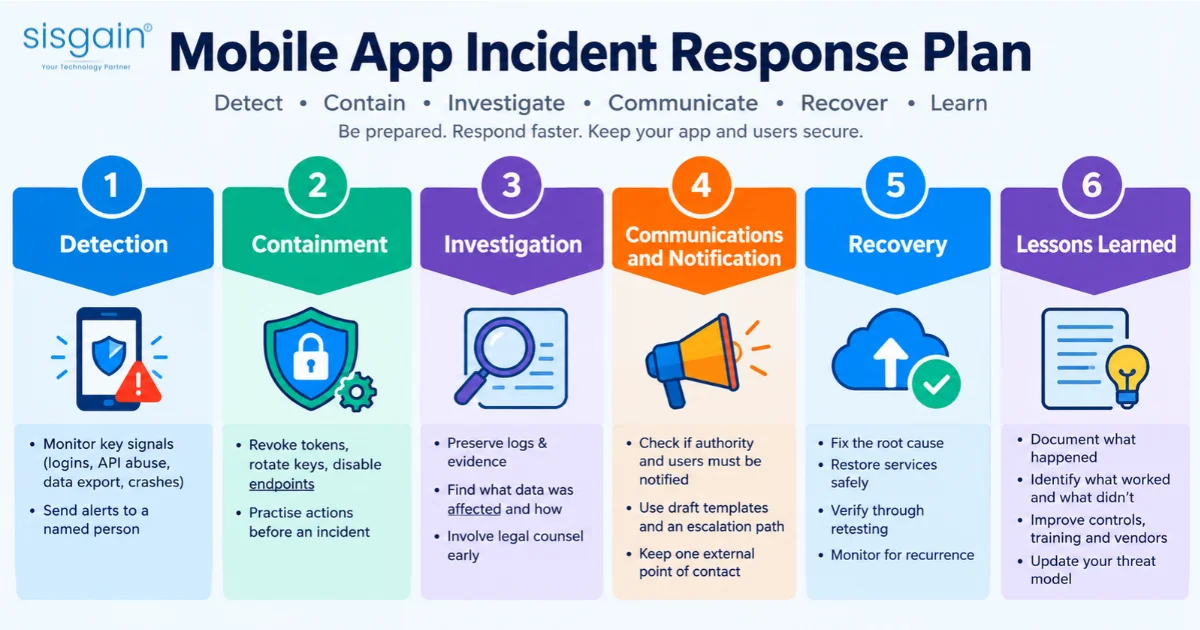
Even well-defended apps experience incidents: a compromised credential, a vulnerable SDK, a misconfigured storage bucket, a fraud campaign. What distinguishes mature organisations is how quickly and calmly they respond. A workable plan has six stages.
- Detection. Define what you monitor: unusual login patterns, API abuse, spikes in failed authentication, data-export anomalies, crash-report anomalies and vendor security notices. Make sure alerts reach a named person, not an unmonitored inbox.
- Containment. Decide in advance who can revoke tokens, rotate keys, disable an endpoint, block an SDK or force an app update. Practise these actions, because under pressure nobody wants to discover that revoking sessions requires a deployment that takes two days.
- Investigation. Preserve logs and evidence, establish what data was affected, how the attacker got in and whether the issue is still active. Involve legal counsel early.
- Communications and notification. Assess whether the relevant authority and affected individuals must be notified, using advice on the duties that apply to your organisation. Prepare draft templates, an internal escalation path and a single point of external communication so messages stay accurate and consistent.
- Recovery. Fix the root cause, restore services safely, verify the fix through retesting and monitor for recurrence.
- Lessons learned. Document what happened, what worked, what did not and what changes to controls, training or vendors are needed. Feed these back into your threat model.
Run a tabletop exercise at least once a year. A two-hour scenario, such as "our API leaked customer records through an authorization flaw," reveals gaps in ownership, tooling and decision-making that no policy document will.
If you do not have in-house security operations capability, a reliable IT Support Company or managed security provider can supply monitoring, patching and response support, so incidents are not handled by whoever happens to be available.
Questions to Ask a Mobile App Development Partner in Abu Dhabi
Choosing a development partner is also a security and compliance decision. Whether you are commissioning a new app or rebuilding a legacy one, these questions separate mature vendors from those who simply promise "bank-grade security."
- Which security framework do you build and test against? Look for named standards such as OWASP MASVS for the client and OWASP ASVS for the backend.
- How do you handle secure storage and secrets management? Expect specifics about Keychain, Keystore and removal of secrets from code.
- How is API authorization designed and tested? A good answer mentions object-level authorization and negative testing.
- What security testing is included in your delivery process? Ask about SAST, dependency scanning, DAST, API testing and manual penetration testing, and who pays for retesting.
- How do you review and approve third-party SDKs? They should be able to describe what data each SDK collects and where it goes.
- How do you support PDPL readiness? They should work with your legal team on data inventory, privacy-by-design and data-subject request capabilities, without claiming to give legal certification.
- Do you have experience with sector requirements such as ADHICS or financial-sector rules? Ask for relevant, verifiable examples.
- Where will data be hosted and processed? Make sure cross-border transfer and hosting decisions are explicit and documented.
- What is your incident-response and vulnerability-disclosure process after launch? Clarify support hours, response targets and responsibilities.
- Who owns the source code, security documentation and test reports? You should receive these artefacts, not be locked out of them.
When evaluating proposals, remember that security has a cost. A lower quote that omits testing, threat modelling and hardening often means those costs reappear later as incident expenses or rework. Our breakdown of enterprise mobile app development cost Abu Dhabi shows how security, testing and compliance activities affect budgets, so you can compare quotes on a like-for-like basis. If you are ready to scope a project, see our Custom Mobile App Development Services for Abu Dhabi Businesses.
Mobile App Data Security Abu Dhabi: A Practical 90-Day Roadmap
Strengthening mobile app data security Abu Dhabi teams rely on does not require a massive transformation on day one. A phased approach works well.
|
Timeframe |
Focus |
Key outcomes |
|
Days 1–30: Discover |
Data inventory, SDK review, architecture and API mapping, quick-win vulnerability scan |
Clear picture of what data you hold, where it flows and your highest-risk gaps |
|
Days 31–60: Fix and govern |
Remediate critical issues, harden storage and authentication, update privacy notice, define retention and request-handling processes |
Reduced exposure and documented privacy governance |
|
Days 61–90: Verify and prepare |
Manual penetration test, retest, incident-response tabletop exercise, vendor contract review |
Verified fixes, rehearsed response and evidence for enterprise customers and auditors |
After the first 90 days, move into continuous improvement: automate security checks in the pipeline, schedule periodic testing, track vulnerability metrics and review your data inventory whenever features or vendors change.
Which Audience Should Start First?
The principles above apply to every business, but your starting priorities differ.
- General SMEs should focus first on the basics: data inventory, secure storage, MFA, API authorization, SDK review and a simple incident plan. These deliver the largest risk reduction per dirham spent.
- Fintech companies should add transaction monitoring, step-up authentication, strong fraud controls, audit logging and confirmed financial-sector obligations.
- Healthcare providers and health-technology vendors should begin by determining how ADHICS and health-data legislation apply, then apply the strictest controls to health information.
Conclusion: Treat Security and Privacy as Product Features
The businesses that win trust in Abu Dhabi's digital economy will be those that treat security and privacy as part of the product, not an afterthought before launch. That means knowing what data your app collects, collecting less of it, protecting it with proven controls, testing both the app and the API, managing vendors carefully and being prepared when something goes wrong.
The most useful mindset shift is this: every technical safeguard is also a privacy outcome. Secure storage limits exposure on lost devices. MFA reduces account takeover. API authorization stops one customer seeing another's data. Encryption protects data in transit and at rest. Testing proves the controls work. Together, they build accountability, which is the heart of data protection.
If you want an expert view of where your app stands today, our team can help you assess data flows, close security gaps and prepare for PDPL expectations before your next release. Talk to us about a Mobile App Security and PDPL Readiness Review.
Disclaimer: This article provides general information, not legal advice. Laws, regulations and regulator guidance change. Consult qualified legal counsel to confirm the requirements that apply to your organisation.