
Over 25 years in IT, I have watched founders lose months of runway on technology choices made for the wrong reasons. The desktop era, the first smartphone wave and the "HTML5 will replace native" promise all produced the same pattern. Someone picked the fashionable tool, and the business paid for it later.
Flutter vs. React Native is today's version of that debate. Forums treat it as a popularity contest. For a founder in Abu Dhabi, it is a business decision that affects your burn rate, your first engineering hires and your investor demo. It also decides how well your Arabic and English experiences work and how smoothly you can expand from the UAE into the wider GCC.
Most comparisons you will find online describe a world that has already changed. Both frameworks rebuilt their core engines over the last two years, and the old "React Native is slow, Flutter is niche" arguments no longer hold. This guide reflects where things stand in September 2026, with the latest Abu Dhabi context, and gives you a decision framework instead of a fake universal winner.
Quick Answer: Flutter or React Native for an Abu Dhabi Startup?
Choose Flutter if you are building a highly branded, visually consistent, mobile-first product with one engineering team and no existing framework commitment. Fintech wallets, healthtech workflows, premium consumer apps and field-service tools are typical fits.
Choose React Native if your team already writes React and TypeScript, you run a React web platform, or your hiring plan centres on JavaScript developers. B2B SaaS companion apps, AI productivity tools and marketplaces with React dashboards are typical fits.
Choose neither by default if you need heavy 3D, ultra-low-latency processing, complex gaming or deep OS-level hardware integration. Evaluate fully native or hybrid architectures first.
Abu Dhabi in 2026: Why This Decision Carries More Weight Than It Used To
Abu Dhabi is no longer an emerging startup market. It is a maturing one, and the latest numbers show it.
Hub71's 2025 Impact Report, published in June 2026, shows its startups have raised more than USD 2.7 billion and generated USD 1.5 billion in revenue by the end of 2025. In 2025 alone, Hub71 startups secured USD 599 million in funding and generated USD 175 million in revenue. The community has grown to 390 startups since 2019. Global founder applications rose 62 per cent in 2025, as Hub71 expanded international partnerships and launched Hub71+ Life Sciences.
Three shifts behind those numbers matter for your mobile stack.
1. Government is now a technology customer and benchmark.
Abu Dhabi's Government Digital Strategy 2025–2027 aims to make the emirate an AI-powered government, with AED 13 billion deployed through 2025–2027. The Department of Government Enablement reports over 100 AI use cases across more than 40 government entities, moving from pilots to production scale. Its TAMM platform offers contextual AI assistance with personalised, multilingual guidance. For founders, this sets a user-experience bar. Residents now use polished, multilingual, AI-assisted services daily, and they will compare your app to them.
2. Data location and sovereignty are part of the buying conversation.
The same strategy targets 100% adoption of sovereign cloud computing for government operations. If you sell to government-linked or regulated enterprises, expect questions about where your data lives and which vendors touch it. That is an architecture question that affects your backend and SDK choices more than your front-end framework, but you should settle it early.
3. The ecosystem is specialising.
Life sciences, climate tech, digital assets and AI now have dedicated tracks. Hub71 also connects founders to regulators and pilot partners. Its programmes include a guided track to trial your solution with regulators and validate it in real-world environments before market deployment. A startup that reaches a regulator-supervised pilot needs a mobile product that is stable, auditable and easy to iterate on.
The practical conclusion is that your mobile framework is a capital-efficiency decision inside a more demanding market. The right choice lets a small team ship a reliable, bilingual, secure app on iOS and Android without doubling engineering effort. The wrong choice creates hiring bottlenecks and rework just when you need to show traction.
That is why we start every MVP development engagement with these trade-offs, before anyone writes code.
Flutter vs. React Native at a Glance
|
Decision factor |
Flutter |
React Native |
Better for Abu Dhabi startups |
|
Primary language |
Dart |
JavaScript / TypeScript |
React Native if your team is React-heavy |
|
UI approach |
Own rendering engine and widget system |
Renders through native platform components |
Flutter for highly custom, controlled visuals |
|
Cross-platform consistency |
Strongly consistent on iOS and Android |
Can mirror each platform's native behaviour |
Flutter for unified branding; React Native for native feel |
|
MVP delivery |
One team, one codebase |
One mobile codebase, familiar React patterns |
Both are fast; team profile should decide |
|
Performance |
AOT-compiled Dart, Impeller renderer; built for 60/120fps |
Native-like; New Architecture removed the old bridge |
Flutter for animation-heavy UX; either for standard business apps |
|
Web alignment |
Flutter web exists but differs from a React stack |
Strong conceptual fit with React web teams |
React Native |
|
Design-system control |
Extensive custom widget control |
Strong, but complex custom UI may need native modules |
Flutter |
|
Device-native features |
Plugins plus platform channels |
Mature native module ecosystem |
Tie; verify your exact SDKs |
|
Hiring |
Flutter/Dart specialists |
Much larger JavaScript/TypeScript pool |
React Native if hiring speed is critical |
|
Long-term risk |
Separate Dart ecosystem |
Dependency and upgrade governance |
Depends on team maturity |
The table explains why "which is better?" is the wrong question. Each framework wins on different factors, and your company decides which factors matter most.
Flutter: When It Is the Better Startup Choice
Flutter is Google's open-source UI framework for building mobile, web, desktop and embedded experiences from one codebase. It uses Dart and draws its own interface instead of relying on the operating system's built-in widgets. On mobile, production code is compiled ahead of time into native machine code.
That architecture gives startups three practical advantages.
1. Visual control and brand consistency
Because Flutter paints every pixel, your app looks and behaves the same on iPhone and Android. For a premium fintech dashboard, a hospitality booking experience or a design-led consumer app, that consistency removes a constant source of friction between designers, engineers and QA.
It also means design decisions become engineering assets. Teams that invest in strong UI/UX design services early, with tokens, components and states defined as a system, get the most from Flutter. The framework rewards design discipline.
2. A mature rendering engine
Flutter's Impeller renderer is now the standard rendering path rather than an opt-in experiment. Its main benefit is that it moves shader compilation to build time, eliminating the startup stutter that older approaches suffered on iOS. For founders, this translates into smoother first impressions in investor demos, where a janky animation can undermine an otherwise strong pitch.
3. One team and one design system
A single Flutter team can serve both platforms. Independent 2026 comparisons generally describe Flutter as a more self-contained, consistent experience with lower maintenance overhead, at the cost of Dart expertise and a smaller hiring pool. For a lean startup in an accelerator programme, consolidating effort matters.
If cross-platform is your plan, our cross platform app development solutions page explains how we structure a shared codebase so it does not become a bottleneck later.
The honest trade-offs
- You need Dart skills. The talent pool is smaller than JavaScript's, though well established.
- Flutter web is not a React replacement. If your primary product is a web platform, a React stack remains the natural fit.
- Niche SDKs need verification. Most needs are covered by plugins and platform channels, but confirm specific KYC, payment or hardware vendors before committing.
React Native: When It Is the Better Startup Choice
React Native lets teams build mobile apps with JavaScript or TypeScript and React concepts. Many articles still describe it as it was years ago: an asynchronous bridge and a reputation for lag. That description is out of date.
Its New Architecture, made up of Fabric, TurboModules and JSI for direct synchronous calls, is now the default, and the old bridge is gone. If your mental model of React Native is "quick to build but laggy," you are working from a 2022 view.
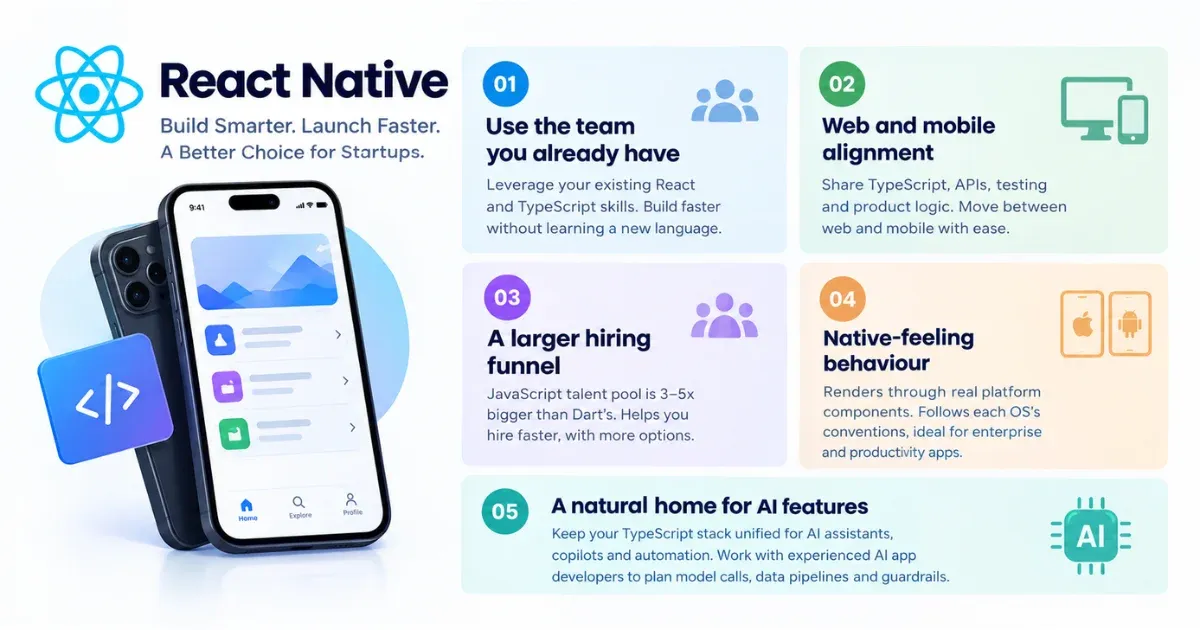
1. Use the team you already have
If your CTO or first engineers have shipped production React and TypeScript, React Native lets them build mobile without learning a new language. In the first six months, that saves the most valuable resource you have, which is time.
2. Web and mobile alignment
For a company with an existing React web application, React Native offers the closest fit. You share TypeScript types, API clients, testing habits and product thinking. UI components are not automatically portable, but your team moves between web and mobile without a context switch.
3. A larger hiring funnel
Comparisons commonly estimate the JavaScript talent pool at three to five times larger than Dart's. A bigger funnel does not guarantee quality, and you still need engineers with real mobile experience, but it helps when you need to hire quickly.
4. Native-feeling behaviour
Because React Native renders through actual platform components, apps can follow each operating system's conventions closely. That suits enterprise tools and productivity apps, where "feels native" matters more than strict brand uniformity.
5. A natural home for AI features
Many Abu Dhabi startups are adding AI assistants, copilots and automation. When those features share TypeScript logic with a web backend, React Native keeps the stack coherent. If AI is central to your roadmap, working with experienced AI app developers early will help you decide where model calls, data pipelines and guardrails should sit.
The honest trade-offs
- Dependency discipline is essential. The JavaScript ecosystem moves quickly, and teams without upgrade governance accumulate technical debt.
- Highly custom UI can take extra effort. Complex visuals may need native modules or specialist libraries.
- The New Architecture is not magic. React Native's own guidance cautions that enabling it does not automatically speed up every app. Teams may need to refactor to benefit.
Performance, User Experience and App Quality
Here is my position: do not claim Flutter is "always faster," and do not call React Native "slow." Neither claim survives contact with independent testing.
Benchmarks disagree on details, and that in itself tells you the gap is narrow. One 2026 comparison found React Native cold-starting about 200ms faster with around 12% less battery use, while noting that Flutter tends to hold a steadier frame rate on graphics- and animation-heavy interfaces. Another line of testing points the other way on startup and sustained frame rate. For most business apps, the difference is too small for users to notice.
Flutter tends to shine when your value depends on custom animation, data visualisation, interactive charts or a tightly controlled visual identity.
React Native tends to shine when you are building a standard SaaS companion, marketplace, booking flow or content app, especially one that shares logic with a web product.
What actually breaks apps
In my experience, the framework explains a small share of real-world performance problems. The larger causes are:
- Poor state management and unnecessary re-rendering
- Oversized images and unoptimised media
- Slow or chatty APIs with weak caching
- Heavy third-party SDKs and poorly written native modules
- No testing on mid-range devices
A well-built React Native app will outperform a badly built Flutter app, and the reverse is equally true. Test on the mid-range Android devices your real users carry, not on the flagship phone in the demo room.
Quick answer: Flutter is generally the stronger fit for animation-heavy, graphics-rich, tightly branded UX. React Native is fully capable for standard business apps. In both cases, architecture and code quality matter more than the framework.
A note on alternatives: Kotlin Multiplatform is a growing third option, especially for teams with strong Android backgrounds. It is worth a look in discovery, but for most non-technical founders the Flutter versus React Native decision remains the practical one.
Cost, Delivery Time and Hiring
Founders always ask which framework is cheaper. I will not give you a percentage, because "40% cheaper" is marketing, not engineering. What I can tell you is what drives cost.
Think total cost of ownership
The MVP build is only the first invoice. Over 24 months, cost is shaped by:
- Hiring and retention. How fast can you find, afford and keep the right engineers?
- Maintenance. OS updates, library upgrades, security patches and store-policy changes recur every year.
- Feature velocity. How quickly can the team ship and test new features after launch?
- Rework risk. Will your architecture survive Series A, or will you rebuild?
Flutter tends to save money when one team owns a design-led product, because there is less duplicated UI work and less platform-specific QA.
React Native tends to save money when you reuse existing React talent and share conventions with your web team.
A hybrid delivery model that works in the UAE
Many Abu Dhabi startups, especially those in incubator programmes with limited early headcount, use a hybrid model. An external team builds and hardens the MVP, then hands over to an in-house team after funding. It works with either framework if you insist on clean documentation, automated tests, CI/CD and full code ownership from day one.
Working with a UAE software development company that understands local procurement, bilingual delivery and enterprise expectations can shorten this path considerably. If you want a partner focused on the emirate itself, our mobile app development services in Abu Dhabi team works on exactly this handover model.
Budget for life after launch
Launch is the start of the spending curve. Crash monitoring, performance tuning, security patches, store compliance and iteration never stop. Skipping app maintenance and support is one of the most common reasons promising MVPs stall six months after release. It is also easy to prevent, because a modest retainer costs far less than an emergency rebuild after a breaking OS update.
Arabic, English and the UAE User Experience
For UAE products, bilingual design is a core requirement. Government platforms already set expectations here. TAMM, for example, provides multilingual support and predictive services that respond to life events. Your users will notice if your app feels like a translation afterthought.
Both Flutter and React Native support Arabic and right-to-left interfaces. The framework is not the challenge. Planning is. Put these in your product brief:
- True RTL layouts that mirror navigation, icons and flows, not just flipped text
- Arabic typography with readable fonts and correct line spacing
- Date, time, number and currency formatting suited to local expectations
- Address formats that work for emirates, districts and landmarks
- Accessible onboarding for first-time and low-confidence users
- Native Arabic QA, not machine translation reviewed by an English speaker
- Bilingual support flows, including notifications, emails and in-app help
Retrofitting Arabic after launch costs far more than designing for it. Layouts break, strings overflow, and back arrows point the wrong way. Treat bilingual UX as a design-system decision from the first wireframe.
UAE Privacy, ADGM and Launch Readiness
This is the section many comparison articles skip. Neither Flutter nor React Native makes an app compliant. Compliance is determined by what your product does with personal data.
The regulatory picture
At UAE federal level, the Personal Data Protection Law (Federal Decree-Law No. 45 of 2021) applies to controllers and processors outside the UAE too, if they process the personal data of people inside the country. It generally requires consent for processing, subject to legal exceptions.
Two things founders should know in 2026:
- Free zones differ. Federal rules apply across the UAE, but DIFC and ADGM operate under their own data-protection regimes. If your company is registered in ADGM, which is common for Hub71 startups, check ADGM's Office of Data Protection requirements, including controller registration.
- The implementing picture is evolving. Sources I reviewed disagree on how far the federal implementing regulations and enforcement have progressed. Some describe active enforcement, particularly around breach notification, while others say official publication of the regulations could not be confirmed. Do not rely on either camp. Confirm the current position with UAE counsel before launch.
This is general information, not legal advice. Regulated financial, health, digital-asset and sensitive-data products need specialist UAE/ADGM legal review.
A practical launch-readiness checklist
- Define every user-data field before development begins.
- Document purpose, lawful basis, retention and access control for each data category.
- Build consent, privacy notices, access and deletion requests, and audit logging into requirements.
- Prepare a tested incident-response plan. Breach readiness is increasingly a sales asset, since enterprise customers and partners routinely ask about incident-response capability during procurement and due diligence.
- Map data flows and vendors. Analytics, crash reporting, payments, KYC, cloud and AI services all create transfer and processing questions.
- Run security testing on authentication, APIs, session handling, encryption, file uploads and third-party SDKs.
- Get specialist advice for regulated products.
Sector-specific considerations
Fintech: Secure authentication, payment and KYC integrations, transaction monitoring and licensing shape the architecture. Our fintech app development services treat these as design inputs from the first sprint, so the Flutter or React Native decision follows the compliance architecture, not the reverse.
Healthtech: Health data raises the bar for consent, access control and vendor management. With Hub71's life-sciences track growing, more founders are building patient and clinician tools. Our healthcare app development practice validates device SDKs, data flows and accessibility before a build starts.
AI products: Model providers, cross-border transfers, prompt logging and output governance all need review, and this matters more as government and enterprise buyers scale their own AI usage.
A Simple Decision Diagram
Use this as a filter, not a verdict.
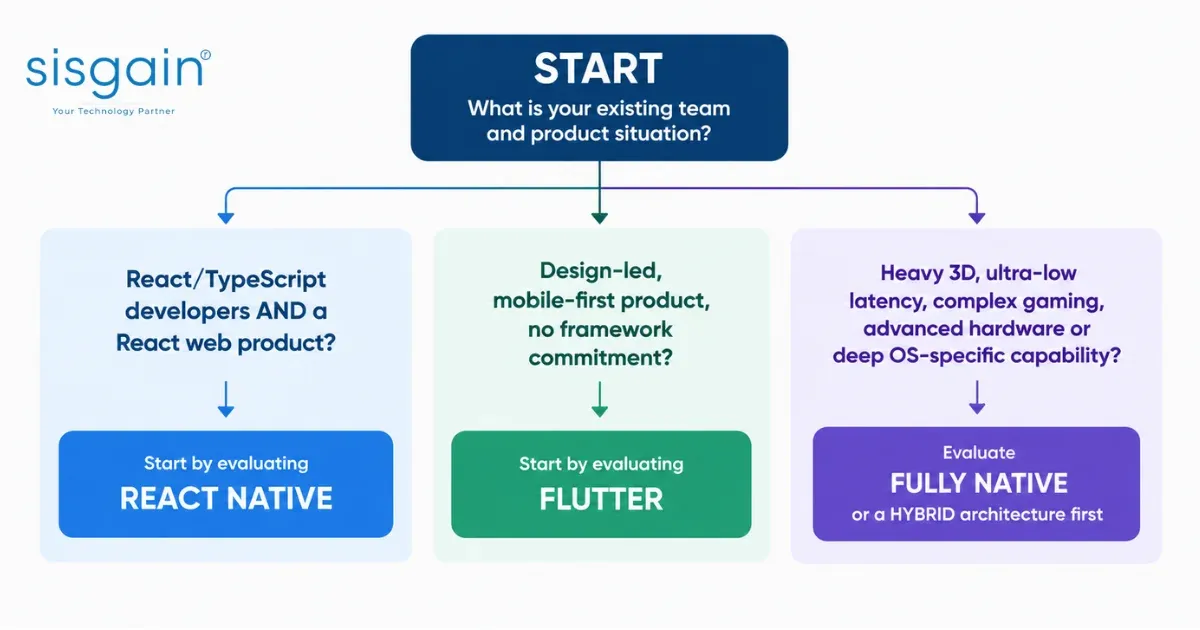
If you fall into more than one branch, run a short technical discovery. It costs a fraction of a wrong architectural choice.
Decision Matrix for Abu Dhabi Startups
|
Abu Dhabi startup scenario |
Recommended framework |
Why |
|
Fintech wallet, investment dashboard or premium banking UX |
Flutter |
High visual fidelity and consistent flows. Security, KYC, payments and compliance still need specialist design |
|
Marketplace, food delivery, booking or loyalty app |
Flutter or React Native |
Flutter for bespoke consumer UX; React Native when your web dashboard is already React |
|
B2B SaaS companion app |
React Native |
Practical when the SaaS product and frontend team already use React and TypeScript |
|
AI assistant, productivity app or enterprise tool |
React Native |
Easier access to JavaScript talent and reuse of product logic |
|
Healthtech or life-sciences app |
Flutter |
Polished patient or clinician workflows; validate SDKs, data flows and accessibility first |
|
Logistics, field-service or inspections app |
Flutter |
Strong for consistent offline-first workflows, camera, barcode scanning, maps and device-oriented UI |
|
Existing native app adding modules |
Neither by default |
Assess native-first or add-to-app architecture before any rewrite |
|
Existing React web business launching mobile |
React Native |
Builds on existing React skills, components and testing patterns |
Not sure whether Flutter or React Native fits your startup? Get a technical discovery assessment covering your MVP scope, required integrations, UX complexity, architecture, security requirements, launch timeline and recommended mobile stack.
Six Questions to Answer Before You Choose
- Is our main product an app, a web platform, or both? If web leads and mobile follows, React Native's alignment matters more. If mobile is the product, Flutter's UI control matters more.
- Does our team have production React/TypeScript or Flutter/Dart experience? Real production experience beats theoretical preference.
- Which native capabilities are non-negotiable? Camera, biometrics, Bluetooth, NFC, offline sync, maps, background location, wearables or AR. List them and verify support for each.
- Is custom UI or animation central to winning users? If yes, weight Flutter more heavily.
- Which third-party SDKs must work on launch day? Payments, KYC, maps, push, CRM, analytics and AI services. A missing SDK can derail a timeline.
- What must we maintain over the next 24 months? Plan for the product you will run after the MVP, not just the demo.
If you can answer these confidently, the decision is usually obvious. If you cannot, invest in discovery before development.
Seven Mistakes I See Founders Make
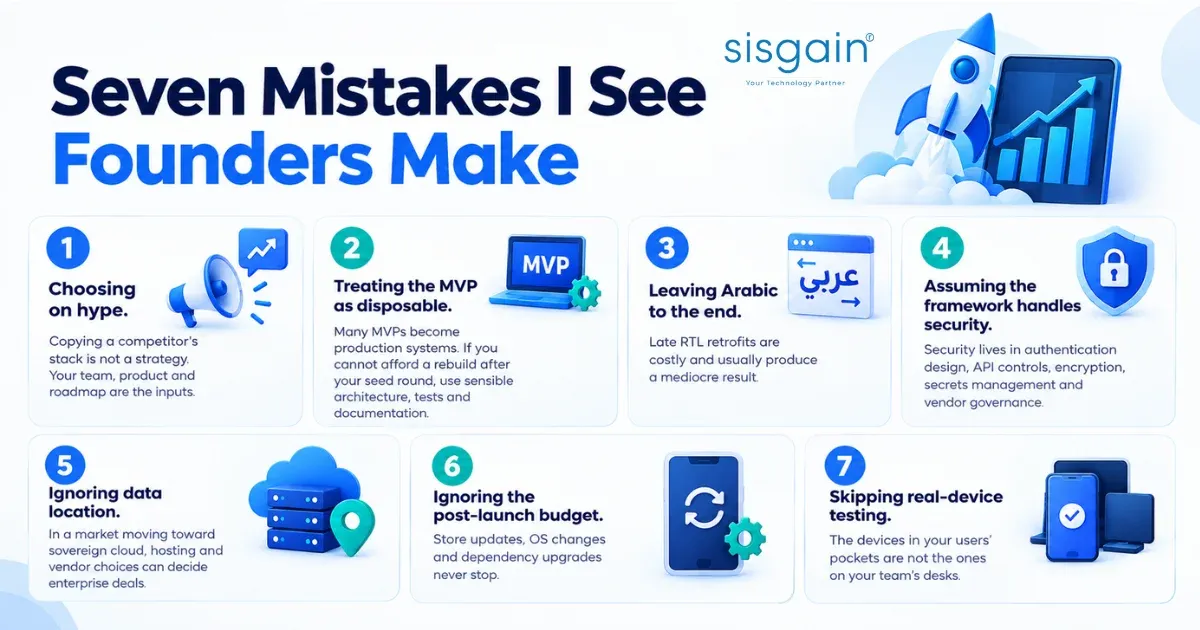
Choosing on hype. Copying a competitor's stack is not a strategy. Your team, product and roadmap are the inputs.
Treating the MVP as disposable. Many MVPs become production systems. If you cannot afford a rebuild after your seed round, use sensible architecture, tests and documentation.
Leaving Arabic to the end. Late RTL retrofits are costly and usually produce a mediocre result.
Assuming the framework handles security. Security lives in authentication design, API controls, encryption, secrets management and vendor governance.
Ignoring data location. In a market moving toward sovereign cloud, hosting and vendor choices can decide enterprise deals.
Ignoring the post-launch budget. Store updates, OS changes and dependency upgrades never stop.
Skipping real-device testing. The devices in your users' pockets are not the ones on your team's desks.
Final Verdict: Flutter or React Native?
Here is the decision rule I give founders.
Default to Flutter for a new Abu Dhabi startup building a mobile-first, customer-facing product that needs strong UI control from a single cross-platform codebase. Its compiled-code model, mature Impeller renderer and custom-UI strengths suit design-led fintech, healthtech, consumer, logistics and marketplace products, provided you validate your required SDKs early.
Choose React Native instead when your real advantage is your React/TypeScript talent, an existing React web application, or the ability to run one connected JavaScript-centric product team. Its modern architecture is far more capable than outdated comparisons suggest, and for many B2B, SaaS and AI products it is the more pragmatic business choice.
Pause and investigate if your product demands heavy 3D, ultra-low latency, advanced hardware or deep OS-level capability.
What will separate the startups that scale from those that stall is the journey around the framework. Launch lean, and design privacy and sector requirements in from the start. Make Arabic and English first-class, and integrate with local and global services. Then prove traction and build an architecture that can grow into the GCC and beyond.
Planning an Abu Dhabi or UAE mobile app? Speak with our team about building a bilingual, secure, scalable MVP for iOS and Android. Explore our mobile app development services in Abu Dhabi or talk to us directly →