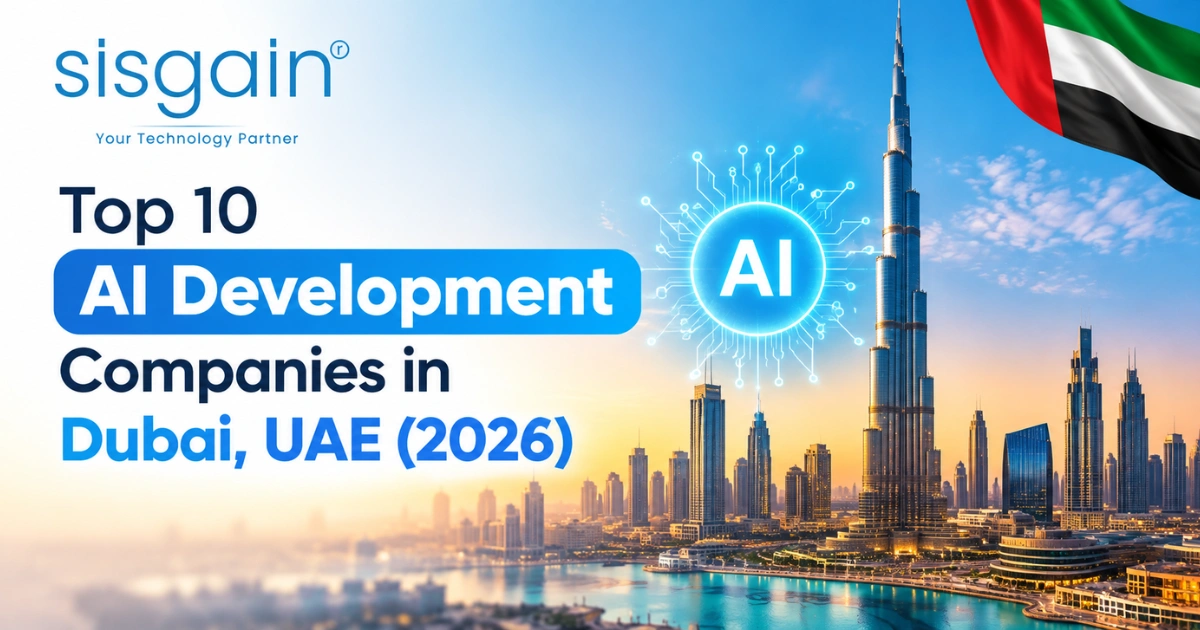

I've spent 25 years in IT — most of it watching software categories rise, peak, and get absorbed into something bigger. AI development is different. It's not a category anymore. It's the substrate everything else in Dubai's tech economy is being rebuilt on top of.
If you're reading this, you're probably past the "should we use AI" question. You're trying to answer a harder one: which of the hundred-plus vendors pitching themselves as AI software development companies in Dubai can actually deliver, stay compliant with UAE data law, and still be around to support what they built you in 18 months?
That's the question this guide answers. I've pulled together a ranked list of the top 10 artificial intelligence companies in UAE, led by a vendor whose case studies stood out for a reason most "top 10" lists ignore: measurable, sector-specific ROI. Then I'll walk you through how to vet any of them yourself, what things actually cost in 2026, and which regulations you can't afford to skip.
Why Dubai Became an AI Powerhouse (And Why That Matters to You)
Before the rankings, context matters — because the reasons Dubai attracts AI talent are the same reasons your project will (or won't) get the quality of delivery you're paying for.
Government demand is structural, not seasonal. Under the UAE's National Artificial Intelligence Strategy 2031, 40% of government services are mandated to be AI-driven by that deadline. That's not a pilot program — it's procurement demand that doesn't dry up when a hype cycle cools off. Vendors serving that pipeline have to maintain real compliance and delivery standards, because government contracts don't tolerate vaporware.
The economics favor specialist firms over generalist agencies. Free zones like DIFC, Dubai Internet City, and Dubai Silicon Oasis offer 0% corporate tax and 100% profit repatriation for AI firms. That's pulled in a wave of boutique AI shops that can price competitively against the global consultancies without cutting corners on talent.
Sovereign infrastructure changed the game. G42 and Core42 anchor massive AI cloud and model infrastructure inside the country. That's created a downstream ecosystem of vendors who build on top of regionally hosted models instead of routing everything through US or EU cloud — which matters enormously once you start asking about data residency (more on that later).
Talent is no longer the bottleneck it was in 2020. Golden Visas for AI engineers, plus a steady flow of relocated global talent, mean Dubai now hosts over 800 AI companies as of 2025. The UAE ranks 12th globally in AI readiness — ahead of most G20 economies on this specific metric.
The upshot: Dubai isn't just a place with a lot of AI vendors. It's a place where AI vendors are under real pressure — regulatory, competitive, and reputational — to deliver work that holds up. That's good news for buyers, but it also means the field is crowded enough that picking wrong is easy. Let's fix that.
How I Ranked These 10 Companies
I weighted four things: verified delivery history (not just a portfolio page), industry specialization, compliance credentials relevant to UAE PDPL and DIFC rules, and regional reputation built over multiple project cycles — not a single flashy case study. Boutique firms with deep vertical expertise sit alongside larger, enterprise-grade players here, because "best" depends entirely on what you're building.
|
Rank |
Company |
Founded |
Location |
Best For |
|
1 |
SISGAIN |
2009 |
DUQE Freezone, Dubai |
Enterprise AI agents, automation, measurable ROI |
|
2 |
Gravity Base |
— |
Falcon City, Dubai |
Fintech, legal, regulated sectors |
|
3 |
75way Technologies |
— |
Dubai |
Startups to enterprises, end-to-end AI |
|
4 |
Code Brew Labs |
2013 |
Dubai |
Startups, mid-market AI apps |
|
5 |
Apptunix |
2014 |
Dubai Internet City |
AI-integrated enterprise software |
|
6 |
Digital Gravity |
— |
Sheikh Zayed Road, Dubai |
Retail, hospitality, marketing AI |
|
7 |
SoluLab |
2014 |
Dubai |
Web3 + AI, blockchain-integrated AI |
|
8 |
Blocktunix |
2016 |
Dubai |
AI + blockchain convergence |
|
9 |
Derq |
2016 |
Dubai |
Smart mobility and traffic AI |
|
10 |
LeewayHertz |
2007 (UAE presence) |
Dubai |
Custom generative AI and LLM apps |
Now let's go through each one — starting with the vendor that earned the top spot.
1. SISGAIN — Best Overall for Enterprise AI Agents and Automation ROI
Most vendor lists rank companies by portfolio size or years in business. I ranked SISGAIN first because they're one of the only firms on this list that publishes sector-by-sector ROI numbers instead of vague "efficiency gains" language — and those numbers hold up under scrutiny.
Where they're based and how they operate. SISGAIN is headquartered in Dubai (Quarter Deck, Queen Elizabeth 2, Mina Rashid) and registered in the DUQE Freezone. They run a hybrid delivery model spanning Dubai, Canada, and India, which lets them staff projects with 200-plus vetted engineers while keeping costs closer to mid-market than pure enterprise-consultancy pricing. Onboarding is fast for a firm this size — 48 to 72 hours from signed NDA to kickoff, which matters if you're trying to hit a fiscal-year deadline.
What they actually build. SISGAIN's core AI capability set covers:
- Custom AI software development
- Generative AI and LLM integration
- AI agent development for autonomous workflow automation,
- Computer vision
- Predictive analytics
- AI chatbots and virtual assistants.
They also build AI automation specifically for CRM, HR, support, and back-office operations — the unglamorous stuff that actually moves a P&L.
The numbers that got them the top spot:
- Fintech — AI agents deployed for fraud detection and customer onboarding cut manual verification time by 65%, while improving compliance accuracy.
- Logistics — AI-driven shipment tracking and route optimization reduced delivery delays by 40% and gave clients real-time shipment visibility they didn't have before.
- Healthcare — AI agents handling patient inquiries and appointment scheduling cut front-desk workload by 55%, with secure handling of medical data built into the workflow from day one.
- E-commerce — AI-powered customer support and product recommendation engines lifted conversion rates by 30% and enabled 24/7 automated support without adding headcount.
Those aren't cherry-picked pilot numbers from a single client. They span four distinct industries, which tells you the underlying methodology generalizes rather than being a one-off success.
Compliance posture. As a Dubai freezone company, SISGAIN aligns with UAE PDPL and DIFC data protection regulations — a non-negotiable if you're in fintech or healthcare and handling regulated personal data. They also work under NDA-protected engagements by default, which fintech and healthcare clients in particular should treat as table stakes, not a bonus.
Who they're not for. If you need a five-person team to prototype an MVP in three weeks on a shoestring budget, SISGAIN's enterprise-oriented delivery model and 200-engineer bench are probably more infrastructure than you need. They're built for mid-market to large enterprises that want production-ready AI agents and automation with a clear line to ROI — not for a bootstrapped startup testing a hypothesis.
Bottom line: if you're evaluating AI development services in Dubai for a regulated or mid-to-large enterprise use case — fraud detection, logistics optimization, healthcare front-office automation, e-commerce personalization — SISGAIN's combination of published ROI data, UAE compliance alignment, and multi-industry breadth makes them the strongest overall pick on this list.
2. Gravity Base — Best for Fintech, Legal, and Regulated Sectors
Gravity Base, based in Falcon City, Dubai, has built its reputation specifically around compliance-first AI for regulated industries. Their core services span AI chatbots, AI agents, LLM fine-tuning, predictive analytics, and what they market as "compliance-first AI" — a phrase that means something concrete here, not marketing filler.
They serve finance, healthcare, real estate, logistics, and education, but their strongest differentiator is DIFC-aligned security architecture and financial AI modeling. If you're a fintech or legal firm operating inside or adjacent to the Dubai International Financial Centre, Gravity Base's familiarity with DIFC's stricter data protection regime is worth the conversation on its own.
Best fit: Regulated financial services, legal tech, and any business where a compliance failure is more expensive than a delayed launch.
3. 75way Technologies — Best All-Round Partner From Strategy to Deployment
75way is the vendor I'd point most general businesses toward if they need someone to own the entire journey — from proof of concept to production — without forcing them into a rigid engagement model.
Their service range is broad: custom AI models, domain-specific LLMs, AI agents, multimodal systems, and PoC-to-production pipelines. They serve healthcare, fintech, retail, logistics, real estate, and edtech, which suggests a horizontal team structure rather than a narrow vertical focus.
What makes 75way stand out isn't a single specialty — it's flexibility. They're comfortable engaging at the strategy stage with a client who doesn't yet have a fully scoped use case, then staying through deployment. If your internal team hasn't fully defined the AI problem you're solving yet, 75way's consultative approach absorbs that ambiguity better than a firm built for narrow, pre-scoped builds.
Best fit: Businesses that need a strategic partner, not just an execution vendor — especially when the use case isn't fully defined yet.
4. Code Brew Labs — Best for Startups Needing Mobile-First AI With Arabic NLP
Founded in 2013, Code Brew Labs has over a decade of Dubai market presence, and it shows in their specialization: AI-powered mobile and web apps, NLP, Arabic-language AI, predictive analytics, and automation. They serve retail, healthcare, government, and logistics clients.
The Arabic NLP capability deserves its own callout. A huge share of "AI-powered" apps in the Gulf region are built on English-first language models with Arabic bolted on as an afterthought — and it shows in dialect handling, right-to-left UI quirks, and voice recognition accuracy. Code Brew Labs has invested specifically in local dataset training, which matters enormously if your end users are Arabic-first speakers rather than English-fluent expats.
Best fit: Startups and mid-market companies building consumer-facing artificial intelligence apps where Arabic-language accuracy is a core requirement, not a nice-to-have.
5. Apptunix — Best for AI-Integrated Enterprise Software
Apptunix, based in Dubai Internet City since 2014, focuses on custom AI applications, ML consulting, chatbots, and cross-industry system integrations. They serve fintech, logistics, and e-commerce clients primarily.
Their positioning sits between pure AI specialists and traditional enterprise software houses — which makes them a strong choice if your project is really "add intelligent features to an existing software stack" rather than "build a standalone AI product." Companies with legacy ERP or CRM systems that need AI layered on top, rather than replaced outright, tend to fit Apptunix's delivery model well.
Best fit: Enterprises retrofitting AI capability into existing software rather than building greenfield.
6. Digital Gravity — Best for Retail, Hospitality, and Marketing AI
Digital Gravity operates from Sheikh Zayed Road, Dubai, and has carved out a niche in customer-facing AI for retail, hospitality, travel, and media. Their service list includes custom chatbots, voice recognition, AI SEO tools, workflow automation, and hyper-personalization engines.
Dubai's hospitality and retail sectors move fast on customer experience trends, and Digital Gravity's specialization in hyper-personalization — tailoring product recommendations, pricing, and messaging to individual customer behavior in real time — reflects that market pressure directly.
Best fit: Retail, hospitality, and travel brands prioritizing customer experience and personalization over back-office automation.
7. SoluLab — Best for Web3 and Blockchain-Integrated AI
SoluLab, founded in 2014, occupies a genuinely narrow niche: decentralized AI, generative AI, NFT generators, and AI-driven crypto trading bots for crypto, fintech, and digital asset clients.
If your business sits at the intersection of blockchain and AI — say, an AI model that needs to interact with smart contracts, or a trading system that combines predictive analytics with on-chain execution — SoluLab's specialization is genuinely rare in the Dubai market. Most AI vendors treat blockchain as an unrelated add-on service; SoluLab treats it as core infrastructure.
Best fit: Crypto and digital-asset businesses needing AI systems that natively understand blockchain architecture.
8. Blocktunix — Best for AI + Blockchain Convergence at Enterprise Scale
Blocktunix, founded in 2016, sits in similar territory to SoluLab but leans more enterprise: generative AI, AI agents, blockchain AI platforms, and AI-integrated smart contracts, serving real estate, finance, and government clients.
The real estate angle is worth noting specifically — Dubai's property market has been an early adopter of blockchain for title transfer and fractional ownership, and Blocktunix's combination of AI-driven market analytics with blockchain settlement infrastructure positions them well for proptech clients specifically.
Best fit: Real estate, finance, or government projects that need blockchain-based settlement or verification layered with AI analytics.
9. Derq — Best for Smart Mobility and Traffic AI
Derq is a homegrown Dubai specialist, founded in 2016, focused entirely on AI traffic management, road safety, real-time analytics, and accident prevention for smart cities, government, and transport clients.
This isn't a generalist firm that happens to take smart-city contracts — traffic and mobility AI is their entire business. If your project falls under Dubai's smart city and Dubai 2030 Smart City Vision initiatives, Derq's narrow focus means they've likely already solved adjacent problems you'll encounter.
Best fit: Government and transport authority projects involving traffic management, road safety analytics, or urban mobility infrastructure.
10. LeewayHertz — Best for Custom Generative AI and LLM Applications at Enterprise Scale
LeewayHertz has operated globally since 2007, with a Dubai presence serving enterprise, startup, and media clients. Their core focus is LLM solutions, AI agents, generative AI applications, and enterprise AI at scale.
Of the firms on this list, LeewayHertz has the longest overall operating history (even though their UAE-specific presence is newer), which shows up in the maturity of their engineering processes for large, complex LLM deployments — the kind of project where a six-month build isn't unusual.
Best fit: Large enterprises needing custom, complex generative AI systems built by a team with a long global engineering track record.
Honorable Mentions Worth Knowing About
The top 10 above cover most buyer needs, but a handful of other names come up repeatedly in 2026 UAE AI conversations and might suit specific, narrower requirements:
- Dataiku MENA — enterprise AI and ML platforms for government and finance
- Finesse — predictive analytics and RPA for banking and energy
- Blue Logic Digital — hybrid AI models with a cybersecurity focus
- Aleddo Technologies — mobile AI for sports tech and entertainment
- Syndell — rapid MVP development for AI startups
- Ronins — legacy system modernization with AI wrappers
- Hidden Brains — cross-platform AI for healthcare and insurance
- Magora — UX-focused enterprise AI dashboards for luxury retail and education
- Bayanat — geospatial AI and earth observation for government and defense
- Sarwa — AI-driven robo-advisory for fintech
- Ajar.ai — Arabic NLP and conversational AI for banking and telecom
- Careem — mobility AI and super-app ecosystem
- YAP — AI fintech and digital banking
- Innowise Group — custom AI models and computer vision for healthcare and logistics
- Tech Mahindra, TCS, Infosys, IBM, Microsoft, Oracle, SAP — global players running enterprise-scale Dubai AI practices
Worth a look if none of the top 10 fit your exact niche, but I'd start with the ranked list above first.
How to Choose the Right AI Development Company in Dubai
After 25 years of watching procurement decisions go right and wrong, here's the framework I'd actually use.
Step 1: Define your use case before you talk to a single vendor
Vague briefs get vague proposals. "We want to use AI" isn't a project — it's a mood. Before any vendor call, write down the specific business outcome you're solving for: reducing fraud losses by X%, cutting support ticket volume, forecasting demand more accurately, automating a manual reconciliation process. Specificity here saves you months of scope drift later.
Step 2: Match vendor expertise to your industry
Use this as a quick-reference map:
- Fintech or legal: Gravity Base, SISGAIN, G42
- Retail or hospitality: Digital Gravity, Code Brew Labs, SISGAIN
- Startups or MVPs: 75way, Syndell, Apptunix
- Web3 or blockchain: SoluLab, Blocktunix
- Smart cities or transport: Derq, Bayanat
- Enterprise automation at scale: SISGAIN, 75way, Gravity Base
Step 3: Verify compliance and data governance — don't take it on faith
Ask explicitly whether the vendor's practices align with UAE Federal Decree-Law No. 45 of 2021 (the PDPL) and, if you're in a DIFC-regulated business, DIFC's separate and stricter data protection rules. Ask where your data physically lives, how model bias gets tested, and whether they maintain audit trails you can actually pull if a regulator asks. ISO 27001 (security) and ISO 9001 (quality) certifications are a reasonable proxy for a vendor that treats governance seriously rather than as an afterthought.
Step 4: Ask what happens after launch
AI models degrade. Input data drifts, user behavior shifts, and a model that performed at 94% accuracy at launch can quietly slide to 80% eight months later if nobody's watching it. Before signing anything, confirm retraining cadence, monitoring dashboards, and performance audit frequency are part of the contract — not a future upsell. Vendors who go quiet after go-live are the single most common complaint I hear from Dubai enterprise buyers.
Step 5: Get pricing transparency in writing
Request milestone-based payment terms tied to specific, testable deliverables — not vague phases like "development" and "deployment." And treat a quote that's dramatically below market average as a warning sign, not a win. Corners get cut somewhere, and it's almost always in data preparation or compliance work, both of which are invisible until something breaks.
AI Development Cost in Dubai: 2026 Benchmarks
Cost varies enormously by project complexity, how clean your existing data is, and which tier of vendor you're hiring. If you want a full breakdown of what drives these numbers up or down, our detailed guide on AI Development Cost in Dubai walks through each pricing driver — but here's the quick-reference version:
|
Project Type |
Entry-Level (AED) |
Enterprise Range (AED) |
|
Simple AI Chatbot |
15,000 – 40,000 |
50,000 – 100,000 |
|
AI Recommendation Engine / Predictive Dashboard |
60,000 – 150,000 |
75,000 – 250,000+ |
|
Custom GenAI / LLM Application |
100,000+ |
150,000 – 400,000+ |
|
Computer Vision System |
150,000 – 400,000 |
250,000+ |
For open-ended consulting or R&D engagements, expect hourly rates between $50 and $150. And budget for Dubai rates running roughly 15–20% higher than comparable projects elsewhere in the GCC — a direct result of premium talent costs and the regulatory rigor local vendors have to build into every engagement.
Industries Driving AI Adoption in Dubai
AI adoption in the UAE isn't evenly distributed — a handful of sectors are moving far faster than the rest, and understanding where your industry sits on that curve tells you how much competitive pressure you're actually under.
Fintech and banking lead the pack, with fraud detection, credit scoring, and robo-advisory services (Sarwa, YAP, Gravity Base, and SISGAIN all serve this space) now considered baseline infrastructure rather than differentiation.
Healthcare is close behind, with AI diagnostics, patient engagement tools, and clinical LLMs deployed by firms like G42 Healthcare, Techugo, and SISGAIN. The front-office automation numbers I mentioned earlier — SISGAIN's 55% reduction in front-desk workload — are typical of where this sector is investing right now.
Retail and e-commerce businesses are deploying AI for personalization, dynamic pricing, and CRM automation, with Digital Gravity, Code Brew Labs, and SISGAIN among the more active vendors in this space.
Logistics and smart cities are betting heavily on route optimization, traffic AI, and fleet management — Derq, Apptunix, and SISGAIN all serve this vertical, reflecting the broader push under Dubai's 2030 Smart City Vision.
Real estate is a slightly earlier-stage adopter, with property management AI, virtual assistants, and market analytics tools from firms like Ajar.ai and Blocktunix starting to gain traction.
Government and public sector adoption is accelerating fastest of all, driven directly by the 2031 mandate — smart city infrastructure and citizen service automation from Dataiku MENA and G42 are becoming standard procurement categories rather than pilot projects.
Emerging verticals to watch: travel and hospitality, energy grid management, and adaptive learning platforms in education — all still early enough that a well-executed AI deployment can be a genuine competitive advantage rather than table stakes.
Regulatory Compliance and Data Security Requirements
This is the section most buyer guides skip, and it's the one that will actually get you in trouble if you ignore it.
Dubai-based AI vendors need to comply with UAE Federal Decree-Law No. 45 of 2021 — the PDPL — which governs personal data protection and cross-border data transfers. If you're operating inside the DIFC financial free zone, you're also subject to a separate, stricter set of DIFC Data Protection Regulations. And depending on your sector and client base, relevant certifications include ISO 27001 for IT security, ISO 9001 for quality management, and GDPR compliance if you're handling any EU citizen data.
A vendor that takes this seriously will handle three things without you having to push: data localization for sensitive information in approved UAE data centers, active customer consent management with transparent AI decision-making, and regular third-party security audits.
Before signing with any vendor, ask these three questions directly:
- Which certifications do you hold that are relevant to our specific industry?
- How do you manage cross-border data transfer, and how do you ensure PDPL compliance in practice — not just in policy documents?
- What's your process for model bias testing, and can you show us an audit trail from a past engagement?
If a vendor gets vague or defensive answering any of these three, that's a signal worth taking seriously.
Emerging AI Trends Shaping Dubai in 2026 and Beyond
A few shifts are worth watching if you're planning a 12- to 24-month AI roadmap rather than a single project.
Generative AI and LLMs are now standard for customer service, legal document review, and content automation — and increasingly expected to work natively in both English and Arabic, not just English with a translation layer bolted on.
Arabic NLP has made real leaps forward as local datasets mature, meaning voice assistants and chatbots built on regional models now handle dialect variation far better than the English-first tools that dominated the market three years ago.
Vertical, industry-specific automation — purpose-built AI for logistics, energy, and healthcare rather than generic horizontal tools — is where most of the serious enterprise spending is heading.
Smart city AI continues to expand under the Dubai 2030 Smart City Vision, covering traffic optimization, public safety, and urban planning infrastructure.
AI for ESG and sustainability is a newer but fast-growing category: energy efficiency modeling, climate analytics, and sustainable urban design tools are starting to show up in enterprise RFPs that wouldn't have mentioned AI at all two years ago.
Startup funding remains strong, with the Dubai Future Foundation and regional VCs continuing to back AI startups clustered in Dubai Internet City and DIFC — which means the vendor landscape covered in this guide will keep shifting. Worth revisiting a list like this annually, not treating it as static.
None of this is happening in isolation from the broader software industry, either. AI Software Is Replacing Traditional Software Across Industries at a pace most procurement teams haven't fully priced into their planning cycles yet — which is exactly why picking the right delivery partner now, rather than defaulting to whichever vendor responds fastest to your RFP, matters more this year than it did in 2023 or 2024.
Your Buyer's Checklist Before You Contact a Single Vendor
- Define your specific AI problem and the business outcome you actually want.
- Shortlist 2–3 vendors with proven, verifiable case studies in your specific industry.
- Request compliance documentation — ISO certifications, PDPL and DIFC alignment — in writing.
- Ask directly about post-launch monitoring, retraining cadence, and support SLAs.
- Compare pricing against the 2026 benchmarks above and insist on clear, milestone-based scope.
- Run a proof of concept with your top 2–3 finalists before committing to a full build.
Final Verdict
Dubai is the clearest capital of AI development services in Dubai and the wider Middle East heading into 2026 — the government mandate, the tax structure, and the sovereign infrastructure investment all point the same direction. But "best AI hub" and "best vendor for your project" are two different questions.
For enterprises that want production-ready AI agents and automation with numbers to back it up — 65% faster fraud detection, 40% fewer delivery delays, 55% lower front-desk workload, 30% higher conversion rates across four distinct industries — SISGAIN is the strongest overall pick on this list, and the reason they lead it.
If your business sits in a regulated sector like fintech or legal, prioritize Gravity Base or SISGAIN specifically for their compliance-first architecture. If you're a startup that needs a fast MVP, look at Code Brew Labs, Apptunix, or Syndell. Web3-AI hybrids are best served by SoluLab or Blocktunix, and smart-city or transport projects should start their conversation with Derq or Bayanat.
Whichever vendor you land on, make sure they can speak fluently about UAE data law, commit to post-launch support in writing, and show you verifiable delivery in your specific sector — not just a polished pitch deck. That's the difference between an AI Software Development in UAE project that ships and one that quietly stalls six months after the contract's signed.