
Artificial intelligence has moved well beyond the pilot stage. In boardrooms from Dubai to Detroit, industrial leaders are no longer asking whether to adopt AI — they are asking how fast. Operational costs are rising, skilled labor is harder to retain, and global supply chains remain unpredictable. Against that backdrop, industrial AI has emerged as the most consequential technology investment of the decade.
This guide explains what industrial AI is, why it matters in 2026, how it works across industries, and what your organization should do to capture real value from it.
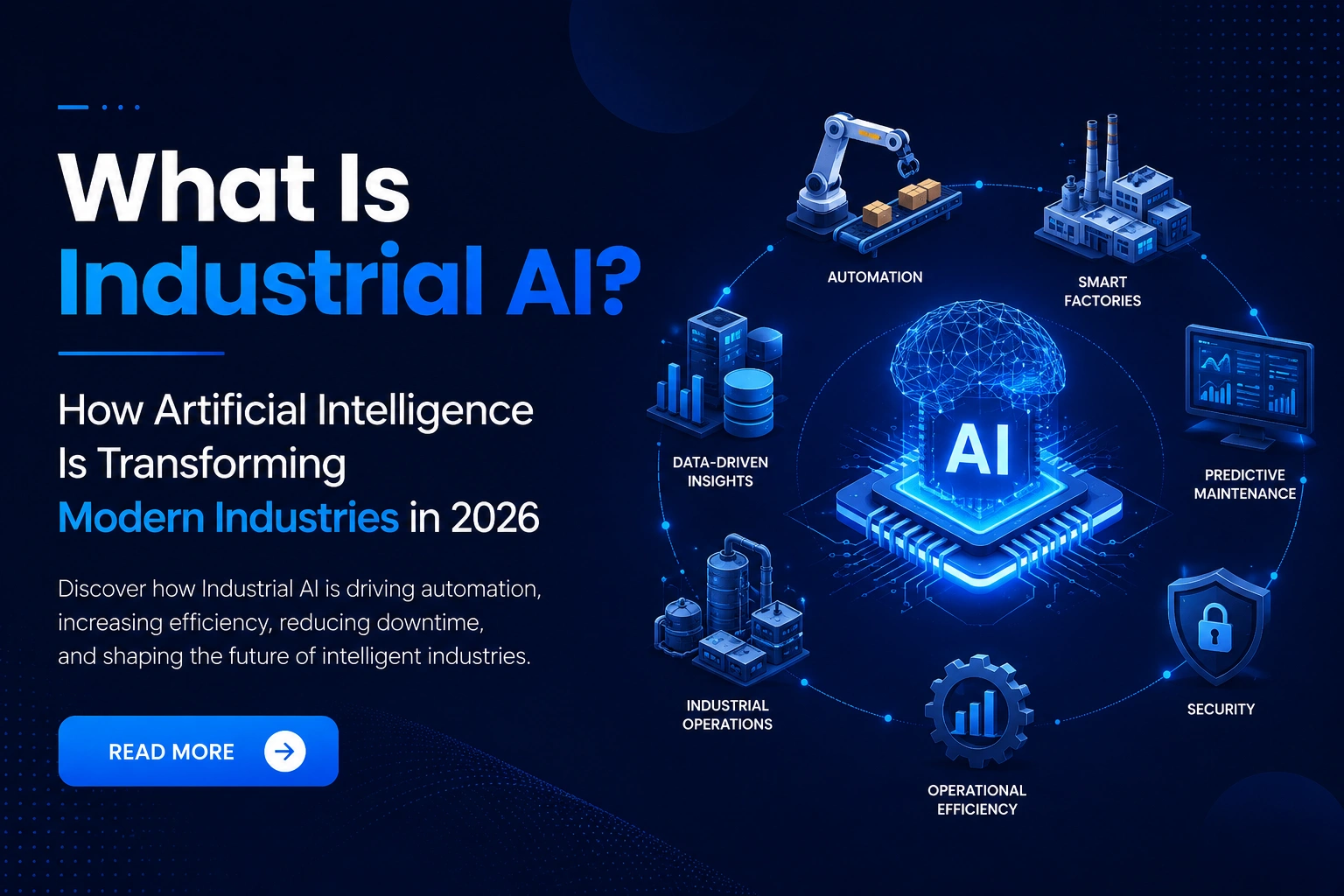
What Is Industrial AI?
Defining Industrial AI
Industrial AI is the application of artificial intelligence technologies — machine learning, computer vision, natural language processing, and predictive analytics — to physical operations, manufacturing processes, and supply chains. Unlike consumer-facing AI that powers recommendation engines or chatbots, industrial artificial intelligence is designed to optimize assets, predict failures, improve quality, and drive autonomous decisions inside complex operational environments.
The goal is not to replace human judgment wholesale. It is to augment operators, engineers, and managers with real-time intelligence they could never generate manually at the scale modern operations demand.
How Industrial AI Differs from Traditional AI
Traditional AI systems are largely reactive and rule-based. They execute predefined logic: if X happens, do Y. Industrial AI, by contrast, is adaptive. Models learn from streaming sensor data, adjust to changing conditions, and surface recommendations that evolve as the environment changes.
Traditional automation also operates in isolation — a robot arm performs a fixed task. Industrial AI connects that arm to a broader intelligence layer that monitors wear, adjusts speed based on downstream demand, and flags anomalies before they cascade into shutdowns.
The Evolution from Automation to Intelligent Decision-Making
The journey from automation to intelligence has unfolded in three phases. First came mechanical automation — conveyor belts, programmable logic controllers, and robotics that removed repetitive human labor. Second came data collection, driven by industrial IoT sensors that made operations visible for the first time. Third — and this is where we are now — comes intelligent decision-making, where AI systems synthesize that data into predictions, recommendations, and autonomous actions that compound in value over time. This is the domain of Enterprise AI Development: building AI systems that are not just functional, but deeply integrated into the operational fabric of an organization.
Why Industrial AI Matters in 2026
Rising Operational Costs
Energy prices, raw material volatility, and logistics inflation have compressed margins across manufacturing and resource industries. AI-driven optimization — whether in energy consumption, yield rates, or procurement — directly targets these cost lines in ways that traditional efficiency programs cannot.
Workforce Challenges and Skills Gaps
The global shortage of skilled technicians and engineers is not improving. Industrial AI helps organizations do more with the teams they have: automating routine monitoring tasks, guiding less experienced workers through complex procedures, and capturing the institutional knowledge of retiring experts in model-driven systems.
Demand for Real-Time Decision Intelligence
Modern operations generate millions of data points per hour. No human team can monitor, correlate, and act on that volume in real time. AI closes the gap, enabling decisions at machine speed — especially critical in process industries where a five-minute delay in detecting an anomaly can cost millions.
Sustainability and Regulatory Pressure
Emissions reporting, energy efficiency mandates, and ESG commitments are no longer voluntary in many jurisdictions. Industrial AI helps organizations track, model, and reduce their environmental footprint with the precision that regulators increasingly require. For businesses operating in the Gulf region, AI Innovations for Dubai Businesses are being actively driven by government-backed smart industry initiatives, making adoption both a competitive and regulatory priority.
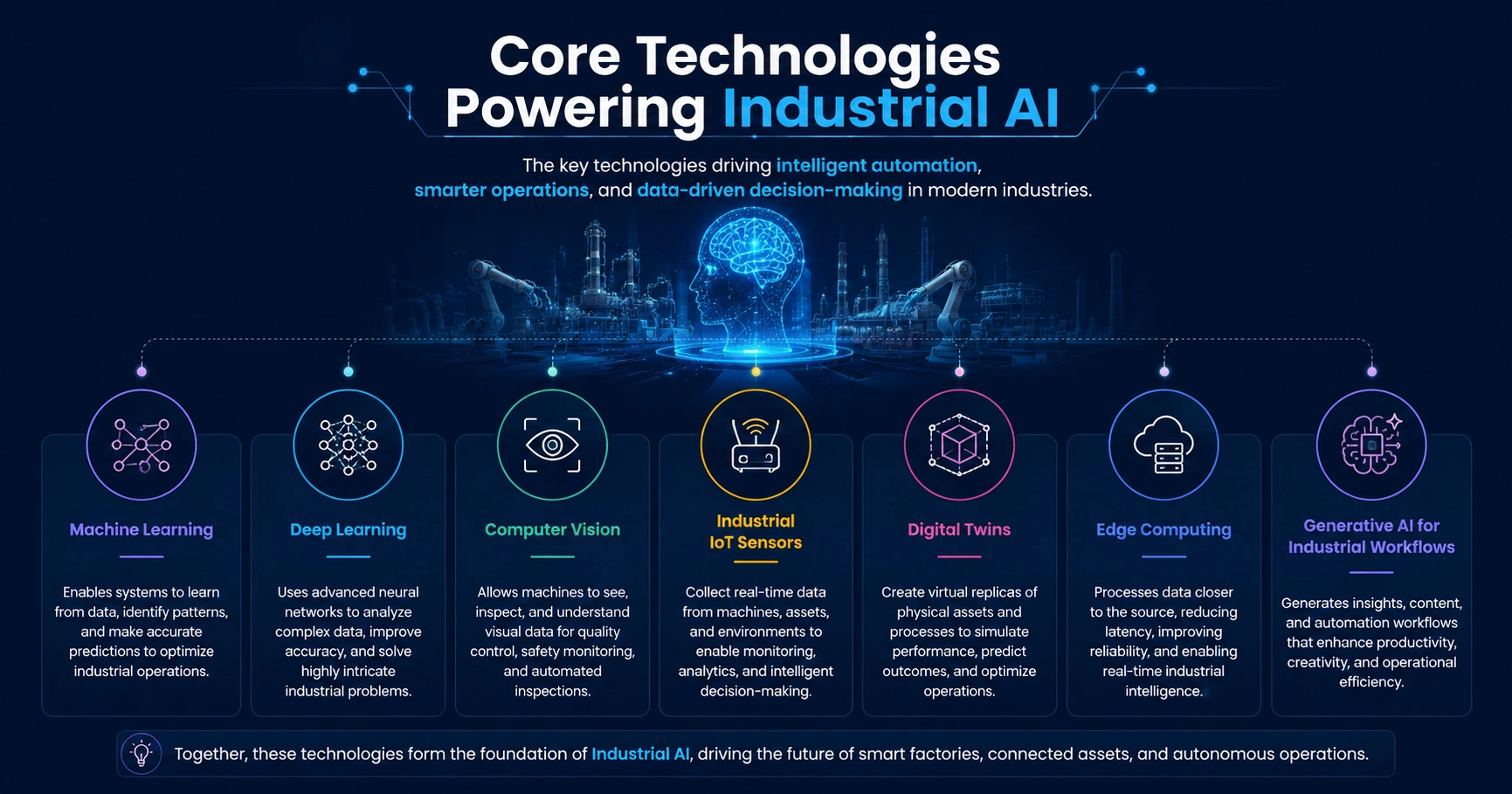
Core Technologies Powering Industrial AI
Machine Learning
Machine learning algorithms identify patterns in historical operational data and use those patterns to make predictions — which equipment is likely to fail, which production parameters yield the highest quality output, which supplier is likely to miss a delivery window. ML is the backbone of most industrial AI applications.
Deep Learning
Deep learning, a subset of machine learning that uses layered neural networks, excels at processing unstructured data: images, audio, vibration waveforms. It powers visual inspection systems that can spot micro-defects invisible to the human eye, and anomaly detection systems that catch irregular acoustic signatures in rotating machinery.
Computer Vision
Computer vision enables AI systems to interpret and act on visual information from cameras placed on production lines, in warehouses, or on construction sites. It is the engine behind automated quality inspection, worker safety monitoring, and inventory management systems that count and classify physical goods without barcode scanning.
Industrial IoT Sensors
AI is only as good as the data it receives. Industrial IoT (IIoT) sensors — measuring temperature, pressure, vibration, flow, humidity, current draw, and dozens of other variables — provide the continuous, granular data streams that AI models need to function. The convergence of cheap sensors, wireless connectivity, and cloud infrastructure has made comprehensive sensor coverage economically viable for facilities of almost any size.
Digital Twins
A digital twin is a live, virtual replica of a physical asset, production line, or entire facility. Fed by real-time sensor data and informed by AI models, digital twins allow engineers to simulate changes, stress-test scenarios, and predict outcomes before making costly physical interventions. In 2026, digital twin adoption has accelerated significantly across energy, aerospace, and heavy manufacturing.
Edge Computing
Processing data at the point of collection — at the "edge" of the network, inside the facility itself — reduces latency, lowers bandwidth costs, and enables AI-driven decisions even when cloud connectivity is limited. Edge computing is particularly important for real-time quality control, safety monitoring, and autonomous vehicle guidance in industrial environments.
Generative AI for Industrial Workflows
Generative AI has moved beyond content creation into operational workflows. In industrial settings, it is being used to synthesize maintenance reports, generate step-by-step repair guidance from sensor data, draft compliance documentation, and help engineers query complex operational databases in plain language. Organizations building custom AI-powered applications in this space are working with generative AI app development services that can tailor these capabilities to specific industrial contexts.
How Industrial AI Works
The lifecycle of an industrial AI system follows a consistent pattern regardless of the specific application.
Data Collection is the foundation. Sensors, PLCs, ERP systems, quality management platforms, and external data sources (weather, commodity prices, supplier feeds) are connected and normalized into a unified data layer.
Data Processing cleans, filters, and contextualizes that raw data. Missing values are imputed, outliers are flagged, and time-series data is aligned so that the AI model receives coherent inputs.
Model Training applies machine learning algorithms to historical data to learn the relationships between inputs and outcomes — the vibration signature that precedes a bearing failure, the combination of temperature and humidity that degrades product yield, the order pattern that signals a demand spike.
Predictive Analytics applies trained models to live data streams, generating forward-looking outputs: failure probability in the next 72 hours, yield forecast for the current production shift, estimated delivery date given current logistics conditions.
Autonomous Recommendations present those predictions to human operators in decision-ready formats, or — in more mature deployments — trigger automated responses: adjusting machine parameters, re-routing a shipment, dispatching a maintenance technician. It is worth noting that industrial AI agents operate very differently from conversational tools; understanding the distinction between AI Agents vs AI Chatbots is important when evaluating which technology fits a given operational use case.
Continuous Optimization closes the loop. As operations evolve and new data accumulates, models are retrained and refined, improving accuracy and expanding the range of decisions the AI can reliably inform.
Major Applications of Industrial AI Across Industries
Manufacturing
AI in industrial automation has fundamentally changed what is possible on the factory floor. Manufacturers are using AI for real-time quality inspection, predictive equipment maintenance, production scheduling optimization, and supply chain synchronization. AI-driven industrial process automation reduces scrap rates, improves throughput, and enables flexible production lines that can switch between product variants without extended downtime.
Logistics and Supply Chain
Logistics networks generate enormous volumes of data — shipment locations, customs statuses, carrier performance metrics, demand signals. AI synthesizes this data into dynamic routing decisions, demand forecasts, and inventory positioning strategies. Companies using AI in their industrial operations report meaningful reductions in both carrying costs and stockout events.
Energy and Utilities
Power grids, pipelines, and water treatment facilities are using AI to predict equipment failures, optimize energy dispatch, detect leaks and anomalies, and manage the complexity introduced by distributed renewable generation. AI enables utilities to balance supply and demand in real time across increasingly heterogeneous grids.
Oil and Gas
Upstream, AI analyzes seismic data to improve reservoir characterization and drilling decisions. Midstream, it monitors pipeline integrity and optimizes throughput. Downstream, it improves refinery yield and reduces energy consumption. Safety monitoring — detecting gas leaks, identifying unsafe worker behaviors — is another growing application.
Construction
AI is being applied to project scheduling, safety compliance monitoring through computer vision, equipment utilization tracking, and predictive risk assessment for large infrastructure projects. The combination of drone imagery and AI analysis gives project managers real-time visibility into site progress at a level of detail that was previously impossible.
Mining
Mining operations are using AI to optimize blast patterns, predict equipment failures in crushers and haul trucks, improve ore grade estimation, and enhance worker safety through proximity detection and fatigue monitoring. Autonomous haul trucks guided by AI are already operating in large open-pit mines.
Pharmaceuticals
In pharma, where regulatory compliance and batch consistency are paramount, AI is used for continuous process verification, predictive quality assurance, and deviation detection. AI-powered industrial solutions are helping manufacturers achieve right-first-time batch rates that were previously unattainable at scale.
Food Processing
Food safety, shelf-life prediction, yield optimization, and waste reduction are the primary AI use cases in food processing. Computer vision systems inspect products for defects and foreign material at line speeds that far exceed human inspection capability.
Predictive Maintenance: The Most Valuable Industrial AI Use Case
Of all industrial AI applications, predictive maintenance consistently delivers the fastest and most measurable return on investment. It is worth examining in depth.
How Predictive Maintenance Works
Predictive maintenance systems continuously monitor equipment health through sensors measuring vibration, temperature, current draw, acoustic emissions, and other variables. Machine learning models — trained on historical failure data — identify the patterns that precede failures days or weeks before they would become apparent to operators. When a model detects an anomaly that matches a known failure precursor, it generates an alert with a recommended action and estimated time to failure.
Cost Reduction Benefits
Unplanned downtime costs manufacturers an average of hundreds of thousands of dollars per hour depending on the industry. Predictive maintenance shifts organizations from reactive (fix it after it breaks) and scheduled preventive maintenance (fix it whether it needs it or not) to condition-based intervention: fix it precisely when the data says it needs attention. This eliminates both emergency repair premiums and unnecessary scheduled work.
Downtime Prevention
Beyond cost, downtime prevention has strategic implications. In high-volume consumer goods manufacturing, a single unplanned line stoppage can trigger delivery failures that damage retail relationships. In process industries like chemicals or steel, unplanned shutdowns can require days of restart procedures. AI-driven predictive systems are increasingly the difference between competitive reliability and costly inconsistency.
Asset Life Extension
By catching degradation early and enabling timely intervention, predictive maintenance extends asset life — often significantly. Organizations report that AI-informed maintenance programs have extended the service life of critical assets by 20–40% in some cases, deferring capital expenditure and improving return on asset investment.
Industrial AI and Quality Control
AI-Powered Visual Inspection
Traditional quality inspection relies on human inspectors sampling a fraction of total production. AI-powered visual inspection systems, using high-resolution cameras and deep learning models, can inspect 100% of production output at full line speed. These systems detect surface defects, dimensional variations, color inconsistencies, and assembly errors that human inspectors routinely miss — particularly toward the end of long shifts.
Defect Detection
Modern defect detection models can identify anomalies at the sub-millimeter level with false positive rates low enough to avoid disrupting production flow. In semiconductor manufacturing, automotive components, and precision engineering, this capability has moved from competitive advantage to table stakes.
Production Optimization
Beyond defect detection, AI analyzes the relationship between process parameters and quality outcomes, identifying the optimal settings for temperature, pressure, speed, and material inputs that maximize yield and minimize variation. This closes the loop between quality monitoring and production control.
Process Consistency
In industries where batch-to-batch consistency is critical — pharmaceuticals, food and beverage, specialty chemicals — AI monitors process variables continuously and makes micro-adjustments to maintain the narrow parameter windows that consistency requires.
Cost Effectiveness of Industrial AI
Reducing Operational Expenses
The cost reduction case for industrial AI is well established across multiple vectors: lower energy consumption through optimized scheduling, reduced maintenance costs through predictive programs, lower scrap and rework costs through AI quality control, and reduced inventory carrying costs through demand-driven supply chain optimization.
Increasing Productivity
AI-driven scheduling and optimization squeeze more output from existing assets without capital investment. Facilities report productivity improvements of 10–25% on specific lines and processes after AI deployment, with some advanced implementations achieving gains at the higher end of that range.
Optimizing Resource Utilization
Labor, energy, raw materials, and capital equipment are all subject to AI-driven optimization. Scheduling AI ensures the right workers with the right skills are deployed at the right time. Energy AI shifts consumption to lower-cost periods. Materials AI minimizes waste. Asset utilization AI identifies underused equipment and reallocates production accordingly.
Improving ROI
ROI Calculations: Industrial AI projects typically pay back in 12–36 months depending on scope and application. Predictive maintenance deployments frequently achieve payback in under 18 months. Quality inspection systems often pay back within 12 months when they replace or supplement manual inspection labor. Supply chain optimization projects tend toward the 24–36 month range due to implementation complexity, but deliver ongoing savings that compound over time.
Cost-Benefit Considerations: Realistic ROI modeling should account for implementation costs (technology, integration, change management, training), ongoing operational costs (platform licensing, data infrastructure, model maintenance), and the full range of benefits (direct cost savings, revenue protection through uptime, and strategic benefits like improved customer reliability).
Budget Planning: Organizations new to industrial AI should plan for phased investment. A well-scoped pilot in a single plant or on a single production line typically requires a fraction of the budget of a full-scale deployment and delivers the proof of value needed to justify broader rollout. For organizations in the region, understanding the AI Development Cost in Dubai is an important first step — costs vary significantly based on solution complexity, integration requirements, and the level of customization needed.
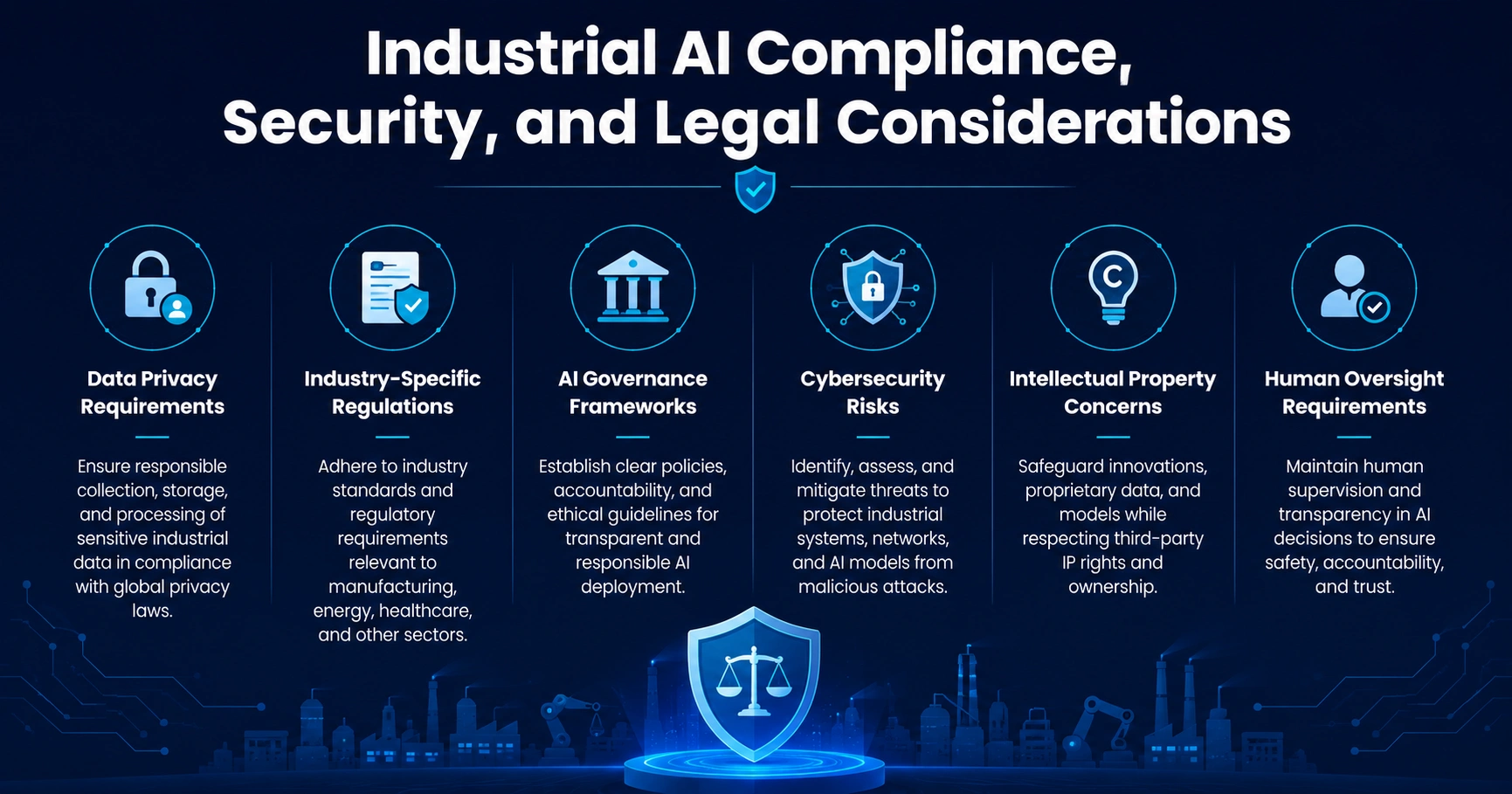
Industrial AI Compliance, Security, and Legal Considerations
Data Privacy Requirements
Industrial AI systems process operational data that may include personally identifiable information — worker location data, biometric data from safety systems, and communications. Organizations must ensure their AI deployments comply with applicable data protection regulations, including GDPR in Europe and equivalent frameworks in other jurisdictions.
Industry-Specific Regulations
Pharmaceuticals (FDA, EMA), aviation (FAA, EASA), financial services, and energy are among the industries with specific AI governance requirements layered on top of general data protection frameworks. AI systems used in regulated processes must meet validation, audit trail, and explainability requirements that commercial off-the-shelf AI products may not address out of the box.
AI Governance Frameworks
Effective AI governance in industrial settings requires documented model development and validation processes, change control procedures, performance monitoring protocols, and escalation paths when AI recommendations conflict with operator judgment. Organizations should establish AI governance frameworks before — not after — deployment.
Cybersecurity Risks
Industrial AI systems expand the attack surface of operational technology environments. AI platforms connected to plant networks create new vectors for cyberattacks that could have physical consequences. Cybersecurity requirements — network segmentation, access controls, anomaly detection, incident response planning — must be designed into industrial AI deployments from the start.
Intellectual Property Concerns
AI models trained on proprietary operational data, engineering specifications, or process recipes raise IP ownership questions that organizations must address in vendor contracts and governance policies. Understanding who owns the model, the training data, and the outputs is essential before deployment.
Human Oversight Requirements
Even the most capable industrial AI systems should operate within frameworks that preserve meaningful human oversight. Autonomous recommendations should include explainability — operators should understand why the AI is suggesting an action. High-consequence decisions should require human confirmation. And organizations should maintain the ability to override, retrain, or shut down AI systems when performance degrades or circumstances change.
Industrial AI Challenges Businesses Must Address
Legacy Infrastructure
Most industrial facilities run on equipment and control systems that predate modern connectivity. Retrofitting these environments with the sensors, networks, and data infrastructure that AI requires is often the largest cost and complexity in an industrial AI program.
Data Quality Issues
AI models are only as reliable as the data they are trained on. In industrial settings, historical data is often incomplete, inconsistently labeled, or biased by past operational practices. Significant effort in data cleaning, enrichment, and governance is typically required before meaningful model training can begin.
Change Management
Technology is rarely the limiting factor in industrial AI deployments. Culture and change management usually are. Operators who have built careers on intuition and experience may resist AI recommendations, especially when the system initially makes errors. Effective adoption requires engagement from the start, transparent communication about the AI's purpose and limitations, and visible leadership commitment.
Workforce Adoption
Training matters. Workers at every level — from floor operators to plant managers to executive sponsors — need to understand how to interact with AI systems, how to interpret their outputs, and when to escalate concerns. Investment in capability building is not optional; it is the mechanism through which AI delivers value.
Integration Complexity
Industrial AI must integrate with ERP systems, SCADA platforms, MES environments, quality management systems, and often multiple generations of control system architecture. Integration complexity is frequently underestimated and is a major source of cost and schedule overrun in enterprise deployments.
Ethical AI Concerns
Worker monitoring through AI — tracking location, movement, productivity, and safety compliance — raises legitimate ethical concerns about surveillance and workplace autonomy. Organizations must engage workers and their representatives, establish clear policies about how AI-generated data is used, and ensure that AI deployment does not erode the dignity and trust that healthy workplaces require.
What Businesses Should Do Next
Assess Current Operations
Before investing in AI, understand where value is being lost. Map your highest-cost failure modes, your largest quality losses, your most significant productivity gaps. AI is most powerful when applied to well-understood problems with substantial impact.
Identify High-Value Use Cases
Not every operational problem is an AI problem. Prioritize use cases where data is available or obtainable, where the business impact of improvement is significant, and where AI has demonstrated proven capability in comparable applications.
Build an AI Roadmap
A roadmap transforms isolated use cases into a coherent program. It sequences investments to build capability progressively, ensures data infrastructure investments serve multiple applications, and provides the organizational continuity that sustains multi-year programs through leadership changes.
Start with Pilot Projects
Pilots de-risk investment and build organizational confidence. A well-designed pilot is narrow enough to deliver results in 90–180 days, representative enough to validate the approach for broader rollout, and instrumented enough to generate the evidence base for scaled investment.
Measure Business Outcomes
AI projects should be held to the same commercial accountability as any other capital investment. Define success metrics before deployment — uptime improvement, defect rate reduction, maintenance cost savings, productivity gain — and measure relentlessly. Outcomes, not outputs, are what matter.
Scale Strategically
Successful pilots create internal advocates and generate organizational learning. Use them to build the business case for scaled deployment, to refine the implementation playbook, and to identify the organizational capabilities — data engineering, AI ops, change management — that need to be built or acquired to sustain a broader program.
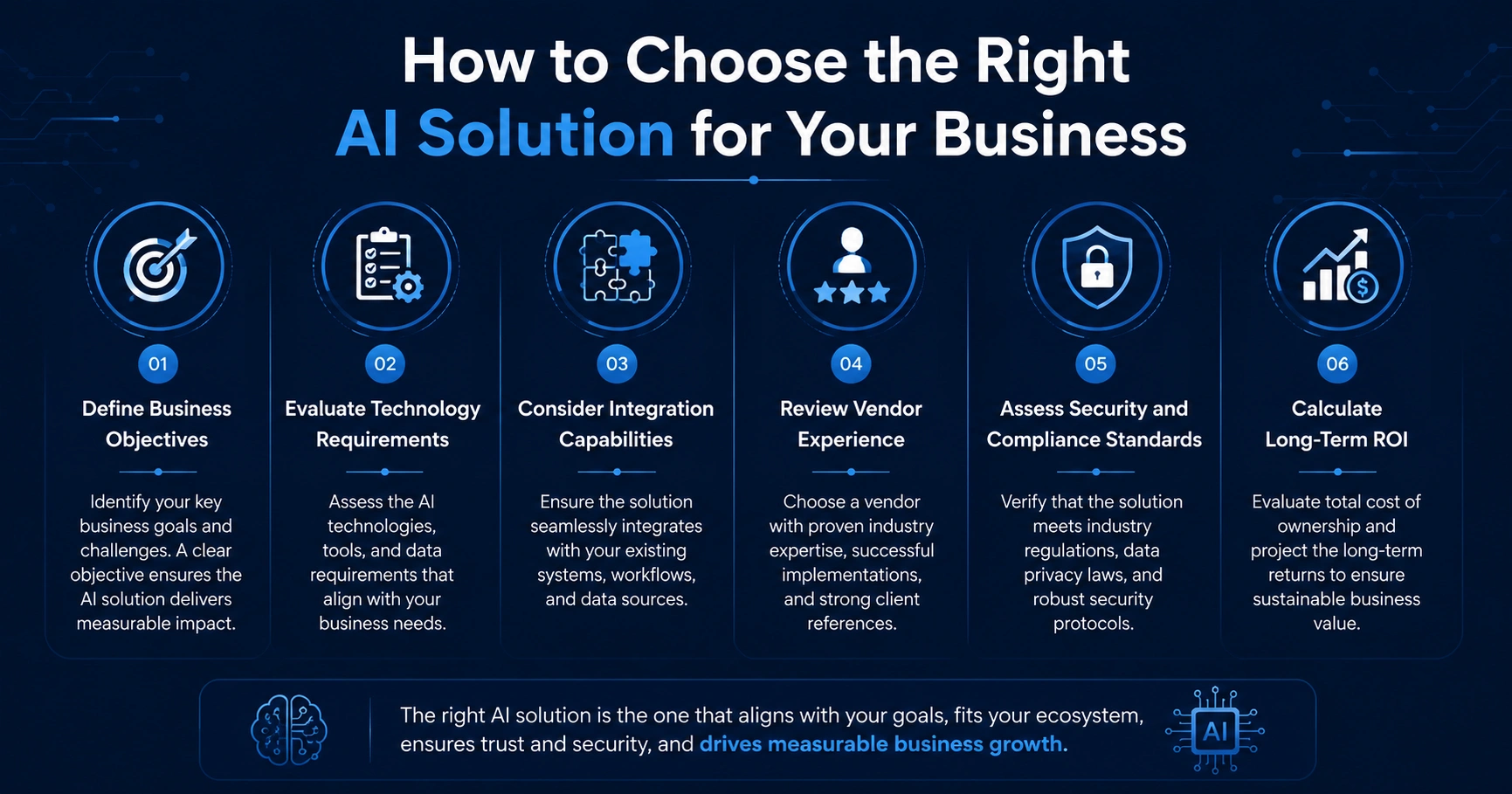
How to Choose the Right AI Solution for Your Business
Define Business Objectives
The most common failure mode in industrial AI investment is starting with the technology rather than the business problem. Begin with a precise statement of the outcome you are trying to achieve — specific, measurable, and tied to a business metric that leadership cares about.
Evaluate Technology Requirements
Not all AI platforms are equal across all use cases. Evaluate solutions on their capability in your specific application domain, their architecture (cloud, edge, hybrid), their data integration capabilities, and their track record in environments similar to yours. Partnering with a reputable AI app development company Dubai can accelerate solution selection by providing local expertise, regional compliance knowledge, and pre-built integrations relevant to your industry.
Consider Integration Capabilities
A powerful AI platform that cannot integrate with your existing operational technology stack will deliver limited value. Evaluate integration depth and flexibility early, and be honest about the complexity of your environment when assessing vendor claims. Many enterprises find that custom software development in Dubai — tailored specifically to their OT environment and data architecture — delivers better long-term integration outcomes than generic off-the-shelf platforms.
Review Vendor Experience
Look for vendors with demonstrated experience in your industry and your type of operational environment. Case studies, reference customers, and independent validation matter more than feature lists and marketing claims. Engaging with an experienced software development companies that understands both the technology and your industry context is a significant advantage — particularly for organizations navigating regional regulations and infrastructure requirements.
Assess Security and Compliance Standards
Vendors should be able to demonstrate compliance with relevant security frameworks (SOC 2, ISO 27001) and provide clear documentation of how their systems handle regulated data. For industries with specific AI validation requirements, ensure the vendor has experience supporting compliance processes.
Calculate Long-Term ROI
Total cost of ownership extends well beyond initial licensing and implementation. Factor in ongoing platform costs, data infrastructure costs, model maintenance, and the internal capability-building investment required to sustain and evolve the program over time. The cheapest initial deployment is rarely the most cost-effective over a five-year horizon.
ALSO READ- Top 12 Generative AI Development Services in 2026
The Future of Industrial AI Beyond 2026
Autonomous Factories
The direction of travel is toward facilities where AI orchestrates production end to end — scheduling, quality control, maintenance, energy management, and logistics — with humans focused on oversight, continuous improvement, and handling the exceptional cases that AI cannot manage. Fully autonomous factories remain aspirational for most organizations, but the enabling technologies are converging rapidly.
AI-Powered Digital Twins
Digital twins are evolving from visualization tools into active AI-powered industrial solutions — living models that continuously optimize their physical counterparts, simulate future states, and recommend interventions before problems materialize. The integration of generative AI into digital twin platforms is accelerating this evolution.
Self-Healing Production Systems
AI systems that detect anomalies and automatically adjust process parameters to compensate — without human intervention — are already operating in some advanced process industries. The extension of this capability to discrete manufacturing and more complex multi-variable environments is a near-term frontier.
Intelligent Supply Chains
AI-powered industrial automation is moving up the supply chain. Future supply networks will be instrumented, predictive, and self-optimizing — dynamically re-routing around disruptions, adjusting procurement based on real-time demand signals, and coordinating across multiple tiers of suppliers with the kind of visibility that spreadsheet-based planning can never provide.
Human-AI Collaboration
The most enduring shift is cultural. The organizations that extract the most value from AI will be those that redesign work around the complementary strengths of human and artificial intelligence — humans providing judgment, context, creativity, and ethical oversight; AI providing scale, speed, pattern recognition, and tireless monitoring. This is not a technology story. It is an organizational design story.
Conclusion
Industrial AI is no longer a technology experiment. It is a strategic imperative for organizations that compete on operational performance. The companies deploying AI in their manufacturing plants, supply chains, energy assets, and logistics networks today are building operational capabilities that their competitors will struggle to replicate quickly.
The window for competitive differentiation through early adoption is not unlimited. As AI platforms mature and implementation knowledge spreads, the advantage shifts from first movers to fast followers — and eventually to those who simply keep pace. The organizations positioning themselves as leaders now are those that will define the benchmark others chase.
If your organization has not yet begun its industrial AI journey, the most important next step is not choosing a platform or a vendor. It is defining the business outcomes you need AI to deliver, identifying the two or three use cases with the highest near-term impact, and commissioning a structured pilot that will generate real evidence — not case studies from other companies, but data from your own operations.
That evidence is what converts AI from a strategic priority on a slide into a line item on a P&L — and ultimately into a sustained competitive advantage.