
Introduction to AI in UAE Government
The United Arab Emirates has always moved faster than most nations when it comes to embracing the future. From building the world's tallest tower to launching an interplanetary Mars mission, the UAE has consistently demonstrated that ambition, backed by strategic investment, can compress decades of progress into years.
Artificial intelligence is the next frontier in that journey — and nowhere is its impact more consequential than inside government.
Today, AI for UAE Government is not a theoretical concept discussed in policy papers. It is an operational reality reshaping how ministries deliver services, how municipalities manage cities, how regulators detect fraud, and how public institutions make decisions that affect millions of residents across Dubai, Abu Dhabi, Sharjah, Ajman, Ras Al Khaimah, Fujairah, and Umm Al Quwain.
The scale of this transformation is significant. According to PwC, AI could contribute up to $320 billion to the Middle East economy by 2030, with the UAE positioned to capture the largest share relative to its GDP. The UAE government has taken this projection seriously, embedding artificial intelligence at the centre of its national development agenda through the UAE National AI Strategy 2031.
For CIOs, CTOs, digital transformation leaders, and public sector executives navigating this shift, understanding where AI creates real value — and how to implement it responsibly — is no longer optional. It is foundational to effective governance.
This comprehensive guide covers every dimension of the AI transformation underway across UAE government entities: why it is happening, what it looks like in practice, where the challenges lie, and how your organisation can build a credible, compliant, and strategically sound AI capability.
It is written for the practitioners who bear responsibility for making these decisions — the CIOs, CTOs, digital transformation leads, and senior public sector executives who must translate national ambition into operational reality. Whether you are evaluating your first AI use case or scaling an existing programme, the frameworks, examples, and strategic insights in this article are designed to be directly useful to your work.
Why UAE Government Is Investing in Artificial Intelligence
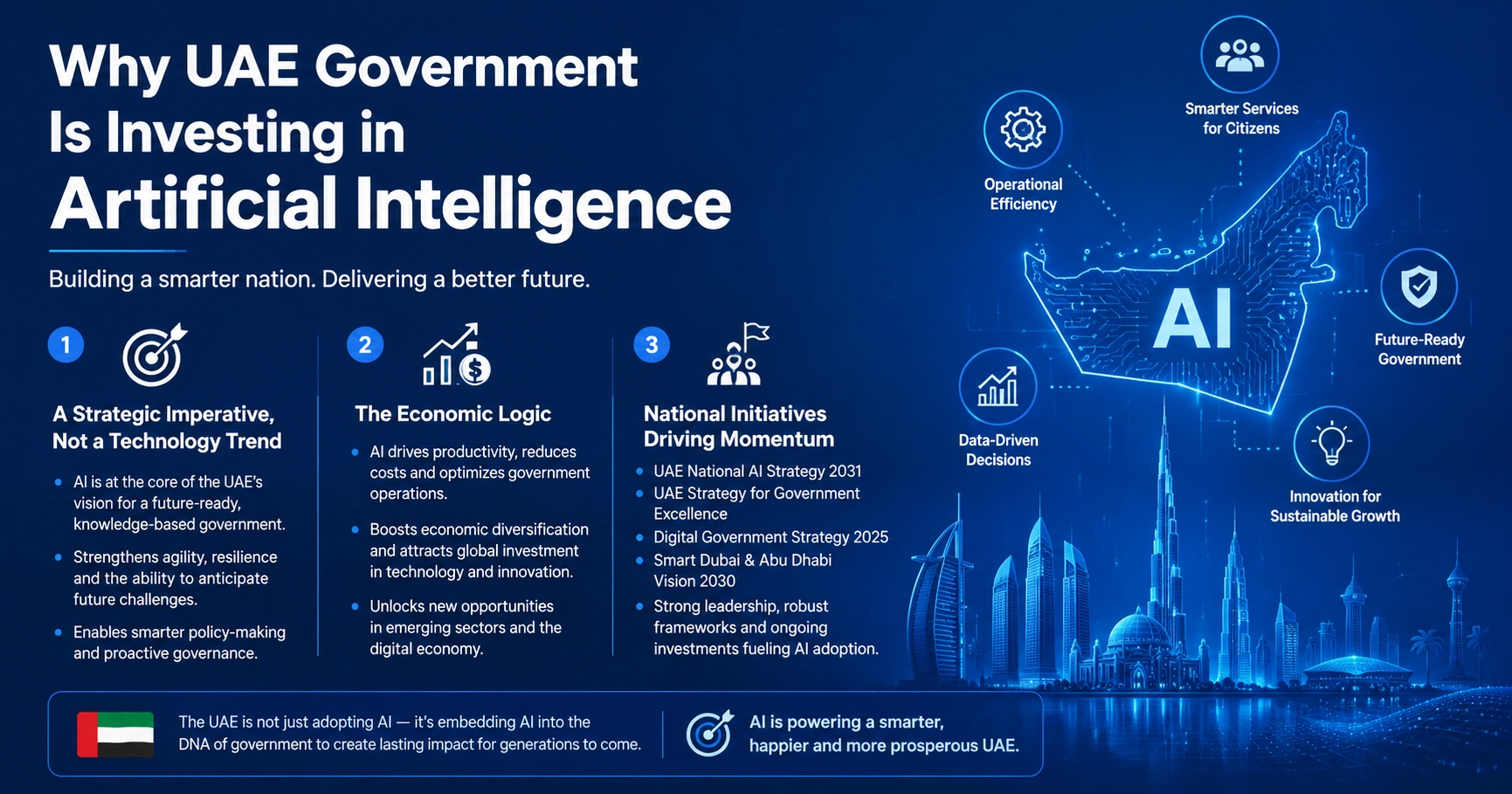
A Strategic Imperative, Not a Technology Trend
The UAE's investment in artificial intelligence is not driven by enthusiasm for emerging technology. It is driven by a clear-eyed assessment of national priorities.
The country's leadership recognised years ago that sustainable growth in a post-oil economy requires fundamentally different engines of productivity. Knowledge, efficiency, and data-driven decision-making must replace the resource-intensive models of the past. AI is the infrastructure that makes that transition possible.
The UAE AI Strategy 2031, launched under the patronage of His Highness Sheikh Mohammed bin Rashid Al Maktoum, set an explicit goal: position the UAE among the world's most AI-ready nations and use artificial intelligence to improve government efficiency by up to 50 percent. That is not a marginal improvement — it represents a structural rethinking of how public services are designed and delivered.
The Economic Logic
Several converging forces make AI investment in UAE government not just strategic but economically rational:
Population and service demand. The UAE's population has grown rapidly, with over 9.2 million residents as of 2024, the vast majority being expatriates with high expectations for digital service quality. Managing this demand with linear headcount growth is unsustainable.
Citizen expectations. Residents of Dubai and Abu Dhabi are accustomed to world-class consumer digital experiences. They expect government services to match the convenience of the private sector apps they use daily. AI-powered automation and personalisation close that gap.
Cross-emirate coordination. Managing services consistently across seven emirates — each with its own government structure, regulatory environment, and infrastructure maturity — creates complexity that AI systems are uniquely suited to manage at scale.
Global competitiveness. The UAE competes aggressively for foreign investment, skilled talent, and business headquarters. A government that operates with efficiency, speed, and data intelligence is itself a competitive advantage in attracting the world's best companies and people.
National Initiatives Driving Momentum
Beyond strategy, a series of concrete national initiatives have created structural momentum for AI adoption across UAE government:
- UAE National AI Strategy 2031 — the overarching framework establishing AI as a pillar of national development
- Smart Dubai Initiative — transforming Dubai into the world's smartest and happiest city
- Abu Dhabi's AI talent and research ecosystem — anchored by the Mohamed bin Zayed University of Artificial Intelligence (MBZUAI), the world's first graduate university dedicated exclusively to AI
- Sharjah's Digital Sharjah initiative — advancing smart government services and e-governance across the emirate
- Emirates AI Lab — driving applied AI research in collaboration with international institutions
- UAE Pass — a unified digital identity platform enabling seamless, AI-enhanced interactions across government touchpoints
Each of these initiatives creates both demand for AI solutions and a policy environment that supports their adoption. For technology leaders inside government entities, these national frameworks provide both the mandate and the legitimacy to move forward.
Key Benefits of AI for Government Agencies
Efficiency at a Scale That Changes Cost Structures
The most immediate and measurable benefit of AI in government is operational efficiency. When routine, high-volume processes — document verification, permit processing, inquiry routing, compliance checking — are automated with intelligent systems, the economics of government service delivery change fundamentally.
A government department that once needed 50 staff members to process visa applications can handle the same volume with a fraction of that headcount, while simultaneously improving accuracy and reducing processing time from days to minutes. This is not speculative — it is already happening across UAE government entities.
Better Decisions Through Better Data
Government decisions have consequences that affect millions of lives. Whether it is allocating healthcare resources, planning transport infrastructure, setting housing policy, or designing public safety interventions, the quality of the underlying data and analysis directly determines outcomes.
AI systems can process vastly larger datasets, identify non-obvious patterns, and model complex scenarios faster and more accurately than any human analyst. For UAE government decision-makers, this capability translates into policies that are more precisely calibrated, better targeted, and more responsive to real conditions on the ground.
Personalised Citizen Services
One of the most transformative applications of AI in government is the ability to move from generic, one-size-fits-all services to personalised interactions tailored to individual circumstances and needs.
An AI-powered platform can recognise that a resident has recently started a business, proactively offer relevant licensing information, flag compliance requirements, and suggest related government services — all without the resident knowing what to ask for. This proactive, contextual intelligence transforms the relationship between government and citizen from transactional to genuinely helpful.
Fraud Detection and Revenue Protection
Government revenues are consistently undermined by fraud, waste, and abuse in procurement, benefits distribution, tax collection, and regulatory compliance. AI systems trained on historical transaction data can identify anomalous patterns that signal fraudulent activity with far greater precision than rule-based systems, and they improve continuously as new data flows in.
For UAE government finance departments and regulatory bodies, AI-powered fraud detection represents both significant revenue protection and a deterrent effect that reduces the overall incidence of fraud over time. The UAE's Ministry of Finance and the Federal Tax Authority are among the entities investing in AI-driven compliance analytics that flag suspicious patterns in real time.
Speed and Availability
AI-powered services do not have opening hours. Citizens in Sharjah, Fujairah, or Ras Al Khaimah can access government services at 2 AM through AI chatbots, virtual assistants, and automated processing systems. This always-on availability is not merely convenient — for residents managing businesses, urgent visa matters, or emergency situations, it is genuinely valuable.
Cost Reduction at Scale
The cumulative cost reduction from AI deployment across a government entity with thousands of employees and millions of annual citizen interactions is substantial. McKinsey estimates that AI automation of government administrative tasks could reduce operating costs by 20 to 30 percent over a five-year implementation horizon. In the UAE context, where government entities invest significantly in quality service delivery, these efficiency gains can be reinvested in service quality, capacity expansion, or capability development.
For technology leaders building the business case for AI investment, the combination of cost reduction, quality improvement, and speed gains typically generates compelling ROI even for moderately complex implementations. Partnering with a proven digital transformation company in Dubai that understands both the technology and the UAE public sector context is one of the most reliable ways to ensure these returns are realised rather than projected.
Major Use Cases of AI in UAE Government
AI in Judicial and Legal Services
The UAE's judicial system processes significant case volumes annually across federal courts, emirate-level courts, and specialised judicial bodies. AI is beginning to transform this domain in ways that improve efficiency without compromising the integrity of judicial processes.
Intelligent document review systems can analyse case files, identify relevant precedents, and prepare case summaries for judges and legal professionals — dramatically reducing preparation time. Natural language processing systems can assist in translating legal documents between Arabic and English with the accuracy that legal contexts demand. Predictive case management systems can optimise court scheduling, reduce adjournment rates, and improve case flow management.
Dubai Courts and the Abu Dhabi Judicial Department have both piloted AI applications in judicial administration, with a focus on backlog reduction and service quality improvement for litigants. These efforts reflect a careful balance between the efficiency benefits of AI and the absolute requirement for human judgement in judicial decisions.
AI in Customs and Border Management
The UAE's position as a global trade hub — with Dubai and Abu Dhabi among the world's busiest ports and airports — creates enormous volumes of customs and border management activity. AI is transforming how this activity is managed.
Computer vision systems inspect cargo containers and vehicles at UAE ports and border crossings, identifying anomalies that suggest contraband, undeclared goods, or customs fraud with accuracy that exceeds human inspection while processing at far greater speed. Risk scoring AI systems evaluate the customs risk profile of each shipment based on hundreds of variables — origin, commodity, importer history, routing — and flag high-risk consignments for detailed examination while allowing low-risk shipments to clear rapidly.
The Federal Authority for Identity, Citizenship, Customs and Ports Security coordinates AI deployment across UAE customs and border operations, with the explicit goal of improving both security outcomes and the speed of legitimate trade flows — a combination that directly supports the UAE's economic competitiveness.
Document Intelligence and Processing Automation
The UAE government processes millions of documents annually — visa applications, trade licences, property registrations, court filings, health records, customs declarations, and hundreds of other document types across multiple languages. Manual processing of these documents is slow, expensive, and error-prone.
AI-powered document intelligence systems can extract, classify, validate, and route documents automatically, achieving accuracy rates above 99 percent while processing at speeds no human team can match. OCR combined with natural language processing handles Arabic and English documents with equal proficiency, a critical requirement across UAE government entities.
The General Directorate of Residency and Foreigners Affairs (GDRFA) in Dubai is among the entities that have deployed intelligent document processing at significant scale, with measurable reductions in processing times for residency and visa applications. Building these kinds of document AI systems requires deep expertise in both Arabic-language NLP and UAE government compliance — capabilities that set apart genuinely specialised providers from generalist vendors. Working with a dedicated custom software development company in Dubai that has built similar systems for government clients shortens the delivery timeline and substantially reduces integration risk.
AI-Powered Predictive Maintenance for Infrastructure
Across Dubai, Abu Dhabi, and Sharjah, government entities manage vast infrastructure assets — roads, bridges, water systems, electrical grids, metro lines, airports, and seaports. Maintaining this infrastructure reactively — fixing things after they break — is both expensive and disruptive.
AI-powered predictive maintenance systems analyse sensor data, operational logs, weather patterns, and usage data to predict equipment failures before they occur. The Roads and Transport Authority (RTA) in Dubai has pioneered predictive maintenance applications for metro systems and road infrastructure, significantly reducing unplanned downtime and maintenance costs.
This same approach is being extended across water utilities in Abu Dhabi, power distribution networks, and airport facilities — creating a pattern of proactive, data-driven infrastructure management that extends asset life and reduces operational costs.
AI-Powered Citizen Services
AI in Education and Training Services
The Ministry of Education and knowledge authorities across UAE emirates are deploying AI to personalise learning experiences, identify at-risk students early, and optimise resource allocation across the education system.
Adaptive learning platforms powered by AI can adjust content difficulty, pacing, and teaching approach in real time based on individual student performance — making education more effective for a student population that is genuinely diverse in background, first language, and learning style. Early warning systems that flag students showing signs of disengagement or academic difficulty enable earlier, more targeted interventions.
For government workforce development programmes, including those supporting Emiratisation, AI-powered training platforms can personalise development pathways, track competency progress, and predict where additional support is needed — making large-scale capability development programmes significantly more effective.
Intelligent Chatbots and Virtual Assistants
The most visible face of AI transformation in UAE government is the intelligent chatbot or virtual assistant deployed across government portals, mobile applications, and customer service channels.
These are not the frustrating, script-limited chatbots of five years ago. Modern AI chatbots built on large language models understand context, handle complex multi-turn conversations, switch seamlessly between Arabic and English, and resolve a significant proportion of citizen inquiries without human intervention.
Dubai's Department of Economy and Tourism has deployed AI-powered virtual assistants that handle business licensing queries. Abu Dhabi Digital Authority (ADDA) has integrated conversational AI into multiple citizen-facing platforms. The Ministry of Human Resources and Emiratisation uses AI chatbots to support employers and workers navigating labour regulations.
The business case for these deployments is compelling. Each query resolved by an AI assistant costs a fraction of a human agent interaction, and satisfaction scores for well-designed AI assistants frequently equal or exceed those for human agents on routine enquiries. For government entities evaluating this technology, understanding the AI Chatbot Building Cost in UAE is an important early step — costs vary significantly based on language complexity, integration requirements, and the sophistication of the underlying language model.
Personalised Government Portals
Beyond reactive chatbots, AI enables proactive personalisation of government digital experiences. By analysing a citizen's interaction history, life events, and service patterns, AI systems can surface relevant services, anticipate needs, and reduce the cognitive burden of navigating complex government processes.
The vision articulated by Smart Dubai — a single unified platform where all government services are accessible, personalised, and frictionless — is fundamentally dependent on AI to work at scale. The progress made through the Dubai Now app and related platforms demonstrates both the ambition and the genuine progress being made toward that vision.
Smart city planners across all UAE emirates increasingly recognise that a unified digital platform is the most powerful tool for citizen engagement at scale. Understanding the Super App Development Cost in UAE is a key consideration for decision-makers evaluating this investment — because while a well-designed super app consolidating government services across an emirate represents significant capital outlay, the long-term efficiency gains and citizen satisfaction improvements make a strong case for prioritisation.
Multilingual Communication
The UAE's resident population speaks dozens of languages, with Arabic and English serving as primary languages but significant communities speaking Hindi, Urdu, Tagalog, Pashto, Bengali, and many others. AI-powered translation and multilingual natural language processing allow government services to communicate effectively with residents in their preferred language, dramatically improving accessibility and reducing miscommunication in consequential interactions like legal matters, health services, and licensing.
AI for Smart Cities and Urban Development
Dubai's Smart City Vision in Practice
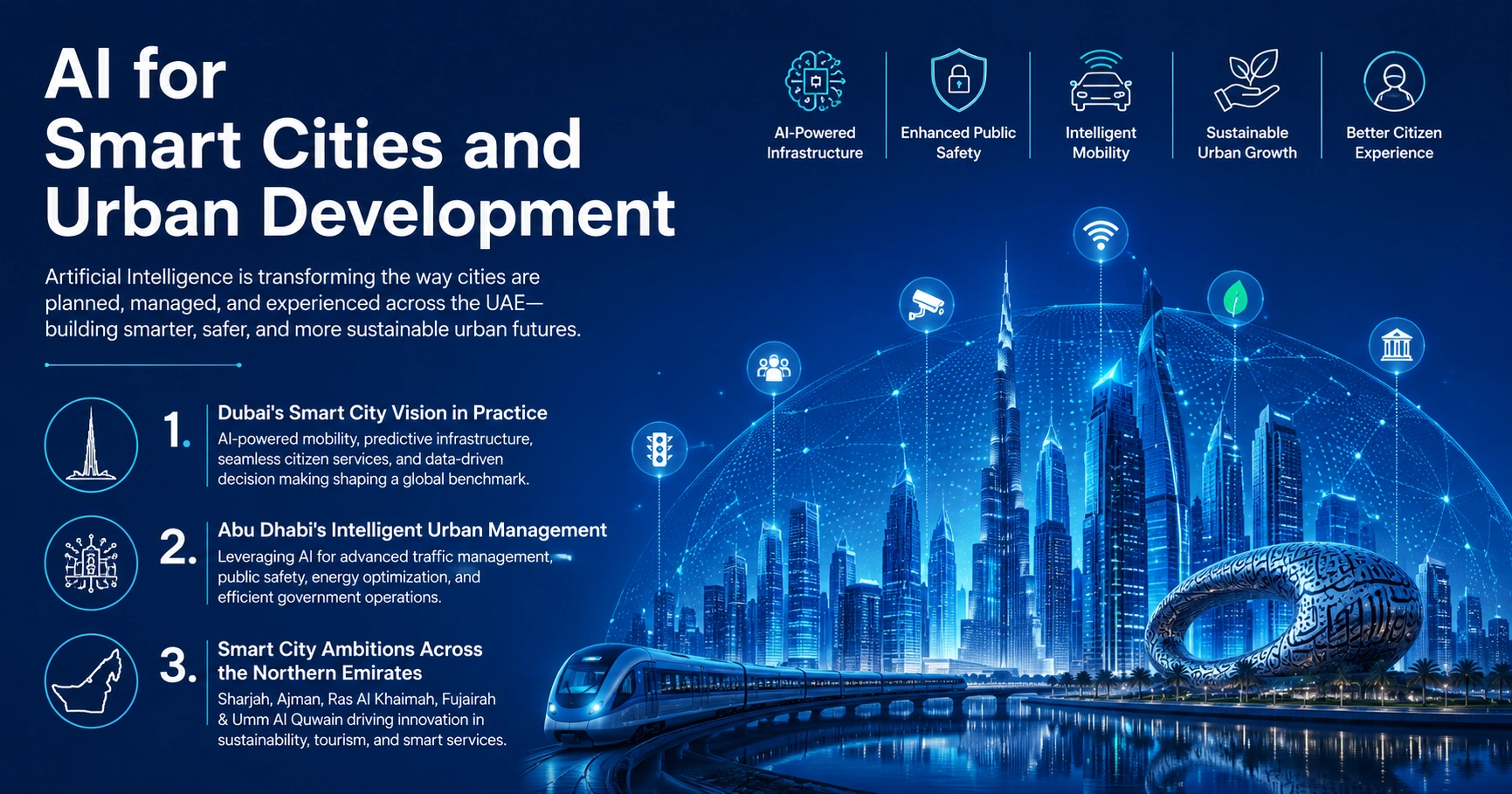
Dubai's commitment to becoming the world's smartest city is more than a vision statement — it is a comprehensive operational programme with hundreds of active technology initiatives. AI sits at the core of this programme across five dimensions: mobility, infrastructure, economy, living, and governance.
In mobility, AI manages traffic signal timing dynamically across Dubai's road network, reducing congestion and average commute times. Predictive algorithms route emergency services more efficiently. The RTA deploys AI-driven demand forecasting for public transport to optimise fleet deployment and reduce both overcrowding and empty running.
In infrastructure, AI systems monitor the health of thousands of assets simultaneously, from air conditioning systems in government buildings to pumping stations in the stormwater network. The Dubai Electricity and Water Authority (DEWA) has deployed AI to optimise energy distribution and predict demand spikes with high accuracy.
Abu Dhabi's Intelligent Urban Management
Abu Dhabi's approach to smart city development reflects the emirate's characteristic emphasis on structured, long-term planning. The Abu Dhabi City Municipality has deployed AI systems for urban planning analysis, using satellite imagery, sensor data, and population movement patterns to inform decisions about zoning, infrastructure investment, and public space design.
The emirate's integrated transport network, including the Etihad Rail project, incorporates AI-driven operations management. Masdar City continues to serve as a living laboratory for AI-enabled sustainable urban systems, with learnings being applied across Abu Dhabi's broader development programme.
Smart City Ambitions Across the Northern Emirates
While Dubai and Abu Dhabi have received the most attention, significant smart city initiatives are underway across Sharjah, Ajman, Ras Al Khaimah, Fujairah, and Umm Al Quwain.
Sharjah's Digital Government initiative has made substantial progress in digitising government services and deploying AI-assisted citizen interfaces. Ras Al Khaimah's economic development agenda increasingly incorporates smart technology for port operations, manufacturing, and tourism management. Fujairah's port authority has integrated AI into logistics and customs operations. Ajman and Umm Al Quwain are building foundational digital infrastructure that positions them to deploy AI-powered services in the near term.
These initiatives reflect a broader truth: AI-enabled smart city development is not exclusive to the UAE's largest emirates. The technology is scalable, and the return on investment is strong for government entities at every level of the federation.
Generative AI in Government Operations
The Transformative Potential of Large Language Models
The emergence of generative AI — systems based on large language models capable of generating human-quality text, code, analysis, and structured data — has opened entirely new possibilities for government operations that were not feasible even two years ago.
Unlike earlier AI systems that performed specific, narrowly defined tasks, generative AI models can handle a remarkably wide range of tasks: drafting policy documents, summarising complex reports, answering citizen queries in natural language, generating data analysis, translating between languages, writing code for government software systems, and synthesising information from multiple sources.
For UAE government entities exploring this technology, the opportunities are substantial. A government ministry that deploys a well-governed generative AI system can dramatically accelerate the work of policy analysts, legal teams, communications departments, and customer service operations simultaneously.
Practical Generative AI Applications in UAE Government
Several concrete applications of generative AI are already emerging in UAE public sector contexts:
Policy analysis and drafting. AI systems can rapidly analyse proposed regulations against existing legal frameworks, identify potential conflicts, summarise public consultation responses, and generate draft policy documents for human review and refinement.
Internal knowledge management. Government entities typically hold vast archives of reports, procedures, legal opinions, and institutional knowledge that is difficult to navigate. Generative AI systems make this knowledge accessible through natural language queries — dramatically reducing the time employees spend searching for information.
Report generation and data synthesis. Annual reports, regulatory filings, performance dashboards, and ministerial briefings that currently require weeks of staff time can be substantially accelerated using AI systems that aggregate data from multiple sources and generate structured narratives.
Training and capability development. AI systems can create customised training materials, simulate complex scenarios for staff development, and provide on-demand guidance to government employees navigating unfamiliar procedures.
The decisions government entities make today about generative AI architecture — which models to use, how to govern outputs, which workflows to automate — will have lasting consequences. These are not purely technical decisions; they are strategic ones. Engaging a specialist AI software development company with proven government deployment experience ensures that generative AI systems are built with the accuracy standards, bias controls, and compliance frameworks that the public sector demands.
AI and Cybersecurity in Public Sector Organizations
The Threat Landscape Facing UAE Government
UAE government entities are high-value targets for cyber threats. They hold sensitive personal data on millions of residents, control critical infrastructure, manage significant financial flows, and represent geopolitically important targets for state-sponsored adversaries.
The threat landscape has grown significantly more sophisticated in recent years. Nation-state actors deploy advanced persistent threats (APTs) that can persist undetected in government networks for months. Ransomware attacks against public sector organisations have increased globally. Supply chain compromises through government vendors and contractors represent a growing attack vector.
Traditional cybersecurity approaches — perimeter firewalls, signature-based antivirus, and manual threat hunting — are insufficient against this threat environment. AI-powered cybersecurity represents the meaningful step-change in defensive capability that UAE government entities need.
AI-Powered Threat Detection and Response
AI cybersecurity systems analyse network traffic, user behaviour, system logs, and endpoint activity at a scale and speed that is impossible for human security analysts. Behavioural analytics identify anomalous patterns that suggest account compromise, insider threats, or malware activity — often hours or days before the threat would be identified through traditional methods.
Automated response capabilities allow AI systems to isolate compromised systems, block malicious traffic, and contain threats in real time — dramatically reducing the window between detection and containment. For UAE government security operations centres (SOCs), this automated first response capability is transformative.
The UAE Cybersecurity Council, established in 2020, has made AI-enhanced cybersecurity a central element of its national cybersecurity strategy, recognising that the volume and sophistication of threats has outpaced purely human-driven defensive capabilities.
Proactive Vulnerability Management
Beyond threat detection, AI systems are transforming how UAE government entities manage their attack surface. AI-powered vulnerability scanners continuously assess government systems for known and zero-day vulnerabilities, prioritise remediation based on exploitability and business criticality, and track remediation progress against risk reduction targets.
For government entities managing complex hybrid environments — on-premises legacy systems, private cloud infrastructure, and public cloud services — AI-powered asset discovery and vulnerability management provides a continuously updated view of the security posture that manual processes cannot match.
The Abu Dhabi Government Information Technology (ADGIT) and the Dubai Electronic Security Center (DESC) are both investing in AI-enhanced security operations capabilities, recognising that the scale and sophistication of threats requires AI-augmented human analyst teams rather than purely human-operated security programmes.
Zero Trust Architecture Enhanced by AI
The adoption of Zero Trust security architecture across UAE government entities — a model that assumes no user, device, or network segment should be inherently trusted — creates natural synergies with AI systems that continuously verify identity, assess risk, and enforce access controls dynamically.
AI systems power the continuous authentication and risk scoring that makes Zero Trust practically implementable at scale, analysing dozens of behavioural and contextual signals to determine whether a given access request represents normal, legitimate activity or a potential threat.
For UAE government CISOs, the combination of Zero Trust architecture and AI-powered security analytics represents the most credible path toward adequate protection against the current threat environment.
Predictive Analytics for Government Decision-Making
Traffic and Mobility Analytics
Urban mobility is one of the domains where predictive AI delivers the clearest, most immediate value for UAE government entities. The consequences of poor traffic management are visible, measurable, and politically salient — congestion affects residents' daily quality of life and imposes real economic costs.
Dubai's RTA operates one of the most sophisticated AI-powered traffic management systems in the world, with real-time signal optimisation, incident prediction, and dynamic routing guidance across thousands of road segments. The system processes data from cameras, inductive loops, GPS tracking, weather sensors, and event calendars simultaneously — a data synthesis task that is far beyond human analytical capacity.
Looking ahead, the integration of vehicle-to-infrastructure (V2I) communication from autonomous and connected vehicles will dramatically expand the data available for UAE government mobility analytics, enabling even more precise demand prediction and more responsive traffic management.
Moving from Reactive to Anticipatory Governance
Historically, government policy has been reactive — identifying problems after they have developed, allocating resources in response to crises, and adjusting programmes based on outcomes that could have been anticipated. Predictive analytics transforms this dynamic, enabling anticipatory governance that identifies emerging challenges before they become crises.
For UAE government entities, this capability has practical applications across virtually every domain of public administration.
Healthcare Demand Forecasting
The UAE's healthcare system, managed through entities like the Dubai Health Authority (DHA) and the Department of Health Abu Dhabi (DoH), faces the challenge of matching healthcare capacity to a dynamic and growing population. AI-powered demand forecasting analyses epidemiological data, demographic trends, seasonal patterns, and regional population movements to predict healthcare demand with sufficient lead time for capacity planning.
This is not theoretical — AI demand forecasting is already informing hospital capacity planning, emergency service deployment, and pharmaceutical procurement decisions across UAE health authorities.
Workforce and Emiratisation Analytics
The UAE's Emiratisation programme, which sets targets for the employment of Emirati nationals in private sector roles, generates complex data about workforce composition, compliance rates, sector-specific challenges, and the outcomes of various policy interventions. AI systems can model the likely impact of different policy levers, identify sectors or companies where compliance is at risk, and enable proactive intervention before targets are missed.
The Ministry of Human Resources and Emiratisation is among the federal entities building advanced analytics capabilities to support more precise, data-driven management of these strategic workforce priorities.
Infrastructure Planning and Spatial Analytics
Urban planning decisions — where to build roads, schools, hospitals, parks, and housing — have consequences that play out over decades. AI-powered spatial analytics integrates population data, economic activity patterns, land use information, and infrastructure capacity data to model the long-term impacts of different planning decisions.
For Dubai Municipality, Abu Dhabi's Department of Municipalities and Transport, and planning authorities across Sharjah and the Northern Emirates, AI-powered spatial analytics is increasingly embedded in the planning process — not replacing human judgement but providing a richer, more rigorous analytical foundation for consequential decisions.
AI Implementation Challenges and Solutions
Challenge 1: Data Quality and Availability
AI systems are only as good as the data they are trained on. Many UAE government entities hold large volumes of data, but that data is often fragmented across legacy systems, inconsistently structured, incomplete, or duplicated. Without addressing data quality at the foundation, AI systems will underperform or produce misleading outputs.
The solution requires a serious data strategy investment before AI deployment. This means data auditing, master data management, API-based integration across systems, data governance frameworks, and — in many cases — significant investment in data engineering to create clean, consistent datasets that AI systems can reliably learn from.
Challenge 2: Legacy System Integration
UAE government entities, like their counterparts globally, often operate on legacy IT infrastructure that was not designed for AI integration. Connecting modern AI systems to decades-old core systems requires careful integration architecture, often involving middleware, API gateways, and data transformation layers.
Governments that have invested in modernising their core infrastructure find AI integration significantly smoother, faster, and less expensive. For entities that have not yet undertaken that modernisation, an incremental approach — starting with use cases that require minimal legacy integration — reduces risk while demonstrating early value that builds the case for deeper infrastructure investment. Providers who specialise in Government IT Solutions Dubai understand both the complexity of legacy UAE government systems and the most effective integration patterns for connecting them with modern AI platforms.
Challenge 3: Talent and Capability Gaps
Implementing and operating AI systems requires specialised skills that are scarce globally and particularly competitive in the UAE market. Data scientists, ML engineers, AI ethicists, and AI-literate programme managers are in high demand from both the private sector and international organisations.
Practical solutions include structured partnerships with universities (MBZUAI is a natural UAE partner), retaining specialist AI development partners for implementation while building internal capability in parallel, and focusing internal talent development on AI literacy and oversight rather than model development — which can be outsourced effectively.
Challenge 4: Change Management and Adoption
Technology implementation is rarely the primary challenge in government AI projects. The human dimension — how staff respond to new ways of working, how leaders communicate the purpose and value of AI investment, how performance management frameworks adapt to AI-augmented workflows — is typically where projects succeed or fail.
Effective change management for AI implementation in UAE government requires visible leadership support, clear communication about the role of AI (augmenting human capability, not replacing jobs), structured training programmes, and feedback mechanisms that allow staff concerns to be heard and addressed promptly. Change programmes that involve frontline staff in solution design consistently achieve higher adoption rates than those that deploy AI as a fait accompli.
Challenge 5: Vendor Dependency and Sustainability
Many government AI projects begin with heavy reliance on a single technology vendor. While this can accelerate initial delivery, it creates long-term risks around vendor pricing power, technology lock-in, and the sustainability of support when vendor priorities shift.
Building a diversified vendor ecosystem, investing in open standards, and developing sufficient internal capability to manage and direct AI systems reduces these risks considerably. Working with an established it software development company that builds solutions on open, extensible architectures — rather than proprietary black-box platforms — gives government entities the ownership and portability that long-term AI programmes require.
Challenge 6: Measuring Value and Demonstrating ROI
Government AI projects are often justified on strategic grounds, with detailed ROI analysis deferred. This creates vulnerability — when budgets tighten, AI programmes without clear, documented value metrics are at risk.
Building measurement frameworks from the outset — defining baseline metrics before deployment, tracking impact systematically, and attributing measurable outcomes to AI investments — is essential for sustaining programme momentum and securing ongoing investment. The most effective UAE government AI programmes establish clear KPIs aligned with service quality, operational efficiency, and citizen satisfaction, and report against these metrics regularly to senior leadership.
UAE Government AI Regulations and Compliance Considerations
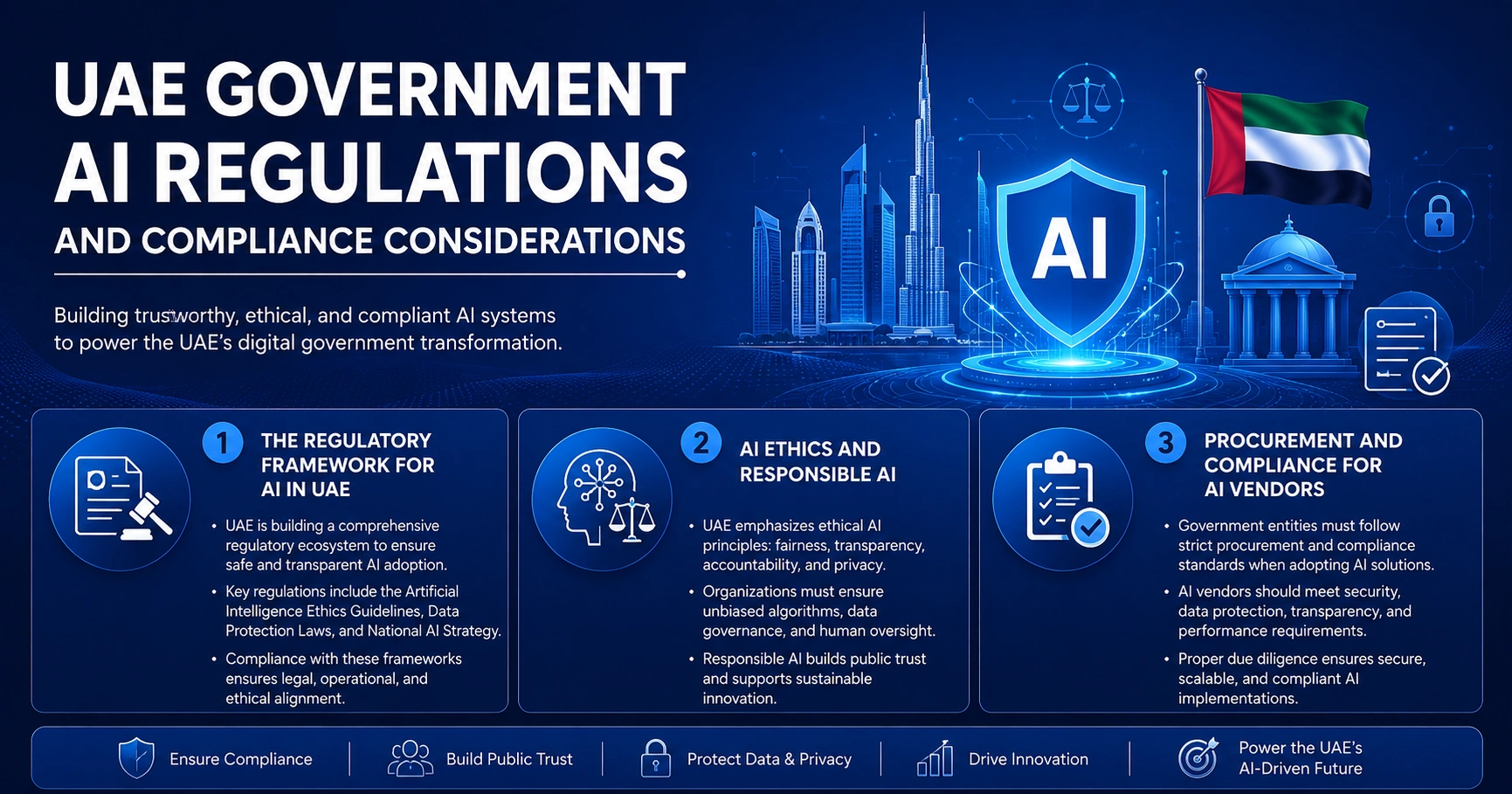
The Regulatory Framework for AI in UAE
The UAE has been deliberate about building a regulatory framework for AI that balances innovation with protection. Government entities deploying AI must navigate an evolving but increasingly structured set of requirements.
Key regulatory frameworks relevant to government AI deployment include:
UAE Personal Data Protection Law (PDPL). Enacted federally in 2021, the PDPL establishes clear requirements for how personal data is collected, processed, stored, and used — including in AI systems. Government entities must ensure that AI systems handling citizen data comply with PDPL requirements around consent, data minimisation, purpose limitation, and individual rights.
Dubai International Financial Centre (DIFC) Data Protection Law. For entities operating within DIFC, a more stringent data protection framework applies, broadly aligned with GDPR standards.
UAE Cybersecurity Law (Federal Law No. 5 of 2012, as amended). AI systems handling sensitive government data must operate within the cybersecurity framework established by UAE cybersecurity legislation and the standards issued by the UAE Cybersecurity Council.
Sector-specific regulations. Healthcare AI must comply with DHA and DoH regulations. Financial sector AI must comply with Central Bank UAE and CBUAE guidelines. AI in the legal and judicial context is subject to Ministry of Justice oversight.
AI Ethics and Responsible AI
The UAE has articulated clear principles around responsible AI through its national AI strategy, including commitments to transparency, fairness, accountability, and human oversight. Government entities deploying AI are expected to implement governance frameworks that operationalise these principles.
Practically, this means maintaining human oversight of consequential AI decisions — particularly in areas affecting individual rights — documenting AI model performance and bias monitoring, establishing clear accountability for AI system failures, and ensuring that AI decisions affecting citizens can be explained in terms that citizens can understand.
The international dimension also matters. As the UAE positions itself as a model of responsible AI governance globally, the practices established in government AI deployments today will shape the country's credibility in international AI governance discussions for years to come.
Procurement and Compliance for AI Vendors
Government AI procurement in the UAE requires vendors to meet specific standards around data localisation, security certification, and regulatory compliance. AI systems handling sensitive government data are generally required to operate on UAE-hosted infrastructure, either on government clouds or certified commercial cloud providers. Vendors must demonstrate compliance documentation and maintain it through the life of the engagement.
Understanding these requirements is essential for government technology leaders evaluating AI solutions. Engaging with AI Software Development in UAE vendors who have already navigated these compliance requirements for comparable government clients is significantly more efficient than attempting to build compliance frameworks from scratch on each new engagement.
Future of AI in UAE Government
AI Governance as a Competitive Differentiator
As AI systems take on more consequential roles in government — from influencing resource allocation to supporting judicial processes to managing critical infrastructure — the governance frameworks around these systems will become increasingly important to citizens, civil society, and international partners.
UAE government entities that invest in robust AI governance — independent auditing, bias monitoring, explainability mechanisms, and transparent public reporting on AI system performance — will earn a level of public trust that translates into political support for continued AI investment. Those that deploy AI without governance rigour risk high-profile failures that set back the entire sector.
The Five-Year Horizon
Looking ahead to 2030, several AI-driven developments will significantly reshape UAE government operations:
Autonomous AI agents will move beyond answering queries to proactively completing complex multi-step government processes on behalf of citizens and businesses — initiating licence renewals, filing regulatory reports, coordinating across multiple government entities without human mediation.
AI-driven legislation and policy modelling will become standard practice for major policy decisions, with AI systems running complex simulations of policy impacts across economic, social, and environmental dimensions before legislation is enacted.
Unified government AI infrastructure will replace the current fragmented landscape of entity-specific AI deployments, with shared AI services, common data infrastructure, and interoperable AI systems creating genuine joined-up government across federal and emirate-level entities.
Biometric and multimodal AI will transform physical government touchpoints — borders, courts, hospitals, tax offices — with seamless identity verification, AI-assisted decision support, and real-time language translation making physical interactions faster, more accurate, and more accessible.
Generative AI Will Redefine the Knowledge Work of Government
The current wave of generative AI capability is still in its early stages of adoption in government contexts. Over the next five years, its integration into the core knowledge workflows of government will deepen substantially. Many software categories that UAE government entities currently rely on — document management, business intelligence, case management, knowledge bases — will be substantially redesigned around generative AI capabilities.
The implications for AI Software Replacing Traditional Software are significant in the government context. Entities that build fluency with AI-native platforms early will be dramatically better positioned to capture the productivity benefits as the technology matures. Those that wait risk not only falling behind in efficiency but also finding that their legacy software investments become increasingly difficult to integrate with the AI-powered ecosystem that surrounds them.
The UAE's Global Leadership Ambition
The UAE's AI strategy is not merely about operational efficiency — it is about establishing the UAE as a global leader in AI governance, development, and application. The establishment of MBZUAI, the UAE's early appointment of a dedicated AI Minister, and the aggressive pursuit of AI talent and international investment reflect a national ambition to shape how AI develops globally, not merely to adopt it.
For UAE government technology leaders, this national ambition creates both resources and expectations. The resources include national AI infrastructure, research partnerships, and talent pipelines. The expectations include a genuine commitment to leading-edge AI deployment that can be showcased internationally as evidence of the UAE's AI leadership position.
How to Successfully Implement AI in Government Agencies
A Proven Implementation Framework
Successful AI implementation in government requires more than good technology. It requires a structured approach that addresses strategy, data, technology, people, and governance simultaneously.
Phase 1: Strategic Assessment and Prioritisation
Begin with a rigorous assessment of where AI can create the most value in your specific context. Not every process benefits equally from AI automation. The highest-value targets are typically high-volume, rule-based processes (strong candidates for automation), decisions that require synthesis of large datasets (strong candidates for analytics and decision support), and citizen interactions that currently require human agents for routine queries (strong candidates for conversational AI).
Prioritise use cases based on three criteria: business value (measured in cost savings, quality improvements, or citizen satisfaction gains), implementation feasibility (data availability, system integration complexity, regulatory considerations), and organisational readiness (leadership support, staff capability, change management capacity).
Phase 2: Data Foundation and Architecture
Before building AI systems, invest in the data infrastructure they require. This means auditing existing data assets, establishing data governance frameworks, building data integration capabilities, and creating the master data management foundations that ensure AI systems have clean, consistent inputs.
The AI Development Cost in Dubai for government projects is significantly influenced by the state of an organisation's existing data infrastructure. Well-structured, accessible data substantially reduces both development cost and time to value — making upfront data investment one of the highest-return actions a government entity can take before embarking on AI implementation.
Phase 3: Proof of Concept and Controlled Deployment
Start with focused proof-of-concept projects that can demonstrate value quickly while managing risk carefully. A successful POC in one department or service area builds internal confidence, demonstrates ROI to leadership, and generates learnings that inform broader deployment.
Resist the temptation to over-engineer the first deployment. A simple, well-executed AI chatbot that handles 40 percent of routine queries reliably is vastly more valuable than a sophisticated system that handles 90 percent but fails unpredictably in the remaining 10.
Phase 4: Scale and Integration
With proven use cases and a functioning data foundation, scale AI deployment systematically across departments and service areas. Focus on integration — ensuring AI systems share data appropriately, present consistent experiences to citizens, and align with the broader government digital architecture.
Phase 5: Continuous Improvement and Governance
AI systems require ongoing governance: model performance monitoring, bias detection and correction, retraining as data distributions shift, and regular review of outcomes against intended objectives. Establish dedicated AI governance functions with clear accountability and regular reporting to senior leadership.
Keeping pace with the rapid evolution of AI capabilities is itself a strategic responsibility. Monitoring developments in AI Software Development in UAE — including new model capabilities, improved Arabic language AI, and emerging government-specific AI applications — ensures that UAE government AI programmes remain current and competitive.
Choosing the Right AI Development Partner in UAE
Why Partner Selection Is the Most Important Decision You Will Make
Government AI projects fail for many reasons — but inadequate partnership is among the most common. An inexperienced vendor may deliver technically functional software that does not integrate with legacy systems, fails to meet regulatory requirements, or cannot be maintained and evolved without expensive ongoing dependency.
The right AI development partner for a UAE government entity has four essential characteristics:
Deep UAE government domain experience. They understand how UAE government entities work — the procurement processes, the regulatory requirements, the stakeholder dynamics, the Arabic language requirements, and the specific technical standards that apply to government systems.
Full-spectrum AI capability. Government AI projects rarely involve a single technology. They require combinations of machine learning, natural language processing, computer vision, predictive analytics, and generative AI — often integrated with complex legacy systems.
Compliance and security expertise. UAE government data security requirements, PDPL compliance, and sector-specific regulatory frameworks must be built into solution architecture from the beginning. Partners who treat compliance as an afterthought will create expensive problems at the worst possible time.
Long-term commitment to the UAE ecosystem. Government AI systems require ongoing maintenance, evolution, and support. A partner with a genuine long-term presence in the UAE provides the continuity and accountability that government projects demand.
What to Evaluate When Selecting an AI Partner
When assessing potential partners for a government AI engagement, evaluate against these criteria:
- Portfolio of delivered government AI projects — not just proposals or case studies from other markets
- Arabic language AI capability — essential for any citizen-facing or document processing application
- UAE data residency and security infrastructure — mandatory for sensitive government data
- Integration experience with UAE government systems — familiarity with common government platforms, ERP systems, and identity infrastructure
- Transparent pricing and engagement models — fixed-price deliverables with clear scope management for capital projects, flexible support models for ongoing operations
The AI development partner landscape in the UAE has matured considerably. Government entities now benefit from working with providers who combine local knowledge with genuine AI technical depth rather than relying on global systems integrators who lack regional context.
As an established AI software development company with deep experience in UAE government technology, we understand what it takes to deliver AI systems that meet the exacting standards of the public sector — from initial strategy through to production deployment and ongoing governance. Our government-specific methodology covers Arabic language AI, PDPL compliance architecture, legacy system integration, and change management support — the full spectrum of capabilities that distinguish successful government AI programmes from expensive pilots that never scale.
We have delivered AI solutions for government entities across Dubai, Abu Dhabi, Sharjah, and the Northern Emirates, building a track record that speaks directly to the challenges UAE public sector leaders face. Government technology leaders who work with us describe the value not just in what we build, but in the institutional knowledge we bring — knowledge about UAE procurement dynamics, regulatory navigation, and the stakeholder management that determines whether AI projects earn sustained organisational support.
Explore our portfolio as a full-service digital transformation company in Dubai to understand the breadth and depth of capabilities we bring to government AI engagements, and discover why public sector leaders across the UAE choose us as their long-term AI implementation partner.

The Engagement Model That Works for Government
Beyond technical capability, the engagement model matters enormously for government AI projects. The most successful partnerships are built on clear governance structures, milestone-based delivery with defined exit criteria, transparent reporting, and collaborative knowledge transfer that builds internal government capability alongside delivered solutions.
Avoid vendors who propose comprehensive multi-year transformation programmes with limited early deliverables. The most credible partners can demonstrate value in phases — delivering functional proof-of-concept implementations within weeks, not years — while building toward more comprehensive capabilities iteratively.
Government AI procurement increasingly favours outcome-based contracting models, where vendor payment is tied to demonstrated performance against agreed metrics. These models align vendor and government interests effectively and provide natural accountability for delivery. An experienced partner who has worked under these models brings both the confidence of past performance and the process maturity to manage outcome-based engagements successfully.
The investment in selecting the right partner is small relative to the cost and disruption of a failed or underperforming AI implementation. Take the time to evaluate thoroughly, check references rigorously, and validate technical claims through independent assessment where appropriate.
Conclusion
Artificial intelligence is not on the horizon for UAE government — it is already here, already delivering value, and already reshaping what citizens and businesses experience when they interact with public institutions across Dubai, Abu Dhabi, Sharjah, and every emirate in the federation.
The question for UAE government technology leaders is not whether to invest in AI, but how to invest well. That means building on strong data foundations, choosing the right use cases, partnering with experienced implementers, governing AI systems with rigour and transparency, and maintaining the human oversight that keeps AI in government trustworthy and accountable.
The UAE's national AI strategy, its world-class AI research infrastructure, and its proven track record of ambitious digital transformation set the context for an AI journey with genuine global significance. The government entities that move with both urgency and discipline will set the standard for what AI-enabled public service looks like — not just in the region, but worldwide.
If your organisation is evaluating AI investment, planning a specific AI implementation, or seeking to understand how generative AI can accelerate your digital transformation agenda, we welcome the conversation.
Our team operates as a trusted digital transformation company in Dubai with a singular focus on delivering measurable outcomes for UAE public sector clients. We combine strategic advisory, architecture design, and hands-on technical delivery — with the governance frameworks and compliance expertise that government AI programmes require. Whether you need a focused assessment, a proof-of-concept deployment, or a long-term AI partnership, we are ready to work with you from the first conversation through to sustained operational success.