
Run a business in Dubai, Abu Dhabi, or Sharjah for more than a year and you'll hit the same wall every growing company hits: spreadsheets stop working. Finance is in one tool, inventory in another, HR is tracked on WhatsApp and Excel, and nobody has the full picture at the same time. Meanwhile, the FTA wants clean VAT records, your bank wants audited numbers, and your customers want faster delivery than last year.
That's the exact gap ERP software in UAE is built to close. Enterprise Resource Planning brings finance, inventory, HR, procurement, and sales into one connected system, so decisions get made on real numbers instead of guesswork.
This isn't a theoretical benefit. UAE businesses operate under specific pressures — mandatory VAT reporting, an upcoming e-invoicing mandate, Emiratization quotas, multi-emirate and free-zone structures, and a labor force that speaks Arabic, English, Hindi, and Urdu on the same shop floor. Generic advice about "improving efficiency" doesn't address any of that. This guide does.
Below are 15 concrete, UAE-specific ways ERP software cuts costs, boosts productivity, and helps you scale — plus what to actually look for before you sign a contract.
What Is ERP Software, Exactly?
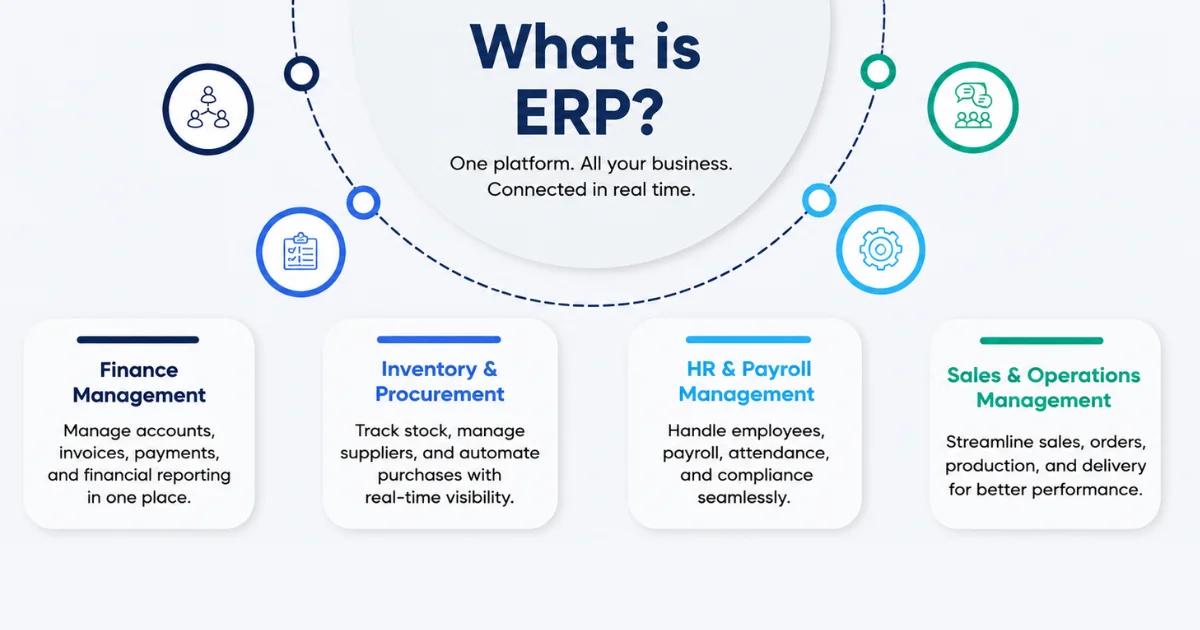
Enterprise Resource Planning (ERP) is a single software platform that connects a company's core functions — finance, inventory, procurement, HR, sales, and manufacturing — into one shared database. Instead of five disconnected tools each holding a partial version of the truth, everyone works off the same live numbers. For a UAE business, that means your Dubai showroom, Abu Dhabi warehouse, and Sharjah factory can all report into one system in real time.
Now let's get into the 15 ways this actually pays off.
1. It Centralizes Data Across Every Department
Right now, your sales team probably has one number for stock on hand, your warehouse has another, and finance has a third—all pulled at different times, all slightly wrong. An ERP system in UAE businesses run on eliminates that by keeping one single source of truth.
When a sales rep in Dubai closes a deal, the same system that logged the sale updates inventory, triggers procurement if stock is low, and feeds the number straight into your P&L. No re-entry, no reconciliation meetings, no "let me check with warehouse and get back to you." Companies running fragmented systems typically spend 5-10 hours a week per department just cross-checking numbers between tools. That's time an ERP gives back immediately.
2. It Automates VAT and FTA Compliance
This is the one that matters most right now. The UAE's phased e-invoicing mandate is rolling out, with Peppol-based real-time reporting to the Federal Tax Authority becoming mandatory for large taxpayers first and expanding from there. Businesses still generating invoices manually in Excel are going to struggle to keep up.
ERP software in UAE built for local compliance auto-generates VAT-compliant invoices, applies the correct tax treatment across mainland, free zone, and designated zone transactions, and produces FTA-ready VAT return reports in a few clicks instead of a few days. Get this wrong and you're not just inefficient — you're exposed to penalties. Get it right and VAT season stops being a fire drill.
3. It Cuts Manual Data Entry and Human Error
Every manual entry point is a chance for a typo, a missed decimal, or a duplicated invoice. A mid-sized trading company processing 200 invoices a month with manual entry will typically see error rates high enough to cause real reconciliation headaches every quarter.
ERP systems auto-populate data across modules. Enter a purchase order once, and it flows through receiving, accounts payable, and inventory without anyone retyping it. Fewer touchpoints means fewer mistakes — and fewer mistakes means less time spent hunting down where a number went wrong.
4. It Gives You Real-Time Inventory and Supply Chain Visibility
Dubai's position as a re-export and logistics hub means many businesses here are juggling stock across ports, free zones, and multiple warehouses simultaneously. Without a connected system, that visibility gap causes two expensive problems: overstocking (cash tied up in slow-moving goods) and stockouts (lost sales because nobody saw the shortage coming).
A properly configured ERP solutions UAE companies rely on tracks stock levels, reorder points, and supplier lead times in real time across every location. Retailers and distributors running this well report meaningfully leaner inventory holding while cutting stockout-driven lost sales.
5. It Streamlines Multi-Branch, Multi-Emirate Operations
Very few UAE companies operate out of a single location for long. You open in Dubai, then add a branch in Abu Dhabi, then a free-zone entity for export, then a warehouse in Sharjah for cheaper storage. Each of those used to mean a separate set of books, a separate inventory count, and a separate headache at month-end.
Dubai ERP platforms built for multi-entity operations consolidate all of that into one dashboard, while still letting each branch or entity keep its own records for local reporting and audit purposes. You get the full group picture and the entity-level detail, without duplicating work.
6. It Delivers Real-Time Financial Reporting and Forecasting
Waiting until month-end to find out your margins slipped is waiting a month too long. ERP systems generate live P&L statements, cash flow reports, and balance sheets pulled directly from operational data — not from someone manually exporting numbers into a spreadsheet three weeks after the fact.
For UAE businesses managing multi-currency trade (AED, USD, and often EUR or INR in the same books), this also means automatic exchange rate handling and consolidated reporting without a finance team manually converting every line. That's the difference between reacting to last quarter's problem and catching this week's.
7. It Automates Payroll, WPS, and Emiratization Reporting
Payroll in the UAE isn't just "pay people on time." It's Wage Protection System (WPS) compliance, gratuity calculations that change with tenure, visa and labor card tracking, and — for many sectors — Emiratization quota reporting to MOHRE.
A UAE-configured enterprise resource planning UAE payroll module handles all of it: automated WPS file generation, end-of-service gratuity calculated per UAE labor law, and Emiratization percentage tracking so you know exactly where you stand before an audit, not after a fine.

8. It Supports Multi-Currency and Multi-Language Operations
The UAE trades with practically everyone. Your suppliers might invoice in USD, your local sales are in AED, and your workforce reads instructions in Arabic, English, and sometimes Hindi or Urdu on the factory floor. A system built for a single-currency, single-language market simply doesn't work here.
Modern ERP software UAE vendors ship supports live exchange rate conversion, dual-language interfaces (Arabic and English at minimum), and multi-currency financial consolidation — so a Dubai-based distributor buying from China and selling to Saudi Arabia can run all of it through one clean set of books.
9. It Speeds Up Decision-Making With Live Dashboards
A CEO who has to ask three department heads for numbers before making a call is a CEO making decisions a week too late. ERP dashboards put sales trends, cash position, inventory turnover, and production output on one screen, updated as transactions happen.
This matters more in fast-moving markets like retail and F&B, where a stockout or a slow-moving SKU needs a same-day decision, not a next-Monday one. Owners running ERP-backed dashboards consistently report shorter decision cycles simply because they stop waiting on reports to be compiled.
10. It Lowers IT Overhead With Cloud Deployment
On-premise servers mean hardware costs, IT staff to maintain them, and a single point of failure if something goes down. The cloud-based ERP system Dubai businesses are increasingly adopting shifts that cost from a large upfront investment to a predictable monthly subscription, with the vendor handling servers, security patches, and uptime.
For SMEs especially, this removes a large upfront capital cost and replaces it with an operating expense that scales with usage. You're not buying a server room; you're buying access to one that someone else maintains better than you could in-house.
11. It Strengthens Customer Relationship Management
Sales and service data living in a separate CRM from your finance and delivery data means your sales team promises delivery dates your warehouse can't hit, and your support team has no idea a customer's invoice is overdue when they call in with a complaint.
An ERP with an integrated CRM module gives every customer-facing team the same live view: order status, payment history, delivery timelines, and support tickets in one place. That consistency is what turns a one-time buyer into a repeat one — because nothing frustrates a customer faster than getting a different answer from two people at the same company.
12. It Modernizes HR From Hiring to Retirement
HR in a growing UAE company covers a lot: recruitment, onboarding, visa processing, leave management, performance reviews, and eventually end-of-service settlement. Doing this across spreadsheets and email threads doesn't scale past a certain headcount.
ERP HR modules manage the full employee lifecycle in one place — automated leave balances, performance tracking tied to KPIs, and gratuity calculations that update automatically as tenure grows. For a company hiring 20-30 people a year, that's the difference between an HR team drowning in admin and one that actually has time for talent development.
13. It Scales With You Instead of Holding You Back
The trap with cheap, rigid software is that it works fine at 10 employees and completely breaks at 100. Modular ERP architecture means you start with finance and inventory, then add HR, manufacturing, or a CRM module as you actually need them — without ripping out and replacing your core system.
This modularity is exactly why so many UAE SMEs work with a Custom Software Development Company in Dubai to configure ERP around their specific growth plan rather than forcing their operations into a rigid, one-size-fits-all package built for a different market.
14. It Strengthens Data Security and Audit Readiness
Financial audits, VAT audits, and increasingly cybersecurity due diligence from banks and investors all require clean, traceable records. A spreadsheet doesn't have an audit trail. An ERP system logs every transaction, every edit, and every user who touched a record, with role-based access so your junior accountant can't approve their own expense claims.
For businesses working with software development firms in uae to build or customize ERP, security architecture — encryption, role-based permissions, regular backups — should be a baseline requirement, not an add-on you negotiate later.
15. It Integrates AI for Predictive, Not Just Historical, Insights
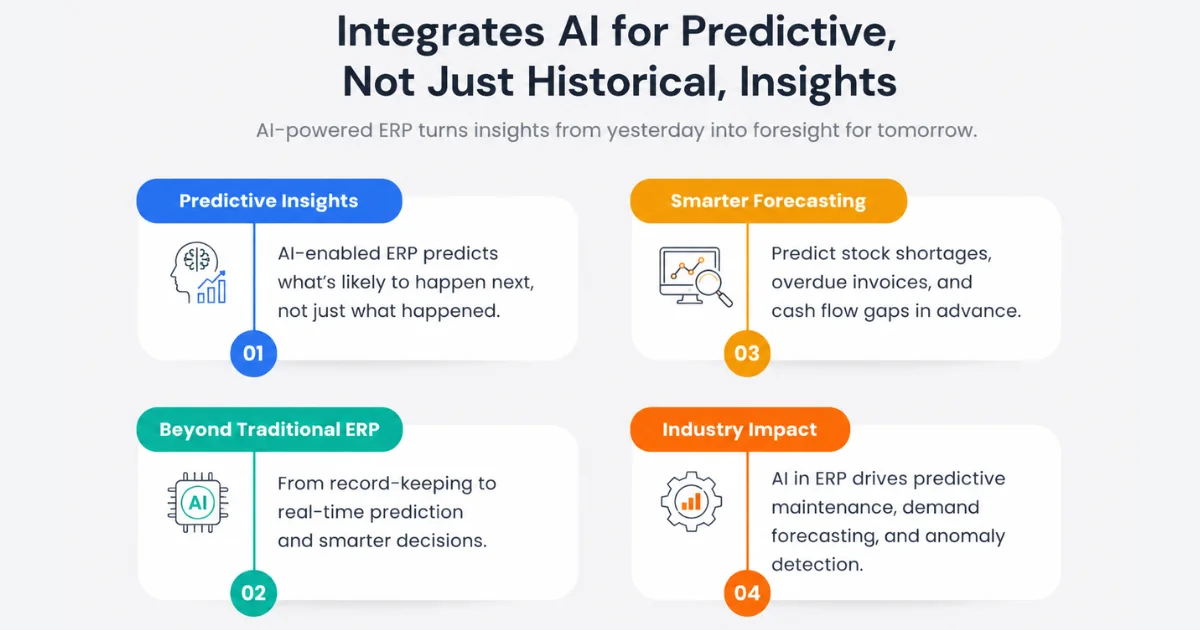
This is where ERP is heading fastest. Static reporting tells you what happened last month. AI-enabled ERP tells you what's likely to happen next month — predicting stock shortages before they hit, flagging invoices likely to go overdue, and forecasting cash flow gaps weeks in advance.
This shift is part of a broader pattern: AI Software Is Replacing Traditional Software Across Industries, and ERP is one of the clearest examples. Businesses investing in AI Software Development in UAE are building predictive maintenance into manufacturing ERP modules, demand forecasting into retail inventory, and anomaly detection into finance — turning the ERP from a record-keeper into a forecasting tool.
Key Features to Check Before You Buy
Not all ERP platforms marketed toward the region are actually built for it. A lot of "global" ERP software gets a light Arabic translation slapped on and is sold as UAE-ready when it isn't. Before you sign anything, run the platform against this checklist:
|
Feature |
Why it matters in the UAE |
Red flag to watch for |
|
FTA-compliant VAT engine |
Wrong tax treatment on free-zone vs. mainland transactions creates audit risk |
Vendor says VAT is "configurable" but has no UAE reference clients |
|
E-invoicing readiness |
Peppol-based reporting is rolling out in phases |
No public roadmap for e-invoicing support |
|
WPS payroll file generation |
Mandatory for salary processing compliance |
Payroll module built for a different country's labor law |
|
Bilingual Arabic/English UI |
Shop-floor and back-office staff often read different languages |
Arabic support limited to invoice templates only |
|
Multi-currency consolidation |
Trade with China, India, Europe, and GCC neighbors in different currencies |
Manual exchange rate entry required |
|
Free-zone and mainland entity support |
Many UAE groups run both structures simultaneously |
System treats all entities identically |
|
Local data hosting or UAE-compliant cloud region |
Data residency expectations for regulated sectors |
Vendor can't confirm where data physically sits |
|
Modular pricing |
Lets you start small and add HR, manufacturing, or CRM later |
All-or-nothing licensing forces you to pay for unused modules |
If a vendor can't answer these clearly in the first sales call, that's usually a sign they're selling a generic product with a UAE label on it, not a system actually built for how business gets done here.
How Much Does ERP Implementation Cost in the UAE?
Cost depends heavily on whether you go with an off-the-shelf platform or a custom build. Off-the-shelf cloud ERP for a small business typically starts in the low tens of thousands of AED annually, scaling with users and modules. Custom-built ERP, tailored to a specific industry workflow, costs more upfront but avoids the ongoing cost of forcing your business to work around software limitations.
If you're comparing options, it's worth reviewing the Average Software Development Cost in 2026 and, if AI features are on your roadmap, the AI Development Cost in Dubai — both will shape whether off-the-shelf or custom makes more financial sense for your specific case.
Choosing Between Off-the-Shelf and Custom ERP
Not every business needs a custom build, and not every business should settle for a generic one either.
Off-the-shelf ERP software Dubai vendors sell works well when your processes are fairly standard — a typical trading or retail business with common workflows can usually get running fast on a pre-built platform with minor configuration.
Custom ERP makes more sense when your workflow doesn't fit a template — a manufacturer with a unique production sequence, a logistics company with non-standard routing rules, or a healthcare provider needing specific compliance tracking. In these cases, working with established Software Companies in Dubai to build around your exact process usually costs less over three years than paying for endless customization of a rigid off-the-shelf tool.
Which UAE Industries Benefit Most From ERP?
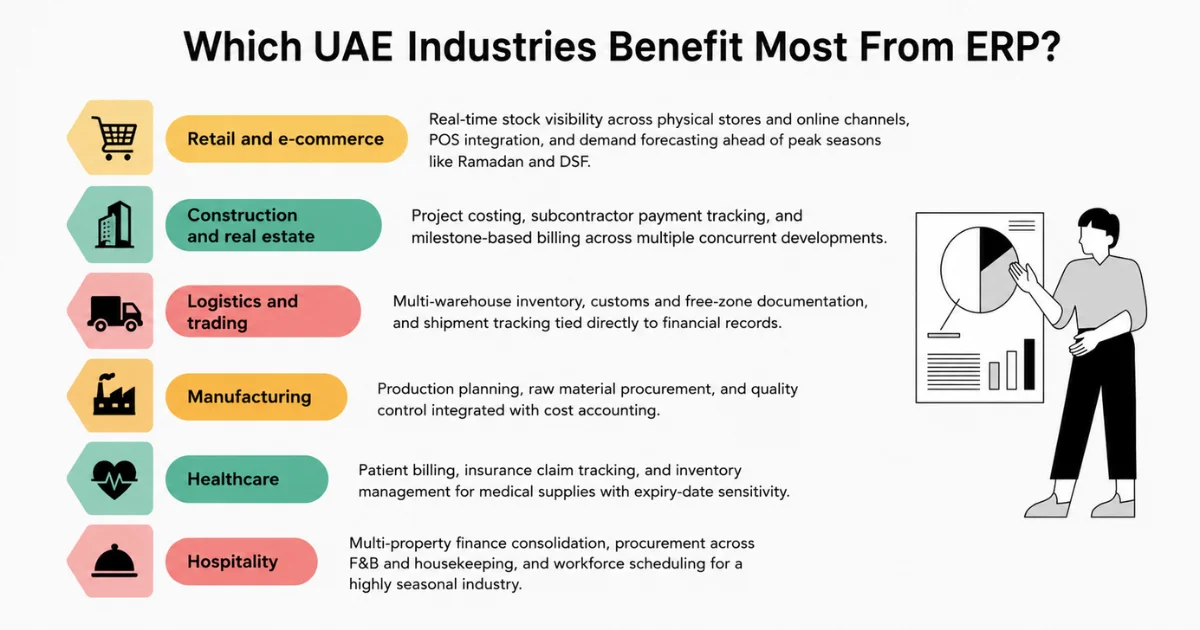
- Retail and e-commerce — real-time stock visibility across physical stores and online channels, POS integration, and demand forecasting ahead of peak seasons like Ramadan and DSF.
- Construction and real estate — project costing, subcontractor payment tracking, and milestone-based billing across multiple concurrent developments.
- Logistics and trading — multi-warehouse inventory, customs and free-zone documentation, and shipment tracking tied directly to financial records.
- Manufacturing — production planning, raw material procurement, and quality control integrated with cost accounting.
- Healthcare — patient billing, insurance claim tracking, and inventory management for medical supplies with expiry-date sensitivity.
- Hospitality — multi-property finance consolidation, procurement across F&B and housekeeping, and workforce scheduling for a highly seasonal industry.
A Realistic Implementation Timeline
Businesses often underestimate how long ERP rollout takes, then get frustrated when week four looks nothing like the finished product. A realistic phased timeline looks something like this:
- Weeks 1-2: Discovery and process mapping. The vendor documents how your finance, inventory, and HR processes actually work today — not how the org chart says they work.
- Weeks 3-6: Configuration and data migration. Chart of accounts, VAT setup, inventory items, and employee records get built out and historical data gets migrated in.
- Weeks 7-9: Testing and parallel run. Your team runs the new system alongside the old one for a cycle or two, catching gaps before full cutover.
- Weeks 10-12: Go-live and stabilization. Full cutover, with the vendor on standby for the first few close cycles while your team adjusts.
Custom builds with heavy industry-specific workflows — manufacturing production sequences, construction milestone billing — extend this to three to six months. Rushing this process to save a few weeks is the single most common reason ERP rollouts fail; a company that skips proper data migration and testing usually spends the following six months fixing errors that a two-week testing phase would have caught.
Signs Your Business Needs ERP Now
If more than two or three of these sound familiar, it's a strong signal you're past the point where spreadsheets and disconnected tools are enough:
- Month-end closing takes more than a week because someone's manually reconciling numbers between systems.
- You've had a stockout or an overstocking problem in the last quarter that a live inventory view would have caught.
- VAT filing involves someone manually pulling data from three different places.
- You can't get a same-day answer to "what's our cash position right now?"
- You're opening a second location and dreading how you'll keep the books in sync.
- Payroll or WPS processing takes your HR team more than a day each month.
Getting Started: What to Look for in an ERP Partner
Before signing with any vendor, confirm three things. First, does the platform natively support UAE VAT and the upcoming e-invoicing requirements, or will you need a separate compliance layer bolted on? Second, does it handle Arabic-English bilingual operation out of the box? Third, can it scale with modules as you grow, instead of forcing a full migration in two years?
Talk to a few software development firms in uae before committing. Ask for references from businesses in your specific sector, not just a generic client list — an ERP that works beautifully for a retail chain may be the wrong fit for a construction firm's project-based billing needs.
The Real Question Isn't Whether You Need ERP
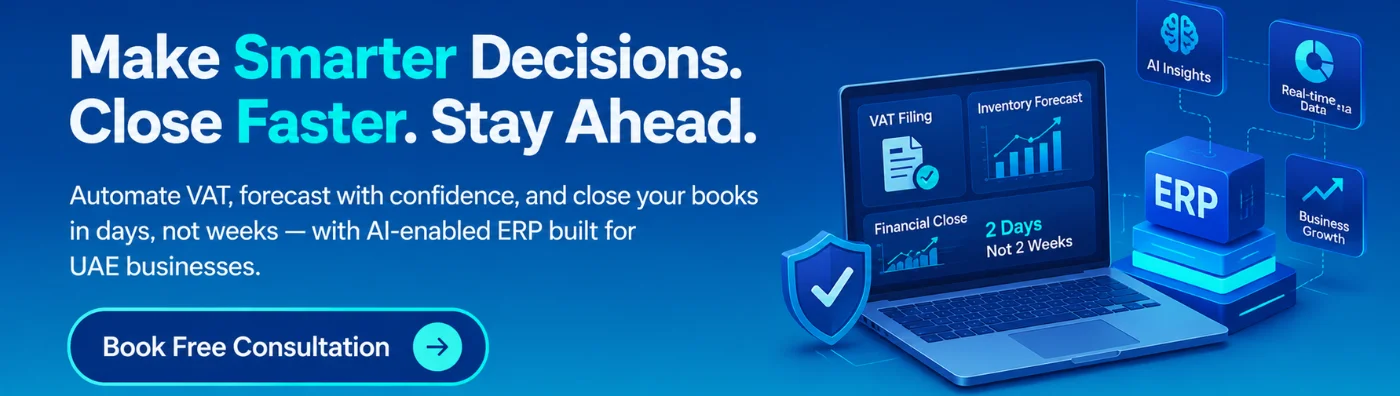
It's whether you can afford to keep running without it while competitors automate their VAT filings, forecast their inventory, and close their books in two days instead of two weeks. UAE's market moves fast, and the businesses pulling ahead right now aren't necessarily the ones with the biggest budgets — they're the ones with the clearest, fastest access to their own numbers.
If you're weighing an off-the-shelf platform against a custom build, or want to understand what AI-enabled ERP could realistically do for your specific operation, talk to a team that builds ERP systems for UAE businesses day in and day out. Get the scoping conversation right, and the rest of the implementation gets a lot easier.