
Government leaders across the Gulf are watching the UAE's U-Ask platform redefine what citizens expect from digital services. This guide breaks down exactly how to build a comparable government AI chatbot—the features that matter, the technology stack required, realistic development costs, and the security standards public sector projects demand. Whether you're scoping a department pilot or a national-scale rollout, you'll find practical benchmarks to inform your roadmap, budget, and vendor decisions. By the end, you'll understand what separates a polished prototype from a production-grade citizen service platform.
What Is U-Ask and Why Is It a Benchmark for Government AI?
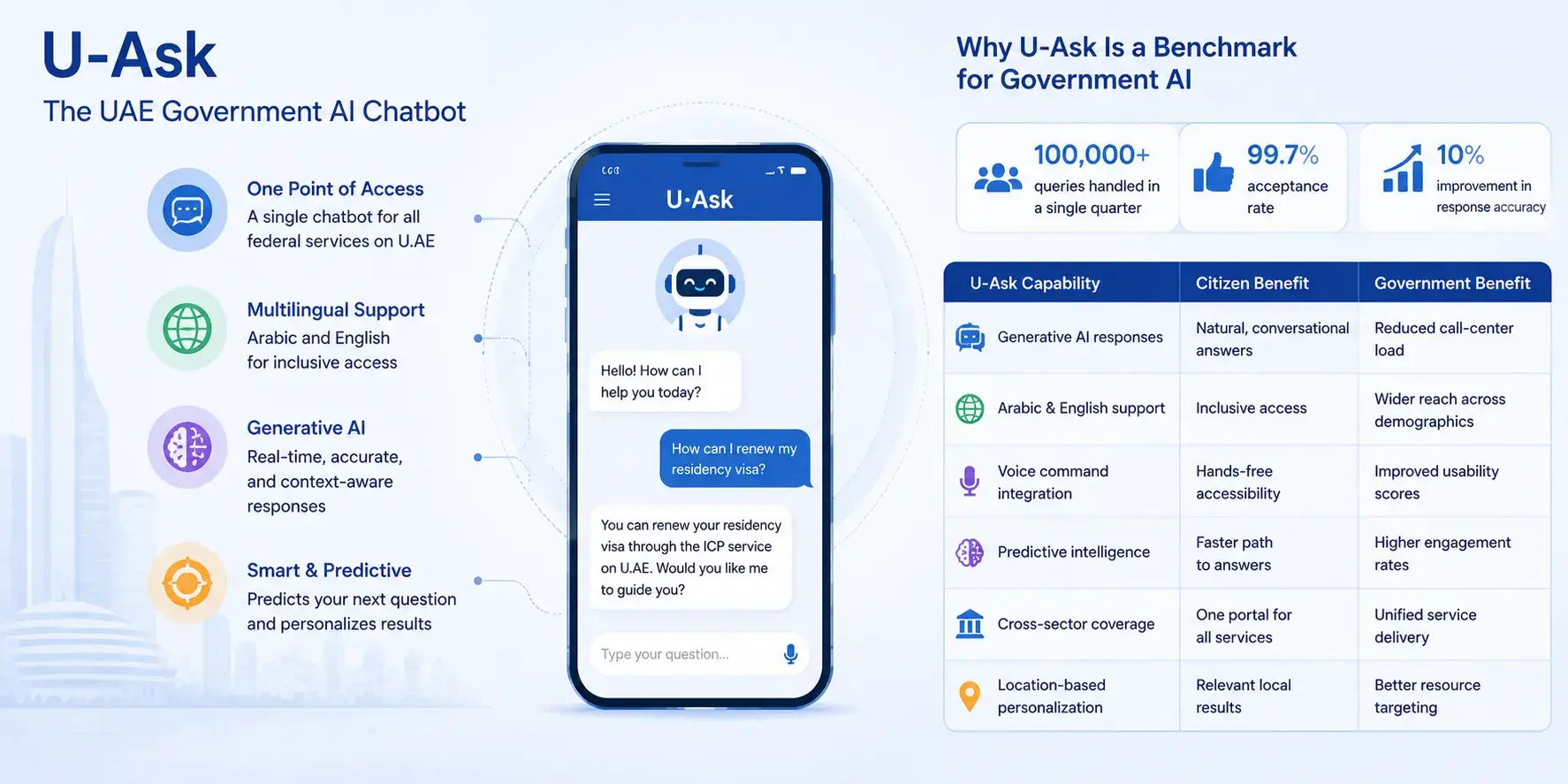
U-Ask is the UAE government's unified, AI-powered chatbot that gives residents, businesses, and visitors a single point of access to federal services. Launched in 2023 and integrated into the U.AE national portal, it uses generative AI to deliver real-time, multilingual answers across health, education, social development, labor, and other sectors.
What makes U-Ask a regional benchmark is its measurable performance. According to the OECD Observatory of Public Sector Innovation, U-Ask handled more than 100,000 queries in a single quarter with a 99.7% acceptance rate and a 10% improvement in response accuracy after adopting generative AI. The platform evolved from a basic rule-based chatbot in 2018 to a context-aware generative system, adding voice commands, location-based personalization, and predictive intelligence that recommends a user's likely next question.
For decision-makers evaluating AI for UAE Government initiatives, U-Ask demonstrates how a well-architected chatbot can consolidate fragmented services into one accessible interface. It directly supports the "We the UAE 2031" vision and shows that citizen-facing AI can scale across an entire federal ecosystem.
|
U-Ask Capability |
Citizen Benefit |
Government Benefit |
|
Generative AI responses |
Natural, conversational answers |
Reduced call-center load |
|
Arabic & English support |
Inclusive access |
Wider reach across demographics |
|
Voice command integration |
Hands-free accessibility |
Improved usability scores |
|
Predictive intelligence |
Faster path to answers |
Higher engagement rates |
|
Cross-sector coverage |
One portal for all services |
Unified service delivery |
|
Location-based personalization |
Relevant local results |
Better resource targeting |
Why Governments Are Investing in AI Chatbots
Governments are investing in AI chatbots because citizen expectations now mirror the private sector's always-on, instant-response standard. A chatbot delivers 24/7 service without proportional staffing costs, which is why the public sector has become a major adopter of conversational AI.
The market signals are clear. According to Precedence Research, the global citizen services AI market reached $13.65 billion in 2024 and is projected to hit $473.25 billion by 2034. This growth reflects a structural shift in how administrations approach service delivery, not a passing trend.
The core drivers behind government investment in AI in Citizen Services include:
- Operational efficiency: Automating high-volume, repetitive queries frees staff for complex casework.
- Citizen satisfaction: Instant, accurate answers reduce frustration and build trust.
- Service accessibility: Multilingual and voice-enabled bots reach underserved populations.
- Cost optimization: Each automated interaction lowers the marginal cost of service.
- Digital transformation: Chatbots become the front door to broader e-government modernization.
The UAE's approach is instructive. Its national UAE Government AI Strategy treats AI as foundational infrastructure rather than an experiment, setting eight strategic objectives that position the country as a global AI destination and a fast adopter across government.
Essential Features of an AI Chatbot Like U-Ask
A government chatbot comparable to U-Ask depends on a layered set of features, not a single language model. The combination of natural language understanding, secure retrieval, and human oversight is what makes the system reliable enough for public service.
The essential features include:
- Natural language processing (NLP): Interprets intent across varied phrasing and dialects.
- Large language models (LLMs): Generate fluent, context-aware responses.
- Retrieval-augmented generation (RAG): Grounds answers in verified government data to prevent fabrication.
- Multilingual support: Serves diverse populations, starting with Arabic and English.
- Voice AI: Enables hands-free and accessibility-focused interaction.
- Knowledge base management: Keeps service information current and accurate.
- Authentication: Verifies identity for personalized or sensitive requests.
- API integration: Connects to live government systems for real-time data.
- Analytics dashboard: Tracks usage, accuracy, and citizen satisfaction.
- Human handoff: Escalates complex cases to live agents.
- Audit logging: Records interactions for compliance and accountability.
- Feedback collection: Captures user input to drive continuous improvement.
|
Feature |
Priority |
Why It Matters |
|
RAG knowledge grounding |
Critical |
Prevents inaccurate or fabricated answers |
|
Identity authentication |
Critical |
Protects sensitive citizen data |
|
Multilingual support |
High |
Ensures inclusive access |
|
Human handoff |
High |
Maintains trust on complex issues |
|
Voice AI |
Medium |
Expands accessibility |
|
Predictive suggestions |
Medium |
Improves user experience |
Technology Stack Required to Build a Government AI Chatbot
The technology stack for a U-Ask-class chatbot combines a conversational front end, a secure back end, an LLM layer, and the supporting infrastructure for retrieval, monitoring, and identity. Each layer must meet government-grade reliability and security standards.
|
Layer |
Typical Technologies |
Purpose |
|
Frontend |
React, Angular, web/mobile widgets |
Citizen-facing interface |
|
Backend |
Node.js, Python, .NET |
Business logic and orchestration |
|
LLM layer |
GPT-class, Azure OpenAI, open-source models |
Response generation |
|
Vector database |
Pinecone, Milvus, pgvector |
Powers RAG retrieval |
|
Cloud |
Azure, AWS, government cloud |
Scalable hosting |
|
Security |
Encryption, WAF, zero trust |
Data and access protection |
|
Identity management |
OAuth, SSO, national ID integration |
Secure authentication |
|
API gateway |
Kong, Azure API Management |
Controlled system access |
|
Monitoring |
Application Performance Monitoring |
Accuracy and uptime tracking |
The right stack depends on existing IT Solutions for Government already in place. Reusing established cloud agreements, identity providers, and API standards reduces both cost and integration risk.
Government System Integrations That Make a Chatbot Useful
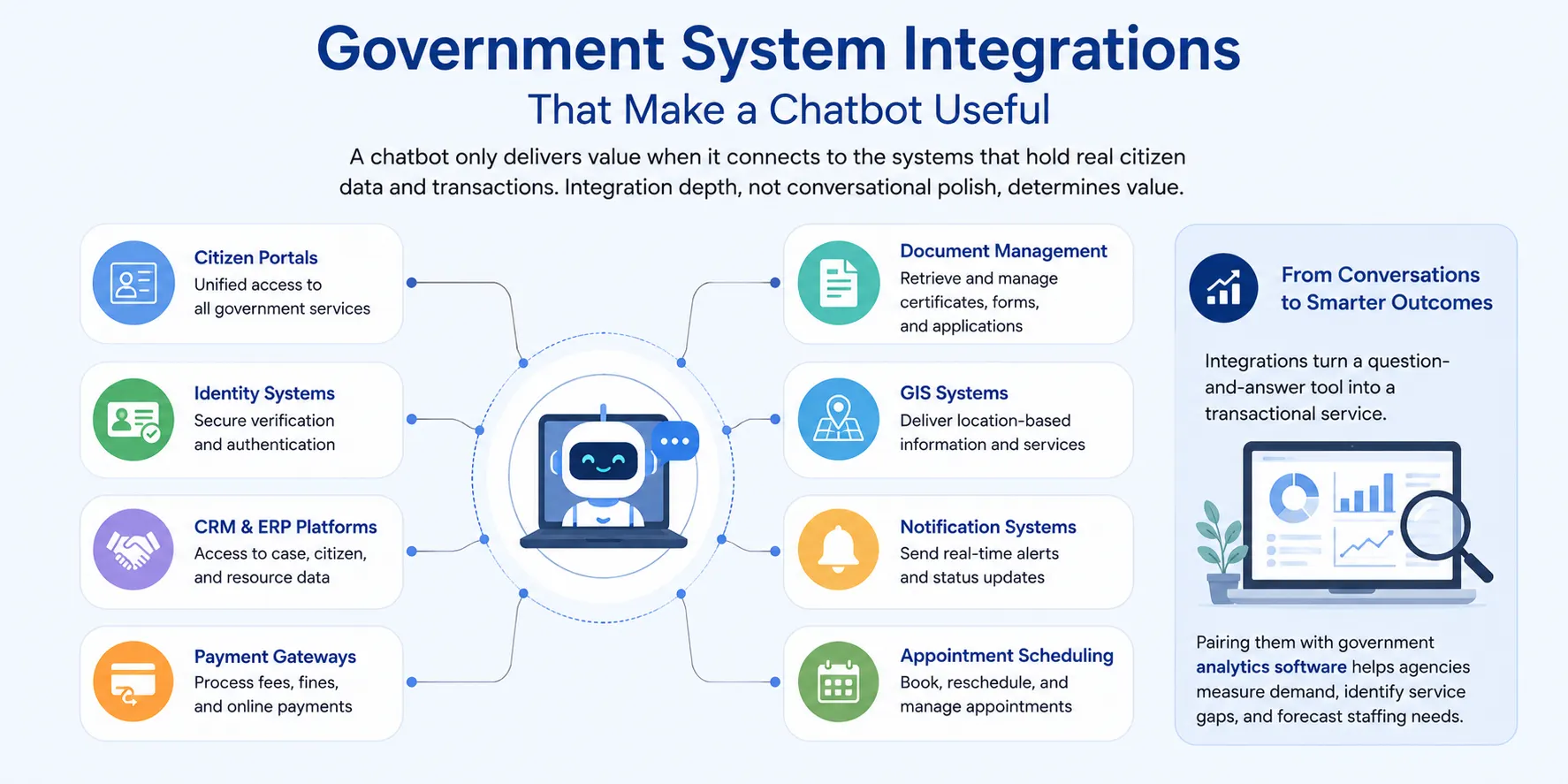
A chatbot only delivers value when it connects to the systems that hold real citizen data and transactions. Integration depth, not conversational polish, determines whether a bot can actually complete tasks.
Priority integrations for a government chatbot include:
- Citizen portals for unified service access
- Identity systems for secure verification
- CRM and ERP platforms for case and resource data
- Payment gateways for fees and fines
- Document management for certificates and applications
- GIS systems for location-based services
- Notification systems for status updates
- Appointment scheduling for in-person services
These integrations turn a question-and-answer tool into a transactional service. Pairing them with government analytics software also lets agencies measure demand, identify service gaps, and forecast staffing needs.
The Government AI Chatbot Development Process
Building a government chatbot follows a structured lifecycle that prioritizes accuracy, security, and citizen trust at every stage. Rushing discovery or testing is the most common cause of failed public sector AI projects.
|
Phase |
Activities |
Estimated Timeline |
|
Planning & discovery |
Requirements, stakeholder alignment |
3–6 weeks |
|
Conversation design |
Intents, flows, tone, escalation rules |
3–5 weeks |
|
Knowledge engineering |
Data ingestion, RAG setup |
4–8 weeks |
|
AI development |
LLM integration, APIs, security |
8–16 weeks |
|
Testing & QA |
Accuracy, bias, security testing |
4–8 weeks |
|
Deployment |
Phased rollout, monitoring |
2–4 weeks |
|
Optimization |
Tuning based on real usage |
Ongoing |
The optimization phase never truly ends. U-Ask's own gains in accuracy came from continuous user behavior analysis after launch, reinforcing that a government chatbot is a living service rather than a one-time build.
How Much Does It Cost to Build an AI Chatbot Like U-Ask?
The cost to build a government AI chatbot ranges from roughly $15,000 for a prototype to $5 million or more for a national-scale platform. The primary cost drivers are integration complexity, security requirements, language coverage, and the level of ongoing support.
|
Scope |
Description |
Estimated Cost |
|
Prototype |
Single use case, limited data |
$15,000–$40,000 |
|
MVP |
Core features, one or two integrations |
$50,000–$150,000 |
|
Department-level |
Multiple integrations, security hardening |
$150,000–$400,000 |
|
Enterprise |
Many systems, advanced AI, compliance |
$400,000–$1,000,000+ |
|
National scale |
Cross-sector, multilingual, high availability |
$1,000,000–$5,000,000+ |
These figures align with broader market benchmarks. Industry analyses place production-ready AI chatbots in the $15,000–$45,000 range for narrow scopes, while mid-market government solutions run $25,000–$100,000 annually, and large platforms reach far higher once integration and compliance are included.
Total cost of ownership also extends beyond the initial build. For an accurate picture of AI Development Cost in Dubai, factor in cloud hosting, model usage fees, maintenance, and continuous improvement—often 20–30% of the build cost per year.
Security and Compliance for Government AI
Security and compliance are the foundation of any government AI chatbot, not an afterthought. Citizen data, identity verification, and public accountability demand controls that exceed typical commercial standards.
A government-grade security checklist should include:
|
Control |
Requirement |
|
Encryption |
Data encrypted in transit and at rest |
|
Identity management |
Strong authentication and SSO |
|
Role-based access control |
Least-privilege access for staff |
|
Audit logging |
Full, tamper-resistant interaction records |
|
Zero trust architecture |
Verify every request continuously |
|
Data residency |
Data stored within national borders |
|
Certifications |
ISO 27001, SOC 2 alignment |
|
Hosting model |
Government, private, or hybrid cloud |
|
AI governance |
Bias monitoring, responsible AI policy |
Responsible AI deserves equal attention. RAG grounding, human oversight, and transparent escalation paths reduce hallucination risk and keep citizens informed when they are interacting with automation versus a person.
Security is where government AI projects succeed or fail. SISGAIN designs secure, compliant architectures built for public sector scrutiny. Speak with our team about secure AI implementation.
Common Challenges and How to Solve Them
Government AI projects face predictable obstacles, and each has a proven mitigation. Anticipating these issues during planning prevents costly rework later.
- Legacy systems: Use API gateways and middleware to bridge old and new platforms.
- Data quality: Invest in knowledge engineering and structured data cleanup before launch.
- Language support: Build multilingual capability into the architecture from the start.
- Policy changes: Maintain a flexible knowledge base that updates without redeployment.
- AI hallucinations: Ground responses with RAG and enforce human handoff for edge cases.
- Cybersecurity threats: Apply zero trust, continuous monitoring, and regular audits.
- Budget constraints: Start with a focused MVP and scale based on measured value.
- User adoption: Promote the service and design for the simplest possible experience.
Future Trends in Government AI
The next phase of government AI moves from answering questions to completing tasks autonomously. Agencies that prepare their architecture now will adapt faster as these capabilities mature.
Key trends shaping the next five years include:
- Agentic AI: Autonomous agents that complete multi-step processes on a citizen's behalf.
- Predictive government: Proactive services that anticipate needs before citizens ask.
- Advanced voice AI: Natural, real-time voice interaction across channels.
- Hyper-personalization: Tailored services based on context and history.
- Digital twins: Simulated models for testing policy and service changes.
To prepare, governments should prioritize modular architecture, clean data foundations, and strong AI governance—decisions that determine how easily new capabilities can be adopted later.
Choosing the Right AI Development Partner
The right development partner is the single biggest predictor of a government AI project's success. Technical skill is necessary but not sufficient; public sector experience and security maturity are equally critical.
|
Evaluation Criteria |
What to Look For |
|
Technical capability |
Proven LLM, RAG, and integration expertise |
|
Government experience |
Track record with public sector projects |
|
Security expertise |
Compliance, encryption, zero trust |
|
Cloud capability |
Government and hybrid cloud delivery |
|
AI governance |
Responsible AI and bias controls |
|
Scalability |
Architecture that grows with demand |
|
Long-term support |
Maintenance and continuous optimization |
When comparing AI solution providers in Dubai, weight long-term support and security as heavily as upfront cost. A lower bid that lacks compliance depth often becomes the most expensive option over time.
Why Choose SISGAIN as Your Government AI Partner
SISGAIN is a global AI and software development company that helps enterprises and public sector organizations accelerate growth through AI, cloud, cybersecurity, and IT infrastructure. For government chatbot initiatives, SISGAIN combines enterprise architecture, secure cloud delivery, and applied AI to move projects from concept to production responsibly.
SISGAIN's strengths align directly with what government AI projects require:
- Enterprise architecture for complex, multi-system environments
- Custom AI development including LLM and RAG implementation
- Security-first design built for public sector compliance
- Cloud capability across government and hybrid models
- Scalable solutions that grow from pilot to national scale
- Long-term support for maintenance and optimization
This blend of disciplines positions SISGAIN to deliver citizen-facing AI that is accurate, secure, and built to last.
Building Government AI That Citizens Trust
A chatbot like U-Ask is the visible result of disciplined architecture, secure integration, and continuous optimization working together. The lesson for public sector leaders is that success comes from treating AI as core infrastructure—grounded in clean data, protected by strong security, and supported well beyond launch. Start with a focused use case, prove measurable value, and scale with a partner who understands both the technology and the stakes of public service.