
Quick Answer
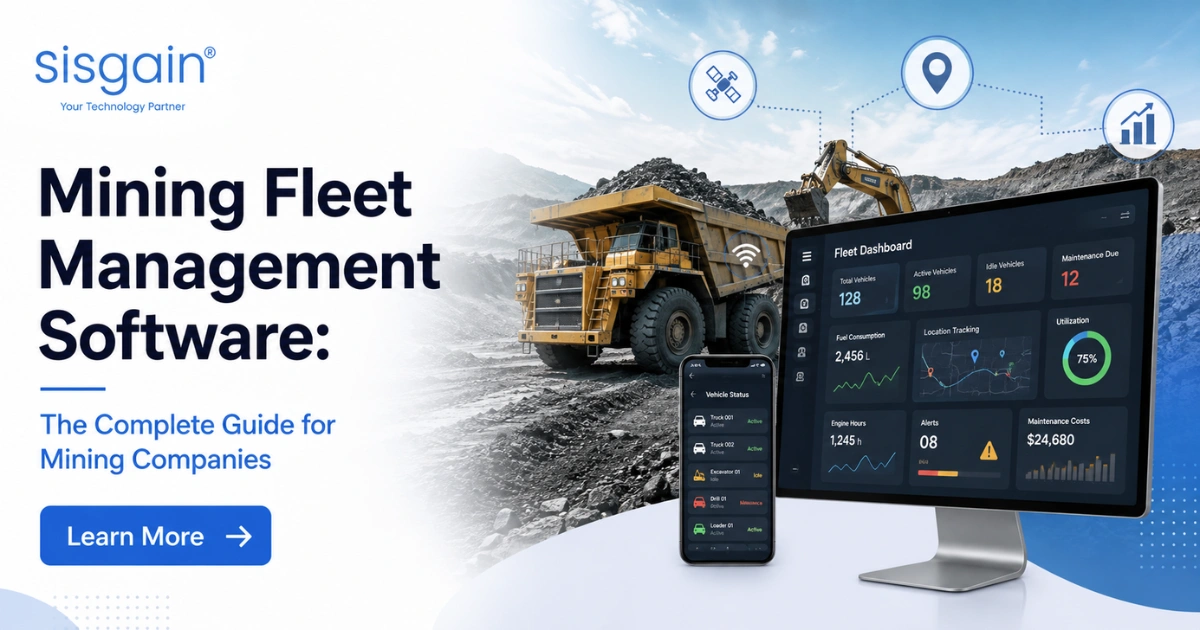
Mining fleet management software is a digital platform that collects real-time data from mining equipment, operators, and site infrastructure to optimize dispatch, equipment utilization, cycle times, production, fuel consumption, maintenance, and safety. It's the operational nervous system that turns scattered machine data into decisions a dispatcher, supervisor, or maintenance planner can actually act on.
A Mine Doesn't Lose Money Only When Equipment Breaks
Ask any operations manager where their production actually goes, and equipment failure is rarely the full answer. It's the truck sitting in a queue at the crusher for eleven minutes it shouldn't need to sit for. It's a shovel that's technically "available" but idle because dispatch assigned it the wrong sequence of trucks. It's fuel burned during unnecessary idling, a maintenance team that finds out about a failing component only after it fails, and three different systems reporting three different numbers for the same shift.
None of that shows up as a single, obvious event. It shows up as a slow bleed in tonnes per hour and cost per tonne — and it's exactly the gap that mining fleet management software is built to close.
A fleet management system (FMS) connects equipment, operators, dispatchers, maintenance teams, and mine infrastructure into one operational picture. It's not a nice-to-have dashboard bolted onto existing workflows. Done properly, it becomes the layer that decides which truck goes where, which machine needs attention before it fails, and where the next hour of lost production is about to happen.
One distinction matters more than any other in this guide:
Mining fleet management software is not simply a GPS tracking platform. It's a mining-specific operational system designed to monitor, coordinate, and optimize mobile equipment, production workflows, dispatch decisions, maintenance activities, and safety-related operations.
That distinction covers a wide range of equipment: haul trucks, excavators, shovels, loaders, drills, dozers, graders, service vehicles, underground trucks, LHDs, and increasingly, autonomous mining equipment operating alongside conventional fleets.
What Is Mining Fleet Management Software?
Mining fleet management software is a platform that brings together equipment telemetry, GPS/GNSS positioning, machine control systems, operator inputs, dispatch logic, and maintenance data into a single operational system used to run a mine's mobile fleet.
It typically covers:
- Real-time equipment monitoring
- Truck and equipment dispatch
- Equipment-state tracking (loaded, empty, queuing, idle, down)
- Cycle-time analysis
- Queue management at crushers, shovels, and dumps
- Payload tracking
- Fuel and idle-time analysis
- Production tracking against plan
- Maintenance coordination
- Safety monitoring
- Operational reporting for shift supervisors and executives
What equipment can a mining FMS manage?
Most platforms are built to handle both surface and underground fleets: haul trucks, excavators, shovels, wheel loaders, drills, dozers, graders, water trucks and other service vehicles, underground haul trucks, LHDs, and — on more advanced sites — autonomous haulage units operating in mixed traffic with human-driven equipment.
Why is this different from ordinary fleet tracking?
A logistics company tracking delivery vans cares about roads, traffic, and delivery windows. A mine cares about none of that. It cares about loading points, haul road grade and condition, crusher throughput, dump capacity, stockpile management, shift changeovers, equipment availability windows, and safety exclusion zones around blasting or active dig faces. Generic fleet tracking software has no concept of any of it. That's the gap mining-specific FMS platforms exist to fill.
Mining Fleet Management Software vs. Mining Operations Software vs. GPS Tracking
These three terms get used interchangeably in vendor marketing, and that's a problem when you're trying to scope a project or write a request for proposal.
|
Technology |
Primary Purpose |
Typical Capabilities |
Best Use Case |
|
Mining fleet management software |
Optimize mobile mining operations |
Dispatch, utilization, production, maintenance, safety |
Active mine operations |
|
Mining operations software |
Manage broader mine workflows |
Fleet, planning, production, maintenance, safety, analytics |
Enterprise mining operations |
|
GPS fleet tracking |
Monitor location |
Location, routes, basic vehicle activity |
Basic asset visibility |
|
Autonomous fleet management |
Coordinate autonomous equipment |
Autonomous dispatch, equipment coordination, safety |
Autonomous or hybrid mines |
GPS tracking answers one question: where is the asset right now? That's useful, but it's the floor, not the ceiling. Mining operations software for mining typically sits a layer above fleet management — it pulls in mine planning, broader production data, and enterprise reporting, treating the fleet system as one component among several rather than the whole platform.
For most operators evaluating a purchase, the practical starting point is the fleet management layer, then expanding outward into planning and enterprise systems once the fleet data is trustworthy. This is also where broader enterprise integration work tends to come in — connecting fleet operations to planning, ERP, and maintenance systems is a common driver behind projects built with Software development solutions in dubai, particularly for operators running multi-site or cross-border operations across the Gulf.
How Does Mining Fleet Management Software Actually Work?
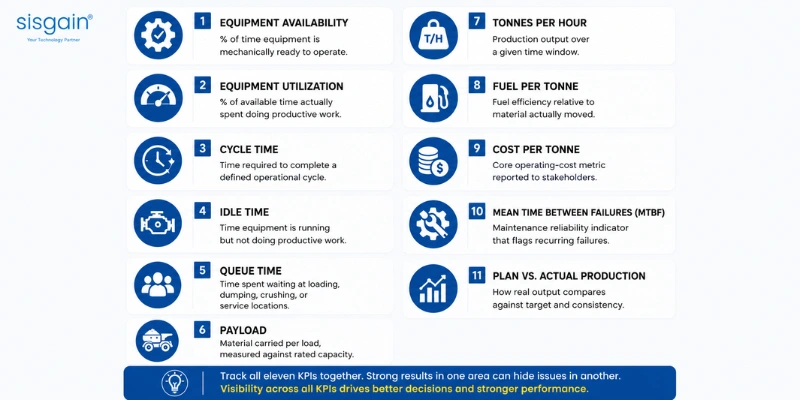
Think of it as an operational loop rather than a static dashboard.
Step 1: Equipment and infrastructure generate data
Every asset and system on site is a data source: GPS/GNSS units, IoT sensors, onboard equipment systems, engine and machine telemetry, payload systems, fuel sensors, operator terminals, dispatch consoles, and safety systems built into the mine's infrastructure.
Step 2: The platform collects and processes that data
Raw signals get turned into usable operational points — equipment location, machine state, speed, payload, fuel consumption, idle time, cycle duration, downtime, engine health, and operator activity. This is the unglamorous but critical part of the system. Bad data in means bad dispatch decisions out.
Step 3: Dispatch logic assigns equipment
The system matches trucks to shovels, excavators, crushers, dumps, stockpiles, fuel stations, and maintenance bays based on current conditions, not a fixed schedule written that morning. If a shovel goes down or a crusher backs up, the assignment logic adjusts in near real time.
Step 4: Supervisors watch for bottlenecks as they happen
Crusher congestion, truck queues, an underutilized loader, an abnormally long cycle time, an equipment failure mid-shift — a well-built FMS surfaces these the moment they start, not at end-of-shift review.
Step 5: Operational data feeds better decisions elsewhere
Everything the system captures flows into production planning, maintenance scheduling, safety management, cost analysis, and shift optimization. This is the step operators most often skip — treating the FMS as a monitoring tool rather than an input into how the mine actually plans its next shift.
The simplified flow: Equipment + Operators + IoT Sensors → Fleet Management Platform → Dispatch Engine + AI Analytics → Dashboards → Maintenance + Production + Safety + Management Decisions.
What Problems Does Mining Fleet Management Software Solve?
Haul truck queuing and production delays
Queues form at crushers, loading areas, dump locations, and fuel stations. Every minute a fully loaded truck sits idle in a queue is a minute of lost tonnage and wasted fuel — and queues compound. One slow crusher cycle can back up an entire haul route within twenty minutes.
Excessive idle time and fuel waste
Real-time equipment-state data separates productive time from waste: unnecessary idling, extended waiting, inefficient routing, and delayed dispatching. Fuel is one of the largest controllable operating costs on a mine site, and idle time is usually the single biggest lever inside it.
Poor visibility into equipment utilization
Owning a fleet of forty haul trucks doesn't mean forty trucks are producing. There's a real difference between available hours, operating hours, productive hours, idle hours, and downtime — and mines that can't separate these numbers are usually overestimating their actual capacity.
Reactive maintenance
When machine data lives in isolated OEM systems rather than a shared platform, maintenance teams often find out about a problem only after the machine has already failed on shift. That's the most expensive way to run maintenance, both in repair cost and in lost production.
Manual dispatch decisions
Experienced dispatchers are genuinely good at their jobs, but conditions on a live mine change faster than any one person can track across a full fleet. Relying purely on dispatcher judgment tends to work fine most shifts and badly on the shifts that matter most — when equipment goes down or conditions shift suddenly.
Siloed operational data
Fleet operations, maintenance, production, safety, mine planning, and enterprise systems frequently run on separate platforms that don't talk to each other. The result is duplicate data entry, conflicting numbers in different reports, and decisions made on stale information.
Remote connectivity challenges
Surface mines have coverage gaps at the pit edges. Underground mines deal with intermittent, latency-sensitive communications by design. Any FMS deployment has to be built around the connectivity reality of the site, not assume constant, low-latency connections everywhere.
Key Features to Look for in Mining Fleet Management Software
Real-time fleet tracking and equipment status
Location alone tells you almost nothing operationally useful. Knowing that a truck is loaded, empty, queuing, idle, or down is what actually drives a dispatch decision.
Dynamic dispatch and route optimization
The system should reassign equipment in real time as conditions change — a shovel going down, a crusher backing up, a haul road closing for maintenance — rather than running off a static plan built hours earlier.
Cycle-time measurement and queue management
Good platforms track the complete haul cycle: load, haul, queue, dump, and return, breaking each segment down so you can see exactly where time is being lost.
Payload and production tracking
This covers loads per shift, tonnes moved, and reconciliation against the production plan — the numbers finance and operations both care about.
Fuel monitoring and idle-time analytics
Fuel consumption connects directly to equipment behavior, route performance, idle time, and haul road conditions. Isolating fuel data from the rest of the operational picture makes it far less useful.
Predictive maintenance and asset health
Integration with machine telemetry and maintenance systems lets teams flag developing issues — rising temperatures, abnormal vibration, pressure drift — before they become failures.
Operator performance and safety monitoring
Speeding, harsh braking or acceleration, entry into unsafe zones, and other safety-relevant events should be tracked and reported, along with fatigue-related workflows where the site's policy calls for them.
Geofencing and hazard alerts
Virtual boundaries around restricted areas, hazard zones, active maintenance bays, and loading zones — with real-time alerts when equipment crosses a line it shouldn't.
Shift, delay, and downtime classification
Accurate reason codes (mechanical failure, operator break, weather delay, planned maintenance) turn a pile of downtime minutes into data you can actually act on.
Central dashboards and reporting
Different roles need different views of the same data — dispatch supervisors, maintenance teams, operations managers, and executives shouldn't all be staring at the same generic screen.
Integration and API support
This is where most FMS projects succeed or stall. The platform needs to talk to ERP, CMMS, mine planning software, SCADA, IoT platforms, safety systems, and weighbridge systems. Custom dashboards, mobile field applications, and mining-specific workflow integrations are exactly the kind of work that falls under Software development services for mining industry — building the connective layer between the FMS and everything else the mine already runs on.
How Does Fleet Management Software Improve Mining Productivity?
The benefits only mean something if you can measure them against a real KPI.
|
Business Objective |
FMS Capability |
KPI to Measure |
|
Increase production |
Dynamic equipment allocation |
Tonnes per hour |
|
Reduce idle time |
Queue and equipment-state monitoring |
Idle hours |
|
Improve utilization |
Real-time fleet visibility |
Productive utilization |
|
Improve availability |
Condition monitoring |
Equipment availability |
|
Reduce fuel waste |
Idle and route analytics |
Fuel per tonne |
|
Improve dispatch |
Dynamic assignment |
Cycle time |
|
Strengthen safety |
Geofencing and alerts |
Safety events |
|
Improve decision-making |
Real-time dashboards |
Plan vs. actual variance |
Increased equipment utilization. Real-time visibility means equipment sitting idle gets reassigned instead of waiting for the next scheduled check-in.
Reduced cycle-time variation. Consistent cycles are easier to plan around than fast-but-erratic ones. An FMS narrows that variance by catching queue buildup early.
Lower fuel consumption. Every idle minute avoided is fuel saved, and at fleet scale, that adds up to a meaningful line item.
Better maintenance planning. Condition data lets maintenance teams schedule work during planned downtime instead of reacting to failures mid-shift.
Faster response to bottlenecks. A crusher backup spotted in minute three gets fixed in minute five, not discovered in the shift report six hours later.
Improved safety visibility. Geofencing and event tracking give safety teams data instead of anecdotes when investigating incidents or near-misses.
Surface Mining vs. Underground Mining Fleet Management Software
These are genuinely different problems, not variations on the same theme.
|
Surface Mining |
Underground Mining |
|
Truck-shovel dispatch |
LHD and underground truck coordination |
|
Crusher and dump queue management |
Constrained-route logistics |
|
Haul-road optimization |
Communication-constrained tracking |
|
Payload and tyre monitoring |
Safety-zone monitoring |
|
Autonomous haulage coordination |
Remote-operation support |
|
Fuel and route analytics |
Shift and equipment utilization tracking |
Open-pit mines
The priorities here are truck-shovel matching, haul road management, crusher queue control, dump allocation, and payload optimization across wide-open, GPS-friendly terrain. Connectivity is generally the easier part of this equation — the harder part is dispatch logic that can keep up with a constantly shifting pit.
Underground mines
Underground operations flip the difficulty. GPS doesn't work below surface, so tracking relies on Wi-Fi mesh, RFID, or other positioning systems. Routes are physically constrained — there's often only one way in and out of a heading — and personnel proximity to moving equipment becomes a safety priority in a way it isn't on an open pit. Ventilation-aware operations and remote-operation support (running equipment from surface or a remote operations center) are increasingly common on newer underground deployments.
Which Mining Fleet Management KPIs Should Companies Track?
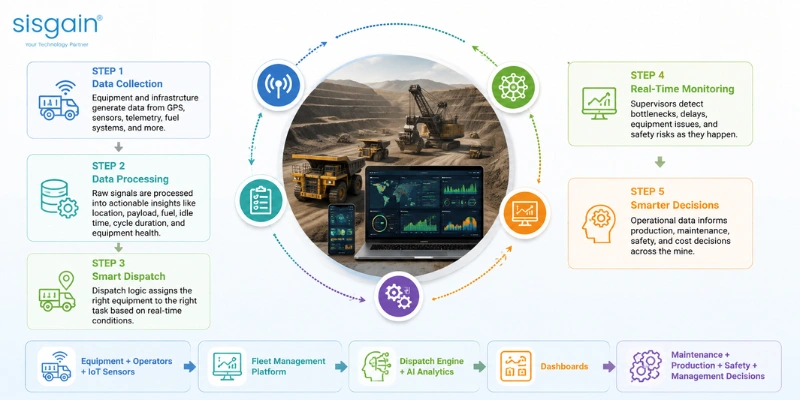
Equipment availability — the percentage of time equipment is mechanically ready to operate.
Equipment utilization — the percentage of available time actually spent doing productive work.
Cycle time — the time required to complete a defined operational cycle, from load to dump and back.
Idle time — time equipment is running but not doing productive work.
Queue time — time spent waiting at loading, dumping, crushing, or service locations.
Payload — material carried per load, measured against the equipment's rated capacity.
Tonnes per hour — production output over a given time window.
Fuel per tonne — fuel efficiency relative to material actually moved.
Cost per tonne — the core operating-cost metric most mines report to stakeholders.
Mean time between failures (MTBF) — a maintenance reliability indicator that flags equipment or components failing more often than expected.
Plan vs. actual production — how real output compares against the shift or daily target, and how consistently.
Track all eleven together, not in isolation. A mine can have excellent availability and still miss production targets if utilization or cycle time is the actual bottleneck — and you only see that by looking at the KPIs side by side.
How Is AI Changing Mining Fleet Management Software in 2026?
AI in mining fleet management works best framed as decision support, not autopilot. The operator or dispatcher still makes the call — AI just gets them a better-informed one faster.
AI-powered dispatch recommendations. Rather than a dispatcher weighing shovel status, queue length, and haul distance manually, the system can evaluate all of those variables simultaneously and surface a ranked recommendation.
Predictive maintenance. Anomaly detection models flag components showing early signs of failure, and prioritize maintenance work based on actual failure risk rather than a fixed calendar interval.
Bottleneck detection. AI analytics can identify recurring patterns behind queues, idle time, delays, and cycle-time variation — patterns that are often invisible when you're looking at one shift at a time.
Production forecasting. Models trained on historical and real-time operational data can forecast likely output, giving planners a earlier warning when a shift is tracking below target.
Anomaly detection. Unusual machine behavior — a vibration signature that doesn't match the equipment's normal profile, for instance — can be flagged before it becomes a bigger operational issue.
None of this replaces human oversight. The recommendations need to be explainable, the underlying data needs validation, and any AI-driven suggestion that affects safety or major equipment decisions should still route through an approval workflow. Custom AI models built for a specific mine's equipment mix and operational data — rather than a generic, off-the-shelf model — are the kind of work covered under AI development solutions, and they tend to perform meaningfully better than one-size-fits-all predictive maintenance tools because they're trained on the site's actual failure history.
It's also worth noting that the principles behind secure, large-scale AI governance aren't unique to mining. Similar questions around data integration, auditability, and real-time decision-making show up in other high-stakes, infrastructure-heavy sectors — the kind of work reflected in UAE Government AI Solutions — even though the operational context is completely different.
How to Choose Mining Fleet Management Software
- Assess your mining method. Open-pit, underground, quarry, processing operations, or a mixed environment all point toward different platform requirements.
- Evaluate fleet compatibility. Is the fleet single-OEM or mixed? Can the software connect with legacy equipment? What telemetry protocols does it actually support, versus what the sales deck claims?
- Review integration capabilities. Check compatibility with CMMS, ERP, mine planning software, SCADA, safety platforms, and existing IoT infrastructure before signing anything.
- Assess connectivity architecture. Cloud, edge, on-premises, or hybrid — and how the platform handles private LTE/5G, Wi-Fi mesh, and remote-site communications where coverage is inconsistent.
- Review data ownership and security. Confirm data export options, API access, role-based permissions, cybersecurity posture, retention policies, and governance before the contract is signed, not after.
- Evaluate scalability. Can the platform grow from one mine to multiple pits, multiple sites, and enterprise-level reporting without a re-platform?
- Assess user adoption. Dispatcher workflows, in-cab usability, mobile access, and training requirements determine whether the system actually gets used or gets worked around.
- Measure time to value. Favor vendors who support pilot programs, KPI baselines, phased rollouts, and real change management over a single big-bang deployment.
- Understand total cost of ownership. Software licensing is only one line item. Hardware, connectivity, integration work, implementation, training, and ongoing support all add up — and they vary a lot by project scope. Understanding software development cost in 2026 is particularly relevant here, since custom integrations, AI capabilities, IoT hardware, and deployment architecture all move the total cost meaningfully compared to an off-the-shelf license alone.
Can Mining Fleet Management Software Work with Mixed-OEM Equipment?
Yes — but it takes real integration work, not a checkbox on a spec sheet.
Most mines don't run a single-brand fleet. They run Caterpillar trucks alongside Komatsu loaders, older legacy machines next to newer connected equipment, and each OEM's telemetry system speaks its own proprietary format. Getting one operational view across all of it means dealing with proprietary data systems, inconsistent telemetry formats, legacy machines with limited or no native connectivity, API limitations on the OEM side, and the underlying work of normalizing all of that into a single data model.
Why interoperability matters
A mine running three equipment brands across two pits doesn't want three dashboards. It wants one operational view that treats a Cat truck and a Komatsu truck the same way for dispatch and reporting purposes.
The role of integration layers
This is usually solved with custom middleware and APIs that sit between each OEM system and the central FMS, translating everything into a unified data model the platform can actually use. It's often the single most underestimated part of a fleet management project — vendors will demo the dashboard, but the real engineering work is in the integration layer underneath it.
Mining Fleet Management Software Implementation Challenges
Implementation is at least as much an operational and change-management project as it is a technical one.
Remote-site connectivity — building for the actual coverage on site, not the coverage the vendor assumes.
Legacy equipment integration — older machines often need retrofitted telemetry hardware before they can participate in the system at all.
Data quality and standardization — inconsistent sensor calibration or missing data points quietly undermine every downstream decision the system supports.
Change resistance — dispatchers and operators who've run the mine a certain way for years won't automatically trust a new system's recommendations.
Operator and dispatcher training — the platform is only as good as the people using it correctly, shift after shift.
Cybersecurity — connecting OT (operational technology) systems to broader networks introduces new attack surface that needs to be secured from day one, not retrofitted later.
Poor KPI definition — the most common root cause of a disappointing rollout. Companies buy the technology before they've agreed on which operational problem it's actually solving.
Implementation best practice
Baseline → Pilot → Integrate → Train → Measure → Scale.
Start by measuring current performance honestly, before any new technology touches the site. Pilot on a limited area or fleet segment. Integrate with the systems that matter most first. Train the people who'll use it daily, not just the managers who bought it. Measure results against the baseline you set at the start. Only then scale it site-wide.
Mining Fleet Management Software Vendor and Solution Landscape
This is an evaluation overview, not a ranking — vendor rankings without a transparent, evidence-based methodology aren't worth much to a buyer doing real due diligence.
OEM-aligned platforms suit mines running predominantly one equipment ecosystem, where deep integration with that manufacturer's telemetry is more valuable than cross-brand flexibility.
OEM-agnostic platforms are built for mixed fleets, multi-site operations, and companies where interoperability is a higher priority than deep single-brand integration.
Specialist mining software platforms offer configurable workflows and broader digital-mining capabilities beyond fleet dispatch alone.
Custom mining operations software fits organizations with unique workflows, significant legacy environments, or integration requirements that off-the-shelf platforms don't cover well.
The broader market includes names like Caterpillar MineStar, Komatsu's fleet systems, Wenco, Sandvik OptiMine, Modular Mining, Hexagon, Datamine, and Micromine — mentioned here as examples of the ecosystem's breadth, not as a recommendation of any one over another. Which category fits best depends entirely on your fleet composition, site conditions, and existing technology stack.
Top Mining Fleet Management Software Trends in 2026
Real-time operational intelligence. The shift is from passive, end-of-shift reporting to immediate bottleneck detection and response while the shift is still running.
Predictive and condition-based maintenance. More machine data is being used to prioritize maintenance work before failures happen, rather than on a fixed calendar schedule.
Autonomous and hybrid fleet coordination. FMS platforms increasingly manage autonomous and conventional equipment operating in the same traffic, on the same haul roads, at the same time.
Mixed-fleet interoperability. Integration flexibility has become one of the biggest procurement factors — arguably bigger than any single feature on the platform itself.
Cloud plus edge architecture. Mines need both central enterprise visibility and local processing that keeps working when the connection to the cloud drops.
AI-assisted decision support. Forecasting, dispatch recommendations, and maintenance prioritization are becoming standard features rather than premium add-ons.
Sustainability and operational efficiency analytics. Fuel consumption, idle time, haul optimization, and equipment efficiency are increasingly tied into measurable, reportable emissions and efficiency data — driven partly by investor and regulatory pressure that didn't exist in the same form five years ago.
How SISGAIN Can Support Mining Fleet Digitalization
Build a Connected Mining Operations Platform with SISGAIN
Most mining companies already have the equipment data they need — it's just scattered across OEM platforms, spreadsheets, maintenance logs, and disconnected operational tools. SISGAIN works with mining operators to design connected digital solutions that turn fragmented fleet, maintenance, production, and IoT data into operational intelligence people can actually use on shift.
SISGAIN can support:
- Custom mining fleet management software development
- Real-time operational dashboards
- IoT and equipment-data integration
- GPS and telemetry connectivity
- AI-powered predictive analytics
- Predictive maintenance platforms
- Mobile applications for field teams
- CMMS and ERP integration
- Cloud and edge architecture
- Legacy-system modernization
- Multi-site operational reporting
- API and data integration layers
Get a Mining Fleet Digitalization Assessment
Find out where disconnected fleet data, idle time, maintenance delays, and limited operational visibility may be affecting your productivity — and what technology architecture would actually fix it, not just paper over it.
Evaluating Mining Fleet Management Software?
Download the Mining Fleet Management Software Evaluation Checklist — 30 questions for mining operations and IT teams, covering operational fit, fleet compatibility, integration, connectivity, data governance, AI and analytics, security, scalability, implementation, and total cost.
Summary: Is Mining Fleet Management Software Worth It?
For most operators running more than a handful of mobile assets, yes — but only when it's treated as part of a broader operational improvement strategy, not bought as a standalone tracking tool and left running on autopilot.
The value chain that actually delivers a return looks like this:
Equipment Data → Operational Visibility → Better Dispatch → Faster Maintenance Decisions → Improved Productivity and Cost Control.
Skip any link in that chain and the return shrinks fast.
Which platform is right for a given site depends on mining method, fleet composition, operational maturity, existing technology stack, site connectivity, data integration requirements, and — increasingly — whether autonomous equipment is part of the near-term roadmap. There's no universal answer, but there is a clear starting point: define the operational problem first, then evaluate technology against it.
This guide is part of SISGAIN's mining operations software content series. For related reading, see our upcoming pieces on mining fleet dispatch systems, predictive maintenance software for mining equipment, and mining fleet management KPIs.