
Cable and satellite deals used to be the only real distribution game in town. That's no longer true. A broadcaster with the right technology stack can now put live sports, news, and premium entertainment directly into a viewer's hand — no distributor, no negotiation, no middleman taking a cut of the relationship.
That's the appeal of OTT. But here's the catch: most teams underestimate what "building an OTT platform" actually involves. It's not a video player bolted onto a mobile app. It's the full technology ecosystem needed to ingest, protect, distribute, monetize, and measure video content across every screen your audience owns.
This guide walks through what OTT streaming platform development really requires — the architecture, the monetization models, the security layer, the realistic costs and timelines, and the questions worth asking before you pick a development partner.
What is OTT streaming platform development?
OTT streaming platform development is the process of building the technology ecosystem required to deliver video content over the internet. It typically includes video infrastructure, content management, transcoding, adaptive streaming, security, monetization, analytics, and applications for web, mobile, smart TVs, and connected devices.
Planning a branded OTT platform? Talk to a development team about your content strategy, monetization model, device requirements, and video architecture.
Request a Discovery Consultation.
In this guide, you'll find:
- What an OTT platform is
- Why broadcasters are investing in OTT
- How OTT streaming platform development works
- Core OTT platform features
- OTT monetization models
- OTT technology architecture
- Build vs. buy vs. white-label
- The development process, stage by stage
- Cost and timeline factors
- How to choose a development partner
- Common broadcaster use cases
- Frequently asked questions
What is an OTT platform?
An OTT platform delivers video content directly through the internet rather than through cable or satellite distribution networks. "OTT" stands for over-the-top — the content goes over the top of traditional broadcast infrastructure and straight to the viewer's device.
The term gets used loosely, so it's worth separating the viewer-facing app from the business behind it. The app is what audiences see. The platform is everything that makes the app work: the systems that ingest content, process it, protect it, deliver it, charge for it, and report on how it performed.
OTT platform vs. a basic video website
A lot of businesses already have "video on their site." That's a different thing from an OTT platform.
|
Capability |
Basic Video Website |
Full OTT Platform |
|
Video hosting |
Basic |
Advanced |
|
Live streaming |
Limited |
Scalable |
|
Content management |
Basic |
Advanced CMS |
|
User identity |
Limited |
Profiles and authentication |
|
Monetization |
Basic |
SVOD, AVOD, TVOD, FAST |
|
Security |
Limited |
DRM, geo-blocking, watermarking |
|
Multi-device delivery |
Limited |
Web, mobile, CTV and smart TV |
|
Analytics |
Basic traffic data |
Audience and revenue intelligence |
|
Personalization |
Limited |
Advanced recommendations |
What actually makes up an OTT platform for media & entertainment
The app is one layer among many. A complete OTT platform for media & entertainment typically includes:
- Video CMS
- Content ingest workflows
- Transcoding
- Video packaging
- CDN distribution
- DRM and content protection
- User authentication
- Subscription and payment systems
- Advertising technology
- Analytics
- Web applications
- iOS and Android apps
- Smart TV applications
- Connected TV applications
Miss one of these and the whole system feels it. A platform with a beautiful app but no real CDN strategy buckles the first time a live match draws a real crowd. OTT platforms are increasingly becoming part of broader Media & Entertainment Software Development in Dubai strategies for companies modernizing their entire digital content ecosystem, not just their video player.
Why broadcasters are investing in OTT streaming platforms
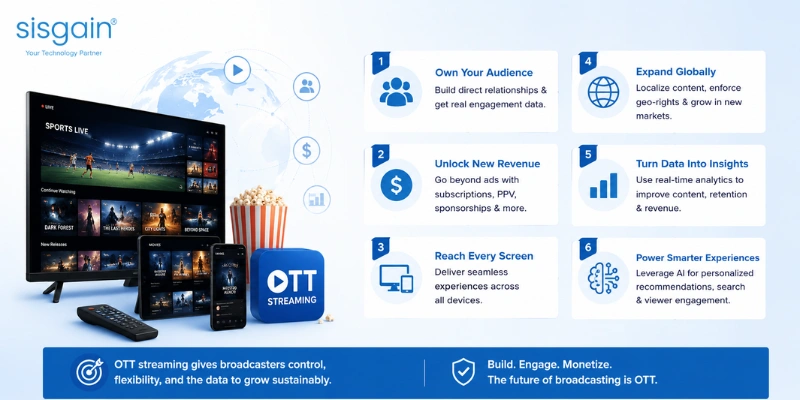
Broadcasters invest in OTT because it hands them control — over the audience relationship, the distribution channel, the monetization model, and the data that used to belong to a cable operator or a third-party platform.
1. Owning the direct viewer relationship
Relying entirely on cable providers, distributors, or third-party platforms means someone else owns the customer. They set the terms, they hold the billing relationship, and they decide what data — if any — flows back to you.
An OTT platform flips that. It gives a broadcaster:
- A first-party audience relationship
- Direct subscriptions, billed on its own terms
- Real engagement data, not a summarized report from a distributor
- Fewer intermediaries taking a cut
- A genuine shot at improving retention, because you can actually see why people leave
2. New revenue streams that don't depend on ad buyers alone
Traditional broadcast revenue leans hard on advertising. OTT opens up more levers:
- Subscription revenue
- Advertising revenue
- Pay-per-view
- Premium event pricing
- Sponsorships
- Hybrid combinations of the above
3. Reaching audiences on every screen they actually use
Viewers move between devices constantly — sometimes in the same evening. An OTT platform needs to follow them across:
- Smartphones
- Tablets
- Web browsers
- Smart TVs
- Connected TVs
- Streaming devices
4. Expanding into global and regional markets
A digital platform doesn't respect the geographic boundaries a broadcast license does — which is both an opportunity and a compliance headache. Getting this right means planning for:
- Localization
- Multi-language support
- Regional content libraries
- Geo-rights enforcement
- Region-specific monetization
- Content licensing restrictions that vary by country
5. Turning viewing data into business intelligence
None of this matters if the data just sits there. The value shows up when you actually use metrics like:
- Watch time
- Completion rate
- Subscriber retention
- Churn
- Content performance
- Ad performance
- Device usage
- Regional audience behavior
6. Supporting AI-driven audience experiences
AI has moved from novelty to infrastructure in OTT. It now shows up in:
- Content recommendations
- Search
- Metadata enrichment
- Viewer segmentation
- Churn prediction
- Personalized promotions
- Automated content tagging
Well-built AI apps sit quietly behind the scenes here — powering the recommendation engine a viewer never notices is even there, because it just feels like the platform "gets" them.
How OTT streaming platform development works
OTT streaming platform development creates a connected workflow that moves video from ingest through processing, protection, delivery, playback, monetization, and analytics.
The flow, in order:
Content Ingest → Transcoding → Packaging → DRM & Security → CDN Delivery → Player & Apps → Monetization → Analytics & Optimization
Step 1: Content ingest
Video has to get into the system before anything else can happen. Sources typically include:
- Live camera feeds
- Broadcast feeds
- Uploaded video assets
- Cloud storage integration
- Existing media libraries
Step 2: Video transcoding
One source file rarely serves every viewer well. Transcoding turns that single file into multiple resolutions and bitrates — 4K, Full HD, HD, SD — so the platform can deliver adaptive bitrate streaming and adjust quality on the fly as someone's connection changes from a strong home Wi-Fi signal to spotty mobile data on a train.
Step 3: Video packaging
Packaging wraps the transcoded video into formats players can actually read. The three that matter most:
- HLS
- MPEG-DASH
- CMAF
The technical differences matter to engineers. For a broadcaster, the practical question is simpler: does the chosen format play reliably across every device the audience actually owns?
Step 4: DRM and content security
Premium content — a live match, a film premiere, an exclusive series — needs protection that goes beyond a login wall. DRM covers:
- Premium content protection
- Unauthorized access prevention
- License enforcement
- Device compatibility
- Content rights compliance
The major DRM ecosystems worth knowing are Widevine, FairPlay Streaming, and PlayReady — each tied to a different device family, which is exactly why a platform usually needs to support more than one.
Step 5: CDN delivery
A broadcaster serving a national or global audience can't rely on a single server location. Distributed delivery infrastructure — a CDN — is what keeps a live stream watchable when thousands of people hit play at the same moment, rather than buffering for everyone at once.
Step 6: Player and application experience
This is the layer viewers actually see and judge the whole platform by:
- Web player
- Mobile applications
- Smart TV apps
- Connected TV interfaces
Step 7: Analytics and monetization
Data flows back into the business layer here, measuring:
- Audience engagement
- Retention
- Churn
- Revenue
- Ad performance
- Content ROI
Need help planning a scalable video architecture? Talk to a development team about live streaming, VOD, DRM, CDN delivery, and multi-device requirements.
Core features of a broadcaster OTT platform
The best OTT platform features combine reliable video delivery with content management, monetization, audience engagement, analytics, and enterprise-grade security.
Video-on-demand and live streaming
- On-demand content libraries
- Live channels
- Live events
- Sports
- News
- Scheduled programming
Multi-device applications
Web, iOS, Android, smart TVs, and connected TVs — ideally all built to feel like one consistent product rather than five separate ones stitched together.
Content management system
A CMS built for broadcasters needs to handle uploading, publishing, metadata, categories, scheduling, rights management, and content expiry — not just "post a video and hope."
Adaptive bitrate streaming
Video quality shifts automatically based on the viewer's current network conditions, so playback keeps running instead of freezing every time bandwidth dips.
Search, categories, and discovery
- Advanced search
- Categories and genre pages
- Watchlists
- Continue watching
- Personalized recommendations
User profiles and parental controls
- Multiple profiles per account
- Content restrictions
- Age-based access
- Individual viewing preferences
OTT monetization tools
- Subscription management
- Advertising
- Pay-per-view
- Promotional offers
- Coupons
- Bundles
Push notifications and audience engagement
New episode alerts, live event reminders, personalized recommendations, and subscription renewal notices all keep an audience coming back instead of forgetting the app exists between big releases.
Analytics dashboards
Viewer behavior, revenue, content performance, device analytics, and engagement — ideally in one place, not scattered across five separate tools.
Content protection
DRM, geo-blocking, watermarking, access controls, and secure authentication working together, not as an afterthought bolted on post-launch.
Localization
Subtitles, multiple audio tracks, language selection, regional metadata, and local payment options matter more than most launch plans give them credit for — especially the payment piece, since a subscription model that only accepts one currency quietly caps your addressable market.
Mobile matters enormously here too. Most viewers' first — and sometimes only — touchpoint with an OTT platform is a phone screen, which is where solid Custom mobile app development in Dubai work earns its keep.
OTT monetization models explained
OTT monetization should align with the broadcaster's audience, content rights, brand positioning, and revenue strategy — not just copy whatever a competitor happens to be doing.
|
Monetization Model |
How It Works |
Best Fit |
|
SVOD |
Recurring subscription for content access |
Premium entertainment, niche media, education |
|
AVOD |
Free or low-cost content supported by advertising |
Broad-reach publishers and media channels |
|
TVOD |
Payment for individual rentals, events, or purchases |
Films, sports, premium releases |
|
FAST |
Free linear-style channels supported by ads |
Broadcaster archives and catalog owners |
|
Hybrid |
Combines multiple monetization approaches |
Broadcasters serving diverse audiences |
SVOD: Subscription Video on Demand
Built around monthly or annual billing for access to a premium content library. The whole model lives or dies on retention — acquiring a subscriber is only half the job; keeping them past month two is where the real churn management work happens.
AVOD: Advertising Video on Demand
Revenue comes from pre-roll and mid-roll advertising, targeted campaigns, and ad measurement. This model tends to suit broadcasters chasing reach over exclusivity — the content stays free, and the audience size is the product.
TVOD: Transactional Video on Demand
Viewers pay per item rather than committing to a subscription. Works well for pay-per-view boxing matches, concerts, and film premieres — anything with a clear, one-time event value.
FAST: Free Ad-Supported Streaming Television
FAST channels recreate the linear-TV experience — a scheduled channel, not an on-demand library — supported entirely by ads. It's a strong fit for broadcasters sitting on a deep content archive that would otherwise go unused.
Hybrid OTT models
Most broadcasters end up here eventually. Common combinations include a free ad-supported tier alongside a premium subscription, a subscription paired with premium event purchases, or advertising layered with sponsorships.
Not sure which OTT revenue model fits your audience? Get help evaluating subscription, advertising, transactional, and hybrid strategies before committing to one.
OTT technology architecture explained
A modern OTT architecture connects video infrastructure, security, applications, business systems, and analytics into one scalable operating ecosystem. Six layers do the real work.
Video and media layer
Ingest, storage, transcoding, packaging.
Delivery layer
CDN, edge delivery, adaptive streaming, low-latency delivery.
Security layer
DRM, encryption, authentication, geo-restrictions, watermarking.
Experience layer
Web applications, mobile apps, smart TV apps, connected TV apps.
Business layer
Subscription management, payment gateways, advertising platforms, CRM, marketing automation.
Data and intelligence layer
Viewer analytics, content analytics, revenue reporting, AI recommendations, churn analysis.
Getting these layers to actually talk to each other — rather than existing as six disconnected vendors — is usually where projects go sideways, and it's exactly where solid App development services in UAE make the difference between a platform that scales cleanly and one that needs a rebuild eighteen months in.
Build vs. buy vs. white-label OTT platform: which is right for you?
The right approach depends on how much control, customization, speed, and long-term ownership a broadcaster actually needs — not on which option sounds more impressive.
|
Approach |
Best For |
Advantages |
Limitations |
|
Custom OTT Platform |
Complex or differentiated businesses |
High flexibility and ownership |
Higher investment |
|
White-Label OTT Platform |
Faster standard launches |
Faster deployment |
Limited customization |
|
Hybrid OTT Approach |
Growing broadcasters |
Balance of speed and control |
Requires integration planning |
Custom OTT streaming platform development
Makes the most sense for major broadcasters, sports networks, businesses with complex content rights, unique monetization needs, large audiences, or requirements for custom integrations that off-the-shelf software simply won't support.
White-label OTT platform
The right call when speed to market matters more than differentiation — standard VOD requirements, a smaller initial launch, or a team that wants to validate demand before investing heavily.
Hybrid OTT development
Uses managed infrastructure for the parts that don't need to be unique, while building custom work into the parts that do: audience experiences, monetization, commerce, integrations, and data.
Broadcasters that outgrow generic software usually end up talking to an OTT App Development Company in UAE precisely because "close enough" stops being good enough once the audience and the revenue model get more complex.
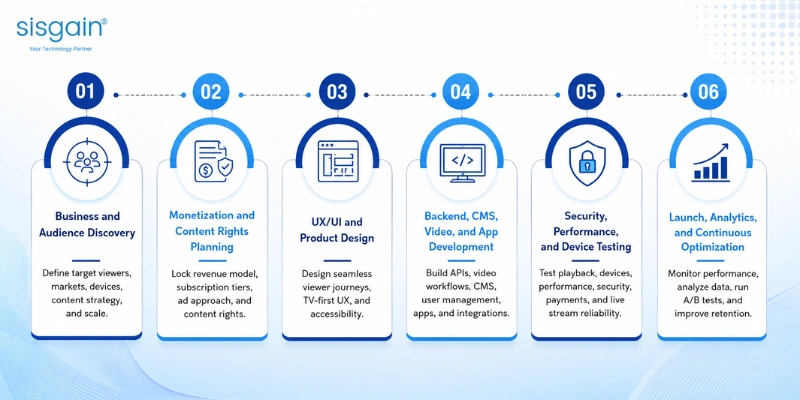
A successful OTT platform should begin with business, audience, content-rights, and monetization planning before a single line of code gets written.
Stage 1: Business and audience discovery
Defines target viewers, geographic markets, target devices, content strategy, and expected audience scale.
Stage 2: Monetization and content rights planning
Locks in the revenue model, subscription tiers, advertising approach, geographic rights, and licensing periods before development starts — changing these mid-build is expensive.
Stage 3: UX/UI and product design
Covers viewer journeys, content discovery, TV-first UX (which behaves very differently from mobile UX), and accessibility.
Stage 4: Backend, CMS, video, and app development
Where the actual build happens: APIs, video workflows, CMS, user management, applications, and integrations.
Stage 5: Security, performance, and device testing
Nothing ships without testing playback, device compatibility, load performance, security, payments, and live-stream reliability under real conditions, not just a demo environment.
Stage 6: Launch, analytics, and continuous optimization
Soft launch, performance monitoring, viewer analytics, ongoing feature releases, A/B testing, and retention optimization. This stage never really ends — it's the difference between a platform that improves and one that stagnates the day it ships.
How AI is changing OTT streaming platform development
AI helps OTT businesses improve content discovery, personalization, operational efficiency, and audience retention — and by 2026, most of these are table stakes rather than differentiators.
- AI-powered content recommendations — surfacing what a specific viewer is likely to watch next, based on actual behavior rather than a static "popular now" row
- Intelligent search and content discovery — understanding intent, not just matching exact titles
- Automated metadata generation — tagging content at a scale no human team could keep up with manually
- Viewer churn prediction — flagging accounts likely to cancel before they actually do
- Audience segmentation — grouping viewers by behavior, not just demographics
- Personalized promotions — offering the right upgrade to the right viewer at the right moment
- AI-assisted content moderation — catching problems in user-generated or licensed content faster than manual review
- Analytics and business forecasting — turning viewing patterns into revenue projections
Platforms that use this well tend to show up on lists of Top Grossing Apps for a reason — personalization and engagement translate directly into revenue, not just vanity metrics. And most of the recommendation and discovery work above runs on the same category of AI apps already reshaping how audiences find content in the first place.
How much does OTT streaming platform development cost?
The cost of OTT streaming platform development depends on platform complexity, target devices, live streaming requirements, security, integrations, audience scale, and ongoing infrastructure needs. There's no single number that applies across the board — anyone offering one without asking questions first probably hasn't scoped the project properly.
Key cost factors
- Number of platforms and devices
- Live streaming vs. VOD
- Content library size
- CMS and migration requirements
- DRM and security
- Recommendation and personalization features
- Payment integrations
- Advertising technology
- CRM and marketing integrations
- Audience scale and bandwidth
- Regional hosting and compliance
- Ongoing maintenance and support
Cost comparison by scope
|
Platform Scope |
Typical Complexity |
Key Requirements |
|
MVP OTT Platform |
Low to medium |
Core VOD, basic apps, authentication |
|
Growth-Stage OTT Platform |
Medium to high |
Multi-device, subscriptions, analytics |
|
Enterprise Broadcaster Platform |
High |
Live events, DRM, scale, integrations |
|
Sports/News OTT Platform |
Very high |
Low latency, peak traffic, live reliability |
Before requesting an estimate, it's worth defining your own requirements first — device targets, content type, expected audience scale, and monetization approach. A vendor who can quote instantly, without asking about any of that, is guessing.
How long does it take to build an OTT platform?
OTT platform timelines depend on the number of applications, complexity of video workflows, integrations, content migration, security requirements, and testing scope. Fixed universal timelines don't hold up in practice — a single-device VOD MVP and a multi-device live sports platform are simply not the same project.
The realistic phases to plan for:
- Discovery and planning
- UX/UI design
- Core platform development
- Application development
- Integrations
- Testing
- Launch preparation
OTT platform use cases for broadcasters and media businesses
Live sports streaming platforms
The hardest category to get right, technically. Peak traffic spikes hit in minutes, latency has to stay low enough that a goal doesn't show up on social media before it shows up on the stream, and pay-per-view plus geo-rights add another layer of complexity on top.
News and live channel platforms
Built around 24/7 streaming, breaking news alerts, live channel schedules, and reliable access across every device a viewer might reach for during a fast-moving story.
Film and entertainment platforms
Success here comes down to content discovery, subscription retention, premium release handling, and multi-language support for audiences that span regions.
Niche subscription video businesses
Education, fitness, faith, lifestyle, and industry-specific media all run smaller but often more loyal OTT audiences — the platform requirements scale down, but the fundamentals stay the same.
Publisher-owned video platforms
Publishers with an existing audience can extend that reach through video — monetizing through advertising, premium memberships, and straightforward content expansion rather than starting an audience from zero.
OTT platform security, DRM, and content rights
Premium OTT platforms require security controls that protect licensed content, revenue, and audience accounts across multiple devices and markets. This isn't generic cybersecurity advice — it's specific to what broadcasters actually risk.
Why DRM matters: it protects premium content, keeps a platform compliant with licensing agreements, and prevents unauthorized redistribution that can violate the terms a broadcaster signed to get the content in the first place.
Beyond DRM, a complete security approach covers geo-blocking and regional rights enforcement, watermarking to trace leaks back to their source, secure authentication, payment security, access and subscription controls, and ongoing content rights management as licenses expire or renew.
How to choose an OTT streaming platform development partner
The right OTT development partner should understand video technology, multi-device applications, media workflows, content security, scalability, and post-launch optimization — not just general app development.
Questions worth asking any potential vendor
- Have you built multi-device video platforms before?
- How do you approach live-event scalability?
- What's your DRM and content protection strategy?
- How do you design CDN and delivery architecture?
- Can your CMS support broadcaster-specific workflows?
- How do you handle legacy system integrations?
- Who owns the source code and platform IP?
- How are analytics implemented?
- What support SLAs are available?
- How is performance and device compatibility actually tested?
- Can the platform support monetization models you might add later?
- What post-launch optimization is included, if any?
What to review during vendor discovery
Look past the pitch deck. Ask to see technical architecture examples, relevant project experience, the actual security approach (not just a buzzword), scalability testing methodology, integration strategy, and what post-launch support really looks like once the contract is signed.
Common mistakes broadcasters should avoid when building an OTT platform
- Treating the OTT platform as only a mobile app — and discovering too late that the CMS, security, and delivery layers were never planned properly.
- Choosing technology before defining the business model — building first and figuring out monetization later almost always means rework.
- Ignoring smart TV and connected TV planning — a huge share of premium viewing happens on the biggest screen in the house, not the smallest.
- Underestimating live-event traffic — a platform that works fine for daily VOD traffic can fall over completely during a major live event.
- Adding DRM too late — retrofitting content protection after launch is far harder than designing for it from day one.
- Failing to plan for content rights by region — leading to content that's licensed in one market accidentally showing up in another.
- Launching without meaningful analytics — flying blind on retention and churn until the damage is already done.
- Locking into an inflexible monetization model — with no path to add advertising, bundles, or a second tier later.
- Ignoring post-launch optimization — treating launch day as the finish line instead of the starting point.
What broadcasters need to remember
A successful OTT platform is a complete digital video ecosystem, not a streaming app with extra steps. Broadcasters need to plan for content ingest, video processing, adaptive delivery, security, monetization, audience identity, analytics, and experiences across web, mobile, smart TVs, and connected devices — all of it working together, not bolted on piece by piece.
The most important decision isn't technical. It's aligning the technology with the business model. A platform built for live sports has different scalability and latency demands than one built for a niche subscription library or a FAST channel running archive content.
The long-term payoff is straightforward: owning the audience relationship, building real first-party data, and having a foundation flexible enough to support whatever content or revenue opportunity comes next.