
Most agribusinesses don't have a data problem. They have a disconnected data problem.
A field supervisor logs planting activity in a notebook. A tractor operator tracks fuel use on a WhatsApp thread. The finance team enters input costs into one accounting tool, while the agronomist tracks crop cycles in a separate spreadsheet nobody else opens. Each piece of information is technically "recorded" — it just isn't connected to anything else, and by the time it reaches a decision-maker, it's days old.
That gap between what's happening in the field and what management can actually see is where most operational cost leaks out: input waste nobody catches until the season is over, machinery breakdowns discovered only after a task is already delayed, cost overruns that surface in a report three weeks too late to act on.
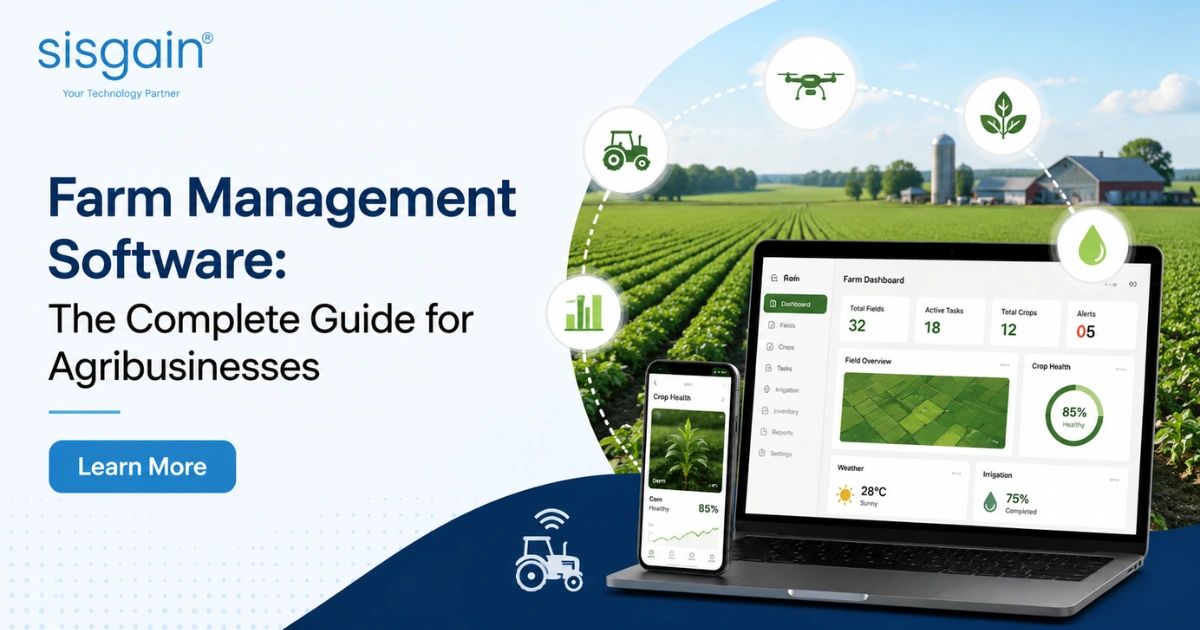
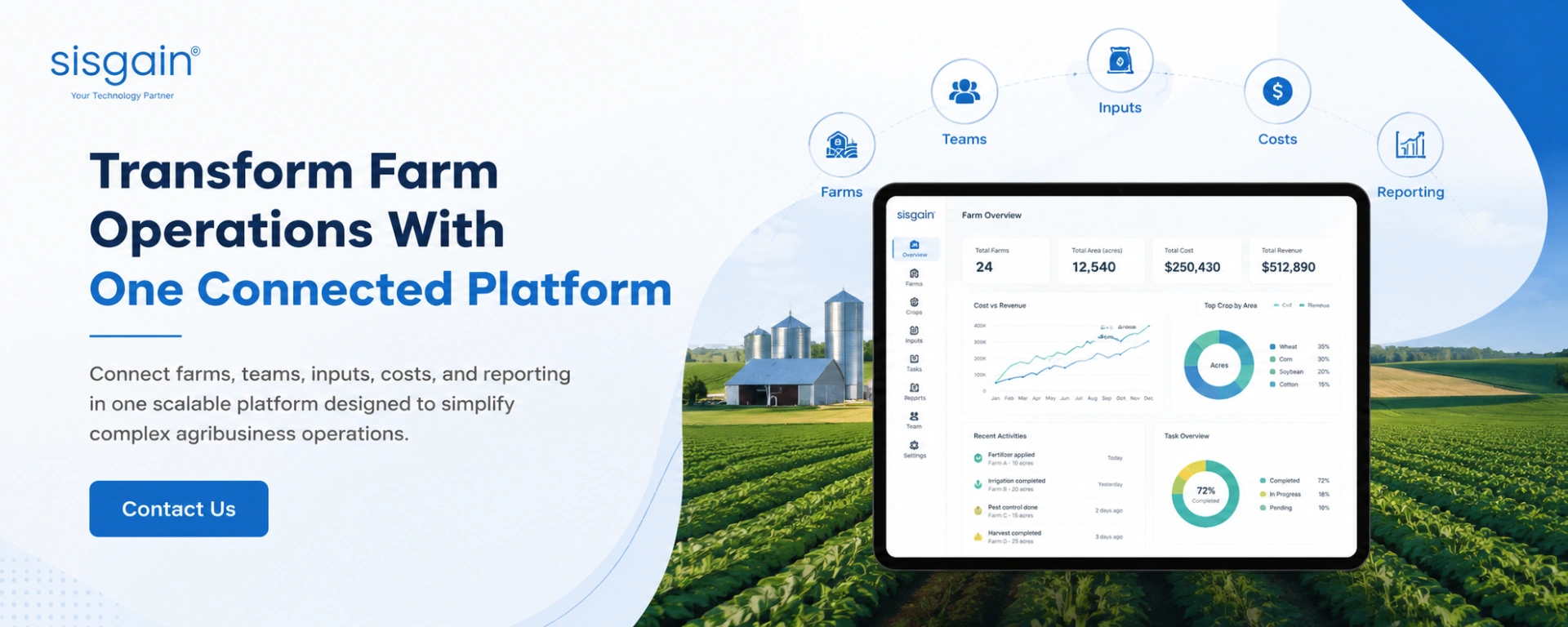
A farm management platform turns scattered field, financial, workforce, and asset data into a connected operating model for better agribusiness decisions.
It's worth being precise about what that means, because "farm management software" gets used loosely. It is not simply a digital diary for logging farm activities — that's what a notes app or a basic mobile form already does. For a growing agricultural enterprise, it functions as an operational system of record: one place where planning, execution, monitoring, reporting, and continuous improvement all draw from the same data.
This guide walks through what farm management software actually does, why it matters more now than it did five years ago, how to evaluate a platform without getting lost in feature lists, and when a custom-built agritech platform makes more sense than an off-the-shelf tool.
Quick Answers About Farm Management Software
What is farm management software? It's a centralized digital platform that helps agricultural businesses plan, record, monitor, and analyze farm operations — crops, labor, inputs, equipment, costs, inventory, and field activities — in one connected system rather than scattered across spreadsheets and paper records.
How does it help agribusinesses? It improves operational visibility, cuts down on manual reporting, supports tighter control over inputs and workforce, simplifies traceability, and gives management more accurate cost and performance data to act on.
Is farm management software the same as precision agriculture? No. Precision agriculture is an approach — using data and technology to apply agricultural resources more precisely. Farm management software is the operational platform that organizes the workflows, records, and decisions surrounding that approach. One is a methodology; the other is the system that runs it.
Who actually needs an agritech platform? Large farms, multi-site agribusinesses, plantations, greenhouse operators, livestock businesses, cooperatives, food producers, and any agricultural enterprise whose operations have outgrown what a spreadsheet can reliably hold.
What Is Farm Management Software?
From Farm Record-Keeping to an Operational System of Record
Basic farm tools typically record isolated events: planting dates, irrigation logs, fertilizer applications, worker attendance, machinery usage. Each of those records is useful in isolation, but they answer narrow questions — "did we water field 4 on Tuesday?" — rather than the questions management actually needs answered, like "which fields are costing more per hectare than planned, and why?"
Modern farm management software is built to answer the second kind of question, because it connects the data instead of just storing it. A fertilizer application isn't just a log entry; it's linked to a specific field, a specific crop cycle, a cost center, and an inventory deduction — all in the same system, all query-able together.
What Data Can a Farm Management Platform Actually Connect?
A capable platform brings together:
- Farms and operational sites
- Fields and geographic zones
- Crops and production cycles
- Inputs and inventory (seed, fertilizer, chemicals, feed, fuel)
- Workers and contractors
- Equipment and machinery
- Irrigation activity
- Financial and operational costs
- Suppliers and procurement
- Quality and traceability records
- IoT and sensor data
- GPS and geospatial information
None of these data types is new to agriculture — farms have always tracked most of them in some form. What changes with a connected platform is that they live in relation to each other, so a cost overrun on one field can be traced back to a specific input batch, worker, or delayed task instead of staying a mystery in a spreadsheet.
This is also where farm software starts to overlap with broader technology solutions for modern agribusiness — GIS mapping, enterprise reporting, and connected devices increasingly sit under one digital ecosystem rather than as separate purchases.
Why Agribusinesses Need Farm Management Software Now
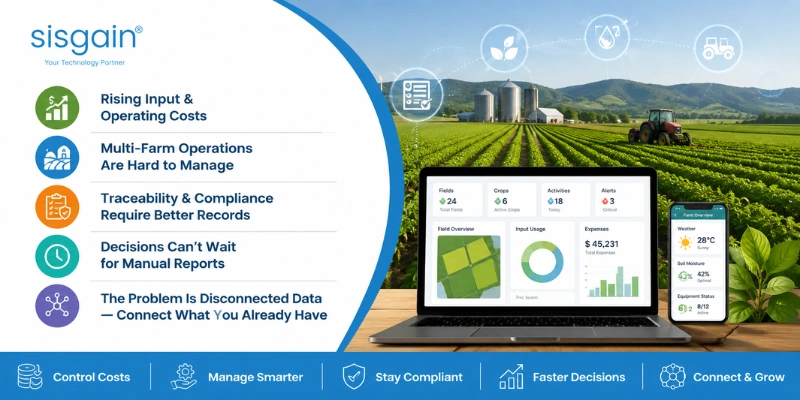
Rising Input and Operating Costs
When fertilizer, fuel, feed, and labor costs climb, the question stops being "are we spending too much?" and becomes "where, specifically, is the spending happening, and does it match the plan?" Fragmented records make that second question almost impossible to answer quickly — by the time a manual report surfaces a variance, the season that caused it is often over.
Multi-Farm Operations Are Hard to Manage Through Spreadsheets
A single farm can run on a spreadsheet for years. A multi-farm operation running different crop cycles, regional teams, contractors, equipment fleets, and local suppliers usually can't — not because spreadsheets are bad tools, but because they were never built for real-time, multi-user, multi-location coordination. Every additional site multiplies the number of disconnected files, and reconciling them becomes its own part-time job.
Traceability and Compliance Require Better Records
Buyers, auditors, and regulators increasingly expect structured, accessible records across production and supply-chain workflows — not a folder of scanned paper logs. A connected system makes that traceability a byproduct of normal operations instead of a scramble before an audit.
Management Decisions Cannot Wait for Manual Reports
There's a structural lag in most agribusinesses between what happens in a field on Monday and what a manager finds out about it. If that gap is a week, decisions are made on stale information — and by the time a problem is visible, the cost of it has already been incurred.
The Problem Is Not a Lack of Data — It Is Disconnected Data
This is worth stating plainly: most agribusinesses evaluating software already have sensors, ERP systems, GPS-enabled equipment, accounting software, and mobile messaging tools in use. The issue is rarely that data doesn't exist — it's that none of these systems talk to each other, so nobody has a single, reliable operating view. Adding another disconnected tool to the pile doesn't fix that. Connecting the existing ones does.
How Farm Management Software Works
1. Data Is Captured
Sources typically include field teams using mobile apps, supervisors, IoT sensors, GPS-enabled machinery, weather services, satellite imagery, drones, ERP and accounting systems, and inventory or procurement systems.
2. Data Is Organized Around Farm Operations
Rather than sitting in disconnected tables, the data is structured around how operations actually flow:
Farm → Field → Crop → Activity → Input → Worker → Asset → Cost → Outcome
3. The Platform Creates Operational Visibility
Dashboards, alerts, and role-based reports turn raw records into something a manager can act on without needing to ask five different people for updates.
4. Teams Take Action
That visibility translates into concrete moves: reassigning a field task, investigating unusual input consumption, scheduling machinery maintenance, responding to an irrigation alert, reviewing a cost overrun, or catching a delayed activity before it cascades into the next one.
Underneath this flow, data typically moves between existing systems through farm management software integration — APIs and connectors that let the platform pull from and push to the tools an organization already runs, rather than replacing them outright.
Core Features of Farm Management Software
Field and Crop Planning
Crop calendars, field allocation, seasonal planning, and activity scheduling give teams a shared production plan instead of individual mental models of what should happen when.
Farm Activity and Task Management
Assigning, tracking, and approving field tasks creates operational accountability — it becomes visible when something is delayed, not just eventually obvious once it affects output.
Input Inventory Management
Tracking seeds, fertilizers, chemicals, feed, and fuel in one system gives better visibility into consumption and tighter control over what's actually being used versus what was planned.
Irrigation Management
Scheduling, monitoring, and water-use records — often paired with smart irrigation integrations — help catch both under- and over-watering before it affects a crop cycle.
Labor and Workforce Management
Task assignment, attendance, productivity tracking, contractor management, and supervisor approvals reduce dependence on verbal updates and give a structured record of who did what, where.
Machinery and Asset Management
Equipment records, utilization tracking, maintenance schedules, and breakdown history open the door to predictive maintenance — catching wear before it causes downtime.
Financial and Cost Tracking
Cost analysis broken down by farm, field, crop, activity, or production cycle turns "we spent too much this quarter" into "field 6's fertilizer cost per hectare is 30% above plan."
Traceability and Compliance Management
Production records, batch information, input history, and quality records create an audit trail that exists because of normal operations, not because someone assembled it under deadline.
GIS and Farm Mapping
Field boundaries, geographic zones, asset locations, and visual mapping turn abstract records into something a manager can actually look at and understand spatially.
Mobile and Offline Access
This is a genuinely non-negotiable requirement, not a nice-to-have. Field connectivity is often unreliable, and software that stops working the moment a worker loses signal doesn't get adopted. Platforms built for agriculture need offline data capture with later synchronization — a capability closely tied to broader mobile app development solutions built for field conditions rather than office environments.
Executive Dashboards and Reporting
Farm owners, COOs, agronomists, and finance teams each need a different view of the same underlying data — and a platform should be able to serve all of them without forcing everyone into one generic dashboard.
Farm Management Software vs. Spreadsheets
|
Capability |
Spreadsheets and Manual Records |
Farm Management Software |
|
Multi-user collaboration |
Limited |
Centralized |
|
Real-time operational visibility |
Manual |
Structured and faster |
|
Mobile field data capture |
Difficult |
Built for mobile workflows |
|
Task accountability |
Fragmented |
Workflow-based |
|
Multi-farm reporting |
Complex |
Consolidated |
|
Integrations |
Manual or limited |
API-driven |
|
Traceability |
Difficult to maintain |
Structured records |
|
Access control |
Basic |
Role-based |
|
Scalability |
Declines as complexity grows |
Designed for expansion |
Spreadsheets aren't inherently a bad tool — they're just not built for the point where operational complexity outpaces one team's ability to keep records accurate, timely, and connected. For a single farm with one crop cycle, that point may never arrive. For a multi-site agribusiness, it usually already has.
Farm Management Software vs. Precision Agriculture
These two terms get used almost interchangeably, but they describe different layers of the same operation.
Farm management software focuses on organizing and managing operations, workflows, records, costs, tasks, assets, and reporting — the operational backbone.
Precision agriculture focuses on using data and technology to support more precise agricultural decisions and resource application — the decision layer, often powered by sensors, GPS equipment, drones, and satellite imagery.
The two work together rather than competing: a precision agriculture program generates a stream of granular field data, and a connected agritech platform for agribusiness is what organizes that data within the broader operational workflow — turning a sensor reading into a task, a cost record, or a report, rather than leaving it as an isolated data point.
Business Benefits of Farm Management Software
Better Input Control and Lower Operational Waste
Visibility doesn't eliminate waste by itself, but it makes waste visible — managers can compare planned versus actual input use and investigate deviations while there's still time to act on them.
Faster Operational Decisions
When field data reaches a dashboard in near real time instead of a weekly summary, the decision that depends on it can happen days earlier.
Improved Labor Productivity and Accountability
Structured task workflows reduce reliance on verbal updates and scattered messaging threads, replacing them with a record everyone can see.
More Accurate Cost Visibility
Costs become traceable per field, crop, production cycle, or activity — rather than only visible as one large number at the end of the season.
Easier Multi-Site Coordination
This is where the value compounds fastest for large and multi-farm agribusinesses specifically: one system, one set of standardized workflows, and consolidated reporting across every site instead of a patchwork of local processes.
Stronger Traceability and Audit Readiness
Records exist because they were captured during normal operations, which means an audit or buyer inquiry doesn't require weeks of reconstruction.
More Reliable Management Reporting
Reports pull from the same underlying data that field teams entered, rather than being manually reassembled and prone to transcription error.
A Scalable Digital Foundation
A connected platform is also the foundation that later integrations — AI, automation, supply-chain systems — actually plug into. Without it, those technologies have nothing reliable to connect to.
Important: Software does not automatically increase farm productivity. Its value depends on reliable data entry, workflow adoption, management discipline, integration quality, and whether teams actually act on the insights it surfaces. A platform is a tool for a well-run operation — it doesn't substitute for one.
Use Cases by Agribusiness Type
Multi-Farm Agribusiness Enterprises
Centralized visibility across locations, standardized workflows, consolidated reporting, and role-based access — this is the segment where the operational case for a connected platform is strongest.
Commercial Crop Farms
Field planning, input tracking, crop activity logging, machinery management, and cost reporting tied directly to yield outcomes.
Horticulture and Greenhouse Operations
Environmental monitoring, tight production schedules, labor-intensive workflows, and batch-level traceability for controlled-environment growing.
Livestock Businesses
Animal records, feed management, health tracking, breeding data, production records, and relevant asset management.
Plantations
Geographically distributed operations, workforce management across large areas, harvesting workflows, asset tracking, and production reporting at scale.
Dairy Operations
Livestock records, feeding schedules, production data, equipment tracking, and operational reporting specific to dairy cycles.
Contract Farming Programs
Coordination across growers, field activity tracking, quality standards, procurement, and traceability across multiple independent operators.
Agricultural Cooperatives
Member coordination, shared services, input distribution, production records, and reporting that serves multiple stakeholders at once.
Food and Agricultural Supply Chains
Connecting farm-level data with processing, warehousing, quality control, and downstream traceability — extending the platform's value beyond the farm gate.
Data, Integrations, and the Connected Agritech Ecosystem
For an enterprise buyer, interoperability isn't a bonus feature — it's a baseline requirement.
ERP Integration for Agribusiness
Operational farm data usually needs to connect with finance, procurement, inventory, and enterprise reporting systems. Strong ERP integration for agribusiness means input costs, labor hours, and inventory movements flow into the finance system automatically instead of being re-entered by hand.
CRM Software for Agribusinesses
Production operations increasingly need to connect with customer, distributor, buyer, or grower relationships — which is where dedicated CRM software for agribusinesses comes in, linking what's happening on the farm to who's buying it.
IoT Solutions for Smart Farming
Sensors, connected irrigation, environmental monitoring, and equipment telemetry generate a constant stream of data. IoT solutions for smart farming are what convert that stream into automated data capture rather than one more manual entry task.
Weather, Satellite, Drone, and GPS Data
The goal with external and machine-generated data isn't collecting more of it — it's converting it into operational context: a weather forecast that changes a task schedule, a satellite image that flags a stressed field.
Cloud Infrastructure
Scalability, availability, remote access, and centralized management all depend on solid underlying infrastructure. This is where Cloud Architecture & Infrastructure Services and managed cloud infrastructure for agribusiness become part of the conversation — the platform is only as reliable as what it runs on.
APIs and Farm Management Software Integration
API readiness should be part of the buying process from day one, particularly for enterprises already running multiple systems. Ask how a platform handles farm management software integration before signing anything — retrofitting integrations after deployment is far more expensive than evaluating for them upfront.
Secure Agricultural Data Management
None of this matters if the data isn't secure. Secure agricultural data management covers role-based access, data backups, encryption, audit logs, clear data ownership, vendor responsibilities, and integration security — questions worth asking explicitly rather than assuming are covered.
How to Choose the Right Agritech Platform
1. Start With the Operational Problem
Not a feature checklist. Ask: Where do we lose the most time? Which reports are unreliable? Where is input waste hardest to identify? Which processes still depend too heavily on spreadsheets? Where does data get entered more than once?
2. Check Whether It Supports Real Farm Workflows
Generic project-management software rarely maps cleanly onto how field operations actually run. Look for a platform built around agricultural workflows specifically.
3. Evaluate Mobile and Offline Capabilities
Test this in the field, not in a demo with perfect Wi-Fi. Offline sync quality is one of the biggest gaps between vendors.
4. Assess Integration and API Readiness
Confirm it can connect to the ERP, accounting, and IoT systems already in use — not just that it "supports integrations" in marketing copy.
5. Review Data Ownership and Security
Who owns the data once it's in the platform? What happens to it if the contract ends?
6. Check Multi-Farm Scalability
A platform that works well for one site doesn't automatically work well for twenty. Ask specifically about multi-site reporting and role management.
7. Evaluate Reporting for Different Decision-Makers
A farm owner, a COO, and an agronomist need different views of the same data — check that the platform can serve all three.
8. Consider Local Languages and Localization
For field teams working in a local language different from head-office reporting, this affects real-world adoption more than most buyers expect going in.
9. Review Implementation and Training Support
A platform with excellent features and no implementation support often ends up half-adopted.
10. Calculate Total Cost of Ownership
Look beyond the license or development fee: infrastructure, integrations, data migration, training, maintenance, support, and future customization all add up.
Custom Farm Management Software vs. Off-the-Shelf Software
When Off-the-Shelf Software May Be Suitable
Standard workflows, smaller operational complexity, limited integration needs, or a need to deploy quickly all favor an off-the-shelf platform. There's no reason to build custom software to solve a problem a existing product already solves well.
When Custom Development May Be the Better Choice
Complex multi-farm workflows, unique production processes, legacy-system integrations, custom dashboards, local language requirements, specialized traceability needs, proprietary operational methods, or enterprise data governance requirements all push toward custom software development.
Custom development isn't automatically the "premium" or better option — it becomes strategically relevant specifically when the cost of forcing operations into a generic workflow exceeds the cost of building a platform around how the organization actually works.
How to Implement Farm Management Software Successfully
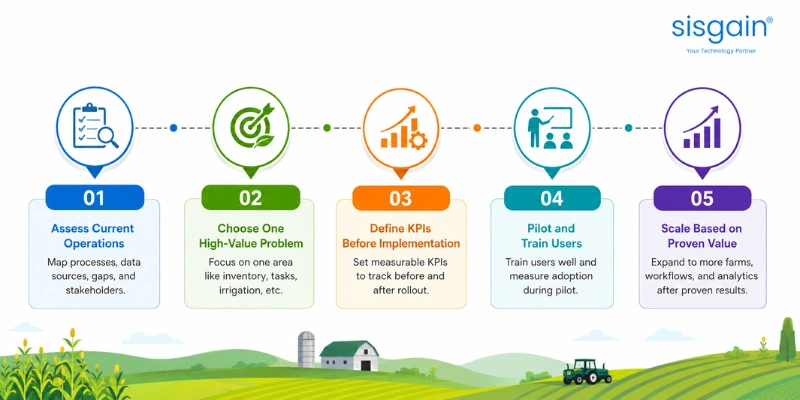
Phase 1 — Assess Current Operations. Map current systems, manual processes, data sources, reporting gaps, and stakeholders before evaluating any software.
Phase 2 — Choose One High-Value Problem. Input inventory, field task tracking, irrigation monitoring, traceability, or machinery management — pick one, not all five.
Phase 3 — Define KPIs Before Implementation. Manual reporting hours, data-entry duplication, inventory variance, task completion delays, input usage variance, and reporting turnaround time are all measurable before and after rollout.
Phase 4 — Pilot and Train Users. Adoption should be measured, not assumed — a platform nobody uses correctly generates worse data than the spreadsheet it replaced.
Phase 5 — Scale Based on Proven Value. Expand to additional farms, integrations, workflows, and analytics only once the pilot has demonstrated measurable value.
Common Challenges When Adopting Farm Management Software
Poor data quality, weak internet connectivity, low digital adoption among field teams, fragmented legacy systems, unclear data ownership, overly complex implementations, choosing software before defining requirements, and trying to digitize everything at once are the recurring failure points across agribusiness technology rollouts.
The goal isn't to digitize every process immediately. It's to build a reliable digital operating model around the processes where better visibility and control produce measurable business value — then expand from there.
How AI Is Changing Farm Management Software
AI-Powered Recommendations
Applications include identifying operational anomalies, prioritizing alerts, supporting forecasts, recognizing patterns, and assisting decisions — layered on top of the operational data a connected platform already holds. This is the direction AI-powered farm management software is heading: not replacing the operational backbone, but making it smarter.
AI Assistants for Farm Operations
Conversational interfaces can help managers retrieve reports, summarize field activity, flag overdue tasks, or query operational data in plain language instead of navigating a dashboard manually — an emerging category covered by AI assistants for farm operations.
Predictive Maintenance
Machine data can help identify maintenance risk before a failure becomes a disruptive breakdown, using patterns in usage and sensor readings rather than fixed maintenance schedules alone.
Computer Vision
Potential applications include crop observation, quality assessment, and automated visual analysis — early-stage but expanding quickly across horticulture and greenhouse operations in particular.
Climate and Operational Risk Alerts
Emerging systems combine weather, historical, and operational data to improve risk awareness ahead of events rather than reacting after them.
It's worth being direct here: AI can support faster detection and better-informed decisions, but results depend heavily on the reliability of the underlying data. An AI layer built on top of disconnected or inconsistent records inherits those same weaknesses.
The Future of Farm Management Software
The clearest trend is a shift from standalone software toward connected agricultural operating systems — AI-assisted decisions, connected IoT ecosystems, automated workflows, predictive maintenance, computer vision, digital traceability, sustainability and carbon reporting, connected supply chains, greater API interoperability, and mobile-first, offline-first field applications.
The future of this space is unlikely to be one application replacing every agricultural system a business runs. It's more likely to be a connected architecture where farm, financial, workforce, IoT, and supply-chain systems exchange reliable data through secure integrations — each doing what it does best, tied together by a platform that keeps them talking to each other.
Farm Management Software ROI: What Should Agribusinesses Measure?
A simplified way to frame ROI:
Estimated Annual Value = Reduced manual reporting costs + Reduced avoidable input variance + Reduced operational delays + Improved asset utilization + Time saved through automation − Annual software and implementation costs
This is a framework for thinking, not a formula that produces a guaranteed number. Estimated savings should never be presented as certain outcomes — ROI needs to be calculated against an agribusiness's own baseline data and verified after implementation, not assumed in advance.
Useful inputs for this calculation include the number of farms, number of workers, weekly reporting hours, average labor cost, annual input expenditure, estimated avoidable waste, and current software costs. The outputs worth tracking are estimated manual-operation cost, potential reporting-efficiency gains, the potential value of improved input visibility, and an indicative payback period.
Farm Management Software Evaluation Checklist
- Supports our highest-priority operational problem
- Works across multiple farms or sites
- Provides mobile access
- Supports offline workflows where needed
- Integrates with ERP or accounting systems
- Supports IoT and external data sources
- Provides API access
- Supports role-based permissions
- Provides the reporting and dashboards we actually need
- Clarifies data ownership
- Meets our security requirements
- Supports future scalability
- Includes implementation support
- Fits our total cost-of-ownership budget
Build a Connected Agritech Platform for Your Agribusiness
Every agribusiness has different workflows, data sources, and operational priorities. The right farm management platform should connect to the way your teams actually work — not force critical operations into disconnected tools and manual processes.
SISGAIN works with agribusinesses to design and build connected digital platforms that bring together farm operations, mobile applications, AI capabilities, IoT data, cloud infrastructure, enterprise systems, and secure integrations under one operational model.
Talk to an Agritech Platform Consultant
Or explore a more specific starting point:
- Request a Farm Software Integration Assessment
- Build a Custom Farm Management Platform
- Evaluate Your Agribusiness Digital Readiness
Summary Box: Farm Management Software in One View
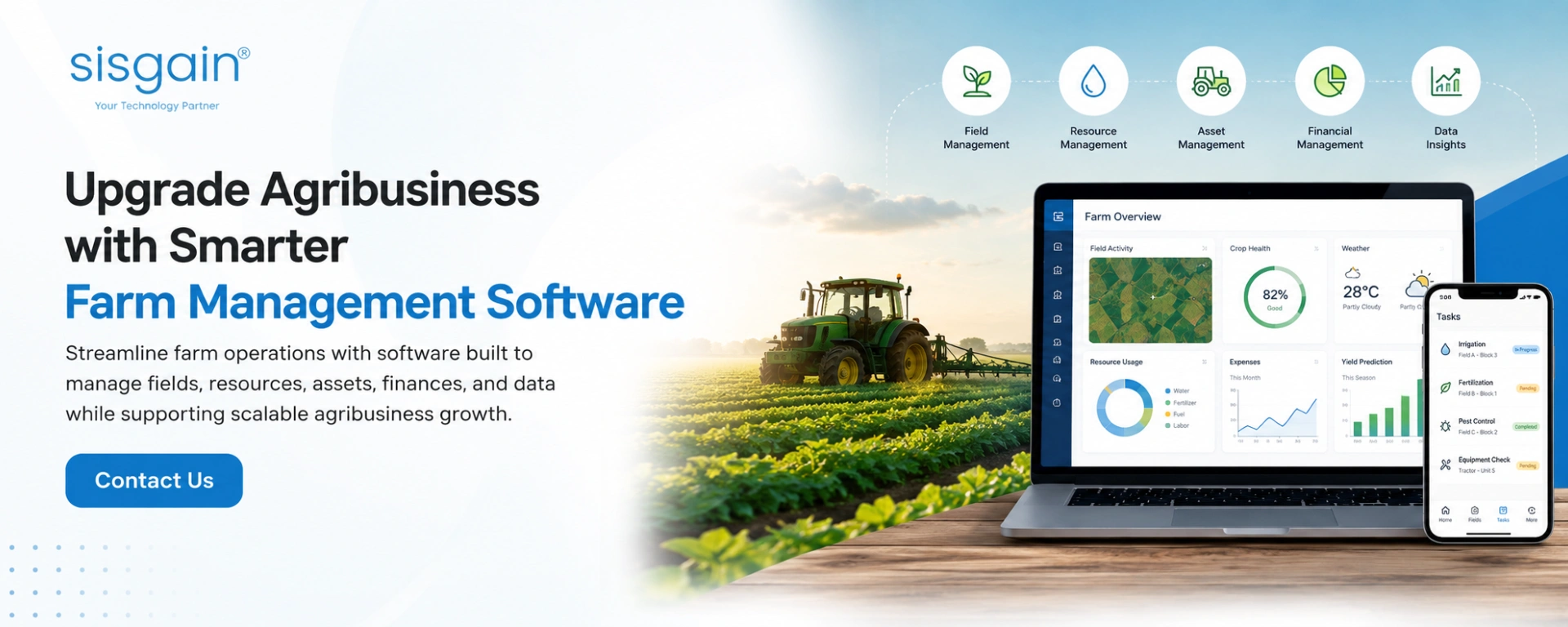
A modern farm management software platform is best understood as an operational foundation for agribusiness, not a simple farm-recording tool. It connects field activities, workers, inputs, assets, financial information, traceability records, and external technologies into one unified operating model.
For large and multi-farm agribusinesses, the real buying question isn't "which software has the most features?" It's:
Which platform can support our actual workflows, connect with our existing systems, provide reliable operational data, and scale as the business grows?
The strongest implementations start with one measurable operational problem, build reliable data and user adoption around it, and only then expand into integrations, automation, AI, IoT, and broader enterprise capabilities. This farm management software guide is a starting point for that evaluation — the right agritech platform for agribusiness is ultimately the one built around how your operation actually runs, not the one with the longest feature list.