

Managing one gym is a scheduling problem. Managing twenty is a data problem — and most gym chains don't realize the shift has happened until the spreadsheets stop lining up.
A single location can run on a booking app, a POS terminal, and a group chat with the front-desk team. Add a fourth or fifth branch and that same setup starts leaking money: a member cancels at one location but still gets billed at another, a promotion runs at one branch and confuses staff at the next, and the owner finds out about a retention problem three months after it started. Gym management software exists to close that gap. It's the operating system that keeps memberships, billing, bookings, staff schedules, access control, and reporting synchronized across every location a chain operates.
This guide is built for people running that decision: gym-chain founders, COOs, franchise leads, and operations managers who need more than a features list. It covers what gym management software actually does, how it differs from a member-facing fitness app platform for fitness businesses, how AI is changing both in 2026, and how to decide whether to buy, build, or blend the two.
Quick Answers: Gym Management Software at a Glance
What is gym management software? Gym management software is a centralized platform that runs the operational and commercial side of a fitness business — memberships, billing, scheduling, CRM, staff management, access control, and reporting — across one or many locations, from a single dashboard.
Who needs it? Independent gyms, multi-location fitness businesses, gym chains, franchises, health clubs, and boutique fitness brands all use some version of it. The complexity of the platform should scale with the complexity of the business, not the other way around.
What are the most important features? Membership management, recurring billing, a gym-specific CRM, scheduling, multi-location dashboards, access control integration, reporting, and a connected member app.
Can it include a mobile app? Yes — and for a chain, it usually should. The management software runs the back office; the mobile app is the layer members actually touch. The two should share data in real time rather than operate as separate systems.
Should a gym chain build or buy? Buy when you need standardized workflows and fast deployment. Build custom software when your membership models, franchise structure, or member experience are different enough that off-the-shelf tools force you to compromise. Many mature chains end up somewhere in between.
What Is Gym Management Software, Exactly?
Strip away the marketing language and gym management software is a platform that handles the operational and commercial mechanics of running a fitness business: onboarding new members, setting up membership plans, processing recurring payments, managing class and facility bookings, tracking leads through a sales pipeline, coordinating trainer schedules, running point-of-sale transactions, sending member communications, controlling facility access, and reporting on all of it.
It's worth being precise here, because the category gets muddied constantly. A booking app that lets members reserve a spot in a spin class is not, on its own, gym management software — it's one feature of it. A POS system that processes protein-shake purchases at the front desk is not a complete management platform. And a slick member-facing mobile app, however polished, is not the operational backend that actually runs the business. Gym management software is the sum of all of these working together, not any single piece of it.
Single Gym vs. Gym Chain: The Requirements Are Not the Same
A single-location gym can get away with simple tools because there's only one version of the truth to manage. A chain can't. The moment a business operates more than one location, the same categories of work — membership, reporting, pricing, access — split into two layers: what headquarters controls, and what each branch needs the flexibility to run locally.
|
Capability |
Single Gym |
Gym Chain |
|
Membership management |
One location, one rule set |
Centralized across locations, with branch exceptions |
|
Reporting |
Location-level only |
Branch-level and executive-level, side by side |
|
Access permissions |
Simple, usually one admin tier |
Role-based and location-based |
|
Pricing |
Set locally |
Standardized, with controlled local variance |
|
Member experience |
Defined by one facility |
Has to feel consistent across every branch |
|
Staff management |
Local schedule, local payroll |
Branch visibility rolled up to organizational view |
|
Analytics |
Basic attendance and revenue reports |
Cross-location performance comparison |
The core problem chains run into isn't a lack of software — it's that they scale locations faster than they centralize data. A fourth location gets opened before anyone has decided who owns pricing decisions, and by the time there are eight, nobody at headquarters can say with confidence what a "standard membership" even costs across the network.
Why Gym Chains Actually Need This Software
It's tempting to frame management software as a time-saver. That undersells it. For a chain, the right platform changes what leadership can see and how fast they can act on it.
1. Centralized Control Without Killing Local Flexibility
Headquarters needs visibility into active memberships, revenue, attendance, class utilization, branch performance, cancellation rates, and sales pipeline health — across every location, in one view. But centralization done badly strips branch managers of the ability to run their location day to day. The systems that work well strike a balance: central governance, with controlled room for branch-level decisions. A branch manager should be able to comp a class or adjust a local promotion without filing a support ticket to corporate.
2. A Member Experience That Doesn't Reset at Every Location
Members increasingly expect their membership to just work, regardless of which branch they walk into. That means a unified profile, consistent booking rules, one payment method on file, synced notifications, and offers that don't contradict each other from location to location. Nothing erodes trust faster than a member being told at Branch B that their membership from Branch A "isn't in the system."
3. Billing That Runs Itself — Mostly
Recurring subscriptions, payment reminders, failed-payment recovery, refunds, invoices, membership upgrades, freezes, and renewals eat an enormous amount of admin time when handled manually across multiple locations. Automating this reduces the manual load significantly, but it doesn't eliminate the need for a finance team — reconciliation and exception handling (a failed payment retry that still fails, a disputed charge) still require a human to close the loop.
4. Turning Leads Into Members Faster
The path from a stranger discovering your gym to becoming a paying member follows a predictable shape: lead → inquiry → trial → follow-up → membership → onboarding. A gym-specific CRM built into the management platform handles lead capture, automated follow-up reminders, pipeline stages, trial tracking, and conversion reporting — so a promising lead doesn't go cold because a sales rep forgot to call back.
This is also where automation starts to pay for itself. AI Chatbot Development Services can handle the first wave of inquiries — answering pricing questions, qualifying leads, and booking trial sessions — before a human ever needs to step in, which matters most for chains fielding inquiries across a dozen locations at once.
5. Retention Through Data, Not Guesswork
Attendance trends, booking frequency, engagement signals, and cancellation patterns tell a story about who's about to churn — if anyone's actually looking at them. This is where the AI conversation gets overstated in most marketing material, so it's worth being precise: AI doesn't stop cancellations on its own. What it can do is flag patterns associated with disengagement — a member who booked four classes a week and hasn't shown up in three weeks — early enough that a retention team can actually act on it. The intervention still has to come from a person.
For chains building this kind of operational intelligence into their workflow, Building High-Performance AI Agents covers how automated agents can support staff with these tasks rather than replace the judgment call entirely.
How Gym Management Software Actually Works
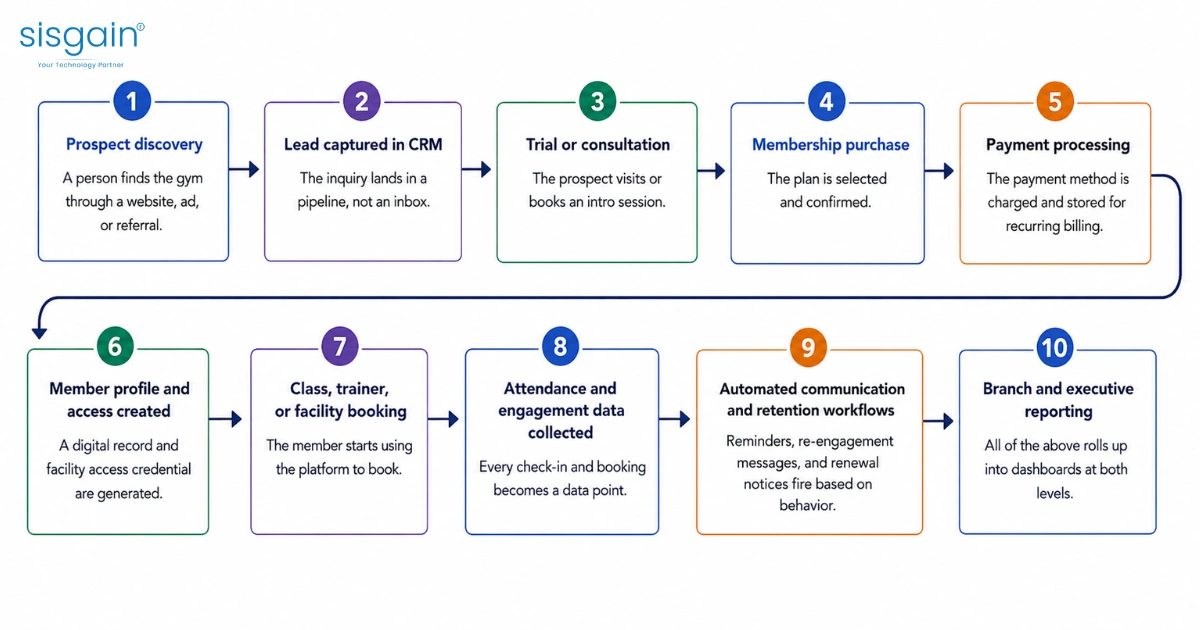
It helps to see the full loop, not just the feature list. A typical operational workflow runs like this:
- Prospect discovery — a person finds the gym through a website, ad, or referral.
- Lead captured in CRM — the inquiry lands in a pipeline, not an inbox.
- Trial or consultation — the prospect visits or books an intro session.
- Membership purchase — the plan is selected and confirmed.
- Payment processing — the payment method is charged and stored for recurring billing.
- Member profile and access created — a digital record and facility access credential are generated.
- Class, trainer, or facility booking — the member starts using the platform to book.
- Attendance and engagement data collected — every check-in and booking becomes a data point.
- Automated communication and retention workflows — reminders, re-engagement messages, and renewal notices fire based on behavior.
- Branch and executive reporting — all of the above rolls up into dashboards at both levels.
The Member's Side of That Loop
From the member's perspective, none of that machinery is visible — it just needs to feel effortless. They discover the gym, submit an inquiry, get a follow-up call, buy a membership, and receive access through a card, QR code, or biometric scan. From there, they lean on the fitness app platform for fitness to book classes, check schedules, make payments, track workouts, get notified about changes, and access any digital content the gym offers. Every one of those interactions feeds data back into the management platform — which is exactly why the two systems need to talk to each other in real time, not on a nightly batch sync.
Essential Features of Gym Management Software for Gym Chains
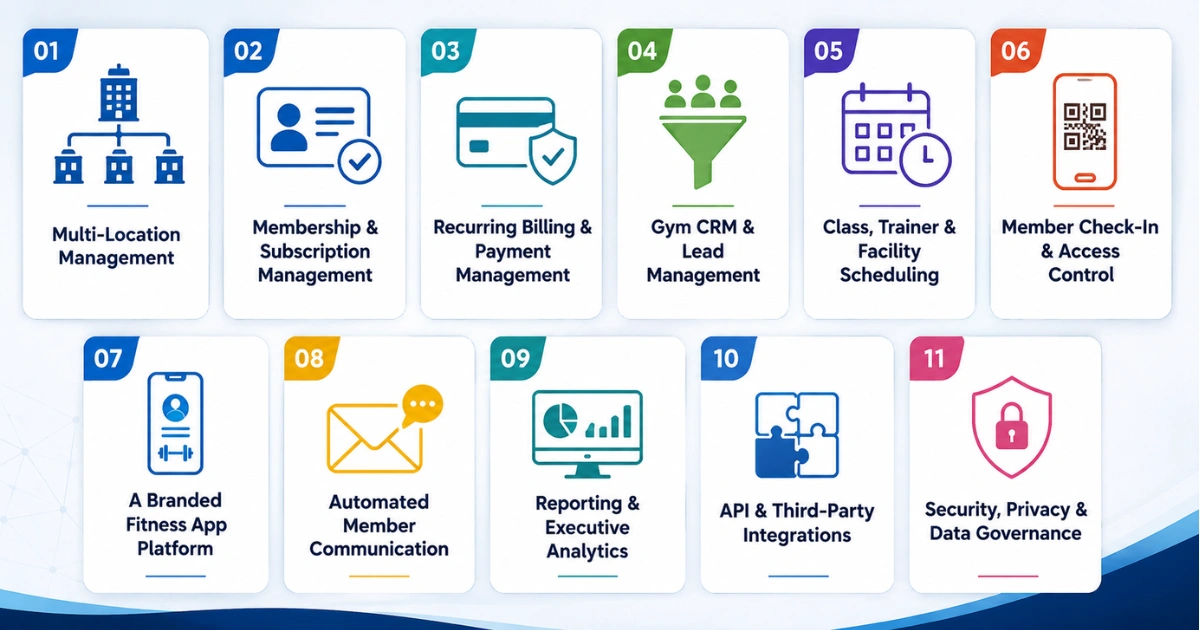
1. Multi-Location Management
A parent-organization dashboard sitting above individual branch accounts, with central membership policies, location-specific exceptions, branch-level reporting, franchise management tools, and role-based administration so a regional manager sees more than a front-desk clerk but less than the CFO.
2. Membership and Subscription Management
Monthly plans, annual plans, class packages, family memberships, corporate accounts, trials, freezes, upgrades, and renewals — all governed by rules that apply consistently whether the member signed up at the flagship location or a satellite branch opened six months ago.
3. Recurring Billing and Payment Management
Recurring payments, gateway integration, failed-payment recovery sequences, refunds, invoices, and reconciliation. This is also where security stops being optional. Payment data moving through a multi-location system needs the kind of protection that comes from secure application development uae practices — proper encryption, tokenized payment storage, and authentication that doesn't rely on a single shared password across branches.
4. Gym CRM and Lead Management
Lead sources, pipeline stages, automated follow-up, trial tracking, sales performance reporting, and conversion analytics. AI-assisted lead prioritization can help a sales team focus on the inquiries most likely to convert, though it works best as a sorting tool, not a replacement for a rep who knows how to close.
5. Class, Trainer, and Facility Scheduling
Class calendars, trainer availability, capacity limits, waitlists, automated cancellation handling, room allocation, and equipment booking — the operational layer that keeps a facility from double-booking its one squat rack during peak hours.
6. Member Check-In and Access Control
Integration with QR codes, RFID cards, mobile access, biometric systems, and smart locks. The detail that gets overlooked here: access-control systems need to sync membership status in near real time. A member who cancels at 9 a.m. shouldn't still be able to badge into a different branch at 9:15.
7. A Branded Fitness App Platform
This is where the operational backend becomes something members actually see and use — managing memberships, booking sessions, paying, viewing workout plans, tracking progress, receiving push notifications, and participating in loyalty or referral programs. For chains that want a member-facing product closer to what people expect from consumer fitness apps, custom fitness app development in Dubai covers building that layer specifically for a chain's brand and workflows, and Fitness App Like MyFitnessPal is the reference point when the goal includes workout tracking, progress monitoring, and nutrition features rather than just booking and payments.
8. Automated Member Communication
Email, SMS, push notifications, membership reminders, booking updates, waitlist alerts, renewal notices, and re-engagement campaigns — the connective tissue that keeps members informed without requiring a staff member to send every message manually.
9. Reporting and Executive Analytics
Branch managers need daily attendance, sales, class utilization, and staff performance. Headquarters needs cross-location revenue, membership growth, retention trends, branch comparisons, and strategic KPIs. Both views should come from the same underlying data — reported at different altitudes, not from different sources.
10. API and Third-Party Integrations
Payment gateways, accounting platforms, CRM systems, marketing automation, access control, wearables, BI tools, and AI systems all need to plug into the core platform. This is also usually where things break in practice — an integration that worked fine at three locations starts dropping data at fifteen. IT Support Services covers the ongoing monitoring and maintenance that keeps a multi-system stack from quietly failing in the background.
11. Security, Privacy, and Data Governance
Role-based access control, multi-factor authentication, encryption, audit logs, backups, consent management, and data retention policies. A word of caution worth including here: specific legal compliance claims should only be made after jurisdiction-specific legal review — "secure" and "compliant" are not interchangeable terms.
Gym Management Software vs. Fitness App Platform: What's the Actual Difference?
This distinction trips up a lot of buyers, and it's worth spelling out clearly because the two are often sold — and bought — as if they're the same thing.
|
Area |
Gym Management Software |
Fitness App Platform |
|
Primary users |
Administrators and staff |
Members and prospects |
|
Primary purpose |
Run business operations |
Deliver a digital member experience |
|
Core capabilities |
Billing, CRM, scheduling, reporting |
Booking, workouts, payments, notifications |
|
Main value |
Operational control |
Engagement and loyalty |
|
Deployment focus |
Internal operations |
Member-facing experience |
|
Best architecture |
Centralized backend |
Integrated branded front end |
Neither one replaces the other. The strongest setup is one connected ecosystem where the backend and the member app exchange data in real time — because when they don't, you get the failure modes every multi-location operator has run into: duplicate member profiles, booking conflicts between systems, membership status that says "active" in one place and "expired" in another, and communication that contradicts itself depending on which channel the member checks.

Why Chains Need a Branded App, Not Just a Booking Tool
Self-service that doesn't add to staff workload. Members managing their own bookings, payments, and freezes means fewer front-desk interruptions for routine requests.
A consistent digital brand. A generic third-party booking app puts someone else's logo between your gym and your member. A branded app reinforces the business every time it's opened.
Personalization that's actually useful. Recommendations and communication tailored to membership type, location, activity history, and stated goals — not a generic blast to the entire member list.
Hybrid fitness experiences. Digital content, remote coaching, and connected workout programs extend the relationship beyond the four walls of a physical location, which matters more every year as members expect some flexibility between in-person and at-home training.
How AI Is Actually Changing Gym Management Software in 2026
AI shows up in gym-tech marketing constantly, and most of it overpromises. Here's a more grounded look at where it's genuinely useful right now.
Predictive retention insights. Models can flag patterns — reduced attendance, lower booking frequency, missed payments, dropping app engagement — that correlate with members who are about to cancel. The value is in surfacing the signal early. Deciding what to do about it is still a human job.
AI-powered member support. Conversational AI handles the repetitive stuff well: FAQs, class info, membership questions, booking help, and initial lead qualification. This is the territory covered by AI Chatbot Development Services — freeing staff from answering "what time does the 6 a.m. class start" for the thousandth time.
AI agents for internal operations. Beyond member-facing chat, agents can assist staff with information retrieval, workflow coordination, and routine internal tasks — the operational plumbing covered under Building High-Performance AI Agents.
AI-driven personalization. Content recommendations, class suggestions, and engagement campaigns tailored to individual member behavior, built on the kind of infrastructure discussed in AI Software Development in UAE.
The honest caveat across all of this: AI is only as good as the data connected to it. A chain running on disconnected spreadsheets and three unlinked booking systems won't get useful AI insights no matter which vendor they buy from — the data has to be centralized and clean first.
How to Choose Gym Management Software for Multiple Locations
Treat this as a decision framework, not a vendor shopping list.
- Can it actually manage multiple locations under one organization — or is "multi-location" a checkbox feature bolted onto single-gym software?
- Can headquarters standardize policies across pricing, membership rules, and access without manually configuring every branch?
- Does it support branch-level flexibility for local promotions and day-to-day decisions?
- Can it integrate with your existing systems — payments, accounting, access control — without custom middleware for every connection?
- Does it support a branded member app, or does it push you toward a generic, unbranded one?
- Who owns the data? Export rights, API access, backup access, and migration terms should be spelled out before signing, not discovered when you try to leave.
- Is security built in, or bolted on as an afterthought?
- Can it scale with new locations and franchise structures without a platform migration every time you grow?
- What support is included — migration help, onboarding, training, and ongoing technical support?
- What's the true cost of ownership — subscription fees, setup fees, payment transaction costs, integration costs, customization, training, and data migration, not just the headline monthly price?
Feature Priority Matrix for Different Gym Businesses
|
Feature |
Small Chain |
Franchise Network |
Enterprise Fitness Brand |
|
Multi-location dashboard |
High |
Critical |
Critical |
|
Central policy management |
Medium |
Critical |
Critical |
|
Branded mobile app |
High |
High |
Critical |
|
API integrations |
Medium |
High |
Critical |
|
Franchise permissions |
Low |
Critical |
High |
|
Advanced analytics |
Medium |
High |
Critical |
|
AI retention analytics |
Emerging |
High |
High |
|
Custom workflows |
Medium |
High |
Critical |
The right priority list depends on how operationally complex the business actually is — a five-location chain with a simple ownership structure may need less than a three-location franchise with independent operators running each site.
Build vs. Buy vs. Hybrid: Which Approach Fits Your Chain?
Buy Ready-Made Software
Best when speed matters and workflows are fairly standard. Faster deployment, predictable subscription pricing, and lower upfront development cost. The trade-off: restricted customization, dependency on the vendor's roadmap, integration constraints, and sometimes real friction around exporting your own data if you ever want to leave.
Build a Custom Platform
Worth the investment when the business has genuinely unique membership models, complex franchise structures, specialized workflows, or a digital experience that needs to differentiate from every other chain running the same off-the-shelf app. custom app development in dubai covers this path for chains that have outgrown what packaged software can offer.
Hybrid Architecture
Increasingly the practical middle ground: buy the core operational software, then build the pieces that need to be distinctive — a custom fitness app, a loyalty platform, an AI engagement layer, or integration middleware connecting systems the off-the-shelf platform doesn't natively support.
Gym Management Software Implementation Roadmap
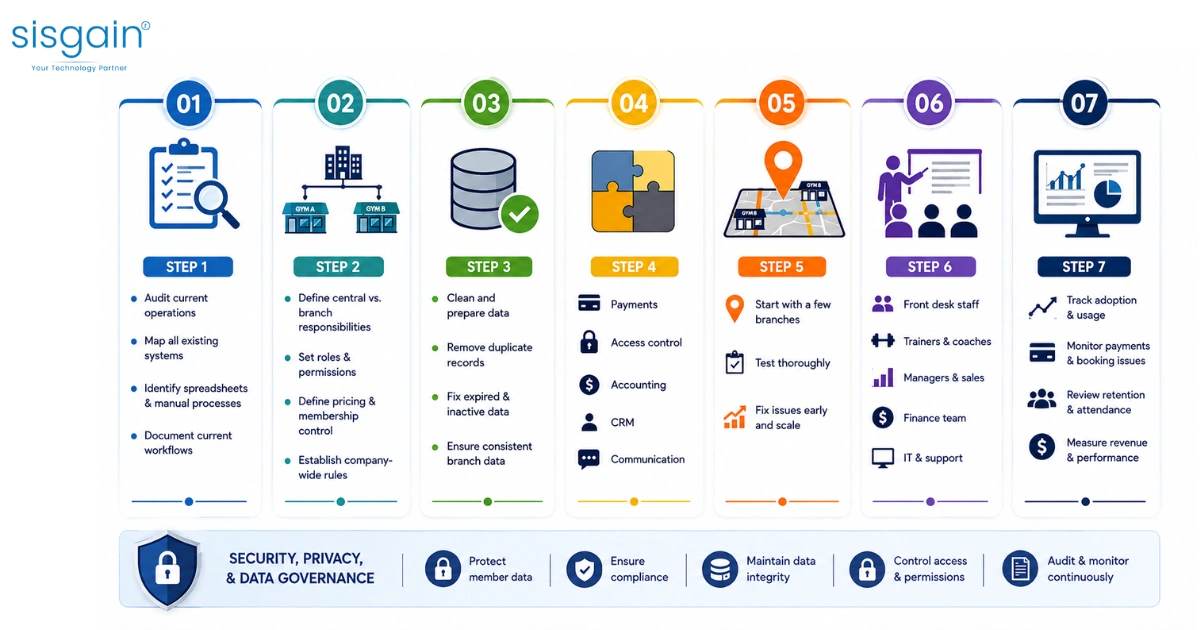
Step 1: Audit current operations. Map every existing system, spreadsheet, and manual process before touching new software.
Step 2: Define central vs. branch responsibilities. Decide who can change pricing, who manages memberships, who sees financial reports, and which rules are non-negotiable across every location.
Step 3: Clean and prepare data. Duplicate member records, expired memberships, and inconsistent branch data will break a migration if they're not fixed first.
Step 4: Configure integrations. Payments, access control, accounting, CRM, and communication systems all need to be connected — and tested — before go-live.
Step 5: Pilot at selected locations. Rolling out to every branch simultaneously multiplies the risk of any single mistake. A phased rollout lets you fix problems while they're still small.
Step 6: Train every user group. Front desk, sales, trainers, managers, finance, and IT support all interact with the system differently and need training suited to their role, not a single generic walkthrough.
Step 7: Monitor adoption and performance. Track system adoption, support ticket volume, payment issues, booking failures, attendance, retention, and revenue after go-live — the first month tells you more than the sales demo ever did.
Common Mistakes Gym Chains Make When Choosing Software
Choosing based only on price. The cheapest platform often costs more once you add up the integrations it can't handle and the workarounds staff build to compensate.
Buying features without mapping workflows first. A long feature list means nothing if it doesn't match how your business actually operates day to day.
Ignoring data ownership. Chains discover this the hard way — usually while trying to switch vendors and finding out their member data isn't easily exportable.
Underestimating integration requirements. Payment gateways, access control, and accounting systems rarely connect as smoothly as a sales demo suggests.
Treating the mobile app as an afterthought. A member-facing app designed as a shrunk-down version of the admin dashboard almost always feels wrong. It needs its own design thinking from the start — the kind of approach covered under Mobile-First Design Services, where the app is built around how people actually use their phones, not around what was easy to port from a desktop system.
Rolling out to every location without a pilot. Skipping the pilot phase means the whole chain absorbs the same mistake at once.
Ignoring staff training and change management. The best software fails if the front-desk team quietly reverts to the old spreadsheet because nobody explained why the new system matters.
The Gym Technology Ecosystem: How Everything Connects
At the center sits the gym management platform, connected outward to the member mobile app, the website, the payment gateway, the CRM, access control, POS, accounting software, marketing automation, wearables, AI systems, and analytics dashboards. None of these pieces deliver much value in isolation.
The real lesson for chains evaluating vendors: the value of gym management software increasingly comes from how well the whole ecosystem works together — not from how many individual features are listed on a product page. A platform with fifty features that don't talk to each other is worth less than one with twenty that do.
The Future of Gym Management Software
A few directional trends worth watching as this space matures through 2026 and beyond, without overstating certainty about any of them:
- AI-assisted retention and operations are likely to become standard rather than a premium add-on, as the underlying models get cheaper to run.
- More connected member data across wearables, apps, and in-gym systems, increasingly treated as a single member profile rather than fragmented data sources.
- Mobile-first member experiences continue to take priority over desktop portals, since almost no member manages their gym membership from a laptop anymore.
- Real-time integrations are becoming an expectation rather than a nice-to-have, particularly around access control and payment status.
- Flexible membership models — pay-per-visit, hybrid digital-physical plans, corporate wellness bundles — are a growing area of investment for chains competing on more than price.
- Security and data governance are getting more scrutiny as chains handle more sensitive payment and biometric data across more locations.
- Personalized digital fitness experiences are increasingly evaluated by chains looking to differentiate from generic booking apps that every competitor also uses.
Summary Box: What Gym Chains Should Do Next
If you're operating a growing gym chain, five actions worth taking before evaluating any specific vendor:
- Map your current operational systems and flag every disconnected workflow.
- Decide which processes should be centralized at headquarters and which should stay flexible at the branch level.
- Build a must-have integration list covering payments, access control, CRM, accounting, and member communication.
- Weigh whether ready-made software, custom development, or a hybrid approach actually fits your growth plan — not just your current budget.
- Pilot the solution at one or two locations before rolling it out chain-wide.
Final Thoughts: Choosing the Right Digital Foundation
Gym management software shouldn't be evaluated as just a booking or billing tool. For a chain that's actually trying to scale, it's infrastructure — the layer connecting operations, member experience, and the data that tells leadership whether the business is actually growing or just adding locations.
There's no universal answer here. Chains running standardized operations across similar locations often do fine with ready-made platforms. Brands trying to build a differentiated member experience — or operating under a franchise structure with more complexity than most off-the-shelf tools were built for — usually end up needing custom development or a hybrid setup. The decision that matters most isn't which vendor to pick. It's understanding your own operational model clearly enough to know what you actually need before you start comparing feature lists.
Planning to Scale Your Fitness Business With a Connected Digital Platform?
Before signing with any vendor, it's worth assessing whether your current technology can actually support centralized multi-location operations, a consistent member experience, branded mobile engagement, secure payment and data handling, AI-enabled workflows, and integrations that won't need to be rebuilt every time you open a new location.
If the honest answer is no, it may be worth exploring a custom digital platform strategy — covering everything from operational software and integrations to the member-facing fitness applications built specifically around custom fitness app development in Dubai, custom app development in dubai, and secure application development uae — rather than forcing a growing chain to fit inside a generic template built for a single location.