
A delivery in Dubai rarely fails because a driver got lost. It fails because the dispatcher didn't know the driver was stuck at Al Barsha, the customer got no update, and the operations manager found out an hour after the delivery window closed. That's not a driver problem — it's a communication gap. Field teams, drivers, dispatchers, and customers are all moving at once, but if they're not connected through a shared system, every delay compounds.
This is exactly why logistics mobile app development Dubai projects have picked up so much momentum over the last few years. A well-built logistics mobile application doesn't just track a van on a map — it becomes the operational layer that ties driver activity, dispatch decisions, fleet status, and customer communication into one continuous workflow. Instead of five disconnected tools (a WhatsApp group, a spreadsheet, a GPS tracker, a phone line, and a paper delivery slip), everyone works from the same live picture.
This guide walks through why Dubai logistics companies need mobile apps, what a serious logistics app should include, how it supports drivers and field teams, and what the development process, technology, and cost actually look like.
Why Logistics Companies in Dubai Need Mobile Apps for Field Operations
Dubai's logistics sector moves fast — dense urban delivery zones, industrial areas spread across long distances, and customer expectations shaped by same-day and next-hour delivery norms. Manual coordination simply can't keep pace with that combination, and the gaps show up in a few predictable places.
Disconnected Driver Communication
Phone calls and scattered messaging apps are still how many teams coordinate driver activity. Status updates get delayed, instructions get lost in a chat thread, and dispatchers end up calling drivers just to confirm something a system should already know.
Limited Real-Time Visibility
Without live GPS data, a fleet manager only knows where a vehicle was, not where it is. Delivery progress, driver status, and accurate ETAs stay guesswork rather than fact, which makes it hard to react to delays before a customer complains.
Manual Proof of Delivery
Paper-based confirmation still exists across parts of the UAE logistics market — signatures on printed sheets, photos taken separately and emailed later, timestamps that get written down by hand and sometimes forgotten. It works, but it's slow, and it's the first thing that breaks down during high-volume periods.
Increasing Delivery Expectations
Customers in Dubai now expect the same experience they get from e-commerce giants: accurate ETAs, live order tracking, and proactive notifications. A logistics operation that can't offer that visibility is competing at a disadvantage, regardless of how efficient its actual delivery process is.
How Logistics Mobile Apps Connect Drivers, Field Teams, and Operations
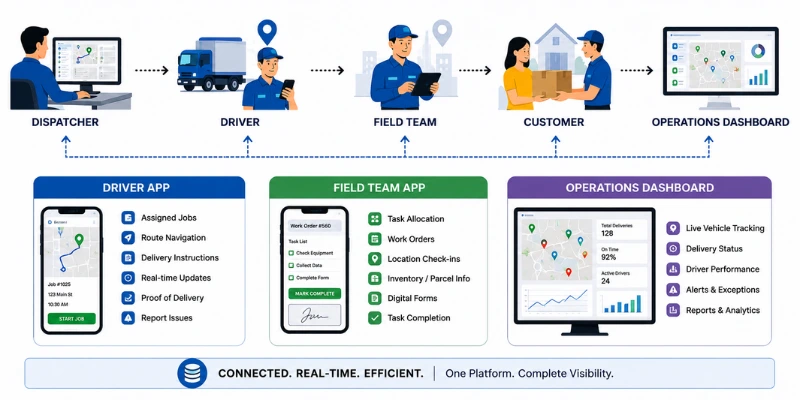
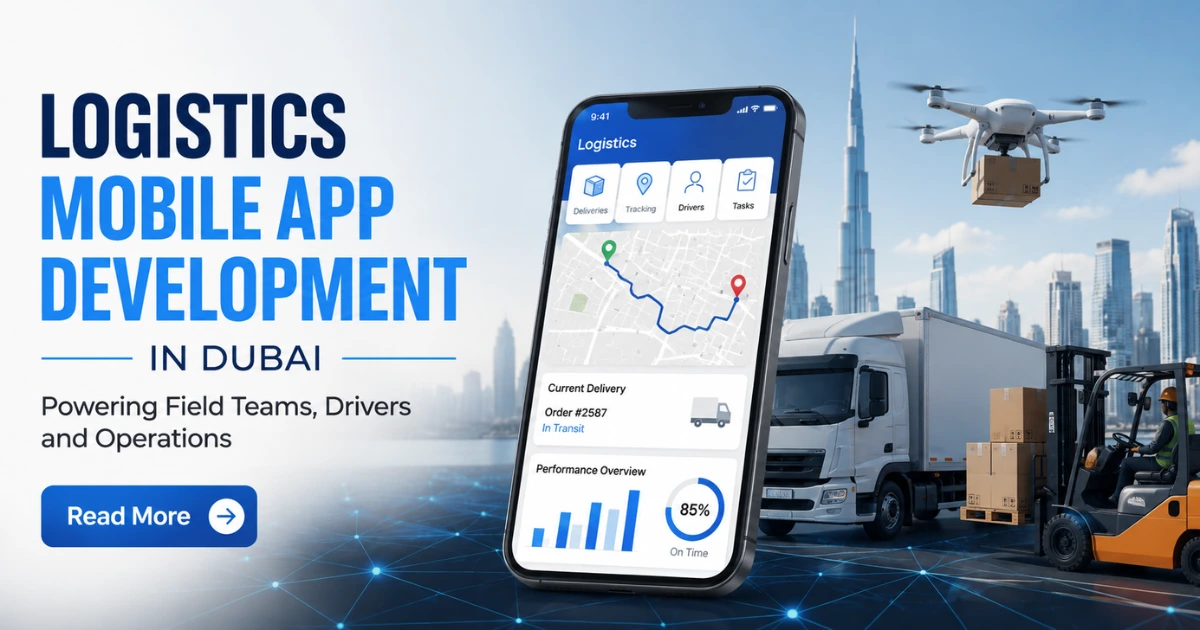
At its core, a logistics mobile application is built around one operational flow: Dispatcher → Driver → Field Team → Customer → Operations Dashboard. Each part of that chain needs its own interface, but they all draw from — and feed back into — the same live data.
Driver App
The driver-facing app is where the day's work actually happens. It typically covers assigned jobs, turn-by-turn route navigation, delivery instructions, real-time status updates, customer details, digital proof of delivery, and a simple way to report incidents like a blocked access point or a damaged parcel.
Field Team App
Field technicians and service teams need a different set of tools — task allocation, work orders, location check-ins, inventory or parcel information, digital forms for on-site data capture, and a clear way to mark a task complete once it's actually done.
Operations Dashboard
This is where dispatchers and managers watch the whole fleet move. Live visibility into vehicle locations, driver performance, delivery status, and flagged exceptions lets a team catch a problem while it's still small — a missed pickup window, a route running late, a vehicle idling far longer than it should.
When these three pieces are properly connected, an order that used to require four phone calls to track down now shows its full status on one screen.
Essential Features of Logistics Mobile App Development in Dubai
Feature scope is usually the biggest driver of both cost and usefulness, so it's worth being specific about what actually belongs in a serious build rather than a generic delivery-tracking app.
Driver and Field Team Features
- Secure driver login and profile management
- Job assignment and task management
- Route navigation with live traffic data
- GPS tracking for accurate, real-time location
- Delivery status updates in a single tap
- Digital proof of delivery with e-signatures
- Photo and document upload for damaged goods or delivery confirmation
- In-app customer communication
- Incident reporting for delays, breakdowns, or access issues
- Push notifications for new jobs or changes
- Offline functionality for areas with weak connectivity
Fleet Management Features
- Live vehicle tracking
- Vehicle status and availability
- Maintenance reminders tied to mileage or usage
- Fuel monitoring
- Driver-to-vehicle assignment
- Trip history logs
- Vehicle utilisation reporting
Operations and Admin Features
- Centralised dispatch management
- Order management
- Real-time delivery monitoring dashboard
- Role-based access control
- Analytics and custom reports
- Automated alerts for exceptions
- API integrations with existing business systems
Not every logistics operation needs every item on this list on day one. A courier business with ten drivers has different priorities than a distribution company running forty trucks across the Northern Emirates — which is exactly why the feature set should be scoped against actual workflows, not copied from a generic template.
How Delivery App Development in Dubai Improves Last-Mile Operations
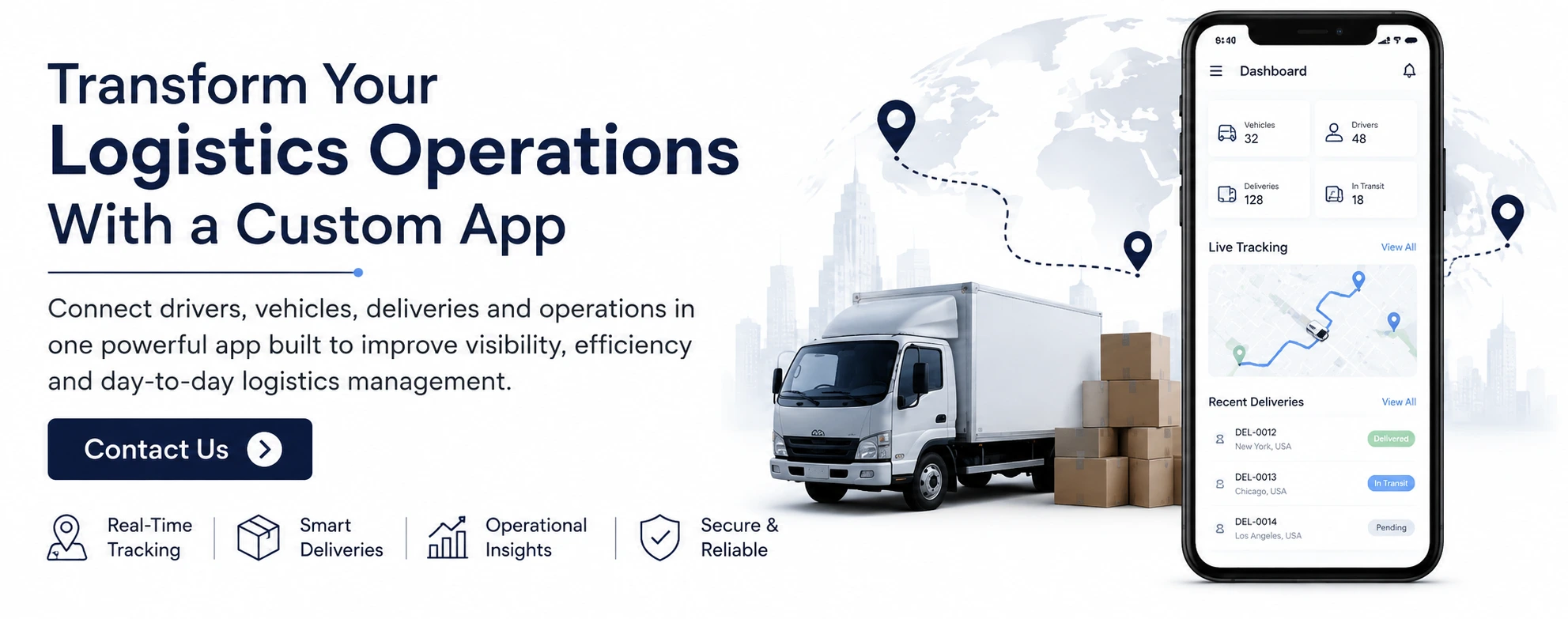
Last-mile delivery is where most customer-facing problems actually happen, and it's also where a mobile app has the most measurable impact. A properly built delivery workflow moves through order assignment, driver allocation, route optimisation, real-time tracking, customer ETA updates, delivery confirmation, and — when something goes wrong — structured failed-delivery management with automated notifications back to the customer.
The value here isn't just speed. It's predictability. When a customer can see a live ETA instead of guessing, and a dispatcher can reroute a driver the moment a delivery window is at risk, the whole operation becomes less reactive. A mobile application can become even more effective when connected with broader logistics software in dubai, allowing delivery teams and management to work from a connected operational ecosystem rather than isolated tools.
Fleet Management App Development for Dubai Transportation Operations
Fleet-focused applications extend beyond delivery tracking into the health and efficiency of the vehicles themselves. That includes live vehicle tracking, driver performance monitoring, preventive maintenance scheduling, fuel monitoring, trip management, route optimisation, vehicle utilisation reporting, compliance documentation, and fleet-wide analytics.
For companies running larger fleets, the return on this kind of visibility tends to show up first in maintenance costs. Catching a mechanical issue during a scheduled check is far cheaper than dealing with a breakdown mid-route. Companies planning a broader fleet platform can also review a fleet management software development dubai guide before defining their mobile application requirements, since the mobile app and the backend fleet system need to be designed together rather than bolted on afterward.
Transportation App Development for Multi-Modal Logistics Businesses
Freight transportation, courier services, trucking operations, and distribution networks all rely on mobile technology differently than a single-vehicle delivery business does. A transportation app typically manages trip assignments, driver scheduling, vehicle allocation, route planning, shipment tracking, delivery documentation, and customer updates across multiple vehicle types and service lines at once.
Businesses handling larger shipment volumes can combine these mobile workflows with a freight management software dubai guide to plan a more comprehensive digital logistics ecosystem — one where a single shipment can be tracked from pickup through final delivery, regardless of how many vehicles or handoffs it passes through along the way.
Technology Stack for Logistics Mobile App Development
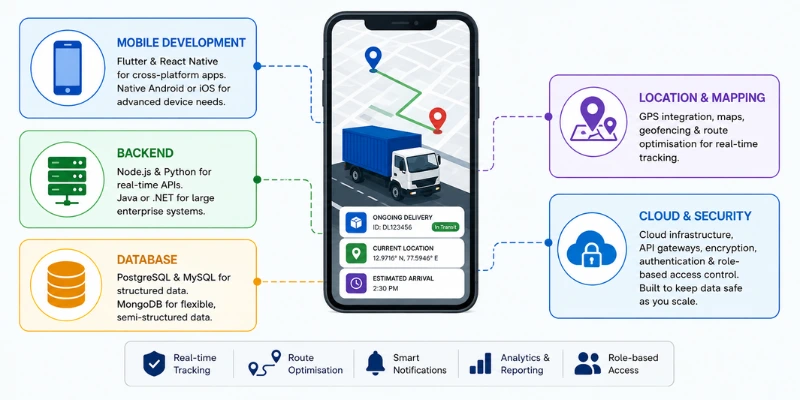
The right technology stack depends on scale, budget, and how the app needs to integrate with existing systems — but a few choices come up consistently in serious logistics builds.
Mobile development: Flutter and React Native are common choices for cross-platform apps that need to launch on both iOS and Android without maintaining two separate codebases. Native Android or iOS development still makes sense for apps with heavy device-level requirements, like advanced background GPS tracking.
Backend: Node.js and Python are widely used for their speed in building real-time APIs, while Java or .NET tends to appear in larger enterprise environments with existing infrastructure investments.
Database: PostgreSQL and MySQL handle structured operational data reliably, while MongoDB is sometimes used where flexible, semi-structured data — like dynamic form submissions from field teams — needs to be stored efficiently.
Location and mapping: GPS integration, mapping APIs, geofencing, and route optimisation APIs form the backbone of any logistics app's real-time tracking capability.
Cloud and security: Cloud infrastructure, API gateways, encryption, authentication, and role-based access control aren't optional add-ons — they're what keeps operational and customer data safe as the app scales.
AI and Automation Opportunities in Logistics Mobile Apps
AI in logistics apps works best when it's solving a specific, narrow problem rather than being bolted on as a marketing feature. A few practical applications are already common in 2026-era logistics platforms.
AI route optimisation factors in live traffic, distance, delivery windows, and vehicle availability to suggest routes that a dispatcher would take much longer to work out manually.
Predictive ETA uses historical delivery patterns alongside real-time conditions to give customers arrival windows that are actually accurate, not just a static estimate based on distance.
Predictive fleet maintenance flags vehicles likely to need service based on usage patterns, helping fleet managers act before a breakdown happens rather than after.
AI-powered dispatch recommends the best driver-vehicle pairing for a job based on location, current workload, and vehicle type.
Intelligent customer support handles routine queries about delivery status, ETA, or order details automatically, freeing up support staff for the exceptions that actually need a person.
Integrations Required for a Logistics Mobile App
A logistics mobile app rarely operates in isolation. To be genuinely useful, it typically needs to connect with an ERP system, CRM, transportation management system (TMS), fleet management platform, payment gateway, mapping service, accounting software, warehouse management system, and notification infrastructure — all through a well-designed set of APIs.
This is often where projects run into trouble, because integration complexity is usually underestimated at the planning stage. Organisations with complex ERP, CRM, or warehouse workflows may benefit from working with a software development company dubai that can handle both the mobile application build and the enterprise integration layer as one coordinated project, rather than treating them as separate vendors with separate priorities.
Security and Compliance Considerations for Logistics Apps
Logistics apps carry sensitive operational and customer data — delivery addresses, driver locations, order details, and sometimes payment information — which makes security a design requirement, not an afterthought.
At minimum, this should include secure authentication, role-based access control, data encryption in transit and at rest, API security, secure cloud infrastructure, regular data backups, audit logs for accountability, device-level security, location-data protection, and secure handling of any payment processing involved. The exact regulatory obligations will vary by business type and should be reviewed with legal counsel rather than assumed from general guidance.
Logistics Mobile App Development Process in Dubai
1. Business and Workflow Discovery — Mapping how drivers, dispatchers, operations teams, customers, and admins actually work today, before designing anything new.
2. UX/UI Design — Building role-specific experiences, since a driver's screen and an operations manager's dashboard need to solve completely different problems.
3. MVP Development — Prioritising the workflows that matter most first, rather than trying to launch every feature at once.
4. Backend and API Development — Building the operational infrastructure that everything else depends on.
5. GPS and Third-Party Integrations — Connecting mapping services, tracking tools, ERP, and TMS systems.
6. Testing — Covering GPS accuracy, offline mode behaviour, device compatibility, security, and performance under real load.
7. Deployment and Optimisation — Launching, monitoring real usage, and refining the app based on how teams actually use it in the field.
How Much Does Logistics Mobile App Development Cost in the UAE?
There's no honest single number here, and any vendor quoting a fixed price without understanding your workflows first should raise a flag. Cost depends on a combination of factors: app complexity, the number of distinct user roles, whether you need both iOS and Android, GPS and mapping requirements, real-time tracking depth, AI features, the number and complexity of integrations, backend architecture, security requirements, admin dashboard scope, and ongoing maintenance and support.
A simple single-role delivery tracking app sits at one end of that spectrum. A multi-role platform connecting drivers, field teams, fleet management, ERP, and AI-driven dispatch sits at the other. Businesses evaluating budgets can also review the logistics fleet management app development cost uae factors that typically influence project scope and investment, which is a more reliable way to plan a budget than working backward from a single quoted figure.
Why Choose SISGAIN Technologies for Logistics Mobile App Development?
Building a logistics application is different from building a typical consumer app. The people using it aren't casually browsing — they're relying on it to do their job, often while driving, standing at a loading dock, or standing in front of a customer. That changes how the app needs to be designed and built.
SISGAIN Technologies approaches logistics mobile app development around the client's actual fleet structure, driver workflows, dispatch processes, and operational requirements, rather than starting from a template and adjusting it afterward. Custom architecture matters here — a distribution business running forty vehicles across multiple emirates has different scaling needs than a courier operation running a dozen bikes across a single district, and the underlying system should reflect that from the start.
Scalability is built into the process rather than added later, so the application can support growth in users, vehicles, orders, and locations without a rebuild every time the business expands. On the integration side, the team works with the APIs, ERP systems, CRM platforms, mapping services, and enterprise tools that a client's operations already depend on, so the mobile app becomes part of the existing ecosystem instead of another disconnected tool.
Security is treated as a core engineering requirement — authentication, access control, secure APIs, encryption, and data protection are built in from the first architecture decisions, not patched in before launch. And because a logistics app is a working tool, not a one-time deliverable, the relationship continues after launch with monitoring, performance optimisation, bug fixes, feature improvements, and ongoing support as operational needs shift.
How to Choose the Right Logistics Mobile App Development Company in Dubai
Choosing a logistics mobile app development company is less about who shows the flashiest portfolio and more about who understands the operational reality of logistics work. A few checks are worth running before signing with any vendor.
- Relevant logistics experience — Have they actually built for driver, fleet, or delivery workflows before, or is this their first attempt at the industry?
- Mobile and backend expertise — Can they build both the app and the infrastructure it depends on, or only one half?
- GPS and mapping capabilities — Do they have real experience with location-based features, not just theoretical knowledge?
- API integration experience — Have they connected apps to ERP, TMS, or CRM systems before?
- Security practices — Can they explain, specifically, how they handle authentication and data protection?
- Scalable architecture — Is the system designed to grow with the business, or will it need a rebuild at the next stage?
- Post-launch support — What happens six months after launch when something needs fixing or the business has changed?
- Transparent development process — Do they explain their process clearly, or keep it vague until the contract is signed?
A logistics software development company Dubai businesses can trust is one that treats these questions as a normal part of the conversation, not an inconvenience.
Conclusion
A logistics mobile app isn't really about the app itself — it's about closing the gap between what's happening on the road and what the operations team can actually see. Better driver coordination, real-time visibility, faster delivery workflows, and data-driven fleet decisions all come from the same source: everyone working off the same live information instead of five disconnected tools.
As logistics mobile app development Dubai continues to mature, the businesses gaining ground are the ones treating their app as core operational infrastructure, with room to add AI and automation as the business scales — not as a side project handed to whoever built the cheapest quote. If you're mapping out requirements for a driver, fleet, or delivery workflow app, the right next step is a proper discovery conversation to define what your operation actually needs before a single screen gets designed.