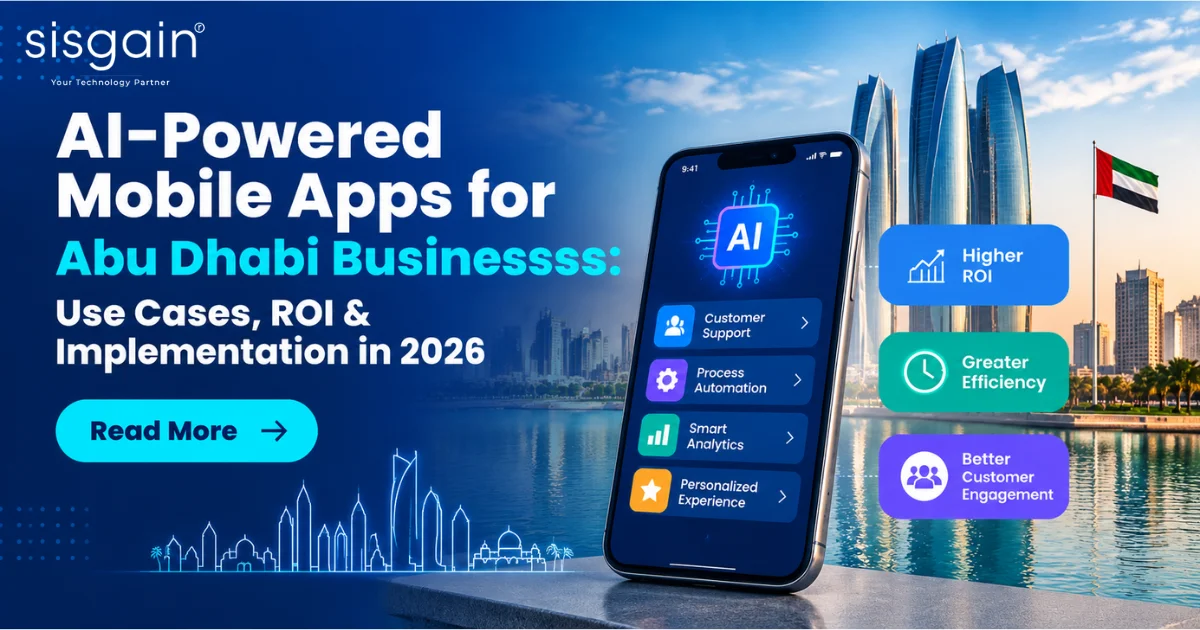

Lower support costs. Faster operations. Higher conversion rates. More personalized customer experiences. These are the outcomes that make AI mobile app development Abu Dhabi businesses are exploring in 2026 worth a serious look, and they are also the outcomes that separate a useful AI investment from an expensive experiment.
Abu Dhabi has made its ambitions in artificial intelligence very public, with a stated goal of building an AI-native government and a growing ecosystem of AI research, infrastructure and talent. Residents and employees across the UAE are also increasingly comfortable using AI tools in daily life, which raises expectations for the apps they use at work and as customers.
For business leaders, the real question is not whether AI is impressive. It is which AI capabilities can deliver measurable value for your particular business. This guide walks through the most practical use cases, a simple ROI model, an indicative implementation roadmap, security considerations and the criteria for choosing a development partner.
The lesson running through all of this is simple: successful AI mobile apps solve defined business problems rather than simply adding AI features. That is the mindset that turns AI mobile app development Abu Dhabi organizations invest in into lasting value.
Quick Answers: What Business Leaders Need to Know
What can an AI-powered mobile app do for a business? It can automate support, personalize offers, forecast demand or delays, and interpret photos and documents, reducing manual effort while improving customer experience.
Which AI features should a business implement first? Start with one high-frequency, measurable workflow, such as customer support automation, product recommendations or document capture, where data is already accessible.
How is AI mobile app ROI measured? Compare attributable revenue gains and cost savings against total costs, including development, integration, hosting, model usage, monitoring and maintenance.
How long does implementation take? A focused proof of concept may take a few weeks and an MVP a few months, depending on scope, data readiness, integrations and security reviews.
Why Abu Dhabi Businesses Are Investing in AI Mobile Apps
Abu Dhabi's public commitment to AI has changed the conversation in boardrooms. When government services, healthcare providers and large enterprises are all moving toward smarter digital experiences, businesses in every sector feel pressure to keep pace. The mobile app is where much of that change becomes visible to customers and employees alike, which is why AI powered mobile apps UAE organizations deploy are drawing attention across retail, healthcare, fintech, logistics, hospitality and real estate.
The shift is from transactional to proactive. A traditional app waits for users to ask for something: check an order, book a slot, search a catalog. An AI-enabled app can anticipate what the user needs. It can warn a logistics manager about a likely delay, suggest a product that fits a shopper's habits, remind a patient who is statistically likely to miss an appointment, or guide a customer through a process in plain Arabic or English.
There is also a competitive reason. Customers who experience fast, relevant, always-available service in one app quickly expect it from others. Teams that adopt AI inside their field and back-office apps often find that routine work, such as inspections, approvals and data entry, becomes faster and less error-prone.
One principle matters more than any technology trend: investment should begin with a measurable business problem. "We need AI" is not a requirement. "We want to reduce cost per support resolution" or "we want to cut inspection time" is.
What Is an AI-Powered Mobile App?
An AI-powered mobile app is an application that uses data and trained models to predict, personalize or interpret, rather than only following fixed, pre-programmed rules. Several technologies sit behind this:
- Machine learning finds patterns in historical data to forecast outcomes or rank recommendations.
- Natural language processing (NLP) lets apps understand and respond to text and speech.
- Computer vision interprets images and video captured by the phone's camera.
- Generative AI produces text, summaries, answers or other content to help users complete tasks.
The difference is easiest to see side by side.
|
App type |
Typical behavior |
Example |
|
Traditional app |
Follows predefined rules |
Displays an order status |
|
AI-powered app |
Uses data to predict, personalize or interpret |
Predicts a delay and recommends an action |
Because AI features depend on reliable data flows, responsive APIs and infrastructure that can handle growing usage, they work best on top of a scalable mobile app architecture. A clever model on a fragile foundation will frustrate users the moment traffic grows or an integration slows down.
High-ROI AI Mobile App Use Cases for Abu Dhabi Businesses
The strongest results usually come from matching a specific business problem to the right AI capability and a clear metric. The table below maps common functions to practical mobile use cases and the KPIs that show whether they are working. This is the core of AI mobile app development Abu Dhabi leaders should evaluate first.
|
Business function |
AI capability |
Mobile app use case |
ROI metric |
|
Customer service |
Conversational AI |
Automated support and bookings |
Cost per resolution |
|
Sales and marketing |
AI recommendations |
Personalized offers and products |
Conversion rate |
|
Operations |
Predictive analytics |
Demand and delay forecasting |
Waste, downtime and forecast accuracy |
|
Field services |
Computer vision |
Inspections and damage assessment |
Inspection time |
|
Healthcare |
NLP and prediction |
Appointment workflows and document processing |
No-show rate and staff time |
|
Banking and fintech |
Fraud detection |
Transaction alerts and identity checks |
Fraud loss and false-positive rate |
|
Real estate |
Recommendation engines |
Property matching and lead qualification |
Qualified leads and viewing bookings |
|
Logistics |
Prediction and vision |
Delivery forecasts and proof of delivery |
On-time delivery rate |
How should you prioritize? High-frequency, repetitive workflows with accessible data are often stronger starting points than broad, complex AI transformations. A process that happens thousands of times a month, follows recognizable patterns and already produces data gives you both the volume to save money and the evidence to measure it. Large, vague programs tend to stall; narrow, well-measured ones tend to scale.
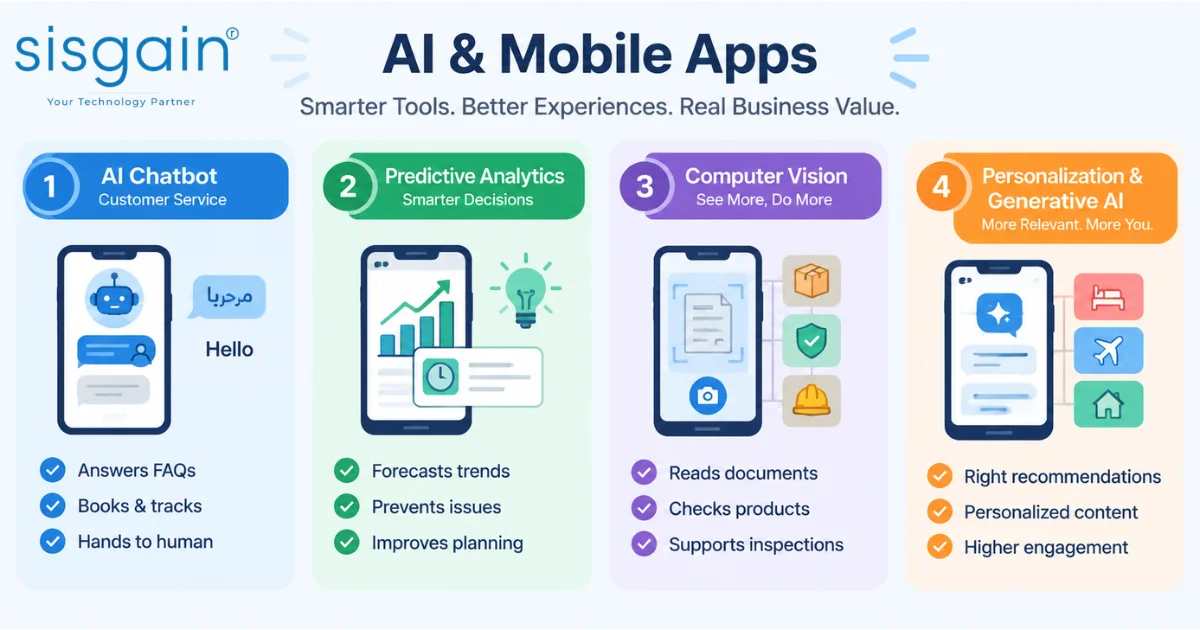
AI Chatbot Integration for Customer Service
A well-designed assistant can answer routine questions, guide users through processes, book appointments, retrieve order information and hand complex cases to a human agent with the conversation history attached. For many businesses, this is the fastest route to visible savings, and it is where AI chatbot integration app projects most often begin.
In Abu Dhabi, bilingual capability is essential. Support in both Arabic and English should be tested properly, including business terminology, regional dialects and the quality of escalation to human staff. Typical examples by sector:
- Retail: order tracking, returns and product availability.
- Healthcare: appointment booking and service information.
- Real estate: property enquiries and viewing requests.
- Banking: account FAQs and transaction guidance.
The value comes from connecting the assistant to your existing systems, which is why effective AI chatbot integration depends on clean links to your CRM, booking and order platforms. Track first-response time, ticket deflection, cost per resolution and customer satisfaction to judge success.
Predictive Analytics for Smarter Business Decisions
A predictive analytics mobile app uses historical and current data to forecast what is likely to happen next: demand swings, customer churn, delivery delays, equipment failures or appointment no-shows. The benefit is better resource allocation, less downtime, more relevant offers and sharper planning.
Consider a logistics manager who opens an app in the morning and sees an early alert: a group of deliveries is likely to run late because of a congested route and a driver shortage at one depot. The app recommends reassigning two routes and notifying affected customers. Instead of reacting to complaints, the manager acts before they happen.
Teams exploring this area often start with a small set of well-understood data sources, then expand. If you are weighing options, predictive analytics solutions can help structure forecasting around the decisions your team actually makes each day.
Computer Vision for Field, Retail and Compliance Workflows
A smartphone camera is a powerful sensor. With computer vision, an app can capture information from documents, products, equipment and physical environments. A computer vision mobile app UAE businesses use might support:
- Insurance damage assessments from photos.
- Proof of delivery in logistics.
- Visual product search in retail.
- Inspections on construction and facilities sites.
- Identity-document capture during onboarding.
The value is faster processing, fewer manual errors and stronger evidence collection. It is important to be realistic, though. High-risk verification and safety decisions may still require human review, and the best designs make it easy to route uncertain cases to a person.
AI Personalization and Generative AI Experiences
Recommendation engines and context-aware content help users find what is relevant faster. Generative AI assistants go further, helping users complete tasks such as planning a trip, comparing properties or summarizing a long document. Done well, AI personalization in mobile apps makes experiences feel considered rather than crowded, which means showing fewer, better suggestions instead of overwhelming users.
Retail, travel, hospitality and real estate apps benefit most. A hotel app might surface dining and spa options matched to a guest's stay, while a property app might rank listings by a buyer's preferences and past behavior. A generative AI mobile app can then answer follow-up questions in natural language. Measure the impact through conversion rate, repeat usage, average order value and retention.
Choosing the Right AI Technology Stack for Mobile Apps
You do not need to become a developer to make good technology decisions, but you should understand the layers involved and what each one is for.
|
Layer |
Example technologies |
Business purpose |
|
Conversational AI |
OpenAI, Gemini, Claude |
Assistants and support |
|
Machine learning |
TensorFlow, PyTorch, cloud ML services |
Forecasting and recommendations |
|
Computer vision |
Vision APIs and on-device models |
Scanning and image analysis |
|
Data integration |
APIs, CRM and ERP systems |
Reliable business context |
|
Mobile frontend |
Native iOS/Android, Flutter, React Native |
User experience |
|
Security |
Encryption, access controls and audit logs |
Data protection |
AI can run in the cloud, on the device or in a hybrid of both. Cloud deployment offers more powerful models and easier updates. On-device processing improves speed, works offline and keeps some data on the phone. Hybrid designs combine the two, for example scanning a document on the device and sending only the extracted fields to the cloud. This choice matters most for enterprise AI app development UAE teams undertake, where integration with existing systems and data sensitivity shape the design.
The frontend decision deserves its own thought. Choosing between native vs cross platform app development depends on performance requirements, access to device features, team capabilities and long-term maintenance. When comparing frameworks, a guide to Flutter vs React Native in Abu Dhabi can help you weigh the trade-offs against your target users and product roadmap.
How to Calculate ROI From an AI Mobile App
The basic formula is simple:
ROI (%) = (Benefits − Total Costs) ÷ Total Costs × 100
Benefits are the attributable revenue gains and cost savings the app produces. Total costs should be complete: implementation, integration, hosting, model usage, monitoring and ongoing maintenance. Leaving out the last few is one of the most common ways ROI gets overstated.
It helps to break benefits into four categories:
- Cost reduction: lower support and manual-processing costs.
- Revenue growth: improved conversion and retention.
- Time savings: faster onboarding, approvals and inspections.
- Risk reduction: fewer errors, fraud losses and compliance gaps.
A worked example. Suppose a business handles 10,000 support queries a month at AED 8 per query. If an AI chatbot successfully handles 30% of the queries that would otherwise have required the full manual-resolution cost, that is 3,000 queries and an illustrative gross saving of AED 24,000 per month, before implementation and ongoing costs.
Treat that figure as an illustration, not a guaranteed result. Actual savings depend on successful resolution rates, how often cases escalate to humans, answer quality and how much of the cost is genuinely avoidable rather than simply shifted. Measure these during a pilot before committing to a business case.
AI Mobile App Implementation Roadmap for Abu Dhabi Businesses
A phased approach reduces risk and creates decision points where you can stop, adjust or scale based on evidence.
|
Phase |
Indicative duration |
Main output |
|
Discovery |
1–2 weeks |
Use-case shortlist and ROI hypothesis |
|
Proof of concept |
2–4 weeks |
Tested AI workflow |
|
MVP development |
6–12 weeks |
Core app and AI integration |
|
Pilot and optimization |
4–8 weeks |
Performance and user feedback |
|
Scale |
Ongoing |
More workflows, users and integrations |
These are planning estimates, not a guaranteed schedule. Scope, data readiness, integrations, security reviews and platform requirements can all change delivery time.
Budget planning deserves the same discipline. When reviewing mobile app pricing UAE enterprise buyers should compare total cost of ownership, not only the initial development quote. Cloud and model-usage fees, monitoring, retraining, support and future integrations can outweigh the build cost over time, so a lower upfront price is not always the lower-cost option.
Security, Data Protection and Implementation Challenges
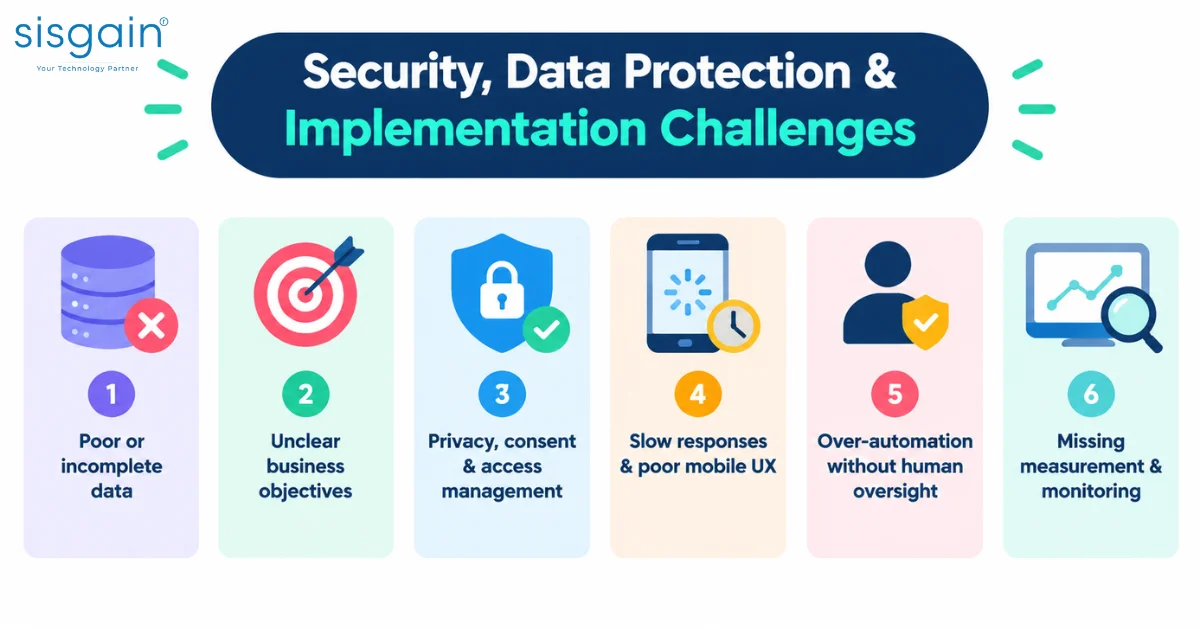
Most AI app problems are not about the model. They are about the conditions around it. Six concerns come up repeatedly:
- Poor or incomplete data. Models are only as good as the information they learn from or retrieve.
- Unclear business objectives. Without a target metric, success cannot be proven.
- Privacy, consent and access management. Users and regulators expect careful handling of personal data.
- Slow AI responses and poor mobile UX. A smart answer that arrives too late feels broken.
- Over-automation without human oversight. Sensitive decisions need clear escalation paths.
- Missing measurement and monitoring. Models drift, and performance needs to be tracked after launch.
On the security side, look for encryption, role-based access controls, audit logs, secure APIs and defined data-retention policies, and assess vendors accordingly. No single architecture automatically ensures compliance. Consent, data handling and governance should be reviewed against UAE data protection law mobile apps must follow, along with any sector-specific requirements that apply to your data and activities. Seek qualified legal advice for your specific situation.
How to Choose an AI Mobile App Development Company in Abu Dhabi
A portfolio of attractive apps is a starting point, not a decision. When evaluating an AI mobile app development company Abu Dhabi businesses can rely on, look for:
- Experience delivering relevant AI use cases, not just standard apps.
- The ability to connect AI with your existing enterprise systems.
- Clear data security and governance practices.
- Transparent discovery, testing and deployment processes.
- Measurable success criteria and post-launch optimization.
- Clear ownership of source code, data and intellectual property.
Local context also matters. Regulatory expectations, bilingual users, enterprise integration patterns and stakeholder processes differ from market to market, which is one reason many organizations prefer a partner offering mobile app development in Abu Dhabi with an understanding of the local business environment. SISGAIN is one such option, combining AI discovery, mobile engineering, integration and ongoing optimization.
How SISGAIN Supports AI-Powered Mobile App Development
SISGAIN works as an implementation partner that connects AI capabilities to business outcomes. You can explore SISGAIN's AI-powered mobile app development capabilities across the full journey, from identifying the right use case to scaling it after launch. Its work covers:
- AI use-case discovery and ROI assessment.
- AI-powered mobile app design and development.
- AI chatbot integration for internal and customer-facing apps.
- Predictive analytics and recommendation systems.
- Computer vision workflows.
- CRM, ERP, payment and cloud integrations.
- Security-conscious architecture, testing and ongoing optimization.
Looking to build an AI-powered mobile app for your Abu Dhabi business? Explore SISGAIN's AI-powered mobile app development capabilities and request a use-case consultation to identify the right features, implementation approach and ROI metrics for your business. You can contact SISGAIN to start the conversation.