
Introduction: Migration is now a business-risk decision
After twenty-five years of watching enterprises move from mainframes to client-server, from client-server to virtualization, and from virtualization to cloud, I have noticed one constant: the technology is rarely the hard part. The hard part is deciding what to move, in what order, under whose accountability, and with what evidence that the result is safe.
That is exactly where buyers of cloud migration services UAE organizations rely on find themselves today. UAE organizations are no longer asking whether to move to the cloud. They are deciding which workloads should move, where their data should reside, how security and regulatory obligations will be met, and how cloud spending will stay under control after go-live.
That shift changes who owns the decision. Cloud migration used to be an infrastructure project sponsored by the data-centre team. Today it sits on the agenda of the CIO, CISO, CFO, Chief Data Officer, and often the board risk committee. A bank migrating digital channels, a hospital group modernizing clinical platforms, a logistics operator consolidating regional systems, and a government-linked entity adopting shared services all face the same underlying question: can we move faster without taking on risk we cannot explain to a regulator, an auditor, or a customer?
My position, after leading and reviewing migration programs across the region and beyond, is simple. A successful migration is a business, security, data, architecture, and operations program, not a one-time server move. Treat it as the latter and you will likely end up with expensive, poorly governed, cloud-hosted legacy. Treat it as the former and the cloud becomes a platform for resilience, speed, and AI-enabled growth.
This guide is written as a decision document for executive buyers. It covers why lift-and-shift is no longer enough, how data residency and sovereign cloud UAE considerations should shape architecture, how to choose between the 6Rs, a five-phase roadmap you can adapt, the security, AI, and FinOps controls that belong in the design from day one, and a practical checklist for choosing a partner. If you are already comparing providers, you can jump straight to our overview of cloud migration services in Dubai or our broader cloud migration consulting services in UAE, and come back to this guide as your evaluation framework.
A note on examples: I use banking, financial services, and insurance (BFSI) scenarios first, because that sector tends to expose every migration risk at once: strict regulatory scrutiny, customer-facing uptime demands, sensitive data, and tight cost accountability. Where it helps, I also point to healthcare and government-linked contexts. These scenarios are illustrative, not descriptions of specific clients.
Why UAE cloud migration is moving beyond lift-and-shift
Let me be fair to lift-and-shift. Rehosting workloads with minimal change is a legitimate tactic. It is useful when a data-centre contract is expiring, when hardware is end-of-life, when a merger demands rapid consolidation, or when you simply need to exit a facility before the next renewal. Speed is a real business value.
The problem arises when lift-and-shift becomes the whole strategy. Moved as-is, an application inherits every limitation it had on-premises: fixed capacity sizing, manual patching, brittle dependencies, and weak observability. Meanwhile you start paying on-demand cloud pricing without capturing elasticity, automation, or managed-service benefits. The result is what I call a cloud-hosted legacy estate: same architecture, new invoice.
A sound cloud migration strategy UAE programs can defend in front of the board starts from outcomes, not infrastructure. These are the concerns I hear most often from CIOs and CISOs in the region:
- Data location and cross-border processing. Where will data, backups, logs, and support access physically and legally sit, and who can touch them?
- Identity, encryption, logging, and cyber resilience. Can we prove who accessed what, who holds the encryption keys, and how we recover from ransomware?
- Hybrid operations while legacy systems remain active. Few enterprises migrate everything. How do we run two worlds safely, sometimes for years?
- AI and data-platform capacity. Will the platform we build today support analytics and AI workloads tomorrow, or will we rebuild it?
- Predictable cloud spend and accountability. Who owns the bill, and how will we know when it drifts?
- Downtime avoidance for customer-facing and regulated workloads. How do we cut over a payment gateway or patient-facing portal without a service interruption?
None of these are solved by moving virtual machines faster. They are solved by design decisions made before the first workload moves. The contrast below is the one I use in executive workshops.
|
Lift-and-shift only |
Modern migration program |
|
Moves virtual machines |
Aligns workloads to business outcomes |
|
Focuses on migration speed |
Balances speed, security, cost, and resilience |
|
Creates cloud-hosted legacy systems |
Modernizes selected applications and operations |
|
Treats cost as a post-go-live issue |
Builds FinOps controls from the start |
|
Treats security as an add-on |
Designs security into the landing zone |
A BFSI scenario. Imagine a regional bank rehosting its internet-banking platform to meet a data-centre exit date. The cutover succeeds, but six months later finance sees compute spend running well above forecast because instances were sized for peak load and never revisited. The security team finds inconsistent logging across accounts, and internal audit cannot easily produce evidence of access reviews. Nothing was technically broken at go-live; the program simply never defined the controls that make a cloud estate governable. This pattern is common, and it is avoidable.
The lesson is not to avoid lift-and-shift. It is to use it deliberately, as one of several migration patterns, inside a framework that already contains security, cost, and resilience guardrails. That framework starts with understanding the regulatory and sovereignty context you operate in.
UAE cloud landscape: residency, sovereignty and regulation
This is the section where migration programs most often stall, usually because teams either over-simplify (assume everything must stay in-country) or under-simplify (assume the hyperscaler handles it). Neither is safe.
Let me state the principle first. Data location and transfer decisions depend on the organization’s data, its sector, its contractual commitments, and the legal jurisdiction that applies to it. There is no single rule that applies to every workload. Anyone who tells you otherwise, in either direction, is giving you a shortcut, not an answer.
This guide is not legal advice. Confirm applicable obligations with your legal, privacy, and compliance teams.
UAE PDPL and cross-border data transfer considerations
The UAE federal Personal Data Protection Law (PDPL) applies to the processing of personal data carried out in full or in part through electronic systems, and it addresses the transfer of personal data outside the UAE. The legislation sets conditions for such transfers, including the level of protection in the receiving jurisdiction and other approved circumstances. Review the primary sources directly, including the text of the law and any executive regulations or guidance issued by the competent authorities, and confirm their current status rather than relying on summaries, this one included.
For migration teams, the practical implications are straightforward even if the legal analysis is not:
- Know what personal data you hold and where it flows. You cannot assess a transfer you have not mapped. This includes customer records, employee data, call-centre recordings, and analytics extracts.
- Look beyond the primary database. Backups, logs, monitoring telemetry, disaster-recovery replicas, and vendor support access can all involve personal data in locations you did not plan for.
- Document your reasoning. For each workload, record the data categories, the processing location, the transfer mechanism relied on, and the security controls applied. This is the evidence your DPO and auditors will ask for.
DIFC and ADGM: jurisdiction-specific data protection requirements
If your organization operates inside the Dubai International Financial Centre, the DIFC Data Protection Law 2020 and its associated regulations set specific obligations for personal-data processing and international transfers. Entities registered in Abu Dhabi Global Market are likewise subject to the ADGM data-protection regime and its related obligations when they process personal data.
This matters for migration planning because a single group can contain entities under different regimes: a mainland operating company, a DIFC-regulated subsidiary, and an ADGM-registered fund manager, for example. Treating them as one compliance population is a common mistake. Your design should record which legal entity owns each workload and which regime applies to it, and privacy counsel who understand the free-zone frameworks should review it.
This is also where specialist local knowledge pays off. Organizations in the capital often look for cloud migration consultants Abu Dhabi teams who understand ADGM expectations alongside federal requirements and government-linked procurement norms. In Dubai, cloud migration Dubai programs frequently need to reconcile DIFC, mainland, and Dubai government requirements inside one estate.
Dubai government cloud expectations and DESC controls
For Dubai government and semi-government use cases, the Dubai Electronic Security Center (DESC) Cloud Service Provider Security Standard is especially relevant. It contains mandatory requirements for cloud service providers serving those entities. If you are a government entity, a semi-government entity, or a supplier to one, treat the DESC standard as a design input from the first architecture workshop, not as a procurement checkbox at the end.
Even outside that audience, the DESC framework is a useful benchmark. Its published emphasis on cloud-service security requirements and guidance gives private-sector security teams a structured reference for evaluating provider controls, shared-responsibility boundaries, and audit evidence.
What “sovereign cloud UAE” actually means
The phrase sovereign cloud UAE appears in nearly every executive briefing now, and it is used loosely. In general, sovereign cloud refers to cloud arrangements designed to meet jurisdictional, data-residency, operational-control, and compliance expectations. That can include in-country infrastructure, local operational staffing, customer-controlled encryption keys, restrictions on provider support access, and contractual commitments about legal jurisdiction.
What it does not mean is a single certified product that makes every compliance question disappear. The exact requirements differ by sector, organization, workload, and applicable legal regime. A government-linked entity processing citizen data may need a much stricter sovereignty posture than a retailer hosting product catalogues. My advice is to define sovereignty as a set of controls you require per data category, then ask providers to demonstrate each one, rather than shopping for a label.
How to build a workload-by-workload data residency matrix
The most useful artifact I have seen in any UAE migration program is a data residency decision matrix: one row per workload, with columns for data categories, legal entity, applicable regime, permitted regions, backup and log locations, support-access rules, encryption key ownership, and the named approver. It turns an abstract debate into a decision that can be reviewed, signed off, and audited. A structured cloud readiness assessment is the natural place to build it.
Start by classifying data. The framework below gives you a practical starting point.
|
Data category |
Example |
Key migration decision |
|
Public data |
Marketing website content |
Can usually use standard global architecture, subject to policy |
|
Internal business data |
Collaboration files, internal analytics |
Classify access, retention, backups, and identity requirements |
|
Confidential data |
Contracts, customer records, financial data |
Define encryption, residency, access, and transfer controls |
|
Regulated or sensitive data |
Health, payments, government-linked systems |
Validate sector rules, jurisdiction, provider controls, and audit evidence |
Suggested visual: UAE data-residency decision matrix. Alt text: “Data-residency decision matrix for UAE cloud migration showing public, internal, confidential, and regulated data categories.”
Using a BFSI example, a bank might classify its public website as public data, its internal collaboration tools as internal data, its customer onboarding documents as confidential, and its core payment processing and card data as regulated. Each class then maps to a different landing-zone segment, different region options, different key-management arrangements, and different approval gates. The same exercise in healthcare would place patient records and imaging data in the regulated tier, with sector-specific health-data rules reviewed by compliance counsel.
The discipline is that the matrix is completed before migration waves are scheduled. If you wait until the build phase to ask where logs are stored, you will already have made the decision by default.
Questions to ask a cloud provider about regional services, backups, logs and support access
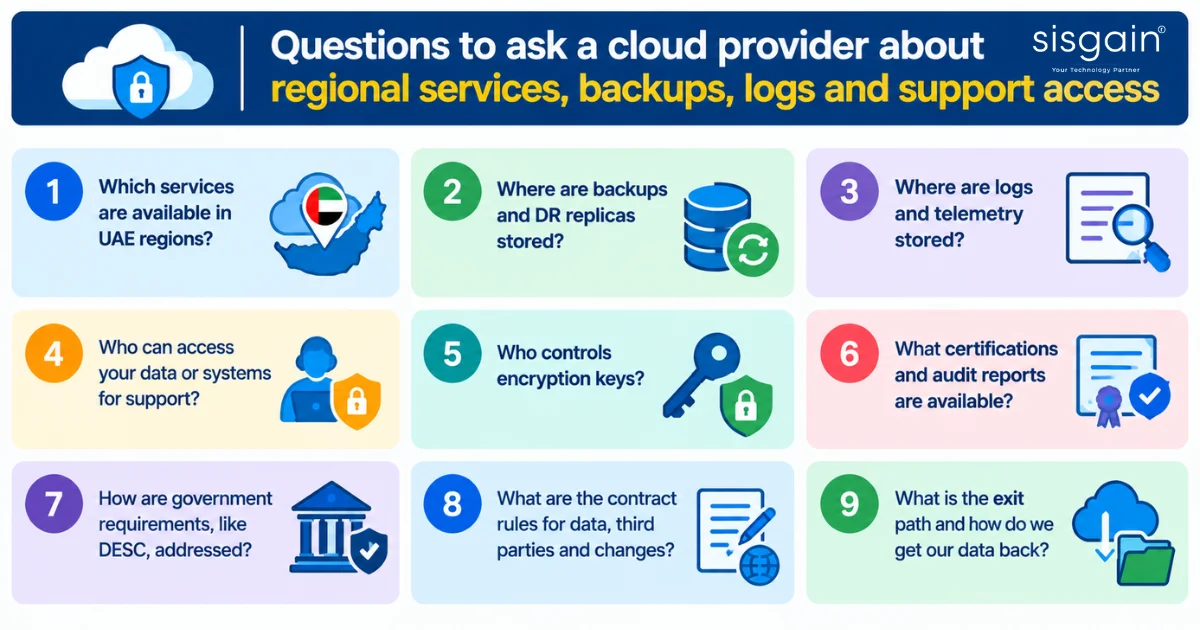
When evaluating hyperscalers, local cloud providers, or a cloud migration company UAE partner who will operate on your behalf, put these questions in writing and require written answers:
- Which services you plan to use are available in the UAE regions, and which are unavailable or limited in features?
- Where are backups, snapshots, and disaster-recovery replicas stored by default, and can this be restricted?
- Where are platform logs, audit trails, and telemetry stored, and for how long?
- Who at the provider or partner can access customer data or systems for support, from which locations, and under what approval and logging controls?
- Who controls encryption keys, and can we hold our own keys outside the provider’s control?
- What independent certifications, attestations, and audit reports can be shared, and how current are they?
- How are government-entity requirements, such as DESC controls, addressed for the services in scope?
- What are the contractual commitments about data jurisdiction, subcontractors, and notification of changes?
- What is the exit path, and how do we retrieve our data and configurations if we leave?
The answers inform more than compliance. They shape architecture and cost. A service that is not available in-country may force a design change, and in-region redundancy often costs more than a default global setup. Better to learn that during assessment than after contracts are signed.
Choosing a migration strategy: the 6Rs
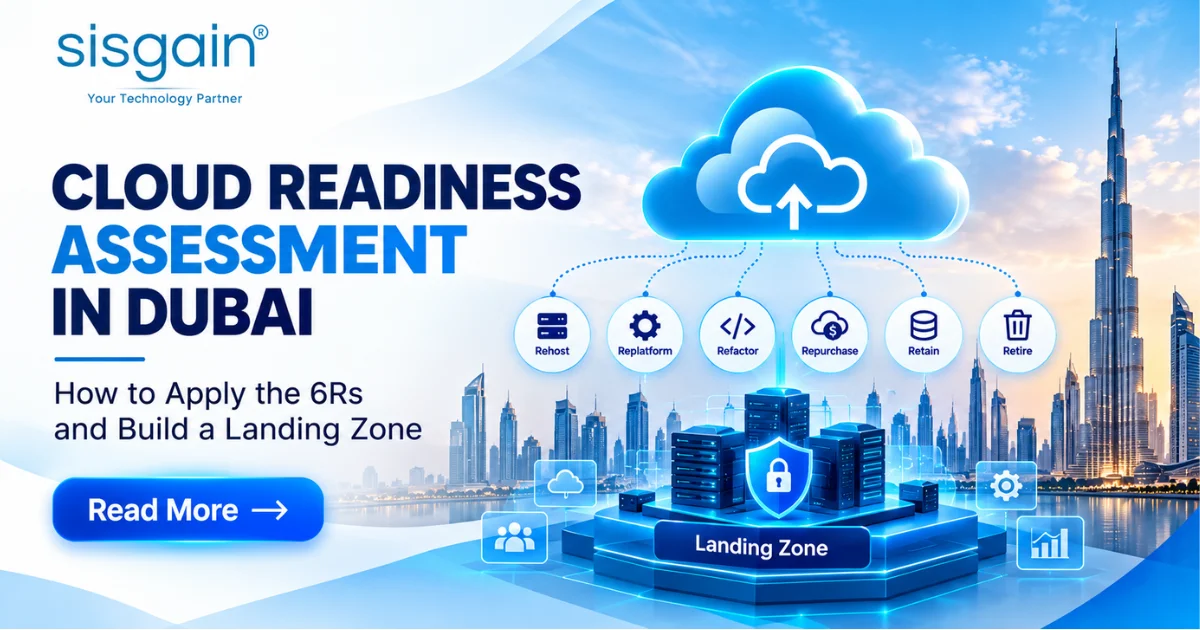
Once data and regulatory constraints are understood, you can decide what to do with each application. The 6Rs framework is the most widely used way to describe the options, and it is useful precisely because it forces a different answer for different workloads. Here is the executive-level version.
|
Strategy |
What it means |
When to use it |
|
Rehost |
Move an application largely as-is |
Data-centre exit, time-sensitive migrations |
|
Replatform |
Make limited cloud optimizations |
Improve operations without full redesign |
|
Refactor |
Redesign for cloud-native services |
Applications needing scalability, speed, or product innovation |
|
Repurchase |
Move to SaaS |
Commodity functions such as CRM, HR, or collaboration |
|
Retire |
Decommission unused applications |
Reducing technical debt and cloud waste |
|
Retain |
Keep workloads where they are for now |
Complex, dependent, or regulatory-sensitive systems |
Suggested visual: 6Rs comparison. Alt text: “Cloud migration strategy UAE 6Rs comparison of rehost, replatform, refactor, repurchase, retire, and retain.”
The 6Rs in business language
Rehost is your speed option. It suits time-bound business cases such as a lease expiry or a hardware refresh you want to avoid. Accept that you are buying time, not transformation, and plan the follow-up optimization.
Replatform is the pragmatic middle. You keep the application’s core design but swap components for managed services, for example moving a self-managed database to a managed database service or adopting managed load balancing. You reduce operational burden without a rewrite.
Refactor is where cloud-native value lives, and also where cost and risk concentrate. Reserve it for applications that genuinely benefit from elasticity, faster release cycles, or new product capabilities. A mobile banking backend that must scale for salary-day peaks is a good candidate. A stable back-office reporting tool probably is not.
Repurchase replaces the application with SaaS. It is often the highest-value move for commodity functions such as HR, CRM, collaboration, and service management. The challenge shifts from infrastructure to data migration, integration, and change management, and the compliance review shifts to the SaaS provider’s data-handling practices.
Retire is the most underrated R. In nearly every portfolio I have assessed, a meaningful share of applications have few or no active users. Retiring them removes cost, attack surface, and migration effort in one decision. Do this before you migrate, not after.
Retain is a legitimate and sometimes wise answer. Core systems with heavy dependencies, mainframe-linked processing, or regulatory-sensitive data may stay on-premises or in a private environment for now. Retain is a decision with a review date, not a failure to modernize.
The key point for executives: a single enterprise portfolio will use multiple approaches. A mature strategy does not force every workload into the cloud, or every workload into the same cloud. In a typical BFSI portfolio I would expect core banking retained for a defined period, digital channels refactored, collaboration repurchased as SaaS, development and test environments replatformed or rehosted, and a long tail of legacy tools retired.
Hybrid and multi-cloud by design
Two terms are often confused with strategy when they are really architecture outcomes.
Hybrid cloud migration is appropriate when some systems must remain on-premises or need low-latency local integration, for example with branch infrastructure, payment terminals, or industrial systems. The risk is operational: hybrid enlarges the surface you must secure, monitor, and support. Design the connectivity, identity, and observability model deliberately, and plan who runs it day to day, whether that is your team or a provider offering managed IT infrastructure services.
Multi-cloud migration should be driven by resilience, regulatory, capability, commercial, or merger-and-acquisition reasons, not trend-following. I have seen organizations adopt a second cloud for negotiating leverage and end up with two half-governed environments and no savings. If you do adopt multiple clouds, standardize identity, network segmentation, observability, backup, policy, and cost controls before scaling across them. Otherwise complexity grows faster than benefit.
With the strategy defined per workload, the next question is sequencing. That is the job of the migration roadmap.
The five-phase migration roadmap
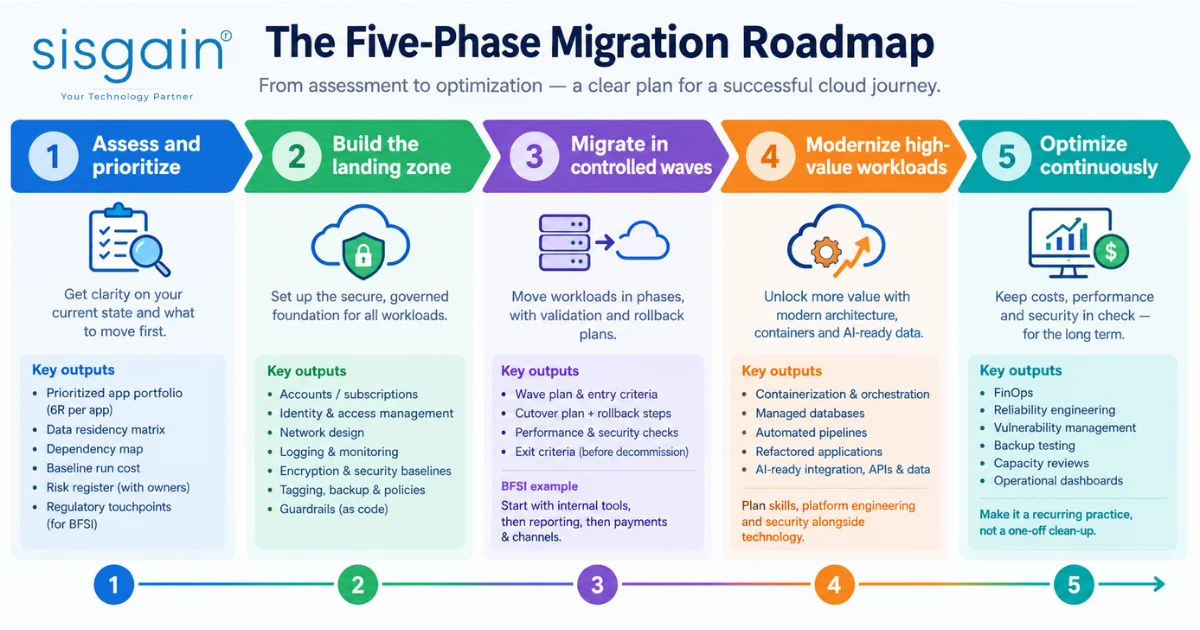
If the previous sections are the decision framework, this is the operating plan. I have used variations of this five-phase structure across banks, insurers, healthcare groups, and public-sector programs, and its value is that each phase has a clear output and a clear gate before the next begins.
Suggested visual: five-stage migration lifecycle diagram. Alt text: “UAE cloud migration roadmap from assessment and landing zone to modernization and FinOps optimization.”
Phase 1: Assess and prioritize
Inventory applications, dependencies, data, licences, risks, service owners, recovery objectives, and business value. Run a cloud readiness assessment before selecting migration waves, because wave planning built on an incomplete dependency map is the most common cause of failed cutovers.
The outputs I insist on are a prioritized application portfolio with a 6R decision per application, the data residency matrix described earlier, a dependency map showing which systems must move together, a baseline of current run cost, and a risk register with named owners. In a BFSI context, add regulatory touchpoints such as notification requirements and audit evidence expectations per workload.
Phase 2: Build the landing zone
The landing zone is the foundation every workload will inherit, so mistakes here multiply. Establish accounts or subscriptions, identity and access management, network design, logging, encryption, security baselines, tagging, backup, policies, and guardrails before the first production workload arrives.
A well-designed landing zone encodes your decisions as code: which regions are permitted, which services are approved, how networks are segmented, how logs flow to a central location, and which tags are mandatory. This is what turns policy documents into enforced controls, and it is the single biggest difference between a governed migration and a sprawling one. A dedicated secure cloud migration in the UAE approach treats this phase as the security architecture, not an infrastructure preliminary.
Phase 3: Migrate in controlled waves
Begin with lower-risk workloads to prove the landing zone, the tooling, and the team’s runbooks. Validate performance and security, then migrate grouped applications according to dependencies and business criticality. Customer-facing and regulated workloads belong in later waves, once the process is proven.
Each wave should have entry criteria (landing zone ready, backups verified, owners signed off), a defined cutover plan with rollback steps, performance and security validation, and exit criteria that must be met before the on-premises copy is decommissioned. A phased plan is almost always safer than a single large cutover. In the BFSI scenario, a bank might start with internal collaboration and development environments, move reporting and analytics next, and approach payment and channel systems last, with parallel running and tested rollback.
Phase 4: Modernize high-value workloads
Once the estate is stable in the cloud, modernize where the business case is strongest. That may mean containerizing selected services, adopting managed databases where suitable, automating delivery pipelines, and refactoring applications that need faster releases or elastic scale.
Containers and orchestration deserve a clear-eyed view. Kubernetes can deliver portability, scaling, and deployment consistency, but it also adds operational complexity that many teams underestimate. Plan skills, platform engineering, and security hardening alongside the technology; our guidance on Kubernetes migration in Dubai covers when it fits and when a simpler managed service is the wiser choice.
This phase is also where AI-ready migration becomes concrete. If your roadmap includes analytics or generative AI, modernizing integration layers, APIs, and data stores now avoids rebuilding them later. We cover this in more depth in AI-ready cloud migration in the UAE.
Phase 5: Optimize continuously
Migration is not the finish line. Implement FinOps, reliability engineering, vulnerability management, backup testing, capacity reviews, and operational dashboards after migration, and make them recurring practices, not one-off clean-ups. Organizations that skip this phase typically see cost and risk drift within two or three quarters. If you want a dedicated programme here, see cloud cost optimization in the UAE.
Security, AI readiness and FinOps as one operating model
I group these three topics deliberately. Cloud migration creates risk when security is bolted on, when AI is planned without data foundations, or when cost governance begins only after bills rise. They share the same prerequisites: clear ownership, consistent tagging and classification, central visibility, and automated guardrails. Treat them as one operating model and you build each control once; treat them separately and you build three overlapping, inconsistent ones.
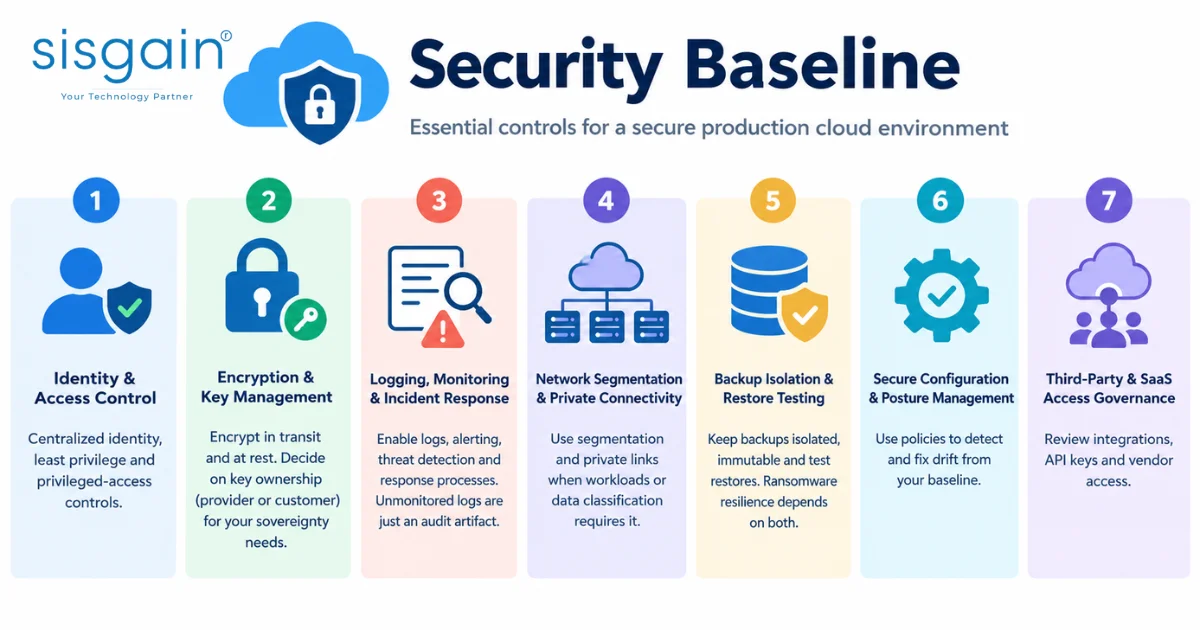
Security baseline
My minimum baseline for any production cloud environment includes:
- Centralized identity, least-privilege access, and privileged-access controls. Most cloud breaches begin with identity, so this is the first control to get right.
- Encryption in transit and at rest, with clear key-management ownership. Decide early whether keys are provider-managed or customer-controlled, and align that with your sovereignty requirements.
- Security logging, alerting, threat detection, and incident-response processes. Logs nobody monitors are an audit artifact, not a defence.
- Network segmentation and private connectivity where workloads or data classification demand it.
- Backup isolation, immutable recovery options, and restore testing. Ransomware resilience depends on backups attackers cannot alter, and on proof that restores work.
- Secure configuration policies and continuous posture management, so drift from the baseline is detected and corrected.
- Third-party and SaaS access governance, including review of integrations, API keys, and vendor access.
For Dubai government and semi-government environments, the DESC cloud security standard is a relevant benchmark, and its published framework emphasizes cloud-service security requirements and guidance. Your security architecture should map controls to the standards that apply to you so that audit evidence is produced as a by-product of operation, not assembled in a panic before an inspection.
One point CISOs raise with me repeatedly is shared responsibility. The provider secures the underlying platform; you remain responsible for identity, configuration, data, and often much of the application stack. Ambiguity here is where incidents hide. Document responsibilities explicitly, by service, between you, the cloud provider, and any managed-service partner.
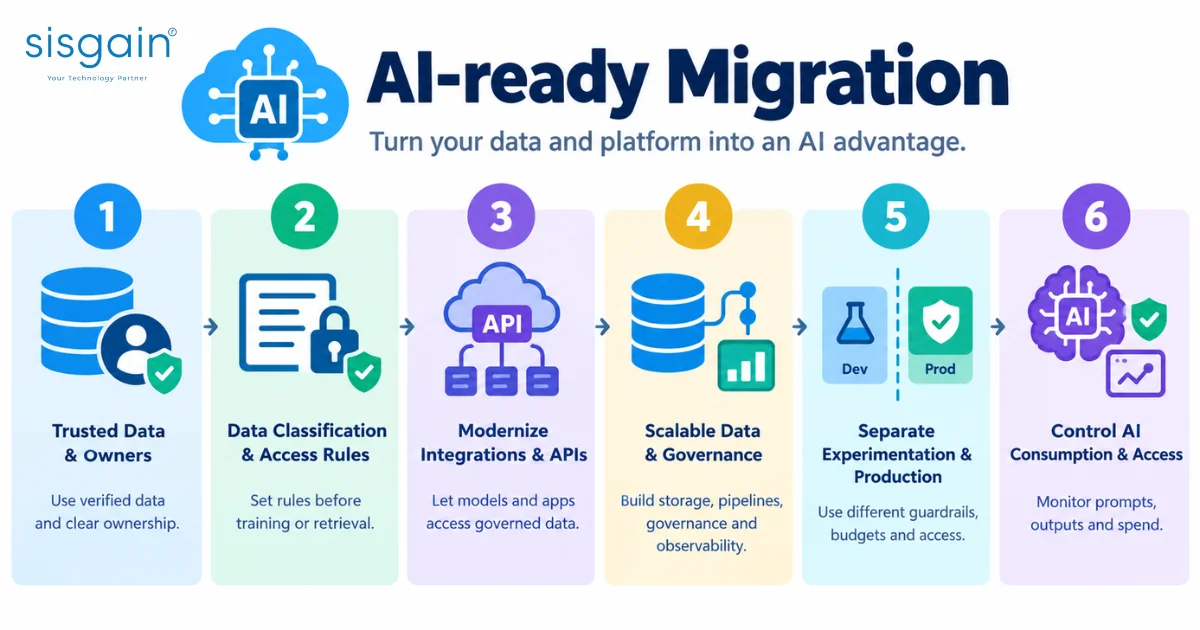
AI-ready migration
Organizations across the region are under pressure to demonstrate AI progress. Frame AI-ready migration as a data and platform discipline, not simply GPU procurement. The sequence that works:
- Identify trusted data sources and data owners. AI built on unowned, unreliable data produces confident nonsense.
- Create data classification and access rules before training or retrieval workflows. An AI assistant that can retrieve any document will eventually expose a sensitive one.
- Modernize integration layers and APIs, so models and applications can access governed data without bespoke point-to-point connections.
- Design scalable data storage, pipelines, governance, and observability.
- Separate experimentation from production workloads, with different guardrails, budgets, and data access.
- Control AI consumption, model access, and sensitive-data exposure, including monitoring of prompts, outputs, and spend.
In a BFSI setting, this might mean a governed data platform feeding fraud analytics and a customer-service assistant, with strict rules about which customer fields can ever reach a model. In healthcare, it means de-identification and consent controls designed before any clinical data enters an AI workflow. When organizations are ready to build on that foundation, specialist AI development solutions in Dubai can connect models and applications to the governed platform. The point of AI-ready migration is that the foundation comes first, so the use cases can follow safely.
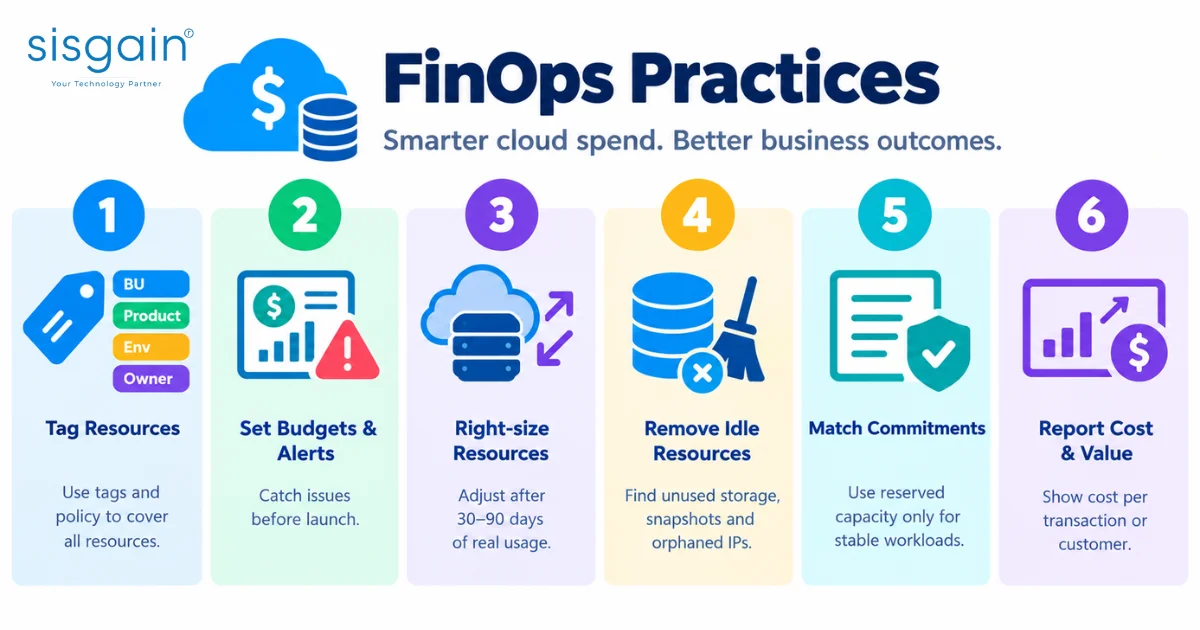
FinOps practices
Cloud cost is an engineering and governance problem as much as a finance one. Here is the checklist I give every program:
- Tag resources by business unit, product, environment, and owner, and enforce tagging through policy so untagged resources cannot be created.
- Set budgets and anomaly alerts before production launch, not after the first surprising invoice.
- Right-size compute and databases after actual usage patterns emerge, usually 30 to 90 days post-migration.
- Review idle resources, unused storage, snapshots, and orphaned IP addresses on a regular schedule.
- Match commitment models to stable workloads only after utilization is understood, so you do not lock in the wrong capacity.
- Report cloud cost alongside service performance and business outcomes, so leadership sees cost per transaction or per customer rather than a raw total.
When executives ask about cloud migration cost UAE programs should expect, my answer is that the migration project cost is the smaller number over time. Run cost, which is shaped by architecture, governance, and optimization discipline, usually dominates. That is why FinOps belongs in the landing zone from day one.
Resilience: DR, BCP and multi-region design
In my experience, CIOs care about recovery more than migration speed, and they are right to. Cloud does not automatically provide disaster recovery. The architecture, backup design, replication, runbooks, and testing determine the recovery capability. An application deployed in a single zone with no tested restore process is no more resilient in the cloud than in a single server room.
Two measures anchor every recovery conversation:
- RTO (Recovery Time Objective): the maximum acceptable time to restore a service.
- RPO (Recovery Point Objective): the maximum acceptable amount of data loss, measured in time.
An RTO of one hour and an RPO of five minutes implies a very different, and much more expensive, architecture than an RTO of 24 hours and an RPO of one day. The right answer depends on the business impact of downtime and data loss, which is why these targets must be set with business owners, not guessed by infrastructure teams.
|
Workload criticality |
Example |
Resilience approach |
|
Mission-critical |
Payments, customer transaction systems |
Multi-zone design, tested failover, defined RTO/RPO |
|
Business-critical |
ERP, customer portals |
High availability, automated backups, periodic DR testing |
|
Important internal workloads |
Collaboration and internal reporting |
Backup, restore validation, documented recovery process |
|
Non-critical |
Archives, legacy tools |
Low-cost backup and retention strategy |
Tiering matters because resilience is a cost lever. Applying mission-critical architecture to every workload is wasteful; applying archive-grade protection to a payment system is dangerous. A tiered model lets you spend where the business impact justifies it.
A complete cloud disaster recovery UAE plan, and its business-continuity (BCP) counterpart, should include:
- A list of critical services and their dependencies, including identity, DNS, and network connectivity, which are often forgotten.
- Agreed RTO and RPO targets per tier.
- Backup and replication design, including isolated or immutable copies.
- Recovery runbooks that a person who did not build the system can follow.
- Communication responsibilities for staff, customers, and regulators.
- A testing schedule, with documented results and evidence of successful restoration.
That last item is where plans most often fail. An untested DR plan is a hypothesis. Schedule failover and restore tests, record the outcomes, and fix what breaks.
On multi-region design, I want to be direct: multi-region architecture should follow a documented risk assessment. It can improve resilience, particularly for mission-critical services and concentration-risk concerns, but it may also increase operational complexity, latency, data-transfer exposure, and cost. It interacts with data residency too, since a second region outside the country may raise the transfer questions discussed earlier. Many organizations are well served by multi-zone resilience within a region, backed by tested backups, and reserve multi-region designs for the few services where the business case is clear.
How to evaluate a cloud migration company in the UAE
By now it should be clear that choosing a partner is a risk decision. Choosing a cloud migration company UAE buyers can trust means looking past logos and hourly rates to what the partner will actually do about compliance, security, cost, and recovery.
Partner evaluation checklist
Use these questions in your RFP and in reference calls. A credible partner will answer them specifically and with evidence.
- Can the partner perform an application, data, dependency, and cloud-readiness assessment?
- Do they show practical experience with UAE data residency and the relevant compliance contexts (PDPL, DIFC, ADGM, DESC where applicable)?
- Can they design secure landing zones, not merely move virtual machines?
- Do they support AWS, Azure, Google Cloud, Oracle Cloud, private cloud, or hybrid environments relevant to your organization?
- Do they have clear modernization capability for containers, Kubernetes, APIs, databases, and DevOps?
- Will they define RTO, RPO, backup, DR testing, and operating procedures?
- Can they establish FinOps tagging, budgets, reporting, and optimization practices?
- Do they offer post-migration managed services, monitoring, security operations, and incident support?
- Can they provide a phased migration plan with business risk, timeline, cost assumptions, and exit criteria?
- Do they make responsibilities explicit through a shared-responsibility model?
A few practical observations from the buyer’s side. First, ask to speak to the people who will actually deliver your program, not only the sales team. Second, ask for a sample landing-zone design or assessment deliverable, since the quality of artifacts reveals the quality of thinking. Third, probe what happens after go-live: who monitors, who patches, who responds at 2 a.m., and how are service levels reported? Continuity of ownership after migration is where many programs lose value, so look for partners who can also provide ongoing IT support services and managed IT infrastructure services instead of handing over a build and leaving.
For organizations seeking cloud migration services in Dubai, evaluate providers on their ability to combine planning, secure implementation, modernization, cost governance, and post-migration support. The same principle applies to teams in the capital searching for cloud migration consultants Abu Dhabi can offer: look for local regulatory fluency across ADGM, federal requirements, and government-linked expectations, plus a delivery model that can operate across emirates.
Be cautious of any provider that promises “100% compliance,” claims to be the best in the market without evidence, or proposes a fixed timeline before completing an assessment. Compliance is a continuing shared effort, and no honest partner can guarantee it as a product feature.
Plan your UAE cloud migration with confidence
Get a cloud migration readiness consultation covering workload assessment, data residency considerations, landing-zone architecture, security controls, migration sequencing, disaster recovery, and FinOps priorities.
Explore supporting resources:
- Cloud readiness assessment
- Secure cloud migration in the UAE
- Kubernetes migration in Dubai
- AI-ready cloud migration in the UAE
- Cloud cost optimization in the UAE
Conclusion
The organizations that get the most from cloud migration services UAE providers offer are not the ones that move fastest. They are the ones that decide best: which workloads to move and which to retire or retain, where data should reside and who may access it, how security is enforced by design, how recovery is proven, and how cost is governed after the celebration of go-live is over.
The framework in this guide gives you the structure for those decisions: a workload-level data residency matrix, a 6R strategy per application, a five-phase roadmap, a combined security, AI, and FinOps operating model, a tiered resilience design, and a partner checklist that rewards substance over salesmanship. Whether your priority is cloud migration Dubai programs under DIFC or mainland requirements, a strategy aligned with ADGM and federal expectations in Abu Dhabi, or a sovereign cloud UAE posture for sensitive workloads, the same discipline applies.
If you are ready to turn this framework into a plan, start with an assessment and a data residency matrix, then talk to a partner who can show you how they will deliver, secure, and operate the result. Our team offers cloud migration services in Dubai built around exactly this decision-first approach.
Regulatory and platform information changes frequently. This article was last updated in October 2026 and should be reviewed periodically against primary sources from the UAE federal government, DIFC, ADGM, DESC, and your cloud providers. It is not legal advice.