
Quick answer: What is secure cloud migration in the UAE? Secure cloud migration in the UAE is the process of moving workloads to the cloud while meeting applicable data-protection, residency, sector and security requirements. It combines data classification, compliant cloud architecture, Zero Trust access controls, encryption, monitoring and audit-ready operational evidence.
UAE organisations are no longer migrating only for cost and scalability. They are designing cloud environments that can prove where data lives, who can access it, how it is protected, and how quickly the business can respond to an incident. That shift changes how a migration should be planned, sequenced and evidenced.
This guide is written for CIOs, CTOs, IT directors, cloud architects and security leads who are planning or reviewing a move to the cloud in Dubai, Abu Dhabi and across the UAE. It explains the regulatory layers, a practical data-classification method, Zero Trust controls, architecture patterns and a phased runbook. It is general guidance, not legal advice. Confirm your specific obligations with legal counsel and your regulator.
Why security and residency shape UAE cloud migration design
Quick answer: In the UAE, cloud migration is now a sovereignty, security and resilience decision rather than a simple infrastructure move. Residency and security requirements influence architecture choices before any workload is moved.
For many years, cloud business cases in the Gulf were built around speed, elasticity and cost. Those drivers still matter, but they are no longer enough. Sovereignty has moved beyond a compliance checkbox and now influences architecture, operational resilience and cyber-security priorities across the GCC. Boards and regulators increasingly ask a different set of questions. Where is the data stored, processed and backed up? Who, including vendor staff, can reach it? How fast can we detect and contain an incident? Can we prove all of this to an auditor?
UAE businesses face overlapping obligations from the federal Personal Data Protection Law (PDPL), financial-sector rules, free-zone regimes such as DIFC and ADGM, and sector-specific data rules for areas like health and government. A migration designed only around performance and cost can create cross-border transfer, access-control and audit problems later, and those are expensive to fix once workloads are live.
A secure migration therefore begins before the first server moves. It starts with data classification, regulatory mapping, identity design and a compliant landing zone. Your cloud migration strategy should treat these as design inputs, and your cloud landing zone design should encode them as guardrails from the first deployment.
Practical takeaway: Treat residency and security as architecture requirements from day one, not as post-migration remediation.
The UAE data protection landscape: PDPL, DIFC, ADGM and sector rules
Quick answer: The UAE has layered data rules. Federal PDPL applies to mainland processing, DIFC and ADGM have their own frameworks, and regulators such as CBUAE add stricter requirements for specific sectors.
This section summarises the main layers. It is not a substitute for legal advice.
Federal PDPL
Federal Decree-Law No. 45 of 2021 governs personal-data processing in the UAE. On cross-border transfers, it generally allows personal data to move to jurisdictions with a "proper protection level", under certain agreements, or with valid data-subject consent. Other transfers require appropriate contractual and regulatory safeguards. In practice, that means every transfer needs a documented basis rather than an assumption.
DIFC Data Protection Law
Organisations operating in the Dubai International Financial Centre follow the DIFC Data Protection Law. Transfers outside the DIFC generally require an adequate jurisdiction or another permitted transfer mechanism, including approved standard contractual clauses. Teams planning DIFC data protection cloud designs should document the chosen mechanism for each transfer path.
ADGM
Businesses in Abu Dhabi Global Market are subject to ADGM's data-protection framework. This should be assessed separately from mainland PDPL obligations, even where the same group operates on both sides.
Financial services and CBUAE
CBUAE rules are stricter for banks. A bank's Master System of Record, including confidential data, must be continuously maintained and stored within the UAE. Confidential customer data cannot be shared outside the UAE without CBUAE approval and prior written customer consent. Insurers, payment providers and other licensed entities should check the rules that apply to their own licence.
Government and critical sectors
Government entities and regulated sectors such as health, energy and telecoms may face additional sovereignty, classification, hosting and security requirements. Emirate-level security standards may also apply, for example in Dubai government environments. Confirm what applies to your entity before choosing a hosting model.
A note on PDPL Executive Regulations
Public sources differ on the current implementation status of the PDPL Executive Regulations. Organisations should treat PDPL readiness as an active migration requirement and monitor updates from the UAE Data Office and legal counsel. Do not plan around an assumed enforcement date.
Practical takeaway: Map each workload to its applicable regulator before selecting a cloud region or architecture.
Data classification: what can move, what must stay onshore
Quick answer: Classify data first, then decide placement. Public and internal data usually move easily. Personal, financial, health and government data need regulator-specific analysis and may require in-country hosting, hybrid or sovereign options.
The most common cause of failed or delayed migrations is not technology. It is not knowing what data exists, where it flows and who touches it. Before you choose a region, run discovery. A structured application discovery and dependency mapping exercise reveals hidden integrations, shadow data stores and cross-border flows that spreadsheets miss.
Use a simple classification model like this as your starting point:
|
Data category |
Examples |
Typical cloud approach |
|
Public data |
Marketing content, public product documentation |
Can usually be hosted in a suitable cloud region, subject to organisational policy |
|
Internal business data |
Internal documents, project files, non-personal operational data |
Cloud-hosted with identity controls, encryption and access logging |
|
Personal data |
Customer, employee, prospect and user data |
Requires PDPL, DIFC or ADGM transfer analysis and strong processing controls |
|
Confidential financial data |
Banking records, transaction data, customer financial information |
Often requires UAE storage and CBUAE-specific controls for banks |
|
Regulated health data |
Patient records, clinical data |
Requires health-sector data rules and strict access governance |
|
Government or classified data |
Public-sector systems and sensitive government workloads |
May require sovereign, in-country or approved hosting arrangements |
For every dataset, your classification register should record:
- Data owner and business purpose. Who is accountable, and why is the data processed?
- Personal-data elements and special-category data. Identify sensitive fields explicitly.
- Locations. Countries and cloud regions where data is stored, processed, backed up or accessed from.
- Third parties. Sub-processors, vendors and support engineers with potential access.
- Retention and deletion. How long it is kept and how it is deleted.
- Security requirements. Encryption, key ownership and logging expectations.
Notice that "accessed from" matters as much as "stored in". A database sitting in a UAE region can still raise transfer questions if administrators or support staff access it from another country.
Practical takeaway: You cannot design a compliant migration if you do not know what data you have, where it flows and who can access it.
Request a compliance-ready migration review. Get a structured review of your data residency, identity, encryption, segmentation, logging and migration-readiness controls before you move workloads to the cloud. Talk to our team about secure cloud migration services in Dubai.
Zero Trust for UAE cloud migration: identity, encryption, keys and segmentation
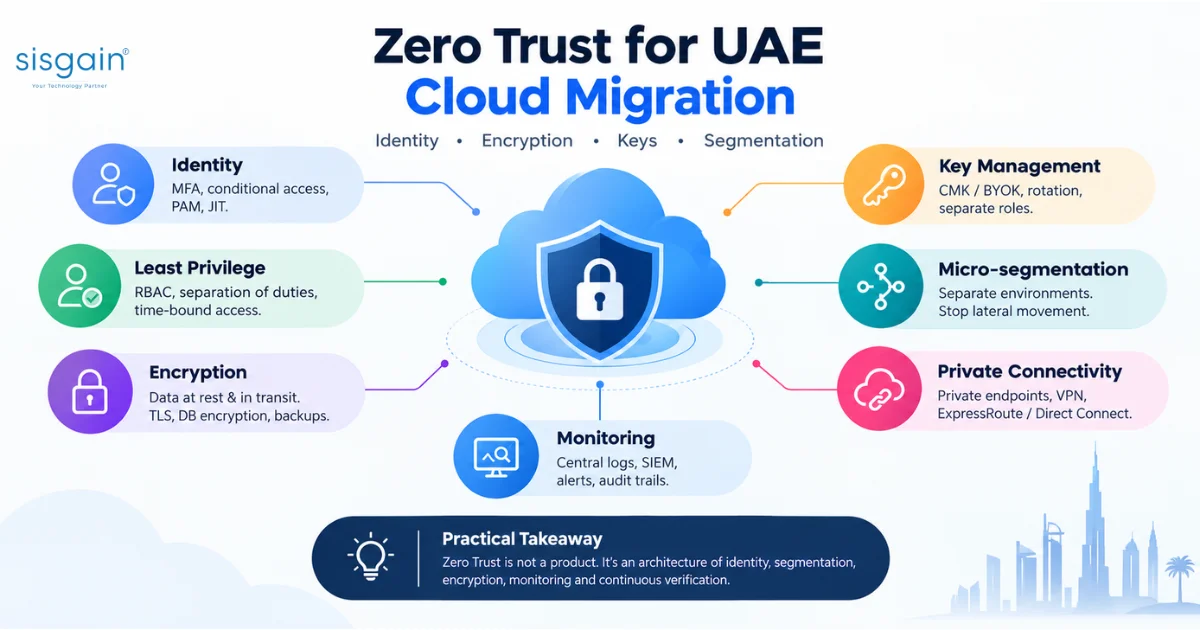
Quick answer: Zero Trust means no user, device or workload is trusted by default. In a UAE cloud environment it is delivered through strong identity, least privilege, encryption, key management, segmentation and continuous monitoring.
Zero Trust assumes no implicit trust based on network location. Access is continuously verified through identity, device posture, context and least privilege. That model suits regulated UAE environments because it produces controls that are both defensible and auditable. If you want specialist help designing it, see our Zero Trust Security Services in Dubai.
The core controls are below.
Identity
Identity becomes the new perimeter. Use Entra ID or an equivalent identity provider with multi-factor authentication, conditional access, privileged access management, just-in-time administrator access and regular access reviews. Federate identities consistently across on-premise and cloud so users have one controlled identity.
Least privilege
Apply role-based access control, separation of duties and time-bound elevated permissions. Aim for no standing production access. Anyone needing elevated rights should request them, receive them for a limited period and have the activity logged.
Encryption
Encrypt data at rest and in transit. Enforce TLS, use database-level encryption and cover backups and snapshots, which are often forgotten.
Key management
Where appropriate, use customer-managed keys or bring-your-own-key (BYOK) models. Define key ownership clearly, set a rotation policy, separate key administrators from data administrators and document recovery procedures. Key control is often central to a sovereignty argument, because it limits who can read data even if infrastructure is shared.
Micro-segmentation
Separate production, non-production, management and sensitive-data environments. Restrict lateral movement so a compromise in one workload cannot spread freely to others.
Private connectivity
Use private endpoints and VPN or dedicated links such as ExpressRoute or Direct Connect-style connections. Avoid unnecessary public exposure of databases, storage and management interfaces.
Monitoring
Centralise logs, integrate with a SIEM, configure anomaly alerts, keep immutable audit trails and maintain tested incident-response playbooks. Detection speed is a major factor in how a regulator or customer judges an incident.
Practical takeaway: Zero Trust is not a product. It is an architecture of identity, segmentation, encryption, monitoring and continuous verification.
Hybrid and sovereign architecture patterns for the UAE
Quick answer: Sovereign cloud is about more than choosing a UAE region. It also covers operational control, support access, data ownership, exit rights and resilience. The right pattern depends on your data and regulator.
Recent GCC research identifies sovereignty and operational resilience as leading cyber-security priorities. That is why a UAE region is a useful starting point but not the whole answer. For a deeper comparison, see our upcoming guide to sovereign cloud UAE options.
Three patterns cover most UAE scenarios:
|
Pattern |
Best suited for |
Key design considerations |
|
In-country public cloud |
Most enterprises with standard compliance needs |
UAE regions, data-residency settings, encryption, private connectivity and vendor due diligence |
|
Hybrid cloud |
Organisations with legacy systems, latency needs or regulated data |
Clear data-placement rules, secure interconnect, consistent identity and unified monitoring |
|
Sovereign or private cloud |
Government, defence, banking, healthcare and highly sensitive workloads |
Stronger control over infrastructure, operations, support access, data ownership and exit terms |
Vendor due diligence checklist
Whichever pattern you choose, verify the following with every provider:
- The physical region for primary storage, backups, disaster recovery and support operations.
- All sub-processors and the countries from which data may be accessed.
- Contract terms for data ownership, deletion, breach notification, audit rights and exit assistance.
- Whether customer-managed encryption keys are supported.
- How the provider helps the organisation meet its specific regulatory obligations.
Avoid ranking providers by assumption. Any comparison should be current, documented and tied to your own requirements.
Practical takeaway: A UAE cloud region helps, but it does not automatically make an architecture sovereign or compliant.
Secure migration runbook: pre-cutover, cutover and post-cutover
Quick answer: A secure migration runs in three phases. Pre-cutover builds the foundation and proves recovery. Cutover moves workloads in controlled waves. Post-cutover verifies controls, retires legacy systems and keeps evidence current.
Use this runbook to structure your cloud migration strategy and delivery plan.
Pre-cutover
- Complete data inventory, classification and data-flow mapping, supported by application discovery and dependency mapping.
- Conduct a privacy and regulatory impact assessment for personal and regulated data.
- Select target regions and confirm residency requirements.
- Build the landing zone with identity, networking, encryption, logging, backup and segmentation controls. See cloud landing zone design.
- Define RBAC and privileged-access workflows.
- Test recovery, rollback, failover and data-deletion procedures.
- Review cloud provider contracts, sub-processors and cross-border access.
Cutover
- Migrate in controlled waves, starting with lower-risk workloads to prove the process.
- Validate data integrity, application performance, access controls and monitoring after each wave.
- Maintain a documented rollback plan and clear decision criteria.
- Restrict production access during migration.
- Capture configuration, approvals, test results and incident records as you go.
Post-cutover
- Decommission legacy systems securely and verify data deletion.
- Validate backups, disaster-recovery objectives and log retention.
- Run access reviews and vulnerability scans.
- Monitor cost, performance, security alerts and compliance exceptions. Strong cloud cost governance keeps spend and policy drift under control.
- Schedule periodic audits and control reviews.
Practical takeaway: A secure migration is not complete at go-live. It is complete when controls, evidence, recovery capability and decommissioning are verified.
Request a compliance-ready migration review. Get a structured review of your data residency, identity, encryption, segmentation, logging and migration-readiness controls before you move workloads to the cloud. Explore our secure cloud migration services in Dubai.
Audit evidence, logging and continuous compliance
Quick answer: UAE organisations should be able to demonstrate compliance, not just assert it. That requires an evidence pack covering data location, access, encryption, vendors, incidents and recovery, produced continuously rather than at audit time.
Regulated environments increasingly expect traceable access, monitoring and audit-ready operations. The most efficient approach is to generate evidence automatically from the landing zone and governance tooling instead of assembling it manually before each review.
Your audit evidence pack should include:
- Data inventory and classification register
- Data-flow diagram showing storage, processing, backup and access locations
- Lawful basis and transfer-assessment records
- Cloud provider and sub-processor due-diligence records
- Encryption and key-management inventory
- Identity and access-review reports
- Privileged-access logs
- Network segmentation and firewall policy documentation
- SIEM alerts, incident records and response evidence
- Backup, recovery and disaster-recovery test results
- Vendor contracts, audit rights, breach-notification clauses and exit provisions
Pair this with continuous governance: policy-as-code, automated configuration checks, tagging standards and scheduled reviews. For a printable starting point, see our upcoming UAE cloud compliance checklist.
Practical takeaway: Build compliance evidence into the landing zone so audits become a reporting exercise rather than a crisis.

Disclaimer: This article provides general information and does not constitute legal advice. Regulatory requirements vary by sector, regulator and data type. Consult qualified legal counsel and your regulator before making compliance decisions.