
Quick Answer
A cloud readiness assessment is a structured review of your applications, infrastructure, data, dependencies, security posture, costs and operating model. It tells you which workloads to move, how to move them (using the 6Rs), what must be fixed first, and what your landing zone must provide, before any migration begins. In the UAE, it also surfaces data residency and regulatory questions for your legal and risk teams.
Why a Cloud Readiness Assessment Shapes Migration Success
For many Dubai enterprises, the question is no longer whether to adopt cloud but how to do it without disrupting the business. Whether you are shaping a cloud migration strategy UAE leadership can defend to the board, or comparing a cloud migration company UAE vendors against your internal capability, the quality of your starting evidence determines the quality of every later decision.
A cloud readiness assessment gives Dubai enterprises an evidence-based view of workload suitability, dependencies, risks, costs and sequencing before they commit to migration. It replaces assumptions with facts: what you run, who owns it, what it connects to, what data it holds and what it costs to operate today.
Migration decisions depend on the relationship between applications, infrastructure, data, operating processes and business priorities. A proper assessment reduces avoidable surprises by revealing:
- Which applications share databases, identity services, network routes, batch jobs or third-party integrations.
- Which systems must migrate together and which can move independently.
- Where performance, licensing, security, resilience or support requirements constrain the target design.
- Which applications are good candidates for early migration and which need remediation or executive decisions first.
Consider an illustrative scenario. An ERP application may appear as a single server in the inventory, yet it may depend on a database, an identity provider, a reporting platform, file-transfer jobs and a warehouse system. Moving only the application server could cause outages or data inconsistencies. The assessment is where those relationships are found, not in the middle of a cutover weekend.
This guide is part of our wider series on cloud migration Dubai organizations are planning. For the full journey, see our cloud migration services guide for the UAE.
What a Cloud Workload Assessment Should Examine
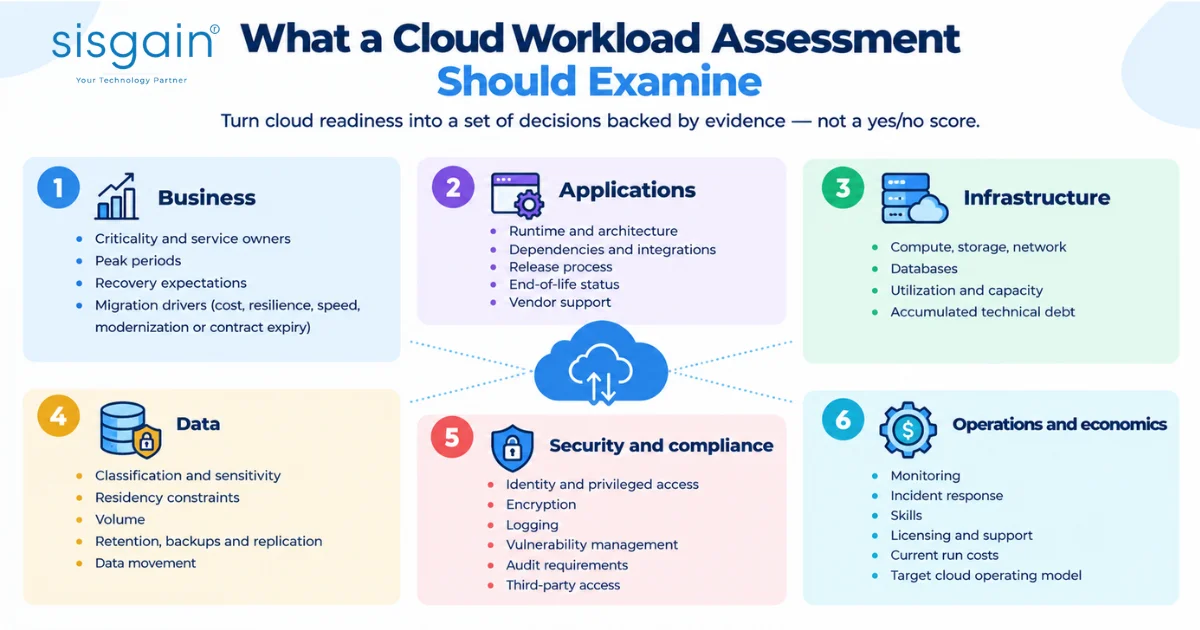
A cloud workload assessment in the UAE is most useful when organized around six areas. This turns "cloud readiness" into a set of decisions backed by evidence rather than a yes/no score.
- Business: criticality, service owners, peak periods, recovery expectations and migration drivers (cost, resilience, speed, modernization or contract expiry).
- Applications: runtime, architecture, dependencies, integrations, release process, end-of-life status and vendor support.
- Infrastructure: compute, storage, network, databases, utilization, capacity and accumulated technical debt.
- Data: classification, sensitivity, residency constraints, volume, retention, backups, replication and data movement.
- Security and compliance: identity, privileged access, encryption, logging, vulnerability management, audit requirements and third-party access.
- Operations and economics: monitoring, incident response, skills, licensing, support, current run costs and the target cloud operating model.
The sixth area is often underestimated. A workload can be technically portable and still be a poor candidate because the team lacks the skills to run it, the licence terms change in the cloud, or support arrangements do not carry over. Assessing operations early also clarifies whether you will need Cloud Managed Services in Dubai & UAE after go-live.
Discovery: Inventory, Dependencies and Data Classification
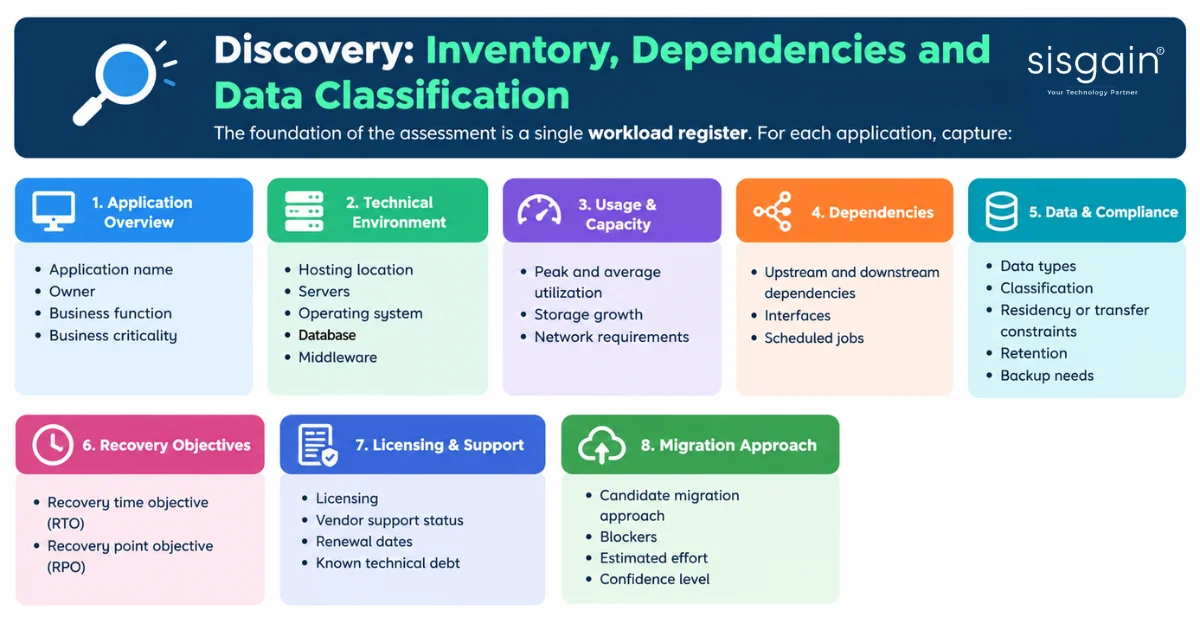
The foundation of the assessment is a single workload register. For each application, capture:
- Application name, owner, business function and business criticality.
- Hosting location, servers, operating system, database and middleware.
- Peak and average utilization, storage growth and network requirements.
- Upstream and downstream dependencies, including interfaces and scheduled jobs.
- Data types, classification, residency or transfer constraints, retention and backup needs.
- Recovery time objective (RTO) and recovery point objective (RPO).
- Licensing, vendor support status, renewal dates and known technical debt.
- Candidate migration approach, blockers, estimated effort and confidence level.
Tooling helps, but people validate
Application discovery and dependency mapping tools can accelerate inventory and reveal observed technical connections. Major providers publish assessment and discovery tooling for inventory, dependency mapping and migration planning. However, automated discovery shows what traffic it has seen. It does not necessarily reveal business criticality, undocumented manual processes or dependencies that only trigger at month-end, quarter-end or during an annual audit.
The practical answer is to combine both: run discovery tooling, then validate the output in structured interviews with application owners. Record a confidence level for each entry so the team knows which findings are verified and which remain assumptions.
Data classification and data flows
Classification drives design. Public, internal, confidential and regulated data may require different controls, locations and access models. Build a data-flow register alongside the inventory, covering not only primary databases but also backups, logs, telemetry, disaster recovery copies, support access and subcontractors. These flows matter later when you review residency and transfer requirements.
How to Apply the 6Rs to a Dubai Enterprise Estate
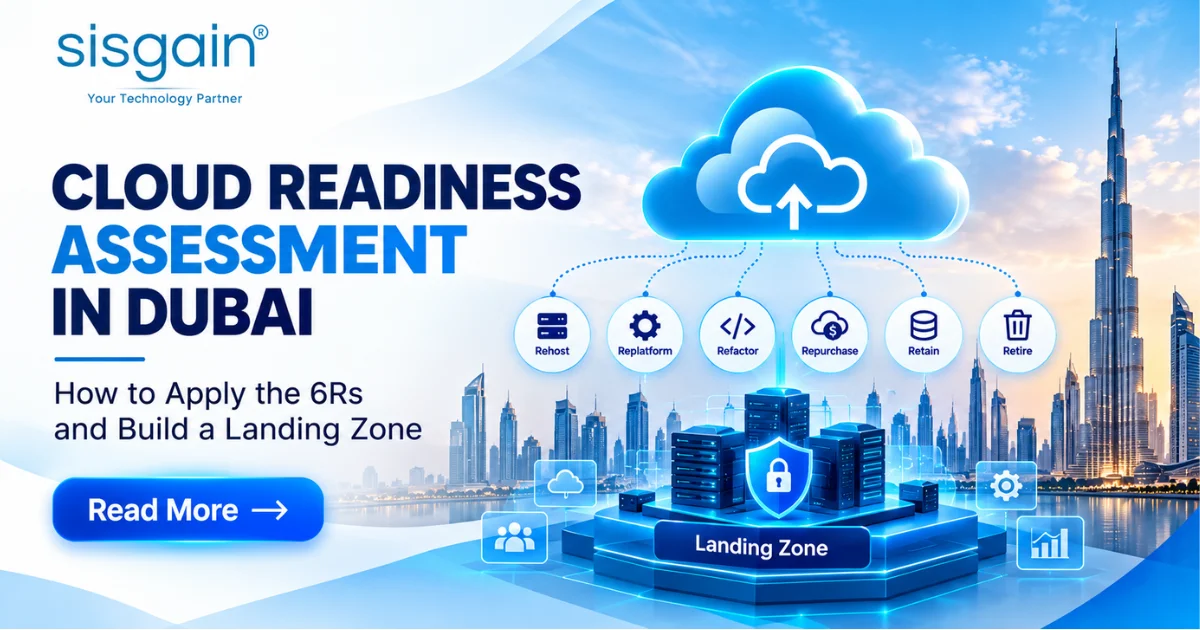
The 6Rs cloud migration model gives each workload a defined treatment. Terminology differs slightly between providers and frameworks, so align final strategy names with your selected cloud provider's current framework. The commonly recognized set is:
|
Strategy |
Meaning |
Decision to assess |
|
Rehost |
Move a workload largely as-is to cloud infrastructure. |
Could a stable legacy application move to virtual machines first, with modernization later? |
|
Replatform |
Make limited changes to use managed services or improve operations without rebuilding. |
Could a database or application tier move to a managed service after compatibility testing? |
|
Refactor / re-architect |
Make substantial design changes to use cloud-native capabilities. |
Does a customer-facing service need redesign for elasticity, resilience or faster releases? |
|
Repurchase |
Replace the application with SaaS or another packaged product. |
Is a supported SaaS product more practical than migrating a heavily customized application? |
|
Retire |
Decommission an application or component that is no longer needed. |
Is the system duplicated, unused or retained only because ownership is unclear? |
|
Retain |
Keep the application where it is for now. |
Does a dependency, contract, regulation or upcoming replacement make immediate migration unsuitable? |
Avoid one-R thinking
Different applications, and sometimes different components of one application, need different treatment. A legacy .NET or Java workload might be rehosted as an interim step, with its database replatformed and a later release refactored. Retire and retain decisions are often the most valuable, because every application you decommission is one you never pay to migrate, secure or operate.
ERP, core banking and healthcare systems should be treated as assessment examples rather than automatic recommendations. Their suitability depends on product support, architecture, data, regulator expectations and business risk.
Where refactoring is on the table, a cloud-native migration path can deliver elasticity and release agility, but it carries the highest effort and should be justified by a clear business outcome. Likewise, if AI initiatives are driving your timeline, assess whether your data platforms and compute patterns suit an AI-ready cloud migration and how you will apply AI workload cost control once experimentation scales.
Build the Business Case: TCO, Risk and Migration Waves
A credible business case compares current-state cost and risk with a realistic target-state estimate. Look beyond cloud compute charges and include:
- Current infrastructure, facilities, support and maintenance costs.
- Cloud compute, storage, networking, managed services and backup.
- Licensing changes and vendor support requirements.
- Migration tooling, consulting, testing, remediation and temporary parallel running.
- Security, monitoring, operations staffing and cloud support.
- Data transfer, inter-region traffic and resilience design.
- Expected savings or changes from right-sizing, elasticity and decommissioning.
Label every estimate as directional until assumptions are validated. Cost-estimation tools, such as the migration evaluation services offered by major providers, can support a TCO model, but results depend on accurate inventory, utilization data, licensing assumptions, architecture and target configuration. Poor inputs produce confident-looking but unreliable outputs.
Plan migration waves by readiness, not server count
Migration waves are groups of workloads selected by dependency, risk, readiness and business value. A practical sequence is:
- Resolve unknown ownership and unmapped dependencies.
- Identify low-complexity workloads suitable for a pilot.
- Group tightly coupled systems into coordinated waves.
- Schedule sensitive or high-impact services with business owners and risk teams.
- Confirm rollback, validation and support plans for every wave.
Align waves with the business calendar. Moving a finance system during year-end close or a customer platform during a peak retail period creates risk that no technical plan can offset.
Landing-Zone Essentials Before Workloads Move
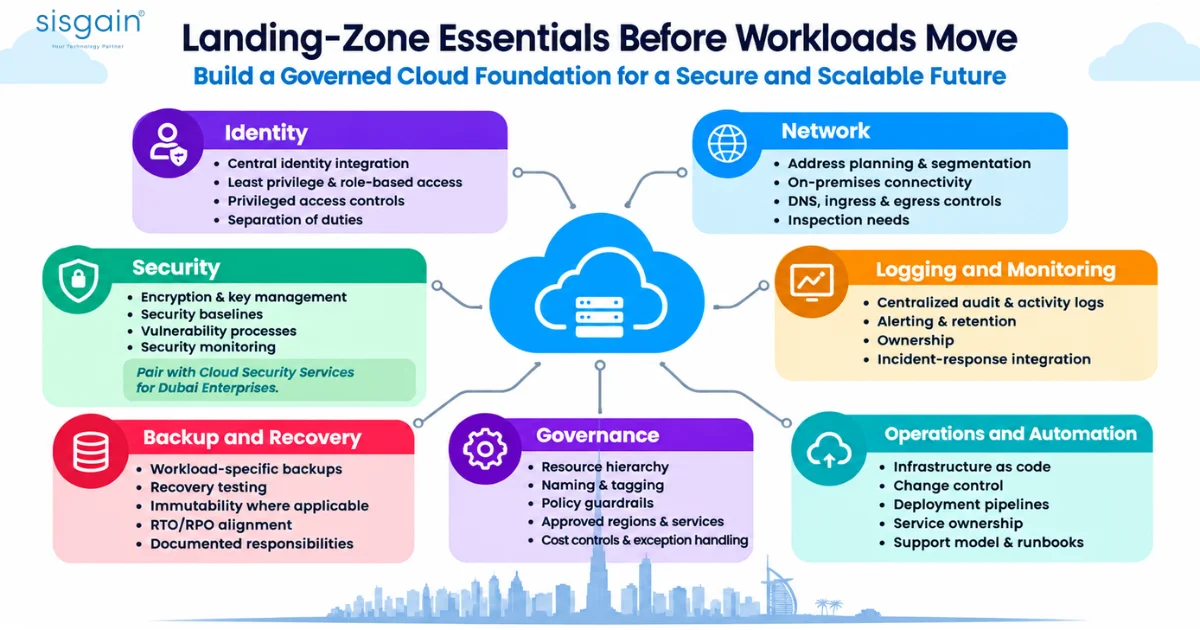
A cloud landing zone UAE teams build is the governed cloud foundation on which workloads are deployed. It is more than a network or an account and subscription structure. Cloud adoption frameworks from the major providers describe it as a set of design areas covering identity and access, resource organization, networking, security, management, governance and platform automation.
Cover these areas in your design:
- Identity: central identity integration, least privilege, role-based access, privileged access controls and separation of duties.
- Network: address planning, segmentation, connectivity to on-premises systems, DNS, ingress and egress controls and inspection needs.
- Security: encryption, key management, security baselines, vulnerability processes and security monitoring. Many teams pair this design work with Cloud Security Services for Dubai Enterprises.
- Logging and monitoring: centralized audit and activity logs, alerting, retention, ownership and incident-response integration.
- Backup and recovery: workload-specific backups, recovery testing, immutability where applicable, RTO/RPO alignment and documented responsibilities.
- Governance: resource hierarchy, naming, tagging, policy guardrails, approved regions and services, cost controls and exception handling.
- Operations and automation: infrastructure as code, change control, deployment pipelines, service ownership, support model and runbooks.
Design the landing zone against your actual requirements rather than copying a reference architecture unchanged. Reference designs are a strong starting point, but decisions should be evaluated against your regulatory position, risk appetite and workload mix, and refined as those evolve.
UAE Compliance Guardrails by Sector
There is no single universal cloud statute in the UAE. Obligations come from a combination of federal law, sector regulators, free-zone regimes, government policy and contracts. The assessment should identify the questions; your legal, risk and regulatory teams should answer them. Nothing in this article is legal advice, and a readiness assessment cannot guarantee compliance.
Personal data. The federal Personal Data Protection Law (PDPL) is a key baseline for many onshore organizations, but it sits alongside sector-specific rules and separate regimes in financial free zones. If you operate in the DIFC, review how DIFC data protection cloud requirements apply to your workloads. Transfer and processing decisions need legal review, and you should confirm the latest applicable rules before acting.
Banking. The Central Bank of the UAE's outsourcing regulation for banks requires governance, due diligence and ongoing monitoring of outsourcing arrangements. It provides that the master system of record, including confidential data, must be maintained and stored within the UAE, sets conditions for sharing confidential data outside the country, and requires prior Central Bank non-objection for material outsourcing.
Healthcare. Federal Law No. 2 of 2019 provides that health data relating to health services provided in the UAE must not be stored, processed, generated or transformed outside the UAE, except where the relevant Health Authority issues a decision in coordination with the Ministry.
Government and other regulated organizations. Requirements vary by entity, data classification, regulator and contract. Confirm your applicable policies and controls rather than assuming one rule applies. Organizations exploring sovereign cloud UAE options should clarify what "sovereign" means for their requirements, whether that is data location, operational control, access by foreign personnel or contractual terms, because the term is used differently across the market.
Storage is not the only question
Distinguish where data is stored from where it may be accessed, processed, backed up, logged or supported. Backups, telemetry, support access, disaster recovery copies and subcontractors can all create data flows beyond the primary database. Map them during assessment and review them against applicable requirements.
Region availability is not a compliance conclusion
Major providers operate cloud regions in the UAE, and that can widen your architecture options. But a local region does not by itself establish regulatory compliance. You still need to assess applicable laws, sector rules, data flows, service configuration, access, contracts and operational controls.
Cloud Readiness Assessment Deliverables and Checklist
What you should receive
Expect tangible outputs, not just a workshop or a score:
- A validated application and infrastructure inventory.
- A dependency map and application groupings.
- A data classification and data-flow register.
- A 6R recommendation for each application, with rationale and assumptions.
- Readiness gaps, risks, constraints and remediation actions.
- Target-state and landing-zone requirements.
- An indicative TCO and business case with assumptions.
- Prioritized migration waves with sequencing rationale.
- A decision log, ownership matrix and next-step roadmap.
Cloud readiness checklist
Copy this list into your planning documents:
- Each application has a named business and technical owner.
- Application dependencies and data flows have been mapped and validated.
- Data types, sensitivity, residency, retention and transfer constraints are recorded.
- Business criticality and recovery objectives are documented.
- The 6R recommendation has a written rationale for every workload.
- Vendor support, licensing and compatibility have been checked.
- Target-region and service availability assumptions have been validated.
- Landing-zone identity, network, logging, security and governance requirements are agreed.
- TCO assumptions include operations, backup, support, migration and data-transfer costs.
- Migration waves account for dependencies, testing, rollback and business calendars.
- Security, compliance, legal and business owners have reviewed open risks.
- Post-migration ownership, monitoring, backup and incident response are defined.
Next step: Get a structured view of your applications, dependencies, risks and migration options before committing to a cloud migration plan. Book a cloud readiness assessment
Choosing Support for Your Assessment
Some organizations run the assessment in-house; others bring in outside help. If you are evaluating a cloud migration provider in Dubai, ask how they validate discovery data with application owners, how they document 6R rationale, and what deliverables you keep at the end. Teams with operations in the capital often look for cloud migration consultants Abu Dhabi and Dubai teams can cover jointly, so ask about delivery presence, sector experience and how legal and compliance reviews are handled.
Be cautious of any claim of guaranteed compliance, zero downtime or a one-size-fits-all approach. A credible provider will state assumptions, show evidence and explain where your own legal and risk teams must decide. When you are ready to move from assessment to delivery, our Cloud Migration Services in the UAE and cloud migration services in Dubai pages outline how assessment findings translate into execution.
Conclusion: Start With Evidence, Not Assumptions
Successful migration is rarely about the tools. It is about knowing your estate, making a deliberate choice for every workload, funding the move with a realistic business case and building a landing zone that your security and compliance teams can stand behind. A cloud readiness assessment in Dubai gives you that foundation, and it keeps legal, risk and business owners involved before costly decisions are locked in.
Once the assessment is complete, you can move into delivery with a validated roadmap, and plan the operating model, security and cost governance that follow, including Cloud Managed Services in Dubai & UAE and Cloud Security Services for Dubai Enterprises.
Ready to see what your estate really looks like? Get a structured view of your applications, dependencies, risks and migration options before committing to a cloud migration plan. Book a cloud readiness assessment