
Quick answer: In 2026, custom supply chain management (SCM) software development in the UAE can be budgeted at approximately AED 110,000–550,000+, depending on features, integrations, automation, security and scalability. Ready-made SaaS uses a different pricing model, with subscriptions and implementation charges varying by vendor. These are indicative third-party estimates, not a guaranteed quote.
Supply chain software cost in the UAE depends on what you are building and how you pay for it. Custom development is a one-off investment plus ongoing support. SaaS is a recurring subscription with implementation on top. This guide covers cost tiers by project type, the factors that move a budget, module complexity, timelines, hidden costs and how to evaluate a development partner in Dubai.
How Much Does Supply Chain Software Cost in the UAE in 2026?
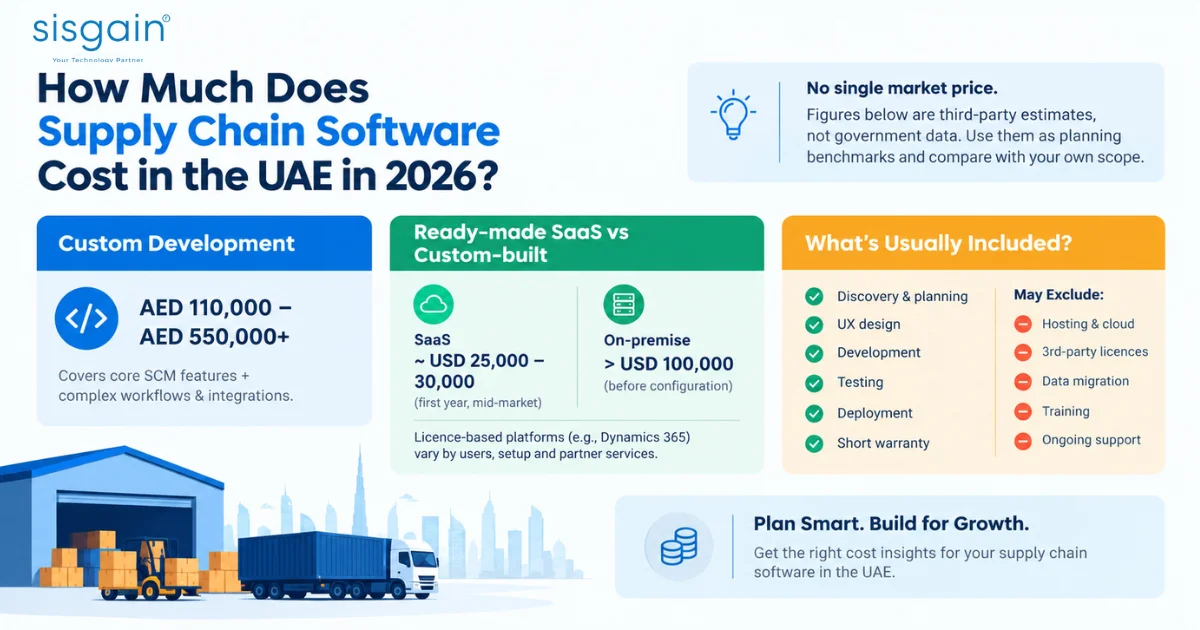
There is no single UAE market price. A distributor running one warehouse and a tracking portal has little in common with a multi-entity manufacturer needing ERP-linked planning across several sites. The figures below are third-party estimates from development companies, not government data or audited market averages. Treat them as planning benchmarks and compare them with your own scope. For wider context, see our guide to software development cost in 2026.
Custom supply chain software development cost
One third-party UAE estimate places custom SCM development between roughly AED 110,000 and AED 550,000+. The lower end typically covers procurement, inventory, order management and reporting. The upper end covers complex workflows, multi-system integration and large-scale operations. Custom development is largely a capital-style investment: you pay to build the system, then budget separately for hosting, support and enhancements.
Ready-made SaaS vs custom-built software
SaaS shifts cost from build to subscription. One third-party comparison suggests certain mid-market cloud deployments may cost approximately USD 25,000–30,000 in the first year, while on-premise enterprise solutions can exceed USD 100,000 before configuration. Licence-led platforms such as Microsoft Dynamics 365 Supply Chain Management are also shaped by user count, implementation, configuration and partner services. These figures use different frameworks from the AED development ranges above, so do not compare them line for line.
What does the quoted price usually include?
A development quotation typically covers discovery, UX design, development, testing, deployment and a short warranty. Depending on the vendor, it may exclude:
- Hosting and cloud infrastructure
- Third-party API or software licences
- Data migration
- User training
- Post-launch support
Always ask for inclusions and exclusions in writing, and separate initial implementation costs from recurring expenses.
Supply Chain Software Cost Breakdown by Project Type
The tables below combine two sets of third-party estimates. They use different currencies, scopes and assumptions, so do not add them together. The tiers also overlap. An advanced SCM build and a full logistics platform may describe similar work under different labels.
Custom SCM development (AED estimates)
|
Solution type |
Indicative estimate |
Typical scope |
|
Basic SCM / MVP |
AED 110,000–180,000 |
Procurement, inventory, order management and basic reporting |
|
Mid-level SCM |
AED 180,000–320,000 |
WMS/TMS modules, integrations and multi-location workflows |
|
Advanced SCM |
AED 320,000–450,000 |
Automation, forecasting, analytics, security and scalability |
|
Enterprise SCM |
AED 450,000–550,000+ |
Enterprise workflows, complex integrations and large-scale operations |
Logistics platforms (USD estimates)
|
Solution type |
Indicative estimate |
Typical scope |
|
Full logistics platform |
USD 80,000–200,000+ |
End-to-end supply chain and logistics workflows; often 6–12 months |
|
Enterprise TMS/WMS |
USD 150,000–500,000+ |
Multi-carrier, ERP, warehouse and transport orchestration; potentially 9–18 months |
|
AI-powered logistics automation |
USD 100,000–300,000+ |
Predictive planning, automation and advanced integrations |
Use the AED table for general SCM budgeting. Use the USD table when your project is logistics-led, such as multi-carrier transport, warehouse orchestration or AI-driven planning. If your scope spans both, the budget depends on which capabilities you actually need.
Supply chain software cost by business size
We have not invented separate price bands by company size, because requirements matter more than headcount. What typically differs:
- Small businesses and eCommerce operators often need inventory control, order management and a few integrations (accounting, marketplace, courier). An MVP or a SaaS product is usually the right starting point.
- Mid-sized distributors and retailers commonly need multi-location stock visibility, WMS/TMS functions, VAT-ready invoicing and ERP integration. This is where custom-versus-SaaS decisions become most finely balanced.
- Large enterprises and manufacturers face multiple legal entities, complex approval workflows, strict access control, high transaction volumes and deep integration with existing systems. Scope, testing and governance drive cost far more than the number of users.
What Factors Affect Supply Chain Software Development Cost?
Price follows the effort needed to design, build, test and maintain each requirement.
Software features and functional complexity
A stock-level dashboard is simple. Multi-step approval workflows, batch and expiry tracking, serial numbers, landed-cost calculation and rule-based allocation each add design and testing effort. Every business rule is a scenario that must be built and verified.
Number of modules and users
Each module (inventory, WMS, TMS, supplier management) adds screens, data models and testing. More users bring role-based permissions, performance requirements and training. A Dubai distributor with one warehouse and three user roles is a different project from a multi-emirate operation with branch-level approvals.
Third-party integrations
Integrations are often the most underestimated cost. Typical UAE requirements include:
- ERP and accounting systems
- Existing WMS or TMS platforms
- eCommerce storefronts
- Last-mile delivery and carrier APIs
- Customs, freight and port-related systems, including Dubai Trade where relevant
Not every business needs all of these. Availability, permissions, API documentation and compatibility must be confirmed during discovery. Legacy or poorly documented systems raise cost.
AI, IoT and predictive analytics
Demand forecasting, route optimisation, anomaly detection and IoT sensor data add data engineering, model validation and ongoing tuning. They also depend on the quality of your historical data. A forecasting feature built on weak data will disappoint, whatever its sophistication. For more on this, see our guide to AI software development cost.
Security, compliance and data migration
Role-based access, audit trails, encryption, backups and secure authentication add effort, particularly for multi-entity operations. Reporting and invoicing must support applicable UAE VAT requirements, which should be confirmed with your accountant or compliance adviser. Migrating legacy item masters, supplier records and open orders is a project in itself. Poor-quality data increases cleansing and testing time.
UI/UX, Arabic-English support and mobile access
Bilingual interfaces need right-to-left layouts, translated content and careful testing of documents, labels and reports. Mobile apps for drivers, warehouse pickers or field teams add device testing, offline handling and barcode or scanner support. These features directly affect adoption, so they are worth budgeting properly.
Cost of Essential Supply Chain Software Modules
We do not publish individual module prices, because they depend on integration depth and business rules. Here is how the main modules compare in function and relative complexity.
Inventory and procurement management
Tracks stock levels, reorder points, purchase requests, purchase orders and goods receipt across locations. Relative complexity: low to moderate. It rises with multi-warehouse transfers, batch or expiry control, and ERP synchronisation.
Warehouse management system (WMS)
A warehouse management system (WMS) controls receiving, putaway, picking, packing, bin locations and cycle counting. Relative complexity: moderate to high. Barcode or RFID scanning, wave picking, slotting logic and mobile workflows increase build and testing effort. Our overview of warehouse management software cost UAE can support this section if a relevant page exists.
Transportation management system (TMS)
A transportation management system (TMS) plans routes, assigns carriers, tracks shipments and manages freight and delivery performance. Relative complexity: moderate to high. Carrier APIs, live tracking, proof of delivery, driver apps and freight settlement add layers. Multi-carrier and cross-border operations are the most demanding.
Order and supplier management
Handles customer orders, fulfilment status, supplier onboarding, performance tracking and communication. Relative complexity: low to moderate. It grows with approval workflows, customer portals and eCommerce order synchronisation.
Demand forecasting and analytics
Dashboards cover KPIs such as stock turnover and on-time delivery. Forecasting adds predictive models. Relative complexity: moderate to very high. Reporting is relatively contained, but accurate forecasting depends on data quality, model validation and continuing refinement. Define the business questions first, then the technology.
Custom SCM Software vs Ready-Made SaaS in the UAE
|
Factor |
Custom-built SCM |
Ready-made SaaS |
|
Initial investment |
Higher upfront build cost |
Lower upfront; implementation fees apply |
|
Implementation |
Longer; built to your workflows |
Faster for standard processes |
|
Customisation |
Full control over workflows and rules |
Limited to configuration options |
|
Integrations |
Built around your systems |
Depends on vendor connectors and APIs |
|
Maintenance |
Your own or a partner’s support contract |
Handled by vendor within the plan |
|
Recurring fees |
Hosting, support, enhancements |
Subscription, per-user or module fees |
|
Best suited to |
Unique workflows, complex integrations, long-term differentiation |
Standard processes, speed to deploy, limited IT resource |
The cheaper option on day one is not always cheaper over five years. Total cost of ownership should include build or implementation, licences, customisation, integrations, support, upgrades and the cost of adapting your processes to the software.
SaaS may be the better choice when your workflows are standard, you need to go live quickly or you lack in-house technical resource. Custom development tends to pay off when your processes are a competitive advantage or off-the-shelf tools cannot integrate with your systems. A hybrid approach is also common, using a standard ERP core with custom logistics software development around it for tracking, dispatch or customer portals.
Supply Chain Software Development Timeline
These are indicative timelines, and they depend on scope, third-party dependencies and how quickly your team provides decisions and data.
|
Project type |
Indicative timeline |
|
Basic shipment-tracking portal |
2–3 months |
|
Full supply chain platform |
6–12 months |
|
Enterprise TMS/WMS |
9–18 months |
Most projects follow these stages:
- Discovery: Workshops, process mapping, requirements, integration review and scope definition.
- Design: Architecture, data models, UX and Arabic-English interface planning.
- Development: Building modules in iterative releases.
- Integration: Connecting ERP, carrier, accounting and other systems, often the main source of delay.
- Testing: Functional, performance, security and user acceptance testing.
- Data migration: Cleansing and loading master and transactional data.
- Rollout: Training, pilot, go-live and stabilisation, ideally phased by site or function.
Hidden Costs to Consider Before Budgeting
Hosting and infrastructure
Recurring. Cloud hosting, storage, monitoring and backup recur monthly or annually, and rise with transaction volume and uptime requirements.
Software licences and third-party services
Recurring or usage-based. Map APIs, SMS and WhatsApp messaging, carrier integrations, database licences and payment services may carry separate charges.
Ongoing support and enhancements
Recurring and optional. Bug fixes, security updates and compatibility changes are essential. New features, extra reports and additional warehouses are optional but likely.
Data migration and change management
Initial. Cleansing legacy data, training staff and managing the transition are frequently underbudgeted. A technically sound system fails if warehouse teams do not adopt it.
How to Reduce Supply Chain Software Development Costs
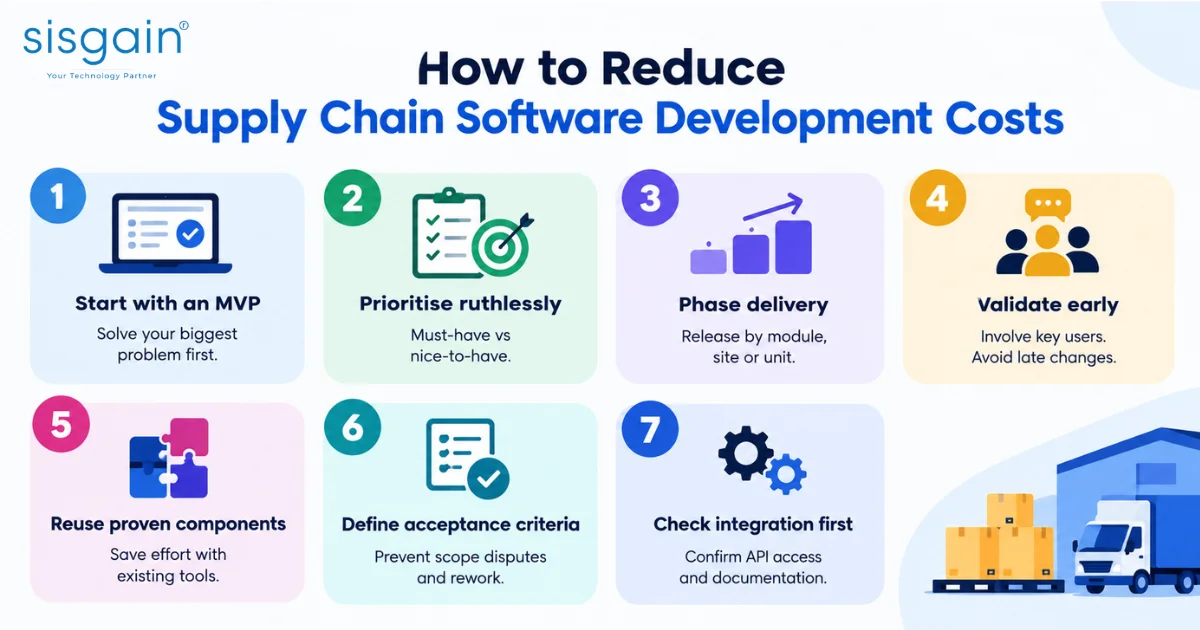
We cannot promise percentage savings, but these practices reduce waste:
- Start with an MVP. Build the modules that solve your most expensive problem first.
- Prioritise ruthlessly. Separate must-have requirements from nice-to-have features.
- Phase delivery. Release by module, site or business unit rather than building everything at once.
- Validate requirements early. Involve warehouse, procurement and finance users in discovery. Late changes are the costliest.
- Reuse proven components. Authentication, reporting frameworks and standard connectors reduce effort where they fit your needs.
- Define acceptance criteria. Clear, testable criteria prevent scope disputes and rework.
- Check integration feasibility first. Confirm API access and documentation before committing to a fixed scope.
How to Choose a Supply Chain Software Development Company in Dubai
A good partner reduces risk. Use this checklist when shortlisting a supply chain software development company in the UAE. For a shortlist of capabilities to look for, see our page on a Logistics Software Development Company in Dubai.
Evaluate relevant technical experience
Look for demonstrable experience with supply chain, warehouse or logistics systems, and with the integrations you need. Ask how they have handled ERP connectivity, multi-location inventory and mobile workflows.
Assess security and scalability
Ask how they approach role-based access, audit trails, backup and performance under high order volumes. Confirm how they design architecture so the system can grow with additional warehouses or modules.
Compare proposals transparently
Compare proposals on a like-for-like basis. A lower quote that excludes integrations, migration or testing is not cheaper. Check:
- Scope and deliverables
- Milestones and payment schedule
- Exclusions and assumptions
- Intellectual property ownership
- Post-launch support terms
- Change-request process
Ask for evidence, not just claims
Request case studies, client references, sample documentation and a walkthrough of their delivery process. Be wary of unsupported superlatives.
SISGAIN Technologies is an IT solutions and custom software development company serving businesses across multiple industries. If you are comparing partners, we can review your workflows, integration needs and constraints, and tell you honestly whether custom development or SaaS suits you better.
How Much Should You Budget for Your Supply Chain Software Project?
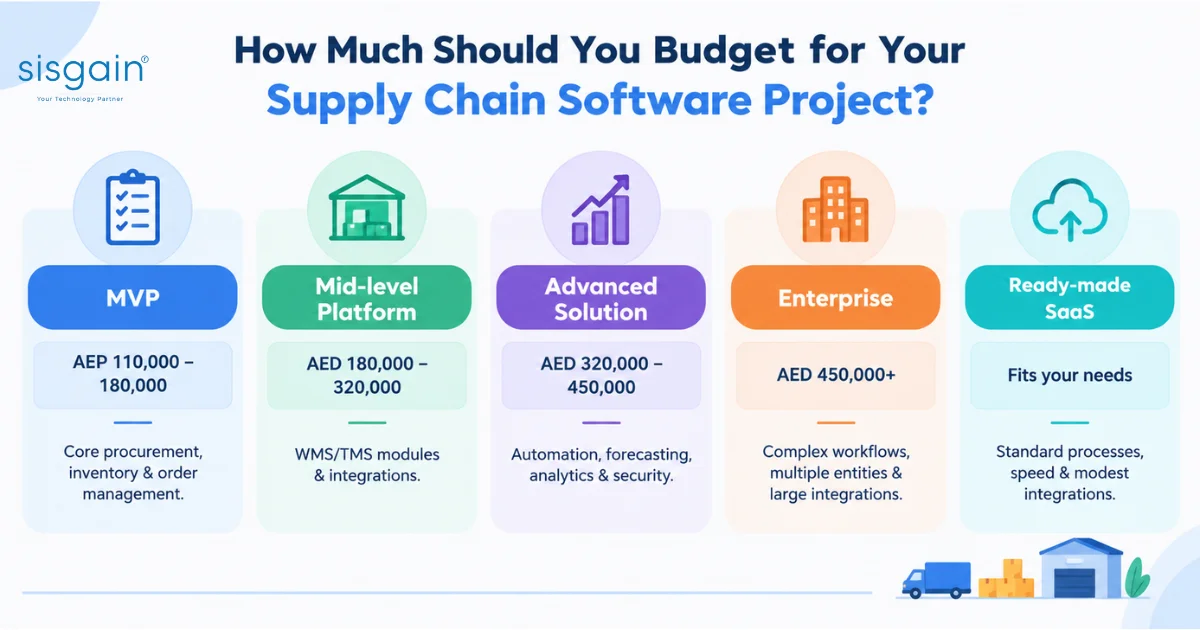
Use this framework to narrow your path:
- MVP (AED 110,000–180,000 indicative): You need core procurement, inventory and order management, and want to validate the approach before investing more.
- Mid-level platform (AED 180,000–320,000): You operate several locations and need WMS/TMS modules and integrations.
- Advanced solution (AED 320,000–450,000): Automation, forecasting, analytics and strong security are central to your operations.
- Enterprise (AED 450,000+): You have complex workflows, multiple entities and large-scale integration needs.
- Ready-made SaaS: Your processes are standard, speed matters and your integration needs are modest.
A scoped quotation becomes necessary when you have legacy systems, several integrations, regulatory-sensitive workflows or AI requirements. At that point, ranges are only a starting point.
Get a Custom Supply Chain Software Cost Estimate
Every supply chain is different, and the most useful number is one based on your scope. SISGAIN Technologies can help you define it and plan a practical route to delivery. Whether you are exploring supply chain software development for the first time or replacing a legacy system, bring us:
- Your business model and current workflows
- Number of warehouses and locations
- Required SCM, WMS and TMS functionality
- ERP and third-party integrations
- AI, analytics and automation requirements
- Expected timeline and budget
We will respond with a tailored estimate rather than an instant fixed price. Contact SISGAIN to discuss your supply chain software project.