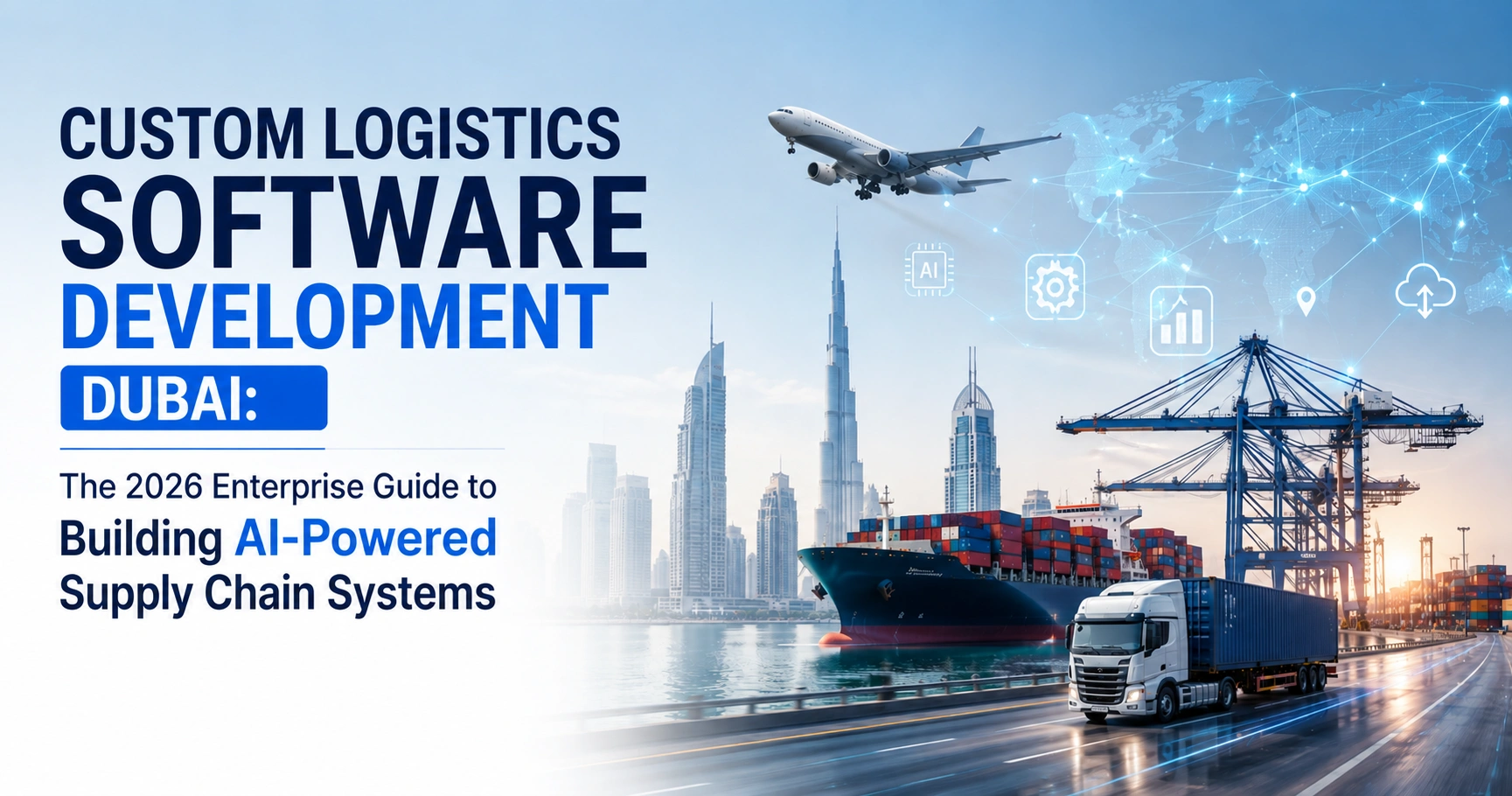

Dubai's logistics industry is no longer competing only on transportation speed. In 2026, companies are competing on visibility, automation, predictive intelligence, and real-time decision-making. The businesses winning market share aren't necessarily the ones with the biggest fleets — they're the ones that know exactly where every shipment is, what's likely to go wrong before it happens, and how to fix it without a human ever picking up a phone.
This shift didn't happen overnight. Dubai has spent the last decade cementing itself as one of the world's most important logistics hubs. Jebel Ali Port continues to expand its container capacity and cements the UAE's role as the gateway between East and West. E-commerce volumes across the GCC have surged, pulling last-mile delivery expectations closer to same-day and next-hour standards. Cross-border trade within the GCC has grown more complex, with varying customs requirements, free-zone regulations, and multi-carrier networks that must all talk to each other in real time.
Against this backdrop, spreadsheets, disconnected point solutions, and generic off-the-shelf platforms are starting to show their limits. A warehouse system that doesn't talk to the transportation system. A fleet tracker that doesn't feed data into demand forecasting. A customer service team that has no visibility into where a shipment actually is. These gaps used to be tolerable inefficiencies. In a market where customers expect real-time tracking and same-day delivery, they've become competitive liabilities.
This is why enterprise logistics companies, 3PL providers, freight forwarders, retail chains, and manufacturers across the UAE are increasingly turning to custom logistics software development in Dubai — purpose-built platforms that combine AI, transportation management, warehouse management, and fleet visibility into a single, unified operating system for supply chain execution.
This guide breaks down everything a CIO, COO, or supply chain leader needs to know before investing in a custom logistics platform in 2026: what these systems include, why AI has become non-negotiable, what they cost, how long they take to build, and how to choose the right development partner.
What Is Custom Logistics Software Development in Dubai?
Custom logistics software development in Dubai refers to building tailor-made digital platforms designed around a company's specific transportation, warehouse, fleet, inventory, and supply chain workflows — rather than forcing operations to conform to a generic, one-size-fits-all product.
Unlike ready-made solutions, a custom-built logistics platform is engineered to integrate directly with:
- ERP systems already running the business
- Multiple carrier and freight networks
- Warehouse operations and automation hardware
- Fleet tracking and telematics devices
- AI-driven analytics and forecasting engines
- Customer-facing tracking portals
- Region-specific compliance and customs requirements
The result is a single operational backbone rather than a patchwork of disconnected tools.
Why Are Dubai Companies Investing in Custom Logistics Software in 2026?
Dubai businesses are investing in custom logistics software because traditional, off-the-shelf systems often can't handle the operational complexity unique to this market — including GCC cross-border movement, multiple overlapping carrier relationships, real-time tracking demands, AI-driven decision-making, and increasingly automated warehouse workflows.
Put simply: generic software was built for generic operations. Enterprise logistics in the UAE isn't generic anymore.
Why Dubai Logistics Companies Need Custom Software Solutions in 2026
Dubai's Logistics Market Is Becoming More Complex
The UAE's position as a re-export and trade hub means logistics companies are managing more moving parts than ever before:
- Rapid growth in international trade volume moving through UAE ports and free zones
- Multiple free-zone jurisdictions, each with its own documentation and compliance nuances
- Continuous expansion of port and airport cargo operations
- Rising last-mile delivery expectations from both B2B and B2C customers
- Same-day and next-hour delivery pressure driven by e-commerce competition
Most legacy systems weren't designed for this level of complexity. The result is a familiar set of operational pain points:
- Fragmented systems that require manual data entry between platforms
- Manual reporting that delays decision-making by days, not minutes
- Lack of real-time visibility into shipments, inventory, and fleet status
- Inefficient route planning that increases fuel costs and delivery times
These inefficiencies compound quickly at enterprise scale. In fact, research consistently shows that a majority of businesses still struggle to get supply chain management right, often because their underlying systems weren't built to support the complexity of modern operations. Custom software directly addresses this gap by unifying operations around a single source of truth.
What Is Custom Logistics Software Development Dubai? (Core Components Explained)
A custom logistics platform doesn't function as one monolithic application — it's an ecosystem of interconnected systems, each handling a specific operational domain while sharing data seamlessly with the others.
Transportation Management System (TMS)
The TMS is the operational brain behind moving goods efficiently. A well-built TMS handles:
- Route planning that factors in traffic, delivery windows, and fuel efficiency
- Carrier management across multiple transportation partners
- Freight optimization to reduce empty miles and underutilized capacity
- Shipment tracking with live status updates from pickup to delivery
Warehouse Management System (WMS)
The WMS governs everything happening inside the four walls of a distribution center or fulfillment hub:
- Inventory control with real-time stock accuracy
- Picking workflows optimized for speed and accuracy
- Packing processes that reduce errors and damage
- Warehouse automation integration with robotics, conveyors, and scanning hardware
Fleet Management Software
Fleet visibility has become a baseline expectation, not a differentiator. Core capabilities include:
- GPS tracking for real-time vehicle location
- Driver management including performance monitoring and compliance
- Fuel monitoring to control one of the largest variable operating costs
- Maintenance scheduling to reduce unplanned vehicle downtime
Last-Mile Delivery Management
Last-mile is often where customer experience is won or lost. This layer typically includes:
- Driver apps for route guidance and delivery confirmation
- Customer notifications with live ETA updates
- Proof of delivery captured digitally, including signatures and photos
When these four pillars are engineered as custom TMS and WMS solutions in Dubai, rather than bolted together from separate vendors, businesses gain the kind of end-to-end visibility that generic software simply cannot replicate.
Enterprise Logistics Software Dubai Guide: Components Every Business Needs in 2026
Beyond the core TMS/WMS/fleet foundation, enterprise logistics platforms in 2026 need to deliver on two fronts: real-time visibility and artificial intelligence.
Real-Time Supply Chain Visibility
Enterprise decision-makers increasingly expect logistics platforms to function like a live control tower, not a historical reporting tool. This includes:
- Shipment tracking that updates continuously across every leg of the journey
- Predictive ETA calculations that adjust dynamically based on real-world conditions
- Control dashboards that give operations teams a single view of the entire network
AI-Powered Logistics Intelligence
AI-powered logistics software for enterprises in Dubai has moved from an experimental capability to a baseline requirement. Enterprises building new platforms in 2026 are embedding AI directly into core workflows rather than treating it as a bolt-on feature.
AI Route Optimization
AI-driven routing continuously recalculates the most efficient paths based on live traffic, weather, and delivery priorities. The benefits are measurable:
- Reduced fuel costs through fewer unnecessary miles
- Faster delivery times without adding fleet capacity
- Better fleet utilization across the full vehicle roster
Predictive ETA Management
Rather than relying on static delivery windows, AI models now predict:
- Potential delays before they happen
- Traffic pattern disruptions along planned routes
- Delivery risk factors tied to weather, congestion, or customs holds
AI Document Processing
Logistics generates enormous volumes of paperwork — much of which AI can now process automatically, including:
- Bills of lading
- Customs documentation
- Invoices
- Proof-of-delivery (POD) records
This directly reduces manual data entry, a major source of delay and error in cross-border logistics. For a deeper look at how automation and intelligence are reshaping the sector, see this breakdown of AI in logistics and how it addresses inefficiency and rising costs.
Why Enterprises Prefer Custom Logistics Software Over Off-The-Shelf Platforms
Off-the-shelf logistics software can be a reasonable starting point for smaller operations. But as complexity grows, its limitations become a genuine constraint on the business rather than a convenience.
|
Factor |
Off-The-Shelf Software |
Custom Logistics Software |
|
Customization |
Limited to vendor-defined settings |
Complete, built around actual workflows |
|
Integrations |
Standard, pre-built APIs only |
Custom integrations with any system |
|
AI Capability |
Generic, one-size-fits-all models |
Business-specific AI trained on real operational data |
|
Scalability |
Dependent on vendor's roadmap |
Designed and architected for growth |
|
Ownership |
Ongoing subscription, no ownership |
Full ownership of the platform and its data |
Dubai-Specific Reasons for Custom Development
Beyond general enterprise flexibility, several factors make custom development particularly relevant in the UAE market:
- GCC customs workflows that off-the-shelf platforms rarely support out of the box
- Arabic-English bilingual interfaces required for regional operations teams and customers
- Regional carrier integrations specific to UAE and GCC transportation providers
- Local ERP integrations with systems already embedded in enterprise operations
- Free-zone operational requirements that vary by jurisdiction
For companies where logistics execution is a genuine competitive differentiator, generic software becomes a ceiling rather than a foundation.
Custom TMS and WMS Solutions Dubai: Features Enterprises Should Demand
Not all TMS and WMS builds are created equal. When evaluating a custom logistics software development in Dubai partner, enterprises should insist on a specific feature baseline.
Essential TMS Features
- Smart route optimization powered by real-time data
- Freight planning across multiple carriers and modes
- Carrier management with performance scorecards
- Cost analytics broken down by route, carrier, and shipment type
- Shipment tracking visible to both internal teams and customers
Essential WMS Features
- Inventory visibility across multiple warehouse locations
- Barcode and RFID integration for accurate stock movement
- Warehouse automation support for robotics and conveyor systems
- Stock forecasting to prevent overstocking and stockouts
Enterprise Integration Features
A logistics platform is only as valuable as the systems it connects to. Enterprises should confirm the platform can integrate cleanly with:
- ERP systems for financial and operational alignment
- CRM platforms for customer-facing visibility
- E-commerce platforms for order-to-delivery continuity
- IoT devices for warehouse and fleet sensor data
- Telematics systems for vehicle and driver monitoring
AI-Powered Logistics Software for Enterprises in Dubai: 2026 Trends
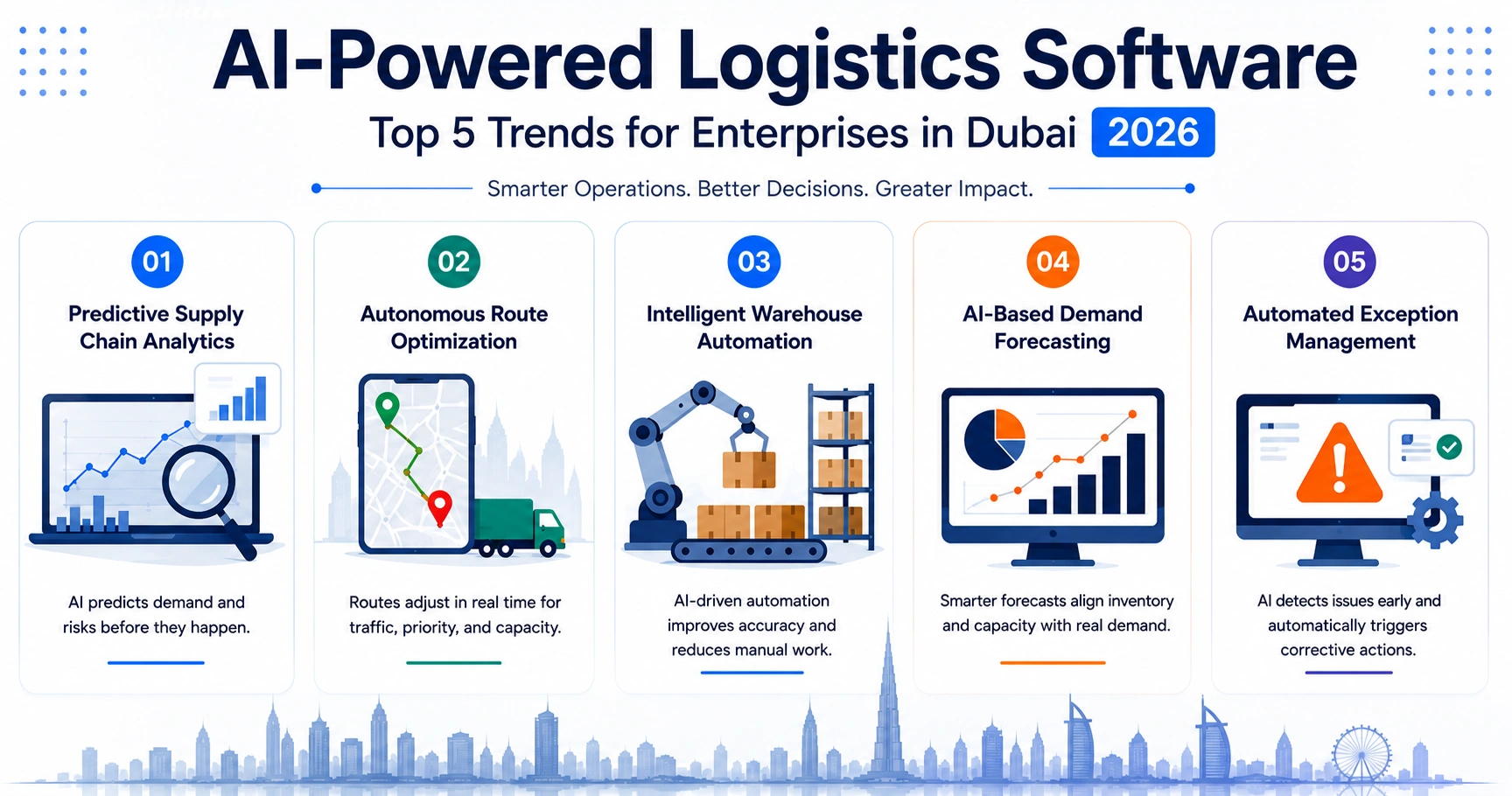
Artificial intelligence in logistics has moved well past pilot projects. In 2026, AI is becoming an operational necessity woven into daily execution rather than a differentiator reserved for early adopters.
1. Predictive Supply Chain Analytics
AI models now forecast demand fluctuations, seasonal spikes, and disruption risks before they materialize, giving planning teams a head start rather than a reaction window.
2. Autonomous Route Optimization
Routing engines increasingly adjust themselves in real time without manual dispatcher intervention, factoring in live traffic, delivery priority, and vehicle capacity simultaneously.
3. Intelligent Warehouse Automation
AI-guided robotics, smart picking systems, and automated inventory reconciliation are reducing manual labor dependency inside distribution centers.
4. AI-Based Demand Forecasting
Forecasting models trained on historical and real-time data help enterprises align inventory, staffing, and fleet capacity with actual demand patterns — reducing both overstock and stockout risk.
5. Automated Exception Management
Instead of waiting for a human to notice a delayed shipment or a failed delivery attempt, AI systems flag exceptions automatically and, in many cases, trigger corrective workflows without manual intervention.
The pattern across all five trends is consistent: AI is moving from experimental projects to operational necessity, and platforms built without AI-readiness baked into their architecture will struggle to keep pace.
Technology Stack Behind Modern Logistics Software Development UAE 2026
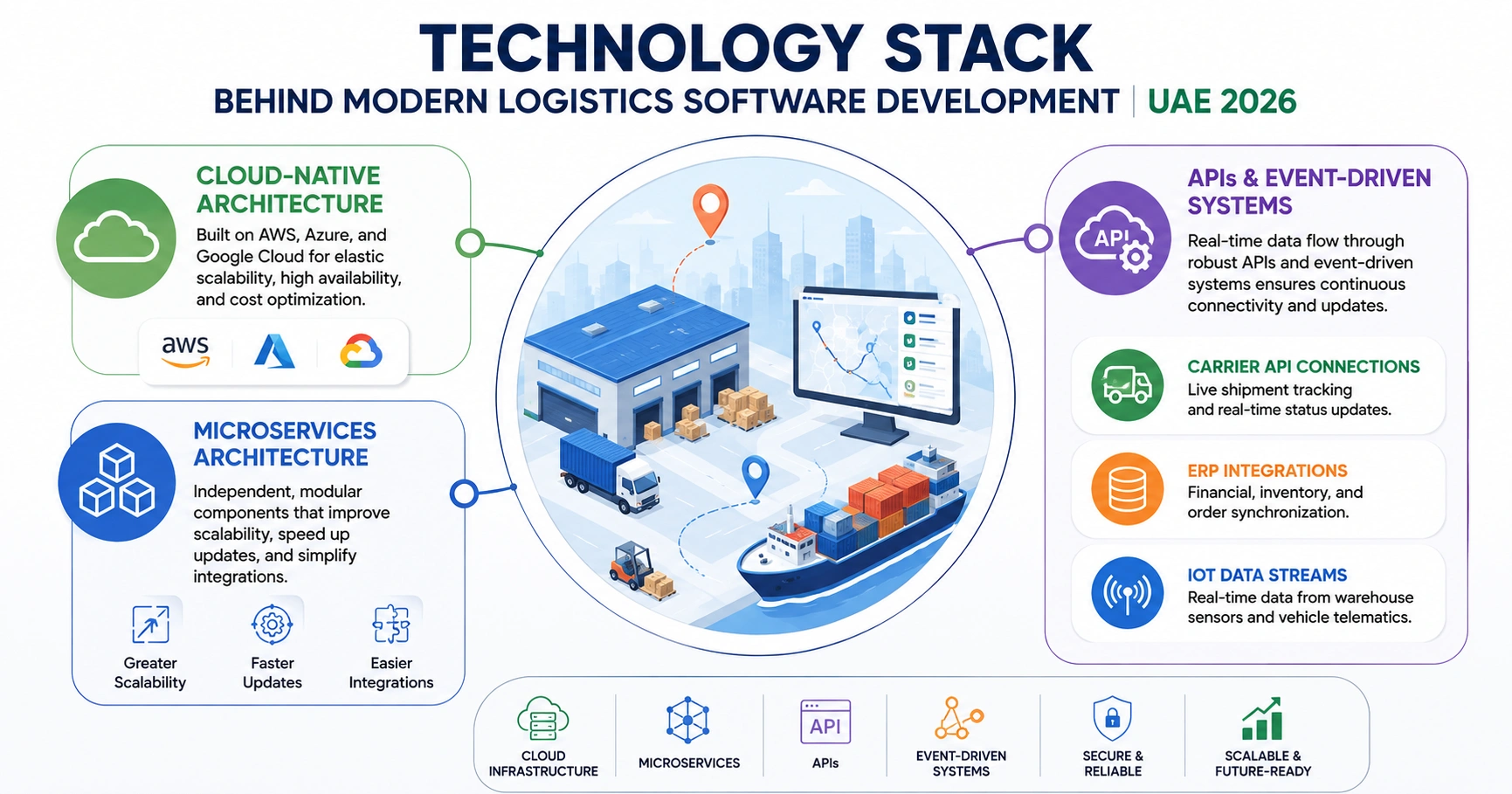
The technical foundation of a logistics platform determines how well it scales, how quickly it can be updated, and how resilient it is under enterprise-level transaction volume.
Cloud-Native Architecture
Modern logistics platforms are built on cloud infrastructure from providers such as AWS, Azure, and Google Cloud. This provides the elasticity needed to handle demand spikes — such as peak shopping seasons — without over-provisioning infrastructure year-round.
Microservices Architecture
Rather than building one large, tightly coupled application, enterprise platforms increasingly use microservices — independent, modular components that communicate with each other. The benefits include:
- Greater scalability as individual components can scale independently
- Faster updates since teams can deploy changes to one service without touching the entire system
- Easier integrations with third-party systems and partner networks
APIs & Event-Driven Systems
Real-time logistics depends on continuous data flow rather than periodic batch updates. This requires robust API architecture and event-driven systems to manage:
- Carrier API connections for live shipment status
- ERP integrations for financial and inventory synchronization
- IoT data streams from warehouse sensors and vehicle telematics
Logistics Software Integration Challenges Enterprises Must Solve
If there's one area where logistics software projects most commonly go over budget or fall short of expectations, it's integration — not core feature development.
Most failures happen because integration complexity is underestimated at the planning stage. Enterprises often scope a project around the visible features — dashboards, tracking screens, reports — without fully accounting for the behind-the-scenes work required to connect every system that needs to talk to each other.
Critical Integrations to Plan For
- Carrier APIs, which vary significantly in documentation quality and reliability
- ERP systems, often legacy platforms with limited modern API support
- EDI (Electronic Data Interchange), still widely used in freight and customs documentation
- Warehouse hardware, including scanners, sensors, and automation equipment
- Telematics systems, which differ by fleet vehicle manufacturer and hardware vendor
- E-commerce platforms, which need real-time order and fulfillment synchronization
As one industry principle puts it: a logistics platform is not just software development — it is an integration ecosystem. Enterprises that plan for this reality from day one avoid the budget overruns and delayed timelines that plague projects treating integration as an afterthought.
How Much Does Custom Logistics Software Development Cost in Dubai in 2026?
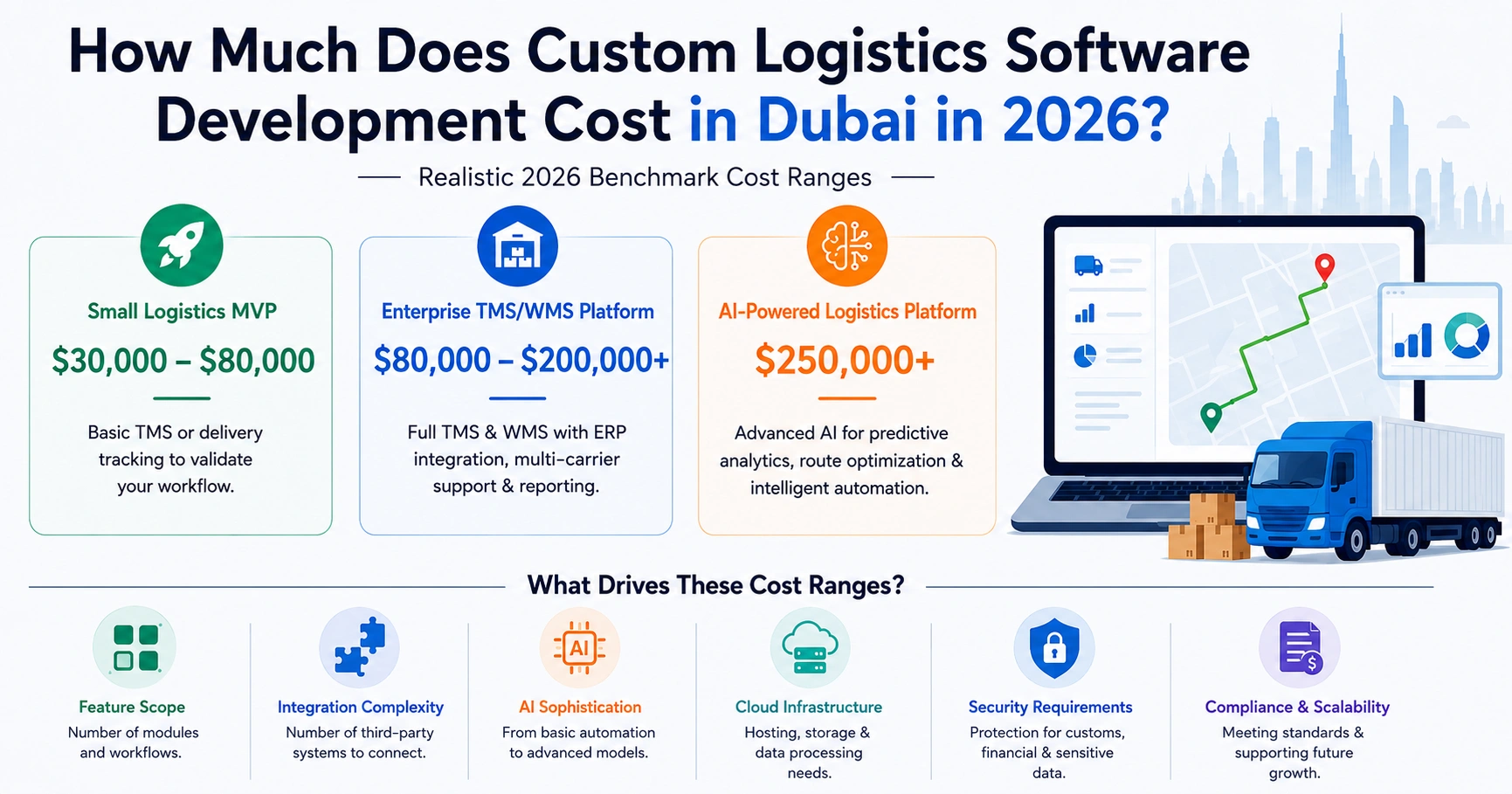
Cost is naturally one of the first questions enterprise buyers ask — and the honest answer is that it depends heavily on scope, integration complexity, and AI sophistication. That said, here are realistic 2026 benchmark ranges based on current market conditions.
Small Logistics MVP
$30,000 – $80,000
Suitable for companies validating a specific workflow — such as a basic TMS or delivery tracking tool — before committing to a full enterprise build.
Enterprise TMS/WMS Platform
$80,000 – $200,000+
Covers a fully integrated transportation and warehouse management system with ERP connectivity, multi-carrier support, and custom reporting.
AI-Powered Logistics Platform
$250,000+
Reflects platforms with advanced AI capabilities — predictive analytics, autonomous route optimization, intelligent document processing — layered on top of a full TMS/WMS/fleet foundation.
What Drives These Cost Ranges
- Feature scope — the number of modules and workflows being built
- Integration complexity — how many third-party systems must connect
- AI sophistication — from basic automation to advanced predictive models
- Cloud infrastructure — hosting, storage, and data processing requirements
- Security requirements — particularly important for platforms handling customs and financial data
For a broader look at how these ranges compare across different types of platforms, see this guide to logistics and fleet management app development costs, as well as a general breakdown of software development costs in 2026 and app development costs in Dubai more broadly.
Hidden Costs Enterprises Should Consider Before Building Logistics Software
Beyond the initial development budget, several ongoing costs often catch enterprises off guard:
- API costs, particularly for high-volume carrier or mapping API usage
- Cloud expenses, which scale with data volume and transaction throughput
- Data engineering, required to keep integrations clean and reliable over time
- Maintenance, including bug fixes, security patches, and platform updates
- AI model updates, since predictive models degrade in accuracy without periodic retraining
Enterprises budgeting for a new platform should plan for these ongoing costs from the outset. Industry data consistently shows that supply chain software costs are rising across the UAE, making it essential to build a realistic total-cost-of-ownership model rather than focusing solely on the initial build price.
Build vs Buy: Should Dubai Companies Develop Custom Logistics Software?
Not every company needs a fully custom platform. The right decision depends on operational complexity, growth trajectory, and how central logistics is to the company's competitive positioning.
Choose Off-The-Shelf If:
- Your workflows are largely standard and don't require heavy customization
- You have a limited number of integrations to manage
- Your operations are smaller in scale and unlikely to strain generic system limits
Choose Custom Development If:
- Logistics execution is a core competitive advantage for your business
- Your operations involve complex, multi-step workflows across warehouses, fleets, and carriers
- You need to integrate with multiple existing systems, including ERP and legacy platforms
- You're scaling regionally or globally and need architecture that grows with you
For most enterprise-level logistics providers, 3PLs, and large retail or manufacturing operations in Dubai, the complexity threshold is crossed well before off-the-shelf software reaches its limits.
Custom Logistics Software Development Process
Understanding the typical development journey helps enterprises set realistic timeline expectations and internal resourcing plans.
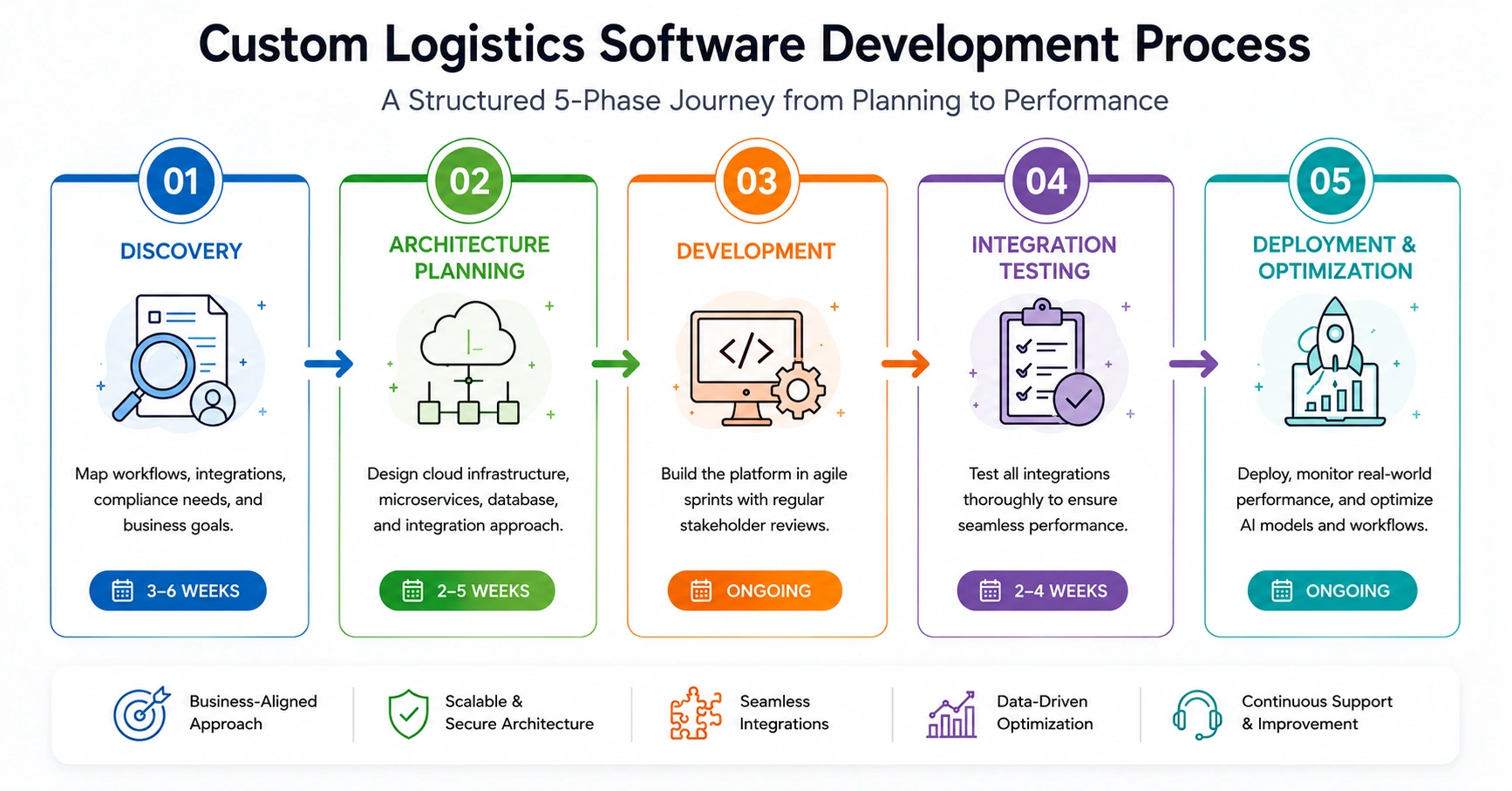
Phase 1: Discovery (3–6 Weeks)
Mapping existing workflows, integration requirements, compliance needs, and business objectives before any code is written.
Phase 2: Architecture Planning (2–5 Weeks)
Designing the technical foundation — cloud infrastructure, microservices structure, database architecture, and integration approach.
Phase 3: Development
Building the platform in agile sprints, with regular stakeholder reviews to validate that the system matches operational reality as it's built.
Phase 4: Integration Testing
Rigorously testing every connection point — carrier APIs, ERP systems, warehouse hardware, telematics — since integration failures are the most common source of post-launch issues.
Phase 5: Deployment & Optimization
Rolling the platform into production, monitoring real-world performance, and refining AI models and workflows based on actual usage data.
How to Choose the Right Logistics Software Development Company in Dubai
Selecting a development partner is arguably the highest-stakes decision in the entire process. The right partner accelerates delivery and reduces risk; the wrong one compounds both.
When evaluating software companies in Dubai for a logistics platform, enterprises should look for:
- ✔ Logistics domain experience — a partner who understands TMS, WMS, and fleet operations, not just generic software delivery
- ✔ AI capabilities — proven experience building predictive models and automation, not just API wrappers around third-party AI tools
- ✔ Integration expertise — a track record connecting ERP, carrier, and warehouse hardware systems successfully
- ✔ Cloud architecture knowledge — experience designing scalable, cloud-native systems built for growth
- ✔ Security practices — particularly critical given the sensitive customs, financial, and customer data logistics platforms handle
- ✔ Long-term support — a partner committed to ongoing maintenance, optimization, and AI model updates after launch
A development partner focused specifically on the custom logistics software development company Dubai space will typically bring far more relevant experience to the table than a generalist software agency working on logistics for the first time.
Future of Logistics Software Development UAE 2026 and Beyond
The trajectory of logistics technology in the UAE points toward increasingly autonomous, intelligent, and interconnected systems:
- Autonomous logistics operations requiring minimal manual intervention across routine decision-making
- AI agents capable of managing exception handling, carrier negotiation, and dynamic routing independently
- Digital twins of warehouse and fleet operations, allowing scenario testing before real-world implementation
- Predictive supply chains that anticipate disruption rather than react to it
- Smart warehouses where automation, AI, and human operators work in a fully synchronized environment
Enterprises building logistics platforms today should architect with this trajectory in mind — even if every capability isn't needed at launch, the underlying system should be flexible enough to incorporate them as they mature.
Conclusion: Building the Logistics Backbone of Tomorrow, Today
Dubai's logistics industry has entered a new competitive phase — one defined less by fleet size and more by intelligence, integration, and real-time visibility. AI has moved from an experimental add-on to a baseline expectation. Enterprises that continue relying on disconnected, generic tools risk falling behind competitors who can see further into their supply chains and react faster to disruption.
Custom logistics software development in Dubai gives enterprises the ability to build exactly what their operations demand — a unified platform combining TMS, WMS, fleet management, and AI-driven intelligence, engineered around real workflows rather than generic assumptions. The path forward requires strategic planning, a realistic budget that accounts for both build and ongoing costs, and — perhaps most importantly — the right development partner with genuine logistics domain expertise.
Ready to build an AI-powered logistics platform designed for your Dubai operations?
Partner with experienced logistics software developers to transform your supply chain from a cost center into a genuine competitive advantage.