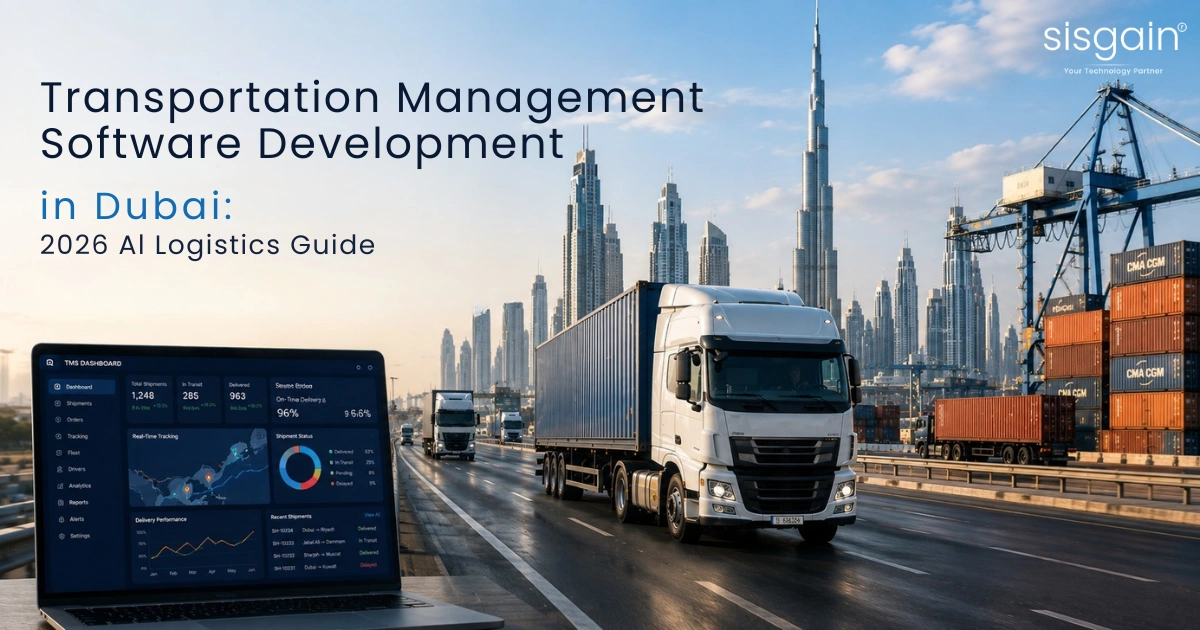

Dubai doesn't move goods the way it did five years ago. Jebel Ali Port, Al Maktoum International, and a highway network that's constantly being re-engineered for autonomous vehicles have turned this emirate into one of the most demanding logistics environments on Earth — and one of the most rewarding for the businesses that get their operations right.
The logistics and transportation sector already contributes AED 51.9 billion to Dubai's real GDP, and under the D33 economic agenda, the city is explicitly positioning itself as one of the world's top five logistics hubs by 2033. That's not a marketing line — it's a government-backed mandate, and it's why fleet operators, 3PLs, freight forwarders, and enterprise shippers across the emirate are replacing spreadsheets and generic SaaS tools with transportation management software built specifically around AI, real-time data, and the way freight actually moves through this region.
This guide breaks down what transportation management system development really involves in Dubai in 2026 — the features, the AI capabilities, the cost drivers, the timelines, and the architectural decisions that separate a system that scales from one that becomes shelf-ware within eighteen months. Whether you're evaluating logistics software development for the first time or replacing a legacy fleet management software platform, you'll find the specifics here, not the generic overview.
Book a Free Transportation Software Consultation
Transportation Management Software Development in Dubai at a Glance
What is transportation management software? A platform that plans, executes, and optimizes the physical movement of goods — covering route planning, dispatch, carrier selection, tracking, billing, and reporting — usually built on cloud infrastructure with AI-driven optimization layered on top.
Why is Dubai investing so heavily in it? Government infrastructure spending, D33's logistics-hub target, a fast-growing e-commerce sector, and rising fuel and labor costs are pushing operators away from manual coordination and toward software-driven fleets.
Major business benefits: lower cost-per-shipment, higher fleet utilization, real-time visibility for customers and internal teams, fewer compliance errors, and data that actually supports decisions instead of just reporting on the past.
Typical development timeline: 3–5 months for a focused MVP, 6–9 months for a mid-market platform, and 9–18 months for an enterprise-grade, AI-powered system with deep ERP and telematics integrations.
Estimated development cost: varies enormously by scope — a lean MVP for a single fleet looks very different from a multi-tenant SaaS platform serving several business units. (More on the specific cost drivers below.)
Core technologies: cloud-native backends, GPS and telematics APIs, IoT sensors, machine learning models for route and demand forecasting, and mobile apps for drivers and customers.
Industries benefiting the most: logistics providers, freight forwarders, courier and last-mile companies, construction, retail, food delivery, oil & gas, and public transportation operators.
Where it's heading next: AI agents that make dispatch decisions autonomously, digital twins of entire fleet networks, EV fleet management, and predictive logistics that flag disruptions before they happen.
Quick Answers
A Transportation Management System (TMS) is a digital platform that helps businesses plan, manage, execute, and track transportation operations, including route planning, vehicle scheduling, dispatch management, real-time fleet tracking, shipment monitoring, and billing through a centralized system integrated with ERP, warehouse management, and telematics solutions.
Dubai businesses need Transportation Management Software because increasing logistics demand, rising fuel costs, e-commerce growth, and smart mobility initiatives are making traditional transportation operations less efficient. A TMS enables companies to improve fleet visibility, automate workflows, optimize routes, reduce delivery costs, and enhance customer satisfaction.
The cost of Transportation Management Software Development in Dubai depends on factors such as software complexity, required features, AI capabilities, integrations, cloud infrastructure, and scalability needs. A basic MVP may require a lower investment, while an enterprise-grade platform with AI, IoT, predictive analytics, and advanced integrations requires a larger budget. Typically, TMS development takes around 3–5 months for an MVP, 6–9 months for a mid-level platform, and 9–18 months for a complex enterprise solution with advanced automation and integrations.
Industries such as logistics, freight forwarding, courier services, retail, manufacturing, construction, healthcare, food delivery, oil and gas, and government transportation benefit significantly from transportation management solutions. Modern TMS platforms use technologies such as cloud computing, GPS tracking, IoT sensors, AI and machine learning, predictive analytics, mobile applications, mapping APIs, and real-time data processing to deliver smarter transportation operations.
AI improves transportation management by enabling intelligent route optimization, predictive ETA calculations, demand forecasting, fuel efficiency improvements, automated dispatching, and predictive vehicle maintenance. For most growing businesses, cloud-based transportation management software provides better scalability, accessibility, faster deployment, and lower infrastructure costs, while on-premise solutions remain suitable for organizations with strict data control, security, or compliance requirements.
Why Transportation Management Software Matters More Than Ever in Dubai (2026)
Dubai's logistics sector isn't quietly growing — it's being deliberately built up as a strategic pillar of the emirate's economy. The D33 agenda targets AED 25.6 trillion in foreign trade by 2033 and explicitly names logistics as one of Dubai's priority high-growth sectors, alongside AI and fintech. That's a government putting its infrastructure budget behind faster ports, expanded air cargo capacity, and smarter road networks.
At the same time, the region's appetite for transportation software is accelerating. The Middle East TMS market was valued at roughly USD 1.64 billion in 2025 and is forecast to grow at an 18.4% CAGR through 2033, reaching around USD 6.41 billion. That's more than double the pace of the global TMS market, which itself is expanding at a healthy 9.8–10.6% CAGR depending on the source. Dubai, as the region's commercial and logistics anchor, is absorbing a disproportionate share of that growth.
A few forces are converging here at once:
- Smart City Vision. Dubai's broader smart-mobility push — connected traffic signals, RTA digital services, and autonomous transport pilots — is raising the baseline for what "modern" fleet operations look like.
- AI-driven transportation. Across the industry, machine learning is moving from pilot projects into core dispatch and planning workflows.
- Digital transformation mandates. D33 alone targets AED 100 billion in annual economic contribution from digital transformation projects — logistics operators that stay on spreadsheets and phone calls are increasingly the outliers, not the norm.
- eCommerce growth. Online retail continues to push last-mile delivery volumes up, and last-mile is consistently the most expensive, least efficient leg of the supply chain without software support.
- Fleet digitization. Telematics, GPS, and IoT sensors have become cheap enough that even mid-sized fleets can afford real-time visibility — the software layer to make sense of that data is now the bottleneck.
None of this is speculative. It's already showing up in procurement conversations, where enterprise shippers are asking logistics partners for real-time tracking and API integrations as a condition of doing business — not as a differentiator. Much of that shift traces back to how AI in Logistics is changing what "efficient" even means for a fleet operator, a trend the next few sections dig into in more depth.
Also Read - Smart City AI Applications
Dubai Transportation Industry in Numbers (Market Overview)
|
Metric |
Figure |
Source Context |
|
Middle East TMS market size, 2025 |
~USD 1.64 billion |
Regional baseline |
|
Middle East TMS market forecast, 2033 |
~USD 6.41 billion |
18.4% CAGR (2026–2033) |
|
Global TMS market size, 2026 |
~USD 16.3–21.3 billion |
Depending on methodology |
|
Global TMS market CAGR |
9.8%–12.1% |
Multiple industry forecasts |
|
Dubai logistics sector contribution to real GDP |
AED 51.9 billion |
Dubai Economy data |
|
D33 target for foreign trade by 2033 |
AED 25.6 trillion |
Dubai Economic Agenda |
|
D33 annual digital transformation contribution target |
AED 100 billion |
Dubai Economic Agenda |
|
Dubai's D33 logistics ambition |
Top 5 global logistics hub by 2033 |
Dubai Economic Agenda |
A few things stand out in this data. First, on-premise deployments still hold a large share of the global market today, but that share is expected to erode steadily as cloud-native platforms prove themselves at scale — a trend Dubai's fast-moving enterprise sector is likely to lead rather than lag. Second, freight and order management remains the largest solution segment regionally, which tracks with what we see in client conversations: most Dubai operators start their TMS journey by fixing dispatch and load planning before layering in predictive analytics.
Government investment is the other structural tailwind here. Between Jebel Ali Port expansions, Al Maktoum Airport's continued build-out, and RTA's ongoing smart-mobility programs, the physical infrastructure is scaling faster than most companies' internal software — which is exactly the gap custom transportation management software is built to close.
What Is a Transportation Management System?
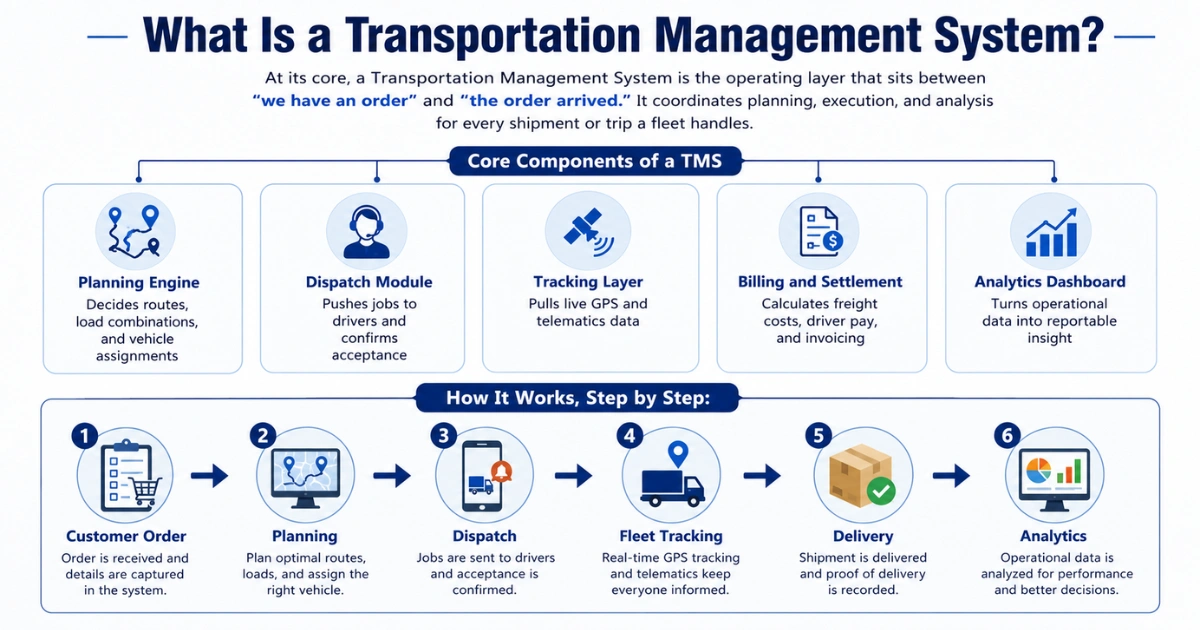
At its core, a Transportation Management System is the operating layer that sits between "we have an order" and "the order arrived." It coordinates planning, execution, and analysis for every shipment or trip a fleet handles.
Core components of a TMS:
- Planning engine — decides routes, load combinations, and vehicle assignments
- Dispatch module — pushes jobs to drivers and confirms acceptance
- Tracking layer — pulls live GPS and telematics data
- Billing and settlement — calculates freight costs, driver pay, and invoicing
- Analytics dashboard — turns operational data into reportable insight
How it works, step by step:
Customer Order → Planning → Dispatch → Fleet Tracking → Delivery → Analytics
An order comes in, the planning engine works out the most efficient route and vehicle assignment, dispatch pushes the job to a driver's mobile app, the fleet tracking layer monitors progress in real time, delivery is confirmed (often with e-signature or photo proof), and the whole cycle feeds back into analytics that inform the next round of planning.
What separates a genuinely useful transportation management system from a glorified spreadsheet replacement is that last loop — the analytics feeding back into planning. Without it, you have digitized manual work. With it, you have a system that gets smarter every week it runs.
Modern transportation management software in Dubai increasingly folds AI into every one of these stages rather than treating it as a bolt-on reporting feature, which is the shift most of this guide is really about.
Why Businesses in Dubai Are Investing in Transportation Management Software
Talk to any fleet manager in the emirate right now and a handful of pressures come up again and again.
Rising fuel costs. Even modest fuel-price swings hit margins hard across large fleets, and manual route planning simply can't optimize for cost the way an algorithm can.
Fleet expansion. Growing operators quickly hit a wall where phone calls and WhatsApp groups can't coordinate dozens (let alone hundreds) of vehicles reliably.
Real-time visibility. Enterprise clients now expect live shipment tracking as a baseline service, not a premium feature — and internal teams need the same visibility to catch problems before customers do.
Driver productivity. Mobile-first dispatch and turn-by-turn routing cut the friction that used to eat into a driver's actual working hours.
Route optimization. AI-based routing routinely finds efficiencies that experienced dispatchers miss simply because the variable space is too large for a human to calculate manually.
Customer expectations. Same-day and scheduled-window delivery are now standard asks, and meeting them without software-driven planning is a losing proposition at scale.
Smart government infrastructure. RTA's digital initiatives and Dubai's broader smart-city investments are raising expectations for how transportation businesses should operate technologically.
Sustainability goals. Emissions tracking and EV-fleet readiness are moving from "future consideration" to active procurement criteria, particularly for companies working with government or multinational clients.
The pattern across all of these: individually, none of them force a company to adopt software. Together, they make manual operations progressively more expensive to sustain — which is why so many Dubai fleets are investing now rather than waiting.
Key Benefits of Transportation Management Software
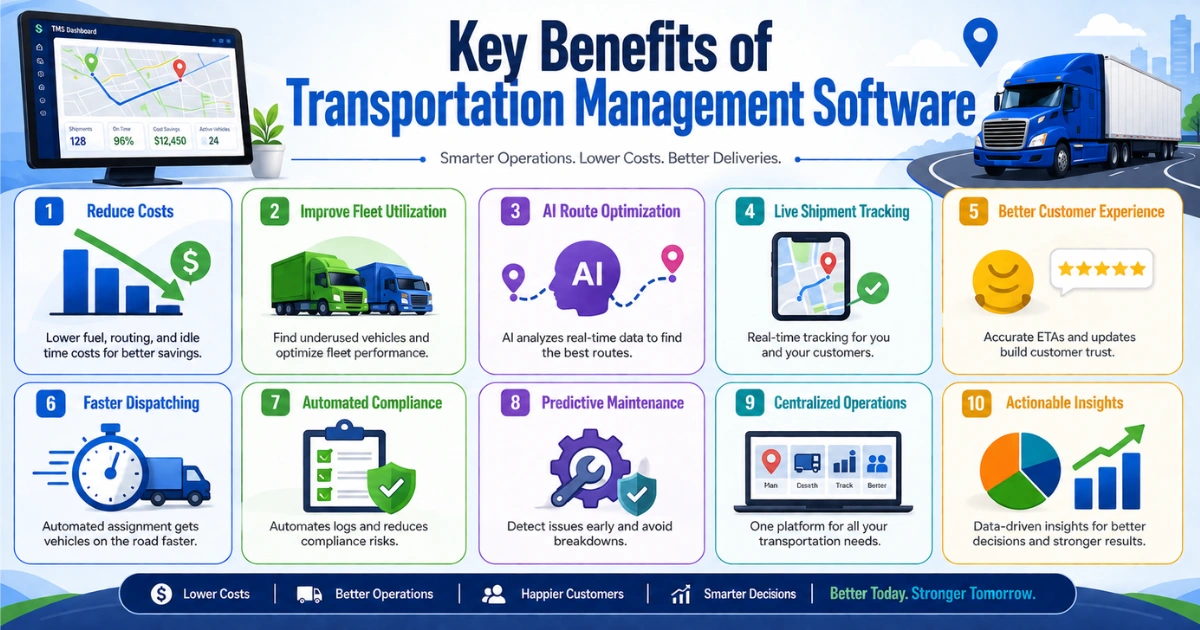
Reduce Transportation Costs
Optimized routing, better load consolidation, and reduced idle time typically produce the fastest, most measurable ROI of any TMS feature — often the first metric finance teams ask about post-launch.
Improve Fleet Utilization
Software surfaces which vehicles are underused and which routes are inefficient, letting operators right-size fleets instead of over-ordering vehicles "just in case."
AI-Based Route Optimization
Machine learning models factor in traffic patterns, delivery windows, vehicle capacity, and driver availability simultaneously — something no dispatcher can do manually at scale.
Live Shipment Tracking
Real-time GPS data turns "where's my order?" from a support ticket into a self-service answer, cutting call center load while improving customer trust.
Better Customer Experience
Accurate ETAs, proactive delay notifications, and delivery proof all compound into a customer experience that's hard to replicate with manual processes.
Faster Dispatching
Automated job assignment based on driver location and capacity shrinks the gap between "order received" and "vehicle en route" from minutes to seconds.
Automated Compliance
Digital logs, automated documentation, and audit trails reduce the manual burden of compliance reporting — and reduce the risk of costly errors.
Predictive Maintenance
IoT-connected vehicles flag maintenance needs before breakdowns happen, avoiding the cascading delays a single failed vehicle can cause mid-route.
Centralized Operations
One platform for planning, dispatch, tracking, and billing removes the data silos that make cross-team coordination slow and error-prone.
Actionable Business Intelligence
Dashboards that surface cost-per-mile, on-time percentage, and driver performance turn operational data into decisions instead of just archives.
Essential Features of Transportation Management Software Development
A production-grade transportation management system in Dubai typically needs to cover the following ground:
|
Feature Category |
What It Delivers |
|
Fleet Management Software |
Vehicle assignment, availability tracking, lifecycle management |
|
Route Optimization Software |
AI-calculated routes factoring traffic, capacity, and delivery windows |
|
GPS Tracking |
Live location data for every active vehicle |
|
Driver Management |
Scheduling, performance tracking, license/document management |
|
Dispatch Management |
Automated or semi-automated job assignment |
|
Freight Management |
Load matching, carrier selection, freight documentation |
|
Load Planning |
Optimized cargo allocation across available vehicles |
|
Warehouse Integration |
Sync between inventory systems and outbound transportation |
|
Shipment Tracking |
End-to-end visibility from pickup to delivery |
|
Billing Automation |
Automated invoicing, rate calculation, driver settlement |
|
Analytics Dashboard |
KPI reporting across cost, time, and performance metrics |
|
Mobile Driver App |
Job acceptance, navigation, proof-of-delivery capture |
|
IoT Integration |
Sensor data from vehicles and cargo (temperature, fuel, load) |
|
Document Management |
Digital storage for permits, manifests, and compliance records |
|
Compliance Module |
Regulatory checks and automated audit trails |
|
Customer Portal |
Self-service tracking and communication for shippers/customers |
|
Multi-Language Support |
Arabic and English at minimum, critical for UAE operations |
|
AI Recommendation Engine |
Suggests optimal routes, carriers, and scheduling in real time |
Not every business needs all eighteen on day one — this is why scoping matters more than feature-count when planning logistics software development. The right approach is usually to launch with the modules that solve your most expensive current problem, then expand.
AI Features Defining Transportation Management Software in 2026
AI in transportation software has moved well past chatbots and basic forecasting. The features actually shaping competitive advantage this year include:
- Predictive analytics — forecasting delays, demand spikes, and cost overruns before they materialize
- Machine learning — continuously improving route and dispatch decisions based on historical outcomes
- Digital twins — virtual models of a fleet or network used to simulate changes before implementing them
- Computer vision — used for proof-of-delivery verification, cargo condition monitoring, and driver safety checks
- Autonomous dispatch — systems that assign and confirm jobs with minimal human intervention
- AI chatbots — handling routine customer and driver queries without tying up support staff
- Predictive ETA — dynamic arrival estimates that adjust in real time as conditions change
- Demand forecasting — anticipating volume shifts so fleets can plan capacity ahead of need
- Fuel optimization — algorithms that minimize fuel consumption across routes and driving behavior
- Smart scheduling — automatically balancing driver hours, vehicle availability, and delivery windows
The common thread: these features work because Dubai's fleets are generating more usable data than ever, thanks to widespread telematics and IoT adoption. AI without that underlying data infrastructure is just a marketing claim — which is why the two need to be built together, not sequentially. If you want the fuller picture of where this is headed across the wider supply chain, our breakdown of AI in Logistics covers the trends feeding into these same TMS capabilities.
Technology Stack for Transportation Management System Development
|
Layer |
Common Technologies |
|
Frontend |
React, Angular, or Vue for web dashboards |
|
Backend |
Node.js, Python (Django/FastAPI), or Java (Spring Boot) |
|
Cloud |
AWS, Microsoft Azure, or Google Cloud Platform |
|
Databases |
PostgreSQL, MongoDB, or a hybrid SQL/NoSQL setup |
|
Mobile |
React Native or Flutter for cross-platform driver/customer apps |
|
AI/ML |
TensorFlow, PyTorch, or cloud-native ML services |
|
Maps |
Google Maps Platform, HERE Maps |
|
GPS |
Real-time GPS hardware integrations via telematics providers |
|
IoT |
MQTT-based sensor networks for vehicle and cargo data |
|
Telematics |
Fleet telematics APIs (Geotab, Samsara, or regional providers) |
|
Payment |
Stripe, regional UAE payment gateways |
|
Cybersecurity |
OAuth 2.0, encryption at rest and in transit, role-based access |
|
Analytics |
Power BI, Tableau, or custom dashboards built on the data layer |
|
APIs |
RESTful and GraphQL APIs for ERP/CRM/warehouse connectivity |
The specific stack should flex based on your existing systems and compliance requirements — a fleet already running on SAP, for instance, will make very different integration choices than one running lean on QuickBooks and spreadsheets.
Transportation Management Software Architecture
A well-designed TMS architecture separates concerns clearly so that each layer can scale independently:
- Driver Apps — mobile-first, offline-capable where connectivity is inconsistent
- Fleet Dashboard — internal operations view for dispatchers and managers
- Admin Portal — configuration, user management, and system-wide controls
- Cloud APIs — the connective layer between all modules and external systems
- Analytics Layer — aggregates data for reporting and forecasting
- IoT Layer — ingests and normalizes sensor data from vehicles and cargo
- AI Layer — runs optimization, prediction, and recommendation models
- Database — the system of record for all operational data
- ERP / CRM / Warehouse / Telematics — external systems the TMS integrates with rather than replaces
The mistake we see most often in Dubai's mid-market fleets is building these layers as one tightly coupled application. It works fine at launch, then becomes expensive to modify the moment the business adds a new vehicle type, region, or integration. Architecting for separation from day one costs a little more upfront and saves significantly more later.
Industry Use Cases
Logistics companies use TMS platforms to coordinate multi-modal shipments and manage carrier relationships at scale.
Freight forwarders rely on automated documentation and rate comparison to move cargo across borders faster.
Courier companies lean heavily on route optimization and live tracking to hit tight last-mile delivery windows.
Construction firms use fleet software to coordinate heavy equipment transport and material delivery across active sites.
Retail businesses connect TMS platforms to warehouse and inventory systems to keep shelves stocked without overordering transport capacity.
Healthcare providers use compliance-heavy TMS configurations for temperature-sensitive and time-critical deliveries.
Food delivery operators depend on predictive ETA and dynamic dispatch to manage high order volumes during peak hours.
Oil & gas companies track specialized vehicle fleets across remote routes where visibility gaps are costly.
Manufacturing companies integrate TMS with production schedules to synchronize outbound shipping with output.
Government and public transportation bodies use transportation software for fleet oversight, route planning, and citizen-facing transit apps.
Smart city initiatives across Dubai increasingly rely on aggregated transportation data to inform infrastructure and traffic planning decisions.
Transportation Management Software Development Process
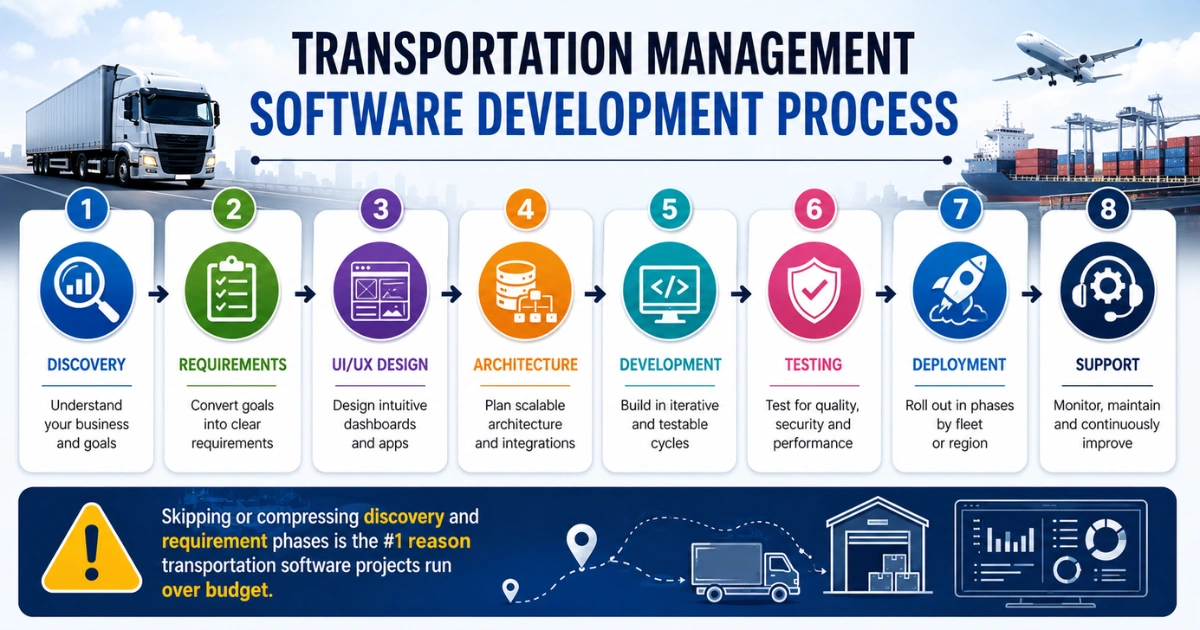
Step 1: Business Discovery — understanding your current operations, bottlenecks, and growth plans ↓
Step 2: Requirement Analysis — translating business goals into technical specifications ↓
Step 3: UI/UX Design — designing dashboards and mobile apps around how dispatchers and drivers actually work ↓
Step 4: Architecture — deciding the technical foundation, integrations, and scalability approach ↓
Step 5: Development — building the platform in iterative, testable increments ↓
Step 6: Testing — QA across functionality, load, security, and real-world usage scenarios ↓
Step 7: Deployment — rolling out to production, often in phases by fleet or region ↓
Step 8: Support — ongoing maintenance, monitoring, and feature iteration post-launch
Skipping or compressing the discovery and requirement phases is the single most common reason transportation software projects run over budget — the cost of getting requirements wrong compounds heavily once development is underway.
Transportation Management Software Development Cost in Dubai (2026)
Cost estimates for TMS development vary too widely to quote a single number responsibly — a lean, single-fleet MVP and a multi-tenant enterprise platform with AI and IoT layered in aren't remotely comparable projects. What actually drives the cost conversation:
- Platform scope — web-only vs. web plus native mobile apps for drivers and customers
- Feature depth — core dispatch and tracking vs. a full eighteen-module system
- Cloud infrastructure — hosting, data storage, and scaling costs over time
- AI complexity — basic route suggestions vs. custom-trained predictive models
- IoT integration — the number and type of sensors and telematics feeds involved
- Third-party integrations — ERP, CRM, payment gateways, and mapping APIs each add scope
- Compliance requirements — data protection, audit logging, and industry-specific regulations
- Ongoing maintenance — post-launch support, monitoring, and iterative feature development
- Enterprise scale — number of users, vehicles, and concurrent transactions the system needs to support
The honest answer to "what will this cost" only comes after a proper discovery phase — anyone quoting a fixed number before understanding your fleet size, integration needs, and AI ambitions is guessing. It helps to look at the bigger picture first: our guides to App Development Cost in Dubai and broader Software Development Costs in 2026 walk through the same cost drivers in more general terms, while our dedicated breakdown of Logistics & Fleet Management App Development Cost gets specifically into how those factors play out for fleet and logistics platforms like this one.
Timeline for Transportation Management System Development
|
Project Type |
Typical Duration |
What's Included |
|
Small MVP |
3–5 months |
Core dispatch, tracking, and a single mobile app |
|
Medium Platform |
6–9 months |
Full feature set, web + mobile, basic AI routing |
|
Enterprise System |
9–14 months |
Multi-region support, deep integrations, advanced compliance |
|
AI-Powered Platform |
10–16 months |
Predictive analytics, ML-driven optimization, IoT layers |
|
Scalable SaaS |
12–18 months |
Multi-tenant architecture, white-labeling, enterprise-grade security |
Timelines stretch or compress based on a handful of recurring factors: how many legacy systems need integration, whether AI models need custom training on your operational data versus using pre-built services, how many languages and regulatory frameworks the platform needs to support, and how much the internal team can dedicate to testing and feedback cycles during development.
Integration Capabilities
A transportation platform is only as useful as the systems it connects to. Common integration points for Dubai-based deployments include:
- ERP systems — SAP, Oracle, Microsoft Dynamics
- CRM platforms — for customer and account management continuity
- Mapping services — Google Maps, HERE Maps
- Payment gateways — for freight billing and driver settlement
- Warehouse management systems — to sync inventory and outbound transport
- Telematics providers — for live vehicle and driver data
- IoT sensor networks — temperature, fuel, and load monitoring
- RTA APIs — where applicable, for regulatory and traffic-data alignment
The integration layer is often where projects quietly go over budget, because legacy systems rarely expose clean, well-documented APIs. Budgeting realistic time for integration testing — not just integration development — is one of the most underrated cost-control moves in this process.
Security, Compliance & Data Protection
Transportation data — customer addresses, shipment contents, payment details, driver location history — is sensitive by default, and Dubai-based platforms need to treat it that way from the architecture stage, not as a post-launch patch.
Core practices worth building in from day one:
- ISO 27001-aligned information security practices
- UAE data protection considerations, including how and where data is stored and processed
- Role-based access control, so drivers, dispatchers, and admins only see what their role requires
- Encryption for data at rest and in transit
- Audit logs covering who accessed or changed what, and when
- Backup and disaster recovery planning, tested rather than assumed
- Cloud security configuration, including regular vulnerability assessments
For companies handling international shipments or working with EU-based partners, GDPR considerations may also apply on top of local requirements — worth clarifying early with legal counsel rather than assuming either framework covers the other.
Future Trends Shaping Transportation Management Software in Dubai
The next wave of transportation technology is already visible in pilot programs and early enterprise deployments across the region:
- AI agents that don't just recommend actions but execute routine dispatch and rebooking decisions autonomously
- Digital twins of entire fleet and route networks, used to simulate changes before committing resources
- Autonomous vehicles, with Dubai actively piloting self-driving transport as part of its broader smart-mobility strategy
- EV fleet management, as sustainability targets push more operators toward electric vehicles and the charging-logistics challenges that come with them
- Drone logistics for select last-mile and inspection use cases
- Predictive logistics that flags disruptions — weather, port congestion, traffic — before they affect delivery timelines
- Blockchain for tamper-proof freight documentation and multi-party chain-of-custody tracking
- Sustainability reporting built directly into the platform rather than compiled manually after the fact
- Edge computing for faster, more reliable processing of IoT data at the vehicle level
- Hyperautomation connecting transportation workflows to broader enterprise automation initiatives
- Smart mobility platforms that tie fleet operations into wider city-level traffic and infrastructure systems
Not every business needs to chase all of these immediately. The practical move is building an architecture flexible enough to absorb them as they mature, rather than betting the entire platform on any single emerging technology today.
Common Mistakes Businesses Make When Building Transportation Software
- Choosing generic software that wasn't built for regional traffic patterns, Arabic-language support, or UAE compliance requirements
- Ignoring scalability and building for today's fleet size instead of next year's
- No mobile strategy, leaving drivers dependent on paper or disconnected tools
- Poor integrations that create data silos instead of a single operational view
- Weak analytics that report on the past without informing future decisions
- Ignoring AI entirely, or bolting it on superficially without real data infrastructure behind it
- No cloud architecture, limiting remote access and scalability
- Poor UX for dispatchers and drivers, which quietly kills adoption regardless of how capable the backend is
- No cybersecurity planning, treating security as an afterthought rather than a design principle
- Skipping maintenance, assuming a launched platform needs no further investment
Most of these mistakes trace back to the same root cause: treating transportation software as a one-time purchase rather than an evolving operational asset.
Why Choose Custom Transportation Management Software Development
|
Factor |
Off-the-Shelf Software |
Custom Transportation Management Software |
|
Customization |
Limited to vendor's feature set |
Built around your exact workflows |
|
Ownership |
Licensed, not owned |
Full ownership of the platform and data |
|
Scalability |
Often capped by vendor pricing tiers |
Scales with your business, not a subscription plan |
|
Integrations |
Restricted to pre-built connectors |
Custom-built for your specific ERP, CRM, and telematics stack |
|
Security |
Shared infrastructure, vendor-controlled |
Configured to your exact compliance requirements |
|
Long-Term ROI |
Recurring licensing costs, feature limits |
Higher upfront investment, greater long-term control and savings |
Off-the-shelf platforms make sense for companies with simple, standard workflows and limited growth ambitions. Once operations get complex — multiple vehicle types, region-specific compliance, custom customer portals, or AI models trained on your own operational history — the constraints of generic software start costing more than a custom build would have. That's the exact inflection point we walk clients through in our guide to Custom Logistics Software Development in Dubai, including how to tell whether you've actually reached it yet.
Why Choose SISGAIN for Transportation Management Software Development in Dubai
Building transportation software isn't a generic engineering exercise — it requires genuine depth in AI, logistics workflows, and the specific regulatory and infrastructure realities of operating in the UAE. That's the combination SISGAIN brings to every engagement:
- AI expertise applied to real dispatch, routing, and forecasting problems — not surface-level chatbot features
- Logistics software development experience across freight, courier, fleet, and multi-modal operations
- Cloud-native architecture built to scale with your fleet, not against it
- Enterprise integrations with the ERP, CRM, and telematics systems businesses are already running on
- Scalable platforms designed for multi-region, multi-tenant growth from the outset
- Mobile applications built for the realities of driver connectivity and usability in the field
- Long-term support that treats launch as the starting point, not the finish line
- UAE-focused solutions that account for Arabic-language needs, local compliance, and regional infrastructure
- Custom development approach that starts with your operational bottlenecks, not a fixed feature template
Conclusion
Dubai's transportation ecosystem isn't just growing — it's being deliberately re-engineered around AI, real-time data, and connected infrastructure, with the D33 agenda putting government weight behind that shift through 2033. Businesses still running fleets on spreadsheets and phone calls aren't just operating inefficiently anymore; they're falling behind a market that's actively raising the bar on what customers, partners, and regulators expect.
Investing in transportation management software isn't only about shaving costs off individual deliveries, though it does that too. It's about building the operational foundation for smarter decision-making, faster response to disruption, and a fleet that can scale without breaking. In a logistics market growing this fast, that foundation is the difference between capturing the opportunity and watching competitors capture it first.
If you're ready to talk through what custom transportation management system development could look like for your fleet, our team is ready to map it out with you.