
I've spent nearly two decades helping businesses navigate technology shifts—from early-stage digitization to full-scale AI transformation. What's happening in the UAE government right now is, without exaggeration, the most concentrated and well-resourced public-sector AI push I've seen in my career. I wrote this piece because I keep having the same conversation with business leaders who are aware of the opportunity but unclear on exactly what's being deployed, where the real entry points are, and what it actually takes to compete. This is my attempt to answer all of that in one place.
Why Every Business in the UAE Should Be Paying Attention to Government AI
Let's be direct. If your business operates in the UAE — or is planning to — the government's accelerating AI agenda is not a background story. It's a strategic signal you need to act on.
The Dubai Centre for Artificial Intelligence (DCAI), launched in June 2023 under the patronage of His Highness Sheikh Hamdan bin Mohammed bin Rashid Al Maktoum, was created with a singular mission: to accelerate the adoption and integration of AI across Dubai's government entities. It brought together the Dubai Future Foundation, Digital Dubai Authority, DEWA, and the Dubai Media Council under one unified AI vision.
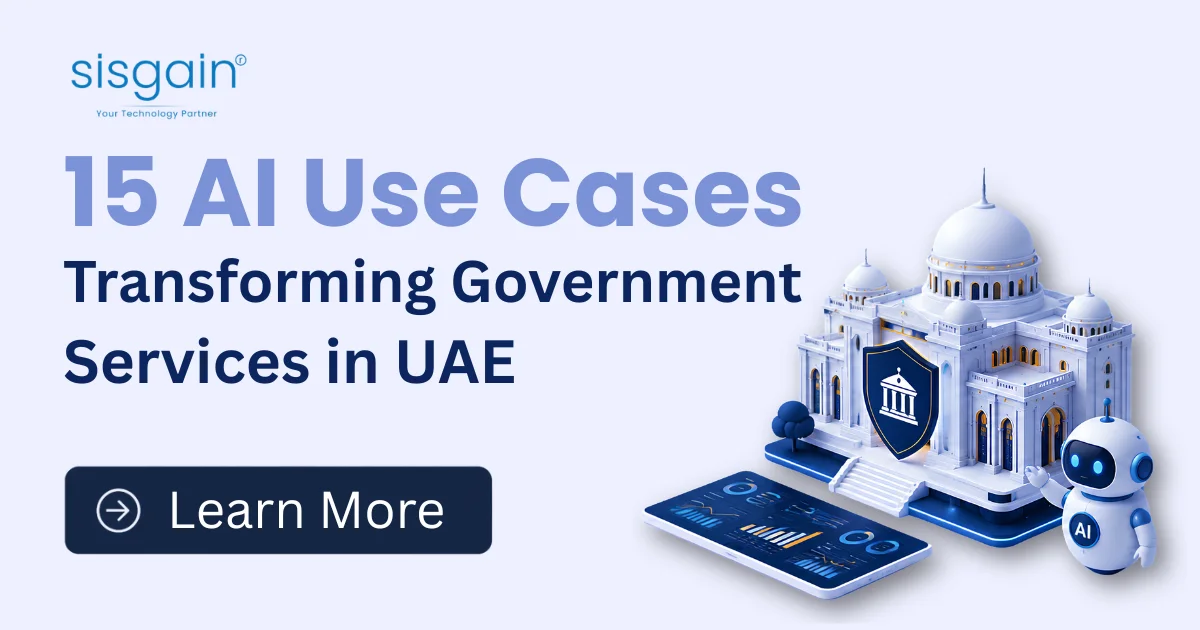
What happened next was remarkable. The Dubai Future Accelerators (DFA), working in collaboration with the DCAI, initiated the first dedicated Generative AI program for government, collaborating with 33 Dubai government entities to identify 183 potential Generative AI use cases. From that discovery phase, 75 AI pilot projects were executed. This report highlights the 15 most critical and high-impact among them.
For B2B enterprises — from large conglomerates to growing mid-market companies — these 15 use cases represent real procurement opportunities, partnership openings, and areas where aligning your product or service with the UAE Government AI Strategy could unlock significant growth.
Let's break them all down.
The UAE's AI Blueprint: What You Need to Know First
Before we walk through the use cases, a little context matters.
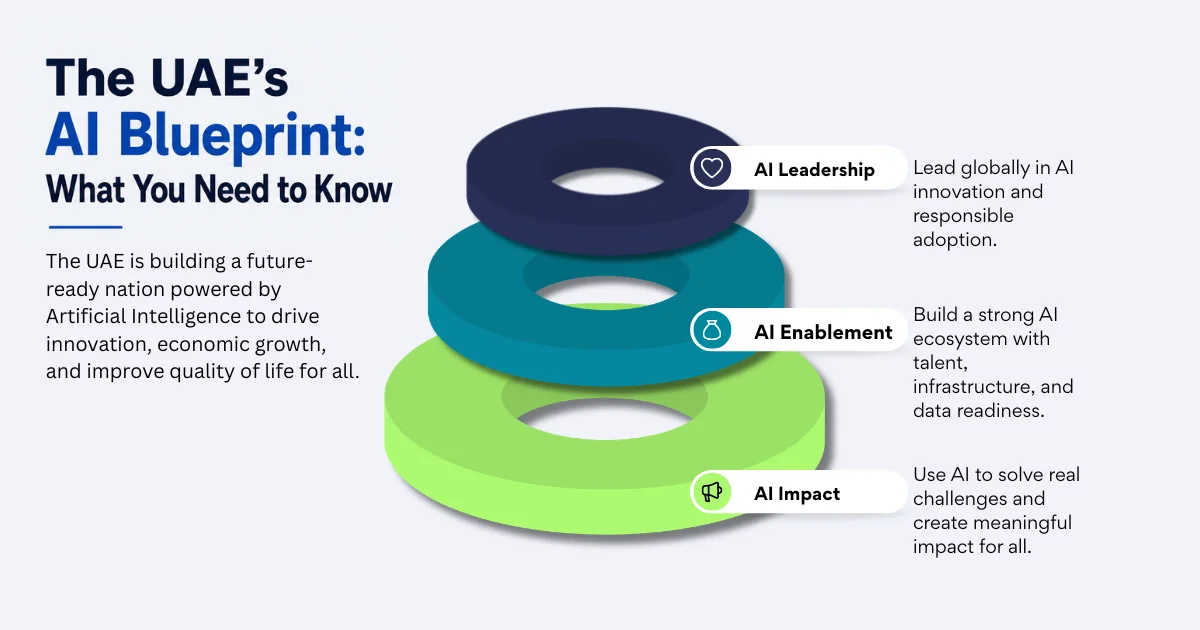
The Middle East stands to capture approximately 2% of the total global value generated by AI by 2030 — a figure that translates to US$320 billion. The UAE, in particular, is expected to see AI contribute close to 14% of its GDP within the same timeframe. That's not a government aspiration. That's a calculated economic target being backed by real infrastructure, policy, and investment.
The DCAI's program was structured in two phases. First, a challenge discovery journey with government entities that identified operational and strategic pain points and mapped them to AI solutions. Second, a three-month innovation sandbox where leading AI companies worked directly with government stakeholders to trial and validate their solutions in a live regulatory environment.
The result: 15 documented AI use cases now serving as a public blueprint for Dubai AI Government Initiatives — and a clear roadmap for private-sector companies looking to integrate with or serve the public sector.
#1: AI in Customer Services — Reshaping How Citizens Interact with Government
Government customer service is a persistent global problem. Long queues, inconsistent information, and high operational costs plague public-sector service delivery worldwide. In Dubai, AI is flipping that narrative.
AI-driven chatbots, virtual assistants, and digital human avatars are now capable of handling up to 80% of routine government inquiries while reducing response times by up to 70%. In Dubai's government happiness centers, AI-powered self-service capabilities are projected to resolve approximately 45% of citizen cases without any human involvement.
The numbers tell the business story clearly: AI integration in government customer services can reduce processing times by up to 50%, drive a 40% increase in satisfaction levels, and deliver a 15–30% boost in overall productivity.
For enterprises offering Government IT Solutions Dubai, this is one of the clearest entry points into the public sector. The demand for NLP-powered interfaces, digital avatar solutions, and AI-powered CRM integrations is rising fast.
#2: Personalised Healthcare — AI-Driven Medicine at Scale
Dubai Health Authority's collaboration with G42 Healthcare on the Emirati Genome Programme is laying the foundation for what could become the world's most advanced government-led personalized medicine initiative. The goal is to build the first de novo Emirati reference genome — a comprehensive database that AI systems can use to tailor treatments to individual genetic profiles.
The projected impact is significant. AI integration with electronic health records (EHRs) is expected to improve diagnostic accuracy by 40%. In cancer treatment alone, AI could cut the time needed to identify effective therapies by 50%, potentially increasing survival rates by 20%. For chronic disease management, AI-powered monitoring tools could reduce hospital readmissions by 25% and trim overall healthcare costs in Dubai by up to 20% by 2030.
This is not a future scenario. It's an active procurement and innovation landscape for healthtech companies, diagnostic AI platforms, and enterprise health data management firms.
#3: Empowering Inclusion — AI for People of Determination
Globally, 1.3 billion people — roughly one in six — experience significant disabilities. A survey found that 42% of individuals with disabilities report difficulties navigating government websites. Dubai has already moved to address this with the Dubai Universal Accessibility Strategy and Action Plan (DUASAP) and DEWA winning recognition as the Best People-of-Determination-Friendly Government Entity in 2024.
AI is extending this work further. Digital avatars that translate spoken language into sign language in real time, conversational assistants in sign language, and AI-powered speech recognition tools are now being integrated into government service touchpoints. Dubai's smart police stations already offer 24/7 services with minimal human intervention, using AI to interpret sign language and provide transcripts for citizens with speech or hearing impairments.
For enterprises building accessibility-focused solutions or working in smart city AI applications, this is a growth area with both social impact and government contract potential.
How many government entities are actively involved in Dubai's AI program?
Placed here because readers are early in the use cases and this reinforces the scale and credibility of the program before they go deeper.
#4: Transforming Information Access — AI-Powered Knowledge Discovery
The Mohammed Bin Rashid Library (MBRL), opened in 2022, houses over 4.5 million printed, digital, and audio books. Its "A World in Your Language" initiative already uses AI to provide access to resources in 13 languages. In 2022 alone, Dubai's public libraries received approximately 271,500 visitors — and the shift to digital is accelerating.
AI in this domain handles intelligent indexing, semantic search, multilingual content discovery, and personalised reading recommendations. For knowledge management companies, EdTech platforms, and document intelligence providers, Dubai's public library and knowledge institutions represent an emerging procurement vertical with clear government backing.
#5 & 6: Smart Urbanism and Lost & Found — AI Meets City Infrastructure
Dubai's smart city vision is not a marketing statement. It's an operational framework backed by budget, data infrastructure, and political will.
Under the Smart Urbanism use case, AI is being deployed to optimize urban services — from waste management and traffic flow to public space utilization and predictive maintenance of city assets.
The Lost & Found use case is a particularly interesting example of AI Government Transformation in a domain most people overlook. AI-powered image recognition and object tracking systems are being piloted to help recover lost items at scale across public venues, transportation hubs, and government facilities. Computer vision, object classification, and real-time database matching are the core technologies here.
For companies in the smart city AI applications space — whether you're building IoT-integrated platforms, city management dashboards, or AI-powered surveillance analytics — these use cases represent active government interest and pilot budgets.

#7: AI Text Recognition for Ancient Manuscripts — Preserving History with Technology
This use case combines cultural preservation with cutting-edge AI. Dubai is deploying advanced Optical Character Recognition (OCR) and AI text analysis tools to digitize and decode ancient Arabic manuscripts — many of which are fragile, partially damaged, or written in historical scripts that standard OCR cannot handle.
Beyond the cultural significance, this use case creates real demand for document AI, NLP specialists with Arabic language capabilities, and archival technology firms. If your enterprise works in enterprise document processing or AI-powered language solutions, the government's interest in this domain is worth tracking closely.
Understanding how AI differs fundamentally from traditional software in handling these kinds of complex, unstructured data problems is critical. If you're evaluating your tech stack, Traditional Software vs AI Software is a read that will sharpen your perspective on why legacy systems can't address these challenges.
#8: AI in Real Estate — Smarter Property Markets
Dubai's real estate market is one of the most dynamic in the world, and AI is being integrated at the infrastructure level. AI systems are now being used to power property valuation models, predictive analytics for market trends, and intelligent matching between buyers, sellers, and renters based on behavioral data.
For the government, this means more accurate land and property taxation, better urban planning decisions, and a more transparent market. For proptech firms, real estate analytics platforms, and data intelligence companies, this is an active area of government-led innovation that is creating new procurement categories.
#9: AI in Logistics and Customs Security — Strengthening Dubai's Trade Position
Dubai handles approximately 14.6 million metric tons of air cargo annually and is one of the world's top five busiest ports by container throughput. The customs and logistics sector is mission-critical to the UAE economy, and AI is being embedded at multiple checkpoints.
AI-powered intelligent monitoring systems are being deployed to analyze cargo manifests, flag anomalies in real time, detect contraband through pattern recognition, and automate clearance workflows. The projected outcome: faster customs clearance, lower compliance costs, and a more secure trade environment.
For logistics technology companies, supply chain platforms, and security AI firms, the government's explicit investment in this domain creates both direct procurement opportunities and an ecosystem ready for private-sector integration.
Businesses looking to scale AI capabilities across industrial and operational environments should explore how AI for Industrial Operations is already reshaping complex sectors — many of the same frameworks apply here.
What sectors does UAE government AI transformation cover beyond digital services?
Placed mid-content when readers have seen enough use cases to appreciate the breadth. It reframes the scope for B2B readers who may have assumed AI transformation was only about citizen apps.
#10: AI-Powered Workforce Management — Optimizing Government Talent
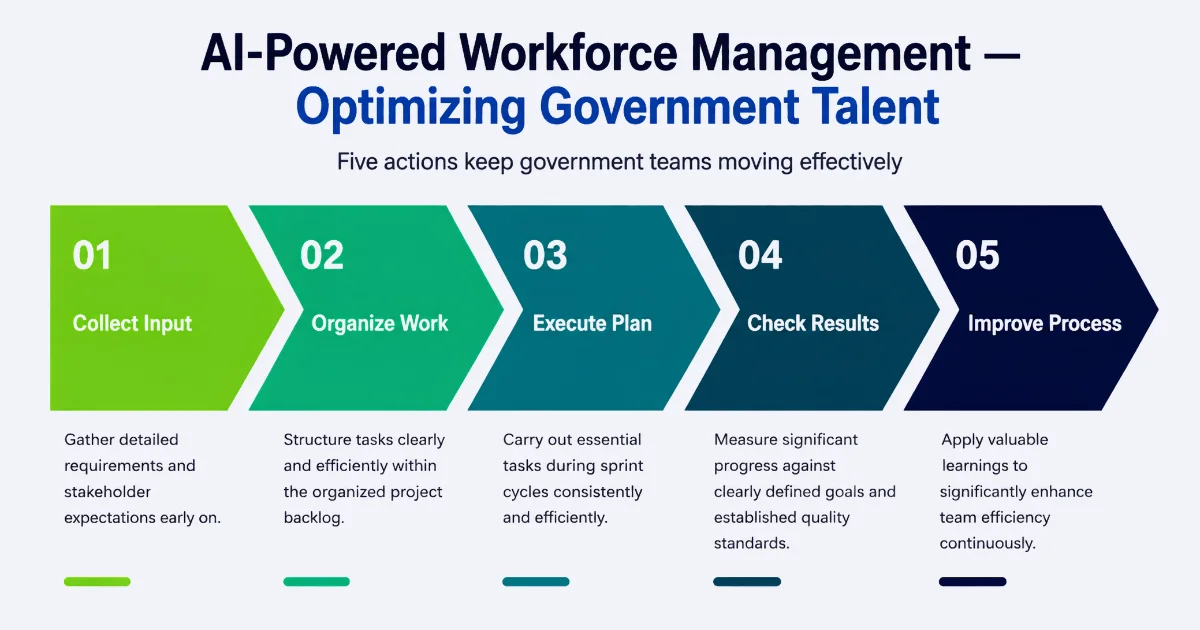
Government workforce management is a challenge of scale and complexity. Dubai employs tens of thousands of public servants across hundreds of entities, and aligning talent to operational needs in real time requires AI at the core of the HR function.
AI workforce management tools being piloted include intelligent talent matching (identifying which employees have the skills for specific roles or projects), productivity analytics, and succession planning models powered by behavioral and performance data.
For HR technology companies, workforce analytics platforms, and enterprise AI developers, this use case signals government willingness to adopt sophisticated AI tools in human capital management — a domain traditionally resistant to technology disruption.
The AI in UAE Government landscape covers workforce and operational transformation in detail, providing additional context for businesses looking to position in this space.
#11: AI-Powered Investment Tools — Smarter Financial Decision-Making in the Public Sector
Dubai's financial sector is a global hub, and the government is deploying AI to transform how public investment decisions are made. AI-powered investment tools are being used to analyze macroeconomic data, model risk scenarios, optimize portfolio allocation, and generate data-driven insights for government fund managers and sovereign wealth entities.
This is particularly relevant for fintech companies, investment analytics platforms, and financial AI developers looking to serve institutional clients in the UAE. The government's adoption of AI-driven financial tools signals a shift in how procurement decisions for financial technology will be made going forward.
#12: AI for Spend Management — Bringing Discipline to Government Finances
Government procurement and spend management has historically been opaque and inefficient. AI is changing that. Smart spend management platforms powered by AI can analyze purchasing patterns, flag irregular transactions, identify duplicate vendors, and recommend cost optimization opportunities in real time.
For enterprises selling financial governance tools, ERP-integrated AI modules, or procurement intelligence platforms, this is an area where the government's stated intent directly translates into active demand.
Businesses exploring their options in AI Software Development in UAE will find that spend management and financial automation represent one of the faster-growing segments of the market.
#13: AI in Advertising — Generative AI Reshaping Government Media
This is one of the more commercially interesting use cases. Dubai's Media Council is exploring how Generative AI in Public Administration extends into public communications — including automated creation of advertising content, multilingual campaign generation, and AI-driven media planning.
AI can now generate localized ad copy, optimize media placements based on real-time audience data, and reduce the time and cost of producing government public service campaigns. For marketing technology companies, creative AI platforms, and media agencies building AI capabilities, this is a direct government procurement opportunity.
#14: AI for Digital Historical Reconstructions — Heritage Meets Innovation
Dubai is combining AI with 3D modeling and digital twin technology to reconstruct historical versions of the city and the broader UAE. These reconstructions serve multiple purposes: education, tourism, cultural diplomacy, and urban planning.
For companies in the spatial AI, digital twin, or immersive experience sectors, this use case represents an emerging category where government cultural budgets and technology infrastructure converge.
#15: AI Chatbots for Government Transactions — End-to-End Digital Citizen Services
The final use case is perhaps the most commercially actionable for a wide range of technology businesses. AI chatbots are being deployed to handle end-to-end government transactions — not just answering questions, but processing applications, verifying documents, and completing service requests autonomously.
This goes beyond traditional chatbot functionality. We're talking about agentic AI systems capable of navigating multi-step government workflows, integrating with backend databases, and delivering completed transactions to citizens without human intervention.
The scale of opportunity here is significant. Every government department that processes applications, issues permits, manages renewals, or handles requests is a potential deployment environment. For AI software development company partners, this is one of the highest-demand categories in the government AI space right now.
Which UAE government AI use case has the broadest B2B commercial potential right now?
Placed right at the end of the 15 use cases before the enterprise strategy sections — a natural pivot point from informational to commercial intent, reinforcing the lead-gen angle.
What This Means for B2B Enterprises in the UAE
Reading through these 15 use cases as a list is one thing. Understanding their commercial implications as a B2B enterprise is another.
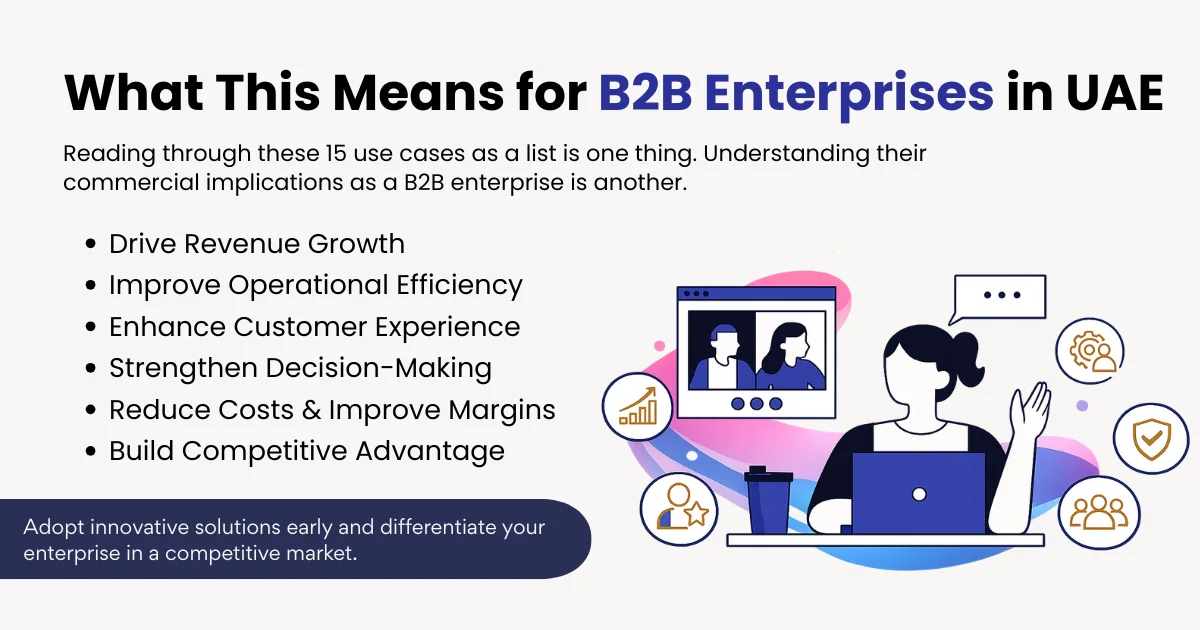
Here's the practical reality: the UAE government has not just articulated an AI vision. It has built the infrastructure to execute it — the DCAI, the innovation sandbox, the pilot programs, and now a published portfolio of documented use cases. That is a procurement pipeline in formation.
Enterprises across sectors — technology, logistics, healthcare, real estate, financial services, and media — have concrete opportunities to align their products and services with ongoing government AI initiatives. The companies that engage now, understand the priority areas, and build relationships with the relevant entities will have a significant first-mover advantage.
This is also why digital transformation services and solutions are seeing accelerating demand in the UAE market. Government AI transformation requires partners who understand both the technology and the regulatory environment.
The Role of the Right Technology Partner
Executing against the UAE Government AI Strategy is not simply a matter of deploying off-the-shelf AI tools. The government's own program demonstrates this — 75 pilot projects across 33 entities required bespoke solutions, deep integration work, and sustained collaboration between technology partners and government stakeholders.
The questions enterprises need to ask are practical:
Do you have an AI development partner with experience in the UAE regulatory and compliance environment? Can your technology scale from pilot to production within government procurement timelines? Do your AI systems support Arabic language processing, multilingual interfaces, and the accessibility requirements set by Dubai's inclusion policies?
These are the differentiators that matter in the government AI space. Enterprises exploring partnerships with software development agencies in UAE should specifically evaluate their government-sector experience and AI integration track record.
Understanding what drives AI Software Development Cost in Dubai is also an important input for budget planning, particularly for enterprises evaluating custom AI builds vs. platform integrations.
How Enterprises Can Position Themselves for Government AI Opportunities
There are several concrete steps B2B enterprises should take to position themselves effectively in this landscape.
First, map your existing capabilities to the 15 use cases outlined in this blog. Identify where your product or service creates direct value for a documented government AI priority. That mapping becomes your go-to-market story for the public sector.
Second, engage with the DCAI ecosystem. The Dubai Centre for Artificial Intelligence actively collaborates with private-sector companies and AI startups. Being part of that conversation puts your company in the room where procurement decisions happen.
Third, invest in building enterprise-grade AI capabilities that meet government-level requirements — data governance, security, auditability, and explainability are non-negotiables in public-sector AI deployment.
Fourth, look at the Enterprise AI Development Process as a framework for how to structure internal AI initiatives that align with government procurement standards. Government clients evaluate vendors differently than commercial clients — preparation and process maturity matter.
Finally, explore what AI Solutions for Dubai Businesses are already proving ROI in adjacent sectors. Understanding the competitive landscape helps you position more effectively.
The Government AI Transformation in Abu Dhabi provides additional context on how the UAE's federal and emirate-level AI visions are complementing each other — useful background for enterprises operating across the UAE rather than exclusively in Dubai.
What Does the Government AI Procurement Process Actually Look Like?
This is the question most business leaders have but rarely find answered directly. Understanding the opportunity is one thing. Knowing how to actually get in the door is another.
The UAE government's AI procurement does not follow a single monolithic process. Different entities — the Dubai Health Authority, Dubai Customs, the Mohammed Bin Rashid Library, DEWA — each manage their own procurement cycles with varying timelines, requirements, and decision-making structures. However, several consistent entry pathways exist for private-sector companies.
The first and most structured pathway is through the Dubai Future Accelerators (DFA) program. This is the official government-backed innovation program where private-sector companies are invited to co-create solutions with specific government entities over a defined sprint period — typically three to four months. Acceptance into the DFA puts your company in a direct working relationship with a government entity, significantly compressing the usual procurement timeline. Companies that successfully deliver in the DFA sandbox frequently convert those engagements into longer-term contracts.
The second pathway is direct government procurement through platforms like the Dubai Government Procurement Portal and Abu Dhabi Government's e-procurement system. These require companies to be registered as approved vendors, which involves compliance and financial health checks, but once registered, opens access to tender opportunities across multiple entities.
The third pathway — and the one most underestimated by enterprises — is through established government IT partners. Many government entities prefer to procure AI capabilities through existing trusted technology vendors rather than onboarding entirely new suppliers. If your company's AI solution can be delivered through an already-approved prime contractor, the path to deployment is significantly shorter.
The practical takeaway: don't wait for a tender to appear before preparing. Vendor registration, regulatory compliance, Arabic-language capability documentation, and proof-of-concept assets should all be ready before you need them. The enterprises that win government AI contracts are typically the ones who prepared six to twelve months before the procurement window opened.
The Compliance and Data Governance Reality: What UAE Government AI Projects Require
Business leaders evaluating government AI opportunities in the UAE consistently underestimate one thing: the compliance floor. This is not a bureaucratic footnote. It is a genuine make-or-break factor that has disqualified otherwise strong technology companies from government contracts.
The UAE has enacted several layers of data regulation that directly affect AI deployments in the public sector. At the federal level, the UAE Personal Data Protection Law (Federal Decree-Law No. 45 of 2021) governs how personal data is collected, processed, stored, and transferred. For AI systems that process citizen data — which covers the majority of the 15 use cases in this report — compliance with this law is mandatory, not optional.
At the emirate level, Dubai has its own data governance frameworks. The Dubai Data Law and the Dubai Data Establishment's governance standards apply to any AI system operating within Dubai government infrastructure. These require data residency within approved environments, audit trail capabilities, and documented consent management frameworks.
Beyond data privacy, UAE government AI projects require explainability. This is a term that carries significant weight in government procurement evaluations. An AI system that makes decisions affecting citizens — in healthcare, customs, workforce management, or financial services — must be able to explain those decisions in clear, auditable terms. Black-box AI models, regardless of their accuracy, are not acceptable in most government deployment contexts.
For enterprises building or sourcing AI Solutions for Dubai Businesses, this means three things need to be in place before you engage: your AI systems must support data residency within UAE-approved cloud environments (Microsoft Azure UAE North and AWS Middle East are the two primary options), your models must be interpretable or accompanied by explainability layers, and your data processing agreements must align with the UAE's regulatory requirements.
Companies that treat compliance as an afterthought typically discover its importance at the worst possible moment — during the technical due diligence stage of a contract negotiation. Building it in from the start is both a commercial and ethical necessity.
What Businesses Should Expect from Government AI Engagements in the UAE
Business leaders need to plan, and planning requires honest expectations about returns. Government AI engagements are not the same as commercial B2B sales cycles, and the ROI profile is different in ways that are worth understanding clearly before you commit resources.
The typical timeline from initial engagement to a signed government AI contract in the UAE runs between nine and eighteen months. This includes the period required for vendor qualification, RFP participation or DFA program completion, technical evaluation, contract negotiation, and final approval. Companies that enter expecting a three-to-six month sales cycle frequently misallocate resources and lose momentum.
The contract value, however, reflects this longer cycle. Government AI projects in the UAE — particularly those tied to the DCAI's documented use cases — tend to be multi-year engagements with significantly higher contract values than equivalent commercial deployments. A government chatbot platform contract, for example, is not a one-time software sale. It typically includes implementation, integration, ongoing model training, maintenance, Arabic language tuning, and performance SLAs — all priced and scoped over a three-to-five year horizon.
Recurring revenue is the other dimension business leaders should model. Government AI contracts in the UAE frequently include managed service components, which generate stable recurring revenue streams that are less susceptible to the commercial market volatility that affects private-sector contracts.
The cost side also requires honest planning. Government AI projects require higher investment in compliance, localization (Arabic NLP, cultural sensitivity in AI outputs), documentation, and stakeholder management than commercial projects of equivalent size. Budget for a longer pre-revenue period and a higher cost of bid compared to commercial sales.
The businesses that approach UAE government AI engagements with a realistic two-to-three year ROI horizon — rather than expecting immediate returns — are the ones that build sustainable positions in this market. It is a high-barrier, high-reward environment. The barrier is the price of admission to a revenue stream that commercial markets simply cannot replicate in terms of scale, stability, and strategic positioning.
Final Thoughts:
The UAE is not experimenting with AI in government services. It is systematically building the infrastructure, policy framework, and pilot portfolio to make AI-powered public services the new standard. The 15 use cases documented by the Dubai Future Foundation and the DCAI are not theoretical. They are active, funded, and expanding.
For B2B enterprises — whether you're a technology company, a consulting firm, a logistics operator, a healthcare provider, or a financial services company — this is the most significant technology-driven procurement cycle the UAE government has initiated in a generation.
The enterprises that understand the UAE Government AI Transformation, align their capabilities with documented government priorities, and build the right technology partnerships will find themselves not just winning contracts but becoming integral to the infrastructure of the world's most AI-forward government ecosystem.
The question is not whether to engage. It's how fast you can move.