
A hospital in Abu Dhabi and a clinic in Dubai used to be strangers. A patient walking from one to the other carried nothing but a folder of printouts and hope that someone would type it all in again. That's not the case anymore. Today, a physician in Al Ain can pull up a patient's lab history from a hospital in Sharjah in the time it takes to say good morning. That shift — from disconnected paperwork to a living, shared health record — is what "digital hospital transformation" actually means in the UAE right now, and it's moving faster than most healthcare leaders realize.
If you run operations, IT, or strategy at a hospital group in the UAE, you already feel the pressure. Regulators are tightening interoperability mandates. Patients expect the same on-demand experience they get from their banking app. Insurers want cleaner claims data. And your board wants to know why the AED 900 million-plus digital health market growing at over 20% a year hasn't yet translated into fewer bottlenecks on your own hospital floor.
This guide is built for that exact conversation. It's not a definitions article. It's a data-backed roadmap — grounded in real UAE regulatory frameworks (NABIDH, Malaffi, Riayati, PDPL), real market numbers, and real implementation patterns — for hospital executives who need to move from "we have some digital tools" to "we run an intelligent healthcare ecosystem."
We'll walk through what digital hospital transformation in the UAE actually looks like on the ground in 2026, why healthcare digital transformation here has become a licensing requirement rather than a strategic choice, and what separates a hospital that's merely digitized from one that has genuinely become a smart hospital. Along the way, we'll pull in the market data, the legal exposure, and the real hospital-group examples — Abu Dhabi's new intelligent surgical network among them — that should be shaping your 2026–2027 planning conversations right now.
The State of Digital Healthcare Transformation in the UAE
Let's start with the number that should be on every hospital CFO's desk. The UAE's digital health market was valued at approximately USD 931 million in 2025 and is projected to reach USD 7.6 billion by 2035 — a compound annual growth rate of roughly 23.4%. Separate estimates put the market at USD 621 million in 2024, climbing toward USD 1.8–2.6 billion by 2030 depending on the research house. The range varies by methodology, but the direction doesn't: digital healthcare transformation in the UAE is not a slow-burn trend. It's a compressed decade of change happening inside about five years.
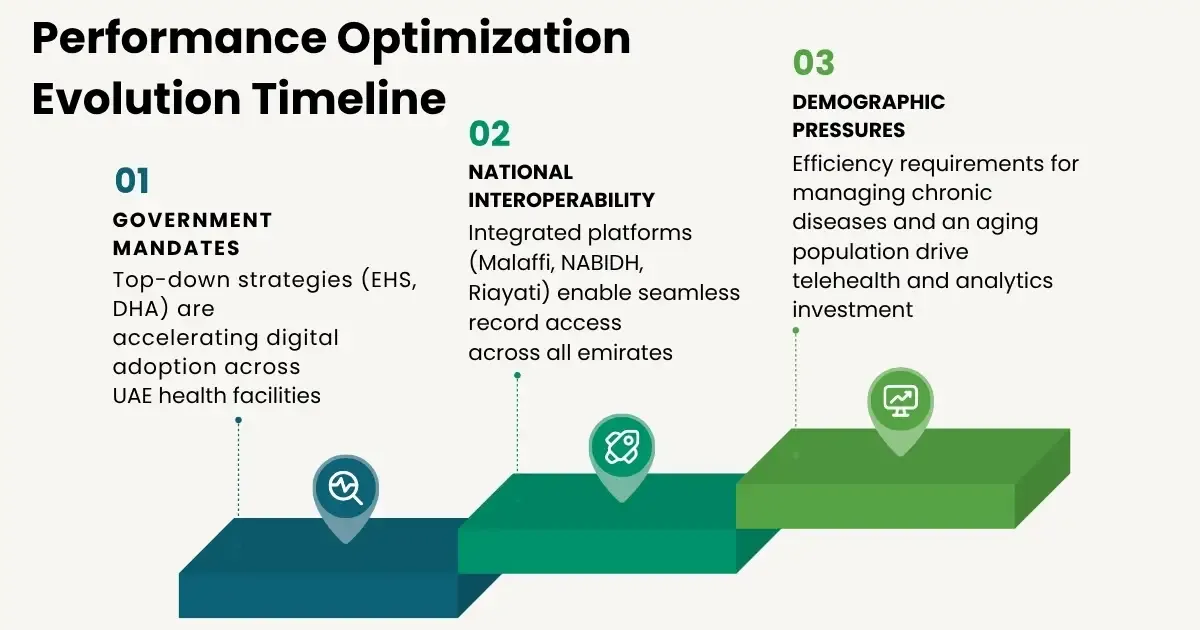
Three forces are driving that number.
First, government mandate, not market pull. Emirates Health Services rolled out an IT Innovation Strategy for 2023–2026 aimed at building internal digital capability across every EHS-run facility. The Dubai Health Authority's e-health strategy and Dubai Health Data Platform pushed the same agenda across the emirate. None of this waited for hospitals to ask for it.
Second, interoperability has gone from ambition to infrastructure. This is the part most outside analyses gloss over, so it's worth sitting with the actual numbers:
|
Platform |
Emirate/Scope |
Facilities Connected |
Clinicians/Users |
Records |
|
Malaffi |
Abu Dhabi |
100% of hospitals; 1,500+ facilities total |
~39,600 clinicians |
559+ million unique clinical records |
|
NABIDH |
Dubai |
1,300+ facilities |
Growing clinician base tied to DHA licensing |
9.47 million patient records |
|
Riayati (federal NUMR) |
UAE-wide |
3,000+ medical facilities |
90,000+ health service providers |
1.9 billion medical records for 9.5 million patients |
Riayati, Malaffi, and NABIDH were formally integrated in early 2023, which means a patient record created in Abu Dhabi is now retrievable — with consent — by a clinician in Dubai. That single integration event quietly rewired how continuity of care works across the whole country.
Third, chronic disease load and an aging expat and national population are forcing efficiency. Diabetes and cardiovascular care alone justify most of the analytics investment hospital groups are making, since remote monitoring and predictive risk scoring reduce costly late-stage interventions.
Here's the part that matters for your roadmap: none of this is optional infrastructure anymore. A Dubai facility without active NABIDH connectivity cannot get a new license or renew an existing one — Dubai's regulator lists a NABIDH-compliant EMR as a prerequisite on its Sheryan licensing portal. Hospital digital transformation UAE-wide has quietly become a compliance category, not just a strategy slide.
Telemedicine, Remote Monitoring, and the Shift Toward mHealth
It's worth naming the parts of digital healthcare transformation in the UAE that happen outside hospital walls, because they change what patients expect once they walk back in. Smartphone penetration in the UAE is among the highest in the world, and that has pulled mHealth — wearables, remote monitoring, symptom-tracking apps — into the mainstream faster than in most comparable markets. Diabetes management alone is projected to be the fastest-growing digital health application category through 2030, which tracks with the region's chronic disease burden.
Telemedicine adoption accelerated hard during 2019–2021 and never gave the gains back. Private operators across the UAE now run remote consultation as a default channel, not an emergency fallback, and regulators have built formal telehealth guidelines to keep pace. For a hospital group, this means the patient your outpatient department sees in person has usually already had a remote triage interaction, checked symptoms on an app, or reviewed lab results on a portal before arriving — and expects your in-hospital systems to already know that.
Workforce Readiness: The Quiet Bottleneck
Every hospital executive we talk to underestimates this part until it's already slowing their project down: technology adoption in a UAE hospital moves at the speed of clinical staff trust, not procurement speed. A NABIDH-compliant EMR rollout or an AI-assisted diagnostic tool is only as effective as the clinicians willing to use it as intended instead of working around it. Successful transformation programs in this market build structured change management and training into the timeline from day one — not as a post-launch afterthought — because a hospital digital transformation that clinicians quietly route around delivers none of the promised efficiency, no matter how compliant the underlying architecture is.
Digital Healthcare Transformation UAE-Wide: How the Emirates Compare
Healthcare digital transformation in the UAE isn't a single, uniform program — Dubai, Abu Dhabi, and the Northern Emirates each run their own regulatory track, even though Riayati now stitches them together at the federal level. Any hospital group operating across more than one emirate needs to plan for all three simultaneously.
|
Emirate |
Governing Platform |
Regulator |
Notable 2026 Development |
|
Dubai |
NABIDH |
Dubai Health Authority (DHA) |
NABIDH-compliant EMR now a hard prerequisite for new facility licenses and renewals via the Sheryan portal |
|
Abu Dhabi |
Malaffi |
Department of Health – Abu Dhabi (DoH) |
Launch of the AI-driven intelligent surgical network connecting Cleveland Clinic Abu Dhabi, PureHealth, Mediclinic Group, and NMC Healthcare |
|
Northern Emirates (Sharjah, Ajman, RAK, Fujairah, UAQ) |
Riayati (federal) |
Ministry of Health and Prevention (MoHAP) |
Continued expansion of Riayati's 3,000+ connected facility network as the federal backbone tying NABIDH and Malaffi together |
A hospital group headquartered in Dubai but operating a satellite clinic in Sharjah, for example, needs an EMR that satisfies NABIDH standards for the Dubai facility and Riayati's federal requirements for the Northern Emirates location — treating them as one uniform build often causes avoidable delays at the Northern Emirates facility specifically.
From "Going Digital" to Architecting an Ecosystem
Most hospitals in the UAE already digitized something — an EMR here, a patient portal there, maybe a billing system bolted onto an old HIS. That's digitization. It's not transformation, and it's definitely not an ecosystem.
Here's a simple test we use with hospital groups we work with: if a patient's data has to be re-typed anywhere inside your building, you're digitized. If your AI models can't see across departments because the data sits in silos, you're digitized. If your compliance team is still manually checking whether a new tool meets DHA or DoH standards, you're digitized.
An intelligent healthcare ecosystem, by contrast, treats data as a shared asset that moves — radiology talks to the lab, the lab talks to the pharmacy, the ERP talks to bed management, and the whole stack reports upward into a single governance layer that satisfies PDPL, DHA, and DoH requirements simultaneously.
This is the real meaning behind "smart hospital UAE" as a category. It's not about having flashy tablets at reception. It's about a hospital where digital hospital transformation reaches the operating model itself — staffing, procurement, clinical decision support, and patient flow — not just the patient-facing surface.
It helps to think of digital healthcare transformation in the UAE as happening in three overlapping waves, rather than one single event:
Wave one — digitization (largely complete across the market). Paper charts became EMRs. Fax referrals became emails. This wave is close to finished at most UAE hospitals, which is exactly why regulators stopped treating it as sufficient.
Wave two — interoperability and compliance (where most hospitals sit today). This is the NABIDH/Malaffi/Riayati work, the PDPL and DHA/DoH compliance layer, and the healthcare ERP integration described in the pillars below. It's unglamorous, it's expensive, and it's non-negotiable.
Wave three — intelligence and ecosystem-level collaboration (where the market is heading). This is what Abu Dhabi's intelligent surgical network represents — multiple hospital groups sharing a governed dataset to improve outcomes collectively, not just individually. Very few UAE hospitals are fully in wave three yet, which is precisely the opportunity: the hospitals that move fastest through wave two will be the ones invited into wave-three collaborations first.
Most hospital digital transformation strategy documents we review talk exclusively about wave one and wave two. The intelligent healthcare ecosystem framing in this guide's title exists because wave three is where competitive advantage will actually get decided over the next few years — not in whether a hospital has digitized, but in whether its data is trusted and clean enough to participate in the shared, AI-driven networks regulators are now actively building.
The Five Pillars of a Smart Hospital in the UAE
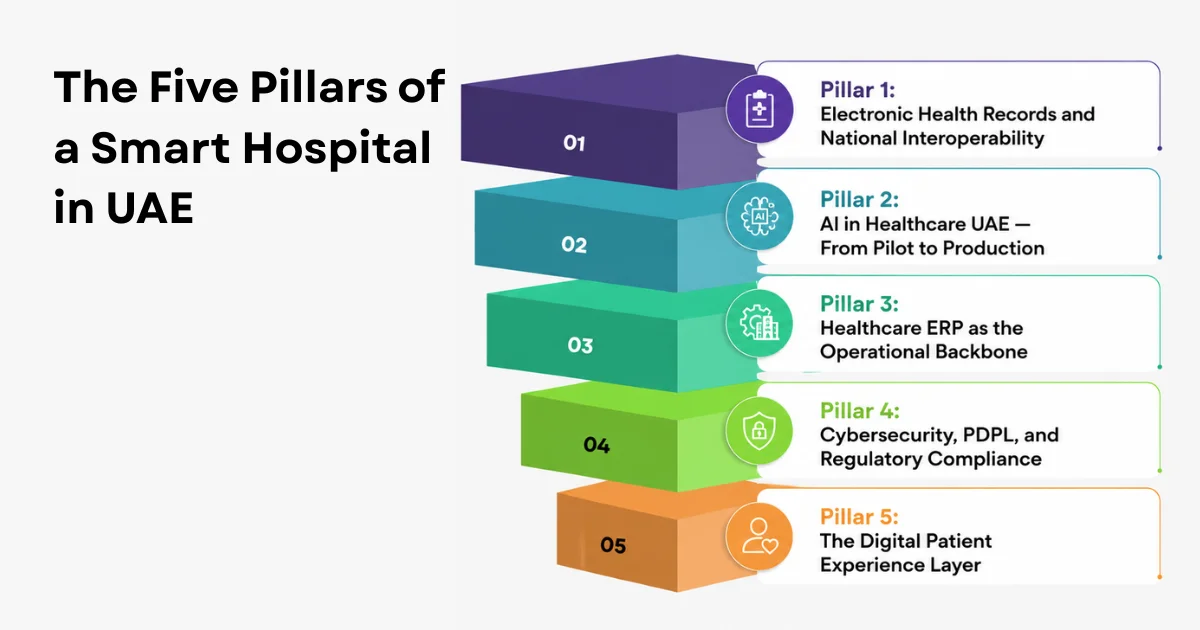
Every serious hospital digital transformation program we've seen work in this market — regardless of hospital size — rests on the same five pillars. Skip one, and the rest underperform. Think of these five pillars as the practical translation of "healthcare digital transformation" from a strategy buzzword into an actual build plan a UAE hospital's IT and clinical leadership can execute against, phase by phase, without losing sight of how the pieces connect to each other.
Pillar 1: Electronic Health Records and National Interoperability
This is the foundation, and it's the one regulators check first. Electronic health records UAE-wide are no longer a single-hospital decision — every EMR has to speak the language of Malaffi in Abu Dhabi, NABIDH in Dubai, or Riayati at the federal level, using standardized coding systems like SNOMED CT and LOINC.
That standardization work is further along than most hospital IT leads assume. Malaffi alone pushed LOINC adoption for lab results from 12% to more than 85% by mid-2025 — a jump that took real engineering effort across hundreds of facilities, not a policy memo. If your hospital's EMR still exports lab data in a proprietary format, you're already behind the standard your peers are operating at.
The practical challenge for most hospital groups isn't choosing an EMR — it's making legacy systems, sometimes fifteen years old, meet a modern interoperability standard without ripping out everything at once. That's where a properly architected Hospital Information Systems UAE approach earns its keep: modular upgrades that bring old infrastructure up to NABIDH/Malaffi compliance without a disruptive full replacement.
Snippet-ready fact: As of 2026, Malaffi connects 100% of Abu Dhabi hospitals and NABIDH is a hard licensing prerequisite for Dubai facilities — meaning electronic health records UAE compliance is now tied directly to a hospital's legal right to operate.
Why the Coding Standards Underneath Your EMR Actually Matter
It's easy to treat SNOMED CT and LOINC as background technical detail that only your IT team needs to care about. That's a mistake. These coding systems are what allow a lab result generated at one hospital to be understood — not just transmitted, but actually understood in a clinically meaningful way — by a completely different system at another facility. Without standardized coding, "interoperability" is really just file transfer: data moves, but nothing on the receiving end can reliably interpret it.
This is also where a lot of legacy electronic health records UAE-based hospitals still run into trouble. A system built a decade ago on proprietary internal codes can technically export a file to NABIDH or Malaffi, but if that file doesn't map cleanly to SNOMED CT or LOINC, the receiving hospital's clinicians end up seeing garbled or incomplete data — which defeats the entire purpose of the exchange and creates its own patient-safety risk. This is precisely the kind of gap a Hospital Information Systems UAE upgrade needs to close before a hospital can claim genuine interoperability rather than technical connectivity on paper.
Pillar 2: AI in Healthcare UAE — From Pilot to Production
AI in healthcare UAE stopped being a proof-of-concept exercise around 2025. It's now embedded in daily clinical workflow at leading facilities, and the results are measurable, not theoretical.
A few examples worth knowing, because your board will ask about them:
- Sepsis prediction. UAE providers began deploying AI-based sepsis prediction systems in 2026 that flag risk up to six hours earlier than traditional clinical assessment — a window that directly reduces ICU escalation and mortality risk.
- Diabetes risk scoring. Dubai's EJADA AI platform has analyzed millions of health records to flag high-risk diabetes patients early, cutting the downstream cost of late-stage treatment.
- Robotic surgery. Major Dubai hospitals — including Dubai Hospital, Mediclinic City Hospital, and Rashid Hospital — have expanded robotic surgery programs reporting 99.1% clinical success rates in complex cardiac procedures and a 95% reduction in operator radiation exposure.
- Administrative automation. Agentic AI chatbots are now booking appointments, updating records, and routing patient requests across departments via WhatsApp and other channels — reducing front-desk load in facilities across Dubai, Abu Dhabi, and Sharjah.
None of this happens without regulatory sign-off, though. The DHA published a dedicated AI policy for healthcare back in September 2021 and has since built out a formal compliance pathway that any hospital-based AI tool must pass — covering clinical validation, data governance, and DHA-specific review before go-live. Hospitals that skip this step, or bolt AI onto an unvalidated pipeline, are the ones that end up in compliance trouble a year later.
If your organization is scoping its first serious clinical AI deployment, it's worth reviewing what a validated, DHA-aligned build actually looks like end to end — we've broken that down in detail in our guide to AI in healthcare.
It's also worth zooming out on why this matters commercially, not just clinically. The Middle East's medical robotics sector alone is projected to grow from roughly USD 626 million in 2024 to more than USD 811 million by 2028, and PwC Middle East estimates AI could contribute up to USD 320 billion to the regional economy by 2030, with healthcare leading that adoption curve. Hospitals positioning themselves for medical tourism — a segment the UAE actively courts as part of its economic diversification strategy — are finding that AI-enabled surgical precision and documented clinical outcomes are becoming a competitive differentiator patients research before choosing where to travel for treatment, not just a back-office efficiency play.
Pillar 3: Healthcare ERP as the Operational Backbone
Clinical systems get the attention, but the operational backbone is where most hospitals bleed money silently — procurement delays, mismatched staffing against patient volume, inventory that expires unused, billing that doesn't reconcile with insurance claims.
A modern healthcare ERP for UAE hospitals unifies finance, HR, supply chain, and asset management with the clinical layer, so a spike in admissions automatically triggers procurement alerts and staffing recommendations instead of a manual scramble. This is especially critical in the UAE's mixed public-private-insurance model, where claims accuracy directly affects cash flow and where 98% insurance coverage means billing errors compound fast across a huge patient volume.
We go deep on exactly how to structure this in our dedicated resource: Healthcare ERP for UAE Hospitals, which walks through module selection, integration sequencing, and common budget traps.
The sequencing question comes up in nearly every ERP conversation we have with hospital finance leads: should procurement, HR, or billing modules go live first? In our experience across UAE hospital groups, billing and claims reconciliation should almost always come first, because it's the module with the most direct, measurable cash-flow impact and the clearest baseline to measure improvement against. Procurement and staffing modules follow once the billing data is clean enough to actually forecast demand from, since a procurement system fed by inaccurate claims data just automates the wrong decisions faster.
A properly integrated healthcare ERP also becomes the operational layer that makes hospital digital transformation visible to non-clinical stakeholders — a hospital board member who never touches the EMR will absolutely notice when procurement stockouts disappear or when monthly close takes three days instead of three weeks.
Insurance and Claims: The Overlooked ROI Driver
There's a specific reason claims accuracy deserves its own callout inside the ERP pillar, rather than being treated as a generic finance detail. With roughly 98% insurance coverage across the UAE population, nearly every patient interaction eventually becomes a claims transaction — which means a hospital's ERP and billing accuracy directly shapes both its own cash flow and its relationship with major payers like Daman and other national insurers. A hospital running healthcare digital transformation initiatives that don't extend cleanly into claims coding and submission accuracy tends to see denials and payment delays that quietly offset the clinical-side gains from EHR and AI investment. Getting this pillar right isn't just an efficiency play — it's often the fastest-measurable proof point a hospital can show its board that the broader digital hospital transformation program is working as intended.
Pillar 4: Cybersecurity, PDPL, and Regulatory Compliance
This pillar is where digital hospital transformation UAE-wide gets legally serious, and it deserves its own full section below — but the short version: health data in the UAE must be stored within the country and retained for 25 years under sectoral health regulations, sits outside general PDPL exemptions in some respects, and carries some of the highest fine tiers in the federal data protection framework. Get this wrong, and the financial exposure dwarfs the cost of doing the interoperability work properly in the first place.
Pillar 5: The Digital Patient Experience Layer
Everything above is invisible to the patient — and that's the point. What the patient sees is the front door: online booking, WhatsApp-based triage, multilingual discharge instructions generated from the EHR, wearable-linked remote monitoring, and a portal that actually reflects what happened in their last visit instead of a static PDF.
Patient-facing digital tools are also where hospitals see the fastest, most visible ROI — not because they're the most technically complex layer, but because patients notice them immediately and insurers reward lower no-show and readmission rates that better engagement produces.
Building this properly requires the underlying systems to already be in sync — which is why hospitals investing in healthcare software Dubai builds tend to sequence the patient experience layer after the EHR and interoperability work, not before it. Building a shiny app on top of fragmented back-end data just creates a nicer-looking version of the same problem.
The UAE's patient population also makes this pillar more complex than in most markets. A single hospital might see patients across a dozen languages and vastly different health-literacy levels within the same day, alongside a growing medical-tourism segment that expects the same digital convenience they'd get from a private hospital in Singapore or Germany. That's part of why generative AI-drafted, multilingual discharge instructions have moved from novelty to near-standard practice at leading UAE facilities — they cut documentation time for clinicians while actually improving patient comprehension of after-care instructions, which measurably reduces avoidable readmissions.
Medical Tourism and the Smart Hospital Advantage
There's a commercial angle to smart hospital UAE positioning that's easy to miss if you only think about digital hospital transformation as a compliance exercise. The UAE actively courts medical tourism as part of its broader economic diversification strategy, and patients evaluating where to travel for elective or complex procedures increasingly research a hospital's technology credentials alongside its surgeon credentials.
A hospital that can point to NABIDH or Malaffi connectivity, AI-assisted diagnostic accuracy, and participation in initiatives like Abu Dhabi's intelligent surgical network has a genuinely different story to tell an international patient than one still running paper-adjacent processes. This is one of the less-discussed reasons hospital digital transformation in the UAE has moved so fast compared to many other markets: it's not purely a domestic patient-care initiative, it's also a competitiveness play in a region where Dubai, Abu Dhabi, and increasingly Saudi Arabia are all racing to become the region's preferred medical tourism destination.
For hospital marketing and business development teams, this means digital healthcare transformation UAE-wide isn't just an IT department's project — it's a commercial asset that belongs in patient-facing communications, international partnership conversations, and medical tourism positioning, not buried in a back-office systems upgrade nobody outside IT ever hears about.
Legacy Hospital vs. Digitally Transformed Hospital: A Side-by-Side Comparison
Use this table as a quick internal audit. Most UAE hospitals sit somewhere in the middle — the goal is moving every row to the right column.
|
Dimension |
Legacy / Partially Digitized Hospital |
Digitally Transformed Smart Hospital |
|
Patient records |
Siloed EMR, manual re-entry between departments |
Fully NABIDH/Malaffi/Riayati-connected, single patient view |
|
Diagnostics |
Manual review, retrospective reporting |
AI-assisted diagnostics with predictive alerts (e.g., sepsis 6-hour early warning) |
|
Operations & supply chain |
Spreadsheet-based procurement, reactive staffing |
Integrated healthcare ERP with predictive demand planning |
|
Compliance |
Manual audits, reactive breach response |
Continuous PDPL/DHA compliance monitoring, automated audit trails |
|
Patient engagement |
Phone-based booking, static discharge paperwork |
WhatsApp/chatbot triage, multilingual AI-generated discharge instructions |
|
Data breach exposure |
High — legacy systems, inconsistent access controls |
Reduced — encrypted, access-logged, localized data storage |
|
Decision-making |
Retrospective monthly reporting |
Real-time dashboards feeding clinical and operational decisions |
|
Licensing risk |
Exposed — non-compliant EMR blocks renewal |
Secured — certified EMR meets Nabidh Minimum Data Set requirements |
If more than half of your hospital's rows still sit in the left column, that's not a five-year problem — under current DHA and DoH licensing rules, it's closer to an eighteen-month problem.
Case Study: What a Real UAE Interoperability Rollout Looks Like
Abu Dhabi's Malaffi rollout is the clearest public example of what disciplined execution looks like at scale, and it's worth studying regardless of which emirate your hospital operates in.
The starting problem: Abu Dhabi's healthcare ecosystem was fragmented across 3,000+ facilities running more than 90 different EMR systems, none of which talked to each other. A patient moving between a private clinic and a public hospital effectively started their medical history from zero each time.
The execution: Abu Dhabi Health Data Services, operating Malaffi as a public-private partnership with the Department of Health, connected 100% of Abu Dhabi-based hospitals within roughly three years of launch — a timeline the platform's own CEO described as a major accomplishment precisely because of how fragmented the starting point was. LOINC adoption for lab data alone went from 12% to over 85% of facilities in about two years, which meant standardizing lab result formats across nearly a hundred different legacy systems without shutting any of them down mid-transition.
The result today: Malaffi holds more than 559 million unique clinical records, serves roughly 39,600 clinicians, and — critically — feeds directly into the federal Riayati platform, so a patient's Abu Dhabi history is visible in Dubai and vice versa where consent allows it.
Why this matters for your hospital's roadmap: the lesson isn't "adopt Malaffi" — it's that a phased, standards-first approach (get the coding systems aligned before chasing flashy front-end features) is what actually got 100% adoption across a genuinely fragmented starting point. Hospitals that try to build AI and patient-facing apps before their underlying data is standardized tend to stall exactly where Abu Dhabi's ecosystem didn't — at the interoperability layer.
How These National Platforms Actually Get Funded
One detail hospital finance teams often ask about: neither Malaffi nor NABIDH was built purely as a government IT project. Malaffi, for instance, is operated by Abu Dhabi Health Data Services as a public-private partnership with the Department of Health – Abu Dhabi, now under the M42 umbrella. That structure matters for hospital groups, because it signals these platforms are built to run as long-term operational infrastructure with commercial accountability, not a one-off grant-funded pilot that might lose momentum after a few years. Hospitals investing in their own NABIDH or Malaffi integration are plugging into infrastructure designed for permanence, which is part of why treating the connection as optional or temporary is such a costly miscalculation.
A Second Case Study: Abu Dhabi's Intelligent Surgical Network
If the Malaffi rollout shows what disciplined interoperability looks like, Abu Dhabi's newest initiative shows where the ecosystem goes once that foundation is in place. In May 2026, the Department of Health – Abu Dhabi, in collaboration with Johnson & Johnson, launched what it describes as the world's first AI-driven intelligent surgical network, connecting operating rooms across Cleveland Clinic Abu Dhabi, PureHealth, Mediclinic Group, and NMC Healthcare.
The network gives surgical teams shared, real-time access to advanced analytics and clinical insights at the point of care — meaning a surgeon at one hospital group can draw on a governed dataset built from procedures across competing hospital networks, something that would have been organizationally unthinkable without the interoperability groundwork Malaffi laid years earlier. Dr. Noura Khamis Al Ghaithi, Undersecretary of the Department of Health – Abu Dhabi, framed the initiative as leveraging "intelligent infrastructure" the emirate had already built to raise the standard of surgical care for both residents and the growing medical tourism population Abu Dhabi serves.
This isn't an isolated headline. It follows Cleveland Clinic Abu Dhabi's own reported progress with robotics and AI, including a transcontinental robotic-assisted focal therapy procedure completed in under an hour, with a specialist collaborating in real time from thousands of miles away. Together, these examples make the same point from two different angles: a smart hospital UAE-wide isn't a single facility's achievement anymore — it's what happens when several competing hospital groups agree to share a governed, interoperable data layer under one regulator's oversight. That's the direction every hospital digital transformation program in this market should be designed toward, even if your own facility isn't part of a headline initiative yet.
The Legal and Security Stakes of Getting This Wrong
This is the section most digital transformation content skips, and it's the one your board and legal counsel actually need.
Healthcare data sits in the highest-risk tier of UAE data protection law. Here's the current regulatory and financial picture as of mid-2026:
|
Regulatory Element |
Detail |
|
Governing framework |
Federal PDPL (Decree-Law No. 45 of 2021), plus sector-specific DHA (Dubai) and DoH/HAAD (Abu Dhabi) healthcare data regulations |
|
Health data storage |
Must be stored within the UAE; retained for 25 years under separate healthcare regulations |
|
Breach notification |
De facto 72-hour standard, enforced by the UAE Data Office even ahead of formal executive regulations |
|
PDPL fine range |
AED 50,000 to AED 5 million (~USD 13,600–1.36 million) for general violations |
|
Sensitive data violations (includes health records) |
Fines can reach AED 20 million for serious breaches involving sensitive personal data processed without lawful basis |
|
Average breach cost, UAE businesses |
Estimated at AED 25–29 million per incident, per recent regional benchmarking, often driven more by regulatory penalty and legal exposure than the initial data loss |
|
AI-specific oversight |
DHA's dedicated AI healthcare policy (in effect since September 2021) requires clinical validation and DHA review before deployment of any AI tool touching patient care |
There's a nuance worth flagging plainly: general federal PDPL exemptions don't automatically cover health data — it's governed by its own sectoral rules layered on top, which is exactly why "we're PDPL compliant" is not the same statement as "we're DHA/DoH compliant." Hospitals that treat these as one checkbox instead of two separate compliance tracks are the ones that get flagged during license renewal.
The uncomfortable truth for hospital leadership: the financial risk of not transforming — inconsistent access logs, un-encrypted legacy systems, non-standardized EMR data that can't prove clean audit trails — now costs more than the transformation itself in almost every realistic scenario. A single serious breach involving patient health records can wipe out several years of IT budget in fines alone, before even counting reputational damage in a market where patients increasingly choose providers based on trust in data handling.
This is precisely why any serious digital transformation plan for a UAE hospital has to be built with compliance as a design requirement from day one, not a review step at the end. Partnering with a digital transformation company in UAE that understands PDPL, DHA, and DoH requirements simultaneously — rather than a generic IT vendor retrofitting compliance after the build — is the difference between a system that passes its first audit and one that needs a costly rebuild six months post-launch.
A Cybersecurity Checklist Specific to UAE Healthcare Data
Given the fine tiers and breach costs above, this is worth making concrete rather than abstract. At minimum, a hospital's cybersecurity architecture should be able to answer "yes" to each of these before go-live on any new digital system:
- Is all patient health data stored on servers physically located within the UAE, satisfying the sectoral data-localization requirement?
- Is there a documented, tested breach-response plan that can meet the 72-hour notification standard the UAE Data Office enforces in practice?
- Are access logs granular enough to prove, during an audit, exactly which staff member viewed which record and when?
- Does the retention policy account for the 25-year requirement specific to health records, rather than a shorter general-business retention default?
- Has the hospital run a VAPT (vulnerability assessment and penetration testing) exercise or tabletop breach drill in the last 12 months, as UAE guidance recommends annually at minimum?
- Is there a clear internal owner — formally appointed or acting as a virtual data protection lead — responsible for PDPL and DHA/DoH compliance specifically, not just general IT security?
Measuring Success: KPIs for Hospital Digital Transformation
Boards need numbers to track, not just phases to approve. These are the KPIs we recommend hospital leadership review quarterly once a digital hospital transformation program is underway:
|
KPI Category |
Specific Metric |
Why It Matters |
|
Interoperability |
% of patient records successfully exchanged via NABIDH/Malaffi without manual re-entry |
Direct measure of whether Phase 2 is actually complete, not just claimed complete |
|
Clinical AI |
Time-to-detection for priority conditions (e.g., sepsis risk flagged pre- vs. post-AI) |
Validates that predictive tools are delivering the clinical lead-time they're designed for |
|
Operational |
Days sales outstanding (DSO) on insurance claims |
Tracks whether ERP integration is actually improving cash flow, not just automating existing delays |
|
Compliance |
Number of PDPL/DHA audit findings per review cycle |
Leading indicator of licensing risk well before a renewal deadline |
|
Patient experience |
No-show rate and average patient portal engagement |
Reflects whether the patient-facing layer is actually being adopted, not just deployed |
|
Workforce adoption |
% of clinical staff using the new EMR/AI tool as intended vs. workaround rate |
Surfaces the change-management gap before it shows up as failed ROI a year later |
Reviewing this table quarterly, rather than only at project milestones, is what separates hospital groups that catch a stalling rollout early from those that discover it during a license renewal review.
A Practical 2026–2027 Roadmap for UAE Hospitals
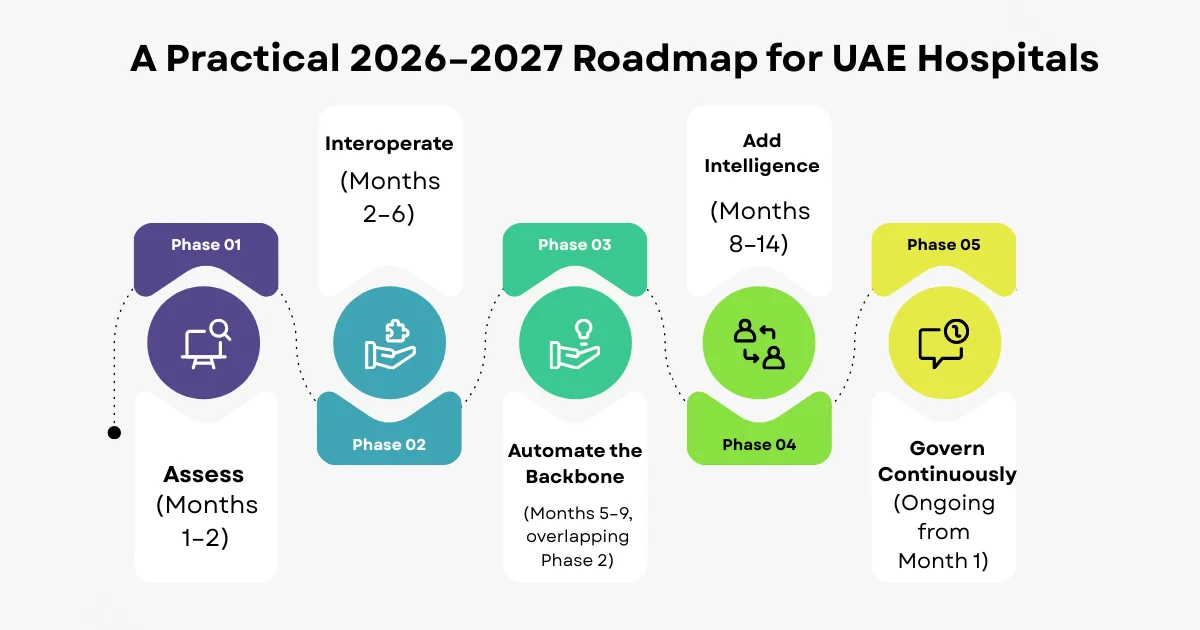
Here's the sequence we recommend to hospital groups, in the order that actually reduces risk instead of just adding technology on top of technology.
Phase 1 — Assess (Months 1–2) Audit every system currently in use against NABIDH Minimum Data Set standards or Malaffi/DoH equivalents. Identify which EMR components are certified, which aren't, and where PDPL/DHA data-storage requirements are already violated. This phase produces a gap report, not a purchase order — resist the urge to buy software before this is done.
Phase 2 — Interoperate (Months 2–6) Bring your EMR up to national platform compliance (NABIDH, Malaffi, or Riayati depending on emirate), standardize coding to SNOMED CT/LOINC, and establish the single sign-on and consent protocols regulators require. This is unglamorous work, and it's also the single highest-leverage phase — everything downstream depends on it.
Phase 3 — Automate the Backbone (Months 5–9, overlapping Phase 2) Deploy or upgrade your healthcare ERP so procurement, staffing, and billing are wired into real clinical demand data rather than static schedules. This phase typically delivers the fastest visible operational savings.
Phase 4 — Add Intelligence (Months 8–14) Introduce AI use cases in priority order: predictive risk scoring (sepsis, diabetes, cardiac) first, since these have the clearest clinical evidence base in the UAE market; administrative chatbots second, since they reduce load quickly with lower clinical risk; diagnostic imaging AI and robotic-assisted procedures last, since they carry the heaviest DHA validation requirements.
Phase 5 — Govern Continuously (Ongoing from Month 1) This isn't a phase that comes after the others — compliance monitoring, breach-response drills, and DHA/PDPL audit trail generation need to run in parallel with every phase above, not bolted on afterward.
The Cost of Waiting: What Delaying Digital Transformation Actually Costs
It's worth being blunt about the alternative to the roadmap above, because "we'll get to it next year" is the most common response hospital IT leads hear from boards still weighing the budget.
Delaying interoperability work doesn't freeze your hospital's risk in place — it compounds it. Every month a facility runs a non-NABIDH or non-Malaffi-compliant EMR is another month closer to a license renewal review that could stall on exactly that gap. Every quarter without a tested breach-response plan is another quarter of exposure to fines that can reach AED 20 million for a single serious sensitive-data violation. And every year a hospital delays AI adoption is another year competitors — including the multi-hospital-group collaborations like Abu Dhabi's intelligent surgical network — pull further ahead on the clinical outcomes and patient-trust data that increasingly influence where patients, insurers, and medical tourists choose to go.
None of this means rushing. It means recognizing that "wait and see" isn't actually a neutral option in a market where digital healthcare transformation has become a regulatory floor, not a competitive ceiling.
Budgeting Realistically Across the Five Phases
A common planning mistake is allocating budget as if these phases are equal in cost. In practice, Phase 2 (interoperability) typically consumes the largest single share of a first-year digital transformation budget, because it involves reworking legacy data structures rather than adding a new visible feature — and it's also the phase boards are most tempted to underfund because it produces the least visible, demo-able output. Hospital leadership teams that protect this phase's budget instead of trimming it are consistently the ones whose Phase 4 AI initiatives perform as expected, rather than underperforming on messy underlying data.
Build, Buy, or Partner? Choosing the Right Delivery Model
Most UAE hospital groups land on one of three delivery models for this roadmap, and each has a different risk profile:
- Build in-house: Works only for large hospital groups with an existing internal engineering team and deep DHA/DoH regulatory expertise already on staff. Slower to start, but retains full architectural control.
- Buy an off-the-shelf platform: Fastest to deploy, but many international EMR and ERP platforms weren't built with NABIDH/Malaffi/Riayati compliance or PDPL data-localization requirements in mind, which often means expensive customization after the fact anyway.
- Partner with a UAE-focused healthcare technology specialist: Combines speed with regulatory fit, since the compliance architecture is designed in from the start rather than retrofitted. This is the model most mid-sized and multi-facility hospital groups in the UAE have converged on, precisely because it avoids re-doing Phase 2 a second time after a generic platform fails its first DHA review.
The ROI Case for Hospital Digital Transformation
Numbers hospital boards respond to:
- The UAE digital health market's 23%+ CAGR isn't abstract — it reflects real provider spend shifting from paper-based and siloed systems toward interoperable, AI-enabled infrastructure, meaning competitors are already capturing efficiency your hospital hasn't yet.
- Early sepsis detection at six hours ahead of traditional methods translates directly into shorter ICU stays and lower mortality-related liability exposure — a clinical outcome with a direct financial shadow.
- A 95% reduction in operator radiation exposure during robotic cardiac procedures reduces long-term occupational health liability for surgical staff, an often-overlooked cost center.
- Avoiding even one serious PDPL/DHA sensitive-data breach (average regional cost AED 25–29 million) pays for a multi-year interoperability and cybersecurity upgrade many times over.
- Reduced front-desk administrative load from chatbot-based booking and triage frees clinical staff hours that can be redirected to patient care in a market already facing provider shortages.
The pattern across every credible UAE case study is the same: the return isn't a single line item — it's the compounding effect of fewer manual errors, faster claims cycles, lower breach risk, and better clinical outcomes hitting the P&L simultaneously.
|
Investment Area |
Typical Driver of Return |
Timeframe to See Impact |
|
Interoperability (NABIDH/Malaffi compliance) |
Avoided licensing risk, reduced duplicate testing, faster referrals |
6–12 months |
|
Healthcare ERP |
Procurement accuracy, staffing efficiency, faster claims reconciliation |
3–9 months |
|
Predictive AI (sepsis, diabetes, cardiac risk) |
Shorter ICU stays, earlier intervention, reduced liability exposure |
9–18 months |
|
Cybersecurity & PDPL compliance |
Avoided breach fines (up to AED 20M) and audit-driven license risk |
Immediate risk reduction; financial return realized only if a breach is avoided |
|
Patient experience layer (chatbots, portals) |
Lower no-show rates, reduced front-desk load, higher patient satisfaction scores |
3–6 months |
Read that table the way a CFO would: the fastest visible wins sit in ERP and patient experience, but the largest avoided losses sit in interoperability compliance and cybersecurity — which is exactly why hospitals that only chase the visible wins and skip the compliance foundation tend to look successful for a year, then face a licensing or breach event that erases the gains.
Public Hospitals vs. Private Hospitals: Different Starting Points, Same Endpoint
It's worth separating public and private hospital groups here, because their starting points for digital healthcare transformation in the UAE genuinely differ, even though the regulatory endpoint — full NABIDH/Malaffi/Riayati compliance, PDPL alignment, DHA-approved AI — is identical for both.
Public sector facilities under Emirates Health Services or Abu Dhabi's public health network typically move as part of a coordinated, government-directed rollout, which gives them clearer top-down mandates but often less flexibility to move faster than the broader program allows. Private hospital groups — the Burjeels, Mediclinics, and NMCs of the market — usually have more autonomy to move quickly on interoperability and AI, but also carry more direct commercial exposure if they get the sequencing wrong, since a licensing delay or a compliance failure hits a private group's revenue and reputation in a way a public facility's funding structure partially absorbs.
The practical implication for hospital digital transformation planning: private groups should treat speed as an advantage worth protecting, prioritizing the phased roadmap above rather than trying to shortcut interoperability to reach AI faster. Public facilities, meanwhile, benefit from aligning their internal transformation timeline closely with EHS or DoH-wide initiatives, since moving in lockstep with the broader national platform reduces the risk of building something that has to be re-worked once the next phase of a national program rolls out.
Common Mistakes UAE Hospitals Make
Across the hospital groups we've worked with on digital hospital transformation projects in the UAE, the same handful of mistakes show up again and again — often made by teams with good intentions and reasonable budgets, but the wrong sequencing.
Buying AI before fixing interoperability. A predictive model is only as good as the data feeding it. Hospitals that deploy AI diagnostics on top of fragmented, non-standardized EMR data get unreliable outputs and, worse, DHA compliance headaches during review.
Treating PDPL and DHA/DoH compliance as one checklist. They overlap, but they're legally distinct requirements. Passing one audit doesn't guarantee passing the other.
Underestimating the ERP layer. Clinical transformation gets the budget attention; operational systems — procurement, staffing, billing — get left on legacy software, which quietly erodes the efficiency gains from the clinical side.
Building patient apps before the back end is ready. A polished patient portal pulling from an unstandardized EMR just makes data inconsistency visible to patients faster.
No continuous governance model. Compliance treated as a pre-launch checkbox instead of an ongoing operational discipline is the single most common reason hospitals fail license renewal reviews.
Skipping the change management budget entirely. Hospitals that fund the software but not the training pathway consistently see clinical staff revert to manual workarounds within weeks of go-live, quietly undermining the entire business case for the investment.
Choosing a vendor that hasn't actually navigated DHA or DoH review before. A platform built for the US or UK market and localized for the UAE afterward tends to hit avoidable friction at the exact review stage that determines whether a hospital can go live on schedule. Local regulatory experience isn't a nice-to-have line item on an RFP — it's the difference between a six-month delay and a smooth launch.
Ignoring the Northern Emirates in a Dubai/Abu Dhabi-centric plan. Riayati connects more than 3,000 facilities nationwide, including Sharjah, Ajman, Fujairah, Ras Al Khaimah, and Umm Al Quwain. Hospital groups with a footprint across multiple emirates that only architect for NABIDH or Malaffi individually often find their Northern Emirates facilities become the weak link in an otherwise compliant network.
A Quick Glossary: The Entities That Actually Matter
Because this space is thick with acronyms, here's a fast reference for anyone new to the UAE's healthcare digital transformation landscape:
|
Term |
What It Actually Is |
|
NABIDH |
Dubai's health information exchange platform, operated under the Dubai Health Authority; mandatory for facility licensing in Dubai |
|
Malaffi |
Abu Dhabi's health information exchange, operated by Abu Dhabi Health Data Services under the Department of Health – Abu Dhabi; connects 100% of Abu Dhabi hospitals |
|
Riayati |
The UAE's federal National Unified Medical Record (NUMR) program, integrating NABIDH and Malaffi nationwide, including the Northern Emirates |
|
PDPL |
The UAE's Federal Personal Data Protection Law (Decree-Law No. 45 of 2021), covering general data protection obligations, with health data further governed by sector-specific rules |
|
DHA |
Dubai Health Authority — the regulator for Dubai's healthcare sector, including its own dedicated AI-in-healthcare policy |
|
DoH |
Department of Health – Abu Dhabi — the regulator for Abu Dhabi's healthcare sector, overseeing Malaffi and initiatives like the intelligent surgical network |
|
SNOMED CT / LOINC |
International clinical coding standards used to standardize diagnoses, procedures, and lab results across different EMR systems so they can be exchanged meaningfully |
Why Hospitals Are Partnering With SISGAIN
Most vendors in this market can sell you an EMR module or a chatbot. Fewer can architect the full stack — interoperability, ERP, AI, and compliance — as one connected system built specifically around UAE regulatory requirements rather than adapted from a Western template after the fact.
That's the gap SISGAIN works in. Whether a hospital group needs a Custom Healthcare IT Solutions In UAE build from the ground up, a legacy Hospital Information System brought up to NABIDH/Malaffi compliance, or a targeted healthcare software development in Dubai engagement for a specific patient-experience or ERP module, the approach stays the same: compliance and interoperability as the foundation, not an afterthought bolted on before an audit.
If your hospital is at the assessment stage — trying to figure out where you actually stand against NABIDH, Malaffi, PDPL, and DHA AI policy requirements before committing budget — that's the right starting conversation to have, and it's one we have with hospital leadership teams across the UAE regularly.
What tends to differentiate that first conversation is specificity. Instead of a generic digital transformation pitch, hospital leadership teams get a direct answer to questions like: which of your current systems would fail a NABIDH or Malaffi compliance review today, what would it cost in time and budget to close that gap, and which AI use cases are actually ready for your patient population versus which ones need another 12 months of data cleanup first. That's the level of detail hospital digital transformation planning actually requires in this market — general best-practice advice doesn't hold up against a DHA or DoH review, but a plan built around your specific facility's current systems does.
What to Look for When Choosing a Healthcare Technology Partner in the UAE
If you take one action item away from this guide, make it this checklist. Run any prospective vendor or partner through it before signing anything:
- Do they have documented experience taking an EMR through actual NABIDH or Malaffi certification — not just claiming "interoperability support" in a sales deck?
- Can they show a PDPL and DHA/DoH compliance framework as a starting design principle, rather than a phase they add once your legal team raises concerns?
- Do they understand the difference between a hospital information system and a healthcare ERP, and can they sequence both without one blocking the other?
- Have they built or integrated AI tools that passed DHA's AI-in-healthcare policy review, including the clinical validation documentation regulators expect?
- Do they localize data storage within the UAE by default, given the 25-year retention requirement for health records?
- Can they name specific UAE hospital groups or facility types they've worked with, rather than only citing generic international healthcare clients?
A partner who can answer all six confidently, with specifics rather than generalities, has almost certainly done this work before — which matters more in this market than in almost any other healthcare IT market globally, because the regulatory bar here is unusually well-defined and unusually enforced.
Conclusion
The UAE isn't asking hospitals whether to transform digitally anymore — the licensing requirements, the interoperability mandates, and the AI compliance frameworks have already answered that question. What's left is execution: getting the sequencing right, treating compliance as infrastructure rather than paperwork, and building a system where electronic health records, AI, ERP, and patient experience all reinforce each other instead of sitting in separate silos.
Hospitals that get this sequencing right in the next 12–18 months will be the ones setting the standard the rest of the market gets measured against. Hospitals that don't will be explaining data gaps to regulators instead of improving patient outcomes.
To recap the thread running through this entire guide: digital hospital transformation UAE-wide starts with interoperable electronic health records, gets its operational muscle from a properly integrated healthcare ERP, earns its "smart hospital" label through validated AI in healthcare UAE use cases, and only stays viable long-term if PDPL and DHA/DoH compliance are designed in from the start rather than patched on afterward. Healthcare digital transformation in this market isn't one project — it's an operating discipline your hospital either builds now, on its own terms, or gets forced into later, on a regulator's timeline.
If you're mapping out where your hospital stands against NABIDH, Malaffi, PDPL, and DHA AI requirements — or you're ready to move from assessment into execution — SISGAIN works with UAE hospital groups on exactly this: architecting the full stack, not just selling a module. Talk to our healthcare IT team about where your hospital's transformation roadmap should start.