
The Moment Dubai's Healthcare Leaders Cannot Afford to Miss
The pressure on healthcare executives in Dubai has never been greater. Patient volumes are climbing. Regulatory requirements are tightening. Staff burnout is a persistent challenge. And patients — more informed and more demanding than ever — expect faster diagnoses, seamless digital experiences, and personalized care.
At the same time, something significant is happening. Hospitals and clinics across Dubai are quietly deploying artificial intelligence and changing what healthcare operations look like from the inside out. Diagnostic errors are being caught earlier. Administrative workloads are shrinking. Patient wait times are dropping. And healthcare organizations that made the investment two or three years ago are now seeing measurable returns.
The UAE healthcare market is projected to surpass $22 billion in value, and AI is a central driver of that growth. The government has made its priorities clear — the UAE National AI Strategy, Dubai Health Authority's smart healthcare programs, and the country's AI charter all signal that artificial intelligence is not a future consideration for Dubai healthcare. It is a present reality.
If you are a hospital owner, healthcare CEO, CIO, medical director, or investor trying to understand what AI actually means for your organization — what it costs, what it delivers, and how to implement it responsibly — this article is built for you.
You will learn what AI in healthcare Dubai looks like in practice across ten real-world applications, how much it costs to build, how to implement it step by step, how to navigate the challenges, and what the next five years will bring. Let's get into it.
What Is AI in Healthcare?
Featured Snippet Answer: AI in healthcare refers to the use of machine learning, natural language processing, computer vision, and predictive analytics to automate clinical and administrative tasks, support diagnostic decisions; personalize treatment; and improve patient outcomes—enabling healthcare organizations to operate more efficiently and deliver higher-quality care.
Breaking Down the Core Technologies
Machine Learning allows systems to learn from historical patient data and improve accuracy over time without being manually reprogrammed. In healthcare, ML powers everything from early disease detection to insurance fraud identification.
Generative AI creates new content — clinical summaries, discharge notes, treatment recommendations — by learning from large datasets. Healthcare organizations are using it to reduce documentation burden and support clinical communication.
Natural Language Processing (NLP) enables machines to read, understand, and generate human language. NLP drives medical transcription, patient chatbot interactions, and clinical note analysis.
Predictive Analytics uses data patterns to forecast outcomes — whether a patient is at risk of readmission, which wards will experience high demand next week, or which patients need preventive interventions now.
Computer Vision enables AI to analyze medical images — X-rays, MRIs, CT scans — with a level of speed and consistency that complements radiologist expertise.
Why Dubai Is Becoming a Global Hub for Healthcare AI Innovation
Dubai's rise as a healthcare AI hub is not accidental. It is the product of deliberate policy, strategic investment, and a healthcare ecosystem built for scale.
The UAE National Strategy for Artificial Intelligence establishes a clear government commitment to making the UAE a global leader in AI by 2031. This includes healthcare as a priority sector. The UAE Charter for the Development and Use of AI, published by UAE legislation authority, provides an ethical and regulatory framework that gives healthcare organizations greater confidence in deployment.
The Dubai Health Authority (DHA) has been a particularly active driver of change. DHA launched an AI training program specifically designed to build internal capacity around smart healthcare transformation, covering AI, cybersecurity, and data strategy. Its EJADA AI system — a disease early-detection and prevention platform — has reported reducing the financial burden of diabetes management by approximately 30%, a meaningful data point for healthcare executives evaluating ROI.
Dubai's medical tourism economy adds another dimension. The city attracts hundreds of thousands of international patients annually, creating pressure to deliver world-class diagnostic accuracy, multilingual care, and seamless digital patient journeys — all areas where AI delivers a competitive edge.
The UAE's infrastructure — cloud connectivity, digital identity systems, and a tech-literate workforce — further removes barriers that slow AI adoption in less developed markets. For healthcare investors and decision-makers, Dubai is not just a place to deploy AI. It is one of the most fertile environments in the world to build and scale it.
10 Real-World Applications of AI in Healthcare Dubai
1. AI Diagnostics
Challenge: Diagnostic errors remain a leading cause of patient harm globally, and high patient volumes strain clinical attention.
How AI Solves It: AI diagnostic systems analyze patient symptoms, lab results, and medical history to surface differential diagnoses — reducing the chance of missed findings.
Business Impact: Faster, more accurate diagnoses reduce unnecessary testing, shorten patient stays, and lower liability risk.
Example Use Case: A multi-specialty hospital in Dubai integrates AI diagnostics into its emergency triage workflow, reducing time-to-diagnosis by a significant margin during peak hours.
2. Predictive Analytics
Challenge: Hospitals struggle to anticipate patient deterioration, readmissions, and resource demand.
How AI Solves It: Predictive models monitor real-time patient data and flag high-risk individuals before conditions escalate.
Business Impact: Proactive intervention reduces ICU admissions, costly readmissions, and emergency escalations.
Example Use Case: A cardiology department uses predictive analytics to identify patients at elevated risk of cardiac events within 48 hours — enabling pre-emptive care adjustments.
3. AI Telemedicine
Challenge: Geographic barriers and appointment backlogs limit access to specialist care.
How AI Solves It: AI-powered telemedicine platforms triage patients, automate appointment scheduling, and support physicians with pre-consultation clinical summaries.
Business Impact: Extended patient reach, reduced no-show rates, and more efficient specialist utilization.
Example Use Case: A Dubai-based telehealth platform uses AI to match patients with the right specialist, cutting average wait times from days to hours.
4. Hospital Management Systems
Challenge: Legacy hospital management systems are fragmented, manual, and expensive to maintain.
How AI Solves It: Intelligent hospital software consolidates scheduling, billing, inventory, staffing, and patient flow into a unified, AI-enhanced platform.
Business Impact: Significant reduction in administrative overhead and improved cross-departmental coordination. UAE Hospitals Are Investing in AI + HMS to modernize operations and align with DHA compliance requirements.
Example Use Case: A 300-bed hospital reduces procurement waste by 18% after implementing AI-driven inventory prediction.
5. AI Medical Chatbots
Challenge: Patient inquiries overwhelm front-desk staff and delay clinical triage.
How AI Solves It: Conversational AI handles appointment booking, symptom checking, prescription reminders, and FAQs — 24 hours a day.
Business Impact: Staff focus shifts to high-value clinical tasks while patient satisfaction scores improve.
Example Use Case: A polyclinic deploys an AI chatbot that handles 60% of inbound patient queries without human intervention, freeing nursing staff for direct care.
6. Remote Patient Monitoring
Challenge: Chronic disease patients between appointments are often invisible to their clinical teams.
How AI Solves It: Wearable-integrated RPM application development enables continuous monitoring of vitals, with AI alerting care teams to concerning changes in real time.
Business Impact: Reduced emergency visits, better medication adherence, and stronger patient-provider relationships.
Example Use Case: A diabetes management program monitors blood glucose levels remotely and triggers automated care team notifications when readings cross clinical thresholds.
7. Personalized Medicine
Challenge: Standard treatment protocols produce inconsistent outcomes across diverse patient populations.
How AI Solves It: AI analyzes genetic data, lifestyle factors, and clinical history to recommend individualized treatment plans.
Business Impact: Better therapeutic outcomes, fewer adverse drug reactions, and stronger patient trust.
Example Use Case: An oncology center in Dubai uses AI-driven genomics analysis to personalize chemotherapy protocols, improving response rates.
8. Medical Imaging
Challenge: Radiologist capacity cannot keep pace with imaging volume at major hospitals.
How AI Solves It: Computer vision models analyze X-rays, CT scans, and MRIs alongside radiologists — flagging abnormalities and prioritizing urgent cases.
Business Impact: Faster reporting turnaround, reduced radiologist burnout, and improved diagnostic confidence.
Example Use Case: An imaging center reduces reporting time from 48 hours to under 6 hours after deploying AI-assisted radiology tools.
9. Drug Discovery
Challenge: Drug development is slow, expensive, and high-risk.
How AI Solves It: Machine learning models screen molecular compounds, predict drug interactions, and identify promising candidates at a fraction of the time traditional methods require.
Business Impact: Lower R&D costs, faster time-to-market, and stronger partnership opportunities with pharmaceutical investors.
Example Use Case: A UAE-based life sciences startup uses AI platforms to narrow a field of 10,000 compounds to 50 viable drug candidates in weeks rather than years.
10. Workflow Automation
Challenge: Administrative tasks consume 30–40% of clinical staff time in many healthcare settings.
How AI Solves It: AI automates documentation, prior authorization, billing reconciliation, shift scheduling, and compliance reporting.
Business Impact: Lower operational costs, reduced staff attrition, and faster revenue cycle completion.
Example Use Case: A hospital group deploys AI-powered billing automation and reduces claim rejection rates by 22% within six months.
Benefits of AI in Healthcare
The business case for artificial intelligence in healthcare is no longer theoretical. Organizations that have implemented AI across clinical and operational functions are reporting meaningful, measurable gains.
- Better Outcomes: Earlier detection, reduced diagnostic errors, and personalized treatment deliver stronger clinical results.
- Faster Diagnosis: AI compresses the time between symptom presentation and confirmed diagnosis — especially critical in emergency and oncology settings.
- Lower Costs: Automation reduces unnecessary testing, minimizes readmissions, and streamlines revenue cycle management.
- Improved Efficiency: AI reduces the time clinical and administrative staff spend on repetitive, low-value tasks.
- Enhanced Patient Experience: Faster responses, 24/7 availability, and more personalized care improve patient satisfaction and retention.
- Resource Optimization: Predictive demand forecasting helps hospitals right-size staffing, bed availability, and supply inventory.
Traditional Healthcare vs. AI-Powered Healthcare
|
Dimension |
Traditional Healthcare |
AI-Powered Healthcare |
|
Diagnosis Speed |
Hours to days |
Minutes to hours |
|
Diagnostic Accuracy |
Dependent on individual clinician |
AI-augmented, consistently reviewed |
|
Patient Monitoring |
Scheduled appointments only |
Continuous, real-time monitoring |
|
Administrative Burden |
High — manual documentation |
Significantly reduced through automation |
|
Cost Management |
Reactive, volume-based |
Predictive, value-based |
|
Patient Communication |
Business hours, phone/email |
24/7 via AI chatbot and digital tools |
|
Data Utilization |
Siloed and underused |
Integrated and actionable |
|
Scalability |
Limited by staff capacity |
Highly scalable through technology |
How AI Is Transforming Different Healthcare Organizations
Hospitals are using AI to manage complex patient flows, reduce readmissions, optimize staffing, and support clinical decisions across multiple departments simultaneously.
Clinics benefit from AI in appointment management, patient triage, automated follow-ups, and chronic disease monitoring — enabling small teams to deliver high-quality care at greater scale.
Diagnostic Centers are deploying AI in medical imaging analysis, report generation, and equipment utilization scheduling — increasing throughput without increasing headcount.
Telemedicine Companies use AI to power patient matching, real-time clinical decision support, and multilingual patient interfaces — critical in Dubai's diverse, multinational patient population.
Healthcare Startups are building differentiated products on AI foundations — from mental health apps to remote monitoring platforms — and accessing global markets from Dubai's innovation-friendly ecosystem.
Home Healthcare Providers use AI-powered RPM platforms, medication management tools, and predictive alert systems to extend quality clinical care beyond the hospital walls.
Is Generative AI Replacing Doctors?
This is one of the most searched questions in healthcare technology right now. The direct answer is no — and the nuanced answer reveals something more interesting.
Generative AI is not replacing physicians. It is relieving them of the tasks that consume their time without using their expertise. Documentation. Prior authorizations. Summarizing patient histories. Drafting referral letters. These are tasks that AI handles well — and that consume a significant portion of a physician's day.
The question of whether is Generative AI Replacing Doctor? reflects an understandable concern about automation. But clinical judgment — built from years of training, patient interaction, ethical reasoning, and contextual understanding — cannot be replicated by a language model.
What AI does do is make physicians more effective. A radiologist supported by AI image analysis catches more anomalies in less time. An emergency physician with an AI-powered triage tool makes faster decisions with more complete information. A general practitioner using predictive analytics identifies at-risk patients before they deteriorate.
The ethical questions are real and worth discussing — bias in training data, accountability for AI-assisted decisions, and transparency in automated recommendations all require careful governance. But the answer to those questions is better regulation and more thoughtful implementation, not avoidance.
The future of healthcare is human-AI collaboration, not human-AI competition.
Challenges of Implementing AI in Healthcare Dubai
Understanding the obstacles is just as important as understanding the opportunities. These are the most common Dubai healthcare development services. Challenges that healthcare organizations face when implementing AI.
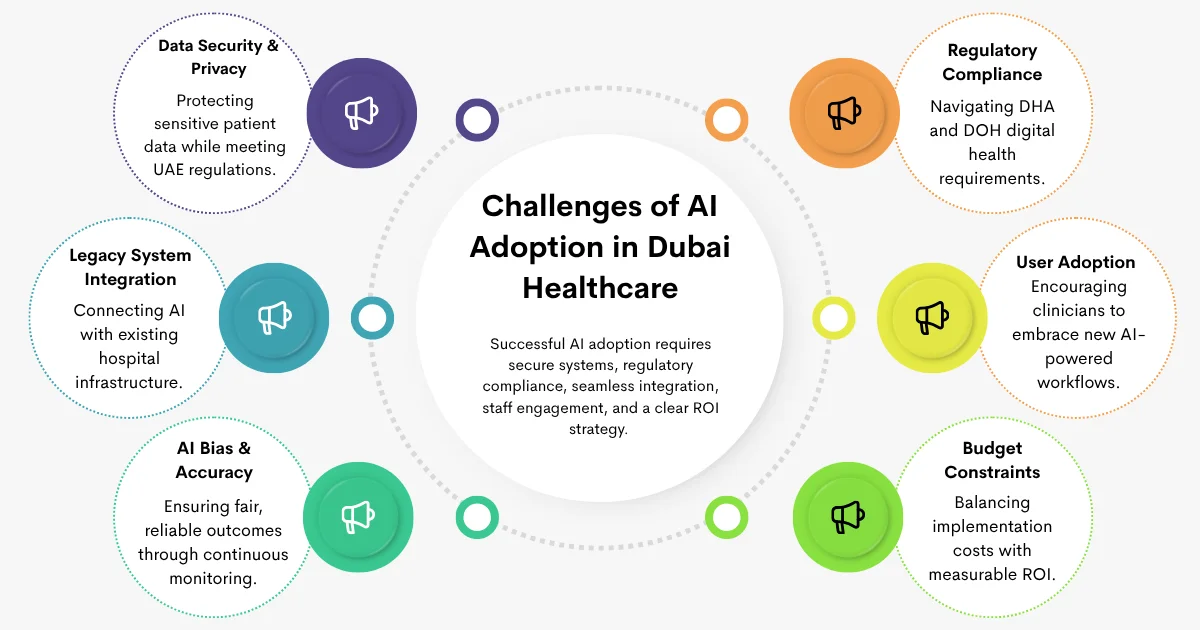
- Data Security and Privacy: Healthcare data is among the most sensitive information processed by any organization. Solutions include end-to-end encryption, role-based access controls, and compliance with UAE data protection regulations.
- Regulatory Compliance: DHA and DOH (Department of Health Abu Dhabi) have specific digital health regulations. Healthcare organizations must work with technology partners who understand the local regulatory landscape — not just international standards.
- Legacy System Integration: Many hospitals operate on aging infrastructure that was never designed to interface with modern AI systems. Middleware solutions and phased integration strategies can bridge this gap without requiring full system replacement.
- User Adoption: Clinical staff resistance is real. The solution is not top-down mandates but co-design — involving physicians and nurses in the development and testing process.
- AI Bias: If training data reflects historical disparities in patient care, AI models can perpetuate those disparities. Regular auditing and diverse training datasets are essential safeguards.
- Budget Constraints: AI implementation requires upfront investment. Starting with a high-impact, contained pilot — such as an AI chatbot or a predictive analytics module — allows organizations to demonstrate ROI before scaling.
How Much Does AI Healthcare Software Development Cost in 2026?
The AI development cost in 2026 varies significantly based on the complexity of the solution, the depth of integration required, and the regulatory compliance standards that must be met. Here is a realistic estimate for the UAE market.
|
Solution Type |
Estimated Development Cost (USD) |
Typical Timeline |
|
AI Medical Chatbot |
$15,000 – $40,000 |
2–4 months |
|
RPM Platform |
$40,000 – $90,000 |
4–7 months |
|
Telemedicine Platform |
$50,000 – $120,000 |
5–8 months |
|
AI Diagnostics System |
$80,000 – $180,000 |
6–12 months |
|
Hospital AI Platform |
$150,000 – $350,000+ |
9–18 months |
Factors affecting the software development cost include: the complexity of AI model training, the number of integrations with existing systems, the need for multilingual support (Arabic + English is standard in Dubai), regulatory approval timelines, data storage infrastructure, and ongoing model maintenance.
Organizations evaluating AI Chatbot Building Cost in UAE should also budget for post-launch maintenance, which typically runs 15–20% of initial development cost annually. Compliance-specific development adds further cost but is non-negotiable in a regulated healthcare environment.
Step-by-Step Guide to Implementing AI in Healthcare
Step 1 — Identify Challenges: Start with the problems you are actually trying to solve. Do not deploy AI for its own sake. Map your highest-cost, highest-friction pain points.
Step 2 — Define Goals: Establish specific, measurable outcomes. Reduce readmissions by 15%. Cut documentation time by 30%. Improve patient satisfaction scores by a defined margin.
Step 3 — Assess Infrastructure: Understand your current data architecture, connectivity, and system compatibility before selecting a solution.
Step 4 — Choose a Development Partner: Work with IT software companies in dubai that have demonstrable healthcare AI expertise — not just general software development firms. The healthcare domain knowledge matters as much as the technical skill.
Step 5 — Build MVP: Start with a minimum viable product that solves one specific problem well. This limits risk and generates early evidence for internal stakeholders.
Step 6 — Test Rigorously: Clinical environments demand more rigorous testing than most industries. Include clinical staff in UAT. Validate AI outputs against clinical standards.
Step 7 — Scale Thoughtfully: Once the MVP delivers measurable results, expand the solution—additional departments, additional use cases, additional facilities.
Future Trends Shaping AI in Healthcare Through 2030
Generative AI will move from documentation support to active clinical decision assistance — helping physicians navigate treatment options and synthesizing complex patient histories in seconds.
Digital Twins will allow hospitals to create virtual replicas of patients — enabling surgeons to simulate procedures and clinicians to test treatment protocols before applying them.
Precision Medicine will become increasingly accessible as AI makes genomic and proteomic analysis faster and more affordable, shifting Dubai's oncology and chronic disease care toward individualized treatment at scale.
AI Surgery Assistance will evolve from robotic precision tools to real-time AI guidance systems that advise surgeons during complex procedures.
Population Health Analytics will enable Dubai's health authorities to identify disease patterns, optimize preventive care programs, and allocate healthcare resources based on predictive demand modeling rather than historical volume.
Autonomous Hospitals — facilities where AI manages significant portions of operational, administrative, and logistical functions — will emerge first in innovation-forward markets like the UAE.
Multilingual Medical Assistants, including an Arabic Medical AI Assistant capable of serving Dubai's large Arabic-speaking patient population with culturally appropriate, clinically accurate interactions, will become standard in UAE healthcare by the end of the decade.
Why Healthcare Organizations Choose SISGAIN
SISGAIN brings a combination of capabilities that most technology providers cannot match in the UAE healthcare market.
Our team has direct experience designing and deploying hospital software for healthcare organizations across the Middle East — which means we understand DHA compliance requirements, local data governance expectations, and the operational realities of UAE healthcare environments.
We build for scalability from day one, so the solutions we deliver today can grow with your organization through 2030 and beyond. Security is embedded at every layer of development — not added as an afterthought. And our project teams include specialists in healthcare AI development UAE who understand both the technical architecture and the clinical context.
For healthcare investors and startup founders, we also serve as a strategic technology partner — helping translate clinical concepts into investor-ready, commercially scalable healthcare technology products.
Conclusion: The Window for Competitive Advantage Is Open — But Not Indefinitely
AI in healthcare Dubai is not a trend on the horizon. It is a operational and competitive reality that is reshaping how hospitals, clinics, and diagnostic centers perform every day. The organizations investing in AI healthcare solutions Dubai now are building advantages in diagnostic accuracy, patient experience, operational efficiency, and revenue management that will compound over the next five years.
For healthcare executives reading this, the question is no longer whether to adopt AI. It is how to implement it strategically, with the right partner, the right sequence, and the right governance framework to protect patients and maximize returns.
SISGAIN has the expertise, the track record, and the UAE healthcare market knowledge to help you move from exploration to execution. The opportunity is here. The infrastructure is ready. The question is whether your organization will lead or follow.