
What is the average Computer Aided Dispatch Software cost in UAE?
The cost of Computer Aided Dispatch Software in UAE varies depending on organization size, deployment model, integrations, and customization. Small businesses may spend a few thousand AED monthly, while enterprise government and smart city projects can require investments ranging from hundreds of thousands to several million AED.
Quick Answer Box
|
Metric |
Indicative Range (AED) |
|
Starting Cost |
3,000–8,000/month (small operators) |
|
Enterprise Cost |
500,000–5,000,000+ (government/smart city) |
|
Cloud Cost |
5,000–50,000/month, scaled by users and modules |
|
On-Prem Cost |
150,000–1,200,000+ upfront, plus annual maintenance |
|
Implementation Cost |
15%–40% of total first-year software spend |
|
Annual Maintenance |
15%–22% of license/subscription value |
|
Deployment Timeline |
6–20 weeks depending on scope |
|
Best Pricing Model |
Cloud subscription for most; enterprise licensing for large agencies with data residency mandates |
All figures above are indicative estimates based on regional software pricing patterns and public procurement benchmarks. Exact UAE pricing is rarely published and should be confirmed through a vendor quotation.
Introduction
If you're pricing out a Computer Aided Dispatch (CAD) system in the UAE right now, you've probably already noticed the problem: nobody publishes real numbers. Vendors quote ranges. Procurement teams get NDAs before they see a proposal. And every "pricing guide" online just repeats the same vague line about costs "varying by requirements" without actually breaking down where the money goes.
That's the gap this guide closes.
The UAE's push toward smart cities, AI-driven public safety, and digital healthcare has put CAD software squarely on the radar for hospital CEOs, EMS directors, government procurement teams, and fleet operators alike. Dubai's smart city initiatives and Abu Dhabi's digital strategy have both accelerated demand for dispatch systems that can handle GPS tracking, AI-assisted resource allocation, and real-time incident management — and budget holders are being asked to justify six- and seven-figure line items with very little public benchmark data to lean on.
This guide breaks down what a Computer Aided Dispatch System in UAE actually costs in 2026 — by organization size, pricing model, deployment type, and hidden line items most buyers miss until the invoice arrives. You'll walk away with a realistic budget range, a procurement checklist, and enough context to challenge a vendor's quote intelligently instead of just accepting it.
What is Computer Aided Dispatch Software?
Computer Aided Dispatch (CAD) software is the operational backbone that connects an incoming call, request, or alert to the resource that responds to it. Instead of a dispatcher manually radioing units and guessing who's closest, CAD systems pull live data — GPS coordinates, Automatic Vehicle Location (AVL), GIS mapping, unit status, and historical response patterns — to recommend or automatically assign the nearest available resource.
A typical CAD workflow looks like this: an incident comes in, gets logged and geocoded, the system cross-references available units against location and capability, a dispatcher (or the AI layer, in newer platforms) assigns the response, and the whole event — timestamps, route, outcome — gets recorded for compliance and reporting.
This isn't a niche tool anymore. CAD platforms now sit at the center of operations across:
- Ambulance and EMS fleets
- Fire departments
- Police and public safety units
- Hospitals coordinating patient transport
- Logistics and last-mile delivery
- Transportation and public transit
- Utilities managing field crews
- Private security firms
Modern CAD platforms in 2026 also layer in ePCR (electronic Patient Care Reporting) for EMS, RMS (Records Management Systems) for police, and predictive dispatch models that use historical incident data to pre-position resources before demand spikes. If you're evaluating a full Computer Aided Dispatch, it's worth understanding this scope before you even get to pricing — because half of what drives cost is which of these modules you actually need versus which ones a vendor bundles in by default. For a deeper technical breakdown, see our guide on AI in Emergency Dispatch Systems.
Why UAE Organizations Are Investing in Computer Aided Dispatch Software in 2026
The UAE isn't adopting CAD software because it's trendy. It's adopting it because national strategy documents — Dubai's smart city roadmap, Abu Dhabi's digital government agenda — explicitly call for faster, data-driven emergency response as a measurable outcome, not a nice-to-have.
A few forces are converging at once:
Government mandates on response times. Public safety agencies across the Emirates are under pressure to cut average response times, and manual dispatch simply can't compete with AI-assisted routing at scale.
Smart city infrastructure is already in place. IoT sensors, traffic cameras, and connected infrastructure across Dubai and Abu Dhabi generate data that's wasted unless a dispatch system can actually consume and act on it. This is pushing organizations toward platforms built for smart city IoT projects rather than legacy standalone dispatch tools.
Healthcare digitization is accelerating. Hospitals and private healthcare groups are under regulatory and competitive pressure to modernize patient transport and emergency coordination, tying CAD investment directly to broader IT services for government and healthcare digitization initiatives.
AI adoption is now a procurement criterion, not a bonus feature. Predictive dispatch, automated triage, and AI-assisted resource allocation have moved from "innovative extra" to a line item RFPs explicitly ask about.
Fleet optimization has a hard ROI case. Every minute a vehicle spends idle or misrouted is a cost. Organizations running dozens or hundreds of vehicles can justify CAD spend purely on fuel and utilization savings, before even counting response-time benefits.
Put together, these pressures mean CAD is no longer a discretionary IT purchase in the UAE — it's becoming a baseline expectation for any organization operating vehicles, emergency response, or field services at scale.
Average Computer Aided Dispatch Software Cost in UAE (2026)
Here's the honest answer: there is no single number, because CAD pricing scales almost linearly with three things — how many dispatchers and vehicles you're running, how many systems it needs to talk to, and whether you're hosting it yourself or renting it as a service.
That said, based on regional software pricing patterns and comparable government procurement benchmarks, here's a realistic range by organization type:
|
Organization Type |
Estimated Cost (AED) |
|
Small EMS / Ambulance Operator (1–10 vehicles) |
4,000–15,000/month or 80,000–250,000 one-time |
|
Private Ambulance Company (10–40 vehicles) |
15,000–45,000/month or 250,000–700,000 one-time |
|
Security Company (multi-site) |
20,000–60,000/month |
|
Private Hospital (dispatch + patient transport) |
300,000–1,200,000 (implementation + annual license) |
|
Government / Public Safety Agency |
800,000–5,000,000+ depending on scale and modules |
These figures are indicative estimates for planning purposes only. Actual pricing depends on vendor, module scope, and negotiated contract terms.
Four cost components sit underneath every number in that table:
- Subscription or licensing — the recurring cost of the core CAD platform
- Implementation — configuration, data migration, and go-live support
- Infrastructure — servers, network hardware, or cloud compute if not bundled
- Training and maintenance — dispatcher onboarding, ongoing updates, and support contracts
Buyers who only budget for the subscription line and forget the other three are the ones who end up surprised by their first-year total.
Understanding CAD Software Pricing Models
Vendors don't all price CAD the same way, and the model they use changes your total cost curve significantly as you scale. Here's what you'll actually encounter in the UAE market.
Per Dispatcher Pricing
You pay per active dispatcher seat. Common for smaller operations where dispatcher headcount is the real bottleneck, not vehicle count.
Per Vehicle Pricing
Cost scales with the number of vehicles or units tracked. Works well for fleet-heavy operations like ambulance or logistics companies.
Per Module Pricing
You pay separately for GIS, AVL, ePCR, reporting, and AI features. Flexible, but costs stack up fast if you need five or six modules.
Subscription Pricing
A flat monthly or annual fee bundling core features. Predictable, but watch for usage caps that force an upgrade tier.
Enterprise Licensing
A negotiated, all-in license for large deployments — typical for government contracts where a single agreement covers thousands of users across departments.
Perpetual Licensing
A one-time license fee plus annual maintenance (usually 18–22% of license cost). Common in on-premise government deployments where long-term ownership matters more than monthly cash flow.
Cloud Subscription
SaaS-style pricing, usually per-user or per-tier, with infrastructure included. Lowest upfront cost, fastest deployment.
Open Source CAD
Free at the license level, but implementation, customization, and support costs can rival or exceed a commercial license — the "free" tag is misleading for any organization without an in-house engineering team.

|
Pricing Model |
Best For |
Advantages |
Disadvantages |
Estimated UAE Cost |
|
Per Dispatcher |
Small teams |
Simple, predictable |
Penalizes growth in staff |
500–2,000/seat/month |
|
Per Vehicle |
Fleet operators |
Scales with actual usage |
Costly for large fleets |
150–600/vehicle/month |
|
Per Module |
Mixed needs |
Pay only for what you use |
Costs stack quickly |
Varies widely |
|
Subscription |
Most mid-size orgs |
Predictable OPEX |
Feature caps at lower tiers |
8,000–40,000/month |
|
Enterprise Licensing |
Government, large agencies |
Custom terms, full coverage |
High upfront negotiation cost |
500,000+ |
|
Perpetual Licensing |
Long-term on-prem buyers |
No recurring license fee |
Large upfront capital outlay |
300,000–1,500,000+ |
|
Cloud Subscription |
Fast-scaling orgs |
Low upfront, quick rollout |
Ongoing dependency on vendor |
5,000–50,000/month |
|
Open Source |
Tech-capable in-house teams |
No license fee |
High hidden implementation cost |
Implementation-dependent |
CAD Software Cost by Organization Size
Small Ambulance Companies
Budget range typically falls between AED 80,000–250,000 for initial deployment, with monthly costs from AED 4,000–15,000. ROI usually shows up within 8–14 months through reduced fuel waste and faster turnaround per call. Implementation timelines run 4–8 weeks. Scalability matters here — a system that only works cleanly under 15 vehicles will need re-platforming as the fleet grows, which costs more long-term than paying slightly more now for a scalable base.
Private Hospitals
Hospitals integrating CAD with patient transport and emergency coordination should budget AED 300,000–1,200,000 depending on how deep the integration with hospital management system solutions goes. ROI is measured less in direct cost savings and more in patient outcomes and reduced ambulance turnaround — harder to quantify but often the deciding factor for hospital boards. Implementation typically takes 10–16 weeks given the compliance and HIS integration work involved.
Government Agencies
This is where budgets scale into the millions. Enterprise-grade deployments covering multiple departments, AI-assisted dispatch, and full compliance reporting land anywhere from AED 800,000 to AED 5,000,000+. Timelines stretch to 16–24 weeks, and scalability isn't optional — it's a contractual requirement, since these systems need to support future population growth and additional service areas without a full re-procurement cycle.
Security Companies
Multi-site security operations typically run AED 20,000–60,000 monthly for a subscription model covering dispatch, AVL, and incident reporting across sites. ROI comes through faster incident response and reduced guard idle time. Deployment usually takes 6–10 weeks.
Fleet Companies
Logistics and transportation fleets see costs scale almost directly with vehicle count, generally AED 150–600 per vehicle monthly depending on the modules included. ROI here is the most straightforward to calculate — route optimization and reduced idle time translate directly into fuel and labor savings, often paying back the software cost within 6–12 months.
For organizations weighing healthcare-adjacent deployments specifically, our Healthcare IT Solutions page covers integration patterns that affect this cost range further.
Hidden Costs Most Buyers Ignore
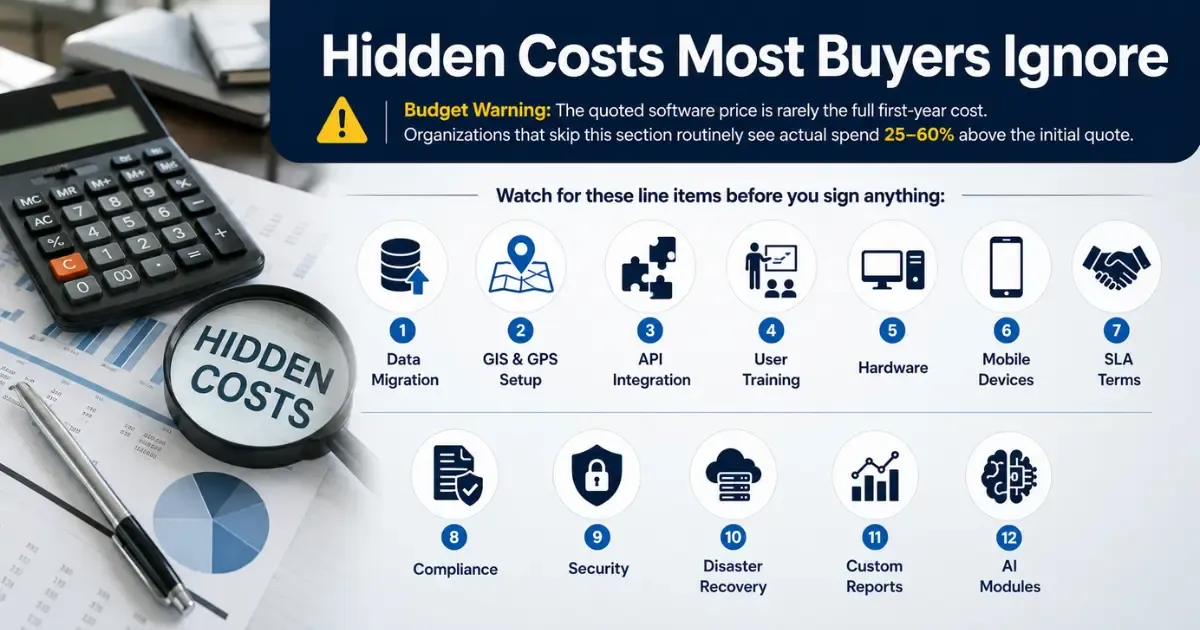
Budget Warning: The quoted software price is rarely the full first-year cost. Organizations that skip this section routinely see actual spend land 25–60% above the initial quote.
Watch for these line items before you sign anything:
- Data migration — moving historical incident and vehicle data from legacy systems isn't free, and poorly scoped migration is the single biggest cause of implementation overruns
- GIS and GPS setup — mapping accuracy for UAE-specific geography and addressing systems often needs custom configuration
- API integration — connecting to existing HIS, ERP, or radio systems
- User training — dispatcher training isn't a one-day affair for complex platforms; budget for multiple sessions and refreshers
- Hardware — in-vehicle terminals, mobile devices, and dispatcher workstations if not already in place
- Mobile devices — field staff need supported, compatible devices, not whatever they already carry
- SLA terms — higher uptime guarantees cost more, and emergency response operations usually need the highest tier
- Compliance — meeting UAE regulatory and data protection requirements can add scope
- Security — penetration testing, access controls, and audit logging aren't always included by default
- Disaster recovery — failover infrastructure for mission-critical dispatch is a separate cost most vendors quote only on request
- Custom reports — beyond standard dashboards, custom reporting for boards or regulators is frequently billed as professional services
- AI modules — predictive dispatch and AI-assisted routing are often priced as premium add-ons, not included in base tiers
Cloud vs On-Premise Computer Aided Dispatch Software Cost
This is the decision that shapes your entire cost structure for the life of the system, so it deserves more than a passing mention.
|
Factor |
Cloud |
Hybrid |
On-Premise |
|
Implementation Cost |
Low |
Medium |
High |
|
Maintenance |
Vendor-managed |
Shared responsibility |
Fully in-house |
|
Security |
Vendor-controlled, shared responsibility |
Mixed |
Full organizational control |
|
Compliance |
Depends on vendor's UAE data residency |
Flexible |
Easiest for strict data residency mandates |
|
Scalability |
Fast, elastic |
Moderate |
Slow, capital-intensive |
|
Performance |
Dependent on connectivity |
Balanced |
Highest for latency-sensitive operations |
|
Support |
Included in subscription |
Split between vendor and internal IT |
Requires internal IT team |
|
Five-Year Cost |
Often lower for small-to-mid orgs |
Moderate |
Often lower at very large scale |
|
Best Use Cases |
Fast-growing, mid-size operators |
Government orgs needing partial data residency |
Large agencies with strict compliance or existing data centers |
For most private operators — hospitals, ambulance companies, security firms — cloud comes out ahead on five-year total cost of ownership, mainly because it avoids the capital outlay for servers and the in-house IT headcount needed to maintain them. Government agencies are the exception: data residency requirements and long procurement cycles often make on-premise or hybrid the more defensible choice, even at a higher sticker price.
Integration Costs That Impact Your Budget
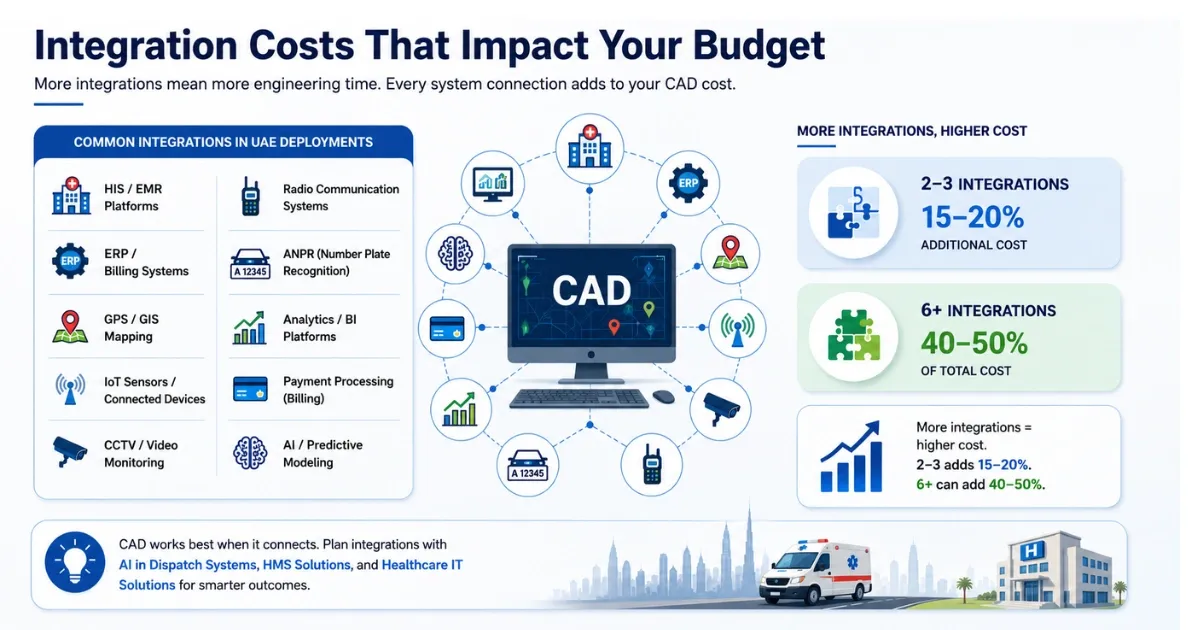
CAD software rarely operates in isolation. The real budget conversation is about how many systems it needs to talk to, because every integration point adds engineering time.
Common integrations that affect UAE deployments:
- Hospital Information Systems (HIS) and EMR platforms
- ERP and billing systems
- GPS and GIS mapping services
- IoT sensor networks and connected infrastructure
- CCTV and video monitoring feeds
- Radio communication systems
- ANPR (Automatic Number Plate Recognition)
- Analytics and business intelligence platforms
- Payment processing (for private ambulance and security billing)
- AI and predictive modeling layers
A CAD deployment with two or three integrations might add 15–20% to implementation cost. A deployment integrating six or more systems — common in large hospitals or government agencies — can push integration costs to 40–50% of total implementation spend. This is exactly why two organizations of similar size can get wildly different quotes for what looks like "the same" software.
If your organization is weighing a broader digital transformation alongside CAD, it's worth reviewing this in context of AI in Emergency Dispatch Systems, Hospital Management System Solutions, and Healthcare IT Solutions together, since integration scope across all three tends to overlap.
Complete Cost Breakdown Table (2026)
|
Category |
Cost Type |
Included Items |
|
One-Time Costs |
Business Analysis |
Requirements gathering, current-state assessment |
|
|
UI Design |
Dashboard and dispatcher interface configuration |
|
|
Development |
Custom feature build, if applicable |
|
|
Integrations |
HIS, GPS, GIS, IoT, radio, ANPR connections |
|
|
Migration |
Historical data transfer |
|
|
Testing |
QA, load testing, user acceptance testing |
|
|
Deployment |
Go-live support |
|
|
Training |
Dispatcher and admin onboarding |
|
Recurring Costs |
Licensing |
Per-seat, per-vehicle, or enterprise license fees |
|
|
Cloud |
Hosting, storage, bandwidth |
|
|
Maintenance |
Bug fixes, patches |
|
|
Support |
Helpdesk, SLA-covered response |
|
|
Security |
Ongoing monitoring, access management |
|
|
Updates |
Feature releases, compliance updates |
|
|
Monitoring |
Uptime and performance monitoring |
Return on Investment (ROI): Is CAD Software Worth the Investment?
Most CAD ROI conversations focus only on response time, which undersells the actual business case. Here's the fuller picture:
Response time improvements of even 60–90 seconds per incident compound into measurable outcomes across thousands of annual dispatches.
Operational savings come from reduced fuel waste, optimized routing, and fewer duplicate dispatches.
Dispatch accuracy improves because the system, not a stressed human under time pressure, is cross-referencing unit availability and location.
Fleet utilization rises when idle time between calls drops.
Staff productivity goes up because dispatchers spend less time manually coordinating and more time managing exceptions.
Compliance reporting that used to take hours becomes automated and audit-ready. For hospitals,
patient outcomes improve with faster, better-coordinated emergency transport.
Customer satisfaction rises for private ambulance and security firms competing on response speed. And for organizations billing per call or per contract, faster turnaround directly supports
revenue growth through higher call capacity per vehicle.
The organizations that get the best ROI aren't necessarily the ones that spend the most — they're the ones that map their specific bottleneck (response time, fleet cost, compliance burden, patient outcomes) to the modules that actually address it, instead of buying every feature a vendor offers.
Budget Planning Checklist Before Buying CAD Software
Before you request a quote, get clear answers on each of these — vague inputs are exactly why vendor quotes come back wildly inconsistent:
- Organization size and expected growth over 3–5 years
- Number of vehicles currently in operation
- Number of active dispatchers, peak and average
- Departments or sites that need coverage
- Full list of required integrations
- Whether AI features (predictive dispatch, automated triage) are needed now or later
- Regulatory and compliance requirements specific to your sector
- Support and SLA expectations
- Deployment model preference (cloud, hybrid, on-prem)
- Future scaling plans — additional vehicles, sites, or departments
- Shortlist of vendors and how you'll evaluate them objectively
How to Get Accurate CAD Software Pricing Quotes in UAE
The gap between a vague estimate and an accurate quote comes down to how much homework you do before you ever talk to a vendor.
- Document requirements first. Vehicle count, dispatcher count, integrations, compliance needs — in writing, before any vendor conversation.
- Shortlist vendors based on UAE market presence and sector-specific experience, not just global brand recognition.
- Run structured demos using your actual workflow, not the vendor's generic sales demo script.
- Request a detailed proposal that separates one-time and recurring costs line by line — reject any quote that bundles everything into a single number.
- Ask for an implementation plan with milestones, not just a delivery date.
- Negotiate — enterprise and government deals almost always have room to move on multi-year terms.
- Clarify support and SLA terms in writing, including response times for critical incidents.
- Review the contract for auto-renewal clauses, price escalation terms, and data ownership.
- Compare pricing across at least three vendors before committing — CAD pricing varies enough between vendors that a single quote tells you almost nothing about market rate.
Conclusion
CAD pricing in the UAE isn't opaque because vendors are hiding something — it's opaque because the honest answer genuinely depends on variables specific to your operation: fleet size, dispatcher count, integration complexity, and whether compliance requirements push you toward on-premise deployment or leave you free to go cloud-first.
What should be clear by now is this: the sticker price on a vendor's proposal is never the whole story. Implementation, integrations, training, and the hidden costs most buyers overlook can add a third or more to your first-year total. Budgeting with that in mind — and using the checklist and questions in this guide during vendor conversations — is what separates organizations that get a system aligned to their actual needs from those that get locked into an oversized or undersized platform they'll be renegotiating in eighteen months.
The deployment model matters as much as the price tag. AI features are increasingly worth budgeting for now rather than later. And vendor selection should be evaluated on UAE-specific experience and integration capability, not just brand recognition. Get those three right, and CAD software stops being a cost center and starts paying for itself through faster response times, better fleet utilization, and measurably improved outcomes.
Ready to see real numbers for your organization? Request a customized quotation and deployment assessment tailored to your fleet size, integration needs, and compliance requirements — and get a clear implementation roadmap before you commit to a vendor.
Figures cited throughout this guide are indicative estimates based on regional software pricing patterns and comparable public-sector procurement benchmarks. Actual UAE pricing should be confirmed directly with vendors, as most CAD providers do not publish fixed rate cards.