
A 999 call comes in from Deira. A tourist has collapsed at the Gold Souk. In Dubai, the ambulance that reaches her in six minutes instead of eleven isn't lucky — it's running on software that knew which vehicle was closest, which route was clearest, and which hospital had a bed free, before the dispatcher finished typing the address.
That software is Computer Aided Dispatch (CAD). And in a city adding new districts, mega-events, and millions of visitors every year, the CAD platform an organization picks in 2026 will decide how well it handles 2031.
This guide walks through exactly how to choose one — the features that matter, the UAE compliance rules that aren't optional, what it costs, and the mistakes that quietly sink these projects.
Quick Summary
- The global CAD software market is valued at roughly USD 2.7–3.7 billion in 2026, with most analysts projecting 8–13% CAGR through 2032–2034 — and the UAE, backed by Smart Dubai and national AI strategy spending, is one of the fastest-growing regional buyers.
- AI-assisted dispatch — automated unit recommendation, predictive routing, live traffic analysis — is now standard in new CAD deployments, not a premium add-on.
- UAE data residency and PDPL compliance are non-negotiable for any CAD platform handling emergency, healthcare, or citizen data.
- Dubai already runs over 300,000 surveillance cameras citywide, including Dubai Police's Oyoon network of roughly 5,000 AI-integrated cameras feeding a central command center — any modern CAD system needs to plug into that ecosystem, not sit beside it.
- GIS, GPS/AVL, and video management integration directly determine dispatch accuracy — these aren't "nice to have" modules.
- Mobile dispatch apps for field crews are now baseline, not differentiators.
- Buy for Smart City expansion, not just today's call volume.
- Always pilot-test with real operational data — Dubai traffic, historical call patterns, actual response zones — before signing.
What Is Computer Aided Dispatch Software?
Computer Aided Dispatch (CAD) software is the system that takes an incident from "someone reported a problem" to "the right responder is on scene" — automatically matching calls to the nearest available unit, tracking that unit in real time, and logging every step for compliance and analysis.
A CAD platform typically covers:
- Call intake — voice, app, or IoT-triggered incident creation
- Incident classification and prioritization
- Resource matching — who's closest, who's qualified, who's free
- GPS/AVL (Automatic Vehicle Location) — live position of every unit
- GIS mapping — visualizing the incident, the responders, and the terrain between them
- AI-based recommendations — suggested unit, suggested route, predicted arrival time
- Mobile responder apps — turn-by-turn routing and status updates from the field
- Reporting and analytics — response-time KPIs, audit trails, post-incident review
The incident lifecycle, in order: report → triage → dispatch → en route → on scene → resolution → report closure → analytics. Every feature in a CAD platform exists to shrink the gaps between those steps.
Workflow diagram suggestion: a horizontal lifecycle diagram showing the eight stages above, with GPS/AVL, GIS, and AI decision points overlaid at the "dispatch" and "en route" stages.
In one sentence: CAD software is the operational nervous system connecting a call for help to a responder on the ground — and in Dubai, that nervous system has to work across police, ambulance, fire, and municipal teams simultaneously.
Why Choosing the Right CAD Software Matters in Dubai
Dubai isn't dispatching for an ordinary city. It's coordinating Smart Police units, Smart Ambulance fleets, and smart logistics networks across free zones, two major airports, a working port, sprawling industrial zones, and a tourism calendar that regularly pulls in millions of extra people for a single event.
That layering is what makes dispatch complexity here fundamentally different from a mid-sized Western city: the same control room may need to coordinate a Dubai Police unit, a private ambulance provider billing through DHA's eClaimLink, an RTA traffic response team, and a municipality crew — for one incident, in one call.
Dubai's surveillance backbone reflects that scale. The city runs more than 300,000 cameras across roads, transit hubs, malls, and neighborhoods, with Dubai Police's Oyoon initiative alone connecting roughly 5,000 AI-integrated cameras directly into a central command and control center. A CAD platform that can't ingest and act on that video-and-sensor layer isn't just outdated — it's blind to a huge share of the incidents the city already knows about.
One-sentence summary: Dubai's dispatch environment is layered — multi-agency, multi-jurisdiction, and camera-dense — so CAD software built for a simpler city will break under Dubai's actual operating conditions.
UAE Computer Aided Dispatch Market Outlook (2026–2032)
|
Metric |
Figure |
|
Global CAD market size, 2026 |
~USD 2.7–3.7 billion (analyst estimates vary) |
|
Projected global CAGR |
8–13% through 2032–2034 |
|
Fastest-growing region |
Asia-Pacific / Middle East, driven by smart-city and NG-911-style modernization |
|
Key regional demand driver |
Government AI and Smart City investment (UAE Vision 2031, Smart Dubai) |
|
Dominant CAD component |
Software (60%+ of global revenue), with cloud-based deployment gaining share over on-premise |
Independent market research firms don't agree on an exact number for the global CAD market — estimates for 2026 range from roughly USD 2.7 billion to USD 3.7 billion, depending on how each firm scopes "CAD" versus adjacent public-safety software. What they agree on is the trend: double-digit growth, cloud displacing on-premise, and AI moving from differentiator to default. The UAE and wider GCC are consistently flagged as above-average growth markets, riding national AI strategies and Smart City budgets rather than organic population growth alone.
Why this matters for buyers: a system priced and architected for 2020-era call volumes and integration needs will be functionally obsolete well before most contracts expire. Budgeting for a platform that can absorb 5–8 years of Smart City expansion is cheaper than a forced replacement in year three.
One-sentence summary: The CAD market is growing fastest exactly where Dubai is investing — AI, cloud, and smart-city integration — so buying an outdated architecture now is a decision you'll be paying for twice.
10 Essential Features Every CAD Software Must Have
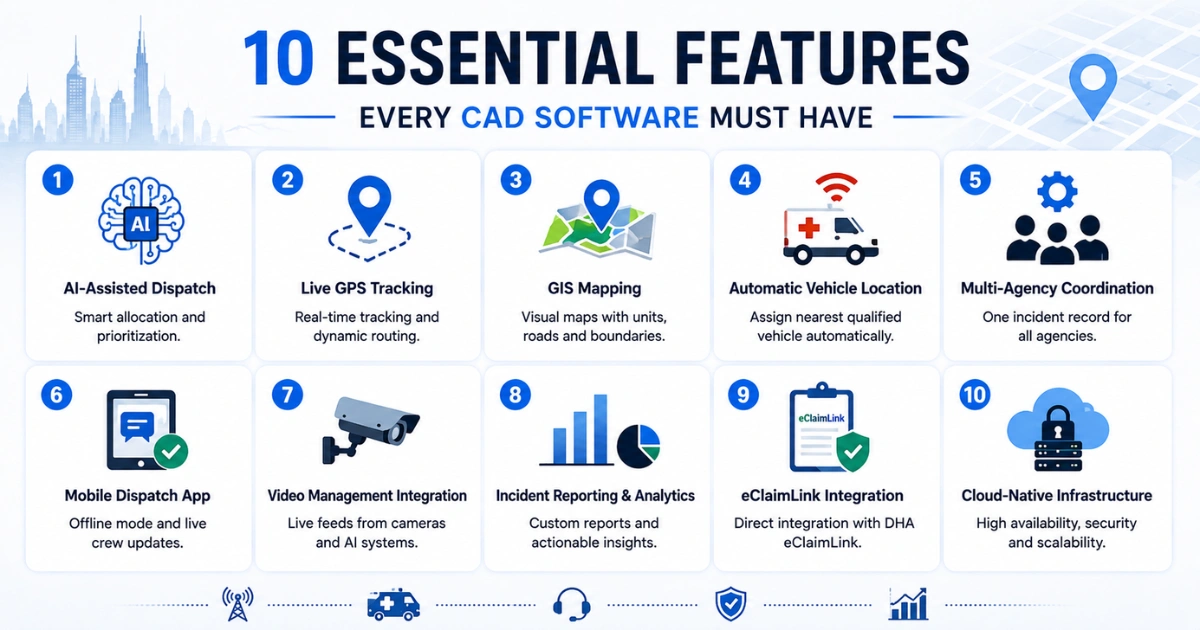
1. AI-Assisted Dispatch
Automated resource allocation, predictive unit recommendations, and incident prioritization that ranks calls by real urgency, not just arrival order.
2. Live GPS Tracking
Real-time vehicle tracking with dynamic routing that recalculates as Dubai's traffic actually changes — not a static route locked in at dispatch time.
3. GIS Mapping
Visual incident mapping that overlays live units, road conditions, and jurisdictional boundaries on one screen.
4. Automatic Vehicle Location (AVL)
Always-on positioning that automatically assigns the nearest qualified vehicle — the single biggest lever on response time.
5. Multi-Agency Coordination
Native workflows for police, fire, EMS, and municipality teams to share one incident record instead of four disconnected ones.
6. Mobile Dispatch App
Tablet-ready apps with offline mode and live crew status updates — essential when responders move between coverage dead zones.
7. Video Management Integration
Direct feeds from Safe City infrastructure, municipal CCTV, and AI cameras so dispatchers see the incident, not just a text description of it.
8. Incident Reporting & Analytics
Custom forms, configurable KPIs, and dashboards that turn every incident into data for the next one.
9. eClaimLink Integration
For private ambulance and healthcare-linked dispatch, direct integration with DHA's eClaimLink for insurance billing avoids a second manual system entirely.
10. Cloud-Native Infrastructure
High availability, built-in security, and horizontal scalability — because dispatch software cannot go down during the incident it exists to handle.
One-sentence summary: Any one of these ten features missing turns into a manual workaround that a control room does not have time for during an actual emergency.
UAE Compliance Checklist Before Buying CAD Software
Direct answer: Before evaluating a single feature, confirm the vendor meets UAE PDPL data protection requirements, stores data within UAE borders, and can pass a UAE Cybersecurity Council / NESA-aligned security review — these three gates eliminate the majority of international CAD vendors outright.
|
Requirement |
Why It Matters |
Mandatory? |
|
PDPL (Federal Decree-Law on Personal Data Protection) |
Governs how citizen and patient data inside incident records can be collected, stored, and shared |
Yes |
|
UAE Cybersecurity Council standards |
Sets baseline security controls for systems touching critical infrastructure and public safety |
Yes |
|
UAE Data Residency |
Emergency and health-linked data increasingly must stay on UAE soil, not a foreign cloud region |
Yes, for most public-safety and health use cases |
|
DHA compliance |
Required for any dispatch platform touching Dubai Health Authority-regulated ambulance or clinical workflows |
Yes, for healthcare-linked dispatch |
|
DCAS alignment |
Relevant for platforms integrating with Dubai's civil defense and ambulance coordination structures |
Case-dependent |
|
RTA data-sharing rules |
Applies where CAD integrates with traffic signal data, road incident feeds, or RTA fleet systems |
Case-dependent |
|
Dubai Municipality standards |
Applies to CAD deployments covering municipal and civil incident response |
Case-dependent |
|
Audit logs |
Regulators and internal governance both require a tamper-evident record of every dispatch decision |
Yes |
|
Access control (RBAC) |
Limits who can view or alter incident and patient data, by role |
Yes |
|
Encryption (at rest and in transit) |
Baseline requirement for any system handling personal or health data |
Yes |
|
Disaster recovery / business continuity |
A dispatch outage is not a bug ticket — it's a life-safety event |
Yes |
One-sentence summary: In Dubai, compliance isn't a checkbox you review after picking a vendor — it's the first filter that decides which vendors you're even allowed to evaluate.
AI Is Transforming Emergency Dispatch in Dubai
Machine learning is now doing three jobs a human dispatcher used to do alone: reading live traffic to predict the fastest real route, flagging incident patterns before they escalate, and recommending which unit to send based on more variables than a person can weigh in seconds — vehicle location, crew qualification, current caseload, and historical outcomes for similar calls.
The payoff is straightforward: faster matches mean faster arrivals, and faster arrivals save lives, reduce resource waste, and cut the operational cost of running a fleet on guesswork. For a city with Dubai's traffic density and event calendar, predictive routing alone can be the difference between a five-minute and a fifteen-minute response on the same route at different times of day.
Emergency dispatch needs AI more than ever — read the deep-dive on how AI is reshaping response models across the region.
One-sentence summary: AI in CAD isn't about replacing dispatchers — it's about giving them, and the units they're sending, better information faster than a human alone ever could.
Step-by-Step Framework for Choosing CAD Software
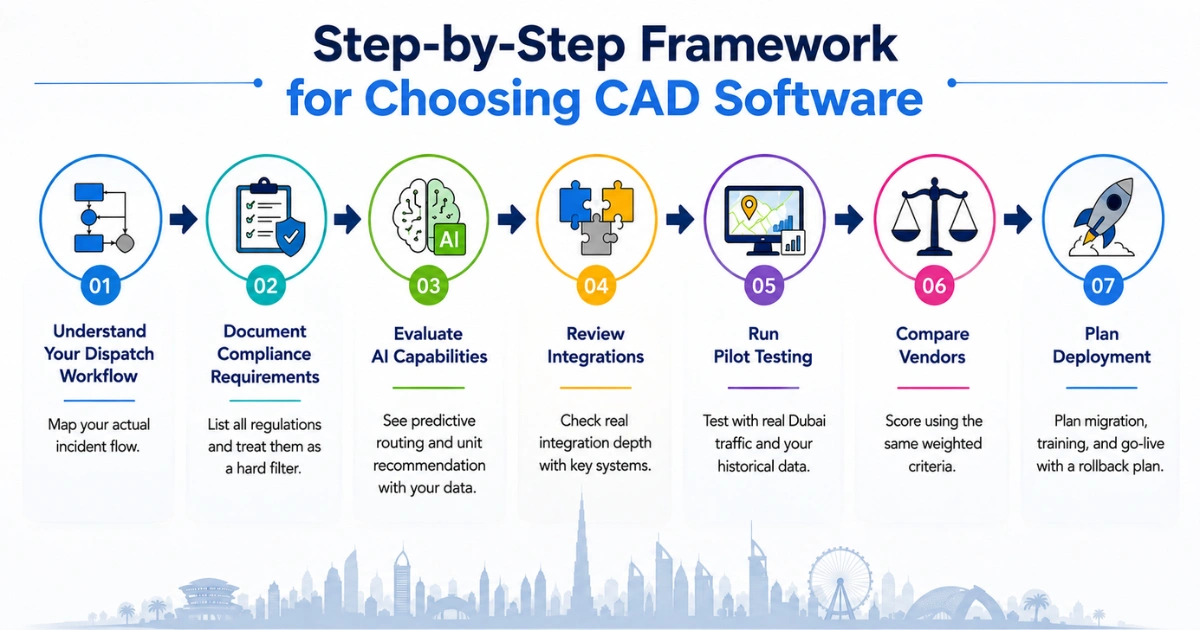
Step 1: Understand Your Dispatch Workflow
Map your actual incident lifecycle before looking at a single vendor. Most failed CAD rollouts start with buying features instead of solving the specific workflow gap the organization actually has.
Step 2: Document Compliance Requirements
Write down every regulation your organization must satisfy — PDPL, DHA, NESA, data residency — and treat it as a hard filter, not a follow-up question.
Step 3: Evaluate AI Capabilities
Ask vendors to demonstrate — not describe — predictive routing and unit recommendation using data resembling your actual call volume and geography.
Step 4: Review Integrations
Confirm real integration depth with hospital systems, ERP, CRM, mapping providers, video management systems, and IoT sensors — not just an API that "can technically connect."
Step 5: Run Pilot Testing
Test with real Dubai traffic conditions and historical call data, not vendor demo data from another country. This step alone catches most of the gaps a sales demo hides.
Step 6: Compare Vendors
Score finalists against the same weighted criteria — compliance, AI depth, integration maturity, mobile capability, and total cost — rather than comparing feature checklists in isolation.
Step 7: Plan Deployment
Sequence migration, training, and go-live around your lowest-risk operational window, with a clear rollback plan if something breaks mid-transition.
One-sentence summary: Organizations that follow this order — workflow, compliance, AI, integrations, pilot, comparison, deployment — consistently avoid the expensive mistake of choosing software before defining the problem it needs to solve.
Top CAD Software Vendors for Dubai
|
Vendor |
Strengths |
UAE Compliance Fit |
Deployment |
Best For |
|
Motorola Solutions |
Deep public-safety pedigree, strong radio/comms integration |
Requires local data residency verification |
Cloud/hybrid |
Large police and emergency networks |
|
Tyler Technologies |
Broad public-sector software suite, strong RMS integration |
Requires regional compliance review |
Cloud |
Municipal and government agencies |
|
CentralSquare |
Mature CAD-to-records workflow, established in North America |
Requires regional compliance review |
Cloud/on-prem |
Multi-agency public safety |
|
Nimbus / KabatOne |
Lighter-weight, ambulance and private-response focused |
Varies by deployment |
Cloud |
Private ambulance and healthcare dispatch |
|
Custom UAE-built solutions |
Built for local compliance from day one; PDPL and data residency native |
Built-in |
Cloud-native, UAE-hosted |
Organizations where compliance, government integration, or eClaimLink billing are non-negotiable |
International platforms bring proven public-safety pedigree but often need significant compliance and localization work to meet UAE data residency and PDPL requirements out of the box. Custom-built UAE solutions start from the opposite direction — compliant by design, but the vendor's depth in AI dispatch and multi-agency workflow needs to be evaluated case by case. Neither category is automatically "better" — the right fit depends on your compliance exposure, your integration needs, and how much customization your workflow actually requires.
One-sentence summary: The best vendor isn't the one with the longest feature list — it's the one whose compliance posture and integration depth match your organization's actual regulatory exposure.
Common Mistakes Organizations Make
- Buying the cheapest option and discovering the hidden cost in integration work later.
- Ignoring UAE compliance until legal or a regulator flags it post-purchase.
- Poor integrations with hospital, ERP, or video systems that were assumed but never tested.
- No mobile app, forcing field crews back onto radio-only updates.
- No AI, leaving dispatch decisions as manual guesswork at scale.
- No GIS, making spatial decisions harder than they need to be.
- No analytics, so response-time problems go undiagnosed for months.
- Ignoring scalability, buying for today's call volume instead of next year's.
- Skipping pilot testing, so problems surface in production instead of a controlled trial.
- Poor training, where a technically sound system fails because dispatchers never trusted or learned it.
One-sentence summary: Almost every CAD project failure traces back to one of these ten decisions made early and cheaply, then paid for expensively later.
CAD Software Cost Considerations
Pricing depends on a combination of factors rather than a flat per-seat number: number of users and vehicles, integration count and complexity, cloud versus on-premise hosting, customization depth, support tier, implementation scope, data migration complexity, and training requirements.
Two organizations with similar headcount can land on very different budgets purely based on how many external systems — hospital records, RTA feeds, video management — they need connected on day one.
For a full breakdown of what drives CAD software pricing in the UAE, see our dedicated guide: Computer Aided Dispatch Software Cost in UAE.
One-sentence summary: Get an itemized cost breakdown by category before comparing vendor quotes — a lower headline price with more integration gaps almost always costs more by year two.
Implementation Roadmap
|
Phase |
Focus |
|
Discovery |
Workflow mapping, compliance requirements, integration inventory |
|
Planning |
Architecture decisions, timeline, risk assessment |
|
UI |
Dispatcher and mobile interface design, usability testing |
|
Development |
Core build, integration development, AI model configuration |
|
Testing |
QA, load testing, pilot testing with real operational data |
|
Migration |
Data migration from legacy systems, validation |
|
Training |
Dispatcher and field-crew onboarding, scenario drills |
|
Go Live |
Phased or full cutover, with rollback plan ready |
|
Support |
Ongoing monitoring, tuning, and 24×7 incident response for the system itself |
One-sentence summary: Skipping or rushing any single phase here — especially pilot testing and training — is the single most common reason CAD go-lives get delayed or rolled back.
Future Trends in CAD Software
The next wave of CAD capability is already visible in early deployments elsewhere and starting to reach the UAE: generative AI assisting dispatcher decision-making in real time, voice-based dispatch interfaces, IoT-triggered incident creation, drone dispatch for first-look assessment, computer vision reading live camera feeds for automatic incident detection, digital twins of city infrastructure for simulation and training, predictive emergency management that flags risk before an incident occurs, autonomous-vehicle coordination, 5G-enabled field connectivity, satellite tracking for coverage gaps, and edge AI processing incident data on-device for lower latency.
Not every organization needs all of this in 2026 — but choosing a platform architected to add these capabilities later, rather than one that requires a rebuild, is the practical difference between a 3-year system and a 10-year one.
One-sentence summary: Future-proofing a CAD purchase isn't about buying every emerging feature now — it's about buying an architecture that can absorb them later without starting over.
Why Organizations Choose SISGAIN for CAD Software Development
SISGAIN builds custom Computer Aided Dispatch software for emergency services, healthcare providers, logistics operators, and government organizations across Dubai, Abu Dhabi, and the wider UAE — with AI dispatch, GIS, and compliance built in from the first line of code, not bolted on afterward.
That means UAE data residency and PDPL alignment from day one, cloud-native architecture built for scale, native integration with healthcare systems including eClaimLink billing workflows, government and enterprise-grade security, and 24×7 support once the system is live and carrying real incidents.
Request a free consultation to discuss your dispatch workflow, compliance requirements, and project scope with our team.
Conclusion
Choosing CAD software in Dubai comes down to six things: AI that actually improves decisions, compliance that's built in rather than retrofitted, Smart City readiness, scalability, and real operational efficiency gains you can measure.
Looking for a secure, AI-powered, and UAE-compliant Computer Aided Dispatch platform? SISGAIN develops future-ready CAD software tailored for emergency services, healthcare, logistics, and government organizations across Dubai, Abu Dhabi, and the UAE. Contact our experts today to discuss your project requirements.