
Quick Answer: How Do You Automate JAWDA EMS KPI Reporting?
Connect ePCR, dispatch, UMOC, telemetry and monitor/defibrillator data into one governed, case-level data model. Implement each DoH-defined KPI as a version-controlled rule, validate timestamps and exclusions automatically, and generate a quarterly submission pack with drill-down case lists. The nominated JAWDA reporting lead reviews exceptions and submits through the DoH portal. Confirm all definitions against the current DoH guidance before configuring any rule.
Introduction
Every ambulance encounter in Abu Dhabi already contains the evidence that the Department of Health (DoH) asks providers to report. The call is time-stamped, the crew documents assessment and interventions, and the monitor records the rhythm. Yet at quarter-end, many quality teams still rebuild that evidence by hand: an ePCR export, a dispatch extract, a spreadsheet of exclusions and several rounds of email to reconcile them.
That approach is becoming harder to defend. DoH's 2026 EMS JAWDA guidance takes effect from Q1 2027, and it asks for more than a headline percentage. It asks providers to show their working. For quality and performance managers, this makes JAWDA EMS KPIs an evidence-management task as much as a calculation task.
The quarterly cycle is also the most useful planning tool available. The Q4 2026 quarter closes on 31 December, and the first period under the new guidance follows immediately. A provider that uses these two cycles deliberately, one to run a parallel test and one to go live, can replace the spreadsheet process without disrupting submissions. This article sets out how, in terms that quality managers and EMS directors can apply. We covered the regulatory background in our guide to the ADEMSIS data compliance mandate. Here we focus on the reporting layer that sits on top of it.
We separate what DoH states from what we recommend throughout. Please confirm every regulatory detail against the original DoH documents before building a plan around it.
Why JAWDA EMS KPIs Are a Data Problem Before They Are a Reporting Problem
JAWDA applies to all DoH-licensed EMS providers in Abu Dhabi, public and private. Each provider nominates a reporting lead and submits quarterly indicators through the JAWDA online portal.
The DoH Standard for EMS and Ambulance Services sets the foundation. It requires providers to implement an ePCR capable of collecting the mandatory elements of the Abu Dhabi EMS Data Dictionary and the KPIs in the current JAWDA indicators. It also requires JAWDA and other quality metrics to be available to DoH on request. For the wider ePCR requirements, see our note on what your ePCR must capture under ADEMSIS.
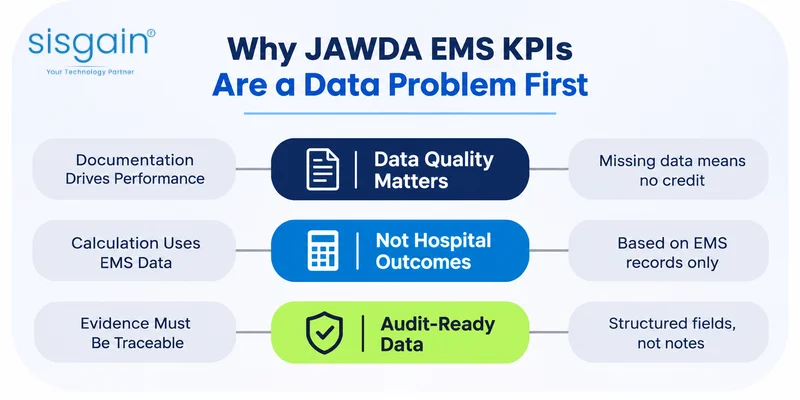
Three features of the model shape everything that follows.
Documentation drives performance. The reporting model is documentation-sensitive. Absence of documentation is treated as non-compliance. A crew may deliver excellent care, but if the patient-side arrival time or the ECG acquisition time is missing, the case cannot be counted correctly.
Calculation relies on EMS data, not hospital outcomes. DoH requires that routine KPI calculation not depend on hospital final diagnosis or ICD data. It relies on documented prehospital presentation, system timestamps and EMS actions. The electronic patient care report is therefore the clinical source of truth, and the quality of that report determines the quality of every indicator.
Evidence must be traceable. Exclusions must be auditable through structured operational and clinical data fields. A narrative note saying a case was excluded is not evidence that DoH can test.
The consequence is simple. Reporting accuracy is decided at the point of care, months before anyone opens a spreadsheet. Automation helps because it moves checking forward in time, to the moment the record is created.
What Breaks When Quarterly KPIs Are Compiled from Spreadsheets
Most EMS organisations that have not yet automated assemble JAWDA data through manual exports, spreadsheets, retrospective chart review and email-based reconciliation. The process often works, in the sense that a submission is made. The risk lies in what it cannot demonstrate. We see four material weaknesses.
- Data fragmentation. ePCR, CAD and dispatch, UMOC, fleet telematics and monitor data are rarely joined consistently. Matching an incident to its patient record, its unit and its device file often depends on someone's patience and a shared inbox.
- Inconsistent KPI logic. Numerator, denominator and exclusion definitions can differ by analyst, station or reporting period. A change in who prepares the report can change the result without any change in performance.
- Late detection. Performance gaps appear only after quarter-end, when corrective action is too late to influence the figure. A missing-ECG pattern that began in week three is discovered in week fourteen.
- Weak auditability. The provider cannot easily show why a case was included, excluded or marked as having missing data. When the reporting lead is asked to evidence a single case, the answer is a search through several files.
Consider a familiar scenario. It is the final week of the quarter. The quality manager holds an ePCR export of several thousand records and a dispatch extract that uses a different incident format. Two analysts match cases manually, one of them applies a slightly different reading of an exclusion, and a handful of records have no patient-side timestamp. The submission is made on time, but nobody can say with confidence how many cases were affected by data quality. That uncertainty is the audit risk.
What Each JAWDA Submission Must Evidence
DoH's guidance requires every KPI submission to include the elements below. Our column on the right translates each into the question an auditor is likely to ask.
|
Submission element |
Question to be able to answer |
|
Raw numerator and denominator |
Can you list the individual cases behind each figure? |
|
Exclusion counts by category |
Is every exclusion coded, categorised and justified? |
|
Exclusion rate |
Is it stable, and can you explain any movement? |
|
Invalid or missing timestamp count |
Which cases are affected, and why? |
|
Raw case volume |
Does it reconcile to dispatch and ePCR records? |
What DoH states: the five elements above must accompany each KPI submission, and exclusions must be auditable through structured fields.
What we recommend: build the submission pack so that every number is a link to the cases that produced it. A figure that cannot be traced to records is a figure that must be defended by argument. A figure that can be traced is defended by evidence.
The Target Architecture: One Governed EMS Quality-Data Layer
The model we recommend places a single governed data layer between the operational systems and JAWDA reporting. In plain terms, the flow is:
ePCR + CAD/dispatch + UMOC + telematics + monitor/defibrillator → ingestion and identity resolution → standardised case-level EMS data model → KPI rules, exclusions, validations and data-quality checks → submission pack, dashboards and alerts → clinical governance, QA/QI, operations and DoH.
The ePCR remains the clinical source of truth. Dispatch and UMOC provide the operational timestamps and pathway context needed for response-time and activation indicators. The new layer does not replace these systems. It joins them, checks them and explains them. For an ambulance ePCR system to support this model, it needs to expose structured data and stable identifiers. Dispatch capability matters equally, and our guide to the features a computer-aided dispatch system should include explains what to require on that side. Where dispatch is itself being reviewed, our computer-aided dispatch software UAE page describes how we approach it.
The case-level golden record
The platform should maintain one record per EMS encounter, linking the patient encounter to its dispatch event, ambulance unit, crew, timestamps, interventions and pathway activation. Seven data domains are needed.
|
Domain |
Examples |
|
Incident and dispatch |
Call receipt, dispatch time, unit assignment, priority, urban/rural class, cancellation status |
|
Response and scene |
Scene arrival, patient-side arrival, scene departure, access or extrication constraints |
|
Clinical assessment |
Presenting symptoms, ACS, stroke, trauma and burn suspicion, BEFAST elements, pain score, vitals, GCS |
|
Interventions |
Aspirin, 12-lead ECG, glucose, defibrillation, haemorrhage control, analgesia, reassessment |
|
Pathways |
SPP eligibility, UMOC activation and time, receiving facility, handover |
|
Outcome and device evidence |
ROSC status, rhythm classification, defibrillation events, device export references |
|
Governance metadata |
User identity, record version, edit history, data-quality flags, audit trail |
DoH's definitions of the first qualifying EMS unit, patient-side arrival, scene departure, valid exclusions and SPP criteria-met cases require consistent, structured treatment across every contributing system. If two systems define patient-side arrival differently, the golden record must state which one governs.
The Five-Stage Automation Blueprint
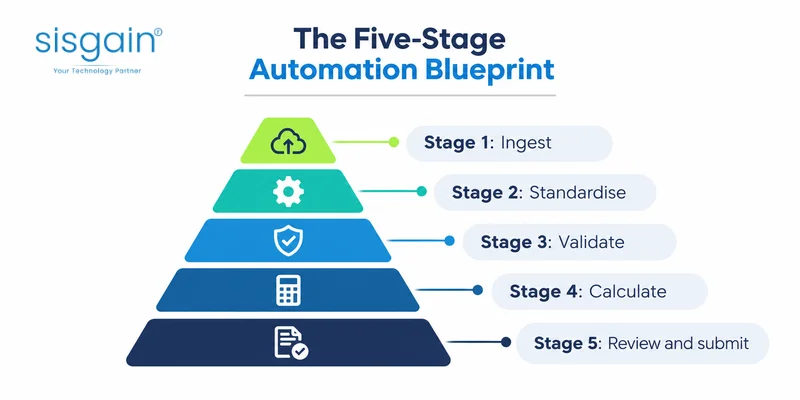
We recommend building the pipeline in five stages. Each stage has a clear output, and each can be tested independently.
Stage 1: Ingest
Connect ePCR, CAD and dispatch, UMOC, fleet telematics and monitor/defibrillator systems through secure APIs, scheduled extracts or event streams. The principle is to preserve source-system identifiers and raw timestamps exactly as received, because auditability depends on them. Many of the connections will involve healthcare messaging standards. Our experience with HL7 integration solutions UAE is relevant here, as is our playbook for integrating healthcare software for patient management. A note of caution: the evidence we have reviewed does not show that ADEMSIS mandates a specific exchange standard. Choose interfaces on technical merit and confirm requirements with DoH.
What good looks like: every record in the quality layer can be traced to its source record, with the original timestamp intact.
Stage 2: Standardise
Map source fields to a canonical EMS data model aligned with the Abu Dhabi EMS Data Dictionary and JAWDA definitions. This includes normalising time zones, units, clinical terms, incident classifications and urban/rural geography. Standardisation is unglamorous, but most reporting disputes trace back to it.
What good looks like: one agreed meaning for each field, documented in a mapping matrix that clinical and technical leads have both signed.
Stage 3: Validate
Apply automated checks before any KPI is calculated. This matters because DoH requires reporting of invalid or missing timestamp counts and category-level exclusion counts.
|
Validation check |
Why it matters |
|
Missing or implausible timestamps |
Directly affects response-time and intervention-time indicators |
|
Duplicate or conflicting records |
Inflates or distorts denominators |
|
Invalid unit or crew assignment |
Breaks attribution to station and crew |
|
Incomplete clinical documentation |
Understates numerators |
|
Incorrect exclusion coding |
Inflates or deflates performance |
|
Out-of-range physiological values |
Signals entry error |
|
Dispatch and ePCR mismatch |
Prevents reliable response-time calculation |
What good looks like: exceptions are raised in the days after an encounter, while the crew can still correct the record.
Stage 4: Calculate
Implement each KPI as a version-controlled rule with explicit numerator, denominator, inclusion, exclusion and timestamp logic. EMS001, for example, measures the percentage of eligible urban responses arriving at scene within seven minutes of official call receipt. It excludes interfacility transfers and calls cancelled before ambulance arrival. Written as a rule, that definition is the same for every analyst and every quarter. When DoH updates a definition or threshold, the rule is versioned, the change is dated and earlier results remain reproducible.
What good looks like: any historical figure can be regenerated from the rule version that was in force at the time.
Stage 5: Review and submit
Generate the quarterly submission pack containing KPI results, raw numerators and denominators, exclusion detail, data-quality metrics and drill-down case lists. The nominated lead reviews exceptions before submitting through the JAWDA portal. Human review is a design feature, not a gap. Overrides should require role-based approval and a documented rationale, and they should be recorded in an immutable audit log.
What good looks like: the lead submits with a clear view of what was excluded, what was flagged and who approved each exception.
Automating EMS001 to EMS010: A KPI-by-KPI Map
The 2026 JAWDA EMS guidance spans response timeliness, time-critical pathway activation, prehospital interventions, documentation and cardiac-arrest outcomes. The table maps each core indicator to what should be automated and where the usual data trap lies.
|
KPI |
What to automate |
Primary sources |
Common trap |
|
EMS001 |
Urban responses arriving within 7 minutes |
ePCR, dispatch |
Call-receipt time taken from the wrong system |
|
EMS002 |
Rural responses arriving within 15 minutes |
ePCR, dispatch |
Urban/rural classification applied inconsistently |
|
EMS003 |
UMOC activation for eligible STEMI, stroke, burn and trauma SPP cases |
ePCR, UMOC, dispatch |
Activation time not captured before transport |
|
EMS004 |
Aspirin before hospital arrival for ACS-suspected patients |
ePCR |
Contraindication recorded as narrative |
|
EMS005 |
12-lead ECG within 10 minutes of patient-side arrival |
ePCR, ECG/monitor |
Scene arrival used instead of patient-side arrival |
|
EMS006 |
ACS, STEMI and stroke scene departure within 15 minutes |
ePCR, dispatch |
Departure time overwritten or missing |
|
EMS007 |
Criteria-met trauma and burn SPP scene departure within 10 minutes |
ePCR, dispatch |
SPP criteria-met flag not structured |
|
EMS008 |
Cardiac-arrest ROSC outcome |
ePCR, monitor/defibrillator |
Device evidence not linked to the encounter |
|
EMS009 |
Defibrillation for shockable-rhythm cardiac arrest |
ePCR, monitor/defibrillator |
Rhythm classification held only in the device file |
|
EMS010 |
Documented glucose for stroke-suggestive patients |
ePCR |
Result recorded in free text |
The guidance also covers air-ambulance activation becoming airborne within 20 minutes, pain assessment and analgesia, and burn-assessment documentation. Please verify indicator wording and targets against the current DoH document before turning any of this into a specification.
Three traps account for much of the lost performance we see in systems of this kind. First, two arrival times: JAWDA treats scene arrival and patient-side arrival differently, so an ePCR that records one "arrival" produces a wrong numerator. Second, exclusions written as narrative instead of coded reasons. Third, device evidence held outside the encounter, so that a defibrillation or ROSC event exists on a monitor but not in the record.
Worked example: EMS005
EMS005 divides the number of ACS-suspected patients with an ECG documented within 10 minutes of patient-side arrival by the number of ACS-suspected patients assessed and transported by EMS, multiplied by 100. DoH sets the target at at least 90%.
To calculate this reliably, the engine needs four inputs: an ACS-suspected flag derived from documented symptoms or clinical findings, the patient-side arrival time, the ECG acquisition time and any coded exclusion. If any one of the four is missing or unstructured, the case cannot be placed correctly. It should fall into the invalid or missing timestamp count, and it should appear on an exception list for review. That is what automation adds: the case is neither silently dropped nor silently counted.
Dashboards That Stand Up to an Audit
A dashboard is only as credible as the data beneath it. We recommend four views, each built for a different decision-maker.
|
View |
Primary audience |
Key question |
|
Executive scorecard |
CEO, COO, Medical Director |
Are we compliant, improving and at risk? |
|
KPI performance |
Quality and JAWDA lead |
Which KPIs are below target, and why? |
|
Station and crew performance |
Operations leadership |
Where are delays or documentation gaps concentrated? |
|
Case-level audit |
Clinical governance and QA |
Can we evidence every inclusion, exclusion and timestamp? |
Every KPI tile should show current performance, target, trend, numerator and denominator, exclusion rate, missing-timestamp count and a measure of data completeness. A figure that shows 91% without showing that 8% of the underlying cases had missing timestamps invites false confidence.
The larger benefit is timing. Real-time alerts for delayed responses, missing ECGs and documentation gaps allow a station supervisor to coach a crew in week three instead of explaining a result in week fourteen. For related work on faster operational response, see our overview of AI in emergency dispatch systems.
Using the Quarterly Cycle as Your Implementation Clock
The quarterly rhythm gives the programme a natural structure, because each submission is a deadline that cannot slip and a test that cannot be faked.
|
Phase |
Typical duration |
Deliverables |
|
Discovery and data audit |
2 to 3 weeks |
System inventory, data-gap assessment, KPI mapping, integration plan |
|
Data foundation |
4 to 6 weeks |
Canonical data model, ingestion pipelines, data-quality rules |
|
KPI engine |
4 to 6 weeks |
Configurable JAWDA rules, exclusion logic, validation controls |
|
Dashboards and workflow |
3 to 4 weeks |
Executive, operational, clinical and audit views |
|
Pilot and calibration |
4 to 6 weeks |
Retrospective parallel run, crew feedback, reconciliation |
|
Go-live and governance |
Ongoing |
Quarterly submission, exception management, continuous improvement |
These durations are our planning estimates, not DoH requirements. A realistic 90-day deployment can deliver a production-ready pilot covering the highest-volume KPIs, followed by full KPI coverage and advanced clinical-quality analytics.
The step that gives leadership confidence is the parallel run. Take the most recently closed quarter, calculate every KPI with the automated engine and compare it with the figure that was actually submitted. Record each variance, and trace it to a cause: a different exclusion reading, a timestamp hierarchy, a duplicate record. Some variances will show that the manual figure was wrong. Others will show that the rule needs calibration. Either outcome is valuable, and neither can be seen without the comparison. Independent verification of reconciliation and offline scenarios is where QA testing services Dubai are most useful.
The practical sequence is straightforward. Start with a two-week data-readiness assessment across ePCR, dispatch, UMOC and device data. Run the parallel test on the quarter that has just closed. Go live for the next one with the automated pack alongside the manual process, and retire the manual process only after one clean cycle.

Governance, Roles and Risk
DoH's standard frames quality assurance, medical oversight and continuous improvement as core EMS obligations. Automation should reinforce those obligations, not substitute for them.
|
Role |
Accountability |
|
Executive sponsor |
Funding, strategic alignment, escalation |
|
JAWDA reporting lead |
Submission ownership and DoH liaison |
|
EMS Medical Director |
Clinical definitions, protocol alignment, QA oversight |
|
Operations lead |
Response-time performance and crew workflow adoption |
|
Data engineering lead |
Integration, data quality, pipeline reliability |
|
Information security lead |
Access control, encryption, retention, audit logs |
|
Clinical quality team |
Case review, corrective action, improvement planning |
The principal risks, with our recommended mitigations, are these.
|
Risk |
Impact |
Mitigation |
|
Incomplete ePCR documentation |
Understated numerator or denominator |
Mandatory structured fields, real-time completeness alerts, crew training |
|
Timestamp mismatch |
Incorrect response-time KPIs |
Single source-of-truth hierarchy, automated cross-system validation |
|
Incorrect exclusions |
Inflated or deflated performance |
Controlled exclusion taxonomy with reason codes and audit trail |
|
Manual overrides |
Loss of trust in reporting |
Role-based approval, immutable log, documented rationale |
|
KPI definition changes |
Non-compliant submissions |
Version-controlled rules and regulatory-change management |
|
Privacy and security |
Regulatory and reputational exposure |
Encryption, role-based access, audit logging, data minimisation |
What to Ask Your ePCR Vendor About Reporting
If your reporting layer will depend on a new or existing ePCR, the vendor conversation should focus on evidence. We have set out a full weighted scorecard in our ePCR implementation and vendor selection guide. For reporting specifically, ask for four things. A sample JAWDA quarterly file showing numerator, denominator, exclusions, exclusion rate, invalid timestamps and case volume. A field-mapping matrix from Data Dictionary elements to system fields. A live run of Abu Dhabi scenarios, such as an urban seven-minute response and an ACS case with ECG. And a demonstration of how exclusions and missing timestamps are reported. This is the same principle we apply throughout: proof, not promises.
When the conversation turns to ePCR vendor selection, treat any generic feature list with caution. What decides the outcome is whether the vendor can show automated, auditable JAWDA output under real operating conditions.
Illustrative Use Cases
The scenarios below are illustrative, not customer cases. Most EMS data teams will recognise the patterns.
A missing patient-side timestamp. A crew records scene arrival but not patient contact. The ECG interval cannot be measured against the 10-minute standard, so the case lands in the invalid-timestamp count. The remedy is a system rule that requires patient-side arrival before the ACS pathway fields unlock, which prevents the gap at the point of care.
An uncoded exclusion. A paramedic withholds aspirin for a sound clinical reason and records it in the narrative. At audit, the exclusion cannot be categorised or counted, and the case reads as a failure. A coded contraindication field with supporting clinical context resolves it and makes the exclusion rate meaningful.
A mismatched dispatch identifier. The CAD incident number differs from the ePCR incident number for a subset of calls. Response-time indicators cannot be reconciled automatically, and manual matching delays the quarterly submission. Interface testing with timestamp reconciliation before go-live prevents it.
How SISGAIN Supports JAWDA KPI Reporting
SISGAIN works across healthcare software, computer-aided dispatch and system integration from our Dubai headquarters, and we have followed the ADEMSIS and JAWDA requirements closely. Our healthcare software development Dubai practice applies that experience to EMS data workflows.
Our reporting and dashboard work is organised around the needs described in this article:
- ePCR-to-JAWDA integration across ePCR, dispatch, UMOC, telemetry and device data.
- A configurable KPI engine with explicit exclusion logic and timestamp validation.
- Executive, operational, clinical and audit dashboards with case-level drill-down.
- Data-quality and audit-readiness support, including exception management.
- Quarterly JAWDA submission support for the nominated reporting lead.
The best first step is a data-readiness assessment. It gives leadership an evidence-based view of where the data stands before committing to a build or a vendor.
Conclusion
Abu Dhabi EMS providers should treat JAWDA automation as a clinical-quality and operational-performance programme, not an IT reporting project. The sound approach combines a governed data model, automated and versioned KPI logic, exception management, crew-facing feedback and audit-ready submission evidence. It is the evidence standard DoH now expects. The quarterly cycle makes the path practical: test on the quarter that has closed, go live on the next, and retire the spreadsheet once a full cycle has reconciled.