
Quick Answer: Which Business Processes Should UAE Companies Automate First?
UAE companies should start with invoice and accounts payable processing, employee onboarding and HR administration, customer support and lead response, procurement and supplier management, compliance and KYC document handling, inventory and order fulfilment, and financial reporting and reconciliation. These seven processes are repetitive, rule-based and data-heavy, which is why they return value fastest and carry the clearest ROI.
Introduction
Walk through the finance, HR or operations floor of almost any mid-sized UAE company and you will find the same pattern. An invoice arrives by email, is forwarded, keyed into the ERP, chased for approval over WhatsApp and paid late. A new hire waits three days for system access. A property or service enquiry sits in a shared inbox over the weekend.
None of these is a technology failure. They are process failures that technology has not yet been asked to fix.
Business process automation in the UAE is no longer an innovation project. It is an operating-model decision. Automation is not about replacing people. It is about giving UAE businesses the speed, accuracy and capacity to compete globally.
In this guide, we cover the seven processes where automation consistently delivers the fastest and most measurable returns, how to sequence them, which KPIs to track, and the risks that stall most programmes. If you want the broader architecture behind this, our guide to automation integration systems for UAE businesses covers how integration and automation work together.
Why UAE Companies Should Automate Now
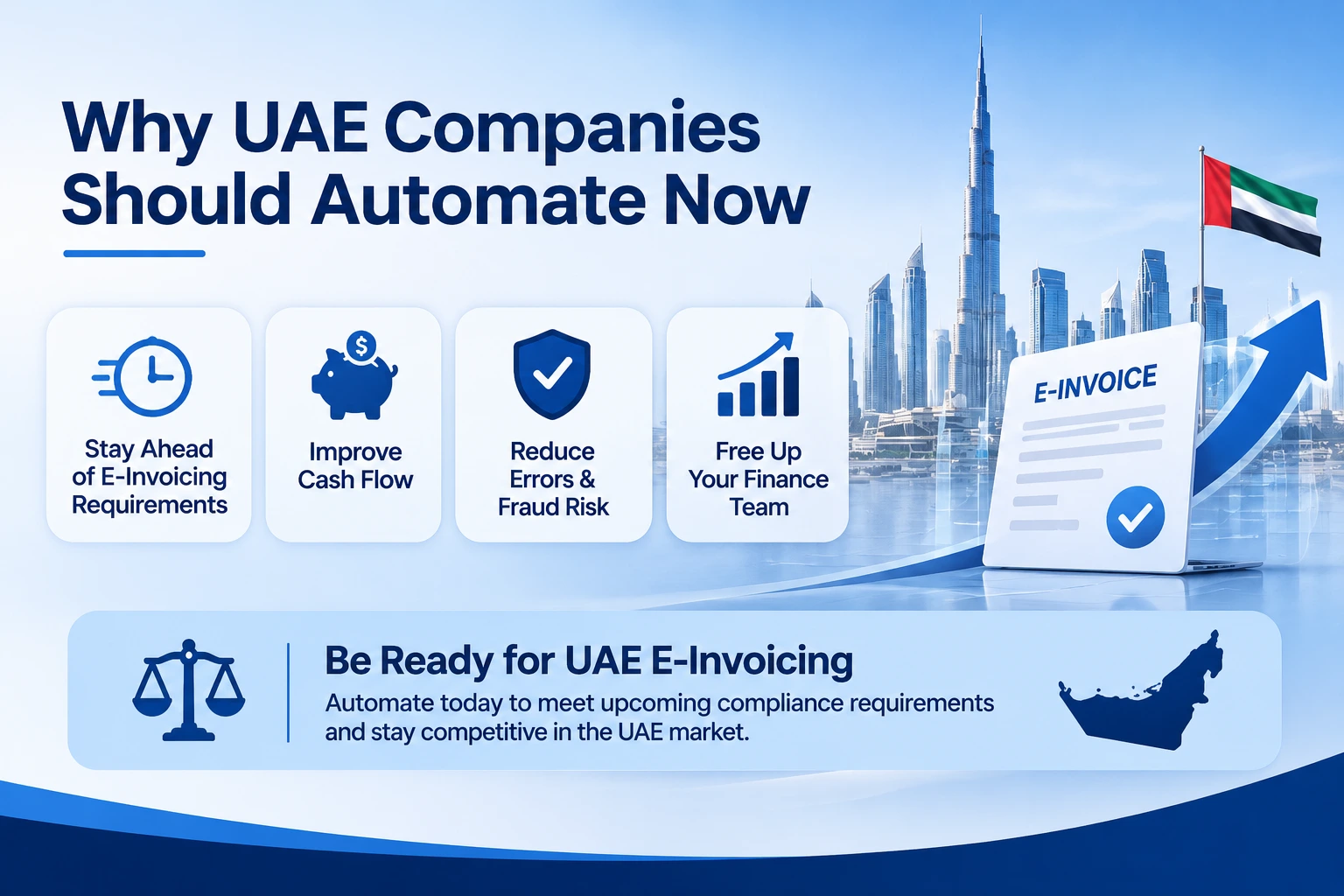
The UAE is moving from digital adoption to intelligent operations, and the policy direction is explicit.
- The UAE Digital Economy Strategy aims to double the digital economy's contribution to GDP from 9.7% to 19.4% within ten years.
- Abu Dhabi's 2025–2027 Digital Strategy targets automation of 100% of government processes and more than 200 AI-driven solutions.
- The federal government plans to deploy agentic AI across 50% of government sectors, services and operations within two years. We cover what that means in practice in our analysis of the UAE's 50% AI-driven government operations target.
- Dubai's Economic Agenda D33 targets an annual AED 100 billion contribution from digital transformation projects by 2033.
- In a regional survey of senior business leaders, 77% of UAE respondents reported significant productivity gains from AI, the highest result in EMEA.
The implication for private-sector leaders is straightforward. When government services, banks, logistics partners and regulators digitise at this pace, every company that touches them is measured against the same standard. Manual approvals and disconnected systems stop being an inconvenience and become a competitive disadvantage.
UAE companies that automate now will set the operating standard for the region.
The Business Case: What Automation Actually Delivers
Before choosing processes, it helps to be precise about what we are buying. Automation produces six measurable outcomes.
|
Business outcome |
What automation delivers |
|---|---|
|
Faster turnaround |
Removes waiting, handoffs and manual approvals |
|
Lower operating cost |
Reduces repetitive work, rework and administrative overhead |
|
Higher accuracy |
Minimises data-entry and compliance errors |
|
Better visibility |
Creates real-time operational dashboards |
|
Improved customer experience |
Enables faster responses and 24/7 service |
|
Scalable growth |
Lets volume rise without a proportional rise in headcount |
Efficiency is not doing more with less. It is doing the right work faster, with fewer errors and better control.
A simple way to size the opportunity is to count recovered hours. In an illustrative ROI scenario from SISGAIN's recent press release, 20 employees each spending 20 hours a month on repetitive tasks represent 400 hours of manual work. Automating 40% of it recovers roughly 160 hours a month, or 1,920 hours a year. That is a planning example, not a client result. Actual returns depend on adoption and on how the recovered capacity is used.
To turn hours into a business case, use this formula:
ROI = (Annual savings − Total implementation cost) ÷ Total implementation cost × 100
Count reclaimed labour hours, avoided error-correction cost and avoided penalties on the savings side. On the cost side, include licensing, integration, training and change management. The last item is the one most estimates leave out and most projects underestimate.
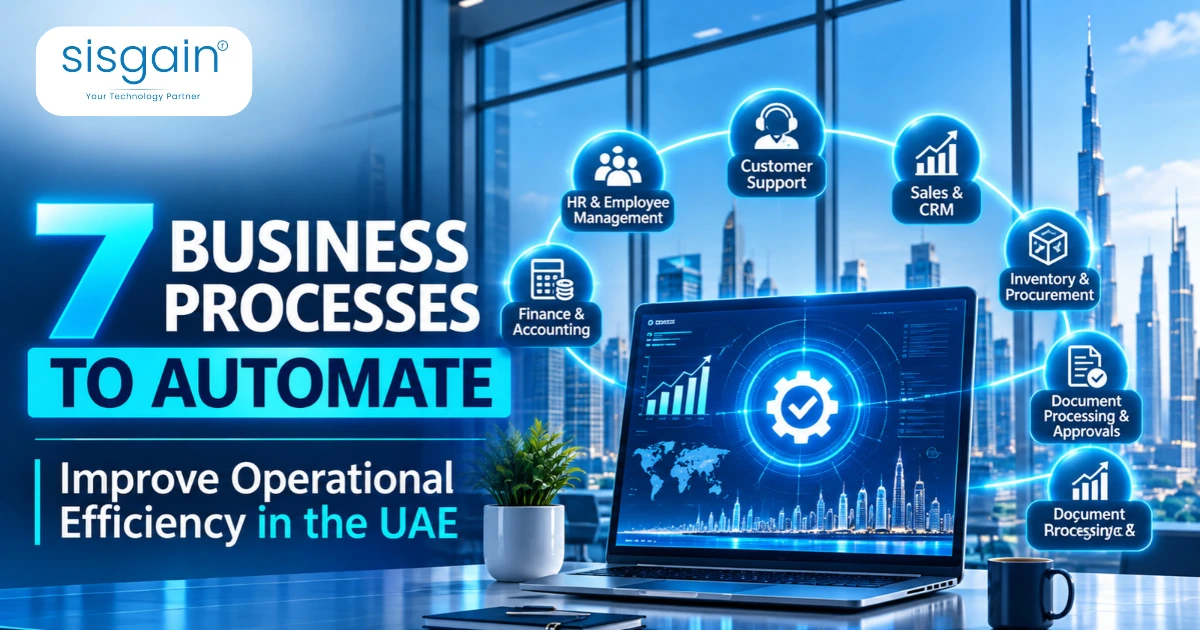
These are not futuristic use cases. They are everyday processes that consume time, create delays and carry operational risk. Here are the seven, in the order we typically recommend reviewing them.
1. Invoice and Accounts Payable Processing
The problem. Manual invoice capture, matching, approval chasing and payment scheduling create delays, duplicate payments and poor cash-flow visibility. Finance teams spend their week on data entry when they should be managing working capital.
What to automate
- Invoice data extraction using OCR and AI
- Three-way matching of purchase order, goods receipt and invoice
- Approval routing and exception handling
- Payment scheduling and vendor communication
- Real-time accounts-payable dashboards
Expected impact. Faster invoice processing, fewer payment errors and tighter working-capital control. The finance team shifts from keying data to analysing cash and supplier terms.
Illustrative scenario. An invoice arrives by email. The system reads it, matches it to the purchase order and goods receipt, routes any mismatch to the right approver, and schedules payment against agreed terms. A person touches it only when the numbers do not agree.
UAE angle. E-invoicing is moving structured, machine-readable invoice data from a nice-to-have to a compliance expectation. Companies that automate AP now will be better placed when those requirements apply to them. Our guide to UAE e-invoicing requirements for distributors explains what to prepare. Because AP automation depends on a reliable ERP core, many clients begin with custom ERP development in Dubai so that matching rules and approvals sit inside one system of record.
2. Employee Onboarding and HR Administration
The problem. Onboarding involves repeated document collection, manual data entry, approvals, system-access requests and compliance checks. Each step lives in a different inbox.
What to automate
- Offer letters, contracts and document collection
- Emirates ID, visa and compliance document workflows
- IT access provisioning
- Training assignments and policy acknowledgements
- Leave requests, payroll inputs and routine HR queries
Expected impact. Faster employee readiness, a better new-hire experience, a lighter administrative load on HR and a stronger audit trail.
Illustrative scenario. When an offer is accepted, the workflow requests documents, validates them, opens the HR record, triggers IT provisioning, assigns mandatory training and notifies the line manager. The employee arrives on day one with access in place.
A great first day should not depend on a spreadsheet, an email thread and five follow-ups.
UAE angle. Workforce compliance carries real weight here. Emiratisation tracking, visa and ID renewals, and audit-ready records are far easier to maintain when they are generated by the workflow rather than reconstructed later. Our article on Emiratisation compliance and HR software covers the reporting side. For the build itself, our enterprise workflow automation services team designs approval chains around your existing HR and payroll systems.
3. Customer Support and Lead Response
The problem. Slow responses, inconsistent replies and manual lead routing cost revenue and damage customer experience. In a market where customers expect an answer within minutes, a lead that waits until Monday is usually a lead lost.
What to automate
- AI-powered assistants for routine questions
- Intelligent ticket classification and routing
- Appointment booking and status updates
- Lead capture, qualification and CRM assignment
- Proactive customer notifications
Expected impact. Faster first response, 24/7 availability, more consistent service quality, and sales teams focused on qualified opportunities rather than inbox triage.
Illustrative scenario. An enquiry arrives on the website, WhatsApp or email in Arabic or English. The assistant answers the routine question, captures the details, scores the lead and assigns it to the right salesperson in the CRM with the full conversation attached.
UAE angle. Customer service is one of the areas where AI-driven productivity gains are already most visible. The practical decision is what kind of automation you need. Our comparison of AI agents vs AI chatbots explains where scripted assistants are enough and where an agent that acts across systems is worth the investment. When you are ready to scope it, our AI chatbot development services in Dubai cover multilingual assistants integrated with your CRM.
4. Procurement and Supplier Management
The problem. Procurement is often fragmented across email, spreadsheets, PDFs and disconnected systems. The result is slow sourcing, weak spend control and unmanaged supplier risk.
What to automate
- Purchase requisitions and approval workflows
- Supplier onboarding and document validation
- RFQ creation and quote comparison
- Contract renewal alerts
- Supplier-performance scorecards
Expected impact. Faster procurement cycles, better spend visibility, less maverick spending and improved supplier compliance.
Illustrative scenario. A purchase request checks budget availability, routes for approval, generates a purchase order and updates the ERP. A contract nearing renewal alerts the owner ninety days ahead, with the supplier's scorecard attached.
UAE angle. Procurement automation lives or dies on integration. Requisitions, budgets, supplier records and goods receipts sit in different systems in most companies we meet, which is why our software integration services in Dubai engagements often come before any workflow build. For the wider case for a connected core, see our overview of ERP benefits for UAE businesses.
5. Compliance, Document Management and KYC
The problem. UAE companies operate in a highly regulated environment. Manual document handling creates compliance gaps, missed renewals and audit risk, often discovered only when an auditor asks for a record that cannot be found.
What to automate
- Document classification and secure storage
- Licence, visa, insurance and contract expiry alerts
- KYC and AML screening workflows
- Policy acknowledgements and training tracking
- Audit-ready reporting
Expected impact. Reduced compliance risk, no missed renewals, faster audit preparation and stronger governance.
Illustrative scenario. A new customer uploads identity documents. The workflow verifies them, runs screening, flags any match for a compliance officer and stores the full decision trail. Every renewal date in the company is tracked in the same place and escalated automatically.
Compliance should be built into the workflow, not discovered during an audit.
UAE angle. Sector rules differ, but the principle is common: evidence must be complete, consistent and retrievable. Our guide to AML compliance in Dubai outlines the due-diligence and recordkeeping expectations that automation should encode. For onboarding flows that depend on document and identity checks, our digital identity verification solutions in the UAE show how verification can be embedded directly into the customer journey.
6. Inventory, Logistics and Order Fulfilment
The problem. Manual stock updates, delayed shipment information and disconnected warehouse systems create stockouts, excess inventory and delivery failures. Each one ties up working capital or costs a customer.
What to automate
- Inventory updates across sales, warehouse and ERP systems
- Low-stock and reorder alerts
- Order validation and fulfilment workflows
- Shipment tracking and customer notifications
- Returns and exception management
Expected impact. Better stock accuracy, faster fulfilment, less working capital tied up in inventory and more reliable delivery.
Illustrative scenario. When stock reaches a defined threshold, the system creates a replenishment request and notifies procurement or the supplier. The customer receives shipment updates without anyone sending them, and returns follow a defined path rather than a chain of emails.
UAE angle. Retail seasons and cross-border trade make demand uneven, which is exactly when manual reconciliation breaks first. If supply chain visibility is the weak point, our analysis of AI-powered supply chain software development in Dubai covers architecture, integration and cost. Where the warehouse itself is the bottleneck, our warehouse management software development team builds systems that connect directly to your ERP and sales channels.
7. Financial Reporting, Reconciliation and Forecasting
The problem. Finance teams spend too much time consolidating data, reconciling accounts and preparing reports, and too little advising leadership. By the time a report is ready, the numbers are already history.
What to automate
- Data consolidation from ERP, banking, payroll and CRM systems
- Bank and ledger reconciliation
- Month-end close checklists
- Management dashboards
- Cash-flow and demand forecasting
Expected impact. A faster financial close, higher reporting accuracy, real-time decision-making and a more strategic finance function.
Illustrative scenario. Instead of manually matching hundreds of transactions, automation matches the routine ones and flags only the exceptions for human review. Dashboards refresh from source systems, so the monthly pack becomes a view rather than a project.
UAE angle. Reporting automation is the layer that benefits most from the other six processes. Clean AP, procurement and fulfilment data make reconciliation and forecasting reliable. This is where AI automation services in Dubai add the most value: consolidating data across systems, surfacing anomalies and supporting forecasts that finance leaders can act on.
What Not to Automate: Where Human Judgement Stays
Automate repetitive, rule-based, high-volume work. Keep people in control of:
- Strategic decisions
- Complex negotiations
- Sensitive customer escalations
- Ethical and risk decisions
- Exceptions that need context and judgement
This matters more as organisations hand more autonomy to AI agents. The faster the technology moves, the more deliberate the boundaries need to be. Our article on the governance risks of rushing into agentic AI outlines the exposure to plan for.
Automate the process. Empower the people.
A Practical Roadmap: Start Small, Prove Value, Scale Fast
|
Phase |
Focus |
Outcome |
|---|---|---|
|
1. Assess |
Identify manual, high-volume, error-prone processes |
Automation opportunity map |
|
2. Prioritise |
Select two or three processes with clear ROI |
Quick-win roadmap |
|
3. Pilot |
Automate one workflow end to end |
Measurable baseline |
|
4. Integrate |
Connect ERP, CRM, HR, finance and operations systems |
Scalable automation |
|
5. Scale |
Apply governance, security and employee training |
Enterprise-wide impact |
To prioritise, score each candidate process on four factors: transaction volume, error or rework rate, clarity of the rules, and expected return. High scores on all four make a strong first pilot. A process with unclear rules scores low regardless of volume, which leads to the most important principle in this guide.
Do not automate chaos. Standardise the process first, then automate it.
Tool choice follows process design, not the other way round. For task-level, rules-based work, RPA services in the UAE are often the quickest route. Where business teams need to adjust workflows themselves, our comparison of low-code vs no-code helps you choose the right level of control.
Success Metrics: Measure What Matters
Capture a baseline for each process before you start, then track the same measures after go-live.
|
KPI |
What it tells you |
|---|---|
|
Process turnaround time |
Speed from request to completion |
|
Cost per transaction |
Unit economics of the process |
|
Error or rework rate |
Quality and data accuracy |
|
Percentage of touchless transactions |
How much runs without human intervention |
|
Employee hours released |
Capacity returned to the business |
|
Customer response time |
Service improvement |
|
Compliance exceptions |
Control strength |
|
Cash-conversion cycle |
Working-capital impact |
|
Employee satisfaction and adoption |
Whether people actually use it |
If you cannot measure the improvement, you cannot manage the automation programme.
Risks to Avoid
Automation fails without foundations. These are the failure patterns we see most often.
- Automating a poorly designed process. The biggest automation risk is not technology. It is automating an inefficient process without redesigning it.
- Weak data and fragmented systems. Automation acts on data. If records disagree across systems, it will act on the wrong version. Our guide to legacy system modernization costs and ROI shows how to assess and fix the foundations.
- No clear business owner. Every automated process needs one accountable person outside IT.
- No training or change management. Teams that were not involved in the design will work around the system.
- Ignoring security, privacy and governance. Access controls, audit logging and policy boundaries belong in the design phase. Our 90-day AI governance implementation plan offers a practical sequence, and IT risk and compliance services can support the controls.
- Treating AI as plug-and-play. It is an operating-model change, not a software install.
How to Choose the Right Automation Partner
By this stage, most leaders ask not whether to automate but who should help. Use these criteria to evaluate any partner:
- Experience with UAE regulatory environments and sector requirements
- Integration capability across ERP, CRM, HR and finance systems, not only bots
- Genuine AI and automation engineering, not manual configuration with an automation label
- Security practices appropriate to your sector
- Local UAE delivery and support
- An architecture that scales past the first project
- Case studies with measurable, verifiable outcomes
A good partner starts by asking about your workflow, including the workarounds your team has built informally. If you are comparing options, our business process automation services in Dubai page outlines how we assess, pilot and scale automation around your existing systems.
Conclusion: The Future of UAE Business Is Intelligent Operations
Automation lets UAE companies serve customers faster, reduce cost and error, strengthen compliance, improve decisions, free teams for higher-value work and scale without a proportional rise in cost.
The companies that win in the next decade will not simply use technology. They will redesign how work gets done.
The practical path is short. Choose one process. Automate it properly. Measure the result. Then scale what works. If you want a starting point, our recent press release on how SISGAIN helps UAE enterprises reduce operational costs through AI automation outlines where enterprises typically find their first savings.
Ready to Identify Your First Process to Automate?
SISGAIN works with UAE enterprises to map manual processes, prioritise by ROI and deliver automation integrated with existing systems. Book a free consultation with our team and we will help you build an automation opportunity map for your business.