
Quick answer: HR software supports UAE Emiratisation compliance by keeping one verified record of nationality, job classification, salary and contract data. It calculates your skilled-role Emiratisation rate in real time, flags shortfalls and attrition before MOHRE deadlines, and produces audit-ready reports, so HR teams can stop rebuilding the numbers in spreadsheets every quarter.
If you run HR or operations at a UAE private-sector company, you already know the clock is ticking. The 2026 target for Emiratisation in skilled roles lands at the end of this year, and the penalty for unfilled positions is a monthly financial contribution that adds up quickly.
I have spent nearly two decades helping organisations modernise how they run, and one pattern keeps repeating in compliance conversations. When I ask a simple question, "What is your current skilled-role Emiratisation rate?", the room goes quiet. Not because the team is careless, but because the answer lives in three different files, and nobody fully trusts any of them.
This guide walks through what Emiratisation actually requires, why spreadsheets break down, and what a well-designed system should do. If you are weighing a build-versus-buy decision, our team also works on custom ERP software development in Dubai, and I will point out where that fits later on.
What does Emiratisation require from UAE private-sector employers?
The rules differ by company size. Based on the Ministry of Human Resources and Emiratisation (MOHRE) guidance we reviewed:
|
Company size |
What is expected |
|
50 or more employees |
Grow Emirati representation in skilled roles by 2% a year, reaching a cumulative 10% by the end of 2026, tracked through half-year milestones |
|
20 to 49 employees (designated sectors) |
Hire at least one UAE national and retain existing Emirati employees |
Beyond the headline targets, employers are expected to provide genuine employment, register Emirati staff in the applicable pension and social-security systems, and pay wages through approved channels. For 2026, the minimum monthly salary for Emiratis in the private sector is AED 6,000. Where required positions stay unfilled, MOHRE can apply monthly financial contributions per position.
A quick note before you rely on any figure here: thresholds, deadlines and contribution amounts can change. Always confirm the current numbers on the official MOHRE website before you plan hiring or budgets.
Why spreadsheets fail at Emiratisation tracking
Let me describe a scenario that will probably sound familiar.
It is the last week of the half-year milestone. The HR manager exports a headcount list from the HR system, a payroll sheet from finance, and a hiring tracker from the recruitment team. The three do not match. Two people left in the quarter but still appear as active. One Emirati hire is in the recruitment sheet but not yet in payroll. Someone has to decide which version is true, and the next two days disappear into reconciliation.
I have seen versions of this play out across industries, and the root causes are almost always the same:
- Duplicate and outdated records. One wrong status flag changes your headcount, and your headcount is the denominator of everything.
- Inconsistent role classification. Two people with the same real job end up in different skill categories because their titles differ.
- No early warning on attrition. An Emirati employee resigns after probation, and leadership finds out at reporting time.
- Disconnected systems. HR, payroll and recruitment each hold part of the truth, and none holds all of it.
This is the same trap I see when companies try to stretch old systems beyond what they were built for. If that sounds familiar, our piece on how legacy systems are modernised in Dubai covers the cost and ROI side of that decision.
The employee data foundation you need first
Before any dashboard or report, you need clean, structured data. If I could give HR teams one piece of advice, it would be this: fix the data model before you buy or build anything. A good Emiratisation-ready employee record covers five blocks.
- Identity: employee ID, full name, nationality, Emirates ID and passport details.
- Employment: date of joining, status (active, probation, resigned, terminated, on leave), employment type, contract type, start and end dates.
- Organisation: establishment or legal entity, department, business unit, location.
- Classification: job title, job code, occupation group, skill level.
- Compliance and pay: basic and total monthly salary, pension and social-security registration status, Wage Protection System (WPS) payment status, exit date and reason.
It looks like a long list, but each field answers a question an inspector or an auditor can ask. If a field is optional in your system today, ask yourself whether you could defend leaving it blank.
How to classify skilled roles correctly
Here is a mistake that quietly distorts the numbers. A company has job titles like "Executive" or "Coordinator" used loosely across departments. One "Operations Executive" is doing skilled, specialised work. Another is doing routine administrative tasks. If both are classified the same way, your skilled-role count is wrong, and so is your Emiratisation rate.
The fix is boring but powerful:
- Maintain a central job catalogue with approved titles.
- Make skill level mandatory for every role.
- Route role changes through an approval workflow, with history kept.
- Restrict manual edits without HR approval.
- Re-validate classifications periodically against MOHRE guidance.
This one control prevents more compliance headaches than almost any other feature on the list.
How HR software calculates your Emiratisation rate
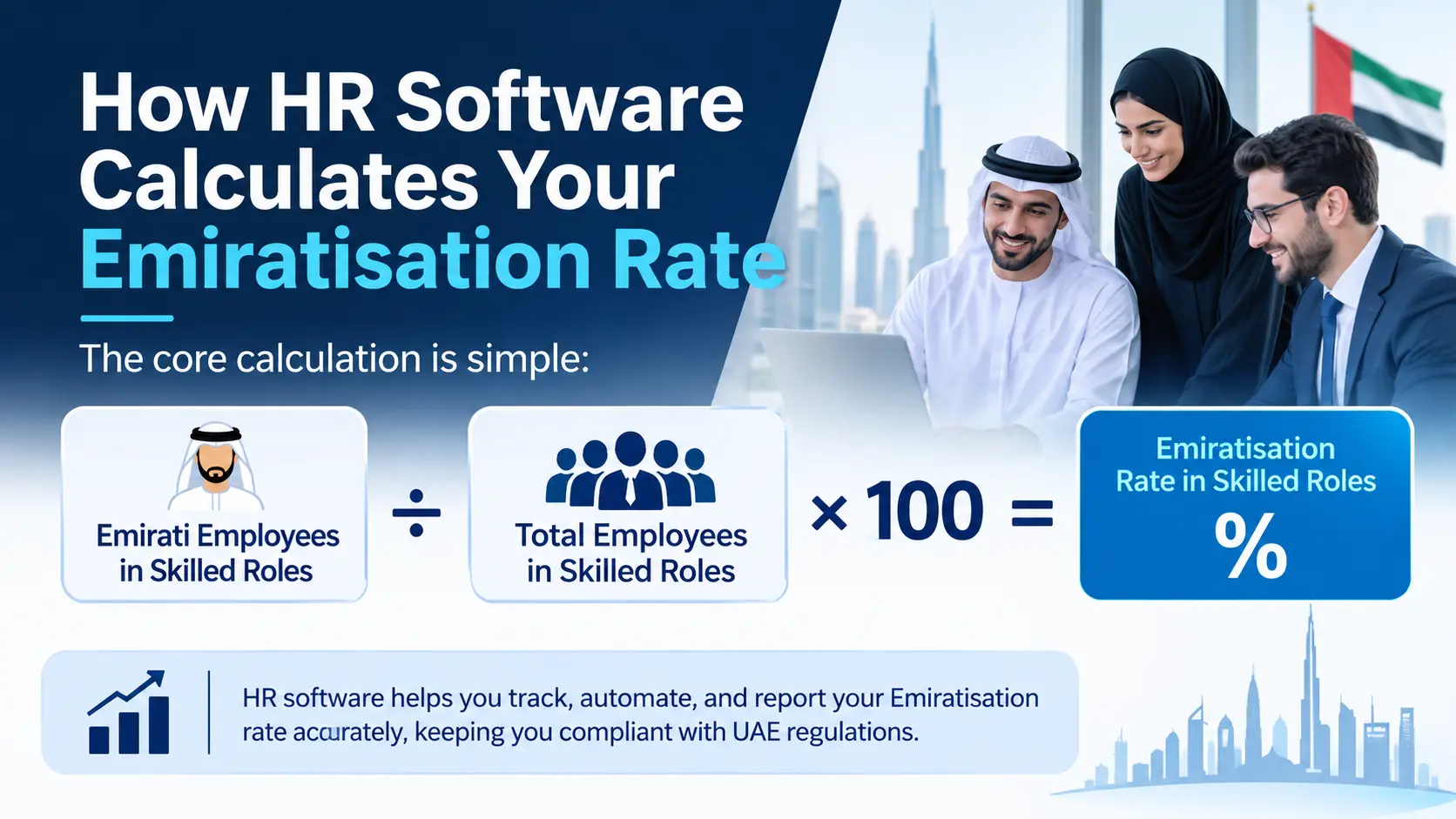
Here is an illustrative example, with made-up numbers. Say a company has 120 employees in skilled roles, and 6 of them are Emirati. That is a 5% rate. To move up by one percentage point, you would need roughly one to two more Emirati hires in skilled roles.
Now the part people miss: the denominator moves too. If the business also hires ten non-Emirati skilled staff during the year, the skilled workforce grows, and the same number of Emirati hires moves the rate less than you expected. This is exactly why a real-time calculation beats a once-a-quarter spreadsheet.
A good system tracks, at minimum:
|
Metric |
Why it matters |
|
Total active headcount |
Confirms which rule applies to you |
|
Total skilled employees |
The denominator of your rate |
|
Emiratis in skilled roles |
The numerator |
|
Current rate vs. required target |
Shows your real position |
|
Variance and required additional hires |
Turns the gap into a hiring plan |
|
Half-year progress |
Keeps you on track for each milestone |
|
Emirati attrition |
Flags retention risk early |
Seven capabilities to look for in Emiratisation-ready HR software
When teams ask me what "good" looks like, I walk them through these seven:
- A live compliance dashboard. Current rate, target, gap, required hires, upcoming milestones, and employees at risk of exit, on one screen.
- A recruitment pipeline that treats Emiratisation roles as priority. Track vacancy, candidate, interview, offer, acceptance, onboarding and first payroll. A hire is not "done" until the person is registered, onboarded and paid through approved channels.
- Retention alerts. Probation completion, contract expiry, resignation notices, long absences and salary alignment.
- Payroll validation. Automatic checks for the AED 6,000 minimum, approved salary changes, and WPS processing.
- Document management with version control. Contracts, offer letters, Emirates ID and passport copies, pension and social-security evidence, payslips and WPS records.
- Approvals and exception management. Every override and every data exception leaves a trail.
- Integration. The system has to talk to payroll, recruitment and other business tools, or you are back to spreadsheets.
That last point is where many projects succeed or stall. Connecting HR, payroll and recruitment data cleanly is its own discipline, and it is the kind of work our software integration services in Dubai team handles. If you want approvals, alerts and reminders to run themselves, workflow automation services in Dubai are usually the layer that makes it stick.
A retention story worth learning from
Here is another pattern I see often. A company works hard to hire Emirati talent, celebrates the onboarding, and then loses the same person a few months later, right after probation. Nobody sees it coming, because nothing in the system was watching probation dates, engagement or salary alignment.
MOHRE expects genuine, sustained employment, not a headcount snapshot. So the most valuable alert in your system is often not "hire more" but "this person is approaching a decision point." A simple prompt to a manager, a conversation about career path, a salary review before the person starts looking elsewhere: these small interventions protect the progress you already paid for.
Reporting that stands up to a MOHRE inspection
A useful reporting setup has three layers.
|
Report |
How often |
What it contains |
|
Management report |
Monthly |
Current vs. target rate, variance, hiring pipeline, attrition, salary compliance, pending documents, department-level performance |
|
Compliance report |
Quarterly or half-yearly |
Headcount by establishment, skilled vs. non-skilled split, Emiratisation percentage, pension and social-security evidence, exceptions and corrective actions |
|
Audit pack |
On demand (PDF and Excel) |
Employee master extract, job classifications, active Emirati employee list, contract and salary evidence, WPS records, recruitment and onboarding records, exception log |
Inspections can ask for employee lists, contracts, leave records and proof of wage payments. If producing that bundle takes your team a week, that is your signal. A good system should make it a few clicks.
Don't forget privacy and security
This data is sensitive: IDs, passports, salaries, contract terms. Role-based access, audit trails and clear rules on where data is stored are not optional extras. Before you pick a platform, ask where it hosts data and who can see what. For a deeper look at the legal side, see our guide on PDPL compliance requirements for UAE software.
A practical seven-phase rollout
If you decide to implement a system, this is the sequence I recommend:
- Data audit. Find missing, duplicate and inconsistent records.
- Role mapping. Map every job title to a skilled or non-skilled category.
- Configuration. Set up fields, workflows, targets and dashboards.
- Data migration. Load employee, contract, payroll and document data.
- Validation. Test calculations, reports and alerts against known numbers.
- Training. HR, recruitment, payroll and leadership all need to use it the same way.
- Go-live and monthly review. Launch dashboards and make the review a standing meeting.
If your organisation already runs an ERP, much of this may be an extension rather than a new system. Our overview of the benefits of ERP software for UAE businesses is a helpful starting point.
Common risks and how to reduce them
|
Risk |
What it causes |
How to reduce it |
|
Wrong skilled-role classification |
Inaccurate rate |
Central job catalogue and approval workflow |
|
Outdated employee records |
Wrong headcount |
Mandatory validation and periodic audits |
|
Emirati attrition |
Lost progress |
Probation, contract and resignation alerts |
|
Salary below AED 6,000 |
Payroll non-compliance |
Automated salary threshold checks |
|
Missing pension or WPS records |
Regulatory exposure |
Onboarding checklist and document workflow |
|
Late discovery of a shortfall |
No time left to recruit |
Live dashboard and monthly variance review |
|
Fragmented data |
Inconsistent reports |
One integrated HR, payroll and recruitment platform |
Build, buy or extend?
There is no single right answer. An off-the-shelf HR platform can be fastest if your needs are standard. Extending an existing ERP can make sense if your data already lives there. A custom module becomes attractive when your classification logic, reporting needs or integrations are unusual.
What I would avoid is deciding on price alone. Look at how well each option handles MOHRE-style reporting, how easily it integrates with payroll and recruitment, where data is hosted, and what it will cost to maintain over several years, not just to launch. If you want a realistic sense of budget ranges, our guide to software development costs in 2026 breaks down what companies actually pay. And if you are comparing partners, you can start with our software development company in Dubai page.
Your eight-step Emiratisation checklist
- Make one system the single source of truth for employee, contract, payroll and document data.
- Complete a full skilled-role classification review before measuring performance.
- Set up an automated dashboard for the monthly rate and target variance.
- Hold a monthly compliance review with HR, recruitment, payroll, finance and leadership.
- Flag Emiratisation-critical vacancies and track candidates through to onboarding.
- Add retention alerts for probation end, contract renewal and resignation risk.
- Keep an audit-ready repository for contracts, payroll, pension, social-security and WPS evidence.
- Review status monthly, and agree corrective actions before each MOHRE milestone.
Want a head start? We can share an Emiratisation data-readiness checklist and walk through it with your team. Request the checklist.
Final thoughts
Emiratisation compliance is not really a software problem. It is a data-trust problem. When HR, payroll and recruitment tell the same story, tracking becomes routine and reporting becomes a button press. The software simply makes that discipline repeatable.