
Dubai has spent the last decade turning itself into one of the busiest crossroads in global trade. But the systems running behind that growth — the ERPs, spreadsheets, and point solutions most enterprises still rely on — were never built for the volume, speed, or complexity moving through the region today. A container ship delay in Jebel Ali, a demand spike from a Ramadan promotion, a new customs rule from a GCC trade partner: legacy supply chain software either can't see these events in real time or can't act on them fast enough to matter.
That gap is why supply chain software development in Dubai has become a board-level conversation rather than an IT line item. Enterprises across retail, manufacturing, 3PL, and FMCG are moving away from rigid, off-the-shelf platforms toward AI-powered, custom-built systems designed around how their operations actually run — not how a vendor in another market decided they should.
This guide walks through why that shift is happening, what's technically changing under the hood, what it costs, and how to choose a development partner who can actually deliver it.
Quick Answer: What Is Supply Chain Software Development?
Supply chain software development is the process of designing, building, and integrating digital systems — including transportation management, warehouse management, procurement, demand forecasting, and analytics tools — that give enterprises real-time visibility and control over the movement of goods, data, and capital across their supply network. In Dubai, this increasingly means AI-powered, cloud-native platforms built to handle GCC-specific trade, customs, and compliance requirements that generic global software wasn't designed for.
Why Dubai Enterprises Are Racing to Modernize Supply Chain Software
Three forces are converging at once, and none of them are slowing down.
First, the UAE's national AI and digital economy strategy has made technology adoption a competitive expectation rather than a differentiator. When government logistics infrastructure — ports, customs, free zones — moves to digital-first processes, private enterprises that haven't modernized their own systems become the bottleneck.
Second, e-commerce growth across the UAE has permanently reset customer expectations. Same-day and next-day delivery, once a luxury offering, is now table stakes for anyone selling online in Dubai. Legacy fulfillment systems, built for slower B2B cadences, simply can't meet that bar without a rebuild.
Third — and this is the one boards are starting to feel financially — supply chain performance has become a direct driver of margin. Fuel, labor, and warehousing costs have all risen, and the enterprises absorbing that pressure best are the ones with the visibility to route around it. The ones without that visibility are eating the cost with no way to see where it's coming from.
Statistics Snapshot
- The global supply chain management software market continues to expand at a strong compound annual growth rate, driven heavily by AI and cloud adoption.
- The UAE's logistics and SCM software segment is one of the fastest-growing in the GCC, tracking closely with the country's broader digital economy targets.
- Enterprise AI adoption in supply chain functions — forecasting, procurement, warehouse automation — has moved from early pilots to mainstream deployment across the region's larger logistics and retail players.
Why Dubai Has Become a Global Hub for Supply Chain Software Development
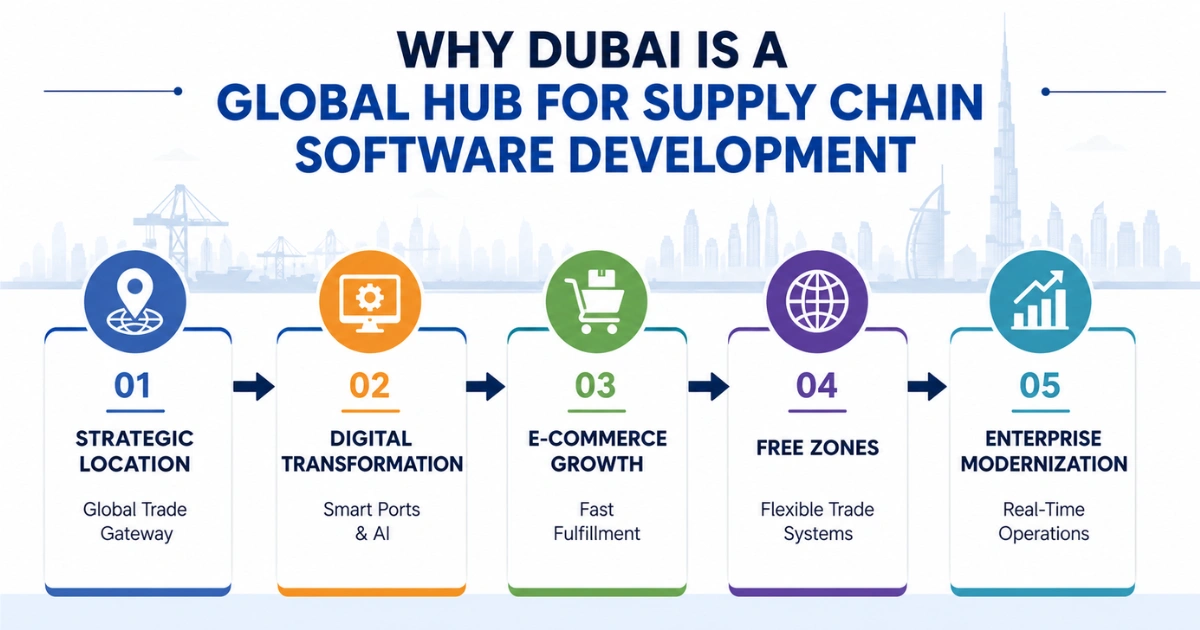
Strategic Location
Dubai sits at the physical intersection of Asia, Europe, and Africa — a geography that has made it a natural transshipment and distribution hub for centuries, and one that modern trade has only reinforced. Jebel Ali Port alone handles cargo volumes that put it among the busiest container ports outside East Asia. That volume creates real pressure on the software managing it: manual processes that worked at a smaller scale simply break down at Dubai's throughput.
Government-Led Digital Transformation
The UAE's national AI strategy and broader Industry 4.0 push aren't abstract policy documents — they're actively reshaping how ports, customs authorities, and free zones operate. Smart port initiatives, automated customs clearance, and digital trade documentation are pulling private-sector supply chains along with them. An enterprise still running paper-based or semi-manual processes now looks conspicuously out of step with the infrastructure it's plugging into.
The E-Commerce Boom
Online retail in the UAE has grown fast enough that fulfillment has become a competitive battleground in its own right, not just a cost center. Same-day delivery promises only work if the warehouse management, inventory, and last-mile routing systems behind them are tightly integrated — which is rarely true of systems bolted together over the years from different vendors.
Free Zones and International Trade
Dubai's free zone model — DMCC, JAFZA, Dubai South, and others — was built specifically to attract regional distribution and re-export business. Each zone comes with its own customs and compliance nuances, which means supply chain software operating across multiple zones needs a level of configurability that global, one-size-fits-all platforms rarely offer out of the box.
Enterprise Digital Transformation Pressure
Perhaps most simply: competitors are modernizing, and doing nothing is no longer a neutral choice. Every enterprise that adopts AI-driven forecasting or real-time visibility raises the baseline expectation for everyone else in its category.
The Biggest Supply Chain Challenges Enterprises Face in 2026
Most enterprises don't wake up one day and decide to build custom software. They arrive at it after hitting the same wall repeatedly — usually one of these seven.
Fragmented Systems
The average mid-to-large enterprise in Dubai is running some patchwork combination of ERP, WMS, TMS, CRM, and — still, remarkably often — spreadsheets to fill the gaps between them. Each system holds a partial view of the truth. None of them agree with each other in real time, and reconciling them becomes a manual job that eats hours every week.
Lack of Real-Time Visibility
This is the gap that shows up most painfully during a disruption. Industry surveys consistently find that only a small minority of supply chain leaders — often cited around 6% — report having full, real-time visibility across their end-to-end supply chain. Everyone else is reacting to problems after they've already cost money.
Rising Operational Costs
Fuel, labor, and warehousing costs have all climbed, and enterprises without granular cost visibility can't tell which lanes, warehouses, or supplier relationships are actually profitable anymore. Cost control without data is just guessing with extra steps.
Legacy ERP Limitations
SAP, Oracle, and Microsoft Dynamics are powerful systems, but they were architected for transaction processing, not real-time operational intelligence. Bolting AI forecasting or IoT data feeds onto a decade-old ERP configuration is possible, but it's rarely clean, and it's almost never cheap.
Omnichannel Fulfillment Complexity
Selling through a website, a marketplace, and physical retail simultaneously means inventory has to be accurate and shared across all three channels at once. Get it wrong, and you're either overselling stock you don't have or sitting on inventory that should have been reallocated to a channel that needed it.
Regulatory Compliance
VAT reporting, ESG disclosure requirements, cross-border documentation, and customs rules across the GCC add a compliance layer that off-the-shelf global software often handles generically — or not at all. UAE-specific compliance logic usually has to be built in deliberately, not assumed.
Manual Decision-Making
Even enterprises with decent data often still make procurement, replenishment, and routing decisions by gut feel and spreadsheet, because the systems that hold the data don't actually surface a recommendation. The data exists; the decision support doesn't.
Why this matters: every one of these seven problems is a systems architecture problem, not a people problem. Hiring more analysts to reconcile fragmented data manually doesn't fix fragmentation — it just makes fragmentation slightly more bearable, at a growing headcount cost. Custom software is what actually closes the gap.
Why Enterprises Are Investing in Supply Chain Software Development in Dubai
Once the pain points are on the table, the business case for custom development tends to write itself. The pattern enterprises report, again and again, looks like this:
- Visibility first. Once inventory, transport, and warehouse data sit in one connected system, disruptions get caught in hours instead of days.
- Automation next. Manual replenishment and manual routing get replaced with rules-based or AI-driven decisions, freeing planners to handle exceptions instead of routine work.
- Cost follows. With granular visibility into which lanes and warehouses are actually profitable, procurement and logistics teams can renegotiate or reroute with real leverage instead of hunches.
- Customer experience improves last, but lasts longest. Faster, more accurate deliveries compound into retention and repeat purchase — the metric that actually shows up on the P&L.
Illustrative ROI Snapshot
|
Investment Area |
Typical Enterprise Outcome |
|
Real-time visibility platform |
Fewer stockouts and expedited-shipping costs from earlier disruption detection |
|
AI demand forecasting |
Reduced excess inventory and working capital tied up in stock |
|
Warehouse automation & WMS upgrade |
Higher order accuracy and faster fulfillment cycle times |
|
TMS with route optimization |
Lower fuel and freight spend per shipment |
|
ERP integration layer |
Fewer manual reconciliation hours across finance and operations teams |
These are directional patterns, not guarantees — actual ROI depends heavily on baseline maturity, so a proper cost-benefit analysis for your specific operation should come before any build decision.
Top Technology Trends Reshaping Supply Chain Software in 2026
The technology stack underneath supply chain software has changed more in the last three years than in the previous decade. Here's what's actually driving that change.
Agentic AI
The shift from AI that recommends to AI that acts is the single biggest change happening in enterprise SCM right now. Agentic systems can autonomously trigger procurement orders when stock hits a threshold, rebalance inventory across warehouses without waiting for a planner to approve each move, and flag — or in some cases reroute around — predicted delays before they happen. This connects directly to broader shifts in AI in logistics, where autonomous decision-making is replacing static rule sets across the board.
AI-Powered Demand Forecasting
Traditional forecasting models relied on historical sales trends and seasonality. Modern AI forecasting layers in weather data, social sentiment, local events, and even competitor pricing signals to produce forecasts that adjust in near real time rather than being recalculated monthly.
Digital Twins
A digital twin is a live, data-fed virtual replica of a physical supply chain — warehouses, transport lanes, supplier network — that lets planners simulate disruptions before they happen. What happens if a key supplier goes offline for two weeks? A digital twin can model the cascading impact and suggest a mitigation plan before the disruption is even real.
Control Towers
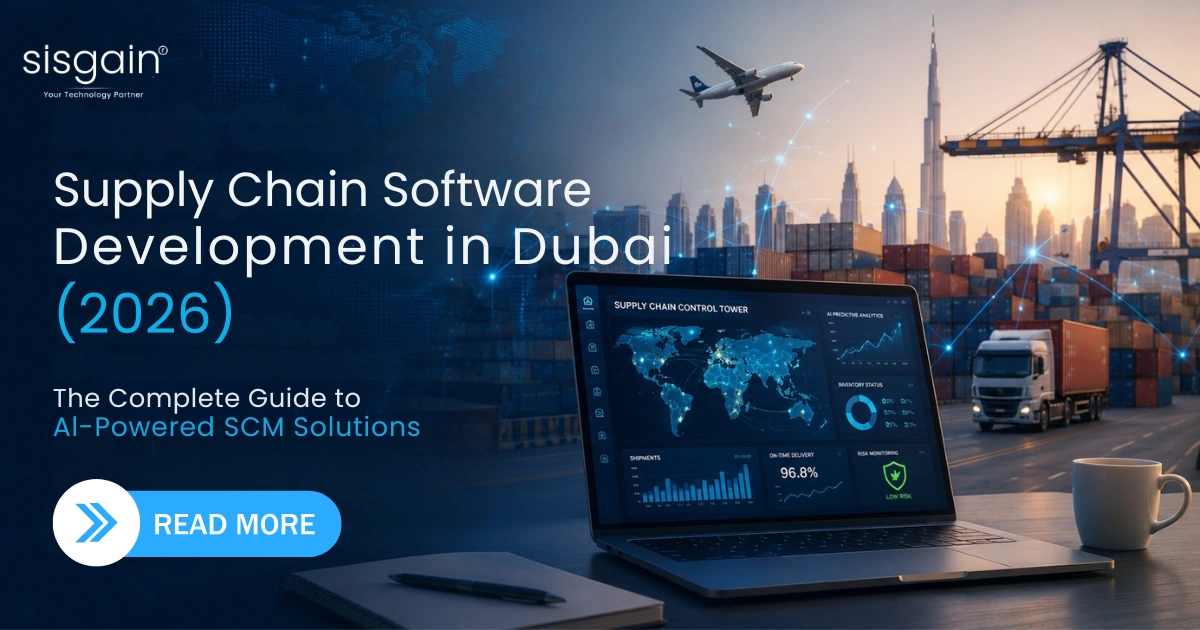
A control tower platform pulls data from every system in the supply chain — ERP, WMS, TMS, supplier portals — into a single operational dashboard. It's the practical answer to the fragmentation problem: one screen, not five logins.
IoT Integration
RFID tags, GPS trackers, and temperature sensors feed live location and condition data into the software layer, which matters enormously for cold chain, pharmaceuticals, and high-value goods moving through Dubai's ports and free zones.
Warehouse Robotics
Automated picking, sorting, and inventory-counting robots are increasingly common in larger Dubai fulfillment centers, and the software coordinating them needs to talk fluently to both the robotics layer and the WMS above it.
Blockchain for Supply Chain Traceability
Blockchain adoption in supply chain is still selective rather than universal, but it's gaining real traction in provenance-sensitive categories — pharmaceuticals, luxury goods, food safety — where an immutable record of custody actually matters to customers and regulators.
ESG and Sustainability Reporting
Carbon footprint tracking, sustainable sourcing verification, and ESG disclosure are increasingly built directly into SCM platforms rather than handled through separate reporting tools, largely because regulators and enterprise customers are both starting to ask for this data as a matter of course.
Cloud-Native Architecture
On-premise SCM deployments are becoming the exception. Cloud-native systems scale on demand, deploy updates without downtime, and — critically for Dubai's multi-site enterprises — give every location the same real-time data without a separate server stack per site.
API-First Ecosystem Design
Modern supply chain platforms are built to connect, not to stand alone. An API-first architecture means new tools — a new carrier, a new marketplace, a new supplier system — can be plugged in without a multi-month integration project every time.
Expert insight: the enterprises seeing the biggest returns from AI in supply chain aren't the ones with the most advanced models — they're the ones with the cleanest, most connected data feeding those models. AI is only as good as the visibility layer underneath it.
Essential Features Every Enterprise Supply Chain Software Should Have
Not every enterprise needs every module on day one, but a genuinely enterprise-grade platform should be built to support all of the following, either natively or through clean integration.
Transportation Management System (TMS)
- Route optimization that accounts for traffic, fuel cost, and delivery windows
- Real-time ETA tracking and proactive delay alerts
- Multi-carrier management across regional and international shipping partners
- Freight cost analysis and spend visibility by lane and carrier
Warehouse Management System (WMS)
- RFID and barcode-based inventory tracking
- Smart slotting and inventory placement logic
- Pick, pack, and ship workflow automation
Fleet Management
- GPS tracking across the delivery fleet
- Fuel consumption monitoring and anomaly detection
- Predictive maintenance scheduling
- Driver performance analytics
Procurement Management
- Supplier portal for order status, documentation, and communication
- Automated purchase order generation tied to demand signals
Inventory and Demand Planning
- AI-driven demand forecasting by SKU, location, and channel
- Automated reorder point calculation
Order and Customer Management
- Centralized order management across all sales channels
- Customer-facing portal for order tracking and documentation
- Mobile apps for field teams, drivers, and warehouse staff
Analytics and Integration Layer
- AI-powered analytics dashboard with exception-based alerting, not just historical reporting
- Deep ERP integration with SAP, Oracle, or Microsoft Dynamics
- Open API layer for third-party and future integrations
- Configurable reporting dashboards by role — CFO, COO, warehouse manager, and planner all need different views of the same data
Feature Depth by Platform Tier
|
Feature Set |
Basic |
Advanced |
Enterprise |
|
Real-time inventory tracking |
Yes |
Yes |
Yes |
|
AI demand forecasting |
No |
Basic |
Advanced, multi-variable |
|
Route optimization |
Manual |
Semi-automated |
Fully automated, dynamic |
|
ERP integration |
Limited |
Single ERP |
Multi-ERP, real-time sync |
|
Digital twin / simulation |
No |
No |
Yes |
|
Multi-warehouse orchestration |
No |
Limited |
Full network optimization |
|
Custom compliance & ESG reporting |
No |
Partial |
Fully built-in |
Build vs. Buy: Which Is Better for Dubai Enterprises?
This is usually the first real decision point, and it deserves more scrutiny than it typically gets.
|
Factor |
Off-the-Shelf Platform |
Custom Development |
|
Upfront cost |
Lower |
Higher |
|
Total cost of ownership |
Often higher over 3–5 years due to licensing and add-ons |
Lower long-term, once built |
|
Ownership |
Vendor-controlled |
Fully owned by the enterprise |
|
Customization |
Limited to vendor's roadmap |
Built exactly around your workflows |
|
AI capability |
Generic, one-size-fits-all models |
Trained and tuned on your own operational data |
|
Security |
Shared multi-tenant environment |
Architected to your own security standards |
|
GCC compliance |
Often generic or absent |
Built in from day one |
|
Integration flexibility |
Constrained by vendor APIs |
Unlimited, API-first by design |
|
Scalability |
Bound by vendor's tiered pricing |
Scales with your infrastructure choices |
|
Long-term ROI |
Diminishes as the business outgrows the platform |
Compounds as the platform grows with the business |
The practical recommendation: off-the-shelf platforms make sense for smaller operations with standard, low-complexity workflows and tight upfront budgets. Once an enterprise has multiple warehouses, multi-channel fulfillment, GCC-specific compliance needs, or a genuine ambition to use AI as a competitive edge rather than a checkbox, custom development almost always wins on total cost and capability within two to three years.
Supply Chain Software Development Cost in Dubai (2026)
Cost is the question every enterprise asks first and the one that's hardest to answer honestly without specifics — but here's a realistic framework.
Cost by Business Size
- Startup / small operation: A lean platform covering core inventory and order management, built for a single warehouse or a handful of SKUs, sits at the lower end of the custom development range.
- SME / mid-market: Multi-module platforms covering WMS, TMS, and basic AI forecasting for a growing multi-location operation land in the mid-range.
- Enterprise: Full-scale platforms with deep ERP integration, AI-driven planning, digital twin capability, and multi-warehouse orchestration sit at the top end — and can run considerably higher depending on integration complexity.
Cost by Complexity Tier
|
Tier |
Typical Scope |
Relative Cost |
|
Basic |
Single-module (e.g., inventory or order management), minimal integration |
$ |
|
Medium |
Multi-module (WMS + TMS), moderate ERP integration, basic reporting |
$$ |
|
Enterprise |
Full platform, deep ERP integration, custom compliance, mobile apps |
$$$ |
|
AI-Native Platform |
Enterprise scope plus AI forecasting, digital twins, agentic automation |
$$$$ |
What Actually Drives the Cost
- Number and depth of features (a basic dashboard costs a fraction of an AI forecasting engine)
- Degree of AI sophistication — a rules-based alert system is far cheaper than a trained predictive model
- Cloud infrastructure choices and expected data volume
- Number and complexity of third-party integrations, especially ERP
- Security architecture and compliance requirements, particularly for regulated goods
For a detailed breakdown by module and complexity, see our full guide to supply chain management software development cost in UAE.
Enterprise Supply Chain Software Development Process
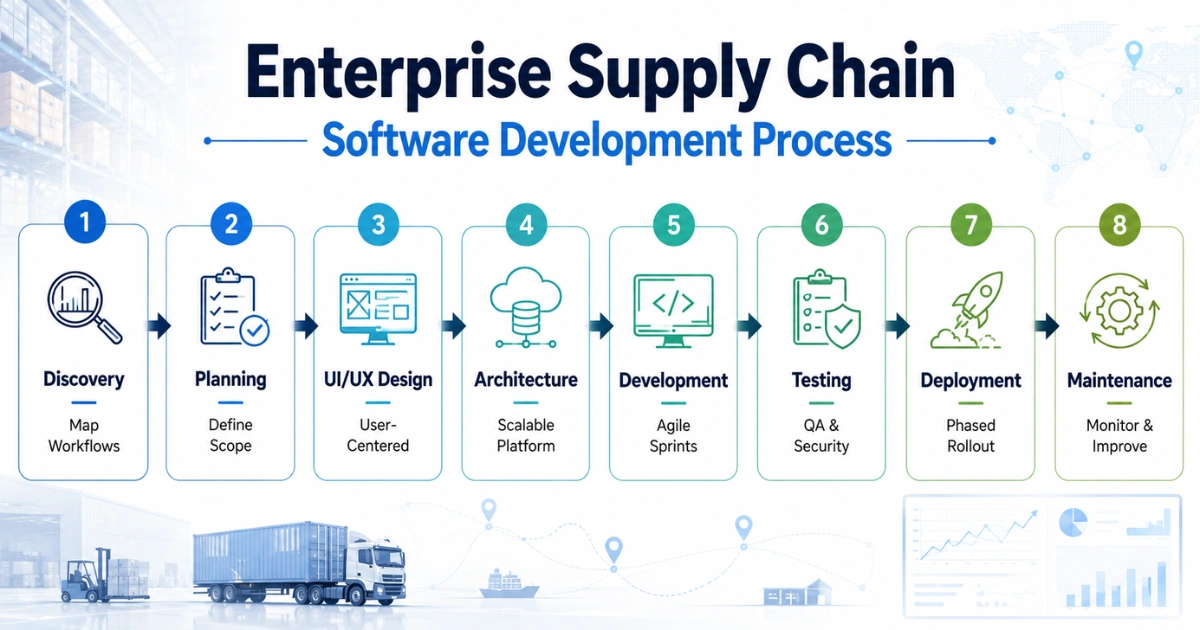
A rushed discovery phase is the single most common reason enterprise SCM projects run over budget or miss the mark on requirements. The process below is what a properly run engagement looks like end to end.
- Discovery — Mapping current workflows, systems, pain points, and stakeholders before a single line of code is written.
- Planning — Defining scope, architecture approach, integration requirements, and a realistic timeline.
- UI/UX Design — Designing interfaces around how planners, warehouse staff, and executives actually work, not a generic template.
- Architecture — Choosing the cloud infrastructure, data model, and integration approach that will support the platform for years, not just launch.
- Development — Building in iterative sprints with regular stakeholder review, not a single black-box delivery at the end.
- Testing — QA across functionality, load, security, and integration points, including real-world data volume simulation.
- Deployment — Phased rollout, typically starting with one module or one site before scaling.
- Maintenance — Ongoing monitoring, updates, and iteration based on real usage data once the platform is live.
How to Choose the Best Supply Chain Software Development Company in Dubai
Not every development shop that lists "logistics software" on its website has actually shipped enterprise-grade SCM platforms. Here's what separates the ones that have from the ones that haven't.
Selection Checklist
- Industry experience — Have they built for logistics, retail, or manufacturing specifically, or is this their first supply chain project?
- AI capability — Can they show real deployed forecasting or automation, not just a slide about "AI-powered" features?
- Cloud expertise — Do they have genuine architecture experience with AWS, Azure, or Google Cloud at enterprise scale?
- ERP integration experience — Have they actually integrated with SAP, Oracle, or Dynamics before, and can they name the specifics?
- Security posture — What's their approach to data security and access control for sensitive commercial data?
- Ongoing support model — What does post-launch support actually look like, contractually?
- Case studies — Can they show results, not just screenshots?
- Agile delivery process — Will you see working software incrementally, or only at the very end?
- Scalability planning — Is the architecture built to handle 3x your current volume without a rebuild?
- Compliance knowledge — Do they understand UAE VAT, customs, and ESG reporting requirements specifically?
Questions to Ask Before Hiring
- "Show me a supply chain platform you've built that's still in production today."
- "Walk me through how you'd handle our specific ERP integration."
- "What happens if our requirements change mid-project?"
- "Who owns the code and the data once the project is delivered?"
- "What does your team look like day-to-day — in-house, or largely subcontracted?"
Industry-Specific Use Cases
The same core platform looks different depending on what's actually moving through it.
Retail: Omnichannel inventory sync is the priority — stock visible and reservable across e-commerce, marketplace, and physical stores in real time, so a sale on one channel doesn't create a phantom stockout on another.
Manufacturing: Raw material forecasting and supplier lead-time tracking matter most, since a single delayed component can stall an entire production line. Digital twin simulation is especially valuable here for testing supplier disruption scenarios.
Healthcare and Pharma: Cold chain monitoring and full traceability are non-negotiable — IoT temperature sensors feeding directly into the platform, with an audit trail that satisfies regulatory review.
3PL Providers: Multi-client visibility is the core requirement — separate, secure views for each client sharing the same underlying warehouse and transport infrastructure, without one client seeing another's data.
E-commerce: Speed of order-to-delivery and accurate real-time inventory across marketplaces are what drive customer retention, making WMS and TMS integration the highest-priority build.
FMCG: High-volume, low-margin operations depend on route optimization and demand forecasting accuracy, since even small inefficiencies compound fast across thousands of daily shipments.
Common Mistakes to Avoid
- Skipping proper discovery. Rushing into development before mapping existing workflows in detail is the fastest way to end up with software nobody actually wants to use.
- Underestimating ERP integration complexity. Treating ERP integration as an afterthought instead of a core architecture decision is one of the most common causes of budget overruns.
- Buying features you don't need yet. Enterprise-tier AI capability sounds impressive in a pitch, but paying for digital twin simulation before your basic inventory data is even clean is money spent in the wrong order.
- Choosing a vendor without regional experience. A development team with no prior GCC compliance or free-zone experience will learn on your project — at your cost and on your timeline.
- Ignoring change management. The best-built platform fails if warehouse staff and planners aren't trained and bought in before go-live.
- Building for today's volume only. Architecture that isn't built to scale means a partial rebuild in two years — plan for 3x your current volume from the start.
Risk Mitigation and Integration Readiness Checklist
Before kicking off a build, most experienced teams will want clear answers to:
- Is your current data (inventory, SKU, supplier records) clean enough to migrate, or does it need remediation first?
- Which systems absolutely must integrate on day one, and which can follow in phase two?
- Who internally owns the project — is there a single accountable stakeholder, or is ownership split across departments?
- What's your realistic tolerance for downtime during migration and cutover?
- Do you have a rollback plan if a phased deployment surfaces a critical issue?
90-Day Supply Chain Modernization Roadmap
A useful framework for enterprises that want to move without overcommitting upfront:
Days 1–30 — Assess and Scope. Audit existing systems, data quality, and integration points. Identify the two or three pain points causing the most operational or financial damage right now, and scope a first phase around fixing those specifically, not everything at once.
Days 31–60 — Design and Pilot. Design the target architecture and begin a focused pilot — often a single warehouse, one product line, or one region — rather than a full enterprise rollout. This surfaces integration issues while the blast radius of a mistake is still small.
Days 61–90 — Validate and Plan the Scale-Up. Measure the pilot against real KPIs: order accuracy, forecast error rate, fulfillment time. Use those results to build the business case and technical plan for a phased, enterprise-wide rollout.
This staged approach is deliberately conservative — it trades a slightly slower start for a much lower risk of an expensive, high-visibility failure six months in.
The Future of Supply Chain Software Beyond 2026
The direction of travel is fairly clear even if the exact timeline isn't. Expect continued movement toward:
- Agentic AI taking on more autonomous decision-making — not just recommending, but executing, with human oversight shifting to exception handling rather than routine approval.
- Autonomous warehouses, where robotics and AI orchestration handle a growing share of picking, packing, and inventory management with minimal manual intervention.
- Hyperautomation, connecting AI, robotics, and process automation across the entire chain rather than in isolated pockets.
- Generative AI applied to supplier negotiation drafting, compliance documentation, and scenario planning narratives.
- Predictive maintenance extending from fleet vehicles to warehouse equipment and even facility infrastructure.
- Self-healing supply chains that detect a disruption and automatically reroute or rebalance before a human ever sees an alert.
- Deeper human-AI collaboration, where the planner's job shifts from data-gathering to judgment calls on exceptions the system has already flagged and pre-analyzed.
None of this replaces the fundamentals covered above — it builds on top of them. An enterprise without clean data and integrated systems today won't be ready for agentic AI tomorrow, no matter how advanced the model is.
Why Choose SISGAIN for Supply Chain Software Development in Dubai
SISGAIN builds enterprise supply chain platforms for organizations that have outgrown what off-the-shelf software can offer — combining deep expertise in AI, cloud architecture, mobile development, and ERP integration with hands-on experience across IoT and analytics-driven logistics systems.
Our teams have worked through the exact challenges covered in this guide: fragmented systems, legacy ERP constraints, GCC-specific compliance, and the real-world complexity of scaling a platform from one warehouse to a multi-site regional operation. We build for ownership, not lock-in — the enterprise owns the code, the data, and the roadmap once the platform ships.
If your supply chain software is holding your operations back rather than moving them forward, that's worth a conversation before it becomes a bigger problem.
Get a Free Consultation to talk through your specific supply chain challenges, or Estimate Your Project Cost to get a realistic scope and budget range before you commit to a build.
Conclusion
Dubai's position as a global trade hub isn't slowing down, and neither is the pressure on the systems trying to keep pace with it. AI-powered, custom-built supply chain software has moved from competitive advantage to operational necessity for enterprises serious about growth in the region — the visibility, automation, and cost control it delivers simply aren't achievable with fragmented legacy systems or generic off-the-shelf platforms.
The enterprises that will be ahead in 2027 and beyond are the ones investing in that infrastructure now, not the ones waiting until a disruption forces the decision. If you're evaluating what that build should look like for your own operation, get in touch for a free logistics software consultation — we'll walk through your current systems, your growth plans, and what a realistic roadmap actually looks like.