
Dubai is no longer competing only on logistics infrastructure — it's competing on logistics intelligence.
For twenty years, the city built its reputation on ports, free zones, and road networks that could move goods faster than almost anywhere else on earth. That infrastructure still matters. But it's no longer the differentiator it used to be. Every serious logistics hub in the Gulf has ports, customs efficiency, and highway access now. What separates a warehouse that wins enterprise contracts from one that loses them in 2026 is what happens inside the four walls — how fast an order gets picked, how accurately stock is counted, how quickly a manager can see a shortage coming before it becomes a stockout.
E-commerce volume across the UAE keeps climbing, omnichannel fulfillment has become table stakes rather than a competitive edge, and warehouse operations that once ran fine on spreadsheets and paper pick lists are starting to buckle under the weight. A 40,000 sq ft facility handling 200 orders a day can survive on manual processes. The same facility handling 4,000 orders a day, across three sales channels, with same-day delivery promises, cannot.
That's the gap a warehouse management system (WMS) is built to close. AI-driven demand forecasting, IoT sensors, robotics, cloud-based platforms, and real-time inventory visibility have moved from "nice to have" pilot projects to baseline requirements for any enterprise that wants to stay competitive in Dubai's logistics market.
A modern WMS isn't inventory software anymore. It's the digital command center connecting people, machines, and every moving part of the supply chain.
This guide breaks down what that actually means — the features worth paying for, what AI and automation are doing to warehouse operations right now, what it costs to build one, and how to think about ROI before you sign a contract.
Why Dubai Enterprises Need Warehouse Management Systems in 2026
Dubai's growing logistics ecosystem
Dubai handles a volume of trade that's genuinely hard to picture until you look at the numbers. Jebel Ali Port remains one of the busiest container ports outside East Asia, and free zones like JAFZA, DAFZA, and Dubai South continue to pull in manufacturers, distributors, and 3PL operators who need warehousing that can keep pace with cross-border trade flows.
Add the e-commerce boom — Noon, Amazon.ae, and a growing wave of direct-to-consumer brands all fulfilling from Dubai-based warehouses — and you get a logistics environment where inventory has to move faster, in smaller batches, to more destinations, than it did even five years ago. A distribution center that used to ship pallets to twenty retail accounts now often ships individual parcels to twenty thousand doorsteps.
That shift changes what "good enough" warehouse operations look like. It's one thing to know roughly how much stock you have. It's another to know exactly how much stock you have, where it sits on the shelf, and whether it can reach a customer in Sharjah by tomorrow morning.
Challenges facing traditional warehouses
Most of the operational pain we hear about from Dubai warehouse operators traces back to the same handful of root causes:
|
Challenge |
Business Impact |
|
Manual inventory tracking |
Stock inaccuracies, mismatched counts between system and shelf |
|
Limited visibility |
Poor decision-making, reactive rather than proactive management |
|
Labor dependency |
Higher operational costs, inconsistent performance across shifts |
|
Slow picking process |
Delayed deliveries, missed SLA windows |
|
Data silos |
Supply chain inefficiency, no single source of truth |
None of these problems are new. What's changed is the cost of tolerating them. A 2% inventory discrepancy was an annoyance in 2018. In 2026, with same-day delivery promises and razor-thin retail margins, that same 2% discrepancy shows up as cancelled orders, refunds, and customers who quietly switch to a competitor.
Why digital transformation is becoming mandatory
Real-time operations, predictive analytics, and automation aren't emerging trends anymore — they're the baseline customers expect. When a shopper orders from a Dubai-based retailer, they expect the same delivery accuracy and speed they'd get from a global platform. A warehouse still running on manual pick sheets and end-of-day spreadsheet reconciliation simply can't deliver that consistently at scale.
This is also where the broader technology stack around a warehouse starts to matter. A WMS rarely operates in isolation — it needs to talk to your supply chain software, your transportation systems, and your sales channels in real time, not through nightly batch uploads.
What Is a Warehouse Management System in 2026?
A warehouse management system used to mean one thing: software that tracked what was in a warehouse and where. That definition hasn't disappeared, but it's now only the starting point.
Traditional WMS vs. AI-powered WMS
|
Traditional WMS |
AI-Powered WMS |
|
Rule-based operations |
Predictive intelligence |
|
Manual decisions |
Automated optimization |
|
Static inventory data |
Real-time visibility |
|
Limited integrations |
Connected ecosystem |
A traditional WMS tells you what happened — stock levels as of the last scan, orders as of the last sync. An AI-powered WMS tells you what's about to happen: which SKUs are trending toward a stockout, which picker route will save the most time this shift, which supplier delivery is likely to run late based on historical patterns.
Think of a modern WMS as three things layered on top of each other:
- A warehouse operating system — the software that runs day-to-day workflows: receiving, put-away, picking, packing, shipping.
- A data intelligence layer — the engine that turns raw scan and transaction data into forecasts, alerts, and recommendations.
- An automation controller — the system that talks directly to robots, conveyors, and IoT sensors, not just to human operators holding a scanner.
This is also where the terminology can get confusing. A enterprise logistics software platform might include WMS functionality alongside transportation and yard management — worth clarifying with any vendor before you assume "WMS" and "logistics platform" mean the same thing in their pitch.
Essential Warehouse Management System Features 2026
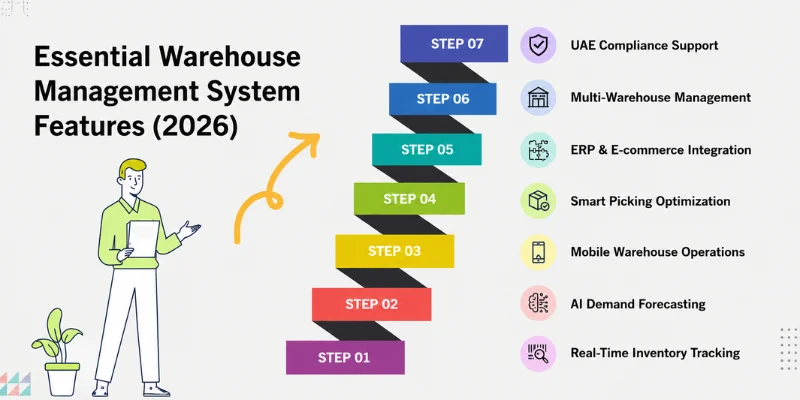
Modern warehouses need more than a digital ledger of what's on the shelf. They need systems that make decisions, not just record them. Here's what actually matters when evaluating or building a WMS in 2026.
1. Real-time inventory tracking
This is still the foundation, and it's still where most warehouses lose the most money when it's done poorly.
A properly built tracking layer combines several identification methods depending on the product and workflow:
- Barcode scanning for standard SKU-level tracking
- RFID for bulk or high-velocity items where scan speed matters
- Serial number tracking for high-value or warranty-relevant goods
- Batch and lot management for regulated or perishable inventory
- Expiry date tracking for food, pharma, and cosmetics
Warehouses that implement this properly typically see inventory accuracy climb to 99% or higher, with a corresponding drop in stockouts and the kind of "system says we have it, shelf says we don't" incidents that erode customer trust.
2. AI-based demand forecasting
This is where the shift from "record-keeping software" to "decision-making software" really shows up. Instead of reordering based on last month's average, AI forecasting models pull in seasonality, promotional calendars, and even external signals like weather or local events to predict what inventory levels should actually look like two, four, or eight weeks out.
Done well, this reduces both overstocking (capital tied up in slow-moving inventory) and understocking (lost sales during demand spikes). It's a natural extension of broader AI in logistics adoption across the region, and it's usually the single feature that delivers the fastest measurable ROI.
3. Mobile warehouse operations
Warehouse staff shouldn't need to walk back to a fixed terminal to check a task list or confirm a pick. Android-based handheld scanners, mobile manager dashboards, and offline-capable apps that sync once connectivity returns are now standard expectations, not premium add-ons — especially in facilities where Wi-Fi coverage isn't uniform across every aisle.
4. Automated picking optimization
Picking is usually the single most labor-intensive activity in a warehouse, and it's the one most improved by smart software. A well-built WMS supports:
- Batch picking (grouping multiple orders into one pass)
- Zone picking (assigning pickers to fixed areas)
- Wave picking (releasing orders in scheduled batches aligned to shipping cutoffs)
- AI route optimization (calculating the shortest walking path per shift, not per order)
The difference between an unoptimized picker and one following an AI-generated route is often the difference between 60 and 120 picks per hour on the same floor.
5. ERP, TMS & e-commerce integration
A WMS that doesn't talk to the rest of your business is a data silo with a nicer interface. Integration typically needs to cover:
ERP systems: SAP, Oracle, Microsoft Dynamics E-commerce platforms: Shopify, Amazon.ae, Noon
These integrations feed order data into the warehouse and push fulfillment status back out — and they need to connect just as tightly to your transportation management system so that a completed pick and pack automatically triggers the right carrier booking, rather than someone manually re-entering the same order into a second system.
6. Multi-warehouse management
Enterprises operating across multiple Dubai locations, or expanding into Abu Dhabi and Sharjah, need centralized visibility — one dashboard showing stock across every facility, with the ability to trigger inter-warehouse transfers when one location runs short and another has surplus.
7. UAE compliance features
This category gets overlooked in generic WMS comparisons, and it shouldn't. Enterprises operating in the UAE need:
- VAT-compliant invoicing and reporting built into fulfillment workflows
- Arabic-language interface support for warehouse staff
- Data security practices aligned with UAE data protection requirements
- Local hosting options where regulatory or contractual requirements demand it
A platform built primarily for the US or European market can miss these entirely, which is one of the strongest arguments for custom development over an off-the-shelf license — more on that below.
AI & Automation Trends Transforming Dubai Warehouses in 2026
1. AI-powered warehouse optimization
Beyond forecasting, AI is now handling operational decisions that used to sit with a warehouse supervisor: where to place fast-moving SKUs for minimum travel distance, how to allocate workers across zones based on real-time order volume, and which orders to prioritize when capacity is tight. The result is faster throughput and fewer of the small human errors that compound over a busy shift.
2. Autonomous mobile robots (AMRs)
AMRs have moved from pilot projects to standard equipment in mid-to-large Dubai facilities. They're not replacing warehouse staff so much as removing the walking — robots handle material movement between zones and assist with picking, while people focus on judgment-heavy tasks like quality checks and exception handling.
3. Warehouse Execution Systems (WES)
This is a distinction worth understanding before you talk to vendors: a WMS manages what inventory exists and where it should go. A WES manages how the physical work gets executed — orchestrating robots, conveyors, and pick stations in real time. Larger, highly automated facilities increasingly run both, with the WES sitting as an execution layer beneath the WMS.
4. Digital twin technology
Before committing capital to a new layout or automation investment, forward-thinking operators are building digital twins — virtual replicas of their warehouse — to simulate changes before touching the physical floor. It's a cheaper way to find out a proposed layout doesn't work than finding out after the racking is installed.
5. Predictive maintenance using IoT
Sensors on conveyors, forklifts, and automated equipment now track vibration, temperature, and usage patterns to flag maintenance needs before a breakdown happens mid-shift. For any facility running automation, unplanned downtime is expensive enough that predictive maintenance usually pays for itself quickly.
6. Sustainable smart warehouses
Energy optimization, carbon tracking, and green logistics reporting are becoming procurement requirements, not just goodwill gestures — particularly for enterprises supplying multinational retailers with their own sustainability commitments to report on.
ROI of WMS Implementation Dubai: How Businesses Recover Investment
WMS investment shouldn't be measured against software cost alone. The real question is what it saves and earns across labor, inventory accuracy, and order fulfillment speed.
Business benefits by category
|
Area |
Expected Improvement |
|
Labor efficiency |
20–40% reduction in labor hours per order |
|
Inventory accuracy |
99%+ |
|
Warehouse productivity |
15–30% improvement |
|
Space utilization |
Up to 20% improvement |
ROI calculation formula
The math is straightforward:
ROI = (Annual Savings − Annual Cost) ÷ Annual Cost × 100
Annual savings should account for reduced labor hours, fewer stock write-offs from inaccurate counts, faster order turnaround (and the resulting drop in expedited-shipping costs), and better space utilization that delays or avoids a warehouse expansion.
Example scenario
Take a mid-sized Dubai distribution warehouse before and after WMS implementation:
Before:
- 50 employees running manual inventory processes
- High picking error rate driving returns and re-shipments
- No real-time visibility into stock levels across zones
After WMS implementation:
- Automated workflows cut labor dependency by roughly a third
- Picking accuracy improves enough to noticeably reduce return-driven costs
- Faster fulfillment supports same-day and next-day delivery commitments without adding headcount
The specific numbers vary by warehouse size, order volume, and how much automation gets layered in — but the pattern holds across most implementations we see in the market. Understanding the underlying software development costs in 2026 helps set realistic expectations for what a custom build versus a licensed platform will actually run.
Best WMS Software Dubai 2026: What Options Are Available?
Enterprise solutions
For large-scale operations with complex, multi-site requirements:
- SAP EWM
- Oracle NetSuite WMS
- Microsoft Dynamics WMS
- Manhattan Associates
- Blue Yonder
These platforms offer deep functionality but come with correspondingly high licensing costs and implementation timelines — and they're often built around workflows that don't map cleanly onto Dubai-specific requirements like Arabic-language support or local VAT reporting without additional customization.
Mid-market solutions
For growing businesses that need more than a spreadsheet but less than an SAP deployment:
- Zoho Inventory
- FirstBit ERP
- Axolon ERP
These cover the fundamentals well and are often the right starting point for a business still validating how much automation it actually needs.
Custom WMS development
Custom builds make sense once a business hits the limits of what off-the-shelf software can flex to accommodate — typically when:
- Workflows are complex enough that standard software forces awkward workarounds
- Multiple warehouses need centralized, tailored management
- The industry has specific requirements (cold chain, pharma, high-value goods) that generic platforms don't handle well
- AI automation needs to be built around proprietary processes rather than a vendor's generic model
How To Choose a Warehouse Management System in UAE
1. Business requirements first
Before comparing vendors, get specific about your own operation: warehouse size, industry vertical, and order volume all shape which features actually matter. A fashion e-commerce warehouse and a cold-chain food distributor need almost entirely different feature sets, even at similar square footage.
2. Integration capability
Confirm — don't assume — that a platform integrates cleanly with your existing ERP, CRM, TMS, and e-commerce channels. "Integration available" in a sales deck sometimes means a costly custom API project once you're under contract.
3. Scalability
Think past your current footprint. Will the system support additional warehouses, a growing user base, and expanding automation without a full replatform in two years?
4. Security & compliance
Data encryption, role-based access control, and reliable backup systems aren't optional extras for a system holding your entire inventory and order history. Confirm these are built in, not bolted on.
Warehouse Management System Development Cost Dubai 2026
Cost depends heavily on scale, feature depth, and how much AI and automation gets built in from day one.
Small warehouse
Cost: $20,000–$50,000 Timeline: 4–8 weeks
Covers core inventory tracking, basic picking workflows, and simple integrations — a solid fit for single-location operations without heavy automation needs.
Medium enterprise
Cost: $50,000–$150,000 Timeline: 3–6 months
Adds deeper ERP/TMS integration, mobile operations, multi-user role management, and often the first layer of AI-driven forecasting.
Large enterprise
Cost: $150,000–$2M+ Timeline: 6–12 months
Covers multi-warehouse orchestration, robotics integration, digital twin modeling, and enterprise-grade compliance and security requirements.
Factors that move the number within each bracket:
- Depth of AI/ML features versus rule-based automation
- Number and complexity of third-party integrations
- Custom mobile app development versus using off-the-shelf scanner software
- Cloud infrastructure choices and hosting requirements
For a broader sense of how these numbers compare across project types, it's worth reviewing typical app development cost in Dubai benchmarks before scoping a WMS build.
Warehouse Management System Implementation Roadmap
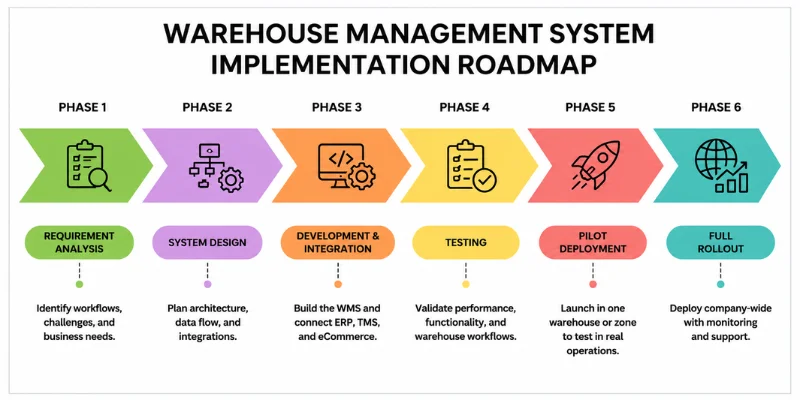
A WMS rollout that skips steps tends to show up as chaos on go-live day. A disciplined roadmap looks like this:
Phase 1: Requirement analysis — mapping current workflows, pain points, and must-have features before writing a line of code.
Phase 2: System design — architecture, data model, and integration planning.
Phase 3: Development & integration — building the platform and connecting it to ERP, TMS, and e-commerce systems.
Phase 4: Testing — functional testing, load testing, and workflow validation with real warehouse scenarios, not just clean sample data.
Phase 5: Pilot deployment — running the system in one zone or one warehouse before a full switch, so problems surface at small scale.
Phase 6: Full rollout — company-wide deployment with monitoring and rapid-response support for the inevitable first-week issues.
Three mistakes derail more implementations than any technical shortfall:
- Over-customization — building every possible feature instead of the ones the business actually needs, which extends timelines and inflates cost without proportional benefit.
- Poor training — the best system in the world fails if warehouse staff don't trust it or don't know how to use it under pressure.
- Ignoring hardware compatibility — scanners, printers, and existing racking systems need to be checked against software requirements before development starts, not discovered as a problem during pilot deployment.
Future of Warehouse Management Systems in Dubai Beyond 2026
The trajectory is toward warehouses that need less human intervention for routine decisions, not warehouses without people. A few directions worth watching:
- AI autonomous warehouses — facilities where inventory placement, replenishment triggers, and picking prioritization run largely without manual input, with human oversight reserved for exceptions.
- Robotics-workforce collaboration — robots and staff working the same floor with software coordinating both, rather than robots operating in isolated, fenced-off zones.
- Predictive supply chains — forecasting that extends beyond a single warehouse to anticipate disruptions across the entire supply network.
- Connected logistics ecosystems — WMS, TMS, and yard management systems operating as one unified platform rather than separate tools stitched together after the fact.
Enterprises building fleet and delivery operations alongside warehouse automation should also be looking closely at logistics & fleet management app development cost as part of the same investment conversation — the two are increasingly built to work as one connected system rather than two separate purchases.
Why Choose Custom Warehouse Management System Development Dubai?
Off-the-shelf software solves the 80% of warehouse operations that look the same everywhere. It's the other 20% — the workflows specific to your product, your customer promises, your existing tech stack — where generic platforms start forcing compromises.
Custom WMS development gives you:
- Business-specific workflows built around how your warehouse actually operates, not how a vendor assumed a "typical" warehouse operates
- Deeper integrations with the exact ERP, TMS, and sales channels you already run
- AI capabilities trained on your own data and demand patterns, not a generic model
- Scalability designed for where your business is headed, not just where it is today
- A genuine competitive advantage — since your competitors can't buy the same system off a shelf
Partner with an experienced software development company in Dubai to build a warehouse management platform designed around your operational goals, not around the limitations of someone else's product roadmap.