
If you've been collecting quotes for the last few weeks, you already know the problem: one agency says AED 60,000, another says AED 450,000, and nobody explains why. Both quotes might be honest. They're just pricing completely different products.
Here's the short answer first, then we'll get into why it varies so much.
Mobile app development in the UAE typically costs between AED 40,000 and AED 500,000+ in 2026. A professionally built, production-ready business app usually lands in the AED 100,000–300,000 range. Enterprise, fintech, healthcare, and AI-heavy applications with deep integrations can pass AED 1 million.
The final number depends on app complexity, the number of platforms you're building for, the features you need, your UI/UX requirements, backend architecture, third-party integrations, security and compliance obligations, how much AI is involved, who's building it, and what happens after launch.
This guide breaks every one of those variables down so you can walk into your next vendor conversation knowing what a fair mobile app development cost in Dubai actually looks like — and what you should be asking for in return.
How Much Does It Cost to Develop a Mobile App in UAE in 2026?
There's no single figure that answers "how much does it cost to develop a mobile app in UAE" honestly, because a five-screen informational app and a marketplace with vendor payouts, logistics, and live dashboards aren't the same category of project. What you can get is a realistic planning range for each stage of ambition.
|
App Type |
Estimated Cost |
Timeline |
|
Prototype / Proof of Concept |
AED 10,000–40,000 |
2–6 weeks |
|
Basic MVP |
AED 40,000–100,000 |
6–12 weeks |
|
Standard Business App |
AED 100,000–250,000 |
3–5 months |
|
Advanced Consumer App |
AED 250,000–500,000 |
5–9 months |
|
Complex Marketplace |
AED 400,000–900,000+ |
8–14 months |
|
Enterprise / Regulated App |
AED 700,000–1,500,000+ |
10–18+ months |
Treat these as planning bands, not fixed quotations. If a vendor gives you an exact number before understanding your user flows and backend needs, ask what assumptions they're making — a real quote comes after discovery, not before it.
Who This Guide Is For
This breakdown is written for the people actually staring at a blank budget line: UAE startups sizing up their first release, Dubai SMEs replacing a clunky legacy system, healthcare and fintech teams navigating compliance-heavy builds, restaurants and logistics companies automating operations, marketplace operators juggling multiple user types, and enterprise teams scoping internal tools. If you fall into any of these, the numbers ahead should map fairly closely to what you'll actually be quoted.
Does Mobile App Development Cost More in Dubai Than Other Parts of the UAE?
Not necessarily, and it's worth being clear-eyed about this before it becomes an excuse for a padded quote. Dubai has a dense concentration of established agencies, which does push average rates up slightly compared to some other emirates — but location is only one input among many.
Team seniority, project scope, architecture decisions, QA rigor, the number of integrations, and the level of post-launch support all move the price more than the city on the invoice. A Dubai agency with a lean, senior team can easily quote less than a larger firm elsewhere in the UAE that's staffed with more juniors and heavier overhead.
What actually differs by location is access: Dubai-based teams tend to offer faster in-person meetings, easier compliance sign-off with local regulators, and stronger familiarity with UAE-specific payment gateways and government integrations. Whether that's worth a premium depends on how hands-on you want the relationship to be.
If you're comparing quotes across emirates, our related breakdown of App Development Cost in Dubai digs deeper into city-specific pricing patterns.
Mobile App Development Cost in UAE by App Type
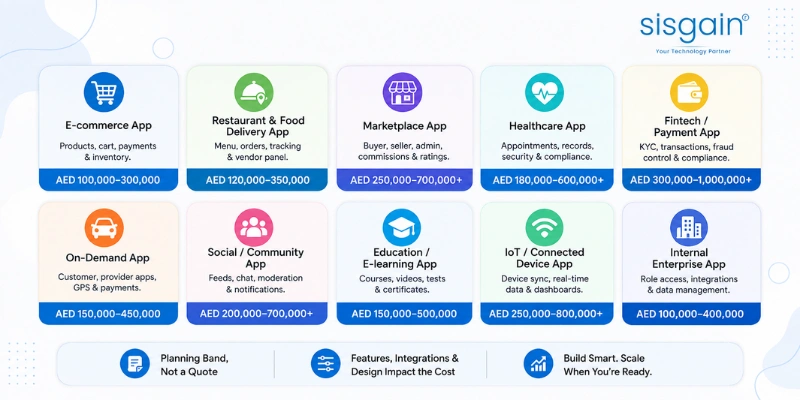
Generic averages hide more than they reveal. Here's what different categories of apps actually run, based on typical UAE project scopes.
E-commerce App — AED 100,000–300,000
Covers product catalogue management, search and filtering, cart and checkout, payment gateway integration, inventory syncing, shipping logic, and promotional tools. Multi-vendor storefronts sit at the higher end of this range.
Restaurant & Food Delivery App — AED 120,000–350,000
Needs a customer-facing menu and ordering flow, live delivery tracking, payment processing, a restaurant or vendor panel, and an admin dashboard to manage all of it. Real-time GPS tracking is usually the single biggest cost driver here.
Marketplace App — AED 250,000–700,000+
Multi-sided platforms are expensive because you're really building three products in one: a buyer experience, a seller experience, and an admin layer to manage commissions, disputes, and moderation. Add multiple dashboards, payout logic, and rating systems, and the scope grows fast.
Healthcare App — AED 180,000–600,000+
Patient records, appointment scheduling, telemedicine, consent management, and integrations with existing healthcare systems all demand serious security work. Data protection isn't optional in this category — it's the majority of the engineering effort.
Fintech / Payment App — AED 300,000–1,000,000+
KYC verification, transaction processing, fraud detection, audit trails, and regulatory compliance push fintech to the top of the pricing spectrum. Security testing alone can account for a meaningful share of the budget.
On-Demand App — AED 150,000–450,000
Ride-hailing, home services, or delivery-style apps need a customer app, a provider app, GPS and dispatching logic, scheduling, and payment handling — effectively two connected products built and maintained together.
Social / Community App — AED 200,000–700,000+
Real-time feeds, messaging, content moderation, and notification systems drive cost here. Scale matters too: an app built for 10,000 users behaves very differently under load than one built for 500,000.
Education / E-learning App — AED 150,000–500,000
Course delivery, video streaming, progress tracking, assessments, and certification workflows are the typical components. Live-class features add complexity beyond static course libraries.
IoT / Connected Device App — AED 250,000–800,000+
Device pairing, real-time data streaming, firmware communication, and dashboard visualization make these projects technically demanding, often requiring specialists beyond a typical mobile team.
Internal Enterprise App — AED 100,000–400,000
Internal tools skip consumer polish but still need solid role-based access, integration with existing enterprise systems, and reliable data handling — often across a larger user base than founders expect.
Every figure above is a planning band, not a quote. Your actual number depends on which features you keep, cut, or push to a later phase.
What Factors Affect Mobile App Development Cost in UAE?
If you only remember one section from this guide, make it this one — it explains almost every quote variance you'll encounter.
1. App Complexity
Basic apps (a handful of screens, minimal logic) sit at the bottom of the range. Medium-complexity apps add user accounts, moderate business logic, and a handful of integrations. Advanced apps introduce real-time features, complex workflows, and multiple user roles. Enterprise apps layer compliance, scale, and legacy-system integration on top of all of it. Screen count barely moves the needle compared to how much decision-making logic sits behind those screens.
2. Features & Functional Requirements
Authentication, multiple user roles, payments, subscriptions, in-app chat, GPS, push notifications, video, offline functionality, and AI personalization each add engineering time. It's not the number of features that matters most — it's how deeply they're woven into your core user flows.
3. iOS vs. Android vs. Cross-Platform
Native iOS and native Android built separately means paying for two codebases. Flutter and React Native reduce duplicated work by sharing most of the code across platforms, which is why cross-platform is the default choice for most business apps today. Native development still earns its keep when you need deep hardware access or platform-specific performance — camera-heavy apps, AR features, or anything requiring the newest OS-level capabilities.
4. UI/UX Design
User research, wireframes, interactive prototypes, a proper design system, accessibility considerations, Arabic RTL layouts, and usability testing all sit under this line item. Skipping this stage doesn't save money — it just moves the cost to expensive rebuilds after launch.
5. Backend Development
This is the part clients underestimate most often. Mobile development isn't just designing screens — someone has to build the APIs, database structure, authentication system, admin panel, analytics pipeline, notification service, file storage, monitoring, and backup/recovery systems behind them. Backend work typically adds AED 20,000–150,000+, scaling with how much data your app needs to move and store.
6. Third-Party Integrations
Payment gateways, CRM and ERP systems, mapping services, SMS providers, logistics platforms, and government systems each bring their own documentation quirks and testing overhead. Budget extra time for any integration you haven't used before — first-time integrations always take longer than the second one.
7. Security & Compliance
Non-negotiable for healthcare, fintech, government, and enterprise projects, and increasingly expected everywhere else too. Encryption, secure authentication, and access controls aren't add-ons anymore — they're baseline requirements clients should assume are included, and should confirm explicitly in every quote.
8. Arabic & English Localization
RTL layouts need to be part of the design process from day one, not bolted on after the English version ships. Retrofitting RTL support into a finished app usually costs more than building it in from the start, because layout assumptions baked into the original design have to be unwound screen by screen.
How Does AI Affect Mobile App Development Cost in UAE?
AI is the biggest shift in app budgets this year, and also the most misunderstood one. Adding an AI chatbot, a recommendation engine, predictive analytics, personalization, computer vision, speech recognition, generative AI, AI-powered search, or intelligent automation doesn't automatically make your app expensive.
What actually drives cost is what the AI is doing, which model or API you're using, whether you need a custom-trained model versus an off-the-shelf one, how much data the system requires, your expected inference volume, and how deeply it's integrated into your existing workflows. A simple support chatbot built on an existing API can be relatively affordable. A custom recommendation engine trained on your own transaction history is a different budget entirely.
If you're planning to add intelligent features to your application, it's worth exploring our AI development in UAE capabilities and understanding how AI development cost changes depending on the complexity of the use case. We've also put together a breakdown of the kinds of AI apps businesses in the region are building right now, if you want a sense of what's realistic for your industry.
Mobile App Development Cost Breakdown
Numbers land better with an example. Here's how a representative AED 200,000 medium-complexity project typically splits across workstreams.
|
Workstream |
Share |
Example |
|
Discovery & Business Analysis |
5–10% |
AED 10K–20K |
|
UX/UI Design |
10–15% |
AED 20K–30K |
|
Mobile Development |
30–40% |
AED 60K–80K |
|
Backend & APIs |
20–30% |
AED 40K–60K |
|
QA |
10–15% |
AED 20K–30K |
|
DevOps |
5–10% |
AED 10K–20K |
|
PM & Documentation |
8–12% |
AED 16K–24K |
Estimated App Cost = Features + UX/UI + Mobile Development + Backend + Integrations + QA + DevOps + Support
The pattern worth noticing: coding is roughly a third of the budget, not the entire budget. Discovery, design, QA, DevOps, and project management together often match or exceed the raw development line. If a quote skips most of these, ask what got cut — it usually surfaces later as scope creep.
Mobile App Development Rates in UAE
Hourly rates tell you what you're paying for the people, separate from the project scope.
|
Resource |
Indicative Rate |
|
Junior Developer |
AED 60–180/hr |
|
Mid-Level Developer |
AED 120–300/hr |
|
Senior Developer |
AED 220–600+/hr |
|
AI/Fintech/Blockchain Specialist |
AED 500–900+/hr |
|
UAE Agency |
AED 180–550+/hr |
|
Offshore/Remote Team |
AED 60–250/hr |
The rate alone tells you very little without knowing what's bundled into it. A lower hourly rate that only covers coding — no business analysis, no UX, no QA, no DevOps, no documentation, no post-launch support — often ends up costing more once you hire separately for everything the quote left out. Always ask what's included before comparing two numbers side by side.
Hidden Costs of Building a Mobile App in UAE
Most people budget for the development quote and forget everything that comes after it. Here's what tends to catch teams off guard.
- Infrastructure & cloud hosting — ongoing server, database, and storage costs that scale with your user base.
- Payment gateway fees — transaction percentages that add up fast once you're processing real volume.
- Maps & location APIs — usage-based pricing that can spike unexpectedly for delivery or ride-hailing apps.
- SMS & email services — needed for OTPs, notifications, and marketing, billed per message sent.
- App store accounts — Apple and Google developer accounts, plus any enterprise distribution fees.
- Security & penetration testing — essential before launch, especially for fintech and healthcare builds.
- Arabic translation — proper localization, not machine translation dropped in at the last minute.
- Legal & privacy documentation — terms of service, privacy policies, and consent flows drafted correctly.
- Maintenance & updates — budget roughly 15–25% of your initial development cost annually, more if you're shipping frequently or supporting new OS versions.
None of these are optional extras. They're part of what it actually costs to keep an app alive and functioning a year after launch.
Do UAE App Development Costs Include VAT?
Usually not automatically — check your contract. UAE VAT sits at 5%, and it applies to most development services unless the supplier's registration status says otherwise. A AED 200,000 development quote, for example, becomes AED 210,000 once 5% VAT is added.
Before signing anything, confirm in writing whether the quoted figure is VAT-inclusive or VAT-exclusive. It's a small detail that causes an unpleasant surprise more often than it should.
Compliance Considerations for UAE Mobile Apps
Beyond VAT, most serious apps need to address data protection, user consent, encryption standards, access controls, audit trails, secure authentication, data retention policies, and — depending on your sector — data residency requirements. Healthcare and fintech apps carry additional sector-specific obligations that should be scoped during discovery, not discovered during a security audit six months post-launch.
Should You Build an MVP or a Full Mobile App?
This decision shapes your entire budget more than almost any feature choice you'll make.
MVP makes sense for startups testing a new concept, teams validating market demand before committing serious capital, and anyone working with a limited budget who needs proof the idea works before scaling it.
Full product builds suit established businesses replacing existing systems, enterprise deployments, regulated industries where compliance can't be phased in later, and complex multi-sided ecosystems that don't function properly as a stripped-down version.
The pragmatic middle path most successful UAE businesses take: Discovery → MVP Build → Scale-Up. Validate the core value proposition with real users first, then reinvest revenue or funding into the features that actually move the needle — instead of guessing at a full feature set upfront and hoping it's right.
A focused MVP Development strategy can help you validate your core product before committing your entire budget to features nobody's asked for yet.
How Can You Reduce Mobile App Development Costs Without Sacrificing Quality?
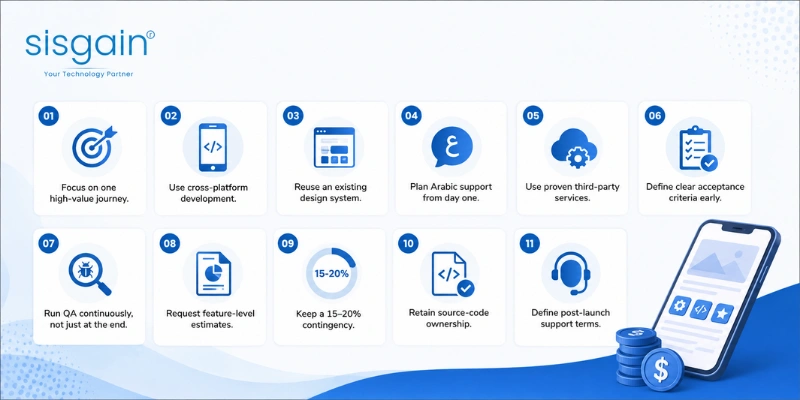
Cutting corners and cutting cost aren't the same thing. Here's what actually brings the number down without gutting the product:
- Prioritize one high-value user journey and build that exceptionally well before adding the rest.
- Choose cross-platform development (Flutter or React Native) unless you have a specific reason not to.
- Reuse an existing design system instead of building one from scratch.
- Plan Arabic support from day one — retrofitting it later almost always costs more.
- Use proven third-party services instead of building custom infrastructure for solved problems.
- Define clear acceptance criteria before development starts, not after a feature is "done."
- Run QA continuously throughout the build, not as a rushed final step before launch.
- Request feature-level estimates so you can see exactly where the budget is going.
- Keep a 15–20% contingency — every project hits something unexpected.
- Retain source-code ownership from the start; buying it back later is expensive.
- Define post-launch support terms in the contract before you sign, not after something breaks.
How to Choose a Mobile App Development Company in UAE
Skip the sales pitch and run through this checklist instead:
- Relevant portfolio — have they shipped something similar to what you're building?
- Technical expertise across the stack you actually need.
- UX capabilities, not just development speed.
- Backend expertise, especially for data-heavy or integration-heavy apps.
- A defined QA process, not "we test as we go."
- Documented security practices.
- Cloud infrastructure expertise.
- AI capabilities, if that's part of your roadmap.
- Industry experience relevant to your sector.
- Clear, responsive communication throughout the project.
- Source-code ownership terms spelled out in the contract.
- Post-launch support commitments in writing.
Before comparing quotes side by side, our guide to Choosing the Best Mobile App Development Company in UAE walks through how to evaluate vendors beyond the headline price — which, as this article should have made clear by now, rarely tells the whole story.
15 Questions to Ask a UAE App Development Company Before Hiring Them
- Does the quote include discovery and business analysis?
- Is UX/UI design included, or billed separately?
- Is backend development covered in this number?
- Is QA included throughout the build, or only at the end?
- Is DevOps and deployment covered?
- Is Arabic/RTL support included?
- Which devices and OS versions will actually be tested?
- Are the third-party integrations you need included in scope?
- Who owns the source code once the project is delivered?
- Who owns the cloud hosting account?
- Is security testing part of the deliverable?
- What happens after launch — is there a support plan?
- What warranty period applies to bugs found post-launch?
- How are change requests priced once development has started?
- Can they provide references from actual UAE-based projects?
Get these answered before you sign, not after.
Is a Mobile App Always the Best Choice for a UAE Business?
Not always. Progressive Web Apps, standard web applications, responsive customer portals, and hybrid builds can outperform a native app for businesses that don't need offline functionality, deep device integration, or app store distribution.
If your users mostly interact with your business through a browser or a shared link rather than downloading a dedicated app, our web app development solutions might get you to market faster and cheaper. It's also worth reading our take on the Future of Web Development in Dubai if you're weighing native versus web before committing budget either way.
How Much Should Different UAE Businesses Budget for an App?
|
Business Situation |
Recommended Budget |
|
Startup testing an idea |
AED 40K–100K |
|
SME customer-service app |
AED 100K–200K |
|
Funded startup |
AED 200K–500K |
|
Marketplace |
AED 300K–700K+ |
|
Fintech / Healthcare / Enterprise |
AED 500K–1.5M+ |
Match your budget to your actual stage, not your ambition. A funded startup building for a 500,000-user market shouldn't budget like a bootstrapped MVP — and a bootstrapped founder shouldn't be quoted enterprise pricing for a validation-stage product.
So, How Much Does It Cost to Build a Mobile App in UAE?
Back to the question you started with:
- AED 40,000–100,000: Lean MVP
- AED 100,000–300,000: Professional commercial app
- AED 300,000–700,000+: Advanced platform
- AED 700,000–1,500,000+: Enterprise, fintech, healthcare, or AI-heavy application
The cheapest development quote isn't necessarily the cheapest product to own. A dependable app needs research, real UX work, solid backend architecture, security testing, thorough QA, a proper deployment process, analytics, ongoing maintenance, and compliance handling — and every one of those either shows up in your upfront quote or shows up later as an unplanned expense.
If you're ready to see what these solutions look like for businesses like yours, take a look at Mobile Apps We Build for Businesses in Dubai, or explore our On-Demand App Development Solutions if your business model involves real-time matching or dispatching.
Planning a Mobile App in Dubai or the UAE?
If you're at the stage of defining scope, estimating features, choosing an architecture, or deciding between an MVP and a full build, that's exactly the conversation worth having before you request formal quotes — not after.
Get in touch with a Trusted Mobile App Development Company in UAE and walk through your roadmap and budget with a team that's built these apps before, in this market, under these exact compliance rules.