
The Warning Every Government Leader Should Be Paying Attention To
I've spent close to two decades sitting across the table from government CIOs, hospital directors, and ministry heads while they weigh technology decisions. And I'll be honest — I haven't seen a warning land quite like the one Dr. Mohamed Al Kuwaiti, head of the UAE's Cybersecurity Council, gave at the Forbes Building the Future Summit in Abu Dhabi recently. He didn't point primarily at outside hackers. He pointed inward — at agencies deploying AI systems, including autonomous "agentic" ones, without following international governance standards.
That's a different kind of risk than most leadership teams are used to managing. It's not a firewall problem. It's a "someone in my own department spun up an AI agent last month and nobody signed off on it" problem. And with the council reporting between 90,000 and 200,000 breach attempts against the UAE every single day, the margin for internal missteps keeps shrinking.
If your department is running IT and digital services through a partner, this is exactly the kind of exposure a solid Government IT Services Dubai partner should be catching before it becomes a headline—not after.
What's Actually Happening on the Ground
|
Risk Signal |
What It Means for Government Leaders |
|
Shadow AI / shadow agents |
Staff use unsanctioned AI tools or agents to move faster, bypassing IT and security review |
|
90,000–200,000 daily breach attempts |
Many state-sponsored, targeting public infrastructure and citizen-facing platforms |
|
Agentic AI in OT/IoT environments |
Autonomous systems now touch infrastructure, not just chatbots—mistakes have physical consequences |
|
Data manipulation & hallucination |
AI decisions embedded in service delivery can be wrong with confidence, and no one notices in time |
|
Regional geopolitical tension |
AI-enabled disinformation is amplifying rumour propagation and hacktivist activity against UAE platforms |
None of this means AI adoption should slow down — the UAE's ambitions here are not optional in a region racing to digitize. It means the governance has to catch up to the deployment speed, and right now, in a lot of departments, it hasn't.
Why Agentic AI Is a Different Than the Chatbot You Rolled Out Last Year
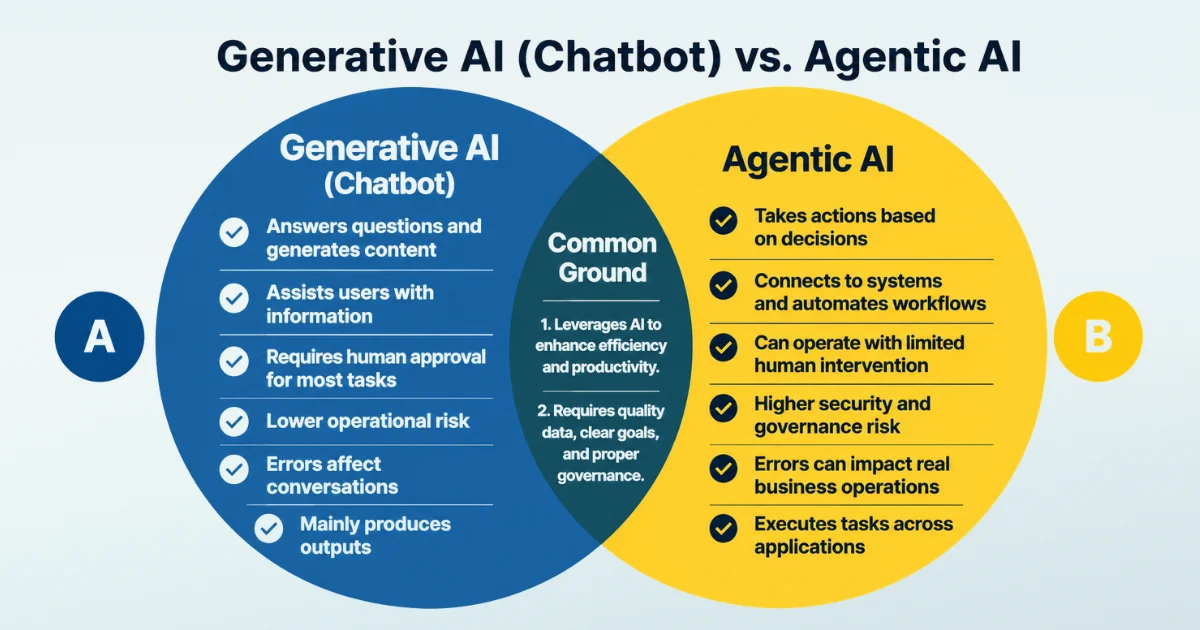
Here's the distinction I find most leadership teams miss: a generative AI tool answers a question or drafts a document. An agentic AI system does something with that answer — it accesses systems, makes decisions, and takes action, often without a human checking each step.
National cybersecurity agencies (UK's NCSC among them) have been blunt about this: agentic systems inherit every known weakness of large language models — prompt injection, jailbreaking, unpredictable reasoning — and then add a much bigger attack surface on top, because the agent can actually do things inside your systems, not just talk about them. If an agent is over-permissioned or poorly scoped, one bad instruction can cascade into a real operational incident, not just an embarrassing chat transcript.
This is exactly why departments evaluating AI development services need a partner who treats permissions, audit trails, and human-in-the-loop checkpoints as part of the build — not as an afterthought bolted on before launch.
Quick Question: Is agentic AI actually banned or restricted in UAE government use?
No blanket ban exists — but agencies like the DoH and DHA require certified, audited AI systems, and unauthorized "shadow" deployment of autonomous agents is exactly what the Cybersecurity Council is warning against.
The Five Risk Zones Every Government Leader Needs to Map
I tell every government client the same thing: you don't need to fear AI, you need to map it. Here are the five zones showing up across UAE public sector risk reports right now.
|
S no. |
Risk Zone |
Why It Matters |
|
1 |
Governance gaps |
Departments launch agentic tools without formal sign-off, leaving no audit trail or accountability owner |
|
2 |
AI-driven phishing & fraud |
Deepfakes and auto-generated text are now convincing enough that staff can't reliably spot them, especially during periods of regional tension |
|
3 |
Biometric data exploitation |
Casual AI avatar and filter apps can harvest facial and biometric data that's nearly impossible to "reset" once compromised |
|
4 |
Regulatory non-compliance |
Over-collecting or mishandling data under the UAE Data Protection Law can trigger significant fines and operational shutdowns |
|
5 |
Workforce resistance |
Staff without training either over-trust AI output or reject it outright — both outcomes create risk |
Every one of these is solvable, but they need to be solved as a system, not as five separate IT tickets. This is where a genuine digital transformation company in uae earns its fee — connecting governance, security, and workforce readiness under one roadmap instead of leaving departments to patch each risk zone in isolation.
It's also worth being clear-eyed about vendor risk. Not every AI tool a department adopts needs to be built from scratch — but it does need to come from a generative ai development company that can show you exactly how data is stored, where it's processed, and who has access, in writing, before a single pilot goes live.
What "Responsible AI" Actually Looks Like Inside a Government Department
"Responsible AI" gets thrown around a lot in conference decks. In practice, for a UAE government entity, it comes down to a handful of concrete things:
- A named AI governance owner — not a committee that meets quarterly, an actual accountable person or cross-functional board
- Data residency discipline — sensitive and health data staying within UAE-approved infrastructure, in line with federal ICT rules
- Phishing-resistant identity controls — because AI voice clones are now good enough to defeat standard multi-factor authentication
- Independent audits of AI functionality, not just at launch but on a recurring cycle
- Alignment with the UAE AI Office and sector regulators (DIFC, ADGM, DHA, DoH) rather than building policy in a silo
The good news: the UAE isn't starting from zero. There's real institutional momentum behind this — you can see it in how fast AI Revolutionizing UAE Government Operations has moved from pilot programs to core service delivery across ministries. The gap isn't ambition. It's that governance frameworks at the national level haven't fully trickled down into department-level SOPs yet — and that's where the actual risk sits.
Building an AI Risk Management Framework That Actually Works
I'm not going to hand you a 40-page compliance document — you don't need one to get started, and honestly, most departments stall out trying to build the perfect framework before doing anything at all. Start here instead:
|
Step |
Action |
Owner |
|
1 |
Inventory every AI tool and agent in active use, including ones IT didn't approve |
IT + Security |
|
2 |
Map what data each tool can access and where it's processed |
Data Protection Officer |
|
3 |
Stand up a cross-functional AI governance board with real authority to pause deployments |
Leadership |
|
4 |
Move to phishing-resistant, scoped identity controls for every AI agent |
Security |
|
5 |
Run mandatory workforce training on spotting AI-driven fraud and understanding AI limitations |
HR + Department Heads |
|
6 |
Schedule recurring audits — not a one-time compliance check |
Governance Board |
This sequence maps closely to where the national conversation is already heading. If you want a sense of scale, look at how seriously the government has committed to this shift — the UAE AI Government Transformation 50% Ambitious Target isn't a side initiative, it's a whole-of-government mandate, which means the governance expectations around it will only get stricter from here, not looser.
And departments looking ahead at where this is all heading — beyond dashboards and chat tools, toward systems that actually support decisions — should take a look at future-ai-uae-government-operations, which lays out where use cases are actually maturing across the public sector right now.
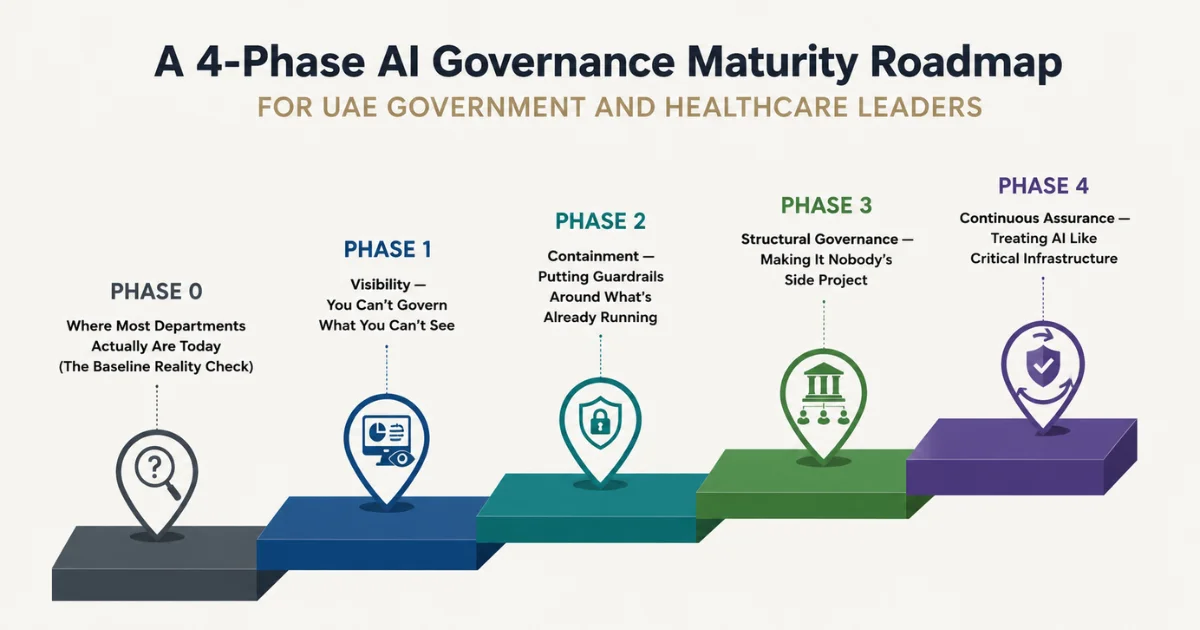
A 4-Phase AI Governance Maturity Roadmap for UAE Government
Every framework I've walked through so far in this piece answers the "what" — what the risk zones are, what responsible AI looks like on paper, what a starter checklist covers. What I haven't answered yet is the harder question every director actually asks me in the room: "Okay, but where do we start, realistically, given our budget and our current mess?"
That's the question this section is for. Over the years, working with government IT teams and hospital groups across the Emirates, I've noticed something consistent: departments rarely fail at AI governance because they don't understand the risks. They fail because they try to jump straight from "we have no policy" to "we have a fully mature governance program," skip the messy middle steps, and end up with a document nobody follows. Maturity isn't a switch you flip. It's a sequence. Here's the sequence that actually works.
Phase 0: Where Most Departments Actually Are Today (The Baseline Reality Check)
Before you can talk about "phases," you need an honest baseline. In my experience, most UAE government sit in one of three starting positions, and it's worth being blunt about which one describes you:
- The Optimist: "We haven't had an incident, so we're probably fine." This is the most dangerous position, because absence of evidence isn't evidence of absence. Shadow AI, by definition, doesn't show up in your dashboards.
- The Overwhelmed: "We know this is a problem, but we don't know where to even start counting the tools in use." This is actually a healthier starting point than the Optimist, because at least the awareness is there.
- The Fragmented: "We have some policies, some audits, some training — but none of it talks to each other." This is common in larger ministries where different departments moved at different speeds, and it creates a false sense of security that's arguably riskier than having no policy at all.
If you recognized your department in one of those three descriptions, you're not behind — you're normal. The UAE Cybersecurity Council's own reporting makes clear that this is a nationwide pattern, not an isolated failure. What separates the departments that get ahead of this from the ones that end up in a news article is simply whether they move through the next four phases deliberately, or wait for an incident to force the sequence on them.
Phase 1: Visibility — You Can't Govern What You Can't See
This is the phase everyone wants to skip, and it's the one that matters most. Visibility means building an honest, department-wide inventory of every AI tool and agent currently touching your systems — including the ones procurement never signed off on, the ones a smart analyst built with a low-code platform over a weekend, and the ones embedded quietly inside a SaaS product you already pay for.
In practice, this looks like:
- A cross-department survey (not just an IT ticket) asking staff directly what AI tools they use to get work done faster
- A technical scan of outbound API traffic to catch AI services nobody self-reported
- A review of every vendor contract signed in the last 18 months for embedded AI features you may not have noticed at signing
- A single, living register — not a one-time spreadsheet — that gets updated as new tools appear
I want to be honest about something here: this phase is uncomfortable. Leaders often discover more shadow AI than they expected, and there's a temptation to treat that discovery as a failure rather than as the whole point of the exercise. It isn't a failure. Finding five ungoverned AI tools during an inventory is a good outcome. Finding them during a breach investigation is not.
Phase 2: Containment — Putting Guardrails Around What's Already Running
Once you know what's actually in use, the instinct is to rip everything out and start over. Resist that instinct. Most of what your staff discovered in Phase 1 exists because it's genuinely useful — people adopted it because it solved a real problem faster than the "approved" process did. Containment means keeping the value while removing the exposure, not punishing adoption.
Containment work typically includes:
- Scoping down permissions on every discovered tool to the minimum needed for its actual task (least-privilege access, applied retroactively)
- Moving any tool touching sensitive citizen or patient data behind approved, UAE-based data residency infrastructure
- Applying phishing-resistant identity controls to any AI agent with system-level access, since standard MFA is no longer a reliable barrier against AI-generated voice and video spoofing
- Setting hard boundaries on what an agentic tool is allowed to do autonomously versus what requires a human sign-off before execution
This is also the phase where the difference between generative AI and agentic AI becomes operationally real, not just theoretical. A generative tool that drafts a citizen-facing email is low risk even if ungoverned — worst case, someone edits a bad draft. An agentic tool that can autonomously update a citizen's record, trigger a payment, or modify an access permission is an entirely different risk category, and containment for agentic tools needs to be stricter by default, not by exception.
Phase 3: Structural Governance — Making It Nobody's Side Project
This is where most departments' AI governance efforts quietly die. Someone in IT security gets handed AI oversight as an addition to their existing job, with no real authority to pause a deployment a department head wants to push live. Six months later, the "governance program" is a folder of policy documents nobody has opened since the kickoff meeting.
Structural governance means giving this function actual teeth:
- A named governance owner or cross-functional board with the authority to delay or block an AI deployment — not just flag concerns
- A mandatory pre-launch review for any new AI tool or agent before it touches production data, citizen services, or patient records
- Clear escalation paths so frontline staff who spot a problem know exactly who to tell and what happens next
- Budget ownership — governance without a budget line is a wish list, not a program
I'll add a point here from direct experience: the departments that get this right almost always have someone at the director level personally sponsoring the governance function, not just an operational manager. AI governance touches procurement, legal, HR, and clinical or citizen-service delivery all at once. Without senior sponsorship, it stalls at the first cross-departmental disagreement.
Phase 4: Continuous Assurance — Treating AI Like Critical Infrastructure
The final phase is the one that separates a department that "did an AI governance project" from one that actually manages AI risk as an ongoing discipline. Continuous assurance means:
- Recurring, scheduled audits of every AI system in production — not a one-time compliance check before a launch
- Red-team style testing for prompt injection and manipulation attempts against agentic systems, mirroring how the department already tests network infrastructure
- Regular refresher training for staff, since AI-driven phishing and deepfake tactics evolve faster than annual training cycles can keep up with
- A feedback loop from incidents (even near-misses) back into the governance board's policy updates
A Maturity Snapshot: Where Does Your Department Actually Sit?
|
Maturity Level |
What It Looks Like |
Typical Risk Exposure |
|
Level 1 — Unaware |
No inventory, no policy, AI adopted ad hoc by individual staff |
Very high |
|
Level 2 — Aware |
Leadership knows shadow AI exists but hasn't inventoried or contained it |
High |
|
Level 3 — Contained |
Full inventory complete, permissions scoped, data residency enforced |
Moderate |
|
Level 4 — Governed |
Named governance owner, mandatory pre-launch review, escalation paths in place |
Low |
|
Level 5 — Assured |
Recurring audits, red-team testing, continuous training feedback loop |
Lowest achievable |
Most UAE government entities I've assessed sit somewhere between Level 1 and Level 2 today — not because leadership doesn't care, but because AI adoption has simply outpaced the governance conversation. That's exactly the pattern Dr. Al Kuwaiti's warning was describing at the national level. The good news is that moving from Level 1 to Level 3 is largely a matter of discipline and sequencing, not budget. The jump from Level 3 to Level 5 is where real investment matters — and where it pays for itself many times over compared to the cost of a single serious incident.
How the UAE's Approach Compares to Global AI Risk Frameworks
One question I get from ministry technology leads fairly often: "Are we behind the rest of the world on this, or ahead?" The honest answer is: further ahead on ambition, still catching up on department-level enforcement — and that's not unique to the UAE.
|
Framework |
Region |
Core Approach |
Where It's Strongest |
|
UAE National AI Strategy 2031 + AI Office guidance |
UAE |
Sector-led governance (DHA, DoH, DIFC, ADGM) under a national AI Office umbrella |
Fast-moving, ambitious adoption targets paired with sector-specific rules |
|
NIST AI Risk Management Framework |
United States |
Voluntary framework built around four functions: govern, map, measure, manage |
Practical, flexible starting point widely used by IT and security teams |
|
EU AI Act |
European Union |
Risk-tiered legal mandate; high-risk systems face binding obligations |
Strongest legal enforcement teeth, especially for high-risk public sector AI |
|
NCSC / CISA joint agentic AI guidance |
UK, US, allied nations |
Technical security guidance specific to agentic AI adoption mandate: |
Most detailed technical guardrails for agentic systems specifically |
The UAE's advantage is speed and coordination—a single AI Office aligning sector regulators is, in principle, faster to act on than fragmented national systems elsewhere. The gap, as Al Kuwaiti's own warning makes clear, is that speed at the national policy level hasn't yet fully translated into enforced discipline at the individual department level. That's not a UAE-specific problem — it's the same gap every government in this list is wrestling with in 2026. It's just that the UAE's adoption pace makes the gap more urgent to close.
A Composite Scenario: What Skipping Phases Actually Costs
I won't name a specific entity here because this pattern isn't unique to one—I've seen versions of it across multiple government engagements, and it's worth walking through because it's exactly the scenario the Cybersecurity Council's warning is trying to prevent.
A department adopts an AI-powered scheduling assistant to reduce citizen wait times. It works well; staff love it. Adoption spreads informally to two other teams who copy the setup without going through procurement. Nobody scopes its data access down—it inherits broad permissions from the staff member who first configured it, because that was the fastest way to get it running. Eight months later, a routine security review (not an incident — just a scheduled review) discovers the tool has read access to a data set well beyond scheduling information, including fields it never needed. No breach occurred. But the department now has to retroactively document who had access to what for how long and justify that to auditors under PDPL—a process that took longer and cost more than proper Phase 1 and Phase 2 work would have taken at the start.
That's the realistic cost of skipping phases: not always a dramatic breach headline, but a slow, expensive, reputationally awkward cleanup that a two-week inventory process would have prevented entirely.
What This Actually Costs, and Why Waiting Costs More
Leadership teams often assume AI governance means a large, multi-year compliance program. It doesn't have to. Phase 1 (visibility) is mostly a time investment—staff surveys, contract reviews, technical scans—and can realistically be completed in a matter of weeks for most departments. Phase 2 (containment) is where real budget enters the picture, primarily around identity controls and data residency infrastructure, but this is infrastructure most departments already need regardless of AI, so it's rarely a fully incremental cost.
The number worth sitting with: IBM's 2025 Cost of a Data Breach research found that organizations using AI extensively in their security operations still saw average breach costs climb toward $4.88 million per incident — and that figure is trending upward as AI agents gain deeper system access. Compare that to the cost of a structured four-phase rollout, spread across a fiscal year, and the math isn't close. This is a case where the "expensive" option is actually the cheaper one.
Common Mistakes UAE Government Make When Adopting AI
I want to close out the practical portion of this piece with something a little more blunt than a framework—the actual mistakes I see repeated across departments and hospital groups, because recognizing your own department in these patterns is often more useful than another checklist.
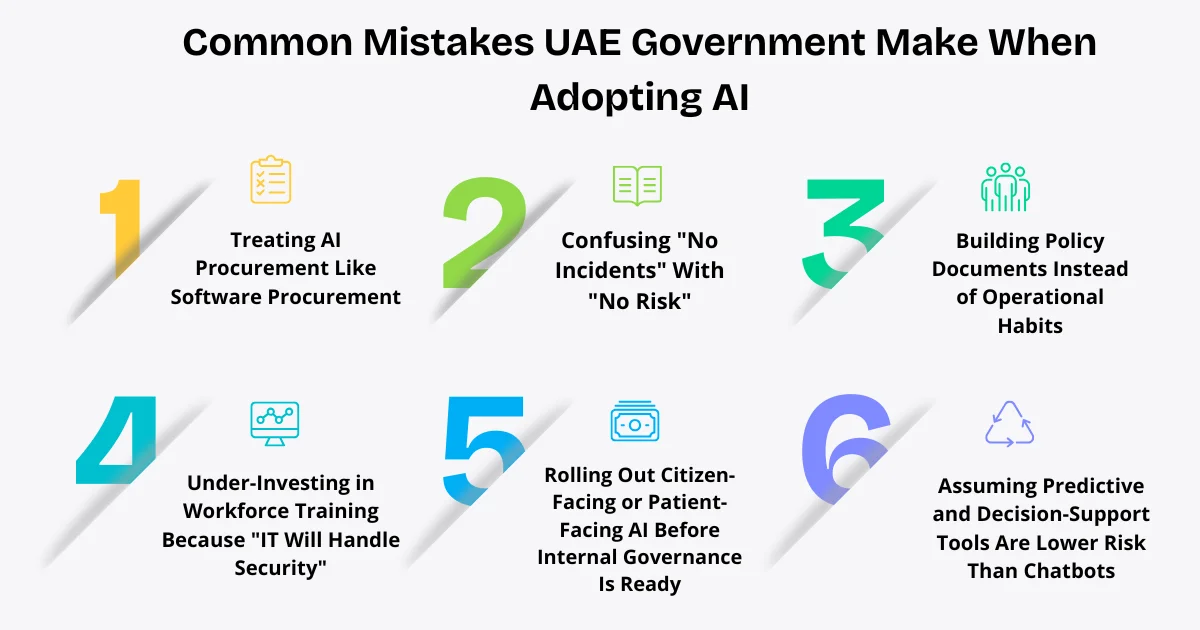
Mistake 1: Treating AI Procurement Like Software Procurement
Most government procurement processes were built for static software — a system you buy, configure once, and audit occasionally. Agentic AI doesn't behave that way. It can change its behavior based on new data, new instructions, or a vendor's own model updates, sometimes without your department being notified. If your procurement checklist for AI tools looks identical to your checklist for a standard software license, you're missing questions that matter: How is the model updated? Who is notified when its behavior changes? What happens if the vendor's underlying model is retrained? A digital transformation company in uae worth working with will insist on these questions being part of the RFP, not an afterthought during implementation.
Mistake 2: Confusing "No Incidents" With "No Risk"
I touched on this earlier with the Optimist archetype, but it deserves repeating because it's the single most common reasoning error I hear in leadership meetings. A department that hasn't had a publicized AI incident often concludes its governance is adequate. But shadow AI, by its nature, doesn't generate visible incidents until something goes wrong at scale. The absence of a fire alarm doesn't mean there's no fire risk — it might just mean the smoke detectors haven't been installed yet.
Mistake 3: Building Policy Documents Instead of Operational Habits
Plenty of departments have an "AI Usage Policy" sitting in a shared drive that nobody has referenced since it was signed off. A policy document is not the same thing as governance. Governance is a habit — a recurring review meeting that actually happens, an inventory that actually gets updated, a pre-launch checklist that actually gets used before a new tool goes live. If your AI governance exists only on paper, it's providing the appearance of protection without the substance of it, which is arguably worse than having no policy at all, because it creates false confidence at exactly the leadership level that should be pushing for more rigor.
Mistake 4: Under-Investing in Workforce Training Because "IT Will Handle Security"
AI-driven phishing and deepfake fraud don't target your firewall — they target your staff's judgment. A finance officer who receives a voice-cloned call that sounds exactly like their director requesting an urgent payment isn't a technology failure; it's a training gap. Departments that pour budget into technical controls while treating workforce training as a checkbox exercise are protecting the wrong layer. The Khaleej Times reporting on workforce resistance as a top risk factor cuts both ways here — undertrained staff either trust AI-generated content too readily or reject genuinely useful AI tools out of fear, and both outcomes trace back to the same root cause: nobody invested properly in building real AI literacy across the organization.
Mistake 5: Rolling Out Citizen-Facing or Patient-Facing AI Before Internal Governance Is Ready
This is the mistake with the highest reputational stakes. It's tempting to prioritize the visible, headline-friendly AI project — a citizen chatbot, a patient-facing scheduling tool — before the unglamorous internal governance work is done. But the citizen or patient experiencing a bad AI interaction doesn't distinguish between "our internal governance was still maturing" and "this department doesn't take AI seriously." A generative ai development company that understands government delivery will push back on launch timelines that outpace governance readiness, even when leadership is eager to show visible progress.
Mistake 6: Assuming Predictive and Decision-Support Tools Are Lower Risk Than Chatbots
There's a common assumption that a citizen-facing chatbot carries more reputational risk than a back-office predictive analytics tool, simply because the chatbot is publicly visible. In practice, the opposite is often true. A flawed predictive model quietly informing resource allocation, risk scoring, or population health decisions can cause far more damage before anyone notices something is wrong — precisely because nobody is watching it the way they'd watch a public-facing tool. Any department deploying forecasting or predictive analytics UAE government strategy work needs the same governance rigor applied to those systems as to anything citizen-facing, if not more, because the feedback loop that catches errors is much slower.
Every one of these mistakes shares a common thread: they're not failures of intent. Nobody sets out to build ungoverned AI risk into a government system. They're failures of sequencing — moving fast on the visible win while treating the unglamorous governance work as something to circle back to later. The departments and hospital groups that avoid this pattern are the ones that build governance into the rollout from day one, not as a retrofit after leadership reads a warning like Al Kuwaiti's and asks, uncomfortably, "wait — do we have this problem too?"
How SISGAIN Helps Government Entities Build This Right
This is the work we do every day at SISGAIN — and I say that as someone who's sat on both sides of the table, as a vendor and as an advisor to teams trying to move fast without creating tomorrow's incident report.
We don't sell departments a single AI tool and walk away. We build the governance, the security layer, and the actual product around each other — from citizen-facing chatbots to full decision-support systems. If your department is weighing an AI assistant for public queries, our Enterprise AI Chatbot Cost & Features guide breaks down what a properly governed rollout actually costs — no vague "contact us for pricing" games.
For agencies further along in their maturity curve, the shift isn't just about adopting AI — it's about AI-Powered Government Transformation done with the right guardrails from day one, and eventually about moving past isolated AI tools altogether toward UAE Government Decision Intelligence Beyond AI — where governance, data, and decision-making are designed as one connected system instead of a patchwork of point solutions.
Final Thoughts:
One question tends to surface toward the end of almost every governance conversation I have, usually from someone who's been quiet through the rest of the meeting: "Whose job is this, exactly?" It's a fair question, and it's usually unanswered, which is a large part of why AI governance stalls even in departments that genuinely want to get it right.
The honest answer is that AI risk doesn't belong to a single department, and pretending it does is part of the problem. It's tempting to hand the entire responsibility to IT and consider the matter closed, but IT rarely has the authority to pause a business-critical AI tool a director wants live by next quarter, and it shouldn't be expected to make that call alone.
A workable ownership model spreads responsibility deliberately rather than defaulting it to whoever's in the room:
|
Function |
Primary Responsibility |
|
IT & Security |
Technical inventory, permissions scoping, identity controls, monitoring |
|
Data Protection Officer |
PDPL compliance, data residency, sensitive data classification |
|
Department Leadership |
Sponsorship, budget, authority to pause a launch |
|
HR / Training |
Workforce readiness, phishing and deepfake awareness training |
|
Legal / Compliance |
Vendor contract review, regulatory alignment with DHA, DoH, DIFC, or ADGM as applicable |
|
AI Governance Board |
Cross-functional decision authority, pre-launch review, recurring audit scheduling |
The point of laying this out explicitly isn't bureaucracy for its own sake. It's that ambiguous ownership is exactly how a department ends up in the composite scenario described earlier — a tool spreads informally because no single function felt clearly responsible for stopping it, and by the time someone notices, the fix is far more expensive than the prevention would have been. A named governance board with representation across these six functions, meeting on a fixed schedule with real authority, is the single structural change that resolves more of this ambiguity than any policy document ever will.