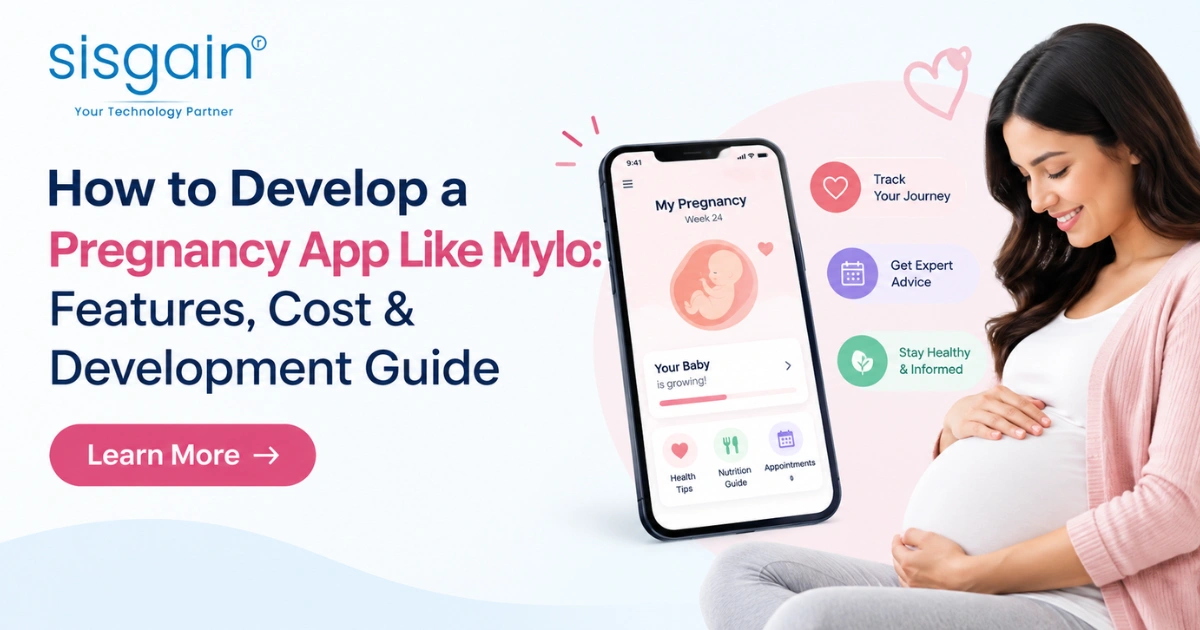

Expecting mothers now want more than scheduled clinic visits and printed advice sheets. They want week-by-week guidance, instant answers, reminders, trusted health content, and digital support they can access anytime. For pediatric clinics, maternity hospitals, women’s health centers, and healthcare startups in the UAE, this shift creates a major opportunity.
A well-designed pregnancy app can help you stay connected with mothers before birth, during pregnancy, and through early childcare. That is why pregnancy app development is becoming a strategic investment for healthcare providers that want stronger engagement, better patient retention, and new digital revenue channels.
Apps like Mylo have already shown how powerful this model can be. A pregnancy app like Mylo is not just a tracker. It combines education, community, reminders, expert support, baby care, and commerce into one user-friendly ecosystem.
In this guide, we will cover the must-have features, development process, technology stack, compliance needs, and the cost to develop pregnancy app platforms in the UAE. If you are planning a digital maternity solution, this guide will help you move from idea to launch with confidence.
For clinics looking to build a secure and scalable solution, investing in healthcare software development can help turn your maternity care vision into a reliable digital product.While healthcare expertise is essential, choosing the right Mobile App Development Company in Dubai can significantly impact scalability, user experience, compliance readiness, and long-term product success. Healthcare providers increasingly look for development partners that understand both clinical workflows and modern mobile technologies.
What Is Mylo and Why Is It So Popular in Pregnancy Care?
Mylo is a pregnancy and parenting platform designed to support mothers through pregnancy, childbirth, and early baby care. It gives users personalized pregnancy tracking, health tips, baby growth updates, community support, expert content, and product recommendations.
Its success comes from one simple idea: pregnancy is not a one-time healthcare event. It is a long, emotional, and information-heavy journey. Mothers need support every week, sometimes every day. Mylo fills that gap by offering a digital companion that stays with users throughout the full maternity experience.
The app provides practical tools such as due date tracking, baby development updates, reminders, symptom logging, and pregnancy tips. It also builds trust through expert-led content and community features where users can ask questions, share experiences, and feel less alone.
From a business view, Mylo is not just a pregnancy tracker. It is a healthcare engagement ecosystem. It keeps users active through content, utility, peer support, and product discovery.
For UAE healthcare startups and clinics, this model is valuable because it can be adapted to local needs, languages, compliance rules, and patient expectations.
Key Features That Made Mylo Successful
A pregnancy app like Mylo usually succeeds because it offers features that mothers use repeatedly. These include:
- Week-by-week pregnancy tracker with fetal development updates
- Expert pregnancy guidance from doctors, nutritionists, and childcare specialists
- Medication and appointment reminders
- Personalized health content based on pregnancy stage
- Community forums for mothers and parents
- Baby care journey after delivery
- Shopping or marketplace features for maternity and baby products
- Interactive tools like kick counter and contraction timer
The key takeaway is simple: users stay engaged when the app offers value before, during, and after the clinic visit.
Why UAE Pediatric Clinics Are Investing in Pregnancy Apps
The UAE healthcare market is becoming more digital, more competitive, and more patient-focused. This shift is also increasing demand for advanced Mobile App Development Solutions that improve patient engagement, care accessibility, and healthcare service delivery. Mothers in Dubai, Abu Dhabi, Sharjah, and other Emirates expect healthcare experiences that feel seamless, secure, and personalized.
For pediatric clinics and maternity care providers, this creates both a challenge and an opportunity.
Many clinics face common problems:
- Patients visit once but do not stay engaged afterward
- Follow-up care depends on phone calls or manual reminders
- Mothers search online for answers instead of returning to the clinic
- Clinics struggle to maintain long-term relationships before childbirth
- Patient retention drops when digital touchpoints are weak
- Multilingual support is needed for UAE’s diverse population
A custom pregnancy app can solve these problems by keeping your clinic connected with expecting mothers throughout the full care journey.
Instead of waiting for the next appointment, clinics can send reminders, share educational content, offer teleconsultations, monitor symptoms, and guide mothers through key pregnancy milestones.
This is where digital healthcare becomes more than convenience. It becomes a patient engagement strategy.
Solutions such as Cross-Platform Health Apps Transforming Patient Care show how mobile-first platforms can support healthcare access across iOS and Android. Similarly, Telemedicine application development solutions in UAE can help clinics extend prenatal and postnatal care beyond physical visits.
How Pregnancy Apps Improve Maternal & Child Healthcare
Pregnancy apps can improve care in several practical ways:
- Remote prenatal support: Mothers can access guidance without visiting the clinic for every question.
- Appointment adherence: Automated reminders reduce missed consultations and scans.
- Parent education: Clinics can share trusted content instead of leaving mothers to rely on random online advice.
- Digital monitoring: Symptom logs and health alerts can help doctors identify concerns earlier.
- Better retention: Mothers who use your app are more likely to return for delivery, pediatric care, vaccination, and baby wellness services.
For UAE clinics, this is a strong advantage. A pregnancy app can become a refined digital touchpoint that improves trust, loyalty, and recurring patient engagement.
Must-Have Features in a Pregnancy App Like Mylo
The success of pregnancy tracking app development depends on features that solve real problems for mothers and healthcare providers. A good app should feel simple for users, powerful for clinics, and secure for medical data.
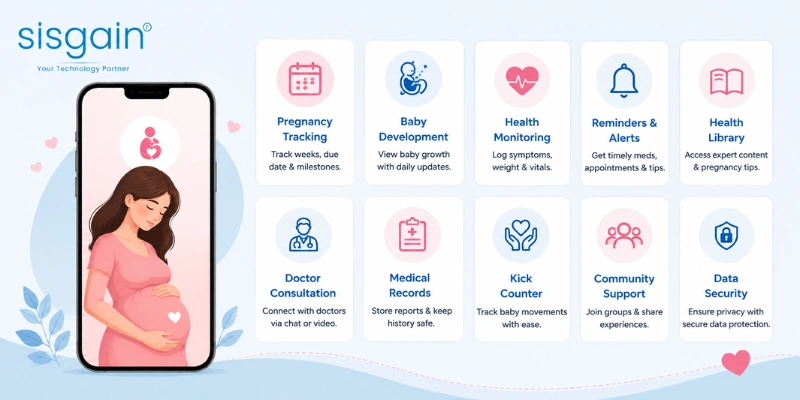
Below are the essential features to consider.
User-Side Features
These features are designed for expecting mothers and parents.
Week-by-Week Pregnancy Tracker
This is the core feature of most pregnancy apps. It shows the baby’s growth, body changes, expected symptoms, and health tips for each pregnancy week.
The tracker can include:
- Baby size comparison
- Fetal development milestones
- Mother’s body changes
- Recommended checkups
- Nutrition tips
- Safe exercise guidance
Baby Growth Updates
Mothers enjoy seeing how their baby is growing. Visual and simple updates help improve emotional engagement.
You can include:
- Baby weight and length estimates
- Organ development updates
- Trimester-based milestones
- Interactive pregnancy timeline
Kick Counter
A kick counter helps mothers track fetal movements during later pregnancy stages. The app can store patterns and alert users if movement seems lower than expected.
Contraction Timer
This tool helps mothers track contraction duration and frequency. It is especially useful in the final weeks of pregnancy and can guide users on when to contact their doctor.
Symptom Logging
A symptom tracker allows mothers to record nausea, swelling, headaches, pain, mood changes, and sleep quality.
For clinics, this data can support better consultation notes and early risk detection.
Medication Reminders
Pregnancy often includes supplements and prescribed medicines. Medication reminders help users follow their care plan and reduce missed doses.
Nutrition Guidance
The app can provide meal recommendations, hydration reminders, safe food lists, and trimester-specific nutrition advice.
In the UAE, this feature can be tailored for diverse dietary preferences, including Arabic, Indian, Western, and vegetarian meal options.
Appointment Reminders
Users can receive reminders for:
- Doctor consultations
- Ultrasound scans
- Lab tests
- Vaccinations
- Follow-up visits
- Postnatal checkups
This directly supports clinic operations and reduces missed appointments.
Pregnancy Calendar
A pregnancy calendar gives users a clear view of milestones, checkups, due date, and personal notes.
Wearable Integration
Modern maternity app development can include wearable integration for tracking:
- Heart rate
- Sleep
- Steps
- Activity levels
- Weight trends
This adds value for health-conscious users and premium care programs.
Clinic-Side Features
A pregnancy app becomes more powerful when it includes tools for healthcare providers.
Doctor Dashboard
Doctors and care teams need a secure dashboard to view patient profiles, appointment history, symptom logs, and care notes.
Patient Monitoring
Clinics can monitor high-risk patients more closely through submitted logs, alerts, and follow-up requests.
Appointment Management
The admin panel should allow staff to manage booking slots, reschedule visits, confirm appointments, and reduce manual coordination.
Alerts and Notifications
Clinics can send alerts for important scans, tests, health risks, medicine schedules, and educational campaigns.
Patient Messaging
Secure in-app messaging helps mothers ask non-emergency questions and receive guidance from clinic staff.
Analytics
Analytics help clinics understand:
- App engagement
- Missed appointments
- Popular content
- Patient retention
- Conversion from pregnancy care to pediatric care
- Teleconsultation usage
This turns your app into a business intelligence tool, not just a patient support platform.
Advanced AI Features in Modern Pregnancy Apps
AI is becoming a major differentiator in women health app development. When designed responsibly, AI can make pregnancy apps more personalized and responsive.
Useful AI features include:
- AI pregnancy chatbot for common questions
- Predictive health alerts based on symptoms and activity patterns
- Personalized recommendations for content, checkups, nutrition, and reminders
- Multilingual AI guidance for Arabic, English, Hindi, Urdu, and other languages common in the UAE
- Smart triage support that guides users to seek medical help when needed
For UAE clinics, an Arabic Medical AI Assistant can be especially useful. It allows Arabic-speaking mothers to ask questions in their preferred language and receive clear, culturally relevant guidance.
However, AI should support medical teams, not replace them. Pregnancy is sensitive, so AI responses must be reviewed, medically safe, and clearly positioned as guidance rather than diagnosis.
Step-by-Step Process to Develop a Pregnancy App Like Mylo
Building a pregnancy app like Mylo requires more than design and coding. Successful Mobile App Development projects also require product strategy, compliance planning, user research, and scalable infrastructure. You need a clear business model, trusted medical content, secure architecture, compliance planning, and post-launch growth support.
Step 1: Market Research & Business Planning
Start by identifying your users and business goals.
Ask:
- Are you building for clinic patients, independent mothers, or both?
- Will the app focus on pregnancy tracking, teleconsultation, baby care, or all three?
- Which languages should the app support?
- Will it include subscriptions, clinic memberships, or marketplace revenue?
- What services will connect to your existing clinic systems?
For UAE healthcare providers, research should include local patient expectations, digital health regulations, competitor apps, pricing models, and cultural preferences.
This step defines your app’s roadmap and helps control the pregnancy app development cost.
Step 2: UX/UI Design for Expecting Mothers
Pregnancy apps need emotional design. The interface should feel warm, calm, and trustworthy.
Good UX should include:
- Simple navigation
- Soft, clear visuals
- Large readable text
- Quick access to emergency contacts
- Easy appointment booking
- Multilingual support
- Clear privacy notices
- Personalized dashboards
Expecting mothers may use the app when anxious, tired, or seeking urgent clarity. The design must reduce stress, not add complexity.
Step 3: Core App Development
During development, your team builds the frontend, backend, databases, APIs, dashboards, and integrations.At this stage, many healthcare organizations work with an experienced AI-Powered Mobile App Development team to integrate intelligent features such as symptom analysis, personalized content delivery, multilingual virtual assistants, and predictive healthcare workflows.
Core development usually includes:
- Mobile app for iOS and Android
- Admin panel for clinic teams
- Doctor dashboard
- User authentication
- Pregnancy tracking engine
- Notification system
- Content management system
- Teleconsultation module
- Payment gateway, if needed
- Analytics setup
For faster launch, many UAE startups choose cross-platform development using Flutter or React Native. This trend highlights why Mobile App Development Matters in Dubai, where organizations need faster deployment cycles, multilingual support, and seamless digital experiences across devices.
Step 4: Testing & Compliance
Healthcare apps need deep testing because they handle sensitive data and health-related decisions.
Testing should cover:
- Data security
- App performance
- Usability
- Medical content accuracy
- Appointment workflows
- Payment flows
- Notification accuracy
- Device compatibility
- Role-based access control
If your app stores or processes protected health information, compliance planning is essential. Building a HIPAA-Compliant App approach can help improve privacy, encryption, access control, and audit readiness, even when local UAE regulations are also applied.
Step 5: Deployment & Post-Launch Support
After launch, your work continues. A pregnancy app needs regular updates, content improvements, bug fixes, analytics reviews, and feature enhancements.
Post-launch support may include:
- App store monitoring
- User feedback analysis
- Security updates
- New trimester content
- AI model improvements
- Clinic workflow optimization
- Performance tuning
- Marketing campaign support
A strong launch plan helps your app gain traction and convert users into loyal clinic patients.
Technology Stack Needed for Pregnancy App Development
The right technology stack affects performance, scalability, security, and cost. For UAE healthcare providers, the stack should support multilingual content, secure cloud hosting, video consultations, and real-time notifications.
|
Layer |
Recommended Technology |
|
Frontend |
Flutter / React Native |
|
Backend |
Node.js / Python |
|
Database |
PostgreSQL |
|
Cloud |
AWS |
|
Video Consultation |
WebRTC |
|
Notifications |
Firebase Cloud Messaging |
|
AI |
Machine Learning / Natural Language Processing |
|
Payments |
Stripe / Telr / Network International |
|
Analytics |
Firebase Analytics / Mixpanel |
|
Security |
Encryption, MFA, Role-Based Access Control |
If you are comparing app development services in UAE, look for a trusted mobile app development partner that understands healthcare workflows, scalable architecture, multilingual user experiences, and secure cloud deployment. The right technical team can reduce future development costs while supporting long-term product growth.
How Much Does It Cost to Develop a Pregnancy App Like Mylo in UAE?
The cost to develop pregnancy app platforms in the UAE depends on features, complexity, compliance needs, integrations, design quality, and whether you build an MVP or a full-scale solution.
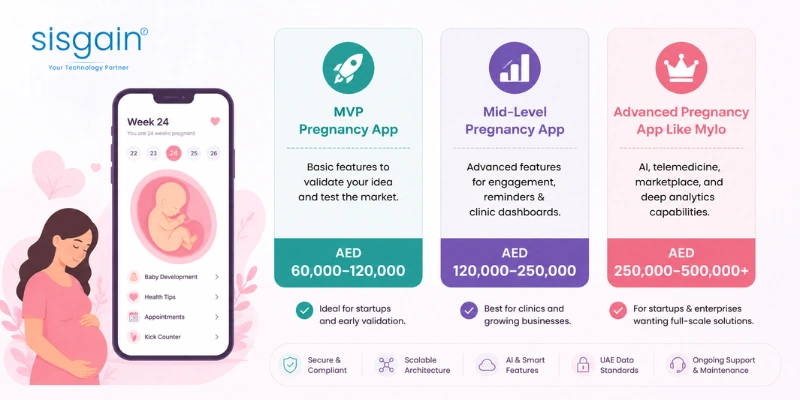
Pregnancy App Development Cost Breakdown
|
App Type |
Estimated Cost in UAE |
|
MVP Pregnancy App |
AED 60,000–120,000 |
|
Mid-Level Pregnancy App |
AED 120,000–250,000 |
|
Advanced Pregnancy App Like Mylo |
AED 250,000–500,000+ |
An MVP is suitable if you want to validate demand. A mid-level app is better for clinics that need patient engagement, reminders, dashboards, and content. An advanced app is ideal for startups or healthcare groups that want AI, telemedicine, marketplace features, and deep analytics.
Cost by Features
|
Feature |
Estimated Cost Range |
|
User registration and profiles |
AED 8,000–18,000 |
|
Pregnancy tracker |
AED 15,000–35,000 |
|
Kick counter and contraction timer |
AED 10,000–25,000 |
|
Appointment booking |
AED 15,000–40,000 |
|
Doctor dashboard |
AED 25,000–60,000 |
|
Teleconsultation |
AED 35,000–90,000 |
|
AI chatbot |
AED 40,000–120,000 |
|
Multilingual support |
AED 15,000–45,000 |
|
Content management system |
AED 20,000–50,000 |
|
Payment gateway |
AED 10,000–30,000 |
|
Wearable integration |
AED 30,000–80,000 |
|
Security and compliance setup |
AED 25,000–75,000 |
What Impacts Cost in 2026?
Several factors can increase or reduce your pregnancy app development cost:
- AI complexity: A simple chatbot costs less than a medically trained AI assistant.
- Compliance requirements: Secure data handling, consent management, and audits add development effort.
- Cloud infrastructure: High traffic, video calls, and analytics require scalable hosting.
- Third-party integrations: Lab systems, EHR, wearables, payments, and pharmacy APIs affect cost.
- UX complexity: Custom animations, personalized journeys, and multilingual interfaces add design time.
- Clinic workflows: A simple admin panel costs less than a full doctor dashboard with analytics.
For a more accurate forecast, review your scope against an app development cost in 2026 framework and prioritize features by launch phase.
Compliance & Security Requirements for Pregnancy Apps in UAE
Pregnancy apps handle sensitive personal and medical data. This can include symptoms, medical records, appointments, prescriptions, pregnancy stage, fetal movement, and consultation history.
For UAE healthcare providers, compliance should be considered from day one. Depending on your business model and location, you may need to align with local health authority expectations, including DHA considerations, patient consent requirements, secure data storage, and privacy rules.
Important security requirements include:
- Encrypted patient records
- Secure login and multi-factor authentication
- Role-based access for doctors, nurses, and admins
- Patient consent management
- Secure cloud infrastructure
- Protected APIs
- Audit logs
- Data backup and disaster recovery
- Clear privacy policy and terms of use
Why Security Is Non-Negotiable in Pregnancy Apps
Trust is the foundation of maternity care. If users feel their data is unsafe, they will not share symptoms, ask questions, or rely on the app.
Security also protects your clinic from operational, legal, and reputational risk. Following a HIPAA-Compliant App development mindset can help your team build stronger safeguards around patient information, even when your app is mainly designed for the UAE market.
A secure app does more than meet regulations. It gives mothers confidence that your clinic values their privacy and wellbeing.
Common Challenges in Pregnancy App Development in 2026
Building a pregnancy app can deliver strong business value, but it also comes with challenges. Planning for these early can save time, cost, and risk.
Common challenges include:
- Sensitive healthcare data: Pregnancy information must be handled with strict privacy and security controls.
- Medical accuracy: Content and AI responses must be reviewed by qualified experts.
- User trust: Mothers need clear guidance, transparent privacy policies, and easy access to real doctors.
- Multilingual requirements: UAE users may prefer Arabic, English, Hindi, Urdu, or other languages.
- AI bias: AI tools must be tested across different user groups and health scenarios.
- Retention issues: Users may uninstall the app if it feels generic or repetitive.
- Healthcare integrations: Connecting with EHR, lab, pharmacy, or appointment systems can be complex.
- Regulatory expectations: Compliance requirements may change as digital health adoption grows.
Many of these issues are also covered in discussions around Dubai Healthcare Development Services Challenges in 2026, especially for startups building healthcare platforms in a fast-moving market.
The best way to reduce risk is to work with a development partner that understands healthcare, product strategy, data protection, and UAE user behavior.
How Pregnancy Apps Make Money
A pregnancy app can support both patient care and revenue growth. The right monetization model depends on whether you are a clinic, hospital, startup, or digital health brand.
Common revenue models include:
- Freemium subscriptions: Offer basic tracking for free and charge for premium guidance, classes, or expert content.
- Clinic memberships: Bundle digital pregnancy support with maternity care packages.
- Teleconsultation commissions: Charge users for virtual doctor, nutritionist, or lactation consultant sessions.
- Partner marketplace: Sell maternity products, baby essentials, supplements, or wellness services.
- Sponsored products: Partner with trusted maternity and baby care brands.
- Premium guidance plans: Offer personalized pregnancy plans with doctor-reviewed content and priority support.
For pediatric clinics, the most valuable model may be retention. A pregnancy app can help convert expecting mothers into long-term pediatric patients after delivery.
Why Partner with a Pregnancy App Development Company in UAE
Choosing the right pregnancy app development company can make a major difference in quality, compliance, speed, and long-term performance. Among the many Mobile App Development Companies serving the UAE market, healthcare organizations should prioritize teams with proven experience in regulated healthcare environments and patient-focused digital platforms.
A local or UAE-focused partner can help with:
- Faster product planning and development
- Healthcare workflow understanding
- Local compliance awareness
- Arabic and multilingual support
- Payment gateway integration
- Telemedicine features
- Scalable cloud architecture
- Post-launch maintenance
- Patient engagement strategy
Healthcare apps are not like basic lifestyle apps. They require careful planning, secure systems, medical sensitivity, and smooth user experience.
Working with a team that offers Custom Healthcare App development Services helps ensure your product is designed around real clinical needs. And if you are comparing app development services in UAE, choose a partner that can support strategy, design, development, compliance, launch, and growth.
The right partner will not just build your app. They will help you create a trusted digital care experience for mothers and families.
Conclusion
Pregnancy apps are no longer optional for clinics and healthcare startups that want to improve maternal engagement, patient trust, and recurring care experiences in the UAE.
A pregnancy app like Mylo can help you support mothers week by week, reduce missed appointments, offer teleconsultations, deliver trusted content, and build long-term relationships that continue into pediatric care.
The best approach is to start with a focused MVP, validate user needs, then expand into AI, analytics, wearable integrations, and premium care plans.
If you are ready to explore pregnancy app development, now is the right time to plan your features, budget, compliance needs, and launch strategy.